January 5

What was advertised in a revolutionary American newspaper 250 years ago today?
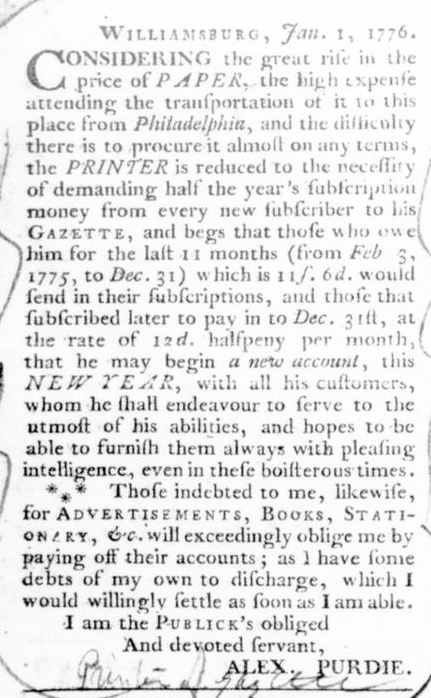
Virginia Gazette [Purdie] (January 5, 1776).

“The PRINTER is reduced to the necessity of demanding half the year’s subscription money.”

In the final issue of his Virginia Gazette for 1775, Alexander Purdie called on subscribers “to pay in their subscriptions, to enable me to lay in a stock of paper for the winter,” and “all persons indebted to me for BOOKS, STATIONARY, [and] ADVERTISEMENTS” to settle their accounts.  He asserted that it was “impossible to carry on such an expensive business, to the publick’s or his own satisfaction, without punctual payment.”

A week later, Purdie expressed even more alarm in a notice in the first edition of his Virginia Gazette for 1776.  “CONSIDERING the great rise in the price of PAPER, the high expense attending the transportation of it to this place from Philadelphia, and the difficulty there is to procure it almost on any terms,” he explained, “the PRINTER is reduced to the necessity of demanding half the year’s subscription money from every new subscriber to his GAZETTE.”  Newspaper subscribers often enjoyed generous credit, but Purdie made clear that was not a viable option.  He simultaneously renewed his call “that those who owe him for the last 11 months” since he commenced publication of hisVirginia Gazette “send in their subscriptions” and “those that subscribed later … pay in to Dec. 31st … that he may begin a new account, this NEW YEAR, with all his customers.”  Like many other printers, Purdie believed that he performed a valuable service for the public, “hop[ing] to be able to furnish them always with pleasing intelligence, even in these boisterous times.”  Many readers may have considered “boisterous” an understatement as they read news and editorials about the war that commenced at Lexington and Concord the previous April.

Where Purdie placed his advertisement within the issue testifies to its urgency.  Like other newspapers of the era, his Virginia Gazette consisted of four pages printed on a broadsheet and folded in half.  Printers usually printed the first and fourth pages on one side, let it dry, and then printed the second and third pages on the other side.  That meant that the news and advertisements that arrived in the printing office most recently appeared on the second and third pages, inside the folded newspaper.  Purdie’s Virginia Gazette had a heading for “ADVERTISEMENTS” in the final column of the third page.  He could have followed the example of other printers and given his notice a privileged place as the first item under that heading.  Instead, he made it the first item in the first column on the fourth page.  He placed his notice in the upper left corner of the final page, making it the first advertisement readers encountered then they turned to that page.  That also guaranteed a spot for the printer’s notice.  Purdie made it a priority rather than risking that news he had not yet received would be of such significance to justify crowding out his notice.  Purdie made a savvy decision in choosing where to place his notice calling on subscribers and other customers to settle accounts.
December 7

What was advertised in a revolutionary American newspaper 250 years ago today?

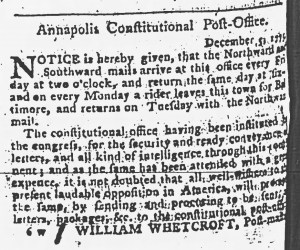
Maryland Gazette (December 7, 1775).

“Annapolis Constitutional Post-Office.”

In early December 1775, William Whetcroft became the latest postmaster to run a newspaper advertisement promoting a local branch of the Constitutional Post Office established by the Second Continental Congress.  In October, Mary Katharine Goddard placed a notice about the Baltimore office in the Maryland Journal.  Otherwise, advertisements for local branches appeared in newspapers published in New England, New York, and Pennsylvania, but not yet in newspapers from colonies south of Maryland.  The headline for this newest advertisement proclaimed, “Annapolis Constitutional Post-Office,” alerting readers of the Maryland Gazette that they had an alternative to the British imperial system.  Whetcroft commenced with an overview of his office’s schedule: “the Northward and Southward mail arrive at this office every Friday at two o’clock, and return the same day at six.”  In addition, “on Monday a rider leaves this town for Baltimore, and returns on Tuesday with the Northward mail.”

Yet Whetcroft used his advertisement to relay more than just the logistical details.  He gave an overview of the purpose that the Constitutional Post Office served as the imperial crisis intensified, hostilities commenced, and some colonizers considered whether they should declare independence rather than continue seeking redress of their grievances against Parliament.  “The constitutional office having been instituted by the congress,” the postmaster explained, “for the security and ready conveyance of letters, and all kinds of intelligence through this continent; and as the same has been attended with a great expence, it is not doubted that all well-wishers to the present laudable opposition in America, will promote the same, by sending and procuring to be sent all letters, packages, &c. to the constitutional post-office.”  Supporters of the American cause had a civic duty, Whetcroft asserted, to make use of this service.

Frederick Green, the printer of the Maryland Gazette, gave Whetcroft’s notice a privileged place the first time it appeared in that newspaper.  It appeared as the second advertisement following the news, preceded only by Green’s own advertisement for the almanac he just published and sold at the printing office.  As much as Green may have been a supporter of the Constitutional Post Office, he still had to earn his livelihood with his own endeavors!  Still, the printer had room for only two advertisements at the bottom of the final column on the second page.  He could have chosen from among several of a similar length to Whetcroft’s advertisement, yet he selected the notice about the Constitutional Post Office to appear alongside news of the revolutionary events taking place in Maryland and beyond.  In subsequent editions, that advertisement ran intermingled among others, but that was common practice for notices that printers initially gave privileged places the first time they ran in their newspapers.

December 6

What was advertised in a revolutionary American newspaper 250 years ago today?

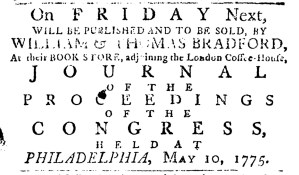
Pennsylvania Journal (December 6, 1775).

“JOURNAL OF THE PROCEEDINGS OF THE CONGRESS, HELD AT PHILADELPHIA, MAY 10, 1775.”

On Wednesday, December 6, 1775, William Bradford and Thomas Bradford, printers of the Pennsylvania Journal, announced that “On FRIDAY Next, WILL BE PUBLISHED … [the] JOURNAL OF THE PROCEEDINGS OF THE CONGRESS, HELD AT PHILADELPHIA, MAY 10, 1775.”  The contents of that volume covered the period from May 10 through August 1.  Throughout the colonies, readers had been able to follow news from the Second Continental Congress reprinted from newspaper to newspaper.  Local printers made editorial decisions about which items to include.  With this volume, however, readers gained access to the entire proceedings.  It supplemented the news they previously read or heard.  It also provided a convenient means of collecting the information in a single place, though some colonizers did save newspapers and one, Harbottle Dorr, even created an extensive index to aid him as he reviewed news of the imperial crisis that eventually became a revolution.

The Bradfords announced publication of the Journal of the Proceedings of the Congress in advance in hopes that the anticipation would incite demand.  They gave their advertisement a privileged place in their newspaper, placing it immediately after the news.  The “ARTICLES of CAPITULATION made and entered into between Richard Montgomery, Esq; Brigadier General of the Continental army, and the citizens and inhabitants of Montreal” on November 12 appeared in the column to the left of the Bradfords’ advertisement.  They may have hoped that news of an American victory in the two-pronged invasion of Canada that targeted Montreal and Quebec City would help to sell copies of the Journal of the Proceedings of the Congress.  In addition to publishing the journal documenting the first months of the Second Continental Congress, the Bradfords previously printed and advertised a complete journal of the proceedings of the First Continental Congress held in Philadelphia in September and October 1774.  Nearly as soon as that body adjourned, the Bradfords published and advertised a collection of Extracts that included “a List of Grievances” and the Continental Association, a nonimportation and nonconsumption agreement intended to use commercial leverage to achieve political goals.  Within a month of marketing the Extracts, the Bradfords made the complete journal available to the public.  These publications supplemented and expanded newspaper coverage of the debates and decisions made by delegates meeting in Philadelphia.

September 14

What was advertised in a revolutionary American newspaper 250 years ago today?

New-York Journal (September 14, 1775).

“SMALL SWORDS … of various sorts.”

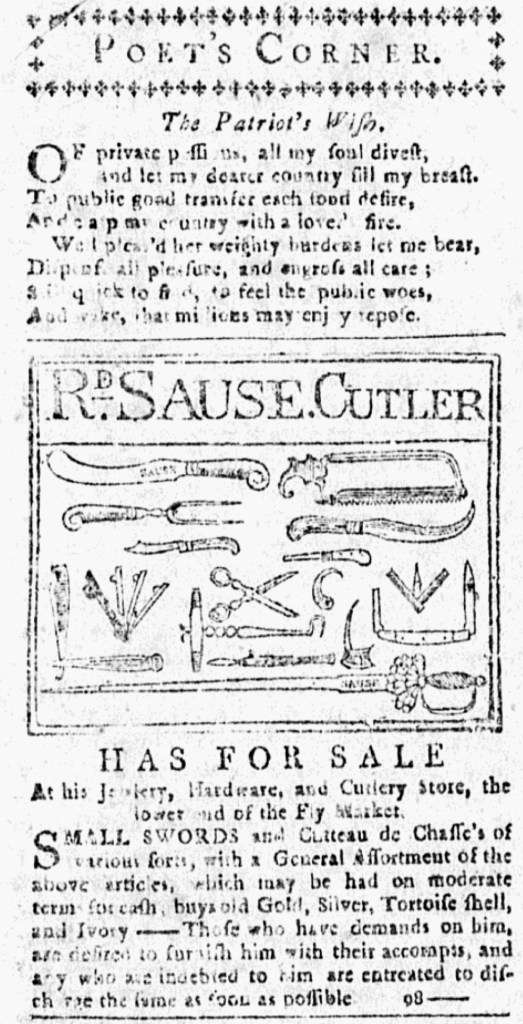
Richard Sause’s advertisement for “SMALL SWORDS” and other items available at his “Jewelery, Hardware, and Cutlery Store” became a familiar sight for readers of the New-York Journal in the summer of 1775.  The woodcut depicting a shop sign with Sause’s name and an array of cutlery, including a sword, made his notice even easier to spot.

On September 14, his notice happened to appear near the top of the left column on the final page of the newspaper, immediately below a regular feature called “POET’S CORNER.”  For that issue, John Holt, the printer, selected a short poem, “The Patriot’s Wish.”

OF private passions, all my soul divest,
and let my dearer country fill my breast,
To public good transfer each fond desire,
And clasp my country with a lover’s fire.
Well pleas’d her weighty burdens let me bear
Dispense all pleasure, and engross all care;
[ ] quick to [ ], to feel the public woes,
And wake, that millions may enjoy repose.

The strained verses were heartfelt even if not especially graceful or elegant.  Perhaps a reader submitted the poem as their way of contributing to the struggle that colonizers endured throughout the imperial crisis and then intensified with the outbreak of hostilities at Lexington and Concord the previous spring.  Sause aimed to make his own contribution by supplying “SMALL SWORDS and Cutteau de Chasse’s,” a type of sword, to the gentlemen of New York who prepared for the possibility that they would have to join the fight.  Although Sause’s advertisement appeared below “The Patriot’s Wish” almost certainly by coincidence, the cutler may have been pleased with the happy accident.  After all, the poem primed readers to think about their duty and to contemplate how to make their own contributions to the cause.  For many, that could have included outfitting themselves with weapons and other military equipment.

August 24

What was advertised in a revolutionary American newspaper 250 years ago today?

Pennsylvania Evening Post (August 24, 1775).

“A dictionary, explaining the most difficult terms made use of in fortification, gunnery, and the whole compass of the military art.”

It was one of the first mentions of an almanac for 1776 in an American newspaper.  The initial notices usually began appearing sometime in August, scattered here and there in different newspapers, and then more printers advertised almanacs for the coming year during the fall.  The number and frequency of advertisements accelerated each year as printers engaged in fierce competition to market and sell the popular reference manuals.

Benjamin Towne, the printer of the Pennsylvania Evening Post, inserted a notice about an almanac for 1776 in the August 24, 1775, edition of his newspaper, making him one of the first that year.  “In the press, and shortly will be published, by the Printer of this paper,” he announced, “The CONSTITUTIONAL ALMANACK.”  The notice appeared immediately after news from the Second Continental Congress, but without the usual line to separate it from other content.  An advertisement offering a reward for a runaway indenture servant ran below the notice about the almanac, a horizontal line demarcating where one ended and the other began.  Similar lines separated the advertisements on the final page of that edition.  Towne resorted to a tactic sometimes deployed by printers when they promoted their own work, placing his notice ahead of any of the paid advertisements and adopting a format that made it look like a news item.  Even if readers did not peruse all the advertisements, they likely read Towne’s notice about his almanac and then realized that they had reached the end of the news.

The printer’s notice included information that he considered newsworthy.  “As a dictionary, explaining the most difficult terms made use of in fortification, gunnery, and the whole compass of the military art, will be subjoined,” Towne declared, “it is presumed this Almanack will be considered a valuable VADE MECUM at this important juncture.”  Prospective customers would benefit from treating the combined almanac and dictionary as a handbook kept constantly at the ready for consultation as more news about the siege of Boston reached them and especially if the news included accounts of new encounters between British regulars and American soldiers.  Following the battles at Lexington and Concord in April and the Battle of Bunker Hill in June, colonizers did not know when they might need to consult a dictionary of “fortification, gunnery, and the whole compass of the military art” to understand the news they read or heard.  The dictionary that accompanied it certainly distinguished Towne’s almanac from others published in the past.

May 6

What was advertised in a revolutionary American newspaper 250 years ago today?

Virginia Gazette [Dixon and Hunter] (May 6, 1775).

“LADIES RIDING HABITS made in the newest Fashion.”

When James Davis, a tailor, opened a shop at a new location in Yorktown in the spring of 1775, he placed an advertisement in John Dixon and William Hunter’s Virginia Gazette.  He opened by extending “his most grateful Acknowledgments to all those who have hitherto been his Customers,” incorporating an appeal in common use throughout the colonies.  Advertisers often thanked existing customers as a means of enhancing their reputations.  Yet that was not Davis’s only purpose; instead, he “takes this Opportunity to inform them, as well as the Public in general, that he has just opened Shop nearly opposite Swan Tavern.”  Any client could expect the tailor’s “close Application to his Business, and the utmost Endeavours to give Satisfaction,” prompting Davis to hope for “general Encouragement” from the residents of Yorktown.

The tailor concluded with a note that singled out one item in particular: “LADIES RIDING HABITS made in the newest Fashion.”  He may have benefited from where his advertisement appeared within the May 6 edition of the Virginia Gazette, immediately following the “POETS CORNER.”  That entry presented a new poem each week.  This time it featured “VERSES by a Lady, on gathering a SNOW-DROP in the garden of her lover.”  That was almost certainly by coincidence rather than by design.  After all, Davis’s advertisement ran at the bottom of the middle column on the fourth page of the supplement the previous week.  Still, the poem may have helped in directing more readers, especially “LADIES” interested in “the newest fashion,” to Davis’s notice.  Even if the verses did not, the decorative printing that called attention to the “POETS CORNER” also distinguished Davis’s advertisement from others on that page.  It was not the first time it had such a fortuitous place.  Two weeks earlier, it followed “AN ODE TO LIBERTY” in the “POETS CORNER.”  If the tailor perused the pages of the Virginia Gazette to confirm that it indeed carried his notice, he may have been more satisfied with where it happened to appear in some issues.  Its proximity to the “POETS CORNER” may have boosted engagement on those occasions that the one followed the other, though via happenstance rather than sophisticated and intentional marketing strategy.

December 30

What was advertised in a colonial American newspaper 250 years ago today?

New-Hampshire Gazette (December 30, 1774).

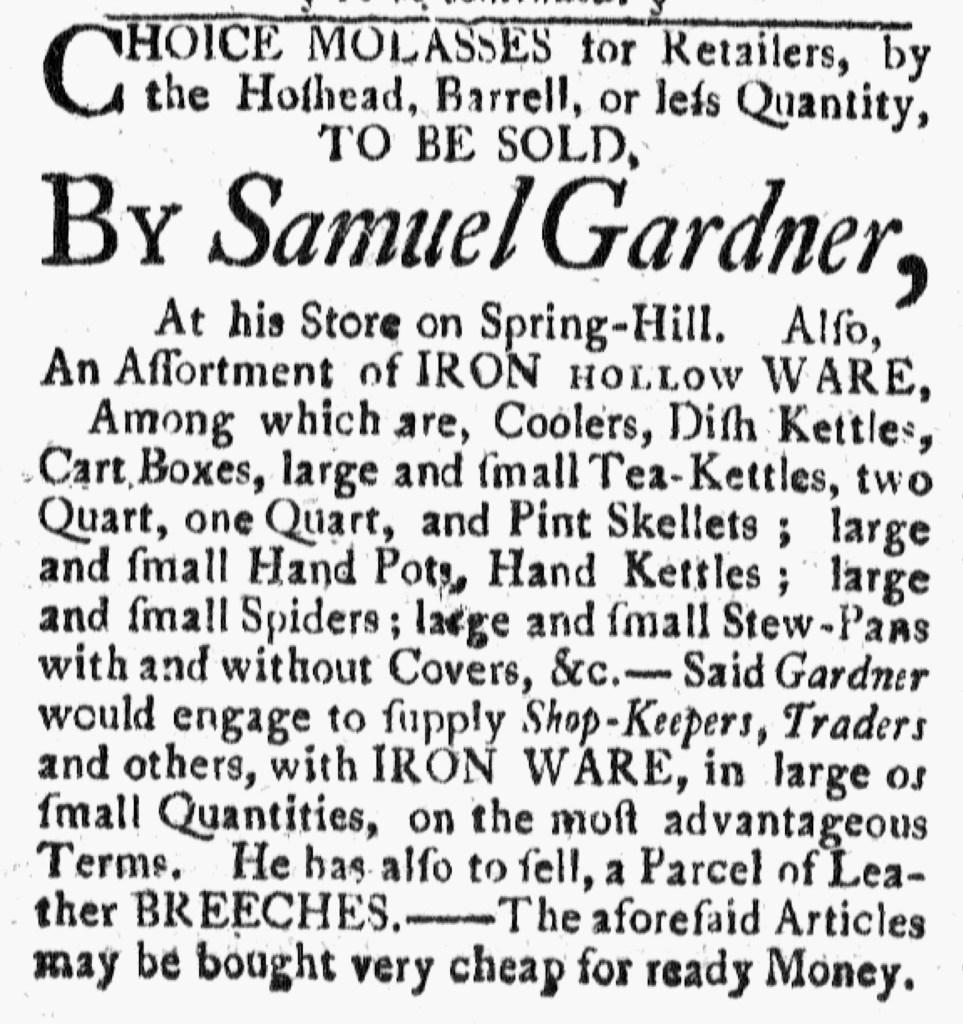
“TO BE SOLD, BY Samuel Gardner, At his Store on Spring-Hill.”

When it came to interspersing advertisements among news, editorials, and other content in colonial newspapers, the New-Hampshire Gazette was the exception to the rule.  Not all newspapers took the same approach to where advertisements appeared, but they generally avoided mixing advertisements and other content.  For instance, some newspapers reserved advertising for the final pages, printing all the news and editorials first, then the shipping news from the custom house to signal the transition to advertising, and finally the paid notices.  Others ran advertising on the first and last pages, printed first on the same side of the broadsheet, and saved the second and third pages for the latest news that arrived.  In some instances, news and advertising appeared on the same page.  The front page, for example, could include a column of paid notices and two columns of news with the advertisements in either the left column or the right column.  No matter the order, individual advertisements did not appear interspersed with news …

… except in the New-Hampshire Gazette.  Daniel Fowle, the printer, took a novel approach that may have looked haphazard to contemporary readers, though later generations came to expect news and advertising alternating in newspapers.  The layout of the New-Hampshire Gazette often required active reading to determine which portions featured advertising and which delivered news.  Consider the December 30, 1774, edition.  A short advertisement placed by George Whipple, “Attorney at LAW,” ran as the first item in the first column on the first page.  News constituted the remainder of the content on that page.  The second page began with news from the “Continental Congress continu’d” from the previous issue.”  It spilled over into a second column, followed by an advertisement for goods available at Samuel Gardner’s store, and then a lengthy essay about conditions in Boston by “MASSACHUSETTENSIS.”  That essay occupied most of the third page.  Three advertisements completed the third column.  More news and editorials appeared in the first column on the final page.  In addition, news from New York and the shipping news from the custom house ran at the top of the third column.  George Craigie’s lengthy advertisement for “A General Assortment of English Goods” interrupted the news and editorials.  Half a dozen advertisements appeared below the shipping news in the final column.  In other issues, Fowle interspersed short advertisements and short news items even more indiscriminately, giving readers of the New-Hampshire Gazette a different sort of visual experience in terms of organizing content compared to what they encountered in other colonial newspapers.

November 23

What was advertised in a colonial American newspaper 250 years ago today?

Pennsylvania Journal (November 23, 1774).

“JOURNAL OF THE PROCEEDINGS OF THE CONGRESS, Held at PHILADELPHIA.”

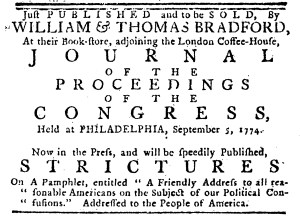
Just three weeks after they first advertised a pamphlet containing “EXTRACTS FROM THE VOTES AND PROCEEDINGS OF THE AMERICAN CONTINENTAL CONGRESS,” William Bradford and Thomas Bradford announced that they “Just PUBLISHED” a more extensive “JOURNAL OF THE PROCEEDINGS OF THE CONGRESS, Held at PHILADELPHIA, September 5, 1774.”  Although printers in towns throughout the colonies produced, marketed, and sold local editions of the Extracts to keep the public informed about what occurred at the First Continental Congress, the Bradfords were nearly alone in printing the Journal.  Hugh Gaine, the printer of the New-York Gazette and Weekly Mercury, joined them in that endeavor.

The Bradfords gave their advertisement for the Journal a privileged place in the November 23, 1774, edition of their newspaper, the Pennsylvania Journal.  It appeared on the third page, immediately following the list of prices current in Philadelphia.  While that may not seem like a spot of any significance in modern newspapers, consider the production of newspapers in eighteenth-century America.  Printers created each four-page issue by first printing the first and fourth pages on one side of a broadsheet, letting the ink dry, and then printing the second and third pages on the other side.  That meant that the most current news often appeared on the interior pages of an issue since printers set type and printed those pages last.  In most newspapers, the shipping news from the customs house or the prices current were the last news items before the advertisements, a familiar visual cue for readers that one type of content came to an end and another began.  For readers examining the news more carefully than the advertisements, an advertisement’s placement immediately following the shipping news and prices current likely increased its visibility.

That their advertisement for the Journal occupied that privileged place was not unique to the Bradfords marketing it in their own newspaper.  On the same day, they placed a notice in the Pennsylvania Gazette.  It ran on the third page, immediately following the shipping news and the prices current.  Among more than fifty paid notices in that issue, the printers of that newspaper apparently believed that the Journal deserved special treatment.  Marketing and selling both the Extracts and the Journal became an extension of keeping the public informed via coverage of the First Continental Congress that appeared in newspapers.

October 31

What was advertised in a colonial American newspaper 250 years ago today?

Boston Evening-Post (October 31, 1774).

“The Manual Exercise, recommended to be practised by the above Resolve of the Congress.”

The placement of advertisements varied in colonial newspapers.  Many printers reserved them for the final pages, while others positioned them on the first and last pages with news on the middle pages.  Sometimes advertisements and news appeared on the same page, such as two columns of news and one column of advertising on the front page or advertisements completing a column of news on any page.  Even with those variations, advertisements and news typically did not alternate within the columns on any page of early American newspapers.

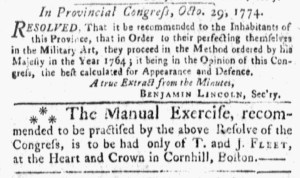
That made an advertisement on the third page of the October 31, 1774, edition of the Boston Evening-Post both unusual and notable.  The first column bore the headline “In PROVINCIAL CONGRESS” and commenced with “A true Extract from the Minutes” of a meeting held on October 26.  The same headline, in smaller font, occurred three more times in the first and second columns, reporting on meetings held on October 28 and 29.  The last of those featured a short resolution: “That it be recommended to the Inhabitants of this Province, that in Order to their perfecting themselves in the Military Art, they proceed in the Method ordered by his Majesty in the Year 1764; it being in the Opinion of this Congress, the best calculated for Appearance and Defence.”  That recommendation came as Boston and the rest of the colony reacted to the Quartering Act, the Massachusetts Government Act, and the other Coercive Acts that Parliament passed in retaliation for the Boston Tea Party.

A brief advertisement immediately followed the resolution: “The Manual Exercise, recommended to be practised by the above Resolve of the Congress, is to be had only of T. and J. Fleet, at the Heart and Crown in Cornhill, Boston.”  The column returned to news, that lone advertisement embedded between articles.  The Fleets happened to be the printers of the Boston Evening-Post, known for their support of the patriot cause.  They likely had dual purposes in running the advertisement and selecting where to place it.  Supplying the public with a military manual reflected their political principles, yet as entrepreneurs the Fleets also stood to generate revenue from its sale.  They served the public good, both in printing the manual and the proximity of their advertisement to the resolution, while also attempting to increase sales in their printing office.  Scholars have debated whether printers who sold political tracts during the era of the American Revolution merely seized an opportunity to line their pockets, yet participating in politics and earning their livelihoods were not necessarily mutually exclusive endeavors.

October 22

What was advertised in a colonial American newspaper 250 years ago today?

Providence Gazette (October 22, 1774).

“On Wednesday next will be published, and sold by the Printer hereof, WEST’s ALMANACK.”

Although he sometimes ran advertisements on the first page of his newspapers, John Carter, the printer of the Providence Gazette, opted to place all of them at the end of the October 22, 1774, edition.  News filled most of the first three pages, with the final third of the last column on the third page given to advertising and then the entire fourth page as well.  As usual, the news concluded with local updates, including accounts of sheep being sent to the “distressed Towns of Boston and Charlestown” to relieve the residents while the Boston Port Act remained in effect and coverage of the capture of a suspected burglar.

As readers finished with the news, they immediately encountered an advertisement for “WEST’s ALMANACK, For the Year of our Lord 1775” before paid notices submitted by Carter’s customers.  That advertisement announced that the printer would publish and sell the almanac on the following Wednesday, the first mention of Benjamin West’s almanac for the coming year in the Providence Gazette.  The public likely anticipated its publication and marketing since West, an astronomer and mathematician, had been collaborating with the printer of the Providence Gazette for more than a decade.  The partnership began before Carter became the proprietor of the newspaper, passing from printer to printer as the Providence Gazette changed hands.  West initially worked with William Goddard, followed by Sarah Goddard, before Carter ran the printing office.

For his part, Carter often gave advertisements for the works that he printed, whether books or West’s almanac, a privileged place.  Sometimes they appeared as the first item on the first page, while other times he positioned them as the first item following the news.  Either way, he increased the chances that readers would see and take note of advertisements that promoted his own endeavors in the printing office.