September 9

What was advertised in a colonial American newspaper 250 years ago today?
Connecticut Gazette (September 9, 1774).

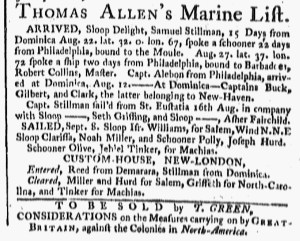
“CONSIDERATIONS on the Measures carrying on by GREAT BRITAIN, against the Colonies in North-America.”

As the number of American editions of Considerations on the Measures Carrying On with Respect to the British Colonies in North-America increased in 1774, so did the number of newspapers that carried advertisements for the political tract.  John Holt, the printer of the New-York Journal, advertised his edition.  Benjamin Edes and John Gill, the printers of the Boston-Gazette, did so as well for their edition.  Ebenezer Watson, printer of the Connecticut Courant, ran his own advertisement when he published a Hartford edition.  Yet it was not solely the printers of the various American editions who advertised or sold the popular pamphlet.  Watson listed local agents in eight towns and two post riders who sold his edition.  David Atwater advertised the New York edition for sale in New Haven in the Connecticut Journal.

Timothy Green, printer of the Connecticut Gazette, joined their ranks with an advertisement in the September 9, 1774, edition of his newspaper.  That made the pamphlet available for purchase in New London in addition to other towns in New England and New York.  Compared to the other advertisements, however, Green’s notice was quite brief, just three lines that completed the column following “THOMAS ALLEN’S Marine List,” a regular feature, on the third page.  “TO BE SOLD by T. GREEN, CONSIDERATIONS on the Measures carrying on by GREAT BRITAIN, against the Colonies in North-America.”  Green did not provide any of the elaborate description about how well the pamphlet had been received in London and how it had influenced residents there to support the American colonies against the abuses perpetrated by Parliament, nor did he encourage readers to review it for themselves so they could be better informed.  Perhaps he expected that the news he printed throughout the rest of his newspaper and the conversations about current events taking place everywhere anyone went those days provided enough reason for colonizers to acquire the pamphlet.  He also did not state which edition he sold, though the variant title in his advertisement suggests that he carried Watson’s Hartford edition.  In stocking and promoting the pamphlet, Green joined printers, post riders, and others in disseminating a political tract intended to influence colonizers and help them in articulating their grievances against Parliament.

September 6

What was advertised in a colonial American newspaper 250 years ago today?

Connecticut Courant (September 6, 1774).

This celebrated Performance … had a wonderful Operation on the Minds of that People.”

A popular political pamphlet originally printed in London and reprinted in four towns in the colonies made another appearance among the advertisements in the September 6, 1774, edition of the Connecticut Courant.  In this instance, Ebenezer Watson, the printer of that newspaper, promoted his own edition of Considerations on the Measures Carrying On with Respect to the British Colonies in North-America produced at his printing office in Hartford.  By that time, John Holt, printer of the New-York Journal, and Benjamin Edes and John Gill, printers of the Boston-Gazette, had already advertised their own editions of the tract.  In New Haven, David Atwater advertised and sold Holt’s New York edition.

Those advertisers replicated the copy from one notice to another.  For his part, however Watson devised his own copy, though he had likely seen at least some of the other advertisements as he scoured other newspapers for content to reprint in the Connecticut Courant.  Watson even offered a variant title in his advertisement, “CONSIDERATIONS On the Measures carrying on by GREAT-BRITAIN, Against the Colonies in NORTH-AMERICA,” though the title on the title page of the pamphlet itself was consistent with the original London edition and the others reprinted in the colonies.  Although Watson did not directly borrow copy from the other advertisements circulating at the time, he seems to have been inspired by them enough to paraphrase from them.  “This celebrated performance” (rather than a “most masterly performance”), he proclaimed, “was first published in England, and had a wonderful Operation on the Minds of that People, in eradicating their Prejudices against the Inhabitants of America.”  In comparison, the other advertisements declared that the tract “had a wonderful effect in removing the prejudices and convincing the people of England.”  Other advertisers commented on the price of American editions compared to the London edition.  Watson did so more elaborately, stating that a “Book so highly admired, and so wonderfully calculated to open blind Eyes, ought to be in the hands” of colonizers throughout America.  That convinced him “to sell it as cheap as he can possibly afford it” without losing money on it.

To disseminate the pamphlet widely, Watson enlisted the aid of local agents in several towns, including Canaan, Farmington, Great Barrington, Litchfield, Middletown, Norfolk, Sheffield, Simsbury, and Torringford.  In addition, readers could acquire copies from two post riders, Joseph Knight and Amos Alden.  As printers in New England marketed a variety of books and pamphlets related to the imperial crisis in the mid 1770s, some of them integrated post riders into their distribution networks in new ways.  They made a point of naming post riders as agents who sold these publications, entrusting them with responsibilities beyond delivering items that buyers ordered from a local dignitary or directly from the printer.  This made post riders’ role in keeping colonizers informed about arguments critiquing Parliament even more visible as they became active proponents rather than mere messengers.

August 26

What was advertised in a colonial American newspaper 250 years ago today?

Supplement to the Connecticut Journal (August 26, 1774).

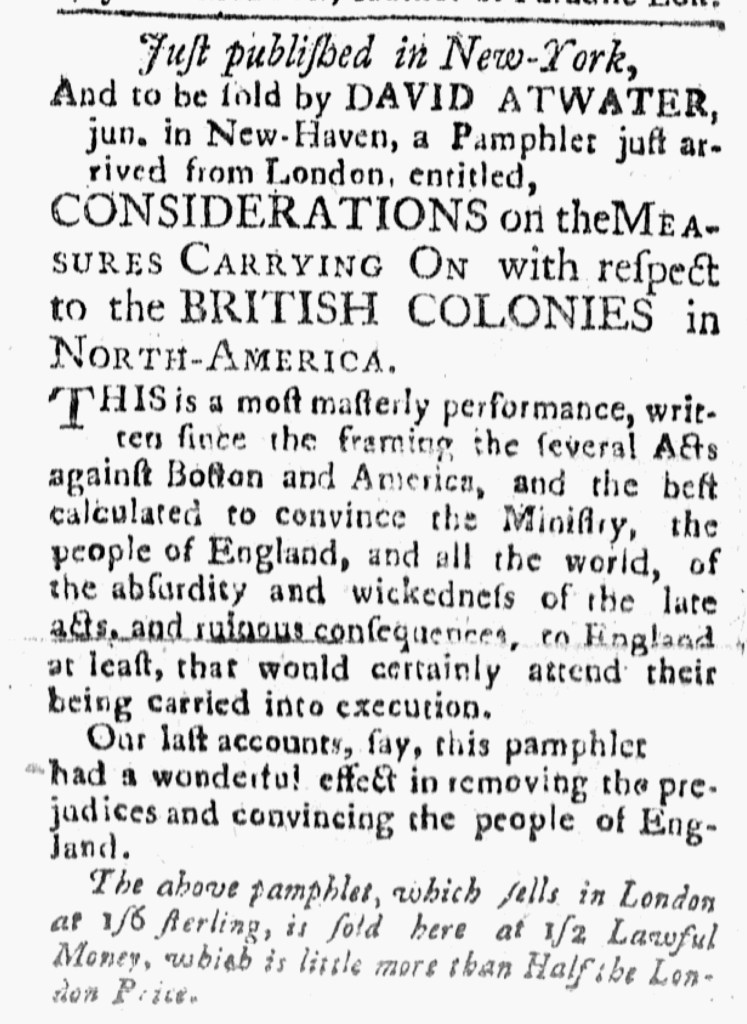
Just published in New-York, And to be sold … in New-Haven, a Pamphlet just arrived from London.”

Printers in several cities published American editions of Considerations on the Measures Carrying On with Respect to the British Colonies in North-America in 1774, including Benjamin Edes and John Gill in Boston, John Holt in New York, Benjamin Towne in Philadelphia, and Ebenezer Watson in Hartford.  The Adverts 250 Project has examined advertisements for this “Pamphlet just arrived from London” that Edes and Gill ran in their own Boston-Gazette and Holt ran in his own New-York Journal.  Both newspapers had reputations for ardently supporting the patriot cause, making it no surprise that their printers would publish and sell a tract outlining the “absurdity and wickedness” of the Coercive Acts that Parliament passed in retaliation for the Boston Tea Party.

Other colonizers joined those printers in their efforts to disseminate the pamphlet.  At the end of August, for instance, the Connecticut Journal carried an advertisement that promoted the edition “Just published in New-York” by Holt.  Readers could purchase it from David Atwater, Jr., in New Haven.  In addition to supplying Atwater with copies of the pamphlet, Holt also provided the copy for the advertisement.  After the introduction that listed Atwater as the local agent who sold the pamphlet, the main body of the advertisement featured copy identical to Holt’s advertisement.  It was the same copy that Edes and Gill appropriated for their advertisement.  Atwater made one small revision to the final note, adjusting the price to suit the currency in Connecticut.

That four printing offices published the pamphlet suggests that it circulated widely in New England, New York, and Pennsylvania.  However, printing and advertising the tract did not necessarily result in sales.  On the other hand, Edes and Gill produced multiple editions, suggesting that they did indeed find buyers for it.  Even if readers did not choose to purchase the pamphlet, they encountered the same rhetoric about the “ruinous consequences” of the Coercive Acts when they perused newspaper advertisements.  As short editorials, those notices buttressed the arguments made in news items and letters that were reprinted from newspaper to newspaper throughout the colonies.

August 21

What was advertised in a colonial American newspaper 250 years ago this week?

Supplement to the New-York Journal (August 18, 1774).

Sold here at 1s6 New-York money, which is little more than half the London price.”

The Adverts 250 Project previously examined an advertisement for a political tract, Considerations on the Measures Carrying On with Respect to the British Colonies in North-America, that appeared in a prominent place in the August 1, 1774, edition of the Boston-Gazette, attributing the copy to Benjamin Edes and John Gill, the printers of that newspaper and the Boston edition of the pamphlet.  Yet Edes and Gill were not the only printers to produce an American edition of Considerations, nor were they the first to advertise it.  When they did, they borrowed advertising copy that previously appeared when John Holt marketed his edition in the New-York Journal.

Holt first announced publication of a New York edition of this “Pamphlet just arrived from London” on July 21.  When Edes and Gill advertised the same pamphlet eleven days later, they used copy identical to Holt’s advertisement, embellishing it with a quotation from Phillippe de Commines that appeared on the title page of the pamphlet.  As was often the case with advertisements for books and pamphlets, the printers did not devise any of the copy on their own, except for “THIS DAY PUBLISHED, (Price 9d.) And sold by EDES and GILL, in Queen-Street.”  Holt may have written the copy that lauded the pamphlet as a “most masterly performance” against the Coercive Acts and reported on its reception in England when he first advertised the pamphlet, though he could have borrowed that overview from someone else, just as Edes and Gill appropriated it from him.  Either way, Holt did eventually make an addition to his advertisement. After it ran twice, he added a note that the pamphlet “sells in London at 1s5 sterling” yet “is sold here at 1s6 New-York money, which is little more than half the London price.”  That suggests that the initial appeals might not have been enough to convince readers to buy the tract, no matter how much they may have been interested in the arguments it made about current events.  The printer found it necessary to add an appeal to price in hopes of selling the pamphlet.  Holt and other patriot printers sought to spread the rhetoric of the American Revolution (and generate revenues for themselves in the process), but doing so required more than merely announcing political pamphlets for sale.  Their advertisements aimed to convince colonizers, even those already sympathetic to their cause, to purchase the books and pamphlets about politics and political philosophy they printed and sold.

August 8

What was advertised in a colonial American newspaper 250 years ago today?

Boston Evening-Post (August 8, 1774).

“THE PATRIOTIC WHISPER in the EARS of the KING.”

The imperial crisis intensified in the summer of 1774.  In response to the Boston Port Act, the Massachusetts Government Act, and the other Coercive Acts that Parliament enacted following the Boston Tea Party, printers, booksellers, and others marketed an array of books and pamphlets that advocated for the rights and liberties of the American colonies.  On August 8, Benjamin Edes and John Gill continued advertising Considerations on the Measures Carrying on with Respect to the British Colonies in North-America in the Boston-Gazette.  That same day, a subscription proposal for “A Small TRACT: Entitled THE PATRIOTIC WHISPER in the EARS of the KING” appeared in the Boston Evening-Post.

The lengthy secondary title of the proposed tract deployed similar rhetoric: “the grand Request of the People of AMERICA made manifest.  Intended as a CHARIOT of LIBERTY for the Sons of AMERICA, and a standing Memorial of the Rights of the American Colonies.  Being a political LIBERTY ORATION upon the Branches of the American Charters, proving them to be as sacred as the British Constitution.”  The subscription proposal delivered an impassioned plea to readers whether or not they happened to purchase copies to examine in more detail.

This “PATRIOTIC WHISPER” originated as a sermon that John Allen gave “on the last Annual Thanksgiving.”  Many colonizers in Boston were familiar with his sermons and tracts.  Allen had previously published The American Alarm, or the Bostonian Plea, for the Rights and Liberties, of the People and An Oration, Upon the Beauties of Liberty, or the Essential Rights of the Americans, though he had adopted the pen name “A British Bostonian” for both.  The extended title of the Oration, Upon the Beauties of Liberty identified it as a sermon “Delivered at the Second Baptist-Church in Boston.  Upon the Last Annual Thanksgiving.”  That made it possible for readers to deduce the identity of “A British Bostonian.”  The subscription notice described Allen as a “humble Lover of Liberty, Dedicated to the Inhabitants of America,” and further explained that the tract was “calculated to support and strengthen the Common Cause of the Rights of the Colonies against the Power of Tyranny.”  Again, the advertising copy made a powerful political statement.

That, however, does not seem to have been enough to garner the necessary number of subscribers to take the tract to press.  Yet Allen’s views on the politics of the moment found their way into print in other pamphlets in 1774.  In Salem, Ezekiel Russell printed The Watchman’s Alarm to Lord N—h; or, The British Parliamentary Boston Port-Bill Unwrap[p]ed.  The title page attributed the work to “the British Bostonian.”  In Hartford, Ebenezer Watson reprinted a “carefully corrected” fifth edition of Allen’s Oration on the Beauties of Liberty.  The widespread dissemination of tracts by Allen promoted John M. Bumsted and Charles E. Clark to describe him as “New England’s Tom Paine” in the twentieth century.[1]  Even though Allen’s “PATRIOTIC WHISPER” did not go to press in a crowded market, the subscription proposal that ran in the Boston Evening-Post contributed to the discourse condemning ongoing abuses by Parliament.

**********

[1] John M. Bumsted and Charles E. Clark, “New England’s Tom Paine: John Allen and the Spirit of Liberty,” William and Mary Quarterly, 3rd ser., 21, no. 4 (October 1964): 561-570.

August 1

What was advertised in a colonial American newspaper 250 years ago today?

Boston-Gazette (August 1, 1774).

“This pamphlet has had a wonderful effect in removing the prejudices and convincing the people of England.”

Benjamin Edes and John Gill, the printers of the Boston-Gazette, gave an advertisement for their American edition of Considerations on the Measures Carrying On with Respect to the British Colonies in North-America a prominent place in the August 1, 1774, edition of their newspaper.  It appeared as the first item in the first column on the first page, making it difficult for readers to miss.  The printers wished to call attention to the book, originally published in London, not only because they hoped to generate revenue from its sales but also as a means for colonizers to become even better informed about current events and the political challenges they faced as Parliament passed a series of laws, the Coercive Acts, following the Boston Tea Party.  As the imperial crisis intensified, patriot printers like Edes and Gill published newspapers, broadsides, pamphlets, books, and other items that documented the ongoing contest with Parliament, the king, and royal officials in the colonies.

To convince prospective customers of the necessity of purchasing and perusing this pamphlet, Edes and Gill explained that it was the “most masterly performance, written since the framing of the several Acts against BOSTON and AMERICA,” including the Boston Port Act and the Massachusetts Government Act, and “the best calculated to convince the Ministry, the people of England, and all the world, of the absurdity and wickedness of the late acts.”  Colonizers used newspapers and other publications in their efforts to shape opinion in the colonies, yet they were just as concerned with the information environment on the other side of the Atlantic.  In their publications and letters, they hoped to sway both officials and the general public in London and throughout Great Britain.  They also took note of the support they received for their plight.  In their advertisement for Considerations, Edes and Gill reported that their “last accounts” indicated “this pamphlet had had a wonderful effect in removing the prejudices and convincing the people of England” that Parliament had not been just in its treatment of the colonies.  Whether that was accurate or wishful thinking likely varied from person to person, but the printers wanted to believe that it was true.

Edes and Gill applauded how the pamphlet made a case about the “ruinous consequences, to England at least,” not just the colonies, “that would certainly attend” from the Coercive Acts “being carried into execution.”  Printers in Hartford, New York, and Philadelphia shared those sentiments, producing other American editions in each of those towns.  They hoped that the dissemination of the ideas expressed in Considerations would buttress the resolve of colonizers distressed by Parliament’s most recent legislation, especially upon learning how their allies in England made a case on their behalf.

July 13

What was advertised in a colonial American newspaper 250 years ago today?

Pennsylvania Journal (July 13, 1774).

“OBSERVATIONS on the ACT of PARLIAMENT commonly called the BOSTON PORT-BILL … BY JOSIAH QUINCY, junior.”

In the spring of 1774, Josiah Quincy, Junior, of Boston, a prominent lawyer and noted patriot, penned Observations on the Act of Parliament Commonly Called the Boston Port-Bill: With Thoughts on Civil Society and Standing Armies.  In it, Quincy encouraged colonizers to unite in opposition to abuses perpetrated by Parliament, continuing work he had undertaken in 1773 when he visited South Carolina to strengthen ties among patriots in northern and southern colonies.  He had also published political essays in the Boston-Gazette, known for its support of the patriot cause, for several years. According to Daniel R. Coquillette and Neil Longley York, the editors of his major political and legal papers, the pamphlet “was the culmination of his thinking and writing about the problem of balancing imperial authority and colonial liberty.”

Benjamin Edes and John Gill printed the tract and advertised it in their newspaper, the Boston-Gazette, a publication known for advocating the patriot cause.  Soon, advertisements appeared widely in other newspapers published in Boston as well as newspapers in other towns in New England.  In general, they were brief announcements that merely named the title and author; Quincy’s reputation as writer, orator, and political philosopher was so well established that printers and booksellers did not consider it necessary to elaborate on what he had written to convince colonizers to purchase copies of the Observations.  Quincy’s pamphlet experienced even greater dissemination when John Sparhawk, a bookseller in Philadelphia, published an edition there and advertised it in the Pennsylvania Journal.  In addition to stocking it at his “London Book-Store,” Sparhawk advised readers that they could acquire copies from local agents, most of them printers and booksellers, in New York, Annapolis, Williamsburg, and Charleston.  That distribution network certainly made Quincy’s Observations more accessible to colonizers beyond New England, helping to explain how his “attempt to define and defend American rights” became, as Coquillette and York assert, “an essential part of the debate over rights in the empire.”

February 13

What was advertised in a colonial American newspaper 250 years ago this week?

Boston-Gazette (February 7, 1774).

“This Pamphlet run thro’ Ten Editions in London in less than twelve Months.”

American printers and booksellers marketed and sold a variety of political pamphlets and treatises during the imperial crisis that led to thirteen colonies declaring independence from Great Britain.  In addition to hawking items printed in London and imported to the colonies, some of those printers and booksellers also published American editions, as was the case with The Judgment of Whole Kingdoms and Nations, Concerning the Rights, Privileges and Properties of the People.  Three American editions appeared in 1773 and 1774, one in Philadelphia, one in Boston, and one in Newport, Rhode Island.

Several rare book dealers, including Bauman Rare Books, offer overviews of the publication history, contents, and significance of The Judgment of Whole Kingdoms and Nations.  Originally published as Vox Populi, Vox Dei in London in 1709, the pamphlet “examines principles of limited monarchy and the right of resistance to tyranny,” drawing on “historical precedents and reiterat[ing] opposition to absolute monarchy during the time of England’s Glorious Revolution.”  Colonial printers and booksellers both answered the demand for this sort of political philosophy and helped to stoke opposition to king and Parliament by publishing and disseminating this pamphlet and other tracts and treatises.  The Judgment of Whole Kingdoms and Nations “contains the seed of what would become the American Bill of Rights – reprinting the English Bill of Rights – and was read by many of the Founding Fathers, including John Adams and Thomas Jefferson, who owned the Philadelphia 1773 edition.”

Adams may have acquired his copy after reading the advertisement that John Langdon placed in the February 7, 1774, edition of the Boston-Gazette, a newspaper that took an especially vocal stance in support of the Sons of Liberty and the rights of Americans.  Langdon, a bookseller, published the book, engaging the services of Isaiah Thomas as printer.  To incite demand, Langdon informed prospective customers that “This Pamphlet run thro’ Ten Editions in London in less than twelve Months.”  How could anyone interested in politics in the colonies miss out on what was such a popular and influential work in the capital of the empire?  Readers of the Boston-Gazette had to decide for themselves how much to trust Langdon’s assertion about the rapid sales of the pamphlet in London.

That report, however, may have contributed to colonizers overestimating how much the general public on the other side of the Atlantic supported them in their disputes with George III and Parliament.  In Misinformation Nation: Foreign News and the Politics of Truth in Revolutionary America, Jordan E. Taylor argues that American newspapers selectively published reports from London, creating narratives of recent events that matched the ideologies of the printers.  Langdon’s note at the end of his advertisement for a political pamphlet used to support the American cause may have buttressed the narrative that Benjamin Edes and John Gill advanced in the news items and editorials they published elsewhere in the Boston-Gazette.  Declaring that The Judgment of Whole Kingdoms and Nations sold so rapidly in London suggested widespread support for the principles it contained as well as applying them to the American colonies.

October 19

What was advertised in a colonial American newspaper 250 years ago today?

Essex Gazette (October 19, 1773).

“The REPRESENTATIONS of Governor Hutchinson, and others, Contained in certain LETTERS transmitted to England.”

Among the various advertisements in the October 19, 1773, edition of the Essex Gazette, Samuel Hall and Ebenezer Hall, the printers of the newspaper, offered a pamphlet “Just published in Boston” and available at their printing office.  Many readers likely already knew about the contents of the pamphlet, “The REPRESENTATIONS of Governor Hutchinson, and others, Contained in certain LETTERS transmitted to England, and afterwards returned from thence, and laid before the GENERAL ASSEMBLY of the MASSACHUSETTS-BAY, Together with the RESOLVES of the two Houses thereon.”  Acquiring the pamphlet and reading the correspondence for themselves, however, gave colonizers an opportunity to see for themselves exactly what Thomas Hutchinson and others had reported to ministers and members of Parliament in letters that had not been intended for public consumption.  Purchasing and perusing the pamphlet also presented another means of participating in politics.

As Jordan E. Taylor explains in Misinformation Nation: Foreign News and the Politics of Truth ion Revolutionary America, this was not the first instance of printers publishing private letters from colonial officials to associates in London.[1]  In the wake of the arrival of British soldiers in Boston in 1768, Benjamin Edes and John Gill, printers of the Boston-Gazette, published Letters to the Ministry from Governor Bernard, General Gage, and Commodore Hood.  The Halls reprinted the pamphlet and sold it in Salem.  Taylor describes the letters as “quite benign – dull even,” yet a “few passages, nevertheless, aroused indignation,” including “Bernard’s suggestion that the Massachusetts charter be altered to weaken the council and strengthen the office of the governor.”  In addition, letters from customs commissioners recommended “two or three Regiments” to “restore and support Government” in Boston.  From the perspective of the printers and many colonizers, these letters were “hard evidence that a group of officials was conspiring to intentionally exaggerate the disorder in Massachusetts and bring troops into Boston.”

In 1773, the Representations of Governor Hutchison and Others further misrepresented the situation in Massachusetts, at least according to colonizers who advocated for the patriot cause and who recognized a pattern in how the misunderstandings between the colonies and Parliament occurred.  This pamphlet included letters from Thomas Hutchinson, Andrew Oliver, the lieutenant governor, and Charles Paxton, a customs officer.  One passage written by Hutchinson addressed “the abridgment of the colonists’ liberties,” though the governor “claimed that he was predicting, rather than prescribing, that those liberties might eventually be limited.”  Paxton requested “two or three regiments” or else “Boston will be in open rebellion.”  Taylor notes that printers “widely shared the letters in their newspapers,” making them widely accessible and perhaps even generating demand for a volume that collected them together.  The letters gained sufficient interest for the pamphlet to go through ten editions as colonizers examined what Hutchinson and others had written for themselves and constructed their own narrative that the Representations and representations of colonial officials amounted to misrepresentations that caused and exacerbated the imperial crisis.

**********

[1] For a more complete account of Letters to the Ministry and Representations of Governor Hutchinson, see Jordan E. Taylor, Misinformation Nation: Foreign News and the Politics of Truth in Revolutionary America (Baltimore: Johns Hopkins University Press, 2022), 52-54.

July 2

What was advertised in a colonial American newspaper 250 years ago today?

New-London Gazette (July 2, 1773).

Also at the Printing-Office in Norwich, and by Nathan Bushnell, jun. and Joseph Knight, Post Riders.”

In early July 1773, Timothy Green, the printer of the New-London Gazette, ran an advertisement for a pamphlet that he “Just Publish’d” and sold at the printing office.  He noted that it was the “Third EDITION corrected.”  The Adverts 250 Project has traced the marketing of earlier editions of that pamphlet, John Allen’s “ORATION, Upon the BEAUTIES of LIBERTY, Or the essential Rights of the AMERICANS,” a publication that John M. Bumsted and Charles E. Clark have described as “one of the best-selling pamphlets of the pre-Revolutionary crisis, passing through seven editions in four cities between 1773 and 1775.”[1]

In advertisements in the Massachusetts Gazette and Boston Weekly News-Letter and the Massachusetts Spy on January 14, 1773, Benjamin Kneeland and Nathaniel Davis announced that the pamphlet was “Now in the press, and will be published in a few days.”  A week later, the printers announced “This Day was published” the “SECOND EDITION.”  Newspaper advertisements did not account for the first edition.  It did not take long for Samuel Hall and Ebenezer Hall, the printers of the Essex Gazette, to advertise that they sold the pamphlet at their printing office in Salem.  Copies of the Oration circulated beyond Boston.

Green … or Joseph Knight, a post rider … apparently acquired the pamphlet and determined that the conditions were right to market a third edition in Connecticut.  The imprint on the title page stated, “Printed by T. Green, for Joseph Knight, post-rider.”  The efforts of the printer and the post rider to disseminate Allen’s Oration extended beyond the printing office in New London to include the printing office in Norwich, Knight, and another post rider, Nathan Bushnell, Jr.  Printer-booksellers frequently stocked books and pamphlets published by their fellow printer-booksellers.  They also served as local agents who collected subscriptions for proposed publications.  Newspaper advertisements, however, rarely mentioned post riders as publishers or even as local agents responsible for selling and distributing books and pamphlets.  Green and Knight devised an innovative method for marketing and disseminating this pamphlet, perhaps increasing its circulation and contributing to the popularity that led to four other editions appearing in the next two years.

**********

[1] John M. Bumstred and Charles E. Clark, “New England’s Tom Paine: John Allen and the Spirit of Liberty,” William and Mary Quarterly, 3rd ser., 21, no. 4 (October 1964): 562.