December 2

What was advertised in a colonial American newspaper 250 years ago today?

Connecticut Gazette (December 2, 1774).

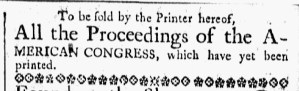
“All the Proceedings of the AMERICAN CONGRESS.”

Among the several advertisements that ran in the December 2, 1774, edition of the Connecticut Gazette, a brief notice announced that “All the Proceedings of the AMERICAN CONGRESS, which have yet been printed” were “sold by the Printer hereof.”  That expanded the options that readers had for learning more about the meetings held by the First Continental Congress in Philadelphia from September 5 through October 26.  The Connecticut Gazette and other newspapers provided coverage.  In addition, printers throughout the colonies began publishing, advertising, and selling Extracts from the Votes and Proceedings of the American Continental Congress shortly after delegates concluded their business.  Within a month, William Bradford and Thomas Bradford advertised a “JOURNAL OF THE PROCEEDINGS OF THE CONGRESS,” an even more complete account to keep colonizers informed about current events.

Timothy Green, the printer of the Connecticut Gazette, was among the printers who produced a local edition of the Extracts, yet when he advertised “All the Proceedings … which have yet been printed” he did not refer to a volume from his own press.  Although printers far and wide quickly created and marketed local editions of the Extracts, only a couple opted to print the more extensive Journal.  The Bradfords advertised their Philadelphia edition.  Hugh Gaine, the printer of the New-York Gazette and Weekly Mercury, printed the only other edition.  Green likely sold Gaine’s edition at his printing office in New Haven, given the proximity of that town to New York, though the Bradfords could have dispatched copies via a ship bound from Philadelphia to New England.  No matter which printer supplied Green with copies of the Proceedings, he advertised the journal of the meetings of the First Continental Congress to readers in Connecticut a little over a week after the Bradfords first promoted their edition in the Pennsylvania Journal.  He did so the day after the Continental Association, a nonimportation pact intended to unite the colonies in resisting the Coercive Acts, went into effect.  As readers made decisions about what they would buy and sell, Green presented them with another option for learning about the political principles behind the Continental Association and the other actions taken by the First Continental Congress.

November 25

What was advertised in a colonial American newspaper 250 years ago today?

South-Carolina and American General Gazette (November 25, 1774).

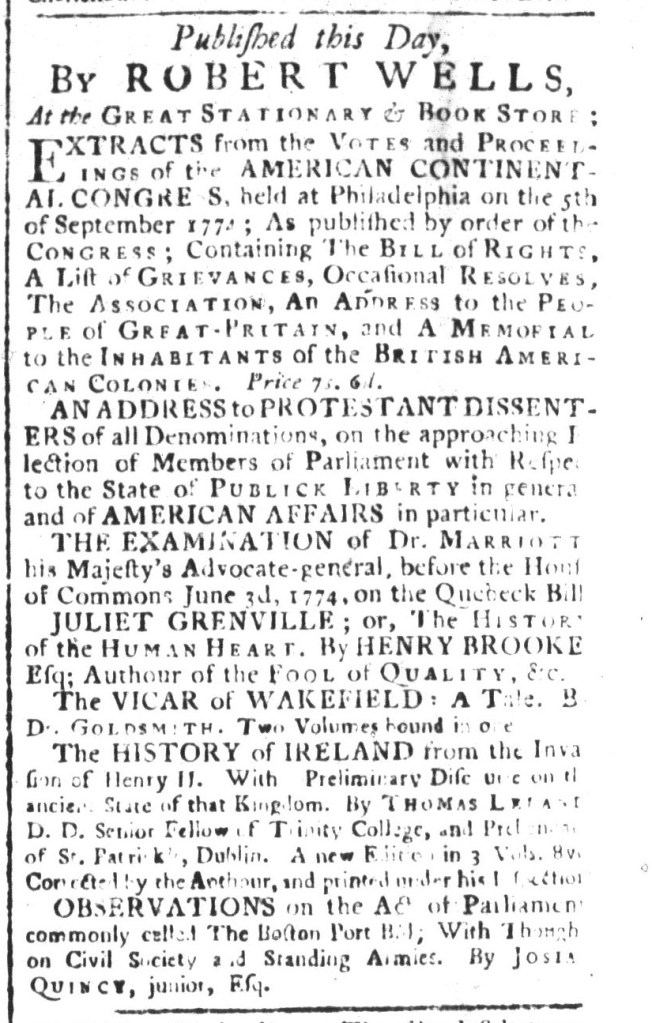
“EXTRACTS from the VOTES and PROCEEDINGS of the AMERICAN CONTINENTAL CONGRESS.”

As soon as the First Continental Congress adjourned near the end of October 1774, printers set about publishing, advertising, and selling “EXTRACTS from the VOTES and PROCEEDINGS of the AMERICAN CONTINENTAL CONGRESS, held at Philadelphia.”  William Bradford and Thomas Bradford, printers of the Pennsylvania Journal, were the first to advertise this political pamphlet, but other printers soon advertised that they produced local editions in their own towns, helping to disseminate the news far and wide.  Conveniently packaging “The BILL of RIGHTS, A List of GRIEVANCES, Occasional RESOLVES, The ASSOCIATION, An ADDRESS to the PEOPLE of GREAT-BRITAIN, and A MEMORIAL to the INHABITANTS of the BRITISH AMERICAN COLONIES” in one volume, this pamphlet supplemented coverage in newspapers.  Its format allowed for easier reference than saving and scouring issue after issue of newspapers that relayed some but not all the contents of the Extracts.  The pamphlet met with such demand that some printers quickly printed second editions.  In the November 24 edition of the Norwich Packet, for instance, Alexander Robertson, James Robertson, and John Trumbull advertised the “second Norwich EDITION” of the Extracts.

The Adverts 250 Project has examined the publication and dissemination of the Extracts in Pennsylvania, the neighboring colonies of Maryland and New York, and multiple towns in New England.  It took a little longer for printers in southern colonies to publish the pamphlet, but within a month of the First Continental Congress finishing its business Robert Wells, the printer of the South-Carolina and American General Gazette, advised readers that they could purchase the Extracts at his “GREAT STATIONARY & BOOK STORE.”  Unlike other printers who ran separate advertisements for the pamphlet, Wells included it among a list of half a dozen titles he sold.  He gave it a privileged place, first on the list, acknowledging its importance and likely interest among readers.  The other items included a couple of novels and a history of Ireland, but Wells concluded the list with “OBSERVATIONS on the Act of Parliament commonly called The Boston Port Bill, With Thoughts on Civil Society and Standing Armies.  By JOSIAH QUINCY, junior, Esq.”  Among the many volumes available at his bookstore, Wells chose to emphasize two concerning current events as the imperial crisis intensified.  Like so many other printers, he marketed items that supplemented the news he published in his newspaper.

November 23

What was advertised in a colonial American newspaper 250 years ago today?

Pennsylvania Journal (November 23, 1774).

“JOURNAL OF THE PROCEEDINGS OF THE CONGRESS, Held at PHILADELPHIA.”

Just three weeks after they first advertised a pamphlet containing “EXTRACTS FROM THE VOTES AND PROCEEDINGS OF THE AMERICAN CONTINENTAL CONGRESS,” William Bradford and Thomas Bradford announced that they “Just PUBLISHED” a more extensive “JOURNAL OF THE PROCEEDINGS OF THE CONGRESS, Held at PHILADELPHIA, September 5, 1774.”  Although printers in towns throughout the colonies produced, marketed, and sold local editions of the Extracts to keep the public informed about what occurred at the First Continental Congress, the Bradfords were nearly alone in printing the Journal.  Hugh Gaine, the printer of the New-York Gazette and Weekly Mercury, joined them in that endeavor.

The Bradfords gave their advertisement for the Journal a privileged place in the November 23, 1774, edition of their newspaper, the Pennsylvania Journal.  It appeared on the third page, immediately following the list of prices current in Philadelphia.  While that may not seem like a spot of any significance in modern newspapers, consider the production of newspapers in eighteenth-century America.  Printers created each four-page issue by first printing the first and fourth pages on one side of a broadsheet, letting the ink dry, and then printing the second and third pages on the other side.  That meant that the most current news often appeared on the interior pages of an issue since printers set type and printed those pages last.  In most newspapers, the shipping news from the customs house or the prices current were the last news items before the advertisements, a familiar visual cue for readers that one type of content came to an end and another began.  For readers examining the news more carefully than the advertisements, an advertisement’s placement immediately following the shipping news and prices current likely increased its visibility.

That their advertisement for the Journal occupied that privileged place was not unique to the Bradfords marketing it in their own newspaper.  On the same day, they placed a notice in the Pennsylvania Gazette.  It ran on the third page, immediately following the shipping news and the prices current.  Among more than fifty paid notices in that issue, the printers of that newspaper apparently believed that the Journal deserved special treatment.  Marketing and selling both the Extracts and the Journal became an extension of keeping the public informed via coverage of the First Continental Congress that appeared in newspapers.

November 14

What was advertised in a colonial American newspaper 250 years ago today?

New-York Gazette and Weekly Mercury (November 14, 1774).

“The great Demand for the Proceedings of the Continental Congress, has caused a second Edition to be printed.”

Hot off the press and flying off the shelf!  Hugh Gaine, the printer of the New-York Gazette and Weekly Mercury, reported a high level of public interest in the Extracts from the Votes and Proceedings of the American Continental Congress.  On November 14, 1774, he took the unusual measure of inserting an advertisement among the news to inform readers that the “great Demand for the Proceedings of the Continental Congress, has caused a second Edition to be printed; — which is this Day published, and sold by Hugh Gaine, in Hanover-Square.”  Although news and advertisements often appeared next to each other in colonial newspapers, printers did not ordinarily intersperse advertisements and news.  That made it noteworthy that Gaine’s advertisement appeared below local news from New York and above shipping news from the custom house.

Although Gaine published and sold a “second Edition” of the Extracts, he was not responsible for the first edition printed in New York.  On November 3, John Holt, the printer of the New-York Journal, ran a notice advising of “THE PROCEEDINGS OF THE CONTINENTAL CONGRESS, With their Letter to the People of QUEBEC, To be sold by the Printer.”  Unlike an advertisement for a Philadelphia edition in the Pennsylvania Journal the previous day, Holt’s notice did not list the contents.  He apparently considered the meeting of the First Continental Congress sufficient recommendation for marketing a pamphlet that gave an overview of the decisions made by the delegates.  He ran the same advertisement, without update, a week later.  Not long after that, Gaine advertised a “second Edition” that seems to have been a competing edition.  He had not previously advertised the Extracts in the New-York Gazette and Weekly Mercury, suggesting that he had witnessed the popularity of Holt’s edition and decided to generate revenue by printing and selling his own edition.  The political pamphlet had not necessarily sold out, as Gaine’s advertisement suggested, but instead a second printer entered the market.  In his History of Printing in America (1810), patriot printer Isaiah Thomas remarked that “Gaine’s political creed, it seems, was to join the strongest party.”[1]  Gaine may not have held to any political principles as strongly as Holt, who had incorporated the “Unite or Die” political cartoon into the masthead of his newspaper, yet his actions did serve the purposes of the First Continental Congress.  The delegates had ordered the publication of the Extracts.  Disseminating that political pamphlet did not require sincere belief on the part of Gaine or any other printer, though most who published and marketed it did tend to vocally support the American cause throughout the imperial crisis.

**********

[1] Isaiah Thomas, The History of Printing in America: With a Biography of Printers and an Account of Newspapers (1810; New York: Weathervane Books, 1970), 472.

November 13

What was advertised in a colonial American newspaper 250 years ago this week?
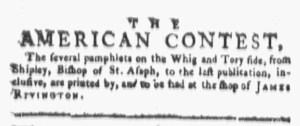
Massachusetts Gazette and Boston Weekly News-Letter (November 10, 1774).

“*** The Votes and Proceedings of the Grand American Continental CONGRESS.”

Just over a week after William Bradford and Thomas Bradford first advertised their Philadelphia edition of Extracts from the Votes and Proceedings of the American Continental Congress in the Pennsylvania Journal, printers in Boston ran advertisements advising the public that they published and sold their own local editions.  Those notices first appeared in the Massachusetts Gazette and Boston Weekly News-Letter and the Massachusetts Spy on November 10, 1774.  Readers could choose between two editions published in Boston.

Thomas Fleet and John Fleet, the printers of the Boston Evening-Post, and the Benjamin Edes and John Gill, the printers of the Boston-Gazette, partnered in publishing one of those editions.  Their advertisements in both the Massachusetts Gazette and Boston Weekly News-Letter and the Massachusetts Spy followed a familiar format for notices about books, pamphlets, almanacs, and other printed items.  A headline proclaimed, “This Day is Published,” followed by a secondary headline that listed the names of the printers.  The body of the advertisement consisted of the title of the pamphlet and a list of its contents.

Massachusetts Gazette and Boston Weekly News-Letter (November 10, 1774).

Nathaniel Mills and John Hicks, the printers of the Massachusetts Gazette and Boston Post-Boy, worked with fellow printer John Boyle as well booksellers Edward Cox and Edward Berry to publish and sell another Boston edition of the Extracts of the First Continental Congress.  That meant that the printers of all five newspapers published in Boston in 1774 participated either in publishing or advertising that important political pamphlet that informed the public about the decisions made by the delegates in Philadelphia.

The advertisement for this edition in the Massachusetts Spy followed the same format as the notice about the other edition, though the secondary headline gave only the names of Mills and Hicks and Boyle.  The notice in the Massachusetts Gazette and Boston Weekly News-Letter, on the other hand, looked more like a news update, especially since it appeared immediately to the left of a report that “Last Evening arrived in Town form the GRAND CONGRESS, the Hon. Thomas Cushing, Esq; John Adams, Esq; Mr. Samuel Adams, and Robert Treat Paine, Esq; … on which Occasion, most of the Bells in Town were rung.”  With three asterisks to draw attention, the notice about the pamphlet started with the title, continued with the contents, and concluded with “sold by Cox and Berry, Mills and Hicks and John Boyle.”

Residents of Boston and nearby towns had ready access to the Extracts as soon as delegates returned from the meeting of the First Continental Congress.  They likely heard about the meetings through conversation and learned about it from reading newspapers, yet they could purchase an overview of the proceedings to examine in as much detail as often as they liked.

November 4

What was advertised in a colonial American newspaper 250 years ago today?

Connecticut Journal (November 4, 1774).

The Proceedings of the Continental Congress will shortly be ready for sale at the Printing Office in New Haven.”

William Bradford and Thomas Bradford, the printers of the Pennsylvania Journal in Philadelphia were the first to advertise the Extracts from the Votes and Proceedings of the American Continental Congress after the First Continental Congress adjourned its meeting in the fall of 1774, but other printers in other towns soon hawked their own editions.  A multiplication of copies produced and disseminated throughout the colonies aided in keeping colonizers informed beyond what they read in newspapers or heard from their friends and neighbors.

The Bradfords announced publication of the Extracts on November 2, a week after the First Continental Congress concluded its meeting.  On November 3, John Holt, the printer of the New-York Journal, ran a shorter advertisement to the same effect: “THE PROCEEEDINGS OF THE CONTINENTAL CONGRESS, With their Letter to the People of QUEBEC, To be sold by the Printer.”  He may have been so occupied with taking the Extracts to press as quickly as possible that he did not focus on crafting an advertisement.  On the other hand, considering the level of interest in the decisions of the delegates, Holt may not have considered an elaborate advertisement necessary to market the pamphlet.  Anne Catharine Green and Son, the printers of the Maryland Gazette in Annapolis, ran their own advertisement that day, though they did not have their edition ready for sale.  Still, they wanted readers to know that it would soon be available: “Now in the press, and speedily will be published, EXTRACTS FROM THE VOTES AND PROCEEDINGS OF THE AMERICAN CONTINETNAL CONGRESS.”  They placed their notice immediately after the news, testifying to its consequence.

Thomas Green and Samuel Green, the printers of the Connecticut Journal and New-Haven Post-Boy, also moved quickly to publish an edition of the Extracts.  They inserted a note in the November 4 edition of their newspaper: “The Proceedings of the Continental Congress will shortly be ready for sale at the Printing Office in New Haven.”  It appeared at the bottom of the final column on the third page of that issue.  Printers usually printed the first and fourth pages on one side of a broadsheet and let them dry while they set type for the second and third pages to print on the other side.  That meant that the Greens’ notice about the Extracts would have been the last item added to that edition.  Perhaps they had hoped to have the pamphlet ready for sale by the time the second and third pages of the newspaper went to press, but settled for alerting readers that they could acquire copies soon.  As quickly as they could, the Greens joined other printers in disseminating the political pamphlet far and wide.

November 2

What was advertised in a colonial American newspaper 250 years ago today?

Pennsylvania Journal (November 2, 1774).

“EXTRACTS FROM THE VOTES AND PROCEEDINGS OF THE AMERICAN CONTINENTAL CONGRESS.”

Delegates to the First Continental Congress met in Philadelphia from September 5 through October 26, 1774.  When the meetings adjourned, an advertisement for “EXTRACTS FROM THE VOTES AND PROCEEDINGS OF THE AMERICAN CONTINENTAL CONGRESS” appeared in the next issue of the Pennsylvania Journal.  William Bradford and Thomas Bradford, printers of that newspaper, did not merely announce their plans to print the Extracts; they proclaimed that the pamphlet was “JUST PUBLISHED AND TO BE SOLD” at their printing office.  The Extracts hit the presses as soon as the delegates finished their business, providing an overview of “The BILL of RIGHTS; a List of GRIEVANCES; occasional RESOLVES; the ASSOCIATION; an ADDRESS to the People of Great-Britain; and a MEMORIAL to the Inhabitants of the British American Colonies.”

In their coverage of the meetings, the Bradfords promoted the Extracts, simultaneously distributing them as a service to the public and a seeking to generate revenue from their sale.  “On Wednesday last,” they reported, “the AMERICAN CONTINENTAL CONGRESS broke up, after having passed a Number of spirited Resolves, wrote several Letters, &c. which are printed in a Pamphlet, and may be had of the Printers.”  Just as Thomas Fleet and John Fleet, printers of the Boston Evening-Post, had taken the unusual step of interspersing news and advertising to hawk a publication related to recent meetings in Massachusetts earlier that same week, the Bradfords directed readers who consumed the news to consume a pamphlet they printed as well.  Readers could do more than learn about current events; they could participate in them by purchasing the Extracts, becoming better informed about colonial grievances, and following the directions for boycotting imported goods detailed in the Continental Association.

Such opportunities quickly became available in other places.  The Bradfords had the scoop for the moment, yet other printers soon published and disseminated other editions in Philadelphia and nearly a dozen other towns.  By the end of the year, one or more local editions appeared in Albany; Annapolis; Boston; Hartford; Lancaster, Pennsylvania; New London, Connecticut; Newport, Rhode Island; New York; Norwich, Connecticut; Providence; and Williamsburg, Virginia.  Heinrich Miller, the printer of the Wochentliche Pennsylvanische Staatsbote, also printed a German translation of the Extracts.  This important pamphlet supplemented newspaper coverage by conveniently collating a summary of the First Continental Congress for easy reference.

October 7

What was advertised in a colonial American newspaper 250 years ago today?

Connecticut Journal (October 7, 1774).

The SPEECH, intended to have been spoken on the BILL for altering the Charters of the Colony of Massachusetts Bay.”

Among the other advertisements that appeared in the October 7, 1774, edition of the Connecticut Journal and New-Haven Post-Boy, Thomas Green and Samuel Green inserted a notice for two political pamphlets “To be sold by the Printers hereof.”  They stocked “The SPEECH, intended to have been spoken on the BILL for altering the Charters of the Colony of Massachusetts Bay.  Written by the Rev. Dr. Jonathan Shipley, Lord Bishop of St. Asaph” as well as “A DECLARATION of the People’s Natural Right to Share in the LEGISLATURE; which is the Fundamental Principle of the British Constitution of State.  By Granville Sharp.”

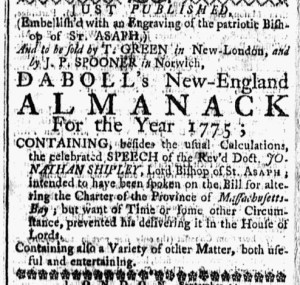
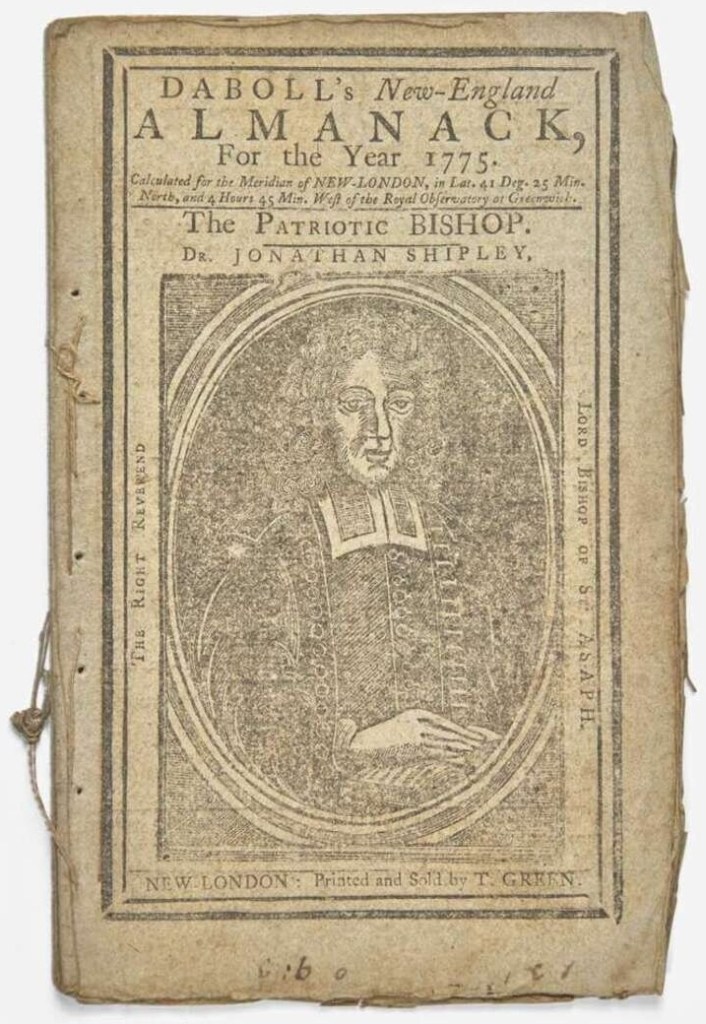
Both pamphlets supported the American cause against abuses perpetrated by Parliament.  The first critiqued the Massachusetts Government Act, legislation that revoked the colony’s charter, gave greater authority to a governor appointed by the king, and prohibited town meetings without prior approval.  As a bishop of the Church of England, Shipley was a member of Parliament.  He intended to object to the Massachusetts Government Act, one of the Coercive Acts passed in retaliation for the Boston Tea Party, but was not allowed to deliver it.  Instead, he had it published.  Although it had little effect in England, the speech circulated widely and to great acclaim in the colonies.  In addition to imported editions sold by booksellers, colonial printers produced at least eleven American editions in Salem, Boston, Newport, Hartford, New York, Philadelphia, Lancaster, and Williamsburg.  The Massachusetts Gazette and Boston Post-Boy reprinted the speech in a supplement that accompanied its September 12, 1774, edition.  In addition, Daboll’s New-England Almanack, for the Year 1775 included the “Celebrated Speech” and a portrait of Shipley on the title page.  The bishop achieved great acclaim among colonizers for his support during their plight.

The Greens advertised and sold Shipley’s speech, but they did not publish their own edition.  They were so eager to disseminate the pamphlet to their customers that they first advertised it in the outer margin of the second page of the September 30 edition of the Connecticut Journal.  A single line declared, “The celebrated SPEECH, of the Bishop of St. Asaph, on the Bill for altering the Charter of the Colony of Massachusetts-Bay.  To be sold by the Printers, and Nathan Hicok, jun. price 4d.”  Hicok was a post rider who joined the ranks of post riders who not only delivered letters and newspapers but also sold political tracts that advocated for the rights of the colonies.  It appears that the Greens may have received copies of the bishop’s speech shortly before taking the September 30 edition to press, but rather than wait an entire week to promote it in the next issue they instead opted to squeeze it into the margin.  They then converted it into a regular advertisement to continue promoting it to readers.  The advertisements do not reveal how many customers purchased and read the pamphlet, but they do indicate that printers and post riders actively worked to distribute it widely.

September 19

What was advertised in a colonial American newspaper 250 years ago today?

Dunlap’s Pennsylvania Packet (September 19, 1774).

“The above pamphlet … is quoted in a respectful manner by the Earl of Chatham.”

Two weeks after the First Continental Congress commenced its meetings in Philadelphia, Joseph Crukshank took to the pages of Dunlap’s Pennsylvania Gazette to advertise that he had “Just published … A TRUE STATE of the PROCEEDINGS in the Parliament of Great-Britain, and in the Province of Massachusetts Bay, relative to the giving and granting the Money of the People of that province, and of all America, in the House of Commons, in which they are not represented.”  As was often the case, the extensive title simultaneously provided an overview of the pamphlet’s contents and served as advertising copy.

Yet that was not the only appeal made in this advertisement.  Crukshank, the printer of this American edition of a work originally published in London, sought to entice buyers with additional information.  “The above pamphlet, said to be written by Dr. Franklin,” he informed readers, “is quoted in a respectful manner by the Earl of Chatham, in his speech on the third reading of the bill for quartering troops in America.”  Colonizers had long celebrated William Pitt the Elder for his advocacy on their behalf, doing so once again when he considered the wisdom of the Quartering Act, one of the Coercive Acts that Parliament passed in the wake of the Boston Tea Party.  Historians have determined that Arthur Lee compiled the pamphlet from material furnished by Benjamin Franklin.

The title of the pamphlet, including its reference to the colonies lacking direct representation in Parliament, buttressed the arguments presented in letters and editorials that ran elsewhere in the September 19, 1774, edition of Dunlap’s Pennsylvania Packet.  On its own, the advertisement operated as a miniature editorial among the other content of the newspaper.  Scholars debate the extent that political pamphlets shaped public opinion, some arguing that newspapers reached many more people.  Compared to pamphlets, newspapers were inexpensive, plus they circulated widely.  Yet advertisements for political pamphlets did important work, even if few readers opted to purchase or read those pamphlets.  The advertisements contributed to an impression of the discourse taking place, signaling to readers what others believed about current events and why they should prefer one position over another.  Most readers of Dunlap’s Pennsylvania Packet never purchased Crukshank’s American edition of a political pamphlet originally published in London, yet the advertisement relayed information about the position taken by a popular politician and made an argument about the colonies’ lack of representation in Parliament.  The advertisement became part of the news environment.

September 9

What was advertised in a colonial American newspaper 250 years ago today?

Connecticut Gazette (September 9, 1774).

“CONSIDERATIONS on the Measures carrying on by GREAT BRITAIN, against the Colonies in North-America.”

As the number of American editions of Considerations on the Measures Carrying On with Respect to the British Colonies in North-America increased in 1774, so did the number of newspapers that carried advertisements for the political tract.  John Holt, the printer of the New-York Journal, advertised his edition.  Benjamin Edes and John Gill, the printers of the Boston-Gazette, did so as well for their edition.  Ebenezer Watson, printer of the Connecticut Courant, ran his own advertisement when he published a Hartford edition.  Yet it was not solely the printers of the various American editions who advertised or sold the popular pamphlet.  Watson listed local agents in eight towns and two post riders who sold his edition.  David Atwater advertised the New York edition for sale in New Haven in the Connecticut Journal.

Timothy Green, printer of the Connecticut Gazette, joined their ranks with an advertisement in the September 9, 1774, edition of his newspaper.  That made the pamphlet available for purchase in New London in addition to other towns in New England and New York.  Compared to the other advertisements, however, Green’s notice was quite brief, just three lines that completed the column following “THOMAS ALLEN’S Marine List,” a regular feature, on the third page.  “TO BE SOLD by T. GREEN, CONSIDERATIONS on the Measures carrying on by GREAT BRITAIN, against the Colonies in North-America.”  Green did not provide any of the elaborate description about how well the pamphlet had been received in London and how it had influenced residents there to support the American colonies against the abuses perpetrated by Parliament, nor did he encourage readers to review it for themselves so they could be better informed.  Perhaps he expected that the news he printed throughout the rest of his newspaper and the conversations about current events taking place everywhere anyone went those days provided enough reason for colonizers to acquire the pamphlet.  He also did not state which edition he sold, though the variant title in his advertisement suggests that he carried Watson’s Hartford edition.  In stocking and promoting the pamphlet, Green joined printers, post riders, and others in disseminating a political tract intended to influence colonizers and help them in articulating their grievances against Parliament.