December 12

What was advertised in a colonial American newspaper 250 years ago today?

New-York Gazette and Weekly Mercury (December 12, 1774).

“He will meet with due encouragement … by every real friend to American manufactures.”

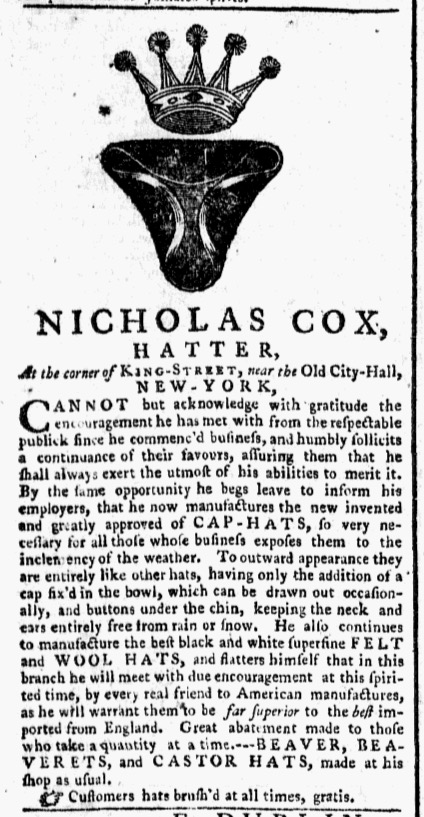
Nicholas Cox, a hatter, made several appeals to consumers in his advertisement in the December 12, 1774, edition of the New-York Gazette and Weekly Mercury.  He commenced with a standard expression of gratitude for “the encouragement he had met with from the respectable publick since he commenc’d business.”  Many purveyors of goods and services did so in their advertisements, signaling to readers that other consumers already considered them worthy of their business.  It was a familiar means of bolstering an advertiser’s reputation.

The hatter also incorporated commentary specific to his trade, proclaiming that he “manufactures the new invented and greatly approved of CAP-HATS.”  For those unaware of this innovation, eh explained that by “outward appearance they are entirely like other hats, having only the addition of a cap fix’d in the bowl, which can be drawn out occasionally.”  In such instances, it “buttons under the chin, keeping the neck and ears entirely free from rain or snow.”  Cox marketed this new style, a very practical element, as “so very necessary for all those whose business exposes them to the inclemency of the weather.”  According to Kate Haulman, colonizers debated whether they should carry umbrellas, “stylistic spoils of empire hailing from India,” in the 1760s and 1770s.  “Some regarded umbrellas as ridiculous and frivolous,” she notes, “serving no purpose that a good hat could not supply.”[1]  Cox produced and sold such hats for men of business who sought to eschew the effeminacy and luxury associated with umbrellas.

His next appeal made an even more explicitly political argument to prospective customers.  He made “the best black and white superfine FELT and WOOL HATS,” like the tricorne hat depicted in the woodcut that adorned his advertisement.  Cox asserted that patriotic consumers had a duty to support his business when they made choices about where to acquire their hats.  He expressed confidence that he “will meet with due encouragement at this spirited time, by every real friend to American manufactures.”  The Continental Association, a boycott of British goods adopted in response to the Coercive Acts, had recently gone into effect.  Cox offered an alternative to colonizers who desired to acquire hats yet wished to remain patriotically correct, either according to their own principles or at least to avoid the ire of others who observed the purchases they made.  Furthermore, his customers did not have sacrifice quality for principles.  The hatter pledged that “he will warrant [his hats] to be far superior to the best imported from England.” That being the case, the crown that appeared above the tricorne hat at the top of his advertisement may have testified to the superior quality of his hats, a general sense of pride in being part of the British Empire, or reverence for the monarch whom many colonizers still hoped would intervene on their behalf in their altercation with Parliament.

In addition to those appeals, Cox included two more common marketing strategies.  He promised a “[g]reat abatement … to those who take a quantity at a time.”  In other words, he gave discounts for buying multiple hats, both for consumers and for retailers who intended to sell them in their own shops.  He also provided a free ancillary service: “Customers hats brush’d at all times, gratis.”  Cox saw to the care and maintenance of the hats he made and sold long after the time of purchase.  He cultivated relationships with customers by encouraging them to return to his shop for assistance in keeping their hats in good order.  Overall, Cox resorted to a variety of familiar and specific appeals when advertising his hats, distinguishing him from competitors who did not put as much effort into marketing their wares.

**********

[1] Kate Haulman, “Fashion and the Culture Wars of Revolutionary Philadelphia,” William and Mary Quarterly, 3rd ser., 62, no 4 (October 2005): 632.

December 9

What was advertised in a colonial American newspaper 250 years ago today?

Connecticut Gazette (December 9, 1774).

“Glass buttons having the word liberty printed in them.”

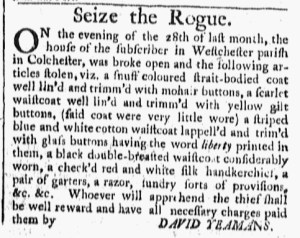
The headline for David Yeaman’s advertisement in the December 9, 1774, edition of the Connecticut Gazette alerted readers that it would document some sort of misbehavior.  “Seize the Rogue,” it proclaimed.  The rogue “broke open” Yeamans’s house and stole several items on November 28.  They included clothing, a “check’d red and white silk handkerchief,” a razor, and “sundry sorts of provisions.”  The unfortunate advertiser offered a reward to whoever apprehended the thief.

Yeamans’s descriptions of the missing garments revealed his taste and sartorial sensibilities.  The thief took a “snuff coloured strait-bodied coat well lin’d and trimm’d with mohair buttons,” a “scarlet waitcoast well lin’d and trimm’d with yellow gilt buttons” that showed very little wear, a “black double-breasted waistcoat considerably worn,” and a “striped blue and white cotton waistcoat lappell’d and trim’d with glass buttons.”  That last piece of clothing testified to more than Yeamans’s sense of fashion. It also said something about his politics and how he felt about the imperial crisis that had been intensifying for the year since the Boston Tea Party.  Those glass buttons had “the word liberty printed in them.”  Yeamans made a statement every time he wore the striped waistcoat adorned with those buttons.

This advertisement, printed immediately below entries from the “CUSTOM-HOUSE, New-LONDON,” and other shipping news in “THOMAS ALLEN’s MARINE LIST,” provided additional coverage of local news, though selected by an advertiser who paid to have it appear in print rather than by the editor who compiled “Fresh Advices from London!” and reports from Boston, New York, Philadelphia, and Hartford.  At first glance, it featured a theft, yet the details about one of the stolen garments prompted readers to think about the contents of the articles and editorials in that issue, including discussion of the Continental Association adopted by the First Continental Congress and the impact of the Boston Port Bill on residents of that city.  Those buttons with “the word liberty printed in them” contributed to discussions about politics when Yeamans wore his waistcoat and when he advertised its theft.

November 17

What was advertised in a colonial American newspaper 250 years ago today?

Massachusetts Spy (November 17, 1774).

“To the whole is added, The ASSOCIATION of the Grand AMERICAN CONGRESS.”

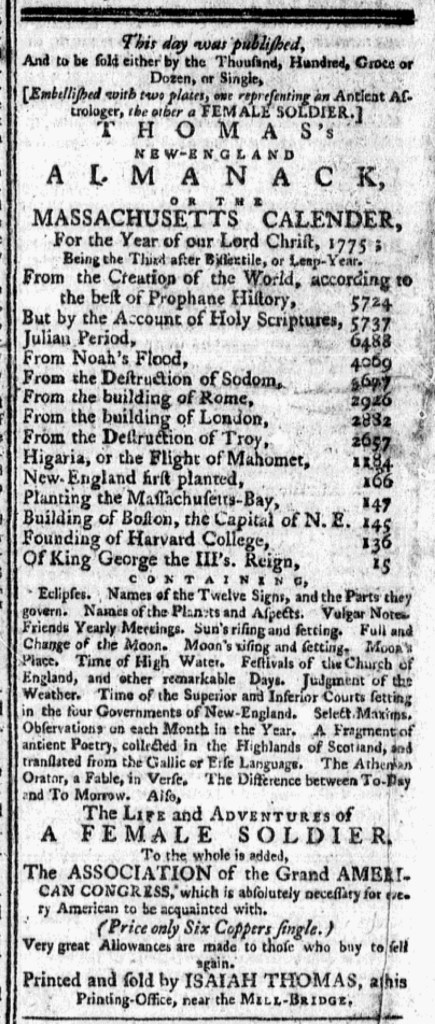
Like many colonial printers, Isaiah Thomas generated significant revenue from publishing almanacs.  From the most affluent to the most humble households in port cities and in the countryside, each year colonizers acquired these handy reference manuals that included all kinds of information.  Thomas’s “NEW-ENGLAND ALMANACK, OR THE MASSACHUSETTS CALENDER, For the Year of our Lord Christ, 1775,” for instance, had everything from the tides or “Time of High Water” to a schedule of “the Superior and Inferior Courts setting in the four Governments of New-England” to poetry.  Thomas “Embellished” the almanac with two images, “one representing an Antient Astrologer, the other a FEMALE SOLDIER.”  The latter corresponded to the “LIFE and ADVENTURES of A FEMALE SOLDIER” that the printer promoted among the content of his almanac.  Practically every almanac included the tides and many listed the dates for important meetings in Connecticut, Massachusetts, New Hampshire, and Rhode Island, so Thomas and other printers sought ways to distinguish their almanacs from others, including images and novel stories.

Thomas anticipated doing brisk business with the contents that he selected for his almanac.  He announced that he sold it “by the Thousand, Hundred, Groce or Dozen, or Single,” offering peddlers, booksellers, and shopkeepers the opportunity to purchase in volume for resale.  A single copy cost “Six Coppers,” yet Thomas promised that “Very great Allowances are made to those who buy to sell again.”  In addition to turning a profit on his almanac, this patriot printer also wanted it disseminated widely because of a particular item that he inserted among the contents.  His almanac included “The ASSOCIATION of the Grand AMERICAN CONGRESS.”  He referred to the Continental Association, a nonimportation agreement recently adopted by the First Continental Congress when it met in Philadelphia in September and October 1774.  The inclusion of the Continental Association distinguished Thomas’s almanac from others advertised in the same issue of the Massachusetts Spy, including “BICKERSTAFF’S BOSTON ALMANACK” published by Nathaniel Mills and John Hicks and “LOW’S ALMANACK” published by John Kneeland.  That newspaper also featured advertisements for two different editions of “EXTRACTS from the Votes and Proceedings of the American Continental CONGRESS,” which included the Continental Association.  Whether or not readers happened to purchase that political pamphlet, Thomas provided easy access to what they needed to know about the nonimportation agreement in an almanac that they would consult for a variety of purposes throughout the coming year.  He asserted that the Continental Association “is absolutely necessary for every American to be acquainted with” … and since so many colonizers already planned to purchase an almanac for 1775 they might as well become acquainted with the Continental Association by purchasing Thomas’s almanac, the one that he sought to distribute “by the Thousand, Hundred, Groce or Dozen” to get into as many households as possible.

November 3

What was advertised in a colonial American newspaper 250 years ago today?

Massachusetts Spy (November 3, 1774).

“I am now sensible that my signing the said Address was altogether improper and imprudent.”

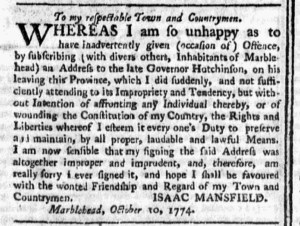
Yet another colonizer who signed “an Address to the late Governor Hutchinson, on his leaving this Province” took to the public prints to recant and apologize.  Isaac Mansfield of Marblehead published his message to “my respectable Town and Countrymen” in the November 3, 1774, edition of the Massachusetts Spy.  Like others who claimed that they regretted their actions, he asserted that he had endorsed the address “suddenly, and not sufficiently attending to its Impropriety and Tendency.”  In other words, he had carelessly affixed his name without giving the contents or their implications much thought.  Upon further reflection, realizing what he had done (and facing the consequences of giving “Offence”), he declared that he had no intention of “affronting any Individual” or, especially, “wounding the Constitution of my Country, the Rights and Liberties whereof I esteem it every one’s Duty to preserve and maintain, by all proper, laudable and lawful means.”  Mansfield had strayed in expressing Tory sympathies, but he had seen the light.  He described signing the address as improper and imprudent, following immediately with an apology and a request for the “Friendship and Regard of my Town and Countrymen.”

Similar disavowals and retractions had been appearing in newspapers in Massachusetts and neighboring colonies for some time.  Much shorter versions by J. Fowle and John Prentice, both of Marblehead, that ran in three newspapers published in Boston and another in Salem during the past week also appeared in the November 3 issue of the Massachusetts Spy.  Some printers treated them as letters to place among news items, while others placed them with advertisements, making unclear which genre these letter-advertisements represented and whether printers charged for inserting them in their newspapers.  Isaiah Thomas, the printer of the Massachusetts Spy, ran the letter-advertisements from Fowle and Prentice below a letter to the editor from “A PROPRIETOR” and above Donald McAlpine’s advertisement for fencing lessons, similar to their placement in the Boston-Gazette three days earlier.  Had the men from Marblehead submitted their letter-advertisements to Thomas’s printing office?  Or had the patriot printer decided to reprint news from another newspaper?  In this instance, the double line separating different kinds of content appeared above the letter-advertisements, signaling to readers that they had finished with the news and began the advertisements.  The placement of Mansfield’s letter-advertisement was less ambiguous.  It ran on the final page, embedded among advertisements.  A notice from Silent Wilde, a post rider, appeared above it and an advertisement for William Hunter’s “Auction-Room” below it.  Does that mean that Thomas charged for printing Mansfield’s letter-advertisement?  Perhaps, though he may have been more interested in publicizing that another member of the community had seemingly come into conformity with patriot politics than generating revenue from Mansfield’s missive.  Either way, readers encountered news about current events as they perused the portion of the Massachusetts Spy that contained advertisements.

November 1

What was advertised in a colonial American newspaper 250 years ago today?

Essex Gazette (November 1, 1774).

“WHEREAS I the Subscriber signed an Address to the late Governor Hutchinson — I wish the devil had had said Address before I had seen it.”

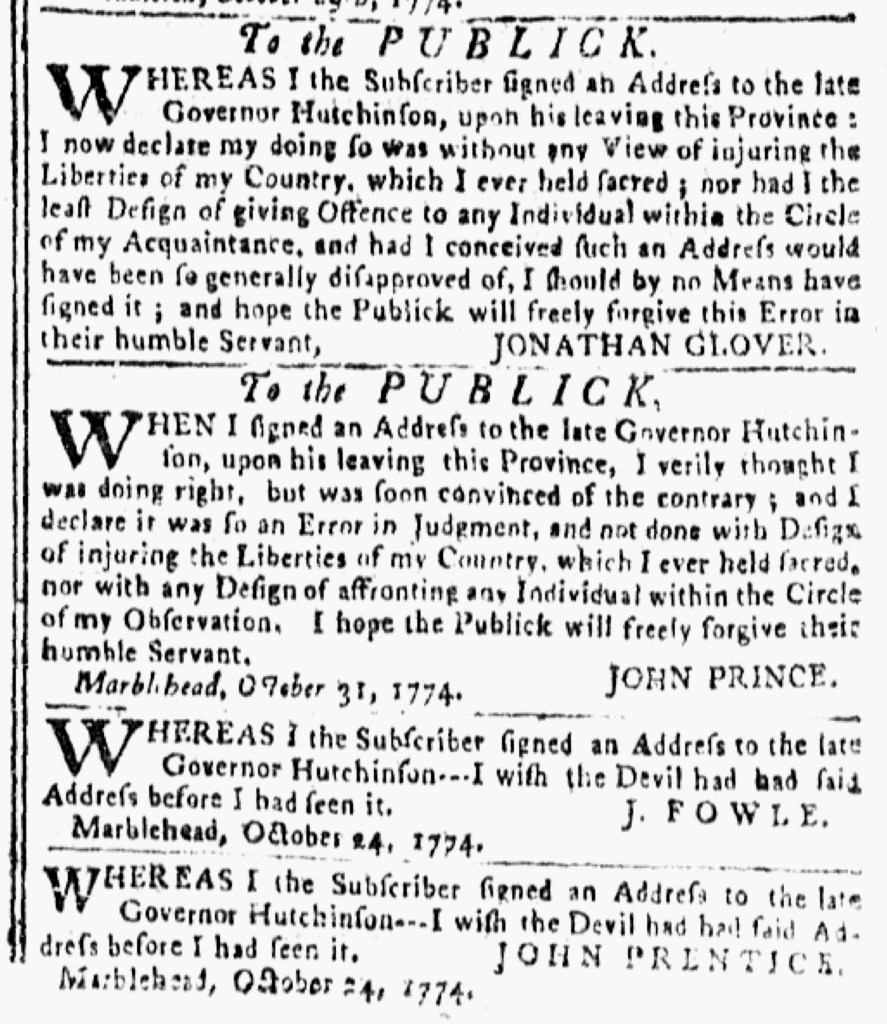
More advertisements from men who wished to recant after signing “an Address to the late Governor Hutchinson, upon his leaving the Province” appeared in the November 1, 1774, edition of the Essex GazetteJohn Stimpson’s letter to that effect ran as an advertisement a week earlier, joined now by letters from Jonathan Glover, John Prince, J. Fowle, and John Prentice.  The printers, Samuel Hall and Ebenezer Hall, positioned them one after another at the end of a column, following an advertisement about a stray cow.  Their position on the page indicated that the Halls considered these letters to be advertisements.  In that case, they would have charged to run them in their newspaper.

Other printers, however, treated some of these same letters differently.  The short missives from Fowle and Prentice each appeared in the Boston Evening-Post, the Boston-Gazette, and the Massachusetts Gazette and Boston Post-Boy the previous day.  In two of those newspapers, they ran with local news, while in the Boston-Gazette the printers placed them between news and advertisements.  They could have been the final news items or the first advertisements in that column.  Even if the printers considered them advertisements, they delivered news to readers.

In the Boston Evening-Post, Thomas Fleet and John Fleet, the printers, provided commentary, reporting that they “have received the Declarations and Acknowledgments of several Deputy Sheriffs, and other Persons, who by signing an Address to Governor Hutchinson had rendered themselves obnoxious to the People.”  They did not have room to publish all of them in that issue, but considered two of them “so concise we can’t omit obliging our Readers with them, as they may serve for a Specimen to other Addressers whose Principles are such as not to incline them to make long Confessions, even when they know they were to blame.”  Samuel Flagg had offered one of those “long Confessions” in the Essex Gazette a month earlier.

Fowle’s letter-advertisement succinctly stated, “WHEREAS I the Subscriber signed an Address to the late Governor Hutchinson — I wish the devil had had said Address before I had seen it.”  Prentice’s letter-advertisement contained an identical message.  Among the others that ran in the Essex Gazette, Glover asserted that he signed the address “without any View of injuring the Liberties of my Country, which I ever held sacred.”  Prince declared that he made “an Error in Judgment” without any “Design of injuring the Liberties of my Country, which I ever held sacred.”  Those two letter-advertisements had variations in wording yet had a similar structure.  For instance, Glover concluded with expressing his “hope the Publick will freely forgive this Error in their humble Servant,” while Prince stated, “I hope the Publick will freely forgive their humble Servant.”

In “Entering the Lists: The Politics of Ephemera in Eastern Massachusetts, 1774,” William Huntting Howell examines other recantations that were either similar or identical.  He questions whether any of them expressed sincerely held beliefs given that they seemed to be “performing by rote.”[1]  That aspect of Fowle’s letter-advertisement calls into question Glover’s invocations of “the Liberties of my Country, which I ever held sacred” and Flagg’s much more extensive reflection on his role in what had transpired. Furthermore, Howell argues, “recantations like these might have kept the Committee of Safety away from one’s house, or signaled to one’s neighbors that one no longer wished to disagree, but they cannot possibly have represented a legitimate conversion or deeply held belief.”[2]  That being the case, the signatories made public apologies in hopes of getting along with others.  By offering the identical letter-advertisements by Fowle and Prentice as prescriptive models for others to copy when ready to make their own “Declarations and Acknowledgments,” the Fleets also signaled that they also believed, as Howell puts it, that “the rote expression of allegiance is not the antithesis of ‘true patriotism,’ but rather its very essence.  The public spectacle of apology or ‘patriotic’ conversion – especially one that follows a pattern – better serves the larger cause than a private change of heart.”[3]

**********

[1] William Huntting Howell, “Entering the Lists: The Politics of Ephemera in Eastern Massachusetts, 1774,” Early American Studies 9, no. 1 (Winter 2011): 214.

[2] Howell, “Entering the Lists,” 215.

[3] Howell, “Entering the Lists, 215-6.

October 31

What was advertised in a colonial American newspaper 250 years ago today?

Boston Evening-Post (October 31, 1774).

“The Manual Exercise, recommended to be practised by the above Resolve of the Congress.”

The placement of advertisements varied in colonial newspapers.  Many printers reserved them for the final pages, while others positioned them on the first and last pages with news on the middle pages.  Sometimes advertisements and news appeared on the same page, such as two columns of news and one column of advertising on the front page or advertisements completing a column of news on any page.  Even with those variations, advertisements and news typically did not alternate within the columns on any page of early American newspapers.

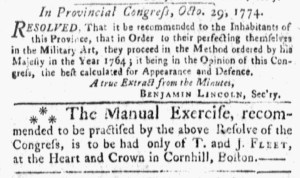
That made an advertisement on the third page of the October 31, 1774, edition of the Boston Evening-Post both unusual and notable.  The first column bore the headline “In PROVINCIAL CONGRESS” and commenced with “A true Extract from the Minutes” of a meeting held on October 26.  The same headline, in smaller font, occurred three more times in the first and second columns, reporting on meetings held on October 28 and 29.  The last of those featured a short resolution: “That it be recommended to the Inhabitants of this Province, that in Order to their perfecting themselves in the Military Art, they proceed in the Method ordered by his Majesty in the Year 1764; it being in the Opinion of this Congress, the best calculated for Appearance and Defence.”  That recommendation came as Boston and the rest of the colony reacted to the Quartering Act, the Massachusetts Government Act, and the other Coercive Acts that Parliament passed in retaliation for the Boston Tea Party.

A brief advertisement immediately followed the resolution: “The Manual Exercise, recommended to be practised by the above Resolve of the Congress, is to be had only of T. and J. Fleet, at the Heart and Crown in Cornhill, Boston.”  The column returned to news, that lone advertisement embedded between articles.  The Fleets happened to be the printers of the Boston Evening-Post, known for their support of the patriot cause.  They likely had dual purposes in running the advertisement and selecting where to place it.  Supplying the public with a military manual reflected their political principles, yet as entrepreneurs the Fleets also stood to generate revenue from its sale.  They served the public good, both in printing the manual and the proximity of their advertisement to the resolution, while also attempting to increase sales in their printing office.  Scholars have debated whether printers who sold political tracts during the era of the American Revolution merely seized an opportunity to line their pockets, yet participating in politics and earning their livelihoods were not necessarily mutually exclusive endeavors.

October 25

What was advertised in a colonial American newspaper 250 years ago today?

Essex Gazette (October 25, 1774).

“By Signing an Address to Governor Hutchinson … I have given just Cause of Offence.”

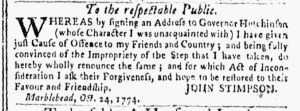
It was another plea for forgiveness for exercising poor judgment, at best, or expressing unsavory political views by signing an address to Thomas Hutchinson that thanked him for his service as governor of Massachusetts.  At the end of October 1774, John Stimpson of Marblehead took to the pages of the Essex Gazette to a acknowledge to “the respectable Public” that he had “given just Cause of Offence to my Friends and Country” when he had done so.  He explained that he “was unacquainted” with Hutchinson’s character the previous spring, but in the time that elapsed since then he became “fully convinced of the Impropriety of the Step that I have taken.”  That being the case, he placed an advertisement to “wholly renounce the same” as well as seek forgiveness for that “Act of Inconsideration.”  Ultimately, Stimpson “hope[d] to be restored to their Favour and Friendship.”

He was not the first to insert an open letter in the Essex Gazette or other newspapers for that purpose.  Thomas Kidder published a similar apology in the Boston-Gazette in July 1774.  Samuel Flagg and Joseph Lee each did so in the Essex Gazette three weeks before Stimpson did.  Flagg’s extensive message to his “Fellow Citizens and Countrymen” incorporated an editorial on the “unjust and oppressive” legislation imposed by Parliament.  Others published similar missives explaining their error, assuring the public that they were not admirers of Hutchinson (and, by extension, the Tory perspective on current events), and asking for forgiveness so they could restore their standing within their communities.

Stimpson’s version of what was becoming a familiar feature in the newspapers did not appear among the news and editorials.  Samuel Hall and Ebenezer Hall, the patriot printers of the Essex Gazette, did not treat it as a letter to the editor to include alongside local news.  Instead, it ran between an advertisement offering a reward for the capture and return of an enslaved man, Caesar, who liberated himself from his enslaver, and a real estate notice announcing the sale of a house and land in Long Wharf Lane in Salem.  Stimpson’s message to “the respectable public” was an advertisement, a paid notice.  The Halls did not extend the opportunity to seek absolution for free.  They may have experienced a bit of satisfaction in generating revenue from someone who made such a poor decision in initially offering support to the royal governor so unpopular among Patriots.

October 24

What was advertised in a colonial American newspaper 250 years ago today?

Boston Evening-Post (October 24, 1774).

This much esteemed Almanack will contain … the FIRST CHARTER granted to the Province of Massachusetts-Bay.”

On October 24, 1774, Nathaniel Mills and John Hicks, the printers of the Massachusetts Gazette and Boston Post-Boy, took to the pages of their own newspaper as well as the Boston Evening-Post to announce that they would publish “Bickerstaff’s Boston ALMANACK, For the Year of our Redemption 1775” later in the week.  A few weeks earlier, “Isaac Bickerstaff” ran a notice promoting the almanac and requesting that proprietors of “new Houses of Entertainment” submit their names to the printing office “immediately” for inclusion in the list of taverns in the forthcoming almanac.  Although the imaginary Bickerstaff was the purported author, Benjamin West provided the astronomical calculations and the printers compiled the rest of the contents.

Once Mills and Hicks were tavernkeepers a few weeks to submit updates before they moved forward with printing the almanac.  As they prepared for publication, they promoted the images that accompanied the pamphlet.  Three woodcuts “Embellished” it: “A fine Representation of a New-Zealand WARRIOR: Two Natives of New Holland advancing to Combat: [and] The Anatomy of Man’s Body, as governed by the Twelve Constellations.”  The anatomy was a standard image incorporated into many almanacs, while the depictions of indigenous warriors from Australia (known at the time as New Holland) and New Zealand reflected the fascination with James Cook’s voyage aboard the Endeavour from 1768 through 1771.  Accounts of that mission to the Pacific Ocean to observe the transit of Venus across the sun in 1769 had been advertised widely in American newspapers in recent years.  Whether or not they purchased books that documented Cook’s endeavor, readers were likely familiar with it from newspaper accounts and conversation.

Yet Mills and Hicks did not focus solely on images depicting people in faraway places to market their almanac.  They also referenced current events and local politics.  “This much esteemed Almanack,” the printers declared, “will contain … a Variety of useful, entertaining historical Matter, and the Substance of the FIRST CHARTER granted to the Province of Massachusetts-Bay.”  That charter, granted by Charles I in 1669, had particular importance in the fall of 1774 because Parliament recently revoked the more recent charter, granted by William and Mary in 1691, via the Massachusetts Government Act, one of the Coercive Acts passed in retaliation for the Boston Tea Party.  That legislation gave more authority to a governor appointed by the king, significantly reducing the role that colonizers formerly played in governing themselves under both charters.  In publishing the “FIRST CHARTER” and disseminating it widely in a pamphlet that readers would consult throughout the coming year, Mills and Hicks gave colonizers ready access to an important historical document and provided a ready reminder of the ideals of government that had been long practiced in the colony and recently overturned by a spiteful Parliament.  The printers practiced politics in choosing to include the charter among the contents of the almanac.

October 23

What was advertised in a colonial American newspaper 250 years ago this week?

Supplement to the New-York Journal (October 20, 1774).

“This being the safest and most efficacious method of convincing the Ministry of Great-Britain of their errour.”

John Keating frequently advertised the “FIRST Paper Manufactory Established in the city of New-York” in the late 1760s and early 1770s.  He often updated his advertisement, yet he incorporated familiar themes about patriotism and supporting the local economy.  He also encouraged readers to save linen rags to make into paper, underscoring that they could play an important role in the production of paper made in the colonies as well as its consumption.

Such was the case in an advertisement in the supplement that accompanied the October 20, 1774, edition of the New-York Journal.  Keating opened with an announcement that his enterprise “is in great want of a large quantity of fine and coarse LINEN RAGS.”  He encouraged “the public in general, to be careful in saving every species of materials that are requisite to support such a useful and necessary branch of business.”  In previous advertisements, he offered instructions for collecting and saving rags as part of the rituals of household management, entrusting women in particular with supplying the resources necessary for the operation of the local paper mill and, in the process, lauding the patriotic spirit of those who heeded his call.  In this instance, he did not distinguish men and women, instead stating that when it came to choosing which paper to consume “that most of his fellow citizens will give the preference to a mill in the province … when it is considered that such a conduct will be a certain means of preventing large sums of money going out of the province.”  In addition to supporting the local economy, Keating asserted that the “present alarming situation of the colonies renders it entirely needless to point out the utility of establishing this and every other kind of manufactory among us, as soon as possible.”  Such a plan, he declared, was “the safest and most efficacious method of convincing the Ministry of Great-Britain of their error, and securing opulence to ourselves.”  Keating effortlessly connected politics, commerce, and the livelihoods and good fortune of colonizers who benefited from domestic manufactures as alternatives to imported goods.  He did so once again with a plea “that more attention will be paid to this affair in the future, both from a principle of patriotism, and frugality.”  In so doing, Keating presented a multitude of reasons for readers to support American industry and buy American products as the imperial crisis intensified.

October 20

What was advertised in a colonial American newspaper 250 years ago today?

Rivington’s New-York Gazetteer (October 20, 1774).

“We [were] suddenly and unwarily drawn in to sign a certain paper published in Mr. Rivington’s Gazetteer.”

Abraham Miller, William Crooker, James Jameson, and a dozen other men from the town of Rye had second thoughts about signing their names to an open letter that appeared as the first item on the first page of the October 13, 1774, edition of Rivington’s New-York Gazetteer.  That letter, initially endorsed by more than eighty men, stated, “WE … being much concerned with the unhappy situation of public affairs think it our duty to our King and country to declare, that we have not been concerned in any resolutions entered into, or measures taken, with regard to the disputes at present at present subsisting with the mother country.”  As other colonizers had participated in protests or proposed responses to the Coercive Acts, these men claimed that they had remained neutral, not taking any action or expressing any views on the matter.  Furthermore, they did not appreciate what they had observed happening in their communities and in the public prints.  “[W]e also testify,” the letter continued, “our dislike to many hot and furious proceedings, in consequence of said disputes, which we think are more likely to ruin this once happy country, than remove grievances, if any there are.”  In conclusion, they declared “our great desire and full resolution to live and die peaceable subjects to our gracious sovereign King George the third, and his laws.”

That letter apparently elicited responses that at least some of the men who affixed their signatures did not expect … and they experienced those unhappy responses very quickly.  Just four days after the letter appeared in print, Miller, Crooker, Jameson, and others signed another letter, that one backpedaling on the sentiments expressed in the first one.  The new letter ran as an advertisement, not a letter to the editor, in the October 20 edition of Rivington’s New-York Gazetteer.  The men who signed it moved quickly to submit it in time to appear in the first issue published after the one that carried the initial letter.  In addition, they paid to make sure that it found a place in the newspaper.  They claimed that they had been “suddenly and unwarily drawn in to sign a certain paper published in Mr. Rivington’s Gazetteer.”  When he published an advertisement in the Boston-Gazette to apologize for signing an address to Governor Hutchinson a few months earlier, Thomas Kidder claimed that he had sone so “suddenly and inadvertently.”  Colonizers who regretted expressing Tory sympathies suggested that they did not hold those views but had only signed their names in haste without taking the time to read and contemplate what they were signing.  After “mature deliberation,” Miller, Crooker, Jameson, and others realized “that we acted preposterously, and without adverting properly to the matter in dispute, between the mother country and her colonies.”  They apologized, asserting that they “are therefore sorry that we ever had any concern in said paper,” the original letter, “and we do by these presents utterly disclaim every part thereof, except our expressions of loyalty to the Kind, and obedience to the constitutional laws of the realm.”  They calculated that disavowal would be sufficient to satisfy most patriots who had made their lives difficult.  After all, few clamored for declaring independence in the fall of 1774.  Most colonizers still wanted a redress of their grievances with Parliament and looked to the king to intervene on their behalf.  They believed that the “constitutional laws of the realm” supported their cause, if applied appropriately.  Miller, Crooker, Jameson, and others did not go as far as endorsing “any resolutions entered into, or measures taken” in protest, but they did run an advertisement to advise the public that they did not discourage or disdain such actions.