September 24

What was advertised in a colonial American newspaper 250 years ago today?

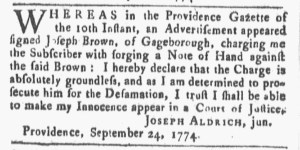
Providence Gazette (September 24, 1774).

“I am determined to prosecute him for the Defamation.”

Defamation!  That was the defense Joseph Aldrich, Jr., made against allegations that appeared in the September 10, 1774, edition of the Providence Gazette.  The original accusation and Aldrich’s response both ran as advertisements.  It started with one that read, “I JOSEPH BROWN, of Gageborough, in the County of Berkshire, and Province of the Massachusetts-Bay, give this public Notice, that Joseph Aldrich, jun. of Gloucester, in the County of Providence, hath forged or counterfeited a Note of Hand against me the said Joseph Brown, for Ninety odd Pounds Lawful Money.”  The notice offered a warning: “All Persons are therefore cautioned against taking any Assignment of said Note, as I am determined to prosecute for the Forgery, instead of paying the Contents.”

Aldrich apparently did not become aware of what Brown charged right away since he did not respond in the next issue of Providence Gazette, but not much time passed before he either read Brown’s advertisement or someone told him about it. That spurred the aggrieved Aldrich into action.  He placed his own advertisement that cited the notice “charging me the Subscriber with forging a Note of Hand against the said Brown” and asserting that “the Charge is absolutely groundless.”  Just as Brown stated that he intended to take the matter to court, so did Aldrich.  “I am determined to prosecute him for the Defamation,” he declared, confident that “I shall be able to make my Innocence appear in a Court of Justice.”

Yet it was not a “Court of Justice” that mattered immediately; it was the court of public opinion that Aldrich sought to sway.  Brown had damaged his reputation, perhaps imperiling his ability to conduct business and support his family.  For Aldrich, the most important news in the September 10 edition of the Providence Gazette appeared among the advertisements, not among the articles and editorials that so animated readers as the imperial crisis intensified.  Paying to run a notice gave Brown access to the public prints to share his version of events involving the supposedly forged and counterfeit note.  In turn, taking out his own notice allowed Aldrich to defend himself against that calumny.  In both instances, advertisements doubled as local news.

September 14

What was advertised in a colonial American newspaper 250 years ago today?

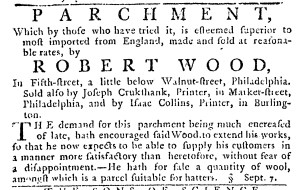
Pennsylvania Journal (September 14, 1774).

“PARCHMENT … esteemed superior to most imported from England.”

In September 1774, Robert Wood took to the pages of Dunlap’s Pennsylvania Packet and the Pennsylvania Journal to promote the parchment that he made in Philadelphia.  To entice prospective customers, he resorted to a variety of appeals.  Most significantly, he invoked customer satisfaction, seeking to convince readers not yet familiar with his product that he already gained a positive reputation among those who had used it.  For instance, he declared that “those who have tried it” considered his parchment “superior to most imported from England.”  He previously encouraged readers to “Buy American” in another advertisement more than two years earlier.  As the First Continental Congress convened in Philadelphia to consider how to respond to the Coercive Acts, including the possibility of another round of nonimportation pacts, Wood had a head start in presenting a “domestic manufacture,” an item produced in the colonies, as an alternative to imported parchment.  Customers did not have to sacrifice quality, plus they could acquire Wood’s parchment “at reasonable rates.”

To further bolster his reputation, Wood declared that the demand for his parchment had “much encreased of late.”  Those familiar with it wished to purchase it in greater quantities, at least according to Wood, another testimonial to the quality of the product.  Wood was prepared to meet the demand, having “extend[ed] his works, so that he now expects to be able to supply his customers in a manner more satisfactory than heretofore.”  Serving his customers included establishing a distribution network for their convenience in acquiring his parchment.  Joseph Crukshank, a printer in Philadelphia, sold Wood’s parchment, as did Isaac Collins, a printer in Burlington, New Jersey.  Taking all of this into consideration, Wood confidently declared that consumers who purchased and used his parchment could do so “without fear of a disappointment.”  He did not make an argument in favor of domestic manufactures as explicitly as he had in other advertisements, but perhaps he did not consider it necessary at a time that the imperial crisis had intensified so significantly.  Stating that his parchment had been “esteemed superior” to English imports sufficiently made the connection for readers, allowing Wood to focus on the demand for his product rather than convince prospective customers of their duty to privilege American products as a means of practicing politics.

September 5

What was advertised in a colonial American newspaper 250 years ago today?

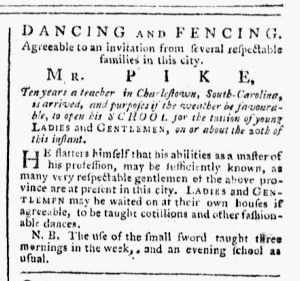
Dunlap’s Pennsylvania Packet (September 5, 1774).

“MR. PIKE, Ten years a teacher in Charlestown, South-Carolina, is arrived.”

When Mr. Pike arrived in Philadelphia near the end of the summer of 1774, he introduced himself to his new neighbors and prospective students with an advertisement in Dunlap’s Pennsylvania Packet.  He devised a headline, “DANCING AND FENCING,” to attract attention and provide a general overview of the services he offered.  As a newcomer with a reputation largely unknown in the bustling urban port, he gave his résumé, declaring that he had been “Ten years a teacher in Charlestown, South-Carolina.”  (The Adverts 250 Project has traced his career there throughout most of his time in that city.)  For quite some time, Pike had been planning to leave Charleston, announcing his intentions in the newspapers there and publishing a farewell message in early May.

According to the dancing master, some of the gentry in Philadelphia already knew how well he had served his students and the community in Charleston.  He chose Philadelphia as his new home, he explained, “Agreeable to an invitation from several respectable families in this city.”  Furthermore, Pike feigned modesty, as many advertisers often did, in declaring that he “flatters himself that his abilities as a master of his profession, may be sufficiently known, as many very respectable gentlemen of the above province are at present in this city.”  He likely referred to Christopher Gadsden, Thomas Lynch, Jr., Henry Middleton, Edward Rutledge, and John Rutledge, South Carolina’s delegates to the First Continental Congress.  They had commenced their meetings in Carpenters’ Hall on the very day that Pike’s advertisement first ran in Dunlap’s Pennsylvania Packet.  Even if Pike had not instructed any of those gentlemen or members of their families, they almost certainly were familiar with his reputation and the balls he hosted so his pupils could demonstrate their grace and proficiency in “cotillions and other fashionable dances.”  The dancing master hoped that casual conversations would include inquiries about him directed to delegates and others from Charleston who happened to be in Philadelphia at the time, resulting in recommendations to supplement and support his advertisement in the public prints.

July 26

What was advertised in a colonial American newspaper 250 years ago today?

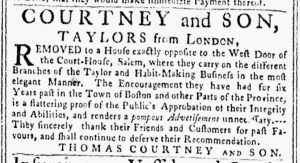
Essex Gazette (July 26, 1774).

“Public approbation … renders a pompous advertisement unnecessary.”

When Thomas Courtney and Son relocated from Boston to Salem, they ran in advertisement in the Essex Gazette to inform readers that they “carry on the different Branches of the Taylor and Habit-Making Business” at a shop near the courthouse.  They described themselves as “from LONDON,” hoping that their origins gave them some cachet among prospective clients, yet also reported that they had followed their trade “for six Years past in the Town of Boston.”

Their experience there served as even more of a recommendation and evidence that prospective customers should give them a chance.  The “Encouragement” they received for so many years, the tailors argued, “is a flattering proof of the Public’s Approbation of their Integrity and Abilities.”  No tailoring shop could have lasted for so long without the “Encouragement” of satisfied customers who gave them return business or offered positive reviews to friends.  Courtney and Son earned such a reputation that “renders a pompous Advertisement unnecessary.”  With that critique of the elaborate appeals made by some of their competitors and other purveyors of goods and services, the tailors expressed gratitude to former customers and declared that they “shall continue to deserve their Recommendation.”

It was not the first time that Courtney and Son deployed that marketing strategy.  Nine months earlier, they moved to a new location in Boston.  On that occasion, they ran an advertisement in the Massachusetts Spy.  Its copy was so similar, nearly identical, to their notice in the Essex Gazette that the tailors may have clipped it from the Massachusetts Spy and later from it.  The two advertisements featured variations in capitalization, not uncommon when advertisers ran notices in more than one newspaper.  In both, the phrase “pompous advertisement” appeared in italics.  While this does not reveal the effectiveness of the advertisement, it does suggest that Courtney and Son believed that it met with a positive reception that merited republishing it rather than devising other sorts of appeals to prospective customers in their new town.

June 25

What was advertised in a colonial American newspaper 250 years ago today?

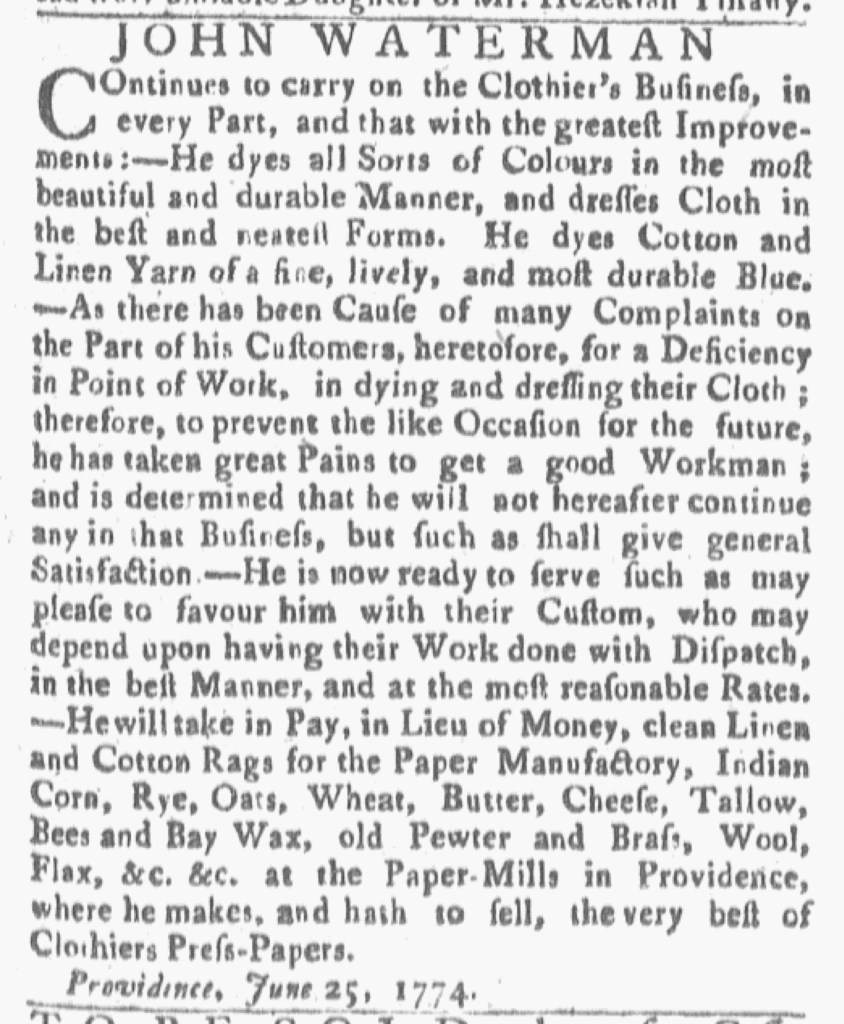
Providence Gazette (June 25, 1774).

“There has been Cause of many Complaints on the Part of his Customers.”

In the summer of 1774, John Waterman ran an advertisement in the Providence Gazette to inform the public that he “Continues to carry on the Clothier’s Business, in every Part, … with the greatest Improvements.”  Among the services he provided, he “dyes all Sorts of Colours in the most beautiful and durable Manner, and dresses Cloth in the best and neatest Forms.”  In particular, he “dyes Cotton and Linen Yarn of a fine, lively, and most durable Blue.”  Waterman did not go into detail about the “Improvements” he made to his business, but some of them likely involved hiring new employees.  At the start of the year, he had placed an advertisement seeking a clothier “well experienced in all Parts of the Business” to work at the “new and most compleat Works in the Colony.”

In this new advertisement, Waterman confessed that “there has been Cause of many Complaints on the Part of his Customers, heretofore, for a Deficiency … in dying and dressing their Cloth.”  Apparently, launching his new enterprise had not gone as smoothly as Waterman hoped.  To remedy the situation, he assured the public that he “has taken great Pains to get a good Workman.”  Furthermore, he asserted that he “is determined that he will not hereafter continue any in that Business, but such as shall give general Satisfaction.”  In other words, he would no longer employee workers who produced shoddy work, deferring to the judgment of his customers when it came to deciding what was unacceptable.  In an effort to redeem his reputation, Waterman acknowledged legitimate concerns voiced by previous customers and pledged that he had taken appropriate action to address them.

That being the case, the clothier proclaimed that he “is now ready to serve such as may please to favour him with their Custom.”  Waterman promised that they “may depend upon having their Work done with Dispatch, in the best Manner, and at the most reasonable Rates,” combining appeals to efficiency, quality, and price.  He asked former and prospective customers to forgive any misstarts that previously occurred and trust that his business now provided exemplary service.

April 21

What was advertised in a colonial American newspaper 250 years ago today?

Rivington’s New-York Gazetteer (April 21, 1774).

“I will requit their kindness by making a bonfire of [the tea].”

The Boston Tea Party serves as the most memorable destruction of tea during the imperial crisis that eventually resulted in thirteen colonies declaring independence from Great Britain, but greater numbers of colonizers participated in bonfires of tea.  Benjamin Booth suggested that he would hold one of those bonfires if anyone in England had the audacity to designate him as the consignee of tea shipped to New York.

He made that bold declaration in an advertisement in the April 21, 1774, edition of the Rivington’s New-York Gazetteer, an advertisement that he felt compelled to place after becoming the subject of vicious rumors.  “[S]ome evil minded persons, with a wicked design no doubt,” he declared, “have reported that I lately received TEA concealed in bales and other packages.”  Booth considered such accusations “trouble enough already” before learning that he had been “appointed … consignee of the tea said to be daily expected, on board the ship London,” an appointment made without his knowledge or permission.  Yet Booth wanted nothing to do with importing tea and all the trouble brewing with it.  That prompted him to make a declaration “once for all” that he “never was, not ever will be knowingly concerned in any contraband goods.”  Furthermore, if anyone had concerns about which commodities he imported and exported, he invited them to examine “the custom-house books, which are PUBLIC RECORDS” to confirm for themselves that Booth “religiously abid[ed] by this determination.”  If that still was not enough to satisfy those who suspected him of operating against the public interest, he stated that “if any person England should treat me so ill, as to consign me any more tea, while the present obstacles remain,” referring to the duties that Parliament imposed, “I will requit their kindness by making a bonfire of it.”  To emphasize the point, he proclaimed that he would do so “in the most public part of the city,” for all to witness, “and with my own hands set fire to the pile.”

Booth was not the first colonizer to resort to an advertisement to communicate his position on tea as the issue reached a boiling point.  Jeremiah Cronin previously did so in the Massachusetts Spy, having a justice of the peace attest to the veracity of his assertions.  Thomas Walley, Peter Boyer, and William Thompson did the same.  Even an associate of John Hancock ran such an advertisement on behalf of the prominent merchant in the New-York Journal even before the Boston Tea Party.  In each of these instances, advertisements provided updates and contributed to the discourse around tea.  Those notices doubled as news items, helping to keep the public informed about developments that did not appear elsewhere in colonial newspapers.

March 27

What was advertised in a colonial American newspaper 250 years ago this week?

New-York Journal (March 24, 1774).

“WATCHES … no Expence for cleaning them.”

John Simnet, a watchmaker, was a prolific advertiser in New York’s newspapers in the early 1770s.  In late March 1774, he placed a new advertisement in the New-York Journal, with a headline that proclaimed, “The Sixth Year of this Advertisement in this Country.”  Simnet referred to the fact that he migrated to the colonies from London, though he first set up shop in New Hampshire.  He advertised there for about a year and a half, frequently engaging in feuds with a competitor, before relocating to New York.  Perhaps prospective customers in and near Portsmouth had not appreciated his abrasive style, though the curmudgeon did not seem to learn his lesson if that was the case.  After settling in New York, he frequently picked fights with local watchmakers, their arguments witnessed by newspaper readers as they perused the advertisements.  Over the years, the colorful Simnet has become a favorite for the Adverts 250 Project, one of the colonial advertisers most often featured thanks to his lively notices.  In March 1774, Simnet had indeed commenced his “Sixth Year” of running advertisements in the colonies.

When he did so, he advanced a marketing strategy he frequently deployed.  Simnet offered an ancillary service for free to his clients who paid for other services: “those Gentlemen, &c. who have employed the Advertiser to Repair their WATCHES, ARE now at no Expence for cleaning them.”  In other words, he did not charge customers for routine cleaning of watches that he previously repaired.  That kept the watches in good running order, which further testified to Simnet’s skills and justified hiring him for other work.  The watchmaker declared that “it will be his endeavour to prove, Watches which are tolerably good, will perform 20 Years without Expence.”  Prospective clients could take their watches to his competitors who did not invest the same care in their work, causing them to have to pay for additional repairs over time, or they could entrust their watches to Simnet with confidence that he would assist them in averting further expense.  His clients could avoid paying for “mending Work” on their watches (and simultaneously safeguard Simnet’s reputation) if they presented their watches for cleaning “at least once a Year.”  Putting a little effort into such routine maintenance, offered for free, made the clients and the watchmakers partners in the enterprise, encouraging customer loyalty.

December 23

What was advertised in a colonial American newspaper 250 years ago today?

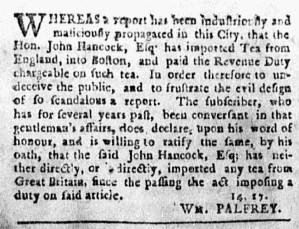
New-York Journal (December 23, 1773).

“John Hancock, Esq; has neither directly, or indirectly, imported any tea from Great Britain.”

As news of the Boston Tea Party reached New York and appeared in the December 23, 1773, edition of the New-York Journal, an advertisement in that newspaper took on new significance.  Starting on December 9 and continuing for four weeks, William Palfrey inserted an advertisement that addressed a “report [that] has been industriously and maliciously propagated in this City, that the Hon. John Hancock, Esq. has imported Tea from England, into Boston, and paid the Revenue Duty chargeable on such tea.”  Such rumors had the potential to tarnish the reputation of one of the merchants who had been most vocal in opposition to the provisions of the Tea Act, decrying Parliament’s attempts to meddle in affairs that he believed rightly belonged to colonial legislatures.

Palfrey, one Hancock’s clerks, took to the public prints to “undeceive the public, and to frustrate the evil design of so scandalous a report.”  He noted that he had “been conversant in that gentleman’s affairs” for “several years past” and, as a result, could vouch for Hancock.  In late 1773, many readers of the New-York Journal may not have been as familiar with the merchant as residents of Boston, though Hancock regularly appeared in articles reprinted from newspapers published in Massachusetts.  Five months before Palfrey’s advertisement appeared, the New-York Journal printed one of Governor Thomas Hutchinson’s letters from June 1768 that described the seizure of the Liberty, “a sloop belonging to Mr. Hancock, a wealthy merchant, of great influence over the populace,” for “a very notorious breach of the acts of trade.”  (The July 8, 1773, edition of the New-York Journal carried the entire letter and other private correspondence by the governor.)  Contrary to abiding by Parliament’s attempts to regulate colonial commerce and tax imported goods, Hancock had a history of smuggling tea and other items to avoid paying duties.  According to Palfrey, neither Hancock’s public position nor his private actions had changed.  The clerk declared “upon his word of honour” (and expressed his willingness to “ratify the dame, by his oath”) that Hancock had “neither directly, or indirectly, imported any tea from Great Britain, since the passing the act imposing a duty on said article” and most certainly had not paid import duties on tea.  As Jordan E. Taylor has recently demonstrated in Misinformation Nation: Foreign News and the Politics of Truth in Revolutionary America (2022), Patriots and Loyalists vied to establish narratives that fit their politics and their purposes, whether in newspapers, other printed materials, letters, or conversation.  That contest over the truth extended to advertisements, including Palfrey’s notice in the New-York Journal.

October 15

What was advertised in a colonial American newspaper 250 years ago today?

New-London Gazette (October 15, 1773).

“Begs the Favour of those who are acquainted with his Abilities and Veracity in Business, to recommend him to Others.”

John Champlin, a goldsmith and jeweler, ran a shop near the courthouse in New London in the early 1770s.  In the fall of 1773, he advertised his services and merchandise in an advertisement that ran for several weeks in the New-London Gazette.  To entice prospective customers, he declared that he “makes and sells all Kinds of Gold-Smith, Silver-Smith, and Jeweller’s Work as cheap as is sold in this Colony.”

Champlin shared his shop with Daniel Jennings, an artisan who pursued an adjacent trade.  Jennings advised readers that he “repairs and hath to sell, all Kinds of Utensils for repairing Clocks and Watches.”  Recognizing that he operated within a regional marketplace, he asserted that he set prices “as cheap as can be had in New-York or Boston.”  Prospective customers, he suggested, did not need to send their clocks and watches to artisans in either of those urban ports.

Jennings did not mention, perhaps intentionally, the prices for similar goods and services in Hartford, though Thomas Hilldrup, a competitor in that town, had advertised extensively in the New-London Gazette and the Connecticut Journal and New-Haven Post-Boy as well as in the Connecticut Courant, the newspaper published in Hartford.  Perhaps Jennings did not mention Hartford because he did not wish to call any more attention to Hilldrup, a relative newcomer whose aggressive advertising campaign targeted prospective customers well beyond the town where he settled.

To secure his share of the market, Jennings issued a plea for “those who are acquainted with his Abilities and Veracity in his Business, to recommend him to Others.”  He considered such recommendations as effective or even more effective than the lengthy advertisements that Hilldrup ran in several newspapers.  After all, even though Hilldrup was industrious with his advertising he had only begun to establish his reputation in Connecticut.  Enlisting satisfied customers could work to Jennings’s advantage if prospective customers trusted word-of-mouth endorsements over flashy newspaper notices.  Whether or not Jennings had Hilldrup in mind when he composed his advertisement, he understood that the power of testimonials from colonizers who had engaged his services in the past.

October 14

What was advertised in a colonial American newspaper 250 years ago today?

Massachusetts Spy (October 14, 1773).

“The encouragement they have had … renders a pompous advertisement unnecessary.”

Although they had operated a shop in Boston for quite some time, Thomas Courtney and Son continued to describe themselves as “TAYLORS, from LONDON,” when they advertised in the October 14, 1773, edition of the Massachusetts Spy.  Like many tailors, milliners, and other artisans, they believed that associating themselves with the cosmopolitan center of the empire conferred a certain amount of cachet in the eyes of prospective customers.  The tailors placed the notice to alert the public that they moved to a new location but continued to “carry on the different branches of the Taylor and Habit making business, in the truest and most elegant manner.”

Despite trumpeting their London origins in the headline of their advertisement, Courtney and Son asserted that they did not need to publish an extensive description of the quality of their work, the exceptional customer service they provided, or any of the other appeals that often appeared in notices placed by members of the garment trades.  Their work spoke for itself, as demonstrated by the longevity of their business and the clientele they cultivated during their time in Boston.  “The encouragement they have had for six years past in the town and province,” Courtney and Sons proclaimed, “is a flattering proof of the public approbation of their integrity and abilities.”

That being the case, the tailors considered “a pompous advertisement unnecessary.”  On occasion, eighteenth-century advertisers promoted their goods and services by critiquing the kinds of marketing that appeared in the public prints.  They suggested something unsavory in the manner that many of their competitors boasted of their abilities or told elaborate stories about their merchandise.  Courtney and Son cast suspicion on the extravagant prose presented in many advertisements, implying that those advertisers oversold what they could deliver to customers.  In the process, they attempted to enlist savvy consumers in expressing the same skepticism … and demonstrating that they could not be fooled with clever marketing by giving their business to Courtney and Son.  After all, the tailors insisted, their reputation spoke for itself.  Rather than publishing overzealous appeals to prospective customers, Courtney and Sons “sincerely thank[ed] their Friends and customers for past favours” and pledged to “continue to deserve their recommendation.”  They considered their reputation essential in marketing their business.