December 2

What was advertised in a revolutionary American newspaper 250 years ago today?
Pennsylvania Ledger (December 2, 1775).

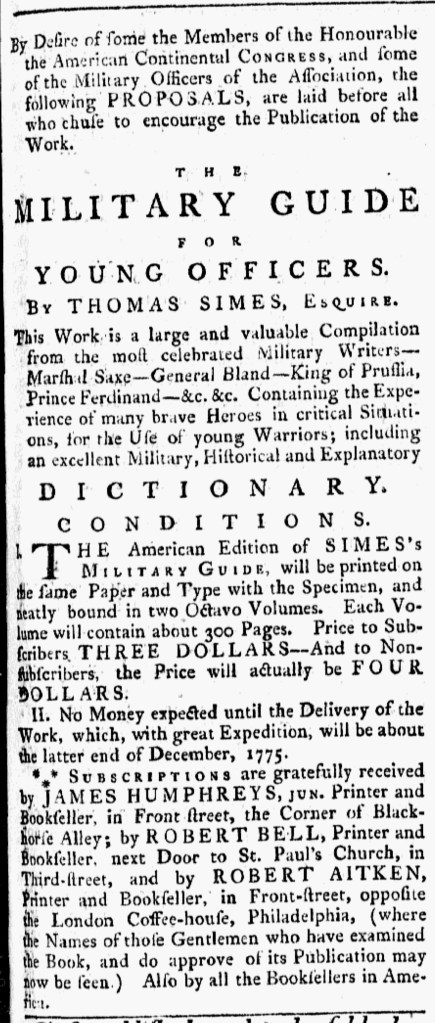
“THE American Edition of SIMES’s MILITARY GUIDE.”

In December 1775, James Humphreys, Jr., Robert Bell, and Robert Aitken collaborated in advertising and publishing The Military Guide for Young Officers by Thomas Simes, making yet another military manual available to the public following the momentous events at Lexington and Concord the previous April.  More recent developments, both military and political, convinced printers that a market existed for military manuals.  According to the introduction to “Books in the Field: Studying the Art of War in Revolutionary America,” an exhibition sponsored by the American Revolution Institute of the Society of the Cincinnati, “a flood of printing began to appear from the American presses.  Much of this activity was centered in Philadelphia, where more than thirty works on military subjects were published in the years 1775 and 1776 alone.”

Of the three of the printer-booksellers who partnered in publishing Simes’s Military Guide, Humphreys was the only one who published a newspaper.  He gave their advertisement a privileged place at the top of the first column on the first page of the December 2, 1775, edition of the Pennsylvania Ledger.  Rather than advertising a book already available for sale, the printer-booksellers distributed subscription proposals, doing so, they claimed, “By Desire of some the Members of the Honourable American Continental CONGRESS, and some of the Military Officers of the Association.”  Readers who wished to reserve copies of the work became subscribers by submitting their names to any of those three printer-booksellers, though they also indicated that “SUBSCRIPTIONS are gratefully received … by all the Booksellers in America.”  Printers, authors, and others in the book trades had more than one reason for circulating subscription proposals.  They hoped to incite greater demand while also learning if sufficient interest existed to make a project viable and, if so, how many copies to produce.

This subscription proposal featured an overview of the contents of the military guide: “a large and valuable Compilation from the most celebrated Miliary Writers … Containing the Experience of many brave Heroes in critical Situations, for the Use of young Warriors” as well as “an excellent Military, Historical and Explanatory DICTIONARY.”  This “American Edition … will be printed on the same Paper and Type with the Specimen, and neatly bound in two Octavo Volumes.”  Apparently, Humphreys, Bell, and Aitken had specimens or samples of the paper and type on display at their printing offices so prospective subscribers could examine them and assess the material quality of the work for themselves before committing to ordering copies.  Printers often circulated specimens along with subscription proposals.  The partners planned to print some surplus copies, expecting that demand would warrant doing so, but encouraged subscribers with a discount.  Those who reserved their copies paid three dollars, but for “Non-subscribers, the Price will actually be FOUR DOLLARS.”  Subscribers did not need to part with their money “until the Delivery of the Work,” anticipated for “the latter end of December, 1775.”  Humphreys, Bell, and Aitken did not take the military manual to press as quickly as they expected.  The imprint on the title page gives the date of publication as 1776.  The partners made one final pitch in the subscription proposals, announcing that “the Names of those Gentlemen who have examined the Book, and do approve of its Publication may now be seen” at Aitken’s printing office.  These marketing efforts apparently helped the partners attract enough subscribers to publish the proposed work.  Not all subscription proposals met with such success.  Current events likely played a role in the outcome when Humphreys, Bell, and Aitken proposed an American edition of The Miliary Guide for Young Officers.
November 18

What was advertised in a revolutionary American newspaper 250 years ago today?

Pennsylvania Evening Post (November 18, 1775).

“The Provedore to the Sentimentalists will exhibit food for the mind.”

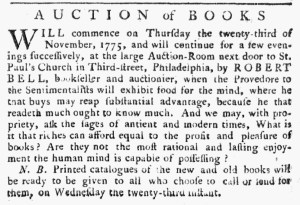
Readers of the November 18, 1775, edition of the Pennsylvania Evening Post encountered two advertisements promoting an “AUCTION of BOOKS,” one placed by Charles Mouse, “auctionier,” and the other by Robert Bell, “bookseller and auctionier.”  Mouse operated a “vendue store,” a combination of an auction house and a flea market, where he had a “large and choice collection of the most useful and entertaining [books].”  He invited those who had books to sell and “will[ing] to take their chance by auction” to deliver them to his vendue store on Second Street in Philadelphia.  The auctions would begin “precisely at six each evening” and “continue till the whole are sold.”  Mouse provided a straightforward account of this endeavor.

Robert Bell, on the other hand, crafted a more elaborate advertisement.  One of the most prominent American booksellers in the second half of the eighteenth century, Bell already established a reputation throughout the colonies by the time he advertised an auction “at the large Auction-Room next door to St. Paul’s Church in Third-street, Philadelphia,” scheduled for November 23.  He colorfully referred to himself in the third person as “the Provedore to the Sentimentalists” who would “exhibit food for the mind” to bidders and curious observers.  Those who made purchases, Bell declared, “may reap substantial advantage, because he that readeth much ought to know much.”  He further mused that “we may, with propriety, ask the sages of antient and modern times, What is it that riches can afford equal to the profit and pleasure of books?  Are they not the most rational and lasting enjoyment the human mind is capable of possessing?”  Mouse’s description of his “large and choice collection of the most useful and entertaining [books]” paled in comparison to the appeals that Bell made to readers.

Bell deployed another strategy to entice prospective bidders.  In a nota bene, he informed them that “[p]rinted catalogues of the new and old books will be ready to be given to all who choose to call or send for them.”  Those catalogues gave a preview of the sale and allowed Bell to disseminate information about the books up for bids more widely.  Those who visited his “Auction-Room” to collect a catalogue likely had an opportunity to browse the books, yet they could take their time going through the entries in the catalogue in the comfort of their own homes or offices or even at a coffeehouse with friends.  Those who sent for catalogues enjoyed the same benefit.  By distributing catalogs, Bell encouraged interest and prompted readers to imagine themselves bidding on the books they selected in advance.  He may have believed that prospective bidders were more likely to bid higher prices if they had spent time with the catalogue in advance and, as a result, became more committed to acquiring the books that interested them.

November 7

What was advertised in a revolutionary American newspaper 250 years ago today?

Pennsylvania Evening Post (November 7, 1775).

“MAPS … Montreal with all its fortifications.  The city of Quebec.”

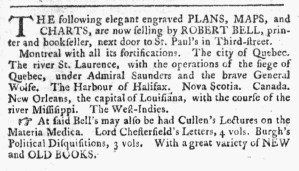
Robert Bell, one of the most prominent American booksellers of the eighteenth century, also sold “PLANS, MAPS, and CHARTS” at his shop in Philadelphia.  In an advertisement in the November 7, 1775, edition of the Pennsylvania Evening Post, he promoted maps depicting “Montreal with all its fortifications.  The city of Quebec.  The river St. Laurence, with the operations of the siege of Quebec, under Admiral Saunders and the brave General Wolfe.  The Harbour of Halifax.  Nova Scotia.  Canada.  New Orleans, the capital of Louisiana, with the course of the river Mississippi.  [And] The West-Indies.”

Bell moved from north to south, generally, in listing the places depicted on the maps and charts that he stocked and sold, though he seemingly made a deliberate decision to list Montreal and Quebec before Halifax.  Current events likely influenced that choice.  For its first major military initiative, the Continental Army launched an invasion of Quebec in hopes of capturing the province and convincing its inhabitants to join the American cause.  That territory had been claimed by the French Empire for centuries, but only recently became part of the British Empire as part of the settlement that brought the Seven Years War to an end in 1763.  The Americans suspected that French speakers in Quebec had little loyalty to the British.

Two expeditions conducted a dual-pronged attack on the province.  In late August, an expedition authorized by the Second Continental Congress and commanded by General Richard Montgomery departed Fort Ticonderoga in New York, headed to Montreal.  Colonel Benedict Arnold, disappointed at being passed over to lead that expedition, convinced General George Washington to send another expedition to Quebec City.  Under Arnold’s command, that expedition departed Newburyport, Massachusetts, and made a harrowing journey up the Kennebec River.

At the time that Bell ran his advertisement, Montgomery’s expedition approached Montreal and Arnold’s expedition approached Quebec, though it would take some time for news to arrive in Philadelphia for readers of the Pennsylvania Evening Post.  Yet those readers did know that those expeditions were underway and that Montgomery began a siege of the town and fort of Saint-Jean in September.  Bell believed that some prospective customers were already interested in maps and plans of Montral and Quebec City and that he could incite demand among others by informing them of the items available at his shop.  The maps he sold supplement the news that colonizers read in the public prints.

September 27

What was advertised in a revolutionary American newspaper 250 years ago today?

Pennsylvania Journal (September 27, 1775).

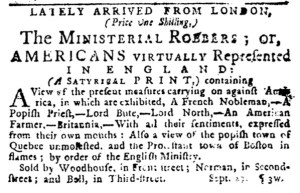
 “AMERICANS VIRTUALLY Represented IN ENGLAND: (A SATYRICAL PRINT.)”

As the imperial crisis intensified and hostilities commenced in Massachusetts in the spring of 1775, American colonizers had supporters in London.  In addition, some artists, engravers, and printers, whatever their own politics may have been, hoped to generate revenue by creating and publishing political cartoons that lambasted the British ministry for the abuses it perpetrated in the colonies.  Some of those prints found their way to eager audiences on the other side of the Atlantic.  In the fall of 1775, William Woodhouse, a bookseller and bookbinder, John Norman, an architect engraver building his reputation, and Robert Bell, the renowned bookseller and publisher, advertised a “SATYRICAL PRINT” that “LATELY ARRIVED FROM LONDON.”

The trio promoted “The MINISTERIAL ROBBERS; or, AMERICANS VIRTUALLY Represented IN ENGLAND,” echoing one of the complaints that colonizers made about being taxed by Parliament without having actual representatives serve in Parliament.  Based on the description of the print in the advertisement, Woodhouse, Norman, and Bell stocked “Virtual Representation, 1775” or a variation of it.  According to the newspaper notice, the image depicted a “View of the present measures carrying on against America, in which are exhibited, A French Nobleman,– A Popish Priest,– Lord Bute,– Lord North,– An American Farmer,– [and] Britannia.”  For each character, “their sentiments, expressed from their own mouths,” appeared as well.

Lord Bute, the former prime minister who inaugurated the plan of regulating American commerce to pay debts incurred during the Seven Years War, appeared at the center of the image, aiming a blunderbuss at two American farmers.  For his “sentiments,” he proclaimed, “Deliver your Property.”  Lord North, the current prime minister, stood next to Bute, pointing at one of the farmers and exclaiming, “I Give you that man’s money for my use.”  In turn, the first farmer stoutly declared, “I will not be Robbed.”  The second expressed solidarity: “I shall be wounded with you.”

The advertisement indicated that the print also showed a “view of the popish town of Quebec unmolested, and the Protestant town of Boston in flames; by order of the English ministry.”  Those parts of the political cartoon unfavorably compared the Quebec Act to the Coercive Acts (including the Boston Port Act and the Massachusetts Government Act), all passed by Parliament in 1774.  The Quebec Act angered colonizers because it extended certain rights to Catholics in territory gained from the French at the end of the Seven Years War.  In the print, the town of Quebec sat high atop its bluff, the flag of Great Britain prominently unfurled, in the upper left with the “French Nobleman” and “Popish Priest” in the foreground.  The legend labeled it as “The French Roman Catholick Town of Quebeck.”  The anti-Catholicism was palpable; the kneeling priest exclaiming “Te Deum” in Latin and holding a cross in one hand and a gallows in the other, playing on Protestant fears of the dangers they faced from their “Popish” enemies.

While Quebec appeared “unmolested” and even favored by Bute, North, and their allies in Parliament, the “English Protestant Town of Boston” appeared in the distance behind the American farmers in the upper right.  The town was indeed on fire, a reference to the battles fought in the vicinity as well as a metaphor for the way Parliament treated the town to punish residents for the Boston Tea Party.  As the advertisement indicated, Britannia, the personification of the empire, made an appearance in the print.  She wore a blindfold and exclaimed, “I am Blinded.”  She looked to be in motion, one foot at the edge of “The Pit Prepared for Others” and her next step surely causing her to fall into it.  There seemed to be no saving Britannia as Bute and North harassed the American farmers and their French and Catholic “Accomplices” watched with satisfaction.

The description of the “SATYRICAL PRINT” in the Pennsylvania Journal merely previewed the levels of meaning contained within the image, yet it likely piqued the curiosity of colonizers who supported the American cause and worried about their own liberties as events continued to unfold in Boston.  Such a powerful piece of propaganda supplemented newspaper reports, maps of the Battle of Bunker Hill, and political treatises circulating in the fall of 1775.

“Virtual Representation, 1775” (London, 1775). Courtesy Boston Public Library.

June 28

What was advertised in a revolutionary American newspaper 250 years ago today?

Pennsylvania Gazette (June 28, 1775).

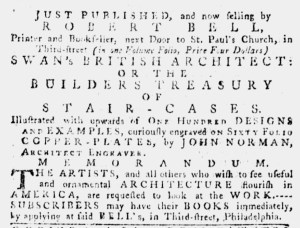
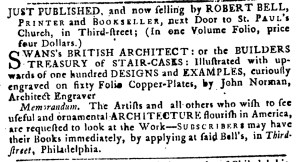
“JUST PUBLISHED … SWAN’s BRITISH ARCHITECT … Illustrated with upwards of ONE HUNDRED DESIGNS AND EXAMPLES.”

At the end of June 1775, Robert Bell, “Printer and Bookseller,” and John Norman, “Architect Engraver,” published an American edition of Abraham Swan’s British Architect: Or, the Builders Treasury of Staircases.  Norman had previously promoted the work with newspaper advertisements and proposals “with a specimen of the plates and letter press” that prospective subscribers could examine.  When the volume was ready for sale and for subscribers to collect the copies they reserved, Bell and Norman ran advertisements in the Pennsylvania Gazette and the Pennsylvania Journal on June 28.  The following day they placed the same advertisement in the Pennsylvania Evening Post.  On July 1, it appeared in the Pennsylvania Ledger and in Story and Humphreys’s Pennsylvania Mercury on July 7.  Of the newspapers printed in English in Philadelphia at the time, only Dunlap’s Pennsylvania Packet did not carry the advertisement.  Bell and Norman made a significant investment in marketing their edition of Swan’s British Architect.

Pennsylvania Journal (June 28, 1775).

To entice prospective customers, they specified that the book was “Illustrated with upwards of one hundred DESIGNS and EXAMPLES, curiously engraved on sixty Folio Copper-Plates” bound into the volume.  They also appended a “Memorandum” requesting that the “Artists and all others who wish to see useful and ornamental ARCHITECTURE flourish … look at the Work.”  If residents of the largest and most cosmopolitan urban port in the colonies wanted their city to maintain and enhance its level of sophistication, Bell and Norman implied, they needed to consider architecture and design important cultural pursuits.  To that end, they also marketed similar publications to those who purchased Swan’s British Architect.  Readers found to subscription proposals bound into the book.  The first one, advertising The Gentleman and Cabinet-Maker’s Assistant with drawings by John Folwell, a local cabinetmaker, and engravings by Norman (dated June 20), faced the title page.  The other, advertising an American edition of Swan’s Collection of Designs in Architecture, Containing New Plans and Elevations of Houses, for General Use (dated June 26), appeared immediately after the letterpress explanations of the engraved illustrations.  The dates on the subscription proposals suggest that they might have circulated separately, yet Bell and Norman made certain to place them before customers who already confirmed an interest in the subject matter.

January 4

What was advertised in a colonial American newspaper 250 years ago today?

Pennsylvania Gazette (January 4, 1775).

“Printed proposals, with conditions and a specimen of the work, are given gratis.”

Robert Bell, one of the most significant publishers and booksellers of the eighteenth century, frequently ran advertisements in newspapers and disseminated subscription proposals, book catalogues, and other marketing media.  At the beginning of 1775, he promoted an “AMERICAN EDITION of LECTURES on the MATERIA MEDICA, as delivered by WILLIAM CULLEN, M.D. Professor of Medicine in the University of Edinburgh.”  Yet Bell supposedly did not envision this project on his own.  He pursued it, he declared, “At the desire of several PHYSICIANS.”  Given the initial interest expressed by “Gentlemen of that Profession,” Bell inserted an advertisement in the Pennsylvania Gazette in hopes of generating additional demand and determining the viability of publishing an American edition of the influential text.

To that end, he invited physicians and others to obtain “Printed proposals, with conditions and a specimen of the work” at his shop.  Those proposals may have taken the form of a handbill or a short pamphlet, similar to the proposals for A Dissent from the Church of England and the proposals for The Catholic Christian Instructed that Bell disseminated in 1774.  The latter pamphlet devoted two pages to a prospectus that described the purpose of the work, a page to “Conditions” for subscribing (such as number of pages, cost, and payment schedule), and a page to a “Specimen of the type” that demonstrated the quality of an important material aspect of the book.  Based on the description of the printed proposals in Bell’s newspaper advertisement, the proposals for Cullen’s Materia Medica likely had a similar format.

Bell called on “gentlemen, who are desirous of encouraging improvements in the divine art of healing,” to submit their name “speedily” so the book “may be carried into execution immediately.”  He warned against dallying and assuming that surplus copies would be offered for sale after the work went to press: “it will be printed only for those who possess so much animation as to encourage the work by their subscription.”  In other words, anyone who desired copies of this American edition of Cullen’s Materia Medica had only a limited time to pre-order them.  When Bell published the book in 1775, the imprint stated, “Printed for the SUBSCRIBERS,” though perhaps the savvy bookseller produced a small quantity of additional copies to sell to those who neglected to subscribe.  Yet there was no guarantee that he would do so.  Bell attempted to leverage scarcity of the proposed work to encourage customers to reserve copies in advance.

January 21

What was advertised in a colonial American newspaper 250 years ago today?

Connecticut Gazette (January 21, 1774).

“Greatly contribute towards the elevation and enlivening of Literary Manufactures.”

Both before and after the American Revolution, Robert Bell, one of the most influential publishers and booksellers of the eighteenth century, set about creating an American market for books.  That did not always mean publications by American authors but rather editions printed in America for American readers.  More than any other printer, publisher, or bookseller, Bell devised advertising campaigns that spanned the colonies in the early 1770s, distributing subscription proposals and inserting notices in newspapers from New England to South Carolina.  His advertisement addressing “SAGES and STUDENTS of the LAW, in AMERICA,” for instance, appeared in newspapers in several colonies, promoting “American editions” of “celebrated works” undertaken by “ROBERT BELL, Printer and Bookseller, of Philadelphia.”

Readers of the Connecticut Gazette, published in New London, encountered Bell’s “SAGES and STUDENTS” advertisement in the January 21, 1774, edition.  By then, the advertisement had been in circulation in various newspapers for several months as Bell attempted to cultivate a community of readers and consumers not bounded by local geography but instead defined by their common interest in “the elevation and enlivening of Literary Manufactures in America.”  To that end, readers in New London and other places near and far had “had an opportunity of seeing at most of the booksellers shops in the capital towns and cities on the Continent, printed proposals with conditions and specimens” for “American editions” of several books, including “BACON’s new abridgment of the law,” “FERGUSON’s essay on the history of Civil Society,” and “A second American edition of Judge BLACKSTONE’s Commentaries on the laws of England.”  For some of those books, Bell asserted that they matched “page for page with the last London edition,” yet he charged only half the price for the American edition.  The savvy publisher wedded bargain prices and supporting American industry at a time when relations with Parliament deteriorated in the wake of the Tea Act.

To learn more about subscribing to these various American editions, prospective customers could view the conditions in the printed proposals as well as examine specimens (or samples) to confirm that the quality of the type, paper, and printing was not inferior to imported editions.  Bell’s marketing efforts thus incorporated several media, not newspaper advertisements alone.  Bell cultivated a network of printers and booksellers to disseminate his various forms of advertising in the public prints and in their printing offices and bookshops, enlisting distant associates in the project of encouraging a market for American editions of important and popular books.

November 19

What was advertised in a colonial American newspaper 250 years ago today?

New-Hampshire Gazette (November 19, 1773).

Printer, Bookseller, Provedore to the SENTIMENTALISTS, and Hand Servant to the FRIENDS of LITERATURE.”

Robert Bell became one of the most influential American booksellers and publishers during the second half of the eighteenth century in part due to his lively marketing efforts.  He developed a flamboyant personality that made him memorable and, simultaneously, made the books he advertised memorable.  Based in Philadelphia in 1773, he placed notices in newspapers from New England to South Carolina.  Two advertisements in the November 19 edition of the New-Hampshire Gazette demonstrate his unique style.

Both featured headlines that addressed prospective customers in a manner meant to flatter them and encourage them to identify with a peer group that they imagined buying the books that Bell presented to them.  For instance, one alerted the “SAGES, and STUDENTS of the LAW, in AMERICA” that they could find subscription proposals for several different law books, including “BACON’s new abridgment of the law” and a “second American edition of Judge BLACKSTONE’s Commentaries on the laws of England,” at their local “booksellers shops.”  The other advertisement promoted Bell’s first American edition of Blackstone’s Commentaries to the “Sons of Science in America.”  In it, Bell described himself as “Printer, Bookseller, Provedore to the SENTIMENTALISTS, and Hand Servant to the FRIENDS of LITERATURE.”  When he named those fanciful occupations, he also depicted his ideal customers.

Bell also insisted that readers envision a community that extended throughout the colonies.  His advertisements ran in newspapers published in many cities and towns, but they did not address the “SAGES, and STUDENTS of the LAW, in PORTSMOUTH” or the “Sons of Science in New Hampshire.”  Instead, Bell treated readers near and far as an integrated market.  In his “SAGES, and STUDENTS of the LAW” advertisement, he advised that prospective subscribers “now have an opportunity of seeing at most of the booksellers shops in the capital towns and cities on the Continent, printed proposals with conditions and specimens” for publishing several books.  In his “Sons of Science” advertisement, Bell credited the “auspicious influence” of those subscribers for making the first edition of Blackstone’s Commentariespossible.  In the other advertisement, he portrayed subscribers as “Encouragers” who “greatly contribute towards the elevation, and enlivening of Literary Manufactures in America.”

Printers, booksellers, and publishers often placed subscription proposals in newspapers in multiple colonies in their efforts to generate sufficient demand to make their projects viable.  Bell was especially proficient at disseminating advertisements and subscription papers throughout the colonies.  When he did so, he devised advertising copy that emphasized that customers were members of communities not bounded by geography.  Their interests rather than their location defined them as they joined other “Sons of Science,” “SAGES, and STUDENTS of the LAW,” and “FRIENDS of LITERATURE” in creating a common American experience.

September 8

What was advertised in a colonial American newspaper 250 years ago today?

Pennsylvania Journal (September 8, 1773).

“Given away GRATIS … ROBERT BELL’S SALE CATALOGUE of a COLLECTION of NEW AND OLD BOOKS.”

Robert Bell became one of the most prominent and influential American booksellers and publishers of the late eighteenth century, in part due to his flamboyant personality and flair for marketing.  He disseminated advertising in the same formats as other booksellers and publishers – newspaper notices, book catalogs, handbills, broadsides – yet introduced innovations intended to engage and entice consumers.

Such was the case in an advertisement that Bell placed in the September 8, 1773, edition of the Pennsylvania Journal.  If they included a headline at all (other than their names), most advertisers used a stark description of their wares, such as “BOOKS” or “PORT WINE.”  Bell, on the other hand, devised a headline that both described and addressed prospective customers: “The CURIOUS IN BOOKS.”  In other advertisements, his headlines addressed “THE SONS OF SCIENCE IN AMERICA” and “THE AMERICAN WORLD” and “those who possess a PUBLIC SPIRIT.”  In other advertisements, his headlines made dramatic pronouncements, such as “HISTORY” and “LITERATURE” and “XENOPHONTICK BANQUET.”  Bell often crafted a headline intended to distinguish his advertisements from others.

He invited “The CURIOUS” to note that “This Day is Published and given away GRATIS, to all who are pleased to call or send for it, ROBERT BELL’S SALE CATALOGUE Of a COLLECTION of NEW AND OLD BOOKS.”  Those who desired a copy had the option of visiting the shop or, for their convenience, Bell had catalogs delivered to those who requested them.  He emphasized the many choices available, declaring that the catalog listed “above FIFTEEN HUNDRED VOLUMES” and then further elaborating the selection included “a number of elegant and uncommon BOOKS, very scare and rarely to be met with.”  That was because many of them were secondhand books from “the LIBRARY of a Gentleman who lately left this Country.”  That meant customers had access to rare volumes not widely available in the colonial marketplace.  It also implied scarcity, just one copy of many of the books in the catalog, so prospective customers needed to purchase books that interested them quickly.

To encourage “The CURIOUS” to take action, Bell listed more than just the authors and titles of the books in his catalog.  Every entry included “the lowest Price fixed to each Book” so consumers could make their own assessments about whether they could afford the books and how much they valued them.  Presenting prospective customers with prices also helped them imagine completing transactions and adding books to their own libraries.  Although they had to pay for any purchases, Bell distributed the catalogs to “The CURIOUS” for free as a means of getting them started on those imaginative journeys that the bookseller hoped would culminate in sales.  Bell combined a lively advertisement and free catalog into an innovative marketing campaign that set him apart from most other booksellers of the period.

May 25

What was advertised in a colonial American newspaper 250 years ago today?

South-Carolina Gazette and Country Journal (May 25, 1773).

“Other curious Tracts worthy of high Rank in every Gentleman’s Literary Repository.”

Robert Bell, one of the most influential booksellers and publishers in eighteenth-century America, had a memorably flamboyant style.  He often packed his newspaper advertisements and book catalogs with florid prose to attract the attention of prospective customers.  Such was the case in an advertisement that ran in several newspapers in May 1773, commencing in the Pennsylvania Chronicle and the Pennsylvania Packet at the beginning of the month and appearing in the South-Carolina Gazette and Country Journal by the end of the month.

Bell often opened his advertisements with an extravagant salutation.  In this instance, he addressed “THE SONS OF SCIENCE IN AMERICA,” advising them that they played an important role in the publication of “a decent American Edition of the splendid Judge BLACKSTONE’S COMMENTARIES on the LAWS of ENGLAND, in four Volumes.”  For nearly two years, Bell had been promoting the project throughout the colonies, including in an advertisement in the Providence Gazette that addressed the “Gentlemen of Rhode-Island, and all those who are animated by the Wish of seeing NATIVE FABRICATIONS flourish in AMERICA.”  The bookseller now reported that under the “auspicious Influence” of his supporters, those “SONS OF SCIENCE” and gentlemen who supported an American publishing industry, the fourth and final volume of Blackstone’s Commentaries went to press and “is now ready to be delivered to the Subscribers.”  Those who placed advance orders could expect to receive their books soon.

The “humble Providore to the Sentimentalists, and Hand Servant to the Friends of Literature” took the opportunity to promote another book that he marketed as “a fifth Volume to range uniformly with said Commentaries.”  That “New Edition” included “much esteemed Letters of the very respectable dissenting Divine Dr. FURNEAUX to Judge BLACKSTONE, with PRIESTLEY’S Remarks on the Commentaries, and some other curious Tracts worthy of high Rank in every Gentleman’s Literary Repository.”  Yet Bell did not confine sales of that book solely to gentlemen who purchased all four volumes of Blackstone’s Commentaries and had extensive libraries.  He presented a single volume with so many entries as an “Accommodation [for] the un-opulent, among whom are many firm Friends to the Exploration and Investigation of every Truth, in which Humanity or Christianity are inserted, who ardently wish to see the Foundation of civil and religious Liberty fully displayed, asserted and established, above and beyond the Reach of all Human Tyranny.”  A prospective buyer’s ideals, not his status, justified acquiring so many essays “in one Volume.”  Bell encouraged readers to think of themselves as part of community devoted to the highest ideals, a community that extended from New England to South Carolina.