Slavery Advertisements Published October 12, 1767

The Slavery Adverts 250 Project chronicles the role of newspaper advertising in perpetuating slavery in the era of the American Revolution. The project seeks to reveal the ubiquity of slavery in eighteenth-century life from New England to Georgia by republishing advertisements about enslaved people – for sale as individuals or in groups, wanted to purchase or for hire for short periods, runaways who liberated themselves, and those who were subsequently captured and confined in jails and workhouses – in daily digests on this site as well as in real time via the @SlaveAdverts250 Twitter feed, utilizing twenty-first-century media to stand in for the print media of the eighteenth century.

The project aims to provide modern audiences with a sense of just how often colonizers encountered these advertisements in their daily lives. Enslaved men, women, and children appeared in print somewhere in the colonies almost every single day. Those advertisements served as a constant backdrop for social, cultural, economic, and political life in colonial and revolutionary America. Colonizers who did not purport to own enslaved people were still confronted with slavery as well as invited to maintain the system by purchasing enslaved men, women, and children or assisting in the capture of so-called “runaways” who sought to free themselves from bondage. The frequency of these newspaper advertisements suggests just how embedded slavery was in colonial and revolutionary American culture in everyday interactions beyond the printed page.

These advertisements also testify to the experiences of enslaved men, women, and children, though readers must consider that those experiences have been remediated through descriptions offered by enslavers rather than enslaved people themselves. Often unnamed in the advertisements, enslaved men, women, and children were not invisible or unimportant in early America.

These advertisements appeared in colonial American newspapers 250 years ago today.

Oct 12 - Boston Post-Boy Slavery 1
Boston Post-Boy (October 12, 1767).

**********

Oct 12 - Boston-Gazette Slavery 1
Boston-Gazette (October 12, 1767).

**********

Oct 12 - Boston-Gazette Slavery 2
Boston-Gazette (October 12, 1767).

**********

Oct 12 - Boston-Gazette Supplement Slavery 1
Supplement to the Boston-Gazette (October 12 1767).

**********

Oct 12 - Boston-Gazette Supplement Slavery 2
Supplement to the Boston-Gazette (October 12, 1767).

**********

Oct 12 - Boston-Gazette Supplement Slavery 3
Supplement to the Boston-Gazette (October 12, 1767).

**********

Oct 12 - Boston-Gazette Supplement Slavery 4
Boston-Gazette (October 12, 1767).

**********

Oct 12 - New-York Mercury Slavery 1
Newport Mercury (October 12, 1767).

**********

Oct 12 - Newport Mercury Slavery 1
New-York Mercury (October 12, 1767).

October 11

What was advertised in a colonial American newspaper 250 years ago this week?

Oct 11 - 10:8:1767 Pennsylvania Gazette.jpg
Pennsylvania Gazette (October 8, 1767).

“The public is referred to a pamphlet of cases, to be had of the vender.”

Nathaniel Tweedy, a druggist, operated a shop “At the Golden Eagle, in Market-street” in Philadelphia. To promote his “fresh assortment of drugs, chemical and galenical medicines, [and] patent and family medicines of all kinds,” he placed advertisements in the Pennsylvania Gazette and other local newspapers in the summer and fall of 1767. In several of them he marketed the “BAUME DE VIE” in particular, listing a broad range of symptoms that it alleviated. According to Tweedy, the Baume de Vie was a cure-all that benefited patients with just about any sort of malady, from “disorders of the stomach and bowels” to “female complaints.”

Tweedy did not consider a brief newspaper advertisement sufficient for relaying the virtues of this particular patent medicine. “For a more ample account of its uses,” he proclaimed, “the public is referred to a pamphlet of cases, to be had of the vender as above.” These “cases” presumably included testimonials from patients who previously benefited from the Baume de Vie. The druggist turned to the advertising pages in the public prints to incite initial interest, but hoped to stoke even more demand by making additional information available in a pamphlet. Rather than purchasing additional space in the newspaper at considerable expense, distributing pamphlets allowed him to target those consumers most interested in his product and most likely to acquire it once they learned more. Furthermore, potential customers might hold onto a pamphlet longer than they kept a newspaper. Tweedy’s marketing efforts resembled those of printers and booksellers who previewed their inventory in newspaper notices but also informed readers that they distributed catalogs at their shops.

Newspapers, catalogs, and pamphlets were all ephemeral, but sometimes catalogs and pamphlets more so than newspapers. As a result, the only evidence of some advertising materials that survives today comes from newspaper advertisements that mention other media, such as Tweedy inviting readers to visit his shop to receive a pamphlet about the Baume de Vie. This also raises questions about Tweedy’s advertising campaign. How many copies of the pamphlet did he distribute? Did he write the copy and have it printed locally? Or did the supplier of the medicines also provide pamphlets for dissemination in local markets? In giving modern readers a more complete glimpse of eighteenth-century advertising media, Tweedy’s newspaper advertisement raises a series of questions about related marketing practices.

October 10

What was advertised in a colonial American newspapwer 250 years ago today?

Oct 10 - 10:10:1767 Providence Gazette.jpg
Providence Gazette (October 10, 1767).

“The said Joseph is not, by me, any Ways authorized or impowered to settle any of my Affairs.”

According to his advertisement, a notice that originally appeared in the September 26, 1767, edition of the Providence Gazette must have surprised John Whipple. It stated that “ALL Persons having any Demands on the Estate of Captain JOHN WHIPPLE, of Providence; and likewise all those who are any ways indebted to said Estate” should contact the executor, Joseph Whipple. At a glance, it appeared to be a standard estate notice; it replicated the language deployed in similar notices published in newspapers throughout the colonies.

However, John Whipple, the deceased, saw the advertisement and then disputed his death and stated in no uncertain terms that he had not “authorized or impowered” Joseph Whipple “to settle any of my Affairs.” In the very next issue, published on October 3, he inserted his own advertisement, but it was not until the following week that the compositor positioned the two contradictory advertisements next to each other. Was that the result of those working in the “PRINTING-OFFICE, [at] the Sign of Shakespear’s Head” attempting to impose order within the pages of the Providence Gazette? Did they seek to assist readers in navigating the two advertisements? Did they place them one after another as a service to the aggrieved John Whipple? Or did the supposedly deceased captain examine the October 3 issue, notice that his advertisement was not even on the same page as the second insertion of Joseph Whipple’s original notice, and then make a subsequent visit to the printing office to demand that his advertisement would be most effective if it appeared immediately after the fraudulent one?

Colonists engaged in extensive and active reading of newspapers, yet the decision to place the advertisements by the feuding Whipples one after the other (which continued in subsequent issues) suggests that someone – printer, compositor, or advertiser – saw a need for greater organization than the system of unclassified advertisements usually provided. This also had the effect of telling a better and more complete story, potentially ramping up interest among readers interested in local gossip. On the rare occasions that runaway wives responded to advertisements placed by their abandoned husbands, printers or others sometimes positioned their notices next to each other, giving each their say while also accentuating the drama for readers.

Sarah Goddard and John Carter and their employees in the printing office did not further differentiate or organize other advertisements in the Providence Gazette according to their purposes, but in the case of the Whipples and an early modern case of identity theft they did print the related advertisements next to each other throughout most of their runs.

Slavery Advertisements Published October 10, 1767

The Slavery Adverts 250 Project chronicles the role of newspaper advertising in perpetuating slavery in the era of the American Revolution. The project seeks to reveal the ubiquity of slavery in eighteenth-century life from New England to Georgia by republishing advertisements about enslaved people – for sale as individuals or in groups, wanted to purchase or for hire for short periods, runaways who liberated themselves, and those who were subsequently captured and confined in jails and workhouses – in daily digests on this site as well as in real time via the @SlaveAdverts250 Twitter feed, utilizing twenty-first-century media to stand in for the print media of the eighteenth century.

The project aims to provide modern audiences with a sense of just how often colonizers encountered these advertisements in their daily lives. Enslaved men, women, and children appeared in print somewhere in the colonies almost every single day. Those advertisements served as a constant backdrop for social, cultural, economic, and political life in colonial and revolutionary America. Colonizers who did not purport to own enslaved people were still confronted with slavery as well as invited to maintain the system by purchasing enslaved men, women, and children or assisting in the capture of so-called “runaways” who sought to free themselves from bondage. The frequency of these newspaper advertisements suggests just how embedded slavery was in colonial and revolutionary American culture in everyday interactions beyond the printed page.

These advertisements also testify to the experiences of enslaved men, women, and children, though readers must consider that those experiences have been remediated through descriptions offered by enslavers rather than enslaved people themselves. Often unnamed in the advertisements, enslaved men, women, and children were not invisible or unimportant in early America.

These advertisements appeared in colonial American newspapers 250 years ago today.

Oct 10 - Providence Gazette Slavery 1
Providence Gazette (October 10, 1767).

**********

Oct 10 - Providence Gazette Slavery 2
Providence Gazette (October 10, 1767).

October 9

What was advertised in a colonial American newspaper 250 years ago today?

Oct 9 - 10:9:1767 South-Carolina and American General Gazette
South-Carolina and American General Gazette (October 9, 1767).

“ORDERS for BOOKS and STATIONARY WARES.”

Each issue of the South-Carolina and American General Gazette concluded with a colophon that ran across all three columns at the bottom of the final page. Most colonial newspapers included a colophon on the final page, though they differed in length and content. The colophon for the October 8, 1767, issue of the Massachusetts Gazette simply stated “Printed by Richard Draper.” On the same day, the New-York Gazette: Or, the Weekly Post-Boy included a longer colophon: “New-York: Printed by JAMES PARKER, at the NEW PRINTING-OFFICE in Beaver-Street where Subscriptions, and Advertisements, &c. for this Paper are taken in.” Parker used the colophon as an advertisement for his own newspaper. One of his local competitors did the same in a more elaborate colophon for the New-York Journal, but also promoted job printing and offered relatively rare information concerning prices for newspaper advertisements. “NEW-YORK: Printed by JOHN HOLT, at the Printing-Office near the Exchange, in Broad Street, where all Sorts of Printing Work is done in the neatest Manner, with Care and Expedition. Advertisements of a moderate Length are inserted for Five Shillings, four Weeks, and One Shilling for each Week after.”

Among this variation, Robert Wells devised one of the most elaborate colophons that graced the pages of colonial newspapers in the 1760s. Had the type been set in a single column and inserted among the advertisements in the South-Carolina and American General Gazette, the contents of the colophon would have been indistinguishable from the paid notices inserted by colonial entrepreneurs. It first indicated Wells’s location, “at the Old Printing-House, Bookseller’s and Stationer’s Shop on the BAY,” and then mentioned specific services related to the newspaper, “Subscriptions and ADVERTISEMENTS.” To entice potential advertisers to choose his newspaper rather than either of the other two printed in Charleston at the time, Wells underscored that the South-Carolina and American General Gazette “circulated through all the SOUTHERN COLONIES.” Advertisers could reach broad markets of prospective consumers.

Yet Wells did not conclude the colophon there. He inserted two more lines about his work as a bookseller and stationer, invoking common appeals to prices, quality, and choice found in advertisements placed by retailers of all sorts. He also hawked bookbinding services, making the “Old Printing-House, Bookseller’s and Stationer’s Shop on the BAY” a location for convenient one-stop shopping. Wells accepted “ORDERS for BOOKS and STATIONARY WARES,” but also promised that “a large Stock is constantly kept up.” He did “all Kinds PRINTING and BO[O]K-BINDING Work … executed with Accuracy and Expedition, at the most reasonable Rates.”

Robert Wells took advantage of the space allotted in his newspaper for a colophon by inserting what amounted to an advertisement for the goods and services he provided. Such was the privilege of operating the press that every issue of the South-Carolina and American General Gazette concluded with a message to colonial consumers.

Slavery Advertisements Published October 9, 1767

The Slavery Adverts 250 Project chronicles the role of newspaper advertising in perpetuating slavery in the era of the American Revolution. The project seeks to reveal the ubiquity of slavery in eighteenth-century life from New England to Georgia by republishing advertisements about enslaved people – for sale as individuals or in groups, wanted to purchase or for hire for short periods, runaways who liberated themselves, and those who were subsequently captured and confined in jails and workhouses – in daily digests on this site as well as in real time via the @SlaveAdverts250 Twitter feed, utilizing twenty-first-century media to stand in for the print media of the eighteenth century.

The project aims to provide modern audiences with a sense of just how often colonizers encountered these advertisements in their daily lives. Enslaved men, women, and children appeared in print somewhere in the colonies almost every single day. Those advertisements served as a constant backdrop for social, cultural, economic, and political life in colonial and revolutionary America. Colonizers who did not purport to own enslaved people were still confronted with slavery as well as invited to maintain the system by purchasing enslaved men, women, and children or assisting in the capture of so-called “runaways” who sought to free themselves from bondage. The frequency of these newspaper advertisements suggests just how embedded slavery was in colonial and revolutionary American culture in everyday interactions beyond the printed page.

These advertisements also testify to the experiences of enslaved men, women, and children, though readers must consider that those experiences have been remediated through descriptions offered by enslavers rather than enslaved people themselves. Often unnamed in the advertisements, enslaved men, women, and children were not invisible or unimportant in early America.

These advertisements appeared in colonial American newspapers 250 years ago today.

Oct 9 - New-London Gazette Slavery 1
New-London Gazette (October 9, 1767).

**********

Oct 9 - South-Carolina and American General Gazette Slavery 1
South-Carolina and American General Gazette (October 9, 1767).

**********

Oct 9 - South-Carolina and American General Gazette Slavery 2
South-Carolina and American General Gazette (October 9, 1767).

**********

Oct 9 - South-Carolina and American General Gazette Slavery 3
South-Carolina and American General Gazette (October 9, 1767).

**********

Oct 9 - South-Carolina and American General Gazette Slavery 4
South-Carolina and American General Gazette (October 9, 1767).

**********

Oct 9 - South-Carolina and American General Gazette Slavery 5
South-Carolina and American General Gazette (October 9, 1767).

October 8

What was advertised in a colonial American newspaper 250 years ago today?

Oct 8 - 10:8:1767 Massachusetts Gazette
Massachusetts Gazette (October 8, 1767).

“The Advertisements taking up so much Room, the several Articles intended for this Page are thrown into a SUPPLEMENT.”

This notice appeared at the bottom of the first column on the second page of the October 8, 1767, edition of the Massachusetts Gazette. Richard Draper followed a standard procedure among eighteenth-century printers: when faced with too much content to fit into the allotted space he opted to distribute a two-page supplement along with the regular issue. This happened fairly frequently, especially in major port cities. Higher concentrations of residents meant greater numbers of advertisements to squeeze into each week’s four-page issue, sometimes yielding supplements devoted almost exclusively to advertising. The October 8 supplement, however, consisted primarily of news items as a result of “The Advertisements taking up so much Room” in the regular issue.

Draper and the Massachusetts Gazette did not have a higher number of advertisers than usual. Instead, advertisements placed by two local shopkeepers occupied significant amounts of space. Shopkeeper Jolley Allen continued publication of his lengthy list-style advertisement that filled two entire columns on the final page. Not to be outdone, bookseller John Mein commenced a new full-page advertisement for his “grand Assortment of the most MODERN BOOKS In every Branch of Polite Literature Arts and Sciences,” the one that he intended to launch in the Boston-Gazette three days earlier. That advertisement combined a previous advertisement for “A NEW EDITION of Dilworth’s Spelling Book” (set apart almost as a distinct advertisement in the lower right corner) and descriptions of two other books followed by a list of other books and stationery supplies in stock. The compositor created four narrow columns instead of the usual three slightly wider ones, resulting in a new look for that particular page compared to the rest of the newspaper.

Overall, just two advertisements accounted for nearly half of the October 8 issue of the Massachusetts Gazette, making the supplement practically a necessity. This happened as a result of both the printer and the advertisers experimenting with the format for newspaper notices. Although colonial newspapers published full-page advertisements sporadically in the 1760s, having an issue dominated by only two advertisements would have been an extraordinary event for readers, one that would have garnered even more notice among potential customers for John Mein and Jolley Allen.

Slavery Advertisements Published October 8, 1767

The Slavery Adverts 250 Project chronicles the role of newspaper advertising in perpetuating slavery in the era of the American Revolution. The project seeks to reveal the ubiquity of slavery in eighteenth-century life from New England to Georgia by republishing advertisements about enslaved people – for sale as individuals or in groups, wanted to purchase or for hire for short periods, runaways who liberated themselves, and those who were subsequently captured and confined in jails and workhouses – in daily digests on this site as well as in real time via the @SlaveAdverts250 Twitter feed, utilizing twenty-first-century media to stand in for the print media of the eighteenth century.

The project aims to provide modern audiences with a sense of just how often colonizers encountered these advertisements in their daily lives. Enslaved men, women, and children appeared in print somewhere in the colonies almost every single day. Those advertisements served as a constant backdrop for social, cultural, economic, and political life in colonial and revolutionary America. Colonizers who did not purport to own enslaved people were still confronted with slavery as well as invited to maintain the system by purchasing enslaved men, women, and children or assisting in the capture of so-called “runaways” who sought to free themselves from bondage. The frequency of these newspaper advertisements suggests just how embedded slavery was in colonial and revolutionary American culture in everyday interactions beyond the printed page.

These advertisements also testify to the experiences of enslaved men, women, and children, though readers must consider that those experiences have been remediated through descriptions offered by enslavers rather than enslaved people themselves. Often unnamed in the advertisements, enslaved men, women, and children were not invisible or unimportant in early America.

These advertisements appeared in colonial American newspapers 250 years ago today.

Oct 8 - Massachusetts Gazette Slavery 1
Massachusetts Gazette (October 8, 1767).

**********

Oct 8 - Massachusetts Gazette Slavery 2
Massachusetts Gazette (October 8, 1767).

**********

Oct 8 - New-York Gazette Weekly Post-Boy Slavery 1
New-York Gazette: Or, the Weekly Post-Boy (October 8, 1767).

**********

Oct 8 - New-York Gazette Weekly Post-Boy Slavery 2
New-York Gazette: Or, the Weekly Post-Boy (October 8, 1767).

**********

Oct 8 - New-York Journal Slavery 1
New-York Journal (October 8, 1767).

**********

Oct 8 - New-York Journal Slavery 2
New-York Journal (October 8, 1767).

**********

Oct 8 - New-York Journal Slavery 3
New-York Journal (October 8, 1767).

**********

Oct 8 - New-York Journal Slavery 4
New-York Journal (October 8, 1767).

**********

Oct 8 - New-York Journal Supplement Slavery 1
Supplement to the New-York Journal (October 8, 1767).

**********

Oct 8 - New-York Journal Supplement Slavery 2
Supplement to the New-York Journal (October 8, 1767).

**********

Oct 8 - Pennsylvania Gazette Slavery 1
Pennsylvania Gazette (October 8, 1767).

**********

Oct 8 - Pennsylvania Gazette Slavery 2
Pennsylvania Gazette (October 8, 1767).

**********

Oct 8 - Pennsylvania Gazette Supplement Slavery 1
Supplement to the Pennsylvania Gazette (October 8, 1767).

**********

Oct 8 - Pennsylvania Gazette Supplement Slavery 2
Supplement to the Pennsylvania Gazette (October 8, 1767).

**********

Oct 8 - Pennsylvania Gazette Supplement Slavery 3
Supplement to the Pennsylvania Gazette (October 8, 1767).

**********

Oct 8 - Virginia Gazette Slavery 1
Virginia Gazette (October 8, 1767).

**********

Oct 8 - Virginia Gazette Slavery 2
Virginia Gazette (October 8, 1767).

**********

Oct 8 - Virginia Gazette Slavery 3
Virginia Gazette (October 8, 1767).

**********

Oct 8 - Virginia Gazette Slavery 4
Virginia Gazette (October 8, 1767).

**********

Oct 8 - Virginia Gazette Slavery 5
Virginia Gazette (October 8, 1767).

**********

Oct 8 - Virginia Gazette Slavery 6
Virginia Gazette (October 8, 1767).

**********

Oct 8 - Virginia Gazette Slavery 7
Virginia Gazette (October 8, 1767).

**********

Oct 8 - Virginia Gazette Slavery 8
Virginia Gazette (October 8, 1767).

**********

Oct 8 - Virginia Gazette Slavery 9
Virginia Gazette (October 8, 1767).

**********

Oct 8 - Virginia Gazette Slavery 11
Virginia Gazette (October 8, 1767).

**********

Oct 8 - Virginia Gazette Slavery 10
Virginia Gazette (October 8, 1767).

October 7

What was advertised in a colonial American newspaper 250 years ago today?

Oct 7 - 10:7:1767 Georgia Gazette
Georgia Gazette (October 7, 1767).

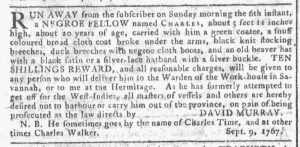
“He has formerly attempted to get off for the West-Indies.”

In the 1760s the pages of the Georgia Gazette often included far more advertising concerning slaves – slaves for sale, runaway slaves, captured slaves – than advertising for consumer goods and services. These advertisements told the story of enslaved men, women, and children reduced to commodities to be bought and sold, but they also told stories of resistance to that dehumanization and commodification. Runaway advertisements testified to the agency, perseverance, and ingenuity of slaves who seized their freedom when they saw opportunities.

Much to his chagrin, David Murray told the story of one of those bold slaves, “A NEGRO FELLOW named CHARLES.” Although he was a young man, only “about 20 years of age,” Charles had previously attempted to escape from his master. While some slaves ran away with the intention of returning after a brief respite from their bondage, Charles had other plans. He did not seek temporary freedom but instead wished to permanently alter his situation. To that end, he had previously attempted “to get off for the West-Indies.” Murray did not offer any speculation to explain why Charles chose that destination; perhaps the young slave hoped to be reunited with family there. Whatever his reasons, Charles aimed to put considerable distance between himself and Murray, prompting the slaveholder to instruct “all masters of vessels” not to “carry him out of the province.” He also cautioned others “not to harbour” Charles, threatening to prosecute anyone who aided the fugitive.

To evade detection and capture, Charles adopted aliases, sometimes calling himself “Charles Time” and other times “Charles Walker.” Such resourcefulness may have aided in his escape and his ability to remain free for at least the month that had passed since Murray first placed his advertisement.

Between changing his name and making new efforts to escape even after his first attempt had been discovered, Charles demonstrated that he would not be subdued easily. While other advertisements treated enslaved men, women, and children as commodities – such as the “SIX FIELD NEGROES” or the “Young NEGROE WENCH” advertised for sale in the same issue of the Georgia Gazette – Murray’s advertisement about a “NEGROE FELLOW named CHARLES” underscored that slaves did not passively acquiesce to lives of perpetual servitude. Although certainly not Murray’s intent, his advertisement about a runaway slave told a powerful story of one man’s determination to fight to free himself from the injustices he experienced in colonial Georgia.

Summary of Slavery Advertisements Published October 1-7, 1767

These tables indicate how many advertisements for slaves appeared in colonial American newspapers during the week of October 1-7, 1767.

Note:  These tables are as comprehensive as currently digitized sources permit, but they may not be an exhaustive account.  They includes all newspapers that have been digitized and made available via Accessible Archives, Colonial Williamsburg’s Digital Library, and Readex’s America’s Historical Newspapers.  There are several reasons some newspapers may not have been consulted:

  • Issues that are no longer extant;
  • Issues that are extant but have not yet been digitized (including the Pennsylvania Journal); and
  • Newspapers published in a language other than English (including the Wochentliche Philadelphische Staatsbote).

**********

Slavery Advertisements Published October 1-7, 1767:  By Date

Slavery Adverts Tables 1767 By Date Oct 1

**********

Slavery Advertisements Published October 1-7, 1767:  By Region

Slavery Adverts Tables 1767 By Region Oct 1