May 10

What was advertised in a colonial American newspaper 250 years ago today?

May 10 - 5:10:1769 Georgia Gazette
Georgia Gazette (May 10, 1769).

“STRAYED off the Common at Savannah, A SORREL HORSE.”

In the late 1760s the Georgia Gazette did not have a standard format for the placement of advertisements in relation to other content. The publication followed a general rule that filling the final page with paid notices, but any additional advertisements could appear just about anywhere else in a standard four-page issue.

Consider the May 10, 1769, edition of the Georgia Gazette. Each page had a different configuration of news and advertising. No paid notices ran on the front page, just the masthead, news, and editorials. As usual, advertisements filled the last page, except for the colophon running across the bottom. It also served as an advertisement of sorts, advising readers of the services available at the printing office: “Hand-Bills, Advertisements, &c. printed at the shortest Notice.” Advertising also filled most of the third page. The Georgia Gazette had two columns per page. An editorial extended for half of the first column on the third page; advertisements accounted for the remainder of the column as well as the entire second column. The second page featured a more even division, with news in the column on the left and advertisements in the column on the right, along with the shipping news positioned at the bottom of that column.

One additional advertisement stood out from the rest of the content on the second page. It ran in the margin across the bottom, spanning both columns. In it, James Read described a horse that had strayed “off the Common at Savannah” and pledged that anyone who found the horse and returned it to him “shall be handsomely rewarded.” The format and placement indicates that Read likely submitted his advertisement to the printing office too late to have it integrated among the other content. Anxious for the return of his horse, Read may have negotiated for it to appear in the issue in any way possible; alternately, the printer may have devised this means of inserting it as a service. Either way, Read’s advertisement further demonstrates the Georgia Gazette’s flexible approach to positioning advertisements within its pages. At a glance, eighteenth-century newspapers may appear to be dense amalgamations of text, but the variations in the placement of news, advertising, and other content suggests that printers and compositors exercised creativity as they significantly altered the layout from issue to issue.

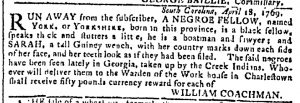
Slavery Advertisements Published May 10, 1769

The Slavery Adverts 250 Project chronicles the role of newspaper advertising in perpetuating slavery in the era of the American Revolution. The project seeks to reveal the ubiquity of slavery in eighteenth-century life from New England to Georgia by republishing advertisements for slaves – for sale, wanted to purchase, runaways, captured fugitives – in daily digests on this site as well as in real time via the @SlaveAdverts250 Twitter feed, utilizing twenty-first-century media to stand in for the print media of the eighteenth century.

The project aims to provide modern audiences with a sense of just how often colonists encountered these advertisements in their daily lives. Enslaved men, women, and children appeared in print somewhere in the colonies almost every single day. Those advertisements served as a constant backdrop for social, cultural, economic, and political life in colonial and revolutionary America. Colonists who did not own slaves were still confronted with slavery as well as invited to maintain the system by purchasing slaves or assisting in the capture of runaways. The frequency of these newspaper advertisements suggests just how embedded slavery was in colonial and revolutionary American culture in everyday interactions beyond the printed page.

These advertisements also testify to the experiences of enslaved men, women, and children, though readers must consider that those experiences have been remediated through descriptions offered by slaveholders rather than the slaves themselves. Often unnamed in the advertisements, enslaved men, women, and children were not invisible or unimportant in early America.

These advertisements appeared in colonial American newspapers 250 years ago today.

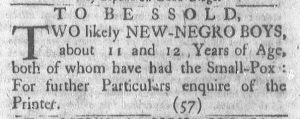
May 10 - Georgia Gazette Slavery 1
Georgia Gazette (May 10, 1769).

**********

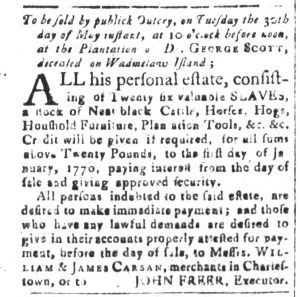
May 10 - Georgia Gazette Slavery 2
Georgia Gazette (May 10, 1769).

**********

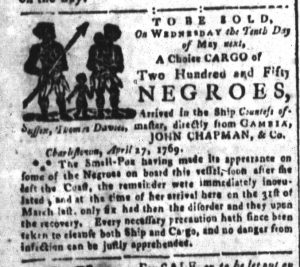
May 10 - Georgia Gazette Slavery 3
Georgia Gazette (May 10, 1769).

**********

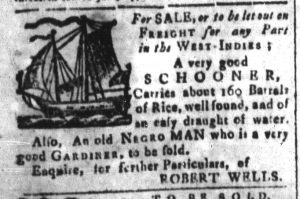
May 10 - Georgia Gazette Slavery 4
Georgia Gazette (May 10, 1769).

**********

May 10 - Georgia Gazette Slavery 5
Georgia Gazette (May 10, 1769).

May 9

What was advertised in a colonial American newspaper 250 years ago today?

May 9 - 5:9:1769 Essex Gazette
Essex Gazette (May 9, 1769).

Just Imported in the Schooner Liberty.”

John Prince placed a short advertisement for “A Quantity of the best JAMAICA SUGARS, by the Hogshead, Barrel, or less Quantity” in the May 9, 1769, edition of the Essex Gazette. He announced that had “just Imported” his wares “in the Schooner Liberty.” The shipping news, printed in the same column, verified that aspect of Prince’s notice. The “Schooner Liberty, J. Lambert,” captain, arriving from Jamaica was the first entry among the vessels on the list of “INWARD ENTRIES” from the “CUSTOM-HOUSE, Port of SALEM & MARBLEHEAD, May 8.” Nine other ships had also entered the port in the past week. For its first appearance in the Essex Gazette, Prince’s advertisement benefited from its proximity to the shipping news.

“Just imported” was a stock phrase deployed frequently in eighteenth-century advertisements. In many instances, readers may have overlooked claims by merchants, shopkeepers, and others claiming to have “just imported” their merchandise, realizing that they used the phrase rather flexibly to suit their own purposes. In addition, some advertisements ran for weeks or even months without any revisions to the copy; the phrase “just imported” took on a different inflection each time it was repeated in a subsequent insertion of an advertisement originally submitted to the printing office some time earlier.

In the case of Prince’s advertisement, “just Imported” aligned quite literally with the shipping news from May 8 published in the May 9 edition of the Essex Gazette. In the next two issues, May 16 and 23, the phrase operated independently of any other content in the newspaper. Some readers may have been aware that the Liberty was still in port, drawing on their own knowledge to assess what counted as “just Imported.” When Prince’s advertisement ran once again in the May 30 edition, the shipping news listed only one vessel “OUTWARD BOUND,” the “Schooner Liberty” making ready to depart for the West Indies. Prince’s advertisement did not appear in the Essex Gazette again after that. He discontinued it while the phrase “just Imported” applied to a vessel still in port, but that certainly was not the case for every advertiser who adopted such language. Given the elasticity of the meaning of “just imported,” shrewd readers likely discounted the phrase unless they had other means of assessing its accuracy, such as the shipping news.

May 8

What was advertised in a colonial American newspaper 250 years ago today?

May 8 - 5:8:1769 New-York Gazette Weekly Mercury
Supplement to the New-York Gazette and Weekly Mercury (May 8, 1769).

“The Medley of Goods.”

Readers of the New-York Gazette and Weekly Mercury encountered a memorable image in the supplement that accompanied the May 8, 1769, edition. Gerardus Duyckinck ran a shop he named “The Medley of Goods” at a location marked by “the Sign of the Looking Glass & Druggist Pot.” The intricate woodcut in his advertisement depicted that sign, with a druggist’s pot perched atop an ornate cartouche and a looking glass suspended below it. The copy for the advertisement filled the remainder of the cartouche, with the entire woodcut extending more than half a column. It dominated any page on which it appeared.

Indeed, Duyckinck’s elaborate woodcut may have been the most memorable image printed in that newspaper in the 1760s. Like other eighteenth-century newspapers, the New-York Gazette and Weekly Mercury included few visual images. Sometimes advertisements featured small icons of houses, horses, ship, or runaway servants or slaves. These crude woodcuts were small, belonged to the printer, and could be used interchangeably in advertisements with matching content. Elsewhere in the May 8 issue and its supplement, five advertisements included woodcuts of horses, three had ships, and one had a house. All of them were a fraction of the size of Duyckinck’s woodcut. A woodcut of a colonist and an Indian flanking a shield and crown was the only other image in that issue. Although it was considerably larger than the other woodcuts, it likely did not garner much additional notice since it was so familiar, appearing week after week. Duyckinck’s woodcut, on the other hand, ran often enough that readers would have recognized it, but not so often that they overlooked it because they expected to spot it among the many advertisements in the New-York Gazette and Weekly Mercury. Even other advertisers who commissioned their own woodcuts to distinguish their notices from others did not invest in images that were as large or as lavish. Duyckinck’s woodcut stood alone among those in the New-York Gazette and Weekly Mercury. Nothing in advertisements published in other newspapers in the 1760s compared to it either.

Woodcuts were prone to damage over time, coming under intense pressure with each impression made on hand-operated presses. That likely contributed to Duyckinck’s decision to deploy this expensive woodcut only occasionally, doing so frequently enough to make it familiar but not so often that it deteriorated an disappeared from the public prints too quickly. It first appeared in the October 29, 1767, edition of the New-York Journal and continued for several weeks. In the spring of 1768 Duyckinck inserted it in the New-York Gazette and Weekly Mercury for a longer period before putting the image on hiatus again for many months. It did not disappear from view for so long, however, that it would have been unfamiliar when it returned in May 1769. Gerardus deployed a variety of marketing strategies in the copy of his advertisement, but the extraordinary visual element increased the likelihood that prospective customers would pay attention to the copy contained within the impressive cartouche.

Slavery Advertisements Published May 8, 1769

The Slavery Adverts 250 Project chronicles the role of newspaper advertising in perpetuating slavery in the era of the American Revolution. The project seeks to reveal the ubiquity of slavery in eighteenth-century life from New England to Georgia by republishing advertisements for slaves – for sale, wanted to purchase, runaways, captured fugitives – in daily digests on this site as well as in real time via the @SlaveAdverts250 Twitter feed, utilizing twenty-first-century media to stand in for the print media of the eighteenth century.

The project aims to provide modern audiences with a sense of just how often colonists encountered these advertisements in their daily lives. Enslaved men, women, and children appeared in print somewhere in the colonies almost every single day. Those advertisements served as a constant backdrop for social, cultural, economic, and political life in colonial and revolutionary America. Colonists who did not own slaves were still confronted with slavery as well as invited to maintain the system by purchasing slaves or assisting in the capture of runaways. The frequency of these newspaper advertisements suggests just how embedded slavery was in colonial and revolutionary American culture in everyday interactions beyond the printed page.

These advertisements also testify to the experiences of enslaved men, women, and children, though readers must consider that those experiences have been remediated through descriptions offered by slaveholders rather than the slaves themselves. Often unnamed in the advertisements, enslaved men, women, and children were not invisible or unimportant in early America.

These advertisements appeared in colonial American newspapers 250 years ago today.

May 8 - Boston Evening-Post Slavery 1
Boston Evening Post (May 8, 1769).

**********

May 8 - Boston Evening-Post Slavery 2
Boston Evening Post (May 8, 1769).

**********

May 8 - Boston-Gazette Slavery 1
Boston-Gazette (May 8, 1769).

**********

May 8 - Boston-Gazette Slavery 2
Boston-Gazette (May 8, 1769).

**********

May 8 - Massachusetts Gazette Green and Russell Slavery 1
Massachusetts Gazette [Green and Russell] (May 8, 1769).

**********

May 8 - Massachusetts Gazette Green and Russell Slavery 2
Massachusetts Gazette [Green and Russell] (May 8, 1769).

**********

May 8 - New-York Gazette Weekly Mercury Slavery 1
New-York Gazette and Weekly Mercury (May 8, 1769).

**********

May 8 - New-York Gazette Weekly Mercury Slavery 2
New-York Gazette and Weekly Mercury (May 8, 1769).

**********

May 8 - New-York Gazette Weekly Mercury Slavery 3
New-York Gazette and Weekly Mercury (May 8, 1769).

**********

May 8 - New-York Gazette Weekly Mercury Slavery 4
New-York Gazette and Weekly Mercury (May 8, 1769).

**********

May 8 - New-York Gazette Weekly Mercury Slavery 5
New-York Gazette and Weekly Mercury (May 8, 1769).

**********

May 8 - New-York Gazette Weekly Mercury Supplement Slavery 1
Supplement to the New-York Gazette and Weekly Mercury (May 8, 1769).

**********

May 8 - New-York Gazette Weekly Post-Boy Slavery 1
New-York Gazette: Or, the Weekly Post-Boy (May 8, 1769).

**********

May 8 - Newport Mercury Slavery 1
Newport Mercury (May 8, 1769).

**********

May 8 - Newport Mercury Slavery 2
Newport Mercury (May 8, 1769).

**********

May 8 - Newport Mercury Slavery 3
Newport Mercury (May 8, 1769).

**********

May 8 - South-Carolina and American General Gazette Slavery 1
South-Carolina and American General Gazette (May 8, 1769).

**********

May 8 - South-Carolina and American General Gazette Slavery 2
South-Carolina and American General Gazette (May 8, 1769).

**********

May 8 - South-Carolina and American General Gazette Slavery 3
South-Carolina and American General Gazette (May 8, 1769).

**********

May 8 - South-Carolina and American General Gazette Slavery 4
South-Carolina and American General Gazette (May 8, 1769).

**********

May 8 - South-Carolina and American General Gazette Slavery 5
South-Carolina and American General Gazette (May 8, 1769).

**********

May 8 - South-Carolina and American General Gazette Slavery 6
South-Carolina and American General Gazette (May 8, 1769).

**********

May 8 - South-Carolina and American General Gazette Slavery 7
South-Carolina and American General Gazette (May 8, 1769).

**********

May 8 - South-Carolina and American General Gazette Slavery 8
South-Carolina and American General Gazette (May 8, 1769).

**********

May 8 - South-Carolina and American General Gazette Slavery 9
South-Carolina and American General Gazette (May 8, 1769).

**********

May 8 - South-Carolina and American General Gazette Slavery 10
South-Carolina and American General Gazette (May 8, 1769).

**********

May 8 - South-Carolina and American General Gazette Slavery 11
South-Carolina and American General Gazette (May 8, 1769).

May 7

What was advertised in a colonial American newspaper 250 years ago this week?

May 7 - 5:4:1769 Virginia Gazette Purdie and Dixon
Virginia Gazette [Purdie and Dixon] (May 4, 1769).
“Best HARD SOAP at 6d. by the box.”

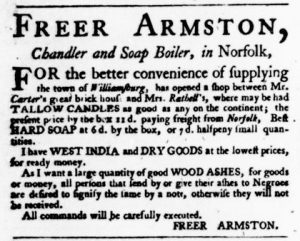
In the spring of 1769, Freer Armston,, a chandler and soap boiler in Norfolk, Virginia, attempted to enlarge his market by expanding his operations into Williamsburg. He placed an advertisement in Purdie and Dixon’s Virginia Gazette to inform prospective customers that he had opened a new shop where he sold “TALLOW CANDLES as good as any on the continent.” With such a bold statement, Armston favorably compared his wares to any others that consumers could acquire.

To make his candles even more attractive, he took the unusual step of naming their price in his advertisement: “by the box 11 d. paying freight from Norfolk.” Advertisers rarely listed prices in eighteenth-century newspapers, though many often made general appeals to low or reasonable prices. Readers likely knew what to expect to pay for a box of tallow candles from other chandlers and shopkeepers in Williamsburg. As a newcomer, Armston attempted to stimulate interest in his merchandise by allowing prospective customers to assess on their own whether he offered a deal. He did the same for his “Best HARD SOAP at 6d. by the box, or 7d. halfpenny [sic] small quantities.” He was not as verbose about the quality of his soap, simply describing it as “Best,” and instead emphasized the price and potential savings by buying in bulk. Customers saved twenty percent when they purchased an entire box of hard soap.

Armston also sought to establish that he was a careful and responsible entrepreneur. In addition to selling candles and soap, he asked readers to provide him with supplies, especially “good WOOD ASHES” used in the production of soap, for which he offered “goods or money.” He was vigilant when it came to accepting ashes from Black men and women, assuming that some did not acquire them by legitimate means. Armston instructed that “all persons that send by or give their ashes to Negroes” must also send a note specifying that they had done so or else he would not accept them. The chandler and soap boiler was not about to give “goods or money” to Black people who could not demonstrate how they came into possession of ashes they delivered to his shop. In addition to offering quality goods at low prices, Armston depicted himself as a good neighbor who attended to maintaining proper order in his business dealings.

May 6

What was advertised in a colonial American newspaper 250 years ago today?

May 6 - 5:6:1769 Providence Gazette
Providence Gazette (May 6, 1769).

“Will engage to make Wigs as can be had there.”

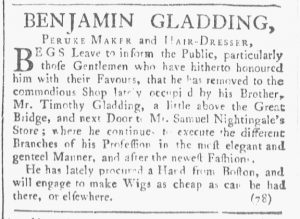
When Benjamin Gladding, a “PERUKE MAKER and HAIR-DRESSER,” advertised in the May 6, 1769, edition of the Providence Gazette, he made multiple appeals to prospective clients. He emphasized both his knowledge of the latest styles and the amenities available at his shop, but he also made a more common appeal to price.

Gladding addressed the public, but he made certain to acknowledge “those Gentlemen who have hitherto honoured him with their Favours.” Doing so made it clear to other prospective customers that Gladding already had an established clientele who placed their confidence in his attention to their hair and wigs. Gladding offered a service that should not be entrusted to some mere novice. To that end, he proclaimed that he “continues to execute the different Branches of his Profession in the most elegant and genteel Manner, and after the newest Fashion.” Experience, skill, and knowledge all played a role as Gladding positioned himself as the wigmaker and hairdresser of choice in Providence. He gained experience and developed skills over time, but maintain knowledge of “the newest Fashion” required constant and immediate attention. Gladding could not rely on what he had learned in years past because his clients certainly would not be satisfied with outdated styles.

Serving them “in the most elegant and genteel Manner” also depended on the setting. In this case, Gladding stressed that he had moved “to the commodious Shop” until recently occupied by his brother. He provided comfortable and spacious accommodation for his patrons. Having sufficient space was even more important because Gladding had a new employee. He reported that he had “procured a Hand from Boston” who assisted in serving his clients. Together, they made wigs “as cheap as can be had” in Boston or elsewhere. Striking a fashionable appearance did not need to be prohibitively expensive, not even in places beyond the largest port cities. Gladding may not have had as much local competition as his counterparts in Boston, but that did not mean that he raised the rates.

To attract existing and new clients to his shop, Gladding resorted to a variety of appeals in his short advertisement. In addition to highlighting his own skill and experience as a wigmaker and hairdresser, he balanced fashion and price as a means of making his services simultaneously exclusive and attainable.

May 5

What was advertised in a colonial American newspaper 250 years ago today?

May 5 - 5:5:1769 New-Hampshire Gazette
New-Hampshire Gazette (May 5, 1769).

“Mends and cleans Watches, in as neat a Manner as any Watch-Finisher in Town or Country.”

John Simnet, “Watch-Finisher, and Manufacturer of London and Dublin,” continued his advertising campaign in the May 5, 1769, edition of the New-Hampshire Gazette. In this installment, he took a more aggressive approach than in previous notices, especially concerning his own expertise and the quality of the service he provided compared to other watchmakers in the area.  Having previously reduced the length of his advertisements, he found himself in a position of needing to elaborate in greater detail. He boldly proclaimed, “The entire Satisfaction I have given the Public, employed on numbers of imperfect Watches, after ev’ry other Workman hath either practised on them in vain, or given them up, gives me occasion to intimate to Gentlemen, that ‘tis much easier to me to repair a Watch before, than after another has with mistaken Judgment, operated on it.” Although he did not give any names, the watchmaker clearly denigrated his competition. He informed prospective customers that they might as well save themselves the time and expense and bring their watches to him first because the lack of skill of other watchmakers would ultimately cause them to seek out Simnet’s services anyway. He promoted his services in other ways as well, offering to do “Small repairs gratis” and pledging not to charge anything if he did not “do [his] Work perfect.”

Nathaniel Sheaff Griffith was not impressed with this newcomer and the competition he presented. In his own advertisement, conveniently placed next to Simnet’s notice, Griffith stated that he “mends and cleans Watches, in as neat a Manner as any Watch-Finisher in Town and Country, & much cheaper.” He invoked the term Simnet applied to himself, “Watch-Finish,” leaving little doubt that he referred to that rival in particular, even as he made a general appeal about his own skills, the quality of his work, and his low price. Griffith also played on his reputation as someone who had lived and worked in New Hampshire for quite some time. “As the said Griffith is well known in this Province,” he declared, “Gentlemen may with Safety leave their Watches in his Custody and depend upon their being seasonably returned.” Prospective customers could hardly have missed the implication that because Simnet was unfamiliar in the community that he could not be trusted. Griffith further demeaned Simnet, who had previously advertised that he planned to remain in New Hampshire for only a year, as an outsider by proposing that “Every Itenerant, or Walking-Watch-Manufacturer, especially those who carries their whole Stock upon ther Backs, should bring Credentials of their Honesty, before they can be trusted with Brass, much more Silver and Gold Watches.” According to Griffith, it was clear that Simnet was not to be trusted. He went so far as to imply that his competitor trafficked in stolen goods. “Some Men may have Watches to sell,” Griffith cautioned, “which for want of being known, may admit of a Doubt, whether they came honestly by them.” For his part, Simnet attempted to alleviate fears that he would steal watched from customers; the final line of his advertisement advised, “Security deposited in Hand, if requir’d.” In other words, he provided some sort of collateral when customers entrusted him with their watches. Just in case it was not abundantly clear that he targeted Simnet, Griffith invoked another aspect of the newcomer’s advertisements. He warned that by arranging for “mending for the low Price of a Pistereen, he may endanger the Loss of his whole Watch.”  Simnet explicitly stated that his price for mending and cleaning was “as low as a Pistereen.”

Simnet had been promoting his services in a series of advertisements in the New-Hampshire Gazette for several months. Griffith apparently did not appreciate the competition infringing on what he considered his market. While many eighteenth-century advertisers made general comparisons between themselves and others who pursued the same occupation, very rarely did they launch attacks at specific individuals. Griffith, however, launched a savage attack against Simnet, even though he never mentioned his rival by name. In so doing, he attempted to use the skepticism and anxiety of local consumers as a wedge to keep them away from Simnet.

Reflections from Guest Curator Patrick Waters

During my week as a guest curator for the Adverts 250 Project, I learned quite a bit about what it was like to live in revolutionary America. What I found most interesting about the advertisements were the subtle things that people were inferring through them. For example, there were many printers that took out advertisements in search of used linen cloth. To most it would just look like a potential buyer who is searching for linen, but the underlying message is much deeper. These people are searching for cloth so that they can make their own paper and resist Parliament’s taxes by hindering the British economy through boycotts. This was part of the larger idea of how print culture allowed colonists to quickly disseminate propaganda and news throughout the colonies.

While reading through dozens of advertisements in search of ones to write about, I found it interesting how the wealthy people lived in colonial and revolutionary America. There were so many advertisements that were aimed at selling high-end products that most people would be unable to afford. What I learned was that the wealthy people of 1769 were not much different than the wealthy today. They could not spend their money on lavish vacations and foreign cars; however, they bought certain items that were designed specifically to flaunt their wealth to their neighbors and guests, such as silver kitchenware, furniture, and even fruit. I found the fruit to be the most interesting way to show off how much money they had because I never thought of how difficult it would be to get fresh produce from a farm to a new destination hundreds of miles away.

While I enjoyed working on the Adverts 250 Project, it certainly came with its difficulties that I had not anticipated. The first issue that I came across was the difference in the English language today and the English language 250 years ago. I simply did not think of the fact that our language was not the same and that I would have to look up certain words for clarification or have to look at strange grammar. It was strange to me the way that they capitalized certain letters or even entire words, which would be considered improper grammar today. The biggest issue that I had to overcome was that their letter “s” looks much more like our letter “f.” This was extremely confusing at first but I eventually stopped noticing it and just read the words as they were supposed to be.

What I really enjoyed about this project was that I felt like a real historian. I have only taken a few history classes as an undergrad but I have never felt like a historian quite as much as when I was at the American Antiquarian Society searching through primary sources. I felt like I was truly unearthing something new while I was sitting in their reading room and searching their digital archive for copies of newspapers. Sitting alongside other historians while searching through primary sources was certainly my favorite part of this project.

May 4

GUEST CURATOR: Patrick Waters

What was advertised in a colonial American newspaper 250 years ago today?

May 4 - 5:4:1769 Massachusetts Gazette Draper
Massachusetts Gazette [Draper] (May 4, 1769).
“Spermaceti Candles.”

In 2019 light is one of the most abundant resources that we have. Simply flip a switch and to illuminate an entire room with almost no effort. However, 250 years ago colonists needed to burn a candle to produce a small amount of light, accompanied by smoke and smell. Richard Smith published this advertisement for his sale of “Spermaceti Candles, by the quantity or single Box” on May 4, 1769. These spermaceti candles were created from the oils harvested from the heads of sperm whales. They were of much better quality than the typical tallow candle. The reason that spermaceti candles were much more desirable than others was that they would burn brighter, produce less odor, and little smoke. This was particularly important to people striving for a cleaner source of light. These candles were also far superior during the warm summer months because they were more resistant to heat. Unlike tallow candles, these high-quality candles would not bend and warp due to the heat and humidity. Because these candles were far superior to the typical tallow candle, they were very expensive and would typically be purchased by those who could afford the luxury. For more information, see Emily Irwin’s article on “The Spermaceti Candle and the American Whaling Industry.”

**********

ADDITIONAL COMMENTARY: Carl Robert Keyes

Richard Smith sold spermaceti candles at his store in King Street in Boston, but he was not a chandler. The candles were among the many items, “an Assortment of ENGLISH GOODS,” that he sold at that location, though he did give them particular prominence in his advertisement in Richard Draper’s Massachusetts Gazette. “Spermaceti Candles” served as a second headline, appearing in font the same size as Smith’s name.

While that may have been the result of design decisions made by the compositor, Smith certainly exercised control over the copy of the advertisement. He chose to highlight various aspects of the candles and merely make a nod to his other wares. For instance, he allowed customers to purchase as many or as few candles as they needed or could afford, offering them “by the Quantity or single Box.” More significantly, he offered assurances about the quality of the spermaceti candles he sold. Smith proclaimed that they were “Manufactured by Daniel Jeackes & Com. at Providence, warranted pure, and free from any Adulteration.” As Patrick notes, the materials for making spermaceti candles were rare compared to tallow or beeswax candles, which made them more expensive for consumers and introduced the possibility that chandlers had diluted the materials during the production process. To ward off any such suspicions, Smith named the manufacturers, Daniel Jeackes and Company, giving prospective customers the opportunity to assess their reputation for themselves. Even if readers were not already familiar with spermaceti candles produced by Jeackes and Company, Smith offered a warranty that they were “pure, and free from any Adulteration.” Presumably this was also a marketing strategy that Jeackes and Company deployed when they supplied Smith with the candles.

This sort of strategy was a common element of advertisements for spermaceti candles in eighteenth-century newspapers. On the same day that Smith’s advertisement ran in Draper’s Massachusetts Gazette, another advertisement for “Sperma-Caeti Candles” appeared in the Boston Weekly News-Letter. It simply stated that the candles were “Warranted pure,” acknowledging the concerns of consumers but not providing nearly as much detail. Smith provided more powerful reassurances by naming the chandlers and commenting on the purity of the candles at greater length. He made those qualities, rather than the candles themselves, the centerpiece of his advertisement.