May 17

What was advertised in a colonial American newspaper 250 years ago today?
May 17 - 5:17:1769 Georgia Gazette
Georgia Gazette (May 17, 1769).

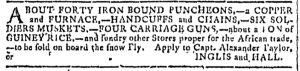
“HANDCUFFS and CHAINS … and sundry other Stores proper for the African trade.”

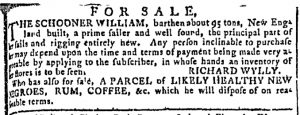
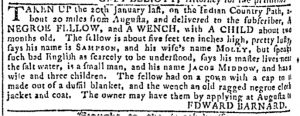
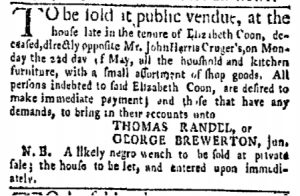
The business of slavery was apparent throughout the Georgia Gazette and other colonial newspapers in the 1760s, especially in the advertisements. While some newspapers certainly published more advertisements concerning enslaved men, women, and children than others, none excluded such content. From New Hampshire to Georgia, advertisements looking to buy or sell slaves or capture those who managed to escape from colonists who held them in bondage appeared among the other advertisements in the public prints. Even if they were not slaveholders themselves, colonial printers facilitated and profited from the trade in enslaved men, women, and children.

Even more so than usual, this was the case for James Johnston, printer of the Georgia Gazette, in the May 17, 1769, edition. In addition to the sorts of advertisements that ran week after week in his newspaper, this issue included an advertisement promoting supplies for slavers involved in “the African trade.” Some of these goods could have been sold to purchasers involved in a variety of endeavors, such as the “FORTY IRON BOUND PUNCHEONS” (or barrels) and “a TON of GUINEY RICE.” Yet the other items offered for sale were not so prosaic: “HANDCUFFS and CHAINS,” “SIX SOLDIERS MUSKETS,” and “FOUR CARRIAGE GUNS.” These were not merely supplies for transatlantic voyages; they were tools of violence and subordination required for trafficking in human cargo.

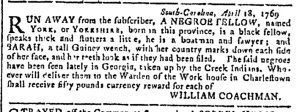
Elsewhere in the same issue auctioneers Ewen and Bolton advertised a “NEW NEGROE WENCH,” a woman who was not “country born” in Georgia or elsewhere in mainland North America. In another advertisement, William Coachman described “SARAH, a tall Guiney wench” who had escaped a month earlier. Both had survived the middle passage from Africa to the American colonies. As women, they were less likely than their male counterparts to spend the voyage in “HANDCUFFS and CHAINS,” but, at the very least, they most certainly saw other captives so restrained during the ordeal. Both had been subject to the violence of the slave trade and ongoing exploitation upon arriving in Georgia.

All of that was part of a system that played a significant role in sustaining newspapers like the Georgia Gazette. Eleven advertisements about enslaved men, women, and children ran in the May 17 issue, making Johnston complicit in “the African trade.” The advertisement for “HANDCUFFS and CHAINS” and other equipment for participating in the transatlantic slave trade did not make the printer any more complicit. Instead, it underscored the depravity of the enterprise that appeared so prominently in the pages of his newspapers week after week.

Slavery Advertisements Published May 17, 1769

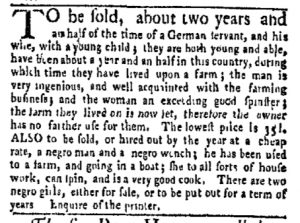
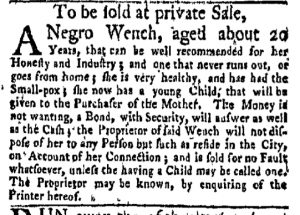
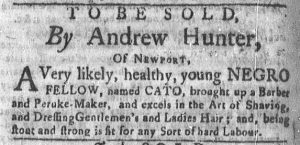
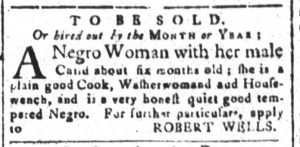
The Slavery Adverts 250 Project chronicles the role of newspaper advertising in perpetuating slavery in the era of the American Revolution. The project seeks to reveal the ubiquity of slavery in eighteenth-century life from New England to Georgia by republishing advertisements for slaves – for sale, wanted to purchase, runaways, captured fugitives – in daily digests on this site as well as in real time via the @SlaveAdverts250 Twitter feed, utilizing twenty-first-century media to stand in for the print media of the eighteenth century.

The project aims to provide modern audiences with a sense of just how often colonists encountered these advertisements in their daily lives. Enslaved men, women, and children appeared in print somewhere in the colonies almost every single day. Those advertisements served as a constant backdrop for social, cultural, economic, and political life in colonial and revolutionary America. Colonists who did not own slaves were still confronted with slavery as well as invited to maintain the system by purchasing slaves or assisting in the capture of runaways. The frequency of these newspaper advertisements suggests just how embedded slavery was in colonial and revolutionary American culture in everyday interactions beyond the printed page.

These advertisements also testify to the experiences of enslaved men, women, and children, though readers must consider that those experiences have been remediated through descriptions offered by slaveholders rather than the slaves themselves. Often unnamed in the advertisements, enslaved men, women, and children were not invisible or unimportant in early America.

These advertisements appeared in colonial American newspapers 250 years ago today.

May 17 - Georgia Gazette Slavery 1
Georgia Gazette (May 17, 1769).

**********

May 17 - Georgia Gazette Slavery 2
Georgia Gazette (May 17, 1769).

**********

May 17 - Georgia Gazette Slavery 3
Georgia Gazette (May 17, 1769).

**********

May 17 - Georgia Gazette Slavery 4
Georgia Gazette (May 17, 1769).

**********

May 17 - Georgia Gazette Slavery 5
Georgia Gazette (May 17, 1769).

**********

May 17 - Georgia Gazette Slavery 6
Georgia Gazette (May 17, 1769).

**********

May 17 - Georgia Gazette Slavery 7
Georgia Gazette (May 17, 1769).

**********

May 17 - Georgia Gazette Slavery 8
Georgia Gazette (May 17, 1769).

**********

May 17 - Georgia Gazette Slavery 9
Georgia Gazette (May 17, 1769).

**********

May 17 - Georgia Gazette Slavery 10
Georgia Gazette (May 17, 1769).

**********

May 17 - Georgia Gazette Slavery 11
Georgia Gazette (May 17, 1769).

May 16

What was advertised in a colonial American newspaper 250 years ago today?

May 16 - 5:16:1769 Essex Gazette
Essex Gazette (May 16, 1769).

“His Want of a full Assortment arises … from his strictly adhering to the Agreement not to import Superfluities.”

As spring turned to summer in 1769, explicit references to the nonimportation agreements adopted by merchants and shopkeepers as a means of economic resistance to the duties on imported paper, glass, and other goods leveled by Parliament in the Townshend Acts appeared with greater frequency in newspaper advertisements for consumer goods. By then the boycott had been in effect for more then four months and had begun to take its toll on the inventories in many shops.

Consider John Appleton’s advertisement in the May 16, 1769, edition of the Essex Gazette. Dated a day earlier, it began with the familiar “imported from LONDON in the last Ships,” but readers discovered on closer examination that the shopkeeper stocked very few items recently transported across the Atlantic, seemingly only those excluded from the boycott. Appleton also addressed the array of goods he usually carried and how his current selection compared. First stating that he “has also a good Assortment of English Piece Goods, suitable for the Season,” he then clarified that “he has not so full an Assortment as is usual for him at this Season of the Year.” He hoped that this would not deter prospective customers from visiting his shop. His diminished inventory resulted “not from any Neglect in him, but from his strictly adhering to the Agreement not to import Superfluities.” In other words, Appleton faithfully abided by the terms of the boycott. He asked for the understanding of prospective customers and, more generally, demanded the respect of all readers who supported the boycott.

To offset any inconvenience, Appleton also acquired alternate merchandise: “a Quantity of Germantown Stockings.” The shopkeeper explained that he now retailed those items “to encourage the Home Manufacture.” In so doing, he demonstrated that he supported another prong of the plan for overcoming the abuses of Parliament. Colonists realized that boycotts by themselves likely would not be enough; they also needed to become more self-sufficient, especially if they wished to correct a trade imbalance with Great Britain. Producing and consuming “domestic manufactures” had been part of the larger plan as soon as colonists began discussing nonimportation agreements. Once again, Appleton made certain that members of his community, especially prospective customers, knew that he had done his part to faithfully execute the plan.

Ordinarily, having a vast assortment of merchandise would have been a selling point for Appleton or any other shopkeeper. Running low on goods would not have been a point of pride. Yet in these circumstances Appleton turned a shortcoming into a virtue, arguing that customers should indeed patronize his shop precisely because he had less to offer than usual. By implication, doing so demonstrated their own patriotism.

May 15

What was advertised in a colonial American newspaper 250 years ago today?

May 15 - New-York Gazette Weekly Mercury
New-York Gazette and Weekly Mercury (May 15, 1769).

“In August last an Agreement was made not to import any Goods from Great-Britain.”

This notice appeared in the May 15, 1769, edition of the New-York Gazette and Weekly MercuryBy Order of the Committee of Merchants in New-York.” The same notice appeared four days earlier in the New-York Journal. Just as “Merchants & Traders” in Boston had been reminding the public about nonimportation agreements and assessing compliance with their resolutions, so did their counterparts in New York. The committee provided a brief overview: “in August last an Agreement was made not to import any Good from Great-Britain (a few Articles excepted) that should be shipt after the first of November, until an Act of Parliament laying Duties on Paper, Glass, &c. for raising a Revenue here should be repealed.” Furthermore, any goods that arrived “contrary to the Agreement” were to be placed in a “public store” and not be offered for sale until such time that the nonimportation agreement came to an end. Those who did not comply “should be deemed Enemies to this Country.” Notably, this notice did not excoriate women as dangerous consumers of imported goods, as so many editorials tended to do, but instead imbued them with considerable political power in making choices about which goods to purchase and which purveyors to patronize.
The placement of this notice in both the New-York Journal and the New-York Gazette and Weekly Mercury makes it impossible to determine whether the printers included it as an editorial or as a paid advertisement. In the New-York Journal, it ran almost immediately after a short section devoted to news about the colony. A brief auction notice appeared between the two. Otherwise, the notice from the Committee of Merchants inaugurated the portion of that edition devoted to advertising. In the New-York Gazette and Weekly Mercury, the notice from the Committee of Merchants also appeared almost immediately after news from the colony, again with one advertisement about an auction preceding it. In this case, however, this meant that the notice from the Committee of Merchants appeared at the top of the column that launched the advertisements for the issue, making it much more visible than if it ran right after news from the colony at the bottom of the previous column. In both cases, the notice from the Committee of Merchants provided context and set the tone for reading the other advertisements, especially those that marketed consumer goods. The notice served as a bridge between the news delivered in the first pages and the advertising in the final pages. In that regard, whether it was a paid notice mattered not nearly as much as how the printers deployed it in their respective newspapers.

Slavery Advertisements Published May 15, 1769

The Slavery Adverts 250 Project chronicles the role of newspaper advertising in perpetuating slavery in the era of the American Revolution. The project seeks to reveal the ubiquity of slavery in eighteenth-century life from New England to Georgia by republishing advertisements for slaves – for sale, wanted to purchase, runaways, captured fugitives – in daily digests on this site as well as in real time via the @SlaveAdverts250 Twitter feed, utilizing twenty-first-century media to stand in for the print media of the eighteenth century.

The project aims to provide modern audiences with a sense of just how often colonists encountered these advertisements in their daily lives. Enslaved men, women, and children appeared in print somewhere in the colonies almost every single day. Those advertisements served as a constant backdrop for social, cultural, economic, and political life in colonial and revolutionary America. Colonists who did not own slaves were still confronted with slavery as well as invited to maintain the system by purchasing slaves or assisting in the capture of runaways. The frequency of these newspaper advertisements suggests just how embedded slavery was in colonial and revolutionary American culture in everyday interactions beyond the printed page.

These advertisements also testify to the experiences of enslaved men, women, and children, though readers must consider that those experiences have been remediated through descriptions offered by slaveholders rather than the slaves themselves. Often unnamed in the advertisements, enslaved men, women, and children were not invisible or unimportant in early America.

These advertisements appeared in colonial American newspapers 250 years ago today.

May 15 - Boston Evening-Post Slavery 1
Supplement to the Boston Evening-Post (May 15, 1769).

**********

May 15 - Boston-Gazette Slavery 1
Boston-Gazette (May 15, 1769).

**********

May 15 - Massachusetts Gazette Green and Russell Slavery 1
Massachusetts Gazette [Green and Russell] (May 15, 1769).

**********

May 15 - Massachusetts Gazette Green and Russell Slavery 2
Massachusetts Gazette [Green and Russell] (May 15, 1769).

**********

May 15 - New-York Gazette Weekly Mercury Slavery 1
New-York Gazette and Weekly Mercury (May 15, 1769).

**********

May 15 - New-York Gazette Weekly Mercury Slavery 2
New-York Gazette and Weekly Mercury (May 15, 1769).

**********

May 15 - New-York Gazette Weekly Mercury Slavery 3
New-York Gazette and Weekly Mercury (May 15, 1769).

**********

May 15 - New-York Gazette Weekly Mercury Slavery 4
New-York Gazette and Weekly Mercury (May 15, 1769).

**********

May 15 - New-York Gazette Weekly Mercury Supplement Slavery 1
Supplement to the New-York Gazette and Weekly Mercury (May 15, 1769).

**********

May 15 - New-York Gazette Weekly Mercury Supplement Slavery 2
Supplement to the New-York Gazette and Weekly Mercury (May 15, 1769).

**********

May 15 - New-York Gazette Weekly Mercury Supplement Slavery 3
Supplement to the New-York Gazette and Weekly Mercury (May 15, 1769).

**********

May 15 - Newport Mercury Slavery 1
Newport Mercury (May 15, 1769).

**********

May 15 - Newport Mercury Slavery 2
Newport Mercury (May 15, 1769).

**********

May 15 - Newport Mercury Slavery 3
Newport Mercury (May 15, 1769).

**********

May 15 - South-Carolina and American General Gazette Slavery 1
South-Carolina and American General Gazette (May 15, 1769).

**********

May 15 - South-Carolina and American General Gazette Slavery 2
South-Carolina and American General Gazette (May 15, 1769).

**********

May 15 - South-Carolina and American General Gazette Slavery 3
South-Carolina and American General Gazette (May 15, 1769).

**********

May 15 - South-Carolina and American General Gazette Slavery 4
South-Carolina and American General Gazette (May 15, 1769).

**********

May 15 - South-Carolina and American General Gazette Slavery 5
South-Carolina and American General Gazette (May 15, 1769).

**********

May 15 - South-Carolina and American General Gazette Slavery 6
South-Carolina and American General Gazette (May 15, 1769).

**********

May 15 - South-Carolina and American General Gazette Slavery 7
South-Carolina and American General Gazette (May 15, 1769).

**********

May 15 - South-Carolina and American General Gazette Slavery 8
South-Carolina and American General Gazette (May 15, 1769).

**********

May 15 - South-Carolina and American General Gazette Slavery 9
South-Carolina and American General Gazette (May 15, 1769).

May 14

What was advertised in a colonial American newspaper 250 years ago this week?

THIS is to assure the Publick, that it was inserted by Mistake of the Printers.”

May 14 - 5:11:1769 Massachusetts Gazette Draper
Massachusetts Gazette [Draper] (May 11, 1769).
William Bant needed to do some damage control. The May 8, 1769, edition of Green and Russell’s Massachusetts Gazette included an advertisement that proclaimed, “William Bant, Has imported in the last Vessels from LONDON, A General Assortment of English GOODS, suitable for the approaching Season, which he will sell at his Shop in Cornhill, Boston.” Green and Russell’s Massachusetts Gazette was published simultaneously with the Boston Post-Boy, each title consisting of two pages yet printed together on a single broadsheet. The very first item in the May 8 edition of the Boston Post-Boy was the news article about the “Merchants & Traders in the Town of BOSTON” who had entered into a nonimportation agreement as an act of economic resistance against the duties leveled on paper, glass, and other imported goods by the Townshend Acts. The article included a report on how well those who had signed “said Agreement” had abided by its terms, indicating that only six or seven local merchants and shopkeepers continued “Importations … as usual.” Furthermore, the article republished “The ARTICLES of the Agreement entered into by the Merchants in August last” as a reminder and to alleviate any confusion. Even if Bant’s advertisement had not appeared in such close proximity to this article, readers would have been aware of the nonimportation agreement and the report assessing compliance because it was the talk of the town. Any who happened to read other newspapers would have also encountered the news there.

Bant’s advertisement advising that he carried goods “imported in the last Vessels from LONDON” seemed to run afoul of the nonimportation agreement, setting him apart from the vast majority of merchants and shopkeepers in Boston. He immediately set about publishing a clarification. Refusing to wait an entire week until the next issue of the combined Boston Posy-Boy and Green and Russell’s Massachusetts Gazette, he turned to the combined Boston Weekly News-Letter and Draper’s Massachusetts Gazette, published just three days later (and dated May 9, the day after the advertisement ran). In a new advertisement he quoted the notice that ran earlier in the week and then offered an explanation: “THIS is to assure the Publick, that it was inserted by Mistake of the Printers, being an old Advertisement sent them last Summer, and intended for that Season only.” This raises interesting questions about the practices for preparing advertisements for publication within the printing office, but none of those would have been Bant’s primary concern. He needed to defend his reputation. To that end, he continued, “The said William Bant further assures the Publick that as he chearfully signed the Agreement for Non-Importation, he has not, neither will he on any Consideration whatever, break the Engagement he thereby laid himself under.” Bant assured prospective customers and the community more generally that he was a man of his word, that in operating his business he abided by his agreements and practiced the right sort of politics. He did not want to be confused for those six or seven who continued “Importations … as usual” contrary to the consensus of his peers and competitors.

Bant feared the impact this unfortunate mistake could have on his business. He underscored once again that the advertisement did not represent his current practices. He had not imported goods from England; instead, an old advertisement ran as a result of an “egregious, though inadvertent Error of the Printers only.” Bant entreated “the Publick, especially his Customers” to recognize what had actually happened and not punish him for it. He begged that prospective customers “will not neglect him in Consequence” of an error made in the printing office. Much to Bant’s dismay, he unexpectedly found politics injected into his newspaper advertisements. He realized the gravity of the situation given public discourse that so inextricably linked politics and commerce in the late 1760s. Like other merchants and shopkeepers, he likely hoped to continue quietly selling surplus goods imported prior to the nonimportation agreement going into effect, but he had no choice but to respond as quickly as possible when the republication of an old advertisement produced the wrong sort of attention for his merchandise and his character.

May 13

What was advertised in a colonial American newspaper 250 years ago today?

May 13 - 5:13:1769 Providence Gazette
Providence Gazette (May 13, 1769).

“The Printer of the PENNSYLVANIA CHRONICLE … is very desirous to extend its Utility.”

On May 13, 1769, William Goddard published “PROPOSALS For continuing and improving the PENNSYLVANIA CHRONICLE AND UNIVERSAL ADVERTISER” not in that newspaper but instead in the Providence Gazette. At the same time, he inserted the same advertisement in the Newport Gazette (May 8), the New-York Journal (May 18), Connecticut Journal (May 19), and the Connecticut Courant (May 22). While it was unusual for printers to advertise their newspapers in faraway markets, Goddard’s vision for his publication explains why he thought colonists in Connecticut, New York, Rhode Island, and other places beyond Philadelphia and its hinterlands would be interested in subscribing to the Pennsylvania Chronicle. He billed it as both “a REGISTER of the BEST INTELLIGENCE” and “a Repository of ingenious and valuable Literature, in Prose and Verse.” He aimed to collect news and editorials concerning current events from correspondents in the colonies, Europe, and other locales, newspapers he received via exchange networks created by fellow printers, and political pamphlets published on both sides of the Atlantic.

Yet the Pennsylvania Chronicle delivered more than just news and editorials. “Literature, in Prose and Verse,” was such a significant component of the publication that Goddard hoped “to incite Persons to preserve their Papers, which will grow into a Family Library of Entertainment and Instruction.” As part of that plan, Goddard promoted the size of the sheets, the quality of the paper, and the “beautiful” type. He also promised that subscribers would annually receive “two elegant Copper Plates … executed by the most ingenious Artists; one to serve as a Frontispiece and the other to close the Volume,” as well as an attractive title page and “a copious and useful INDEX.” After they gathered the issues, the plates, the title page, and the index, Goddard encouraged subscribers to have them bound together into a single volume to become an important part of home libraries.

Individual issues of the Pennsylvania Chronicle were not ephemeral; instead, they were part of a larger publication with value that endured beyond delivering the “freshest Advices, both Foreign and Domestic.” The Providence Gazette, which carried Goddard’s subscription notice, incorporated that phrase into its masthead, as did many other newspapers printed in the American colonies. The masthead for the Pennsylvania Chronicle, however, advised that it contained “the freshest Advices, both Foreign and Domestic; with a Variety of other Matter, useful, instructive, and entertaining.” The inclusion of that “other Matter” transformed the Pennsylvania Chronicle into more than just a vehicle for delivering news and advertising. It explained why Goddard believed he could cultivate a market for this publication beyond Philadelphia and the surrounding area. This was not merely a publication that fellow printers could scour for material to reprint or merchants could peruse for political and economic news and then lay it aside in coffeehouses. It was an anthology that merited preservation for the continued edification and entertainment of subscribers and their families.

May 12

What was advertised in a colonial American newspaper 250 years ago today?

May 12 - 5:12:1769 New-Hampshire Gazette
New-Hampshire Gazette (May 12, 1769).

“BLANKS of most sorts, and a variety of BOOKS sold at the Printing-Office.”

Three advertisements placed by the printers of the New-Hampshire Gazette rounded out the final page of the May 12, 1769, edition. Each appeared at the bottom of a column, immediately above the colophon that listed Daniel Fowle and Robert Fowle in Portsmouth as the printers. Each notice testified to a different aspect of the printing business.

The notice in the first column warned that “ALL Persons indebted to the Printers, for News-Papers, &c. are NOW desired to make payment, if ever they design it, and would avoid unnecessary Trouble and Expence.” Colonial printers frequently inserted such appeals into their newspapers, but the Fowles did so more regularly than most others in the 1760s. Some printers incorporated their calls to settle accounts into annual messages that commemorated the completion of one year of publication and the beginning of another. Such messages to subscribers and other readers often outlined improvements to be made in the coming year, but also earnestly requested that customers pay their debts. The Fowles used some of the most creative and colorful language, once even threatening to publish the names of any who did not settle accounts within a short time, though they never followed through on that strategy for public shaming.

The advertisement in the second column informed readers that “BLANKS of most sorts, and a variety of BOOKs [are] sold at the Printing-Office.” Operating the newspaper was not the extent of how the Fowles earned their livelihood. They also sold books, some that they had printed but most imported from Britain. In addition, they did job printing and produced “BLANKS of all Kinds,” better known to day as printed forms. Colonists used these blanks for a variety of commercial and legal transactions, relying on the standardized language. A similar advertisement published in the Georgia Gazette provided a list of the various sorts of blanks available at the local printing office: “bonds, bills of sale, mortgages, powers of attorney, bonds of arbitration, indentures, bills of lading, articles of agreement between masters of vessels and seamen, summonses, warrants, and attachments, for the court of conscience, summonses before justices of the peace, executions for the use of magistrates, indico certificates.” Some, such as the indigo certificates, were specific to local usage, but most were used throughout the colonies.   Like advertisements, blanks supplied an important revenue stream for printers.

Finally, the third column concluded with an advertisement for “Ames’s Almanack, for 1769, to be Sold at the Printing Office, in Portsmouth.” This was incredibly late for an advertisement for an almanac to appear; some of the contents certainly remained useful for the remainder of the year, but more than one-third of 1769 had already elapsed. By and large, printers, booksellers, and others had ceased advertising almanacs for quite some time. The appearance of this notice indicates that the Fowles still had surplus almanacs in stock. They hoped for some sort of return on their investment if they could sell any of them at that point. Its position as the last item in the May 12 issue, with the exception of the colophon, tells another story. The Fowles needed to fill the space to complete the column and the issue. This advertisement may have been just as valuable for that purpose as for any sales that resulted from it.

Indeed, the placement of all three advertisements from the printers suggests that they served dual purposes. Each tended to some aspect of operations at the printing office in Portsmouth while simultaneously completing a column and contributing to the tidy appearance of the final page of the May 12 edition of the New-Hampshire Gazette.

May 11

What was advertised in a colonial American newspaper 250 years ago today?

May 11 - 5:11:1769 Boston Weekly News-Letter
Boston Weekly News-Letter (May 11, 1769)

“Lately imported … before the Resolution of the Merchants for Non-Importation took Place.”

Erasmus Williams’s advertisement for “A large Assortment of all kind of Linnen Drapery” looked much the same as so many other advertisements placed in the Boston Weekly News-Letter and other newspapers by merchants and shopkeepers seeking to sell a variety of imported textiles. Nearly half of the advertisement consisted of a lost of the fabrics included among Williams’s merchandise at the Sign of the Blue Glove, from “Cambricks” to “printed Linens” to “flower’d & plain Lawns.”

Yet Williams included a curious preamble with his advertisement: “Lately imported from London, but last from New-York, and before the Resolution of the Merchants for Non-Importation took Place.” Like others who promoted their wares in the public prints, Williams noted the origins of his textiles. Usually asserting a connection to London worked to the advantage of advertisers, but that was not necessarily the case in 1769. In defiance of the taxes levied on paper, glass, lead, paint, and tea by the Townshend Acts, “Merchants & Traders in the town of BOSTON” and other places participated in boycotts of most English goods. A week before Williams’s advertisement ran in the Boston Weekly News-Letter, Richard Draper inserted an overview of such agreements in the Massachusetts Gazette. Draper reprinted the original resolutions adopted by merchants the previous August. In addition, he published a report that assessed to what extent those merchants had abided by the agreement not to import “any Kind of Goods or Merchandize from Great Britain.” This report found that only six out of 211 signers had imported such goods, but acknowledged that they had done so “through Inattention” and did not “countermand their Orders.” All six “readily and of their own Motion” agreed to surrender their goods to the committee of merchants overseeing the boycott. For the most part, even those “Merchants & Traders” who had not signed the agreement had adhered to it anyway. Only six or seven people continued to import goods from Great Britain “as usual.” Of equal concern, “It likewise appeared that a Quantity of Goods had been imported from New-York” since the nonimportation agreement went into effect, a strategy that might have allowed local merchants to sidestep the boycott. That being the case, those merchants who did abide by the terms of boycott determined that “the Articles of their Agreement should be printed in the Public Papers” as a reminder to merchants, shopkeepers, and consumers alike.

Two weeks before that report appeared in Draper’s Massachusetts Gazette, Williams commenced publishing his advertisement, complete with the preamble that declared he had imported his merchandise “before the Resolution of the Merchants for Non-Importation took Place.” As a committee of merchants went about assessing compliance to the boycott, he proclaimed that he had not violated the agreement. Furthermore, his preamble advised prospective customers that they could still acquire English goods they wanted at his shop without defying the boycott, on a technicality. Politics need not infringe too much on his business or his customers’ desires.

Slavery Advertisements Published May 11, 1769

The Slavery Adverts 250 Project chronicles the role of newspaper advertising in perpetuating slavery in the era of the American Revolution. The project seeks to reveal the ubiquity of slavery in eighteenth-century life from New England to Georgia by republishing advertisements for slaves – for sale, wanted to purchase, runaways, captured fugitives – in daily digests on this site as well as in real time via the @SlaveAdverts250 Twitter feed, utilizing twenty-first-century media to stand in for the print media of the eighteenth century.

The project aims to provide modern audiences with a sense of just how often colonists encountered these advertisements in their daily lives. Enslaved men, women, and children appeared in print somewhere in the colonies almost every single day. Those advertisements served as a constant backdrop for social, cultural, economic, and political life in colonial and revolutionary America. Colonists who did not own slaves were still confronted with slavery as well as invited to maintain the system by purchasing slaves or assisting in the capture of runaways. The frequency of these newspaper advertisements suggests just how embedded slavery was in colonial and revolutionary American culture in everyday interactions beyond the printed page.

These advertisements also testify to the experiences of enslaved men, women, and children, though readers must consider that those experiences have been remediated through descriptions offered by slaveholders rather than the slaves themselves. Often unnamed in the advertisements, enslaved men, women, and children were not invisible or unimportant in early America.

These advertisements appeared in colonial American newspapers 250 years ago today.

May 11 - Massachusetts Gazette Draper Slavery 1
Massachusetts Gazette [Draper] (May 11, 1769).

**********

May 11 - New-York Journal Slavery 1
New-York Journal (May 11, 1769).

**********

May 11 - Pennsylvania Gazette Slavery 2
Pennsylvania Gazette (May 11, 1769).

**********

May 11 - Pennsylvania Gazette Supplement Slavery 1
Pennsylvania Gazette (May 11, 1769).

**********

May 11 - Pennsylvania Gazette Supplement Slavery 2
Pennsylvania Gazette (May 11, 1769).

**********

May 11 - Pennsylvania Gazette Supplement Slavery 3
Pennsylvania Gazette (May 11, 1769).

**********

May 11 - Pennsylvania Journal Slavery 1
Pennsylvania Journal (May 11, 1769).

**********

May 11 - Pennsylvania Journal Supplement Slavery 1
Supplement to the Pennsylvania Journal (May 11, 1769).

**********

May 11 - Pennsylvania Journal Supplement Slavery 2
Supplement to the Pennsylvania Journal (May 11, 1769).

**********

May 11 - Pennsylvania Journal Supplement Slavery 3
Supplement to the Pennsylvania Journal (May 11, 1769).

**********

May 11 - Virginia Gazette Purdie and Dixon Slavery 1
Virginia Gazette [Purdie and Dixon] (May 11, 1769).

**********

May 11 - Virginia Gazette Purdie and Dixon Slavery 2
Virginia Gazette [Purdie and Dixon] (May 11, 1769).

**********

May 11 - Virginia Gazette Purdie and Dixon Slavery 3
Virginia Gazette [Purdie and Dixon] (May 11, 1769).

**********

May 11 - Virginia Gazette Purdie and Dixon Slavery 4
Virginia Gazette [Purdie and Dixon] (May 11, 1769).

**********

May 11 - Virginia Gazette Purdie and Dixon Slavery 5
Virginia Gazette [Purdie and Dixon] (May 11, 1769).

**********

May 11 - Virginia Gazette Purdie and Dixon Slavery 6
Virginia Gazette [Purdie and Dixon] (May 11, 1769).

**********

May 11 - Virginia Gazette Purdie and Dixon Slavery 7
Virginia Gazette [Purdie and Dixon] (May 11, 1769).

**********

May 11 - Virginia Gazette Purdie and Dixon Supplement Supplement Slavery 1
Supplement to the Virginia Gazette [Purdie and Dixon] (May 11, 1769).

**********

May 11 - Virginia Gazette Purdie and Dixon Supplement Supplement Slavery 2
Supplement to the Virginia Gazette [Purdie and Dixon] (May 11, 1769).

**********

May 11 - Virginia Gazette Rind Slavery 1
Virginia Gazette [Rind] (May 11, 1769).

**********

May 11 - Virginia Gazette Rind Slavery 2
Virginia Gazette [Rind] (May 11, 1769).

**********

May 11 - Virginia Gazette Rind Slavery 3
Virginia Gazette [Rind] (May 11, 1769).