October 16

What was advertised in a colonial American newspaper 250 years ago today?
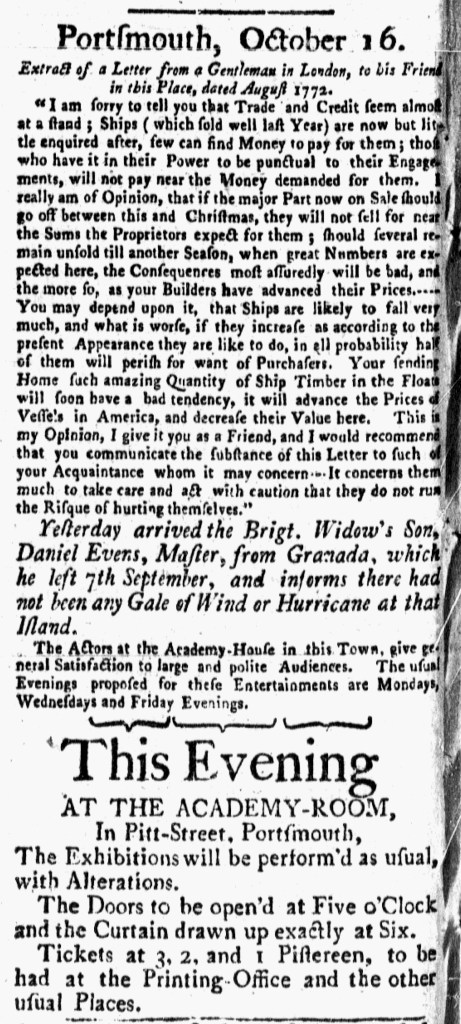
New-Hampshire Gazette (October 16, 1772).

“The Exhibitions will be perform’d as usual.”

In the summer of 1772, an advertiser who went by “the Exhibitor” and “the Projector” sought to establish a series of performances of “several serious and comic pieces of Oratory” in Portsmouth, New Hampshire.  The Exhibitor proposed a subscription series as a means of determining whether sufficient interest existed to make the project viable, encouraging “those Ladies and Gentlemen who are inclined to favour” the proposal to subscribe quickly because “the Season advance, and he is obliged to go to the Southward in October next.”  Those ladies and gentlemen could purchase subscriptions at the printing office.  In addition, tickets for performances were available “at the Printing Office at Mr. Appleton’s Book-Store, and at Mr. Stavers’s Tavern.”

As was often the case with itinerant performers who advertised that they intended to remain in town for only a limited time, the Exhibitor decided to remain in Portsmouth longer than he originally indicated.  In the middle of October, he placed an advertisement to announce that “This Evening … The Exhibitions will be performed as usual, with Alterations.”  In other words, the show continued, but the Exhibitor varied the content to offer something new to prospective patrons who had recently been in the audience.  Readers could procure tickets “at the Printing-Office and the other usual Places.”

The Exhibitor seemed to get assistance in marketing the performance from Daniel Fowle and Robert Fowle, the printers of the New-Hampshire Gazette.  In the October 16 edition, they concluded the news from Portsmouth with a short blurb that reported, “The Actors at the Academy-House in this Town, give general Satisfaction to large and polite Audiences.  The usual Evenings proposed for this Entertainment are Mondays, Wednesdays and Friday Evenings.”  The Exhibitor’s new notice appeared immediately below that review; news content selected by the editor flowed seamlessly into an advertisement.  The Fowles may have done so as a service to the community if they recognized the benefits of having local productions inspired by “the Entertainments at Sadler’s Well’s,” a renowned theater that had been operating in London since 1683.  In addition, they may have received commissions on the tickets they sold, making the success of the Exhibitor’s venture worth promoting with a short puff piece embedded in the news.

Slavery Advertisements Published October 16, 1772

GUEST CURATOR: Julia Tardugno

The Slavery Adverts 250 Project chronicles the role of newspaper advertising in perpetuating slavery in the era of the American Revolution. The project seeks to reveal the ubiquity of slavery in eighteenth-century life from New England to Georgia by republishing advertisements about enslaved people – for sale as individuals or in groups, wanted to purchase or for hire for short periods, runaways who liberated themselves, and those who were subsequently captured and confined in jails and workhouses – in daily digests on this site as well as in real time via the @SlaveAdverts250 Twitter feed, utilizing twenty-first-century media to stand in for the print media of the eighteenth century.

The project aims to provide modern audiences with a sense of just how often colonizers encountered these advertisements in their daily lives. Enslaved men, women, and children appeared in print somewhere in the colonies almost every single day. Those advertisements served as a constant backdrop for social, cultural, economic, and political life in colonial and revolutionary America. Colonizers who did not purport to own enslaved people were still confronted with slavery as well as invited to maintain the system by purchasing enslaved men, women, and children or assisting in the capture of so-called “runaways” who sought to free themselves from bondage. The frequency of these newspaper advertisements suggests just how embedded slavery was in colonial and revolutionary American culture in everyday interactions beyond the printed page.

These advertisements also testify to the experiences of enslaved men, women, and children, though readers must consider that those experiences have been remediated through descriptions offered by enslavers rather than enslaved people themselves. Often unnamed in the advertisements, enslaved men, women, and children were not invisible or unimportant in early America.

From compiling an archive of digitized eighteenth-century newspapers to identifying advertisements about enslaved men, women, and children in those newspapers to preparing images of each advertisement to posting this daily digest, Julia Tardugno served as guest curator for this entry. She completed this work as part of the Summer Scholars Program, funded by a fellowship from the D’Amour College of Liberal Arts and Sciences at Assumption University in Worcester, Massachusetts, in Summer 2022. 

These advertisements appeared in colonial American newspapers 250 years ago today.

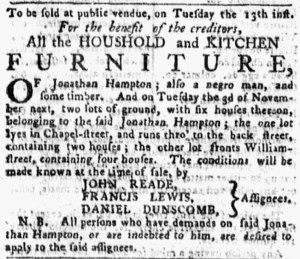
Connecticut Journal (October 16, 1772).

October 15

What was advertised in a colonial American newspaper 250 years ago today?

Massachusetts Gazette and Boston Weekly News-Letter (October 15, 1772).

“WANTED immediately, a Wet-Nurse.”

Richard Draper had too much content to publish all of it in the October 15, 1772, edition of the Massachusetts Gazette and Boston Weekly News-Letter.  He remedied the situation, in part, by printing and distributing a supplement on a smaller sheet.  That supplement included additional news, but no advertising.  Even with the supplement, Draper did not have enough space for all the news and advertising received in the printing office.  A note at the bottom of the final column on the third page instructed readers to “See SUPPLEMENT” and advised that “Other Articles and Advertisements must be defer’d.”

Why insert such a note on the third page instead of placing it at the end of the final column on the last page?  The process of printing newspapers on a manually-operated press provides an explanation.  Like most other newspapers from the era of the American Revolution, a standard issue of the Massachusetts Gazette and Boston Weekly News-Letter consisted of four pages created by printing two pages on each side of a broadsheet and folding it in half.  Printers usually set the type and printed the first and fourth pages on one side of the sheet.  After it dried, they printed the second and third pages on the other side.  That resulted in the latest news often appearing inside the newspaper rather than on the front page.  That also meant that the last portion of the newspaper arranged by the compositor was the third page, not the final page.  That being the case, announcements about supplements and omitted materials usually appeared on the third page.

Draper did manage to include one additional advertisement in the standard issue for October 15 rather than deferring it for a week.  The urgency of the notice may have convinced him to make a special effort to include it.  “WANTED immediately,” the advertisement proclaimed, “a Wet-Nurse, with a young Breast of Milk, that can be well Recommended, to suckle a Child in a Family: Enquire of the Printer.”  That notice ran in the right margin of the third page, almost the entire length of an extensive advertisement that listed merchandise stocked by John Barrett and Sons at their store “near the MILL-BRIDGE” in Boston.  With some creative graphic design, Draper squeezed an advertisement seeking a wet nurse, a notice that likely arrived late to the printing office, into that issue.  In so doing, he adapted to the technology of the printing press while providing a special service to that advertiser.

Slavery Advertisements Published October 15, 1772

GUEST CURATOR: Julia Tardugno

The Slavery Adverts 250 Project chronicles the role of newspaper advertising in perpetuating slavery in the era of the American Revolution. The project seeks to reveal the ubiquity of slavery in eighteenth-century life from New England to Georgia by republishing advertisements about enslaved people – for sale as individuals or in groups, wanted to purchase or for hire for short periods, runaways who liberated themselves, and those who were subsequently captured and confined in jails and workhouses – in daily digests on this site as well as in real time via the @SlaveAdverts250 Twitter feed, utilizing twenty-first-century media to stand in for the print media of the eighteenth century.

The project aims to provide modern audiences with a sense of just how often colonizers encountered these advertisements in their daily lives. Enslaved men, women, and children appeared in print somewhere in the colonies almost every single day. Those advertisements served as a constant backdrop for social, cultural, economic, and political life in colonial and revolutionary America. Colonizers who did not purport to own enslaved people were still confronted with slavery as well as invited to maintain the system by purchasing enslaved men, women, and children or assisting in the capture of so-called “runaways” who sought to free themselves from bondage. The frequency of these newspaper advertisements suggests just how embedded slavery was in colonial and revolutionary American culture in everyday interactions beyond the printed page.

These advertisements also testify to the experiences of enslaved men, women, and children, though readers must consider that those experiences have been remediated through descriptions offered by enslavers rather than enslaved people themselves. Often unnamed in the advertisements, enslaved men, women, and children were not invisible or unimportant in early America.

From compiling an archive of digitized eighteenth-century newspapers to identifying advertisements about enslaved men, women, and children in those newspapers to preparing images of each advertisement to posting this daily digest, Julia Tardugno served as guest curator for this entry. She completed this work as part of the Summer Scholars Program, funded by a fellowship from the D’Amour College of Liberal Arts and Sciences at Assumption University in Worcester, Massachusetts, in Summer 2022. 

These advertisements appeared in colonial American newspapers 250 years ago today.

Maryland Gazette (October 15, 1772).

**********

Maryland Gazette (October 15, 1772).

**********

Maryland Gazette (October 15, 1772).

**********

Maryland Gazette (October 15, 1772).

**********

Maryland Gazette (October 15, 1772).

**********

Maryland Gazette (October 15, 1772).

**********

Maryland Gazette (October 15, 1772).

**********

Maryland Gazette (October 15, 1772).

**********

Massachusetts Gazette and Boston Weekly News-Letter (October 15, 1772).

**********

New-York Journal (October 15, 1772).

**********

New-York Journal (October 15, 1772).

**********

New-York Journal (October 15, 1772).

**********

New-York Journal (October 15, 1772).

**********

South-Carolina Gazette (October 15, 1772).

**********

South-Carolina Gazette (October 15, 1772).

**********

South-Carolina Gazette (October 15, 1772).

**********

South-Carolina Gazette (October 15, 1772).

**********

South-Carolina Gazette (October 15, 1772).

**********

South-Carolina Gazette (October 15, 1772).

**********

South-Carolina Gazette (October 15, 1772).

**********

South-Carolina Gazette (October 15, 1772).

**********

South-Carolina Gazette (October 15, 1772).

**********

South-Carolina Gazette (October 15, 1772).

**********

South-Carolina Gazette (October 15, 1772).

**********

Supplement to the South-Carolina Gazette (October 15, 1772).

**********

Supplement to the South-Carolina Gazette (October 15, 1772).

**********

Supplement to the South-Carolina Gazette (October 15, 1772).

**********

Virginia Gazette [Purdie and Dixon] (October 15, 1772).

**********

Virginia Gazette [Purdie and Dixon] (October 15, 1772).

**********

Virginia Gazette [Purdie and Dixon] (October 15, 1772).

**********

Virginia Gazette [Purdie and Dixon] (October 15, 1772).

**********

Virginia Gazette [Purdie and Dixon] (October 15, 1772).

**********

Virginia Gazette [Purdie and Dixon] (October 15, 1772).

**********

Virginia Gazette [Purdie and Dixon] (October 15, 1772).

**********

Virginia Gazette [Purdie and Dixon] (October 15, 1772).

**********

Virginia Gazette [Purdie and Dixon] (October 15, 1772).

**********

Virginia Gazette [Purdie and Dixon] (October 15, 1772).

**********

Virginia Gazette [Purdie and Dixon] (October 15, 1772).

**********

Virginia Gazette [Purdie and Dixon] (October 15, 1772).

**********

Virginia Gazette [Purdie and Dixon] (October 15, 1772).

**********

Virginia Gazette [Rind] (October 15, 1772).

**********

Virginia Gazette [Rind] (October 15, 1772).

**********

Virginia Gazette [Rind] (October 15, 1772).

**********

Virginia Gazette [Rind] (October 15, 1772).

**********

Virginia Gazette [Rind] (October 15, 1772).

**********

Virginia Gazette [Rind] (October 15, 1772).

**********

Virginia Gazette [Rind] (October 15, 1772).

**********

Virginia Gazette [Rind] (October 15, 1772).

October 14

What was advertised in a colonial American newspaper 250 years ago today?

Pennsylvania Journal (October 14, 1772).

“Having for some years operated for, and with the most proficient of the art, in the above-mentioned metropolis (of London).”

When William Johnson, a “GLOVER and BREECHES-MAKER,” arrived in Philadelphia in the fall of 1772, he placed advertisements in the Pennsylvania Journal to introduce himself to the community and invite prospective clients to visit the shop he opened on Front Street.  Like many other artisans who migrated across the Atlantic, Johnson emphasized his experience working in London, the cosmopolitan center of the empire.  Until he had time to establish his reputation in the local market, he depended on his connections to London to sell his services.  In the headline for his advertisements, he described himself as “lately arrived from LONDON.”  In the nota bene that concluded his notice, Johnson declared that he “hopes himself capable to give all possible satisfaction, with respect to the neatness of the fitting, and execution of the workmanship; having for some years operated for, and with the most proficient of the art, in the above-mentioned metropolis (of London).”  He opened and closed his advertisement with references to London.

Johnson also intended for the timing of his arrival to resonate with prospective clients.  Having “lately arrived from LONDON” suggested that he was familiar with the most recent styles in that “metropolis.”  His clients could depend on getting news and advice about current trends, helping them to keep up with new tastes on the other side of the Atlantic and perhaps stay ahead of friends and acquaintances in Philadelphia.  Some artisans continued to promote their connections to London long after they relocated to the colonies.  Johnson provided details that made it possible for prospective clients to determine for themselves that he did indeed recently arrive in the city and, by extension, his knowledge of fashions in London was as current as possible.  He reported that he “lately arrived from LONDON, by Capt. SPARKS.”  The “ship Mary and Elizabeth, J. Sparks from London” appeared among the “ARRIVALS” in the shipping news from the “Custom-House, Philadelphia,” in the September 30 edition of the Pennsylvania Journal.  When Johnson’s advertisement ran in the October 14 edition, he had been in the city for less than three weeks.  In addition, merchants, shopkeepers, and others also referenced the arrival of the ship in their advertisements.  Randle Mitchell, for instance, stated that he “Just imported” new merchandise “in the Elizabeth and Mary, Capt. Sparks, from London.”  Robert Bass, an apothecary, stocked new medicines “JUST IMPORTED in the Mary and Elizabeth, Capt. Sparks from London.”

As yet unknown to prospective clients in Philadelphia, Johnson attempted to leverage his experience in the “metropolis” of London to convince prospective clients to avail themselves of his services.  That experience garnered proficiency in his craft, including “the neatness of the firring, and the execution of the workmanship,” while also giving him access to current styles in the most fashionable city in the empire.  He included the name of the captain of the vessel that transported him across the Atlantic as a means of confirming that he possessed recent knowledge of the latest trends.

Slavery Advertisements Published October 14, 1772

GUEST CURATOR: Julia Tardugno

The Slavery Adverts 250 Project chronicles the role of newspaper advertising in perpetuating slavery in the era of the American Revolution. The project seeks to reveal the ubiquity of slavery in eighteenth-century life from New England to Georgia by republishing advertisements about enslaved people – for sale as individuals or in groups, wanted to purchase or for hire for short periods, runaways who liberated themselves, and those who were subsequently captured and confined in jails and workhouses – in daily digests on this site as well as in real time via the @SlaveAdverts250 Twitter feed, utilizing twenty-first-century media to stand in for the print media of the eighteenth century.

The project aims to provide modern audiences with a sense of just how often colonizers encountered these advertisements in their daily lives. Enslaved men, women, and children appeared in print somewhere in the colonies almost every single day. Those advertisements served as a constant backdrop for social, cultural, economic, and political life in colonial and revolutionary America. Colonizers who did not purport to own enslaved people were still confronted with slavery as well as invited to maintain the system by purchasing enslaved men, women, and children or assisting in the capture of so-called “runaways” who sought to free themselves from bondage. The frequency of these newspaper advertisements suggests just how embedded slavery was in colonial and revolutionary American culture in everyday interactions beyond the printed page.

These advertisements also testify to the experiences of enslaved men, women, and children, though readers must consider that those experiences have been remediated through descriptions offered by enslavers rather than enslaved people themselves. Often unnamed in the advertisements, enslaved men, women, and children were not invisible or unimportant in early America.

From compiling an archive of digitized eighteenth-century newspapers to identifying advertisements about enslaved men, women, and children in those newspapers to preparing images of each advertisement to posting this daily digest, Julia Tardugno served as guest curator for this entry. She completed this work as part of the Summer Scholars Program, funded by a fellowship from the D’Amour College of Liberal Arts and Sciences at Assumption University in Worcester, Massachusetts, in Summer 2022. 

These advertisements appeared in colonial American newspapers 250 years ago today.

Pennsylvania Gazette (October 14, 1772).

**********

Pennsylvania Gazette (October 14, 1772).

**********

Pennsylvania Journal (October 14, 1772).

**********

Pennsylvania Journal (October 14, 1772).

October 13

What was advertised in a colonial American newspaper 250 years ago today?

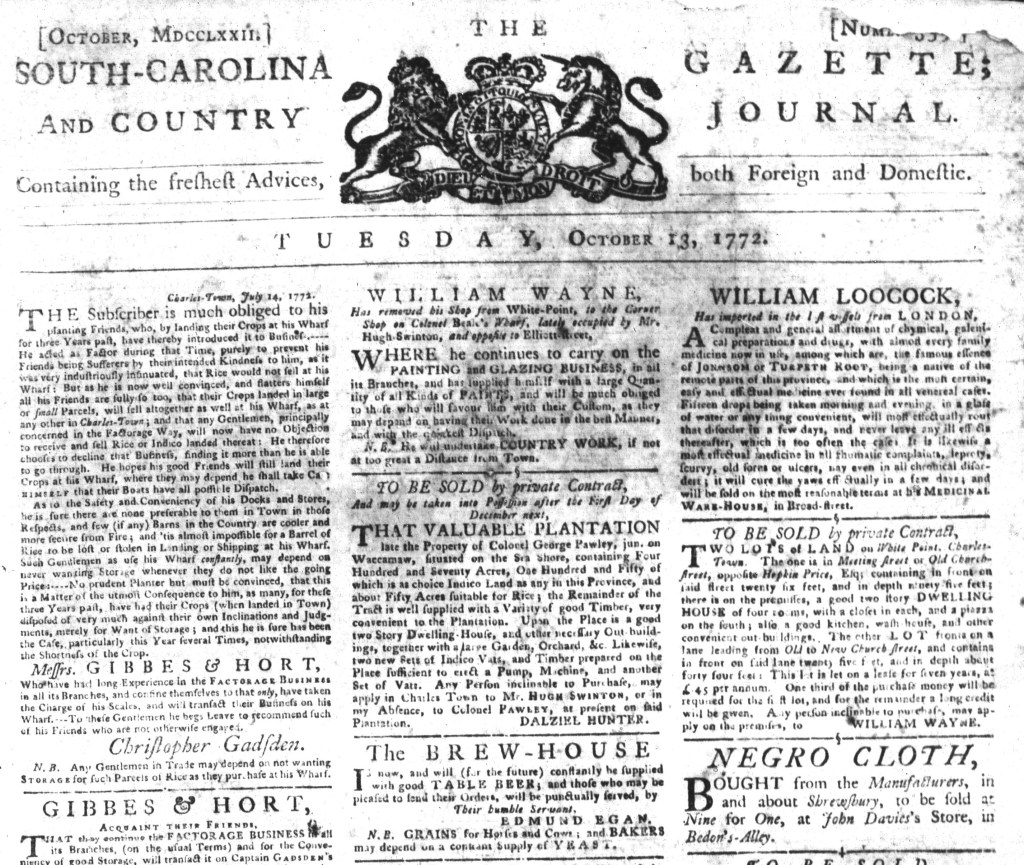
South-Carolina Gazette and Country Journal (October 13, 1772).

“He continues to carry on the PAINTING and GLAZING BUSINESS.”

Colonial printers often resorted to publishing advertising supplements to accompany their weekly newspapers that featured both news and paid notices.  This was especially true for newspapers in the largest port cities, Boston, Charleston, New York, and Philadelphia.  Each standard issue consisted of four pages created by printing two pages on each side of a broadsheet and then folding it in half.  When printers had sufficient additional content to justify the resources required to produce additional pages, they printed two- or four-page supplements.  Although news sometimes appeared in those supplements, additions, and extraordinary editions, they most often consisted of advertising.

That was not the case for the October 13, 1772, edition of the South-Carolina Gazette and Country Journal and the Addition that Charles Crouch distributed on the same day.  The bulk of the news appeared in the two-page Addition after Crouch devoted ten and a half of the twelve columns in the standard issue to paid notices, including more than a dozen that offered enslaved people for sale or offered rewards for the capture and return of enslaved people who liberated themselves by running away from those who held them in bondage.  Paid notices filled the entire first page below the masthead.  They also filled the entire third and fourth pages.  A short note, “For more London News, see the Addition,” appeared at the bottom of the first column of the second page, the only full column of news.  Halfway down the next column, a header for “NEW ADVERTISEMENTS” alerted readers to the content on the remainder of the page.

The two-page Addition gave three times as much space to news compared to the standard issue.  News that arrived via London, most of it extracts from letters composed in various cities on the European continent, filled the first page and overflowed onto the second.  A short proclamation from the governor of the colony ran as local news midway through the second column on the other side of the sheet.  Crouch managed to squeeze in a few more advertisements, including one that promoted a “COMPLETE GERMAN GRAMMAR” that he sold at his printing office.  Instead of an advertising supplement that accompanied the newspaper, the Addition amounted to a news supplement that accompanied an advertising leaflet.  In many instances, colonial newspapers were vehicles for delivering advertising.  That was especially true of the October 13 edition of the South-Carolina Gazette and Country Journal and its Addition.

Slavery Advertisements Published October 13, 1772

GUEST CURATOR: Julia Tardugno

The Slavery Adverts 250 Project chronicles the role of newspaper advertising in perpetuating slavery in the era of the American Revolution. The project seeks to reveal the ubiquity of slavery in eighteenth-century life from New England to Georgia by republishing advertisements about enslaved people – for sale as individuals or in groups, wanted to purchase or for hire for short periods, runaways who liberated themselves, and those who were subsequently captured and confined in jails and workhouses – in daily digests on this site as well as in real time via the @SlaveAdverts250 Twitter feed, utilizing twenty-first-century media to stand in for the print media of the eighteenth century.

The project aims to provide modern audiences with a sense of just how often colonizers encountered these advertisements in their daily lives. Enslaved men, women, and children appeared in print somewhere in the colonies almost every single day. Those advertisements served as a constant backdrop for social, cultural, economic, and political life in colonial and revolutionary America. Colonizers who did not purport to own enslaved people were still confronted with slavery as well as invited to maintain the system by purchasing enslaved men, women, and children or assisting in the capture of so-called “runaways” who sought to free themselves from bondage. The frequency of these newspaper advertisements suggests just how embedded slavery was in colonial and revolutionary American culture in everyday interactions beyond the printed page.

These advertisements also testify to the experiences of enslaved men, women, and children, though readers must consider that those experiences have been remediated through descriptions offered by enslavers rather than enslaved people themselves. Often unnamed in the advertisements, enslaved men, women, and children were not invisible or unimportant in early America.
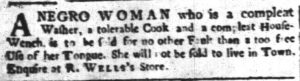
From compiling an archive of digitized eighteenth-century newspapers to identifying advertisements about enslaved men, women, and children in those newspapers to preparing images of each advertisement to posting this daily digest, Julia Tardugno served as guest curator for this entry. She completed this work as part of the Summer Scholars Program, funded by a fellowship from the D’Amour College of Liberal Arts and Sciences at Assumption University in Worcester, Massachusetts, in Summer 2022. 

These advertisements appeared in colonial American newspapers 250 years ago today.

Connecticut Courant (October 13, 1772).

**********

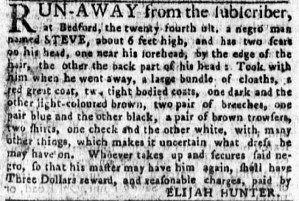
South-Carolina Gazette and Country Journal (October 13, 1772).

**********

South-Carolina Gazette and Country Journal (October 13, 1772).

**********

South-Carolina Gazette and Country Journal (October 13, 1772).

**********

South-Carolina Gazette and Country Journal (October 13, 1772).

**********

South-Carolina Gazette and Country Journal (October 13, 1772).

**********

South-Carolina Gazette and Country Journal (October 13, 1772).

**********

South-Carolina Gazette and Country Journal (October 13, 1772).

**********

South-Carolina Gazette and Country Journal (October 13, 1772).

**********

South-Carolina Gazette and Country Journal (October 13, 1772).

**********

South-Carolina Gazette and Country Journal (October 13, 1772).

**********

South-Carolina Gazette and Country Journal (October 13, 1772).

**********

South-Carolina Gazette and Country Journal (October 13, 1772).

**********

South-Carolina Gazette and Country Journal (October 13, 1772).

**********

South-Carolina Gazette and Country Journal (October 13, 1772).

October 12

What was advertised in a colonial American newspaper 250 years ago today?

Boston-Gazette (October 12, 1772).

New Advertisements.”

Benjamin Edes and John Gill, printers of the Boston-Gazette, wanted to increase the chances that readers took notice of their call to settle accounts in the fall of 1772.  In the October 12 edition, they inserted an announcement that “ALL Persons indebted for this Paper, whose Accounts have been above 12 Months standing, are requested to make immediate Payment.”  The copy was standard for such notices, placed by printers throughout the colonies, but Edes and Gill deployed a format intended to increase the attention the notice received.  Decorative type enclosed the printers’ notice to delinquent subscribers within a border.  Edes and Gill did not however, devise that format for their own purposes.  Instead, they adopted a strategy already in use by some of their advertisers.  Herman Brimmer and Andrew Brimmer, for instance, enclosed “Variety of Goods,” the headline to their lengthy advertisement listing scores of items, within an ornate border.  Jonathan Williams, Jr., had a border around his entire advertisement.

Edes and Gill also selected an advantageous place on the page for their notice, inserting it at the top of the first column on the final page.  It appeared immediately below a headline for “New Advertisement,” another design element intended to direct attention to the printers’ call for subscribers to pay their bills.  That headline helped to distinguish advertisements on that page from others that ran on the second and third pages.  A brief note on the third page also aided Edes and Gill’s efforts to highlight their notice.  The advertisements on the third page commenced with instructions: “For New Advertisements, See last Page.”  The printers incorporated a variety of means of increasing the visibility of their notice. They exercised their prerogative in placing it first among the notices labeled “New Advertisements” and used notes elsewhere in the issue to direct readers to one of the only advertisements that featured a border composed of decorative type.  Edes and Gill used graphic design to demand attention for an otherwise mundane notice.

Slavery Advertisements Published October 12, 1772

GUEST CURATOR: Julia Tardugno

The Slavery Adverts 250 Project chronicles the role of newspaper advertising in perpetuating slavery in the era of the American Revolution. The project seeks to reveal the ubiquity of slavery in eighteenth-century life from New England to Georgia by republishing advertisements about enslaved people – for sale as individuals or in groups, wanted to purchase or for hire for short periods, runaways who liberated themselves, and those who were subsequently captured and confined in jails and workhouses – in daily digests on this site as well as in real time via the @SlaveAdverts250 Twitter feed, utilizing twenty-first-century media to stand in for the print media of the eighteenth century.

The project aims to provide modern audiences with a sense of just how often colonizers encountered these advertisements in their daily lives. Enslaved men, women, and children appeared in print somewhere in the colonies almost every single day. Those advertisements served as a constant backdrop for social, cultural, economic, and political life in colonial and revolutionary America. Colonizers who did not purport to own enslaved people were still confronted with slavery as well as invited to maintain the system by purchasing enslaved men, women, and children or assisting in the capture of so-called “runaways” who sought to free themselves from bondage. The frequency of these newspaper advertisements suggests just how embedded slavery was in colonial and revolutionary American culture in everyday interactions beyond the printed page.

These advertisements also testify to the experiences of enslaved men, women, and children, though readers must consider that those experiences have been remediated through descriptions offered by enslavers rather than enslaved people themselves. Often unnamed in the advertisements, enslaved men, women, and children were not invisible or unimportant in early America.

From compiling an archive of digitized eighteenth-century newspapers to identifying advertisements about enslaved men, women, and children in those newspapers to preparing images of each advertisement to posting this daily digest, Julia Tardugno served as guest curator for this entry. She completed this work as part of the Summer Scholars Program, funded by a fellowship from the D’Amour College of Liberal Arts and Sciences at Assumption University in Worcester, Massachusetts, in Summer 2022. 

These advertisements appeared in colonial American newspapers 250 years ago today.

Supplement to the Boston Evening-Boy (October 12, 1772).

**********

Massachusetts Gazette and Boston Post-Boy (October 12, 1772).

**********

Massachusetts Gazette and Boston Post-Boy (October 12, 1772).

**********

New-York Gazette and Weekly Mercury (October 12, 1772).

**********

New-York Gazette and Weekly Mercury (October 12, 1772).

**********

New-York Gazette and Weekly Mercury (October 12, 1772).

**********

New-York Gazette and Weekly Mercury (October 12, 1772).

**********

New-York Gazette and Weekly Mercury (October 12, 1772).

**********

Supplement to the New-York Gazette and Weekly Mercury (October 12, 1772).

**********

Supplement to the New-York Gazette and Weekly Mercury (October 12, 1772).

**********

Supplement to the New-York Gazette and Weekly Mercury (October 12, 1772).

**********

Newport Mercury (October 12, 1772).

**********

Newport Mercury (October 12, 1772).

**********

Newport Mercury (October 12, 1772).

**********

Pennsylvania Packet (October 12, 1772).

**********

Pennsylvania Packet (October 12, 1772).

**********

Supplement to the Pennsylvania Packet (October 12, 1772).

**********

Supplement to the Pennsylvania Packet (October 12, 1772).

**********

Supplement to the Pennsylvania Packet (October 12, 1772).

**********

Supplement to the Pennsylvania Packet (October 12, 1772).

**********

South-Carolina and American General Gazette (October 12, 1772).

**********

South-Carolina and American General Gazette (October 12, 1772).

**********

South-Carolina and American General Gazette (October 12, 1772).

**********

South-Carolina and American General Gazette (October 12, 1772).

**********

South-Carolina and American General Gazette (October 12, 1772).

**********

South-Carolina and American General Gazette (October 12, 1772).

**********

South-Carolina and American General Gazette (October 12, 1772).

**********

South-Carolina and American General Gazette (October 12, 1772).

**********

South-Carolina and American General Gazette (October 12, 1772).

**********

South-Carolina and American General Gazette (October 12, 1772).

**********

South-Carolina and American General Gazette (October 12, 1772).

**********

South-Carolina and American General Gazette (October 12, 1772).