October 11

What was advertised in a colonial American newspaper 250 years ago this week?
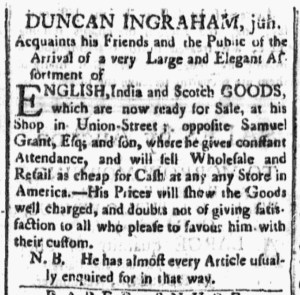
Massachusetts Spy (October 8, 1772).

“He has almost every Article usually enquired for in that way.”

In the fall of 1772, Duncan Ingraham, Jr., took to the pages of the Massachusetts Spy to promote “a very Large and Elegant Assortment of ENGLISH, India and Scotch GOODS, which are now ready for Sale, at his Shop” on Union Street in Boston.  In an advertisement that ran in the October 8 edition, he made appeals to both price and choice in his efforts to entice consumers to shop at his establishment.  Ingraham made bold claims in both regards.  He trumpeted that he would “sell Wholesale and Retail as cheap for Cash [as] at any Store in America,” comparing his prices to those in other shops in Boston as well as Charleston, New York, Philadelphia, and other ports throughout the colonies.  Ingraham confidently stated that “His Prices will show the Goods well charged.”  In turn, he “doubts not of giving satisfaction to all who please to favour him with their custom.”

He had many competitors in Boston, including several who advertised in the Massachusetts Gazette and Boston Weekly News-Letter on the same day.  Herman Brimmer and Andrew Brimmer, Caleb Blanchard, Joshua Gardner, and William Jackson all placed advertisements that listed dozens of imported items available at their shops, demonstrating an array of choices for prospective customers.  The partnership of Amorys, Taylor, and Rogers also published what amounted to a catalog of their merchandise under a headline that promised “GOODS EXTREMELY CHEAP.”  Ingraham adopted a different strategy, choosing instead to market his “very Large and Elegant Assortment” of goods with a nota bene in which he declared that he “has almost every Article usually enquired for in that way.”  He left it to readers to imagine his merchandise on their own.  Even if he did not happen to carry an item a shopper desired, if such a bold claim managed to get them into his store, then he still had an opportunity to make a sale by recommending alternatives.

Ingraham may not have wished to pay to insert a lengthy list of his inventory in the public prints, but that did not mean that he did not attend to consumer choice in an effort to make himself competitive with other merchants and shopkeepers.  In some ways, he invocation of “almost every Article usually enquired for” made even bigger claims than the extensive lists in other advertisements.

October 10

What was advertised in a colonial American newspaper 250 years ago today?

Providence Gazette (October 10, 1772).

“The Shop of Holden and Grainger, Taylors, was broke open.”

Advertisements in eighteenth-century newspapers sometimes served as precursors to police blotters that recorded crimes in later centuries.  In particular, they most often provided details about burglaries, in part because the victims offered rewards for the return of stolen goods and the conviction of the culprits.

Two burglaries occurred in Providence on the night of September 22, 1772.  Perhaps the same “Thief or Thieves” perpetrated both crimes.  William Barton reported his shop “was broke open, and robbed of … five new Beaver Hats, not coloured; one second handed Hat, cut in the new Fashion; and one Cloth coloured Surtout, with Basket Buttons.”  Similarly, tailors Holden and Grainger declared that their shop “was broke open” and an even greater array of items taken.  The details that the tailors provided would have made it easy to identify the stolen goods, including “one Suit of Claret coloured Broadcloth, not finished, the Lining nearly of the same Colour, with Leather Pockets, a Pocket in the Lining of the left Forebody, having Gold Basket Buttons, and Gold Knee-straps, the Breeches not lined” and “a light grey Broadcloth lapelled Jacket, with Basket Buttons of the same Colour, partly worn, having new Lining to the Skirts, and Tow-cloth Pockets.”  Holden and Grainger also stated that “the same Shop was broke open” near the end of August.  Unfortunately for Barton, that had been the case for his shop as well.  The “Thief or Thieves” may have kept some or all of the stolen items for themselves, but they more likely fenced them.  The articles then entered what Serena Zabin has called an “informal economy” that made participating in the consumer revolution more accessible to the lower sorts – free, indentured, and enslaved – who did not have the means to purchase new goods directly from shopkeepers who retailed them or artisans who produced them.

Barton offered a reward of fifteen dollars for apprehending the burglars or five dollars for recovering the stolen articles.  Similarly, Holden and Grainger promised twelve dollars to “Whoever apprehends the Thief or Thieves” and six dollars for the stolen items.  They also decided to take advantage of placing their notice in the Providence Gazette by concluding with a nota bene that informed the public that they “have for Sale choice Deer Skins, and ready made Breeches, cheap for Cash or Grain.”  Like many other advertisers, they placed an advertisement with more than one purpose.  As long as they had the public’s attention, they figured they could benefit from promoting their services in addition to seeking assistance in recovering their stolen goods.

Slavery Advertisements Published October 10, 1772

GUEST CURATOR: Julia Tardugno

The Slavery Adverts 250 Project chronicles the role of newspaper advertising in perpetuating slavery in the era of the American Revolution. The project seeks to reveal the ubiquity of slavery in eighteenth-century life from New England to Georgia by republishing advertisements about enslaved people – for sale as individuals or in groups, wanted to purchase or for hire for short periods, runaways who liberated themselves, and those who were subsequently captured and confined in jails and workhouses – in daily digests on this site as well as in real time via the @SlaveAdverts250 Twitter feed, utilizing twenty-first-century media to stand in for the print media of the eighteenth century.

The project aims to provide modern audiences with a sense of just how often colonizers encountered these advertisements in their daily lives. Enslaved men, women, and children appeared in print somewhere in the colonies almost every single day. Those advertisements served as a constant backdrop for social, cultural, economic, and political life in colonial and revolutionary America. Colonizers who did not purport to own enslaved people were still confronted with slavery as well as invited to maintain the system by purchasing enslaved men, women, and children or assisting in the capture of so-called “runaways” who sought to free themselves from bondage. The frequency of these newspaper advertisements suggests just how embedded slavery was in colonial and revolutionary American culture in everyday interactions beyond the printed page.

These advertisements also testify to the experiences of enslaved men, women, and children, though readers must consider that those experiences have been remediated through descriptions offered by enslavers rather than enslaved people themselves. Often unnamed in the advertisements, enslaved men, women, and children were not invisible or unimportant in early America.

From compiling an archive of digitized eighteenth-century newspapers to identifying advertisements about enslaved men, women, and children in those newspapers to preparing images of each advertisement to posting this daily digest, Julia Tardugno served as guest curator for this entry. She completed this work as part of the Summer Scholars Program, funded by a fellowship from the D’Amour College of Liberal Arts and Sciences at Assumption University in Worcester, Massachusetts, in Summer 2022. 

These advertisements appeared in colonial American newspapers 250 years ago today.

Pennsylvania Chronicle (October 10, 1772).

**********

Pennsylvania Chronicle (October 10, 1772).

October 9

What was advertised in a colonial American newspaper 250 years ago today?

New-London Gazette (October 9, 1772).

“Staffordshire and Liverpool Warehouse, in Kingstreet, BOSTON.”

Ebenezer Bridgham continued his efforts to create a regional market for his “Staffordshire and Liverpool Warehouse” in Boston with an advertisement in the October 9, 1772, edition of the New-London Gazette.  That advertisement featured copy identical to a notice in the October 2 edition of the New-Hampshire Gazette, though the compositors in the two printing offices made very different decisions about the format of the advertisements.  Bridgham’s advertisement ran a second time in the New-Hampshire Gazette (less the headline announcing “Crockery Ware”) the same day that it first appeared in the New-London Gazette.  He likely dispatched letters to the printing offices on the same day, but, given the distance, the New-London Gazette received its letter later and published his advertisement in the next edition after its arrival.

With advertisements in newspapers in Connecticut and New Hampshire in the fall of 1772, Bridgham continued a project that commenced more than a year earlier with advertisements in the Connecticut Courant, the Essex Gazette, and the Providence Gazette in September 1771.  He added the New-London Gazette the next month.  He placed a subsequent notice in the Connecticut Courant in June 1772, but he did not pursue the same coordinated campaign that he launched in the fall of 1771.  Although his “Crockery Ware” advertisement appeared in both the New-London Gazette and the New-Hampshire Gazette in early October 1772, it did not run in the other newspapers at that time.

That may have been the result of Bridgham learning which advertisements in which newspapers generated orders from country shopkeepers and other customers … and which did not.  His prior experience may have constituted a rudimentary form of market research that guided his decisions about where to focus his advertising efforts.  Alternately, Bridgham may have been delinquent in submitting payment for his advertisements, causing printers not to run them until he settled his debts.  His “Crockery Ware” advertisement eventually ran in Hartford’s Connecticut Courant on November 17.  In February 1772, Ebenezer Watson, printer of the Connecticut Courant, inserted a notice that “No Advertisements will for the future be published in this paper, without the money is first paid.”  The delay in publishing Bridgham’s “Crockery Ware” advertisement may have been due to waiting for payment.  Beyond these possibilities, Bridgham may have been haphazard in submitting his “Crockery Ware” advertisement to various printing offices.  If so, that deviated from the coordination he demonstrated in the fall of 1771.

Slavery Advertisements Published October 9, 1772

GUEST CURATOR: Julia Tardugno

The Slavery Adverts 250 Project chronicles the role of newspaper advertising in perpetuating slavery in the era of the American Revolution. The project seeks to reveal the ubiquity of slavery in eighteenth-century life from New England to Georgia by republishing advertisements about enslaved people – for sale as individuals or in groups, wanted to purchase or for hire for short periods, runaways who liberated themselves, and those who were subsequently captured and confined in jails and workhouses – in daily digests on this site as well as in real time via the @SlaveAdverts250 Twitter feed, utilizing twenty-first-century media to stand in for the print media of the eighteenth century.

The project aims to provide modern audiences with a sense of just how often colonizers encountered these advertisements in their daily lives. Enslaved men, women, and children appeared in print somewhere in the colonies almost every single day. Those advertisements served as a constant backdrop for social, cultural, economic, and political life in colonial and revolutionary America. Colonizers who did not purport to own enslaved people were still confronted with slavery as well as invited to maintain the system by purchasing enslaved men, women, and children or assisting in the capture of so-called “runaways” who sought to free themselves from bondage. The frequency of these newspaper advertisements suggests just how embedded slavery was in colonial and revolutionary American culture in everyday interactions beyond the printed page.

These advertisements also testify to the experiences of enslaved men, women, and children, though readers must consider that those experiences have been remediated through descriptions offered by enslavers rather than enslaved people themselves. Often unnamed in the advertisements, enslaved men, women, and children were not invisible or unimportant in early America.

From compiling an archive of digitized eighteenth-century newspapers to identifying advertisements about enslaved men, women, and children in those newspapers to preparing images of each advertisement to posting this daily digest, Julia Tardugno served as guest curator for this entry. She completed this work as part of the Summer Scholars Program, funded by a fellowship from the D’Amour College of Liberal Arts and Sciences at Assumption University in Worcester, Massachusetts, in Summer 2022. 

These advertisements appeared in colonial American newspapers 250 years ago today.

Connecticut Journal (October 9, 1772).

**********

New-Hampshire Gazette (October 9, 1772).

**********

New-London Gazette (October 9, 1772).

October 8

What was advertised in a colonial American newspaper 250 years ago today?

South-Carolina Gazette (October 8, 1772).

“Dancing & Fencing.”

“THE Sign of the Golden Cup.”

Mr. Pike, a dancing master, and Thomas You, a silversmith, both used graphic design to draw attention to their advertisements in the October 8, 1772, edition of the South-Carolina Gazette, yet they adopted different strategies.  Their notices further enlivened the vibrant graphic design that distinguished notices in that newspaper from those that ran in other newspapers.  The compositor for the South-Carolina Gazette made liberal use of varying font sizes, gothic letters for headlines, italics, capitals, and centering compared to advertisements.

That being the case, the compositor may have played a role in how the dancing master used decorative type and gothic letters to enhance his advertisement.  The headline “Dancing & Fencing” in gothic letters appeared inside a border composed of printing ornaments above a secondary headline spread over three lines: “PIKE’s ACADEMY / for / DANCING and FENCING.”  Compare that to a similar advertisement that Pike ran in the South-Carolina Gazette and Country Journal.  It featured only one headline, “DANCING and FENCING,” that did not appear in a different font than the rest of the advertisement.  Rather than constituting a second headline, “PIKE’s ACADEMY, for FENCING and DANCING” was part of the first paragraph of the advertisement.  An enterprising compositor at the South-Carolina Gazette likely played a significant role in designing Pike’s advertisement, perhaps assuming full responsibility without consulting the advertiser.

On the other hand, You almost certainly submitted instructions to include a woodcut depicting a golden cup in his advertisement for the merchandise he sold at the “Sign of the Golden Cup.”  You commissioned that image for his exclusive use, previously inserting it in advertisements in the South-Carolina Gazette in December 1770 and March 1771.  Prior to that, he used a different woodcut in his advertisements in December 1766 and July 1767.  He seemed to appreciate that images helped draw attention to his notices.  How to incorporate an image, however, he may have left to the discretion of the compositor.  In 1772, his woodcut of a golden cup appeared in the center, flanked by his name and location.  In earlier advertisements, it was positioned to the left, replicating the placement of woodcuts depicting ships that adorned other notices.

The advertisements in the South-Carolina Gazette testify to both the role of the compositor in designing newspaper notices and occasional collaboration or consultation involving both the compositor and the advertiser.  Rather than dense text, variations abounded in the advertisements in that newspaper, making the South-Carolina Gazette one of the most visually interesting publications in the early 1770s.

Slavery Advertisements Published October 8, 1772

GUEST CURATOR: Julia Tardugno

The Slavery Adverts 250 Project chronicles the role of newspaper advertising in perpetuating slavery in the era of the American Revolution. The project seeks to reveal the ubiquity of slavery in eighteenth-century life from New England to Georgia by republishing advertisements about enslaved people – for sale as individuals or in groups, wanted to purchase or for hire for short periods, runaways who liberated themselves, and those who were subsequently captured and confined in jails and workhouses – in daily digests on this site as well as in real time via the @SlaveAdverts250 Twitter feed, utilizing twenty-first-century media to stand in for the print media of the eighteenth century.

The project aims to provide modern audiences with a sense of just how often colonizers encountered these advertisements in their daily lives. Enslaved men, women, and children appeared in print somewhere in the colonies almost every single day. Those advertisements served as a constant backdrop for social, cultural, economic, and political life in colonial and revolutionary America. Colonizers who did not purport to own enslaved people were still confronted with slavery as well as invited to maintain the system by purchasing enslaved men, women, and children or assisting in the capture of so-called “runaways” who sought to free themselves from bondage. The frequency of these newspaper advertisements suggests just how embedded slavery was in colonial and revolutionary American culture in everyday interactions beyond the printed page.

These advertisements also testify to the experiences of enslaved men, women, and children, though readers must consider that those experiences have been remediated through descriptions offered by enslavers rather than enslaved people themselves. Often unnamed in the advertisements, enslaved men, women, and children were not invisible or unimportant in early America.

From compiling an archive of digitized eighteenth-century newspapers to identifying advertisements about enslaved men, women, and children in those newspapers to preparing images of each advertisement to posting this daily digest, Julia Tardugno served as guest curator for this entry. She completed this work as part of the Summer Scholars Program, funded by a fellowship from the D’Amour College of Liberal Arts and Sciences at Assumption University in Worcester, Massachusetts, in Summer 2022. 

These advertisements appeared in colonial American newspapers 250 years ago today.

Maryland Gazette (October 8, 1772).

**********

Maryland Gazette (October 8, 1772).

**********

Maryland Gazette (October 8, 1772).

**********

Maryland Gazette (October 8, 1772).

**********

Maryland Gazette (October 8, 1772).

**********

Massachusetts Gazette and Boston Weekly News-Letter (October 8, 1772).

**********

New-York Journal (October 8, 1772).

**********

New-York Journal (October 8, 1772).

**********

New-York Journal (October 8, 1772).

**********

New-York Journal (October 8, 1772).

**********

South-Carolina Gazette (October 8, 1772).

**********

South-Carolina Gazette (October 8, 1772).

**********

South-Carolina Gazette (October 8, 1772).

**********

South-Carolina Gazette (October 8, 1772).

**********

Supplement to the South-Carolina Gazette (October 8, 1772).

**********

Supplement to the South-Carolina Gazette (October 8, 1772).

**********

Virginia Gazette [Purdie and Dixon] (October 8, 1772).

**********

Virginia Gazette [Purdie and Dixon] (October 8, 1772).

**********

Virginia Gazette [Purdie and Dixon] (October 8, 1772).

**********

Virginia Gazette [Purdie and Dixon] (October 8, 1772).

**********

Virginia Gazette [Purdie and Dixon] (October 8, 1772).

**********

Virginia Gazette [Purdie and Dixon] (October 8, 1772).

***********

Virginia Gazette [Purdie and Dixon] (October 8, 1772).

**********

Virginia Gazette [Purdie and Dixon] (October 8, 1772).

**********

Virginia Gazette [Purdie and Dixon] (October 8, 1772).

**********

Virginia Gazette [Purdie and Dixon] (October 8, 1772).

**********

Virginia Gazette [Purdie and Dixon] (October 8, 1772).

**********

Virginia Gazette [Purdie and Dixon] (October 8, 1772).

**********

Virginia Gazette [Purdie and Dixon] (October 8, 1772).

**********

Virginia Gazette [Purdie and Dixon] (October 8, 1772).

**********

Virginia Gazette [Purdie and Dixon] (October 8, 1772).

**********

Virginia Gazette [Rind] (October 8, 1772).

**********

Virginia Gazette [Rind] (October 8, 1772).

*********

Virginia Gazette [Rind] (October 8, 1772).

**********

Virginia Gazette [Rind] (October 8, 1772).

**********

Virginia Gazette [Rind] (October 8, 1772).

***********

Virginia Gazette [Rind] (October 8, 1772).

*********

Virginia Gazette [Rind] (October 8, 1772).

**********

Virginia Gazette [Rind] (October 8, 1772).

October 7

What was advertised in a colonial American newspaper 250 years ago today?

Pennsylvania Gazette (October 7, 1772).

“A quantity of large and small silver work.”

In the fall of 1772, John David, a goldsmith, placed an advertisement in the Pennsylvania Gazette to inform prospective customers that he recently imported a “Neat Assortment of JEWELLERY” as well as a “quantity of large and small silver work.”  To entice consumers, he provided some examples of the merchandise they would find at his shop near the drawbridge in Philadelphia.  The jewelry included “paste shoe, knee, and stock buckles,” “stone sleeve buttons, of different sorts,” “coral necklaces,” and “very neat paste and garnet ear-rings.”  He also stocked “silver soup and punch ladles” and “silver and steel top thimbles.”  He pledged that he would “dispose of” these goods “on the most reasonable terms,” leveraging price in his effort to attract customers.

David used an image of a silver teapot to draw attention to his advertisement.  The woodcut occupied the left third of his advertisement, accounting for a significant amount of the space he purchased in the Pennsylvania Gazette.  In addition, he paid to have the image created for his exclusive use.  Of the fifty advertisements that appeared in the October 7, 1772, edition of the Pennsylvania Gazette, only four included an image. The other three all used stock images of ships at sea in notices that alerted readers of ships seeking passengers and freight.  The printer provided those familiar woodcuts.  In contrast, David made special arrangements for his image of a silver teapot, an image not previously seen by readers of any of the newspapers published in Philadelphia at the time.

The use of images commissioned by advertisers seemed to accelerate in the early 1770s compared to their frequency in newspapers in earlier decades, especially newspapers published in major urban ports.  As merchants, shopkeepers, artisans, and other entrepreneurs experimented with marketing strategies, a growing number decided that visual images augmented advertising copy.  Images commissioned for the exclusive use of particular advertisers remained relatively rare compared to the overall volume of advertising, due to both cost and technology, yet more advertisers decided to enhance their newspaper notices with images that replicated their shop signs or depicted their merchandise.

Slavery Advertisements Published October 7, 1772

GUEST CURATOR: Julia Tardugno

The Slavery Adverts 250 Project chronicles the role of newspaper advertising in perpetuating slavery in the era of the American Revolution. The project seeks to reveal the ubiquity of slavery in eighteenth-century life from New England to Georgia by republishing advertisements about enslaved people – for sale as individuals or in groups, wanted to purchase or for hire for short periods, runaways who liberated themselves, and those who were subsequently captured and confined in jails and workhouses – in daily digests on this site as well as in real time via the @SlaveAdverts250 Twitter feed, utilizing twenty-first-century media to stand in for the print media of the eighteenth century.

The project aims to provide modern audiences with a sense of just how often colonizers encountered these advertisements in their daily lives. Enslaved men, women, and children appeared in print somewhere in the colonies almost every single day. Those advertisements served as a constant backdrop for social, cultural, economic, and political life in colonial and revolutionary America. Colonizers who did not purport to own enslaved people were still confronted with slavery as well as invited to maintain the system by purchasing enslaved men, women, and children or assisting in the capture of so-called “runaways” who sought to free themselves from bondage. The frequency of these newspaper advertisements suggests just how embedded slavery was in colonial and revolutionary American culture in everyday interactions beyond the printed page.

These advertisements also testify to the experiences of enslaved men, women, and children, though readers must consider that those experiences have been remediated through descriptions offered by enslavers rather than enslaved people themselves. Often unnamed in the advertisements, enslaved men, women, and children were not invisible or unimportant in early America.

From compiling an archive of digitized eighteenth-century newspapers to identifying advertisements about enslaved men, women, and children in those newspapers to preparing images of each advertisement to posting this daily digest, Julia Tardugno served as guest curator for this entry. She completed this work as part of the Summer Scholars Program, funded by a fellowship from the D’Amour College of Liberal Arts and Sciences at Assumption University in Worcester, Massachusetts, in Summer 2022. 

These advertisements appeared in colonial American newspapers 250 years ago today.

Pennsylvania Gazette (October 7, 1772).

**********

Pennsylvania Gazette (October 7, 1772).

**********

Pennsylvania Gazette (October 7, 1772).

**********

Pennsylvania Gazette (October 7, 1772).

**********

Pennsylvania Journal (October 7, 1772).

**********

Pennsylvania Journal (October 7, 1772).

October 6

What was advertised in a colonial American newspaper 250 years ago today?

South-Carolina Gazette and Country Journal (October 6, 1772).

“Advertisements omitted this Week, for want of Room, shall be in our next.”

Charles Crouch had more content than would fit in the September 29, 1772, edition of the South-Carolina Gazette and Country Journal.  To resolve the dilemma, he inserted a notice advising that “Sundry NEW ADVERTISEMENTS omitted this Week, in order to give Place to the LONDON NEWS, &c. shall have particular notice in our next.”  The following week, the October 6 edition consisted almost entirely of advertising.  A header for “NEW ADVERTISEMENTS” ran at the top of the first column on the first page.  Advertisements filled all three columns on that page.  Another header for “NEW ADVERTISEMENTS” appeared midway down the final column of the second page.  The first two and half columns featured news items, but the remainder of the second column as well as the entire third and fourth pages consisted entirely of advertising.  Crouch presumably made sure that “Sundry NEW ADVERTISEMENTS” that he omitted in the previous issue did indeed run in the October 6 edition.

Still, he found himself once again in the position of not having sufficient space to publish all of the advertisements received in the printing office.  He inserted a notice at the bottom of the final column on the third page: “Advertisements omitted this Week, for want of Room, shall be in our next.”  Why did the notice appear there instead of the bottom of the last page?  Understanding the process for producing newspapers on manually-operated presses reveals the answer.  A standard issue of the South-Carolina Gazette and Country Journal (and other colonial newspapers) consisted of four pages created by printing two pages on each side of a broadsheet and then folding it in half.  Printers often produced the first and last pages first.  After the ink dried, they then printed the second and third pages on the other side of the sheet.  In his effort to give the advertisements omitted the previous week “particular Notice” in the October 6 edition, Crouch printed them first, placing them on the first page.  Other new advertisements also ran on the fourth page, interspersed with notices that appeared in previous editions.  Crouch made publishing all of those advertisements a priority.  He also made advertisements a priority for the second and third pages, though he realized that subscribers who expected to receive news would not be satisfied with an issue that served solely as a mechanism for delivering advertisements.  He opted for a couple of columns of news on the second page before filling the rest of the newspaper with advertisements.  The notice at the bottom of the final column on the third page would have been the last of the type set and placed into position for the October 6 edition once Crouch determined that he did not have space for all the advertisements he intended to publish.

Crouch did have other options.  He could have produced an advertising supplement to accompany the September 29 edition or the October 6 edition or both.  He may have decided, however, that he did not have enough additional content to warrant doing so.  He may not have had the time to print a supplement.  He may not have considered doing so worth the resources required.  He apparently believed that advertisers would be patient with a short delay, though he made certain to acknowledge that he owed them space in his newspaper.