Slavery Advertisements Published October 22, 1772

GUEST CURATOR: Julia Tardugno

The Slavery Adverts 250 Project chronicles the role of newspaper advertising in perpetuating slavery in the era of the American Revolution. The project seeks to reveal the ubiquity of slavery in eighteenth-century life from New England to Georgia by republishing advertisements about enslaved people – for sale as individuals or in groups, wanted to purchase or for hire for short periods, runaways who liberated themselves, and those who were subsequently captured and confined in jails and workhouses – in daily digests on this site as well as in real time via the @SlaveAdverts250 Twitter feed, utilizing twenty-first-century media to stand in for the print media of the eighteenth century.

The project aims to provide modern audiences with a sense of just how often colonizers encountered these advertisements in their daily lives. Enslaved men, women, and children appeared in print somewhere in the colonies almost every single day. Those advertisements served as a constant backdrop for social, cultural, economic, and political life in colonial and revolutionary America. Colonizers who did not purport to own enslaved people were still confronted with slavery as well as invited to maintain the system by purchasing enslaved men, women, and children or assisting in the capture of so-called “runaways” who sought to free themselves from bondage. The frequency of these newspaper advertisements suggests just how embedded slavery was in colonial and revolutionary American culture in everyday interactions beyond the printed page.

These advertisements also testify to the experiences of enslaved men, women, and children, though readers must consider that those experiences have been remediated through descriptions offered by enslavers rather than enslaved people themselves. Often unnamed in the advertisements, enslaved men, women, and children were not invisible or unimportant in early America.

From compiling an archive of digitized eighteenth-century newspapers to identifying advertisements about enslaved men, women, and children in those newspapers to preparing images of each advertisement to posting this daily digest, Julia Tardugno served as guest curator for this entry. She completed this work as part of the Summer Scholars Program, funded by a fellowship from the D’Amour College of Liberal Arts and Sciences at Assumption University in Worcester, Massachusetts, in Summer 2022. 

These advertisements appeared in colonial American newspapers 250 years ago today.

Maryland Gazette (October 22, 1772).

**********

Maryland Gazette (October 22, 1772).

**********
Maryland Gazette (October 22, 1772).

**********

Maryland Gazette (October 22, 1772).

**********

Massachusetts Gazette and Boston Weekly News-Letter (October 22, 1772).

**********

New-York Journal (October 22, 1772).

**********

New-York Journal (October 22, 1772).

**********

New-York Journal (October 22, 1772).

**********

New-York Journal (October 22, 1772).

**********

South-Carolina Gazette (October 22, 1772).

**********

South-Carolina Gazette (October 22, 1772).

**********

South-Carolina Gazette (October 22, 1772).

**********

South-Carolina Gazette (October 22, 1772).

**********

Supplement to the South-Carolina Gazette (October 22, 1772).

**********

Supplement to the South-Carolina Gazette (October 22, 1772).

**********

Supplement to the South-Carolina Gazette (October 22, 1772).

**********

Supplement to the South-Carolina Gazette (October 22, 1772).

**********

Supplement to the South-Carolina Gazette (October 22, 1772).

**********

Virginia Gazette [Purdie and Dixon] (October 22, 1772).

**********

Virginia Gazette [Purdie and Dixon] (October 22, 1772).

**********

Virginia Gazette [Purdie and Dixon] (October 22, 1772).

**********

Virginia Gazette [Purdie and Dixon] (October 22, 1772).

**********

Virginia Gazette [Purdie and Dixon] (October 22, 1772).

**********

Virginia Gazette [Purdie and Dixon] (October 22, 1772).

**********

Virginia Gazette [Purdie and Dixon] (October 22, 1772).

**********

Virginia Gazette [Purdie and Dixon] (October 22, 1772).

**********

Virginia Gazette [Purdie and Dixon] (October 22, 1772).

**********

Virginia Gazette [Purdie and Dixon] (October 22, 1772).

**********

Virginia Gazette [Purdie and Dixon] (October 22, 1772).

**********

Virginia Gazette [Rind] (October 22, 1772).

**********

Virginia Gazette [Rind] (October 22, 1772).

**********

Virginia Gazette [Rind] (October 22, 1772).

**********

Virginia Gazette [Rind] (October 22, 1772).

**********

Virginia Gazette [Rind] (October 22, 1772).

October 21

What was advertised in a colonial American newspaper 250 years ago today?

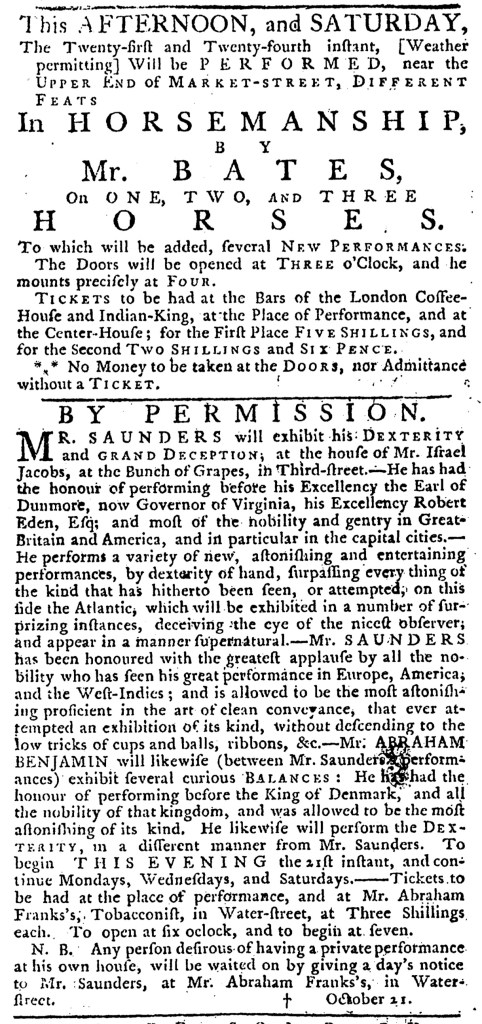
Pennsylvania Journal (October 21, 1772).

“MR. SAUNDERS will exhibit his DEXTERITY and GRAND DECEPTION.”

Newspaper advertisements help in revealing some of the entertainments enjoyed by colonizers in the eighteenth century.  For instance, two advertisements in the October 21, 1772, edition of the Pennsylvania Journal promoted upcoming performances and encouraged residents of Philadelphia to purchase tickets.  The first offered feats of “HORSEMANSHIP, BY Mr. BATES,” promising that he did tricks “On ONE, TWO, AND THREE HORSES.”  Bates and his act would have been familiar to regular readers at the time this advertisement appeared, so to entice anyone who had already seen the show to come again he proclaimed that he added “several NEW PERFORMANCES.”  Patrons needed to purchase tickets in advance since “No Money [would] be taken at the DOORS, nor Admittance without a TICKET,” yet they also received a discount for purchasing more than one.  The first ticket cost five shillings and the second only two shillings and six pence.  In other words, Bates advertised a “buy one, get one half off” promotion.

The other advertisement announced that “MR. SAUNDERS will exhibit his DEXTERITY and GRAND DECEPTION … at the Bunch of Grapes.”  Most likely, Hyman Saunders, the illusionist and itinerant performer who previously advertised in newspapers in both New York and Philadelphia, placed this notice.  He boasted that he “had the honour of performing before his Excellency the Earl of Dunmore, now Governor of Virginia … and most of the nobility and gentry in Great-Britain and America, and in particular in the capital cities.”  Saunders described his act as “dexterity by hand, surpassing everything of the kind that has hitherto been seen, or attempted, on this side of the Atlantic,” intending that such hyperbole would motivate readers to come to the show.  As a bonus, they would also see “Mr. ABRAHAM BENJAMIN … exhibit several curious BALANCES,” feats of “DEXTERITY, in a different manner from Mr. Saunders.”  Benjamin previously “had the honour of performing before the King of Denmark, and all the nobility of that kingdom.”  The pedigrees of both performers likely resonated with residents of Philadelphia who aspired to be as cosmopolitan as their counterparts in European cities.  Patrons could purchase tickets in advance at the Bunch of Grapes or “at Mr. Abraham Franks’s, Tobacconist.”  Saunders advised that performances would “continue [on] Mondays, Wednesdays, and Saturdays.”  Colonizers could also hire him for private performances in their own homes, entertaining themselves and guests fortunate enough to receive invitations.

Performers used newspaper advertisements to drum up interest in their performances in early America.  They likely resorted to handbills and broadsides as well, though those kinds of advertisements were more ephemeral.  Itinerant performers depended on publicity to draw audiences to their shows.  Even those who spent some time in town had to resort to promoting their acts to keep audiences coming or coming back for more.

Slavery Advertisements Published October 21, 1772

GUEST CURATOR: Julia Tardugno

The Slavery Adverts 250 Project chronicles the role of newspaper advertising in perpetuating slavery in the era of the American Revolution. The project seeks to reveal the ubiquity of slavery in eighteenth-century life from New England to Georgia by republishing advertisements about enslaved people – for sale as individuals or in groups, wanted to purchase or for hire for short periods, runaways who liberated themselves, and those who were subsequently captured and confined in jails and workhouses – in daily digests on this site as well as in real time via the @SlaveAdverts250 Twitter feed, utilizing twenty-first-century media to stand in for the print media of the eighteenth century.

The project aims to provide modern audiences with a sense of just how often colonizers encountered these advertisements in their daily lives. Enslaved men, women, and children appeared in print somewhere in the colonies almost every single day. Those advertisements served as a constant backdrop for social, cultural, economic, and political life in colonial and revolutionary America. Colonizers who did not purport to own enslaved people were still confronted with slavery as well as invited to maintain the system by purchasing enslaved men, women, and children or assisting in the capture of so-called “runaways” who sought to free themselves from bondage. The frequency of these newspaper advertisements suggests just how embedded slavery was in colonial and revolutionary American culture in everyday interactions beyond the printed page.

These advertisements also testify to the experiences of enslaved men, women, and children, though readers must consider that those experiences have been remediated through descriptions offered by enslavers rather than enslaved people themselves. Often unnamed in the advertisements, enslaved men, women, and children were not invisible or unimportant in early America.

From compiling an archive of digitized eighteenth-century newspapers to identifying advertisements about enslaved men, women, and children in those newspapers to preparing images of each advertisement to posting this daily digest, Julia Tardugno served as guest curator for this entry. She completed this work as part of the Summer Scholars Program, funded by a fellowship from the D’Amour College of Liberal Arts and Sciences at Assumption University in Worcester, Massachusetts, in Summer 2022. 

These advertisements appeared in colonial American newspapers 250 years ago today.

Pennsylvania Gazette (October 21, 1772).

**********

Pennsylvania Gazette (October 21, 1772).

**********

Pennsylvania Gazette (October 21, 1772).

**********

Pennsylvania Gazette (October 21, 1772).

**********

Pennsylvania Gazette (October 21, 1772).

**********

Supplement to the Pennsylvania Journal (October 21, 1772).

**********

Supplement to the Pennsylvania Journal (October 21, 1772).

**********

Supplement to the Pennsylvania Journal (October 21, 1772).

**********

Supplement to the Pennsylvania Journal (October 21, 1772).

October 20

What was advertised in a colonial American newspaper 250 years ago today?

Essex Gazette (October 20, 1772).

“At his Shop at the Head of Hippocrates, in SALEM.”

In the fall of 1772, Nathaniel Dabney’s name would have been familiar to regular readers of the Essex Gazette.  The apothecary frequently placed advertisements encouraging prospective customers to visit his shop “at the Head of Hippocrates, in SALEM.”  A woodcut that depicted a bust of the physician from ancient Greece, often known as the “Father of Medicine,” atop a pillar adorned many of his advertisements.  Rather than appearing in the upper left corner, as was often the case for woodcuts, the narrow image extended the length of Dabney’s advertisements.  The apothecary first incorporated the woodcut into his advertisements in the fall of 1771.

A year later, he opted to publish an advertisement that did not include his signature image, though he continued to associate the “Head of Hippocrates” with his business.  In this advertisement, he relied on a double headline.  “Fresh DRUGS” ran in a large font on the first line, followed by his name in an even larger font on the second line.  The copy suggested that his previous advertising efforts had been effective.  The apothecary “RETURNS his Thanks to those Persons in Town and Country, who have been pleased to favour him with their Custom.”  He then informed current and prospective customers that he just imported “a few Articles, which compleat his Assortment in the DRUG and GORCERY WAY.”  He sold them “very cheap” in “large or small Quantities.”

Why did Dabney decide not to use the woodcut that became so familiar to readers and served as a logo for his shop?  Perhaps he decided that he achieved sufficient visibility and name recognition that he no longer needed to include it in every advertisement.  The cost of advertising may have also influenced his decision.  The colophon for the Essex Gazette stated that “ADVERTISEMENTS not exceeding eight or ten Lines are inserted for Three Shillings.”  Advertisers paid by the amount of space their notices occupied, not the number of words.  Dabney’s long and narrow woodcut and the copy that accompanied it extended far beyond “eight or ten Lines.”  The apothecary may have determined that he wished to keep his name in the public eye without assuming the expense of printing the woodcut in each advertisement.

Slavery Advertisements Published October 20, 1772

GUEST CURATOR: Julia Tardugno

The Slavery Adverts 250 Project chronicles the role of newspaper advertising in perpetuating slavery in the era of the American Revolution. The project seeks to reveal the ubiquity of slavery in eighteenth-century life from New England to Georgia by republishing advertisements about enslaved people – for sale as individuals or in groups, wanted to purchase or for hire for short periods, runaways who liberated themselves, and those who were subsequently captured and confined in jails and workhouses – in daily digests on this site as well as in real time via the @SlaveAdverts250 Twitter feed, utilizing twenty-first-century media to stand in for the print media of the eighteenth century.

The project aims to provide modern audiences with a sense of just how often colonizers encountered these advertisements in their daily lives. Enslaved men, women, and children appeared in print somewhere in the colonies almost every single day. Those advertisements served as a constant backdrop for social, cultural, economic, and political life in colonial and revolutionary America. Colonizers who did not purport to own enslaved people were still confronted with slavery as well as invited to maintain the system by purchasing enslaved men, women, and children or assisting in the capture of so-called “runaways” who sought to free themselves from bondage. The frequency of these newspaper advertisements suggests just how embedded slavery was in colonial and revolutionary American culture in everyday interactions beyond the printed page.

These advertisements also testify to the experiences of enslaved men, women, and children, though readers must consider that those experiences have been remediated through descriptions offered by enslavers rather than enslaved people themselves. Often unnamed in the advertisements, enslaved men, women, and children were not invisible or unimportant in early America.

From compiling an archive of digitized eighteenth-century newspapers to identifying advertisements about enslaved men, women, and children in those newspapers to preparing images of each advertisement to posting this daily digest, Julia Tardugno served as guest curator for this entry. She completed this work as part of the Summer Scholars Program, funded by a fellowship from the D’Amour College of Liberal Arts and Sciences at Assumption University in Worcester, Massachusetts, in Summer 2022. 

These advertisements appeared in colonial American newspapers 250 years ago today.

Connecticut Courant (October 20, 1772).

**********

Essex Gazette (October 20, 1772).

**********

Essex Gazette (October 20, 1772).

**********

South-Carolina Gazette and Country Journal (October 20, 1772).

**********

South-Carolina Gazette and Country Journal (October 20, 1772).

**********

South-Carolina Gazette and Country Journal (October 20, 1772).

**********

South-Carolina Gazette and Country Journal (October 20, 1772).

**********

South-Carolina Gazette and Country Journal (October 20, 1772).

**********

South-Carolina Gazette and Country Journal (October 20, 1772).

**********

South-Carolina Gazette and Country Journal (October 20, 1772).

**********

South-Carolina Gazette and Country Journal (October 20, 1772).

October 19

What was advertised in a colonial American newspaper 250 years ago today?

Massachusetts Gazette and Boston Post-Boy (October 19, 1772).

“PROPOSALS For Re-Printing by Subscription … Baron de MONTESQUIEU’s celebrated Spirit of Laws.”

It would have been hard for readers to miss the subscription proposal that dominated the final page of the October 19, 1772, edition of the Massachusetts Gazette and Boston Post-Boy.  John Boyles announced his intention to publish an “American Edition” of the “Baron de MONTESQUIEU’s celebrated Sprit of the Laws,” a work of political philosophy “Which ought to be in EVERY MAN’s Hands.”  Boyles explained that the book had been “Translated from the French Original” as well as “translated and published in most of the civilized Nations of EUROPE.”  Colonizers who wished to participate in the transatlantic republic of letters needed to acquire copies of their own.  To make this particular edition even more attractive than imported alternatives, the publisher stated that it would include “a larger Account of the Life and Writings of the AUTHOR, than is in the European Editions.”

The format of the subscription proposal suggests that it may have been printed separately as a broadside or handbill, on paper of a different size, for distribution beyond subscribers to the Massachusetts Gazette and Boston Post-Boy.  If that was indeed the case, the compositor did not wish to set the type once again in order to insert the subscription proposal in the newspaper.  Its width exceeded two newspaper columns, causing the compositor to create a narrow third column by rotating the type for additional advertisements to run perpendicular to the page.  In the years immediately preceding the American Revolution, advertisers sometimes arranged to have book catalogues, broadsides, or handbills incorporated into newspapers, expanding the reach of their marketing efforts.  That being the case, I suspect that more advertising ephemera circulated in early America than has been identified and preserved in research libraries, historical societies, and private collections.  This subscription proposal in the Massachusetts Gazette and Boston Post-Boy hints at a hidden history of early American advertising impossible to recover in its entirety.  Although newspaper notices constituted, by the far, the most voluminous form of advertising in early America, other printed media likely circulated more frequently than previously realized.

Massachusetts Gazette and Boston Post-Boy (October 19, 1772).

Slavery Advertisements Published October 19, 1772

GUEST CURATOR: Julia Tardugno

The Slavery Adverts 250 Project chronicles the role of newspaper advertising in perpetuating slavery in the era of the American Revolution. The project seeks to reveal the ubiquity of slavery in eighteenth-century life from New England to Georgia by republishing advertisements about enslaved people – for sale as individuals or in groups, wanted to purchase or for hire for short periods, runaways who liberated themselves, and those who were subsequently captured and confined in jails and workhouses – in daily digests on this site as well as in real time via the @SlaveAdverts250 Twitter feed, utilizing twenty-first-century media to stand in for the print media of the eighteenth century.

The project aims to provide modern audiences with a sense of just how often colonizers encountered these advertisements in their daily lives. Enslaved men, women, and children appeared in print somewhere in the colonies almost every single day. Those advertisements served as a constant backdrop for social, cultural, economic, and political life in colonial and revolutionary America. Colonizers who did not purport to own enslaved people were still confronted with slavery as well as invited to maintain the system by purchasing enslaved men, women, and children or assisting in the capture of so-called “runaways” who sought to free themselves from bondage. The frequency of these newspaper advertisements suggests just how embedded slavery was in colonial and revolutionary American culture in everyday interactions beyond the printed page.

These advertisements also testify to the experiences of enslaved men, women, and children, though readers must consider that those experiences have been remediated through descriptions offered by enslavers rather than enslaved people themselves. Often unnamed in the advertisements, enslaved men, women, and children were not invisible or unimportant in early America.

From compiling an archive of digitized eighteenth-century newspapers to identifying advertisements about enslaved men, women, and children in those newspapers to preparing images of each advertisement to posting this daily digest, Julia Tardugno served as guest curator for this entry. She completed this work as part of the Summer Scholars Program, funded by a fellowship from the D’Amour College of Liberal Arts and Sciences at Assumption University in Worcester, Massachusetts, in Summer 2022. 

These advertisements appeared in colonial American newspapers 250 years ago today.

Boston Evening-Post (October 19, 1772).

**********

Boston Evening-Post (October 19, 1772).

**********

Boston-Gazette (October 19, 1772).

**********

Boston-Gazette (October 19, 1772).

**********

New-York Gazette and Weekly Mercury (October 19, 1772).

**********

New-York Gazette and Weekly Mercury (October 19, 1772).

**********

Supplement to the New-York Gazette and Weekly Mercury (October 19, 1772).

**********

Supplement to the New-York Gazette and Weekly Mercury (October 19, 1772).

**********

Newport Mercury (October 19, 1772).

**********

Pennsylvania Packet (October 19, 1772).

**********

Pennsylvania Packet (October 19, 1772).

**********

South-Carolina and American General Gazette (October 19, 1772).

**********

South-Carolina and American General Gazette (October 19, 1772).

**********

South-Carolina and American General Gazette (October 19, 1772).

**********

South-Carolina and American General Gazette (October 19, 1772).

**********

South-Carolina and American General Gazette (October 19, 1772).

**********

South-Carolina and American General Gazette (October 19, 1772).

**********

South-Carolina and American General Gazette (October 19, 1772).

**********

South-Carolina and American General Gazette (October 19, 1772).

**********

South-Carolina and American General Gazette (October 19, 1772).

**********

South-Carolina and American General Gazette (October 19, 1772).

October 18

What was advertised in a colonial American newspaper 250 years ago this week?

Massachusetts Spy (October 15, 1772).

“The least favours gratefully acknowledged.”

John Langdon deployed a variety of strategies for marketing his inventory at the “New Book-Store” in Boston in the fall of 1772.  Like many other retailers, he emphasized the choices that he provided for consumers.  In an advertisement in the October 15 edition of the Massachusetts Spy, the bookseller informed prospective customers that he recently imported a “LARGE and Grand Assortment of BOOKS in all Arts and Sciences.”  Those new titles supplemented those he already had in stock.  He confidently proclaimed that he now offered “as large a collection as is to be found at any Store in America.”  His selection supposedly rivaled what consumers would encounter in shops in urban ports like Charleston, New York, and Philadelphia as well as in the shops operated by local competitors.  Langdon intended for that bold claim to double as an invitation for prospective customers to browse in his shop and discover titles of interest among his extensive inventory for themselves.

In addition, thew bookseller made appeals to price and customer service.  He explained that he planned to depart for England in the spring.  As a result, he wished to sell his inventory over the course of the next several months.  To do so, he set low prices.  Langdon pledged that “every Gentleman who may please to favour him with their custom may depend on purchasing at a little more than the sterling cost and charges.”  In other words, he did not mark up the prices exorbitantly but instead sought to make only a small profit on each book he sold.  Langdon concluded his advertisement with a note that the “least favours [are] gratefully acknowledged.”  He appreciated any business, no matter how large or small the transaction.  Even though he had such a large inventory, no purchase … and no customer … was insignificant. Langdon intended to cultivate relationships with everyone who entered his shop.

Langdon’s advertisement for the New Book-Store was no mere announcement that he sold books.  Instead, he crafted a notice that incorporated multiple marketing strategies.  He emphasized the size of his inventory, his motivation for setting low prices, and the importance of every customer in his effort to encourage consumers to acquire books from him.

October 17

What was advertised in a colonial American newspaper 250 years ago today?

Pennsylvania Chronicle (October 17, 1772).

“It is needless to mention a long list of peoples’ names … [and] what great benefit they have received by the proper use of this Balsam.”

Advertisements for patent medicines frequently appeared in newspapers throughout the colonies.  The Pennsylvania Chronicle carried them, including a notice promoting “Dr. HILL’s American Balsam” on October 17, 1772.  William Young provided a brief and enthusiastic overview of the remedy’s effectiveness, boldly proclaiming that “IT is known, by experiment, that this Balsam is one of the most excellent medicines ever before prepared since the creation of the world, for colds, coughs, consumptions, swimming in the head, rheumatism, pain, gravel, sore throat,” and many other ailments.

Young indicated that he could have produced testimonials, but he considered doing so unnecessary given the reputation of Dr. Hill’s American Balsam.  He reported that “great numbers of people in this and the neighbouring provinces” who had “made trial” of the medicine could confirm its efficacy, yet be believed it “needless to mention a long list of peoples’ names and their residences, who have earnestly desired it might be published for the good of their fellow-creatures.”  Instead, Young underscored “what great benefit they have received by the proper use of this Balsam, when all other medicines have been used in vain.”

That strategy differed from the one deployed by Nicholas Brooks in promoting Maredant’s Drops in the Pennsylvania Gazette earlier in the year.  Brooks published the names of several people “cured by Maredant’s drops” as well as detailed testimonials written by two satisfied customers.  In contrast, Young suggested that there were so many customers whose symptoms had been alleviated by Dr. Hill’s American Balsam that listing their names would have been superfluous.  Whether or not he could have published such a list seemed less important to him than asserting how many people supposedly encouraged him to do so.  That left it prospective customers to imagine for themselves how many patients benefited from the medicine.  In choosing not to publish any specifics, neither names nor testimonials, Young invited readers to envision even grander stories about the effectiveness of Dr. Hill’s American Balsam than he could have compiled in a newspaper advertisement.

Slavery Advertisements Published October 17, 1772

GUEST CURATOR: Julia Tardugno

The Slavery Adverts 250 Project chronicles the role of newspaper advertising in perpetuating slavery in the era of the American Revolution. The project seeks to reveal the ubiquity of slavery in eighteenth-century life from New England to Georgia by republishing advertisements about enslaved people – for sale as individuals or in groups, wanted to purchase or for hire for short periods, runaways who liberated themselves, and those who were subsequently captured and confined in jails and workhouses – in daily digests on this site as well as in real time via the @SlaveAdverts250 Twitter feed, utilizing twenty-first-century media to stand in for the print media of the eighteenth century.

The project aims to provide modern audiences with a sense of just how often colonizers encountered these advertisements in their daily lives. Enslaved men, women, and children appeared in print somewhere in the colonies almost every single day. Those advertisements served as a constant backdrop for social, cultural, economic, and political life in colonial and revolutionary America. Colonizers who did not purport to own enslaved people were still confronted with slavery as well as invited to maintain the system by purchasing enslaved men, women, and children or assisting in the capture of so-called “runaways” who sought to free themselves from bondage. The frequency of these newspaper advertisements suggests just how embedded slavery was in colonial and revolutionary American culture in everyday interactions beyond the printed page.

These advertisements also testify to the experiences of enslaved men, women, and children, though readers must consider that those experiences have been remediated through descriptions offered by enslavers rather than enslaved people themselves. Often unnamed in the advertisements, enslaved men, women, and children were not invisible or unimportant in early America.

From compiling an archive of digitized eighteenth-century newspapers to identifying advertisements about enslaved men, women, and children in those newspapers to preparing images of each advertisement to posting this daily digest, Julia Tardugno served as guest curator for this entry. She completed this work as part of the Summer Scholars Program, funded by a fellowship from the D’Amour College of Liberal Arts and Sciences at Assumption University in Worcester, Massachusetts, in Summer 2022. 

These advertisements appeared in colonial American newspapers 250 years ago today.

Pennsylvania Chronicle (October 17, 1772).

**********

Pennsylvania Chronicle (October 17, 1772).

**********

Pennsylvania Chronicle (October 17, 1772).