January 21

What was advertised in a colonial American newspaper 250 years ago today?

Providence Gazette (January 21, 1775).

“TO be Sold, by Order of the Committee of Inspection … sundry Merchandize.”

In December 1774 and January 1775, newspaper advertisements became records of compliance with the provisions of the Continental Association, a nonimportation, nonconsumption, and nonexportation agreement adopted by the First Continental Congress when it met in Philadelphia in September and October 1774.  The tenth article of the Continental Association made provisions for goods that arrived during the months December 1774 and January 1775, items that likely had been shipped before American merchants and shopkeepers could cancel orders previously dispatched across the Atlantic.  The importers could return those goods, turn them over to the local Committee of Inspection to store until the boycott ended, or have the committee sell them, reimburse the importer for costs, and designate any profits for relief of residents of Boston.  For the sake of both transparency and compliance, the tenth article also specified that “a particular Account [be] inserted in the publick Papers.”

Such was the case when James Angell, “Clerk of the Committee,” inserted an advertisement in the January 21, 1775, edition of the Providence Gazette.  That notice announced the upcoming sale of “sundry Merchandize, imported from Great Britain, via New-York.”  That included “6 Tierces [large barrels], 3 Barrels, 5 Bales, 2 Boxes, 1 Hamper, [and] 24 Crates” of unspecified goods as well as “1 Bundle, containing 2 Dozen of Frying Pans” and “8 Bundles, containing 4 Dozen of Iron Shovels.”  As was the case in similar advertisements in other newspapers, the Committee of Inspection did not provide the same extensive catalog of merchandise that merchants and shopkeepers often did to attract the attention of prospective customers when they composed their own newspaper notices.  The committee merely made clear that a notable quantity of items would go up for sale.  The goods “were shipped at Liverpool on board the Ship Daniel, Capt. Casey, the 15th of September, and arrived at New-York since the first Day of December last.”  That accounting made clear that the items had been ordered and shipped before the First Continental Congress agreed on the details of the Continental Association, yet since they arrived after that pact went into effect they fell under its jurisdiction.  On behalf of the Committee of Inspection, Angell decreed that the sale would occur “agreeable to the Association of the Continental Congress.”
Slavery Advertisements Published January 21, 1775

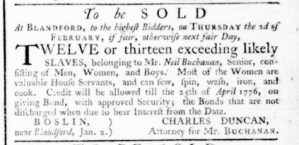
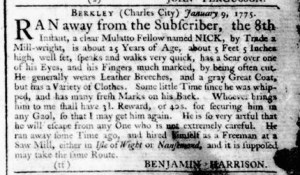
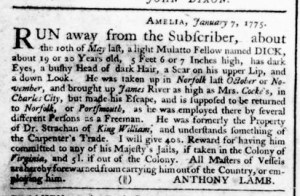
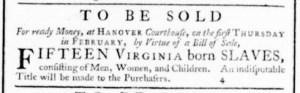
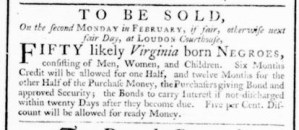
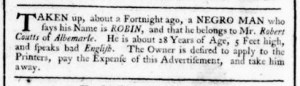
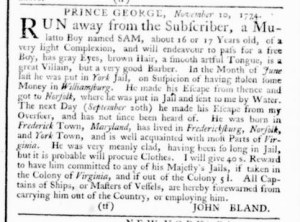
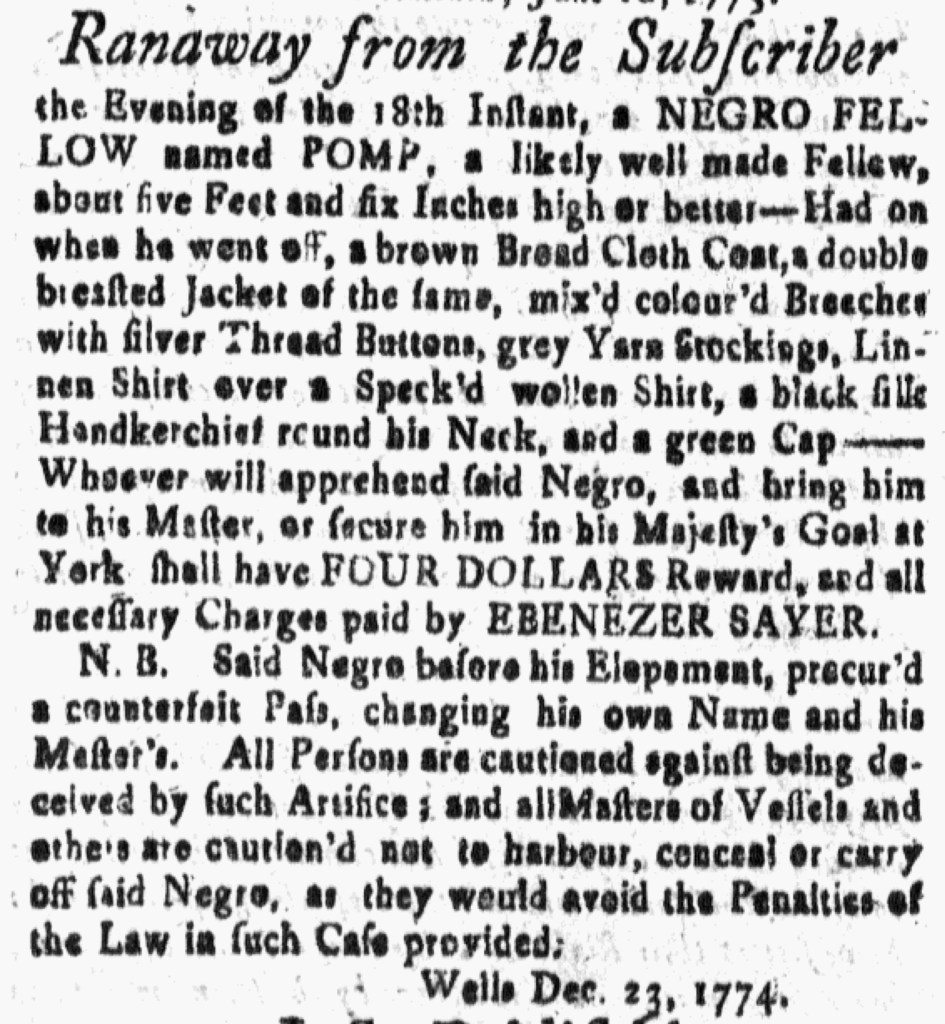
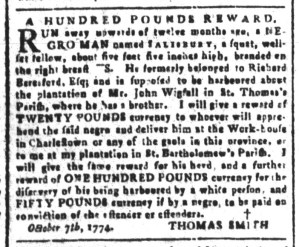
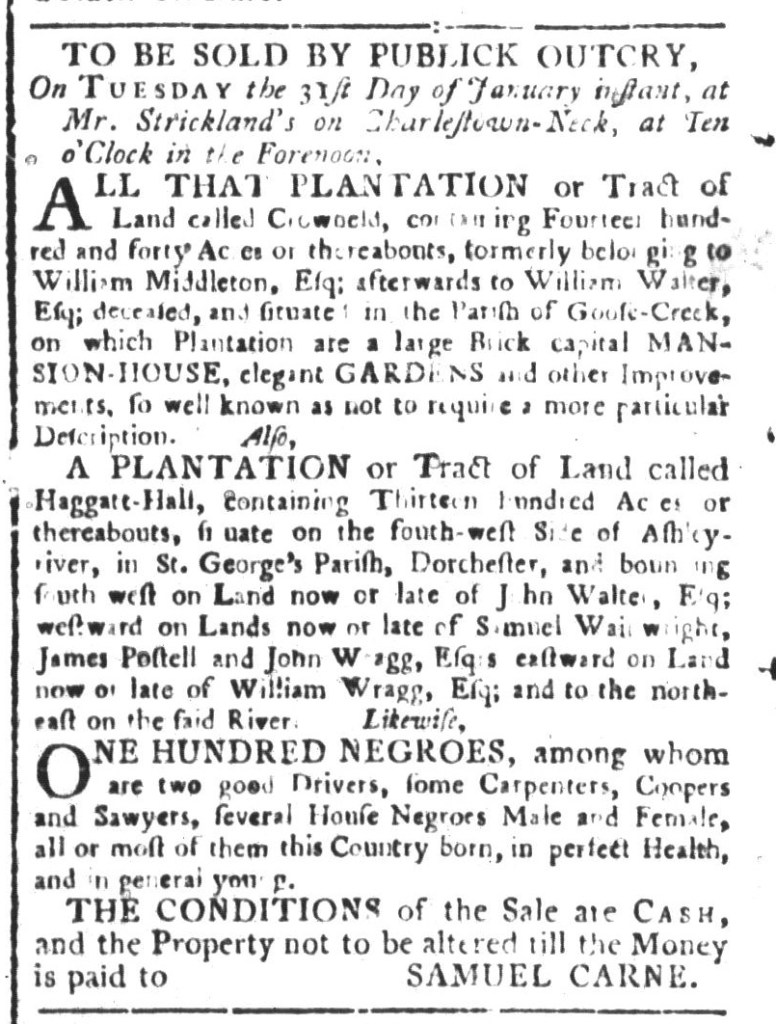
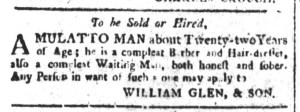
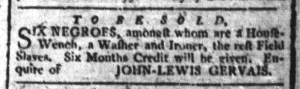
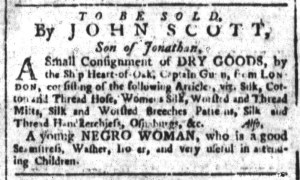
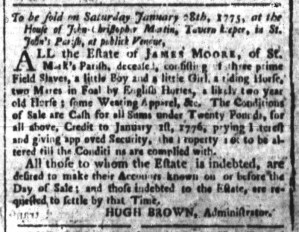
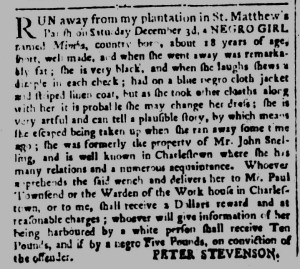
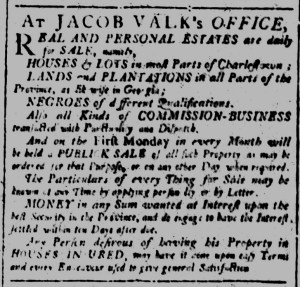
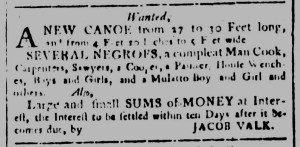
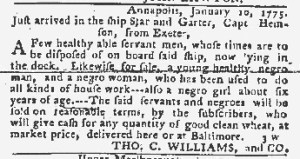
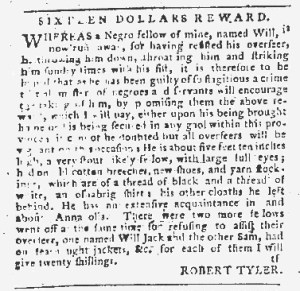
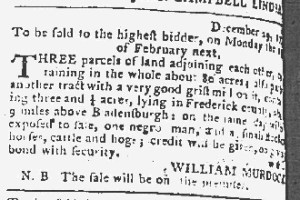
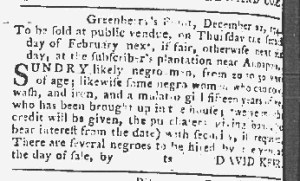
The Slavery Adverts 250 Project chronicles the role of newspaper advertising in perpetuating slavery in the era of the American Revolution. The project seeks to reveal the ubiquity of slavery in eighteenth-century life from New England to Georgia by republishing advertisements about enslaved people – for sale as individuals or in groups, wanted to purchase or for hire for short periods, runaways who liberated themselves, and those who were subsequently captured and confined in jails and workhouses – in daily digests on this site as well as in real time via the @SlaveAdverts250 Twitter feed, utilizing twenty-first-century media to stand in for the print media of the eighteenth century.

The project aims to provide modern audiences with a sense of just how often colonizers encountered these advertisements in their daily lives. Enslaved men, women, and children appeared in print somewhere in the colonies almost every single day. Those advertisements served as a constant backdrop for social, cultural, economic, and political life in colonial and revolutionary America. Colonizers who did not purport to own enslaved people were still confronted with slavery as well as invited to maintain the system by purchasing enslaved men, women, and children or assisting in the capture of so-called “runaways” who sought to free themselves from bondage. The frequency of these newspaper advertisements suggests just how embedded slavery was in colonial and revolutionary American culture in everyday interactions beyond the printed page.

These advertisements also testify to the experiences of enslaved men, women, and children, though readers must consider that those experiences have been remediated through descriptions offered by enslavers rather than enslaved people themselves. Often unnamed in the advertisements, enslaved men, women, and children were not invisible or unimportant in early America.

These advertisements appeared in colonial American newspapers 250 years ago today.

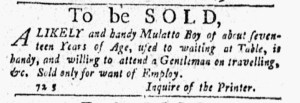
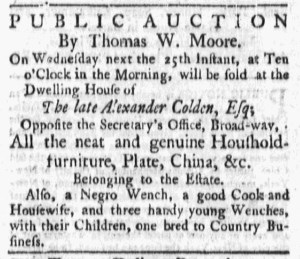
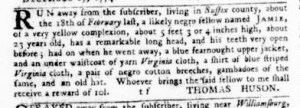
Virginia Gazette [Dixon and Hunter] (January 21, 1775).

**********

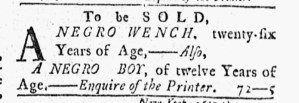
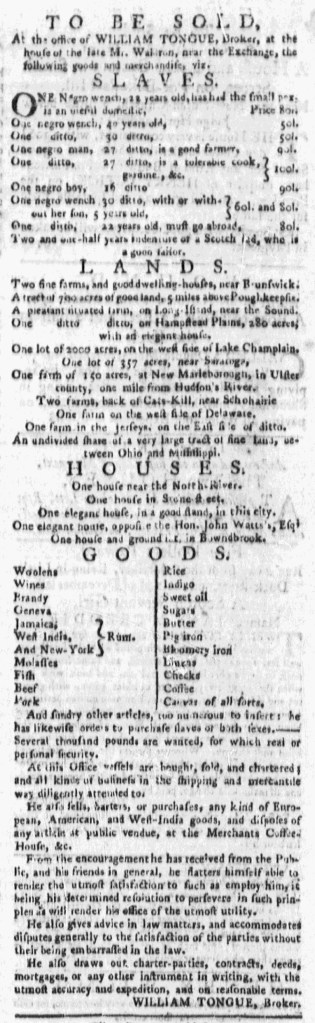
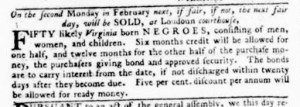
Virginia Gazette [Dixon and Hunter] (January 21, 1775).

**********

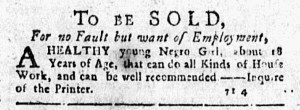
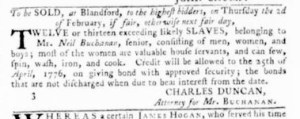
Virginia Gazette [Dixon and Hunter] (January 21, 1775).

**********

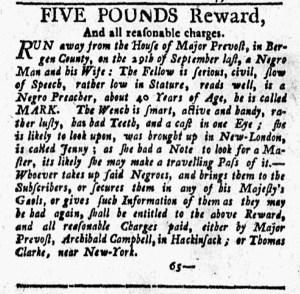
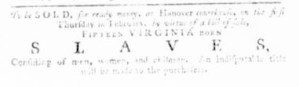
Virginia Gazette [Dixon and Hunter] (January 21, 1775).

**********

Virginia Gazette [Dixon and Hunter] (January 21, 1775).

**********

Virginia Gazette [Dixon and Hunter] (January 21, 1775).

**********

Virginia Gazette [Dixon and Hunter] (January 21, 1775).

**********

Virginia Gazette [Dixon and Hunter] (January 21, 1775).

**********

Virginia Gazette [Dixon and Hunter] (January 21, 1775).

**********

Virginia Gazette [Dixon and Hunter] (January 21, 1775).

**********

Virginia Gazette [Dixon and Hunter] (January 21, 1775).

January 20

What was advertised in a colonial American newspaper 250 years ago today?

Connecticut Gazette (January 20, 1775).

“To be sold … agreeable to the tenth Article of the Association … Apothecaries Drugs.”

On January 12, 1775, the Committee of Inspection for Norwich, Connecticut, placed an advertisement for an upcoming sale of “three Chests and six Casks of Apothecary’s Drugs” that would be held on January 20 in the Norwich Packet.  They ran the notice again a week later, this time stating that the sale would take place on January 24.  That allowed four more days for word of the sale to circulate and attract prospective customers.  It also made possible advertising in the January 20 edition of the Connecticut Gazette, published in New London.

The advertisement specified that the local Committee of Inspection would oversee that sale “at the Town-House in Norwich … agreeable to the tenth Article of the Association of the American Continental Congress.”  That nonimportation, nonconsumption, and nonexportation agreement had been disseminated far wide in the months since the meetings of the First Continental Congress in Philadelphia concluded at the end of October 1774.  The tenth article made provisions for imported goods that arrived in the colonies between December 1, 1774, and February 1, 1775.  The importers had three options.  They could either return the goods, surrender them to the local Committee of Inspection to store until the boycott ended, or entrust them to the committee to sell.  After the sale, the committee reimbursed the importer what they paid for the goods, but applied any profits to relief of Boston where the harbor had been closed to commerce since the Boston Port Act went into effect on June 1, 1774.
The tenth article of the Continental Association also called for “a particular Account [to be] inserted in the publick Papers.”  When the Committee of Inspection for Norwich advertised the sale of “Apothecaries Drugs, Imported in the ship Lady Gage, from London, via New-York, since the first of December last” in both the Norwich Packet and the Connecticut Gazette, they did more than address prospective customers.  They also kept the public throughout the region that the two newspapers circulated updated on compliance with the Continental Association, encouraging others to abide by it as well.
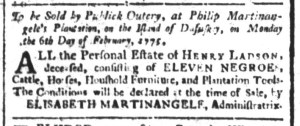
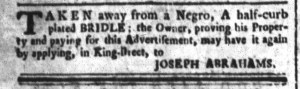
Slavery Advertisements Published January 20, 1775

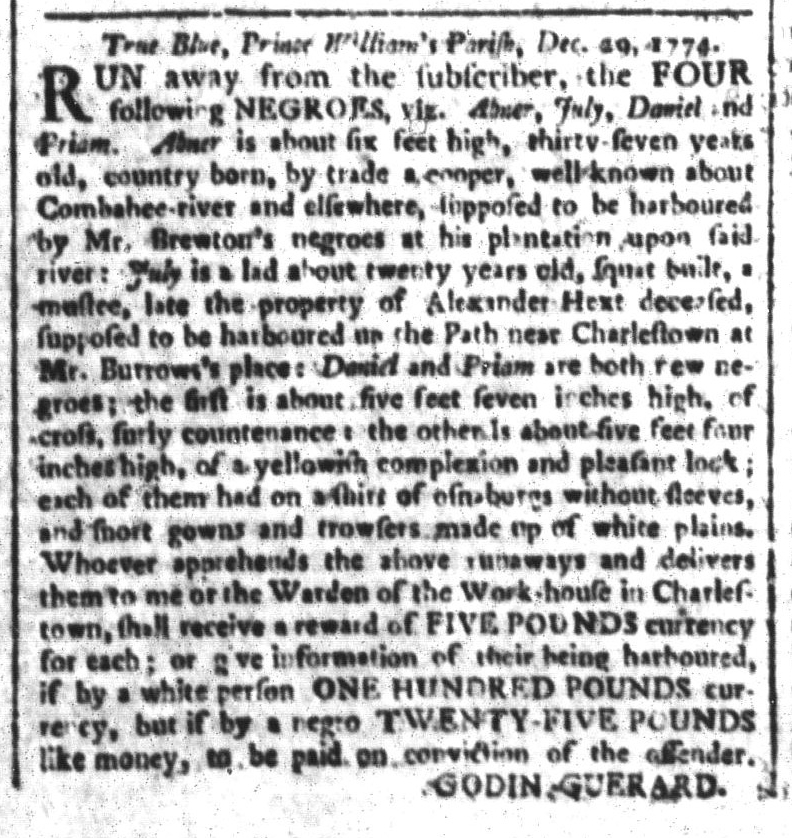
The Slavery Adverts 250 Project chronicles the role of newspaper advertising in perpetuating slavery in the era of the American Revolution. The project seeks to reveal the ubiquity of slavery in eighteenth-century life from New England to Georgia by republishing advertisements about enslaved people – for sale as individuals or in groups, wanted to purchase or for hire for short periods, runaways who liberated themselves, and those who were subsequently captured and confined in jails and workhouses – in daily digests on this site as well as in real time via the @SlaveAdverts250 Twitter feed, utilizing twenty-first-century media to stand in for the print media of the eighteenth century.

The project aims to provide modern audiences with a sense of just how often colonizers encountered these advertisements in their daily lives. Enslaved men, women, and children appeared in print somewhere in the colonies almost every single day. Those advertisements served as a constant backdrop for social, cultural, economic, and political life in colonial and revolutionary America. Colonizers who did not purport to own enslaved people were still confronted with slavery as well as invited to maintain the system by purchasing enslaved men, women, and children or assisting in the capture of so-called “runaways” who sought to free themselves from bondage. The frequency of these newspaper advertisements suggests just how embedded slavery was in colonial and revolutionary American culture in everyday interactions beyond the printed page.

These advertisements also testify to the experiences of enslaved men, women, and children, though readers must consider that those experiences have been remediated through descriptions offered by enslavers rather than enslaved people themselves. Often unnamed in the advertisements, enslaved men, women, and children were not invisible or unimportant in early America.

These advertisements appeared in colonial American newspapers 250 years ago today.

New-Hampshire Gazette (January 20, 1775).

**********

South-Carolina and American General Gazette (January 20, 1775).

**********

South-Carolina and American General Gazette (January 20, 1775).

**********

South-Carolina and American General Gazette (January 20, 1775).

**********

South-Carolina and American General Gazette (January 20, 1775).

**********

South-Carolina and American General Gazette (January 20, 1775).

**********

South-Carolina and American General Gazette (January 20, 1775).

**********

South-Carolina and American General Gazette (January 20, 1775).

**********

South-Carolina and American General Gazette (January 20, 1775).

**********

South-Carolina and American General Gazette (January 20, 1775).

**********

South-Carolina and American General Gazette (January 20, 1775).

**********

South-Carolina and American General Gazette (January 20, 1775).

**********

South-Carolina and American General Gazette (January 20, 1775).

**********

South-Carolina and American General Gazette (January 20, 1775).

**********

South-Carolina and American General Gazette (January 20, 1775).

**********

South-Carolina and American General Gazette (January 20, 1775).

**********

South-Carolina and American General Gazette (January 20, 1775).

**********

South-Carolina and American General Gazette (January 20, 1775).

**********

South-Carolina and American General Gazette (January 20, 1775).

**********

South-Carolina and American General Gazette (January 20, 1775).

**********

South-Carolina and American General Gazette (January 20, 1775).

**********

South-Carolina and American General Gazette (January 20, 1775).

**********

South-Carolina and American General Gazette (January 20, 1775).

**********

South-Carolina and American General Gazette (January 20, 1775).

**********

South-Carolina and American General Gazette (January 20, 1775).

**********

South-Carolina and American General Gazette (January 20, 1775).

Happy Birthday, Isaiah Thomas!

Isaiah Thomas, patriot printer and founder of the American Antiquarian Society, was born on January 19 (New Style) in 1749 (or January 8, 1748/49, Old Style).  It’s quite an historical coincidence that the three most significant printers in eighteenth-century America — Benjamin Franklin, Isaiah Thomas, and Mathew Carey — were all born in January.

isaiah_thomas1818
Isaiah Thomas (January 30, 1739 – April 4, 1831). American Antiquarian Society.

The Adverts 250 Project is possible in large part due to Thomas’s efforts to collect as much early American printed material as he could, originally to write his monumental History of Printing in America.  The newspapers, broadsides, books, almanacs, pamphlets, and other items he gathered in the process eventually became the initial collections of the American Antiquarian Society.  That institution’s ongoing mission to acquire at least one copy of every American imprint through 1876 has yielded an impressive collection of eighteenth-century advertising materials, including newspapers, magazine wrappers, trade cards, billheads, watch papers, book catalogs, subscription notices, broadsides, and a variety of other items.  Exploring the history of advertising in early America — indeed, exploring any topic related to the history, culture, and literature of early America at all — has been facilitated for more than two centuries by the vision of Isaiah Thomas and the dedication of the curators and other specialists at the American Antiquarian Society over the years.

Thomas’s connections to early American advertising were not limited to collecting and preserving the items created on American presses during the colonial, Revolutionary, and early national periods.  Like Mathew Carey, he was at the hub of a network he cultivated for distributing newspapers, books, and other printed goods — including advertising to stimulate demand for those items.  Sometimes this advertising was intended for dissemination to the general public (such as book catalogs and subscription notices), but other times it amounted to trade advertising (such as circular letters and exchange catalogs intended only for fellow printers, publishers, and booksellers).

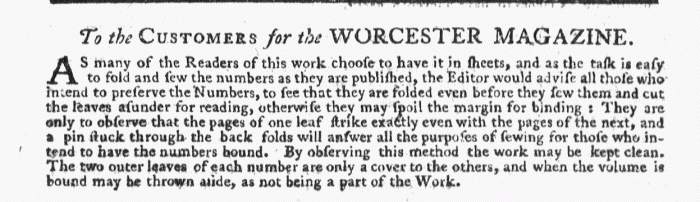
Thomas also experimented with advertising on wrappers that accompanied his Worcester Magazine, though he acknowledged to subscribers that these wrappers were ancillary to the publication:  “The two outer leaves of each number are only a cover to the others, and when the volume is bound may be thrown aside, as not being a part of the Work.”[1]

jan-30-worcerster-magazine-april-1786
Detail of Advertising Wrapper, Worcester Magazine (Second Week of April, 1786).

Thomas’s patriotic commitment to freedom of the press played a significant role in his decision to develop advertising wrappers.  As Thomas relays in his History of Printing in America, he discontinued printing his newspaper, the Massachusetts Spy, after the state legislature passed a law that “laid a duty of two-thirds of a penny on newspapers, and a penny on almanacs, which were to be stamped.”  Such a move met with strong protest since it was too reminiscent of the Stamp Act imposed by the British two decades earlier, prompting the legislature to repeal it before it went into effect.  On its heels, however, “another act was passed, which imposed a duty on all advertisements inserted in the newspapers” printed in Massachusetts.  Thomas vehemently rejected this law as “an improper restraint on the press. He, therefore, discontinued the Spy during the period that this act was in force, which was two years. But he published as a substitute a periodical work, entitled ‘The Worcester Weekly Magazine,’ in octavo.”[2] This weekly magazine lasted for two years; Thomas discontinued it and once again began printing the Spy after the legislature repealed the objectionable act.

jan-30-advertising-wrapper-worcester-magazine-4th-week-may-1786
Third Page of Advertising Wrapper, Worcester Magazine (Fourth Week of May, 1786).

Isaiah Thomas was not interested in advertising for its own sake to the same extent as Mathew Carey, but his political concerns did help to shape the landscape of early American advertising.  Furthermore, his vision for collecting American printed material preserved a variety of advertising media for later generations to admire, analyze, ponder, and enjoy.  Happy 276th birthday, Isaiah Thomas!

**********

[1] Isaiah Thomas, “To the CUSTOMERS for the WORCESTER MAGAZINE,” Worcester Magazine, wrapper, second week of April, 1786.

[2] Isaiah Thomas, The History of Printing in America: With a Biography of Printers, and an Account of Newspapers, vol. 2 (Worcester, MA: Isaac Sturtevant, 1810), 267-268.

January 19

GUEST CURATOR: Braydon Booth-Desmarais

What was advertised in a colonial American newspaper 250 years ago today?

Norwich Packet (January 19, 1775).

“A fresh ASSORTMENT of DRUGS, and GENUINE PATENT MEDICINES.”

Benjamin Dyer Published this advertisement in the Norwich Packet on January 19, 1775.  The advertisement says that he was selling many items, including “GENUINE PATENT MEDICINES,” at his shop in Norwich-Landing.  Patent medicines were available to anyone without needing a prescription.  According to the American Antiquarian Society’s Past Is Present blog, “Usually patent medicines were made of relatively inexpensive ingredients sold at high prices. It is important to know that because many patent medicines did not explicitly list their ingredients.”  Due to this the people selling the items can make claims about what was in the medicine without being fact checked.  It is also important to realize that Dyer referred to all the medicines as “GENUINE,” meaning that whatever was supposed to be in each medicine was in that medicine. Another interesting thing about this advertisement was how it listed each type of medicine that he sold instead of just saying that medicines were available.  I believe that this is because he wanted to show that he had a large number of medicines available.  Shopkeepers like Dyer tried to convince people that their “ASSORTMENT” of medicines were truly genuine and not fakes.

**********

ADDITIONAL COMMENTARY: Carl Robert Keyes

When Braydon and I met to discuss the advertisement that he selected to examine for the Adverts 250 Project, we talked about patent medicines as the over-the-counter medications of the eighteenth century.  They were so familiar to consumers that they did not need descriptions of what each did.  Readers of the Norwich Packet recognized, for instance, Turlington’s Balsam of Life and knew which illnesses, complaints, or discomforts that nostrum treated.  Stoughton’s Elixir, Godfrey’s Cordial, and Bateman’s Drops were the name brands of the period.  When consumers had access to multiple remedies that purported to treat the same symptoms, many had favorites based on experience and reputation.  Reading the list of “GENUINE PATENT MEDICINES” in Dyer’s advertisement in 1775 would have been similar to browsing the aisles of a pharmacy in 2025.

As I worked on other aspects of producing the Adverts 250 Project and Slavery Adverts 250 Project beyond working with Braydon on developing his entry, I noticed another interesting aspect of Dyer’s advertisement.  In addition to running it in the Norwich Packet, he also inserted it in the Connecticut Gazette, published in New London, on January 20.  That increased the circulation of his advertisement, placing it before the eyes of many more prospective customers. This aspect of Dyer’s marketing campaign resonates with the analysis of yesterday’s advertisement, also selected by a student in my Revolutionary America course, that ran in the Connecticut Journal, published in New Haven.  Connecticut had four newspapers, printed in four towns, yet each circulated widely throughout the colony and beyond.  Many advertisers dispatched advertising copy to printing offices in more than one town.  In addition to Dyer’s advertisement, the January 19, 1775, edition of the Norwich Packet featured a notice from clock- and watchmaker Thomas Harland.  He simultaneously ran an advertisement in the Connecticut Courant, published in Hartford.  In his case, he ran two different advertisements rather than submitting identical copy.  Though both advertised in more than one publication, Dyer and Harland made decisions that suited their needs when it came to which messages for consumers they wished to disseminate in which newspapers.

Welcome, Guest Curator Braydon Booth-Desmarais

Braydon Booth-Desmarais is a senior at Assumption University in Worcester, Massachusetts. He is a History major with a minor in Theology. He has had a passion for all parts of American history ever sense he could remember. In Fall 2024, he researched, wrote, and presented “The Bomb Heard Around America: Martin Luther King’s Response to the Bombing of His Home and What It Teaches Us” for his capstone seminar. His goals include furthering his education to work towards becoming a college professor. Braydon made his contributions to the Adverts 250 Project and the Slavery Adverts 250 Project while enrolled in HIS 359 Revolutionary America, 1763-1815, in Fall 2024.

Welcome, guest curator Braydon Booth-Desmarais!

Slavery Advertisements Published January 19, 1775

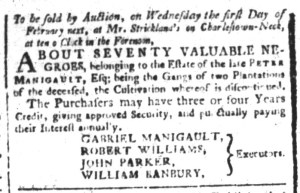
The Slavery Adverts 250 Project chronicles the role of newspaper advertising in perpetuating slavery in the era of the American Revolution. The project seeks to reveal the ubiquity of slavery in eighteenth-century life from New England to Georgia by republishing advertisements about enslaved people – for sale as individuals or in groups, wanted to purchase or for hire for short periods, runaways who liberated themselves, and those who were subsequently captured and confined in jails and workhouses – in daily digests on this site as well as in real time via the @SlaveAdverts250 Twitter feed, utilizing twenty-first-century media to stand in for the print media of the eighteenth century.

The project aims to provide modern audiences with a sense of just how often colonizers encountered these advertisements in their daily lives. Enslaved men, women, and children appeared in print somewhere in the colonies almost every single day. Those advertisements served as a constant backdrop for social, cultural, economic, and political life in colonial and revolutionary America. Colonizers who did not purport to own enslaved people were still confronted with slavery as well as invited to maintain the system by purchasing enslaved men, women, and children or assisting in the capture of so-called “runaways” who sought to free themselves from bondage. The frequency of these newspaper advertisements suggests just how embedded slavery was in colonial and revolutionary American culture in everyday interactions beyond the printed page.

These advertisements also testify to the experiences of enslaved men, women, and children, though readers must consider that those experiences have been remediated through descriptions offered by enslavers rather than enslaved people themselves. Often unnamed in the advertisements, enslaved men, women, and children were not invisible or unimportant in early America.

These advertisements appeared in colonial American newspapers 250 years ago today.

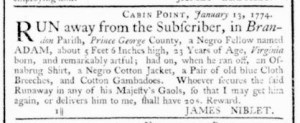
Maryland Gazette (January 19, 1775).

**********

Maryland Gazette (January 19, 1775).

**********

Maryland Gazette (January 19, 1775).

**********

Maryland Gazette (January 19, 1775).

**********

Massachusetts Spy (January 19, 1775).

**********

New-York Journal (January 19, 1775).

**********

New-York Journal (January 19, 1775).

**********

New-York Journal (January 19, 1775).

**********

Supplement to the New-York Journal (January 19, 1775).

**********

Supplement to the New-York Journal (January 19, 1775).

**********

Rivington’s New-York Gazetteer (January 19, 1775).

**********

Rivington’s New-York Gazetteer (January 19, 1775).

**********

Virginia Gazette [Pinkney] (January 19, 1775).

**********

Virginia Gazette [Pinkney] (January 19, 1775).

**********

Virginia Gazette [Pinkney] (January 19, 1775).

**********

Virginia Gazette [Pinkney] (January 19, 1775).

**********

Virginia Gazette [Pinkney] (January 19, 1775).

**********

Virginia Gazette [Pinkney] (January 19, 1775).

**********

Virginia Gazette [Pinkney] (January 19, 1775).

**********

Virginia Gazette [Pinkney] (January 19, 1775).

January 18

GUEST CURATOR: Dominic Bonanno

What was advertised in a colonial American newspaper 250 years ago today?

Connecticut Journal (January 18, 1775).

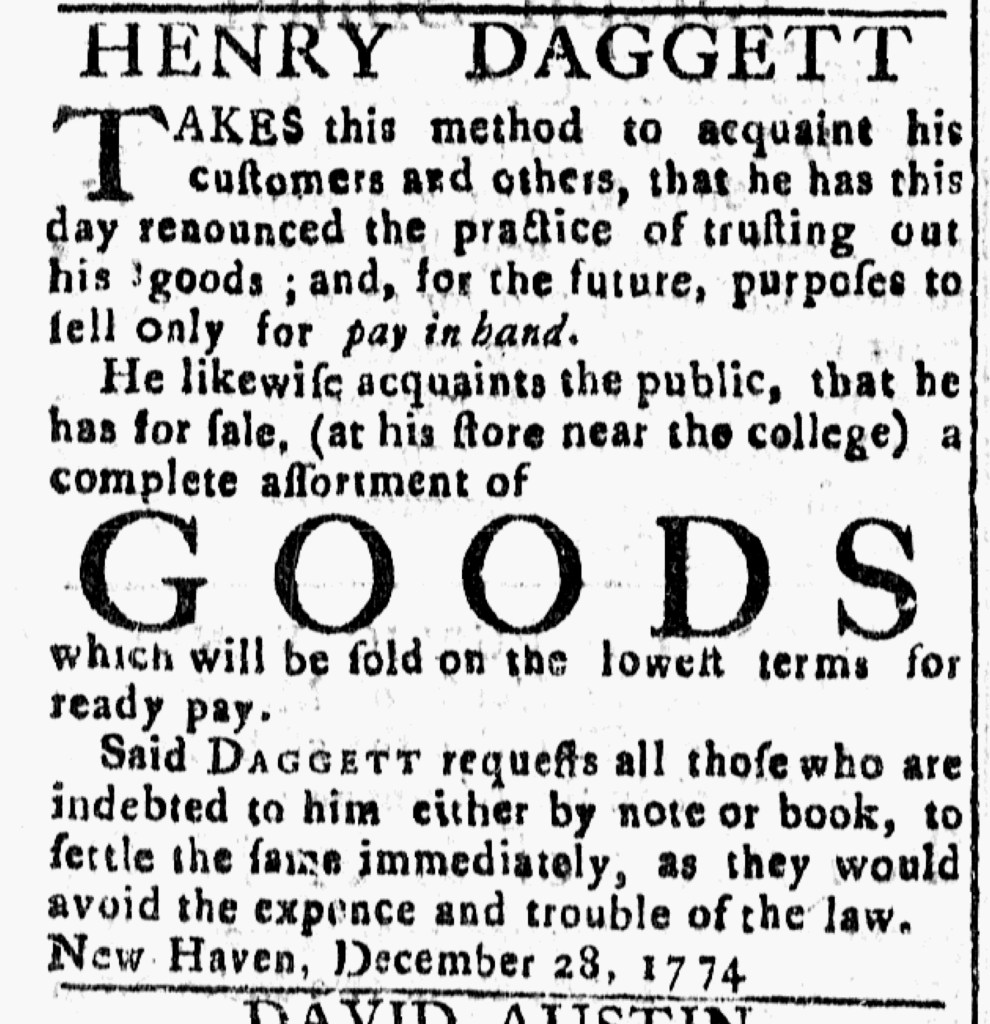
“HENRY DAGGETT TAKES this method to acquaint his customers and others …”

The advertisement from the Connecticut Journal that I have selected was published by Henry Daggett.  He created it with three different purposes. First, Daggett mentions that he has stopped accepting lines of credit as payments from customers: he “renounced the practice of trusting out his goods; and, for the future, purposes to sell only for pay in hand.”  He wanted customers to pay the same day as their purchases.  Next, Daggett moves into stating that he has an assortment of goods to sell in his store “on the lowest terms” or for the lowest prices.  Finally, Daggett aggressively mentions that anyone who is in debt to him “either by note or book” must settle with him immediately or he will take them to court, what he called “the expence and trouble of the law.”

In addition to figuring out why Daggett placed this advertisement, I wanted to know more about how it was distributed to the public.  I read about “Printing Presses and Distribution” on the webpage about “Connecticut’s Newspaper History” created by the Connecticut State Library.”  Once newspapers were printed, “[d]istribution of the final product was usually by the carrier, often the printer’s apprentice.  Subscribers who had the paper delivered to their homes were charged a fee.  …  Outside of town, the post rider was the main distributor of newspapers. The post, or mail, came in once a week in the early days.  Often the printer was also postmaster and would see that newspapers were carried free of charge from office to office.”  I imagine that Henry Daggett got his point across to the public because of wide distribution of newspapers in Connecticut during the era of the American Revolution.  They were delivered not only in the town of publication but also to many other towns as well.

**********

ADDITIONAL COMMENTARY: Carl Robert Keyes

When Dominic and I met to discuss this advertisement, I asked him why he chose Henry Daggett’s notice in the Connecticut Journal.  He was especially interested in the circulation of newspapers and the advertisements they contained.  As Dominic outlines, Daggett had several reasons for running his advertisement.  He wanted to know more about how confident Daggett would have been that others, especially prospective customers and former customers who still owed him for previous purchases, would see the advertisement.  That gave us a chance to talk about readership and distribution throughout the colonies and then look for secondary sources about newspapers published in Connecticut in the eighteenth century.

This also gave me an opportunity to share with Dominic that the production of newspapers in Connecticut differed from other many other colonies in early 1775.  The sites of publication were more centralized in other colonies.  For instance, three newspapers were published in South Carolina, all of them in Charleston, and disseminated throughout the colony from there.  Similarly, two newspapers were published in Virginia (with a third established only a few weeks after Daggett’s advertisement ran on January 18, 1775).  Printers in Williamsburg published those newspapers.  In Pennsylvania, three English-language newspapers were published in Philadelphia (with two more established by the end of the month) and two German-language newspapers were published in Germantown.  Three newspapers were published in New York, all of them in New York City.

The situation was a little different in most colonies in New England.  While the New-Hampshire Gazette, published in Portsmouth, was the only newspaper in that colony, Rhode Island has two newspapers, the Newport Mercury and the Providence Gazette, and Massachusetts had five newspapers printed in Boston as well as Essex Gazette, published in Salem, and the Essex Journal, published in Newburyport.  In early 1775, Connecticut was the only colony with newspapers published in four towns: the Connecticut Courant and Hartford Weekly Intelligencer, the Connecticut Gazette (published in New London), the Connecticut Journal and New-Haven Post-Boy, and the Norwich Packet and the Connecticut, Massachusetts, New-Hampshire, and Rhode-Island Weekly Advertiser.  As the full title of the Norwich Packet suggests, colonial newspapers circulated widely beyond their sites of publication.

Advertisers in Boston, Charleston, New York, Philadelphia, and Williamsburg could easily visit or send messages to multiple printing offices when they wished for their notices to appear in more than one newspaper.  In contrast, advertisers in Connecticut had ready access to one printing office, if they happened to live in one of the four towns with a newspaper, yet had to devote more effort in submitting their notices to other printing offices when they wished to disseminate them in multiple newspapers.

Welcome, Guest Curator Dominic Bonanno

Dominic Bonanno is a senior at Assumption University in Worcester, Massachusetts. He is a Marketing major with a concentration in Sales and a minor in Management.  Dominic started his own business when he was sixteen years old and has continued his passion for sales, accepting a full-time position as a commercial/industrial real estate broker for the company Colliers International.  Dominic made his contributions to the Adverts 250 Project and the Slavery Adverts 250 Project while enrolled in HIS 359 Revolutionary America, 1763-1815, in Fall 2024.

Welcome, guest curator Dominic Bonanno!