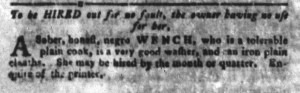
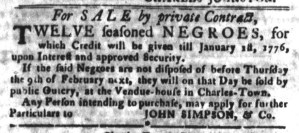
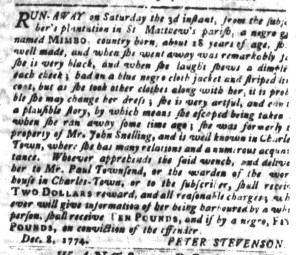
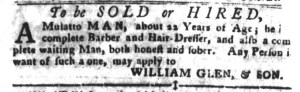
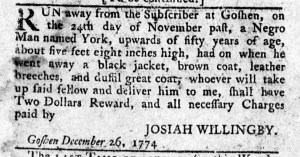
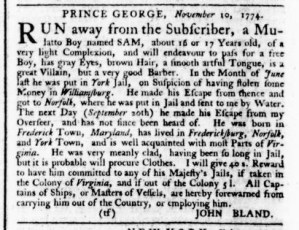
Slavery Advertisements Published January 18, 1775

The Slavery Adverts 250 Project chronicles the role of newspaper advertising in perpetuating slavery in the era of the American Revolution. The project seeks to reveal the ubiquity of slavery in eighteenth-century life from New England to Georgia by republishing advertisements about enslaved people – for sale as individuals or in groups, wanted to purchase or for hire for short periods, runaways who liberated themselves, and those who were subsequently captured and confined in jails and workhouses – in daily digests on this site as well as in real time via the @SlaveAdverts250 Twitter feed, utilizing twenty-first-century media to stand in for the print media of the eighteenth century.

The project aims to provide modern audiences with a sense of just how often colonizers encountered these advertisements in their daily lives. Enslaved men, women, and children appeared in print somewhere in the colonies almost every single day. Those advertisements served as a constant backdrop for social, cultural, economic, and political life in colonial and revolutionary America. Colonizers who did not purport to own enslaved people were still confronted with slavery as well as invited to maintain the system by purchasing enslaved men, women, and children or assisting in the capture of so-called “runaways” who sought to free themselves from bondage. The frequency of these newspaper advertisements suggests just how embedded slavery was in colonial and revolutionary American culture in everyday interactions beyond the printed page.

These advertisements also testify to the experiences of enslaved men, women, and children, though readers must consider that those experiences have been remediated through descriptions offered by enslavers rather than enslaved people themselves. Often unnamed in the advertisements, enslaved men, women, and children were not invisible or unimportant in early America.

These advertisements appeared in colonial American newspapers 250 years ago today.

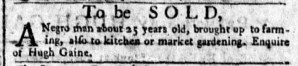
Connecticut Journal (January 18, 1774).

Slavery Advertisements Published January 17, 1775

The Slavery Adverts 250 Project chronicles the role of newspaper advertising in perpetuating slavery in the era of the American Revolution. The project seeks to reveal the ubiquity of slavery in eighteenth-century life from New England to Georgia by republishing advertisements about enslaved people – for sale as individuals or in groups, wanted to purchase or for hire for short periods, runaways who liberated themselves, and those who were subsequently captured and confined in jails and workhouses – in daily digests on this site as well as in real time via the @SlaveAdverts250 Twitter feed, utilizing twenty-first-century media to stand in for the print media of the eighteenth century.

The project aims to provide modern audiences with a sense of just how often colonizers encountered these advertisements in their daily lives. Enslaved men, women, and children appeared in print somewhere in the colonies almost every single day. Those advertisements served as a constant backdrop for social, cultural, economic, and political life in colonial and revolutionary America. Colonizers who did not purport to own enslaved people were still confronted with slavery as well as invited to maintain the system by purchasing enslaved men, women, and children or assisting in the capture of so-called “runaways” who sought to free themselves from bondage. The frequency of these newspaper advertisements suggests just how embedded slavery was in colonial and revolutionary American culture in everyday interactions beyond the printed page.

These advertisements also testify to the experiences of enslaved men, women, and children, though readers must consider that those experiences have been remediated through descriptions offered by enslavers rather than enslaved people themselves. Often unnamed in the advertisements, enslaved men, women, and children were not invisible or unimportant in early America.

These advertisements appeared in colonial American newspapers 250 years ago today.

Essex Gazette (January 17, 1775).

**********

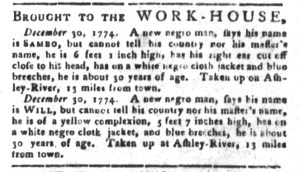
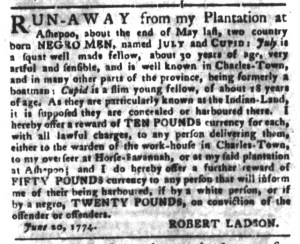
South-Carolina Gazette and Country Journal (January 17, 1775).

**********

South-Carolina Gazette and Country Journal (January 17, 1775).

**********

South-Carolina Gazette and Country Journal (January 17, 1775).

**********

South-Carolina Gazette and Country Journal (January 17, 1775).

**********

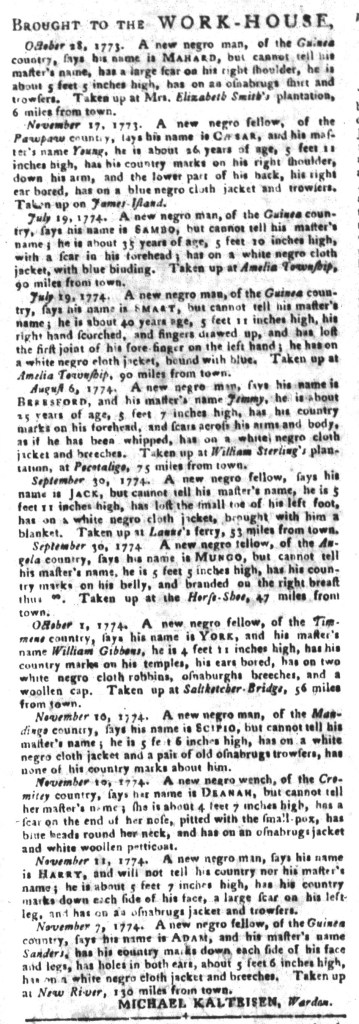
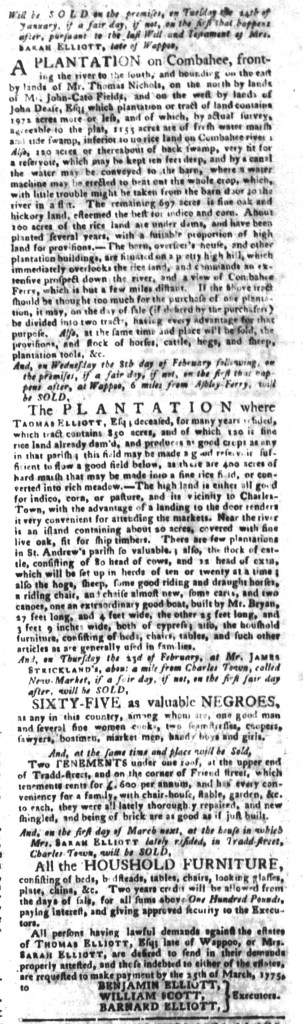
Supplement to the South-Carolina Gazette and Country Journal (January 17, 1775).

**********

Supplement to the South-Carolina Gazette and Country Journal (January 17, 1775).

**********

Supplement to the South-Carolina Gazette and Country Journal (January 17, 1775).

**********

Supplement to the South-Carolina Gazette and Country Journal (January 17, 1775).

**********

Supplement to the South-Carolina Gazette and Country Journal (January 17, 1775).

**********

Supplement to the South-Carolina Gazette and Country Journal (January 17, 1775).

**********

Supplement to the South-Carolina Gazette and Country Journal (January 17, 1775).

**********

Supplement to the South-Carolina Gazette and Country Journal (January 17, 1775).

Happy Birthday, Benjamin Franklin!

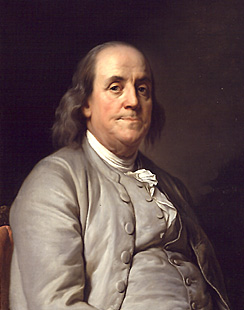
Today is an important day for specialists in early American print culture, for Benjamin Franklin was born on January 17, 1706 (January 6, 1705, Old Style), in Boston. Among his many other accomplishments, Franklin is known as the “Father of American Advertising.” Although I have argued elsewhere that this title should more accurately be bestowed upon Mathew Carey (in my view more prolific and innovative in the realm of advertising as a printer, publisher, and advocate of marketing), I recognize that Franklin deserves credit as well. Franklin is often known as “The First American,” so it not surprising that others should rank him first among the founders of advertising in America.

benjamin-franklin
Benjamin Franklin (Joseph Siffred Duplessis, ca. 1785).  National Portrait Gallery.

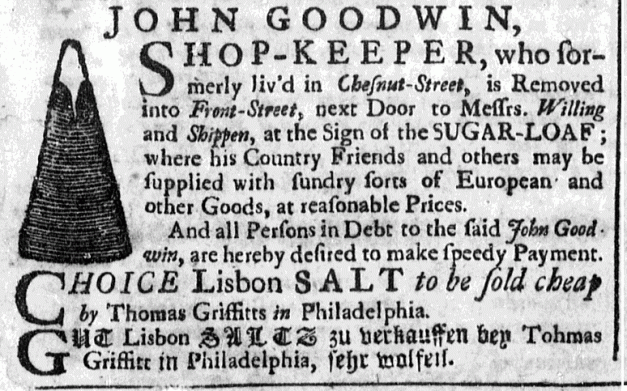
Franklin purchased the Pennsylvania Gazette in 1729. In the wake of becoming printer, he experimented with the visual layout of advertisements that appeared in the weekly newspaper, incorporating significantly more white space and varying font sizes in order to better attract readers’ and potential customers’ attention. Advertising flourished in the Pennsylvania Gazette, which expanded from two to four pages in part to accommodate the greater number of commercial notices.

jan-17-pennsylvania-gazette-19-161736
Advertisements with white space, varying sizes of font, capitals and italics, and a woodcut from Benjamin Franklin’s Pennsylvania Gazette (December 9-16, 1736).

Many historians of the press and print culture in early America have noted that Franklin became wealthy and retired as a printer in favor of a multitude of other pursuits in part because of the revenue he collected from advertising. Others, especially David Waldstreicher, have underscored that this wealth was amassed through participation in the colonial slave trade. The advertisements for goods and services featured in the Pennsylvania Gazette included announcements about buying and selling enslaved men, women, and children as well as notices offering rewards for those who escaped from bondage.

jan-17-pennsylvania-gazette-slave-19-161736
Advertisement for an enslaved woman and an enslaved child from Benjamin Franklin’s Pennsylvania Gazette (December 9-16, 1736).

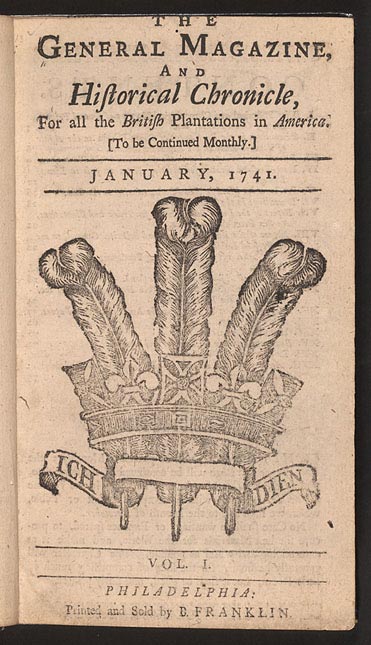
In 1741 Franklin published one of colonial America’s first magazines, The General Magazine and Historical Chronicle, for all the British Plantations in America (which barely missed out on being the first American magazine, a distinction earned by Franklin’s competitor, Andrew Bradford, with The American Magazine or Monthly View of the Political State of the British Colonies). The magazine lasted only a handful of issues, but that was sufficient for Franklin to become the first American printer to include an advertisement in a magazine (though advertising did not become a standard part of magazine publication until special advertising wrappers were developed later in the century — and Mathew Carey was unarguably the master of that medium).

general-magazine
General Magazine and Historical Chronicle, For all the British Plantations in America (January 1741).  Library of Congress.

In 1744 Franklin published an octavo-sized Catalogue of Choice and Valuable Books, including 445 entries. This is the first known American book catalogue aimed at consumers (though the Library Company of Philadelphia previously published catalogs listing their holdings in 1733, 1735, and 1741). Later that same year, Franklin printed a Catalogue of Books to Be Sold at Auction.

Franklin pursued advertising through many media in eighteenth-century America, earning recognition as one of the founders of American advertising. Happy 319th birthday, Benjamin Franklin!

January 17

What was advertised in a colonial American newspaper 250 years ago today?

Essex Gazette (January 17, 1774).

“ALL Persons who have … Subscription Papers … are desired immediately to return the same.”

Samuel Hall and Ebenezer Hall, the printers of the Essex Gazette, inserted a brief notice in the January 17, 1775, edition to request that “ALL Persons who have in their Hands any Subscription Papers for printing the Independent Whig … to return the same to the Printers hereof.”  They referred to a project that they had first announced more than fifteen months earlier on September 23, 1773, with another advertisement in their newspaper.  On that occasion, they confided that “A Number of the principal Gentlemen in this Town … encouraged the Publication” of the work that Thomas Gordon and John Trenchard first distributed as a weekly magazine in London in 1720.  For those not as familiar with that “celebrated Performance,” the printers gave the full title: “THE Independent Whig, Or, A Defence of primitive Christianity, and of our Ecclesiastical Establishment, against the extravagant Claims of fanatical and disaffected Clergymen.”

The Halls informed the public that they could subscribe to the work at their printing office in Salem.  Those not yet certain that they wished to reserve copies could examine the “Proposals.”  The printers eventually published subscription notices in the Massachusetts Spy in February 1774, hoping to reach even more prospective customers in Boston and other towns throughout the colony.  Yet the Halls apparently did not limit their marketing efforts to newspaper advertisements, choosing to circulate “Subscription Papers” that likely described the purpose of the book and the conditions for ordering copies.  They may have requested that friends and associates post the subscription proposals in their shops and offices, recruiting the assistance of local agents in other towns.  Such items often featured space for subscribers to sign their names, making their support of the project visible to others, though local agents sometimes compiled separate lists.  No copies of the “Subscription Papers” that the Halls mention in their newspaper advertisement survive, at least not any that have been identified and cataloged yet.  Their newspaper notice testifies to a more extensive culture of marketing media in early America than the collections in research libraries, historical societies, and private collections reveal.  How much advertising ephemera circulated that has been lost without any mention in the public prints?

January 16

What was advertised in a colonial American newspaper 250 years ago today?

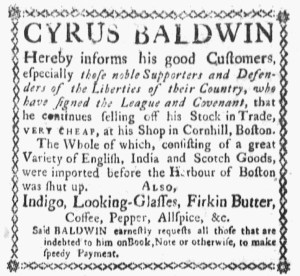
Boston Evening-Post (January 16, 1775).

Those noble Supporters and Defenders of the Liberties of their Country, who have signed the League and Covenant.”

The decorative border around Cyrus Baldwin’s advertisement in the January 16, 1775, edition of the Boston Evening-Postdrew attention to it … and the shopkeeper wanted the entire community to see what he had to say about the “great Variety of English, India and Scotch Goods” that he offered for sale “at his Shop in Cornhill, Boston.”  It was a message not only for “his good Customers” but “especially those noble Supporters and Defenders of the Liberties of their Country, who have signed the League and Covenant.”  Baldwin could have invoked the Continental Association that went into effect on December 1, 1774, but made an even stronger statement about fidelity to the American cause demonstrated by some of his customers.

As summer approached in 1774, the Boston Committee of Correspondence disseminated the Solemn League and Covenant, a nonimportation agreement drafted by Samuel Adams and Joseph Warren in response to the Boston Port Act.  Colonizers in Boston and throughout Massachusetts debated the measure, some enthusiastically signing and others arguing that they should wait to engage in a coordinated effort that spanned the colonies.  When the First Continental Congress met in Philadelphia in September and October, the delegates devised a nonimportation pact, the Continental Association, to achieve that unified response.  Newspapers carried details in their coverage of the meetings, printers published and sold pamphlets that included the Continental Association along with other “EXTRACTS FROM THE VOTES AND PROCEEEDINGS OF THE AMERICAN CONTINENTAL CONGRESS,” some printers published broadside versions of the Continental Association for easy reference in homes and offices, and advertisements documented goods surrendered and sold under the conditions of the tenth article of the Continental Association.

Baldwin could have made an appeal to consumers who adhered to the Continental Association.  Instead, he sought to associate his customers and his goods with the uncompromising spirit of the Solemn League and Covenant drafted as soon as the colonies received word about the Boston Port Act.  The resolve of many colonizers strengthened as news about the other Coercive Acts – the Massachusetts Government Act, the Administration of Justice Act, and the Quartering Act – arrived, yet Baldwin declared that many of his customers had been unwavering in their determination to take action before receiving dispatch after dispatch about new abuses perpetrated by Parliament.  Even those who had not signed the Solemn League and Covenant could ameliorate their regrets, Baldwin suggested, by making purchases alongside others who had been “noble Supporters and Defenders of the Liberties of their Country” months before the Continental Association.  As the imperial crisis intensified, he offered consumers an opportunity to revise how they remembered their participation in resistance efforts.

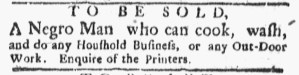
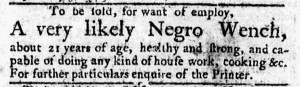
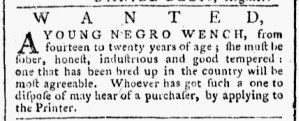
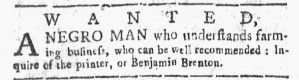
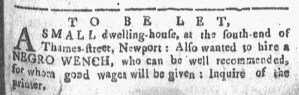
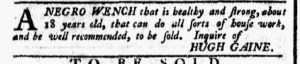
Slavery Advertisements Published January 16, 1775

The Slavery Adverts 250 Project chronicles the role of newspaper advertising in perpetuating slavery in the era of the American Revolution. The project seeks to reveal the ubiquity of slavery in eighteenth-century life from New England to Georgia by republishing advertisements about enslaved people – for sale as individuals or in groups, wanted to purchase or for hire for short periods, runaways who liberated themselves, and those who were subsequently captured and confined in jails and workhouses – in daily digests on this site as well as in real time via the @SlaveAdverts250 Twitter feed, utilizing twenty-first-century media to stand in for the print media of the eighteenth century.

The project aims to provide modern audiences with a sense of just how often colonizers encountered these advertisements in their daily lives. Enslaved men, women, and children appeared in print somewhere in the colonies almost every single day. Those advertisements served as a constant backdrop for social, cultural, economic, and political life in colonial and revolutionary America. Colonizers who did not purport to own enslaved people were still confronted with slavery as well as invited to maintain the system by purchasing enslaved men, women, and children or assisting in the capture of so-called “runaways” who sought to free themselves from bondage. The frequency of these newspaper advertisements suggests just how embedded slavery was in colonial and revolutionary American culture in everyday interactions beyond the printed page.

These advertisements also testify to the experiences of enslaved men, women, and children, though readers must consider that those experiences have been remediated through descriptions offered by enslavers rather than enslaved people themselves. Often unnamed in the advertisements, enslaved men, women, and children were not invisible or unimportant in early America.

These advertisements appeared in colonial American newspapers 250 years ago today.
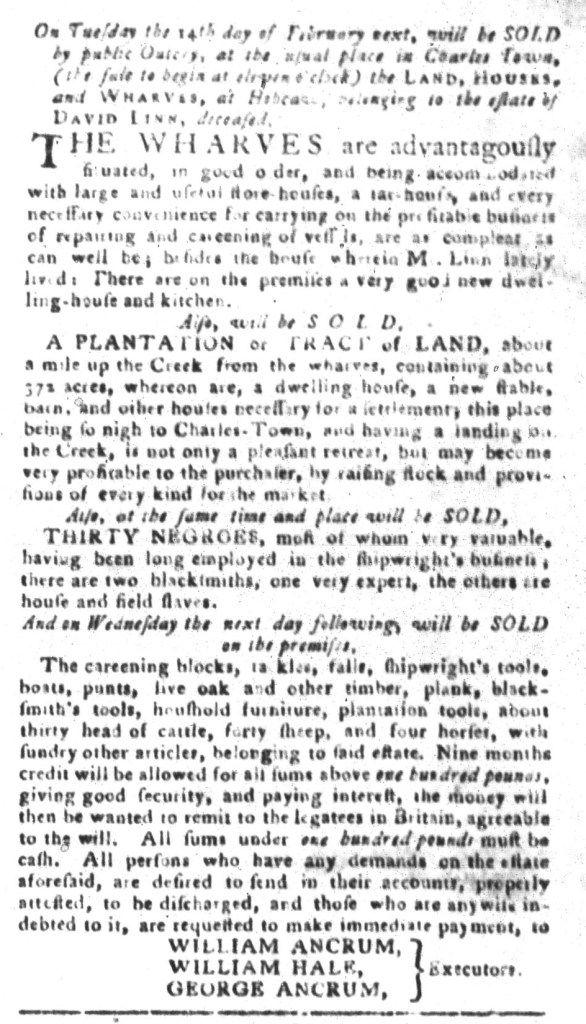
Boston Evening-Post (January 16, 1775).

**********

Connecticut Courant (January 16, 1775).

**********

Connecticut Courant (January 16, 1775).

**********

Connecticut Courant (January 16, 1775).

**********

Dunlap’s Pennsylvania Packet (January 16, 1775).

**********

Newport Mercury (January 16, 1775).

**********

Newport Mercury (January 16, 1775).

**********

New-York Gazette and Weekly Mercury (January 16, 1775).

**********

New-York Gazette and Weekly Mercury (January 16, 1775).

**********

New-York Gazette and Weekly Mercury (January 16, 1775).

**********

New-York Gazette and Weekly Mercury (January 16, 1775).

**********

Supplement to the New-York Gazette and Weekly Mercury (January 16, 1775).

January 15

What was advertised in a colonial American newspaper 250 years ago this week?

Supplement to the New-York Journal (January 12, 1775).

“All kinds of business will be transacted on commission.”

John Holt included a significant amount of content – news, editorials, advertisements – in each issue of the New-York Journal.  Like other colonial newspapers, his publication consisted of four pages published once a week.  Most featured three columns per page, but the New-York Journal had four.  Even then, that often was not enough space for everything submitted to Holt’s printing office, prompting him to distribute supplements with even more content.

Such was the case with the January 12, 1775, edition.  In addition to the standard issue, Holt printed a four-page supplement that featured both news and advertising.  Some of that advertising, however, had an unusual format as the result of Holt using a smaller sheet that accommodated only three columns.  That left enough space to insert advertisements in the right margins, though they had to be divided into shorter segments and printed perpendicular to the rest of the content.

For instance, William Tongue’s advertisement for a “MERCHANT BROKER’S OFFICE” that previously ran in a single column appeared in five short segments in the right margin on the second page.  In addition to maximizing the use of space in the supplement, it saved the compositor time because the type had already been set.  On other pages, the right margins contained multiple shorter advertisements, such as Jonathan Durrell’s advertisement for locally produced “EARTHEN WARE” divided into three segments and a notice concerning Isaac Adolphus’s estate divided into two segments on the first page.  In total, Holt managed to squeeze eight advertisements of various lengths, including one offering an enslaved woman for sale, into the margins of the supplement, following a strategy commonly used by colonial printers.

Supplement to the New-York Journal (January 12, 1775).

Apparently, the printer made a calculated decision about the size of the sheets to use for the supplement; it was not the result of a disruption in his paper supply caused by current events.  A week earlier on January 5, he used the larger sheet for both the standard issue and a supplement with four full columns, but on January 19 used the larger sheet for the standard issue and, once again, the slightly smaller sheet for the supplement.  On that occasion, he used only a half sheet, distributing a two-page supplement devoted entirely to paid notices.  That suggests that he carefully managed his resources rather than resorting to whatever paper came to hand.  Advertisements and other content sometimes appeared in the margins out of necessity when printers had difficulty acquiring paper during the imperial crisis, but seemingly that was not the case in this instance.  Instead, Holt shrewdly balanced how much content to print against anticipated revenues from advertising.

Supplement to the New-York Journal (January 12, 1775).

January 14

What was advertised in a colonial American newspaper 250 years ago today?

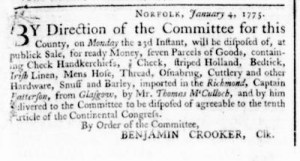
Virginia Gazette [Dixon and Hunter] (January 14, 1775).

“Seven Parcels of Goods … delivered to the Committee to be disposed of agreeable to the tenth Article of the Continental Congress.”

As an advertisement in the January 14, 1775, edition of Dixon and Hunter’s Virginia Gazette made clear, Thomas McCulloch of Norfolk abided by the Continental Association.  The First Continental Congress adopted that nonimportation, nonconsumption, and nonexportation agreement when it met in Philadelphia in September and October 1774, intending to use economic leverage to convince Parliament to repeal the Coercive Acts passed in retaliation for the destruction of tea during the Boston Tea Party.

“BY Direction of the Committee for this County,” the advertisement informed readers, “on Monday the 23d Instant, will be disposed of, at publick Sale, for ready Money, seven Parcels of Goods … imported in the Richmond, Captain Patterson, from Glasgow, by Mr. Thomas McCulloch.”  The “Committee for this County” referred to the local Committee of Inspection, empowered to oversee the sale of imported goods that arrived between December 1, 1774, and February 1, 1775.  According to the tenth article of the Continental Association, importers had several options for dealing with such items.  They could return the goods, surrender them to the committee to store until the nonimportation agreement concluded, or entrust them to the committee to sell.  McCulloch “delivered [his goods” to the Committee to be disposed of agreeable to the tenth Article of the Continental Congress.”  In that case, the committee would reimburse him what he paid but apply any profit to the relief of Boston where the harbor had been closed since the Boston Port Act went into effect on June 1, 1774.

Another advertisement in the same issue of Dixon and Hunter’s Virginia Gazette advised the public of the sale of “SUNDRY Parcels of Goods lately imported from Great Britain” for sale “Under the Direction of the Committee for the County of CHARLES CITY.”  In this instance, the committee divided the merchandise into “Lots not over ten Pounds Value” to encourage sales.  These local Committees of Inspection joined their counterparts in Massachusetts, New York, and other colonies in advertising imported goods sold according to the tenth article of the Continental Association and, in the process, demonstrating compliance with that measure.

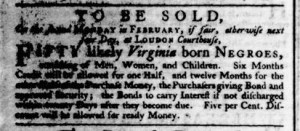
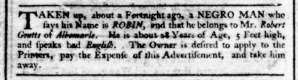
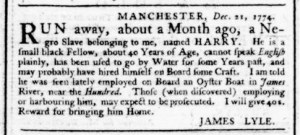
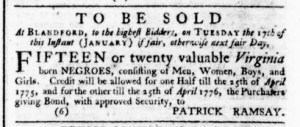
Slavery Advertisements Published January 14, 1775

The Slavery Adverts 250 Project chronicles the role of newspaper advertising in perpetuating slavery in the era of the American Revolution. The project seeks to reveal the ubiquity of slavery in eighteenth-century life from New England to Georgia by republishing advertisements about enslaved people – for sale as individuals or in groups, wanted to purchase or for hire for short periods, runaways who liberated themselves, and those who were subsequently captured and confined in jails and workhouses – in daily digests on this site as well as in real time via the @SlaveAdverts250 Twitter feed, utilizing twenty-first-century media to stand in for the print media of the eighteenth century.

The project aims to provide modern audiences with a sense of just how often colonizers encountered these advertisements in their daily lives. Enslaved men, women, and children appeared in print somewhere in the colonies almost every single day. Those advertisements served as a constant backdrop for social, cultural, economic, and political life in colonial and revolutionary America. Colonizers who did not purport to own enslaved people were still confronted with slavery as well as invited to maintain the system by purchasing enslaved men, women, and children or assisting in the capture of so-called “runaways” who sought to free themselves from bondage. The frequency of these newspaper advertisements suggests just how embedded slavery was in colonial and revolutionary American culture in everyday interactions beyond the printed page.

These advertisements also testify to the experiences of enslaved men, women, and children, though readers must consider that those experiences have been remediated through descriptions offered by enslavers rather than enslaved people themselves. Often unnamed in the advertisements, enslaved men, women, and children were not invisible or unimportant in early America.

These advertisements appeared in colonial American newspapers 250 years ago today.
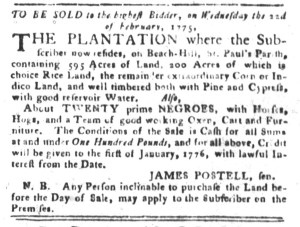
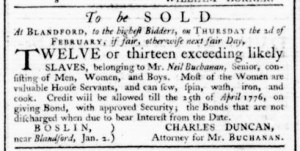
Virginia Gazette (January 14, 1775).
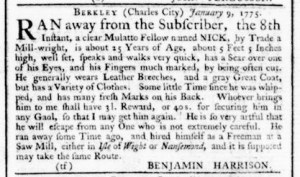
**********

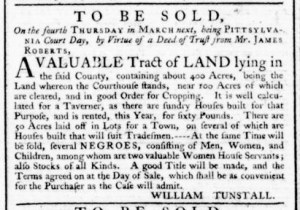
Virginia Gazette (January 14, 1775).

**********

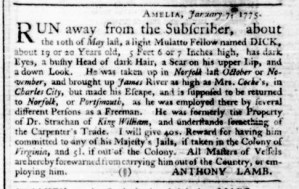
Virginia Gazette (January 14, 1775).

**********

Virginia Gazette (January 14, 1775).

**********

Virginia Gazette (January 14, 1775).

**********

Virginia Gazette (January 14, 1775).

**********

Virginia Gazette (January 14, 1775).

**********

Virginia Gazette (January 14, 1775).

**********

Virginia Gazette (January 14, 1775).

**********

Virginia Gazette (January 14, 1775).

January 13

Who was the subject of an advertisement in a colonial American newspaper 250 years ago today?

New-Hampshire Gazette (January 13, 1775).

“A NEGRO FELLOW named POMP … procur’d a counterfeit Pass.”

On January 13, 1775, nearly two dozen advertisements about enslaved people appeared in newspapers printed in the American colonies.  Twenty-two of them ran in the South-Carolina and American General Gazette, published in Charleston, and one in the New-Hampshire Gazette, published in Portsmouth.  Those numbers tell a familiar story about the size of the enslaved population in the southern colonies, yet the example from New-Hampshire Gazette demonstrates that slavery was practiced throughout the colonies on the eve of the American Revolution.

Ebenezer Sayer of Wells, Massachusetts (now Maine), placed a notice in the newspaper printed closest to his town, the New-Hampshire Gazette, to advise that “a NEGRO FELLOW named POMP” liberated himself by running away sometime during the evening of December 18, 1774.  Sayer described Pomp’s clothing, including the “black silk Handkerchief round his Neck, and a green Cap,” to help readers recognize him.  He also offered a reward to anyone who apprehended Pomp and brought him to Sayer in Wells or secured him in the jail in York, Massachusetts (Maine).

In a nota bene, Sayer revealed that Pomp was quite ingenious and carefully planned his escape from enslavement.  Before he departed, Pomp “procur’d a counterfeit Pass, changing his own Name and his Master’s.”  Sayer did not reveal how he learned about the pass or anything about its origins, though he does suggest that Pomp could read and write well enough to alter the pass on his own.  “All Persons are cautioned against being deceived by such Artifice,” Sayer admonished.  He also issued a standard warning to “all Masters of Vessels and others … not to harbour, conceal or carry off said Negro.”  Those who aided him would face “Penalties of the Law.”  In other words, colonies in New England had their own slave codes to maintain social order, further demonstrating that slavery was not restricted to plantations in southern colonies.  Yet Pomp’s story (and the stories of many of the enslaved people in advertisements in the South-Carolina and American General Gazette) also testifies to the spirit of resistance and resilience among enslaved people on the eve of the American Revolution, an exceptionally important story itself.