January 26

GUEST CURATOR: James “Jack” Driscoll

Who was the subject of an advertisement in a colonial American newspaper 250 years ago today?
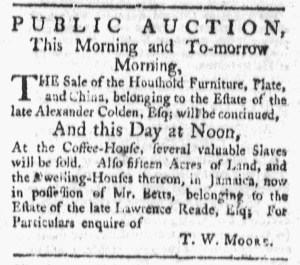
Rivington’s New-York Gazetteer (January 26, 1775).

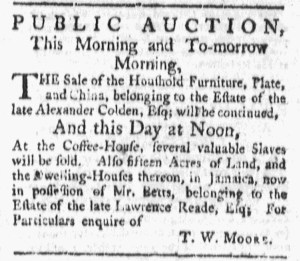
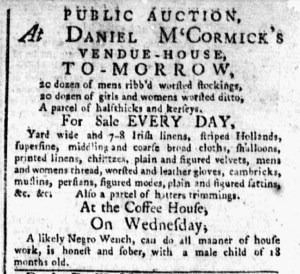
“PUBLIC AUCTION … several valuable Slaves will be sold.”

In this advertisement in Rivington’s New-York Gazetteer from January 26, 1775, T.W. Moore advertised a public auction being held “This Morning and To-Morrow Morning” to sell off the possessions of the late Alexander Colden to the highest bidder. In addition to these household items up for sale, Moore held another auction “this Day at Noon” for several enslaved people. This especially stood out to me because this shows public auctions, a competitive method, was a primary method of buying and selling goods, land, and even enslaved people in Revolutionary America. While people who were involved in the open market used auctions to sell off belongings and estates, enslavers used them as a way to reach a wider range of buyers in their efforts to make a profit off of enslaved people.

This advertisement shows that slave auctions happened even in New York.  In “The Forgotten History of Slavery in New York,” Andrea C. Mosterman declares, “New York’s slavery past is still relatively unknown.”  However, we can see by this advertisement, that these slaves for sale were an important part of Moore’s auctions. There was a high demand for enslaved people in New York before, during, and after the American Revolution. In 1788, Mosterman states, “Close to 75% of the free, white Kings County families enslaved people within their home.”  The American Revolution did not result in freedom for everyone.  Instead, some people would stand and look at other human beings being sold against their will along with everyday items like furniture and China dishes.  By participating in these auctions, they treated enslaved people as property instead of as human beings.

**********

ADDITIONAL COMMENTARY: Carl Robert Keyes

In addition to selecting an advertisement to examine for the Adverts 250 Project, Jack is serving as guest curator for the Slavery Adverts 250 Project this week.  Beyond this advertisement for “several valuable Slaves” up for bids at Moore’s auction on January 26, 1775, he identified eight other advertisements about enslaved people that appeared in the New-York Journal and Rivington’s New-York Gazetteer on the same day.  As Jack makes clear, that auction was not an isolated incident.  Instead, slavery was widely practiced in New York on the eve of the American Revolution and continued after thirteen colonies secured independence as a new nation.

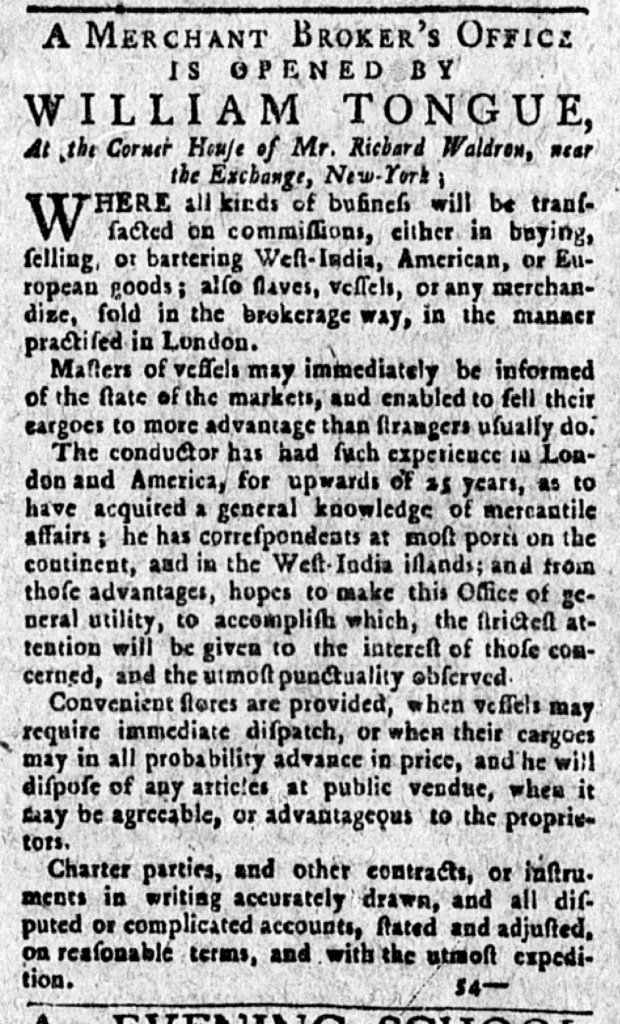
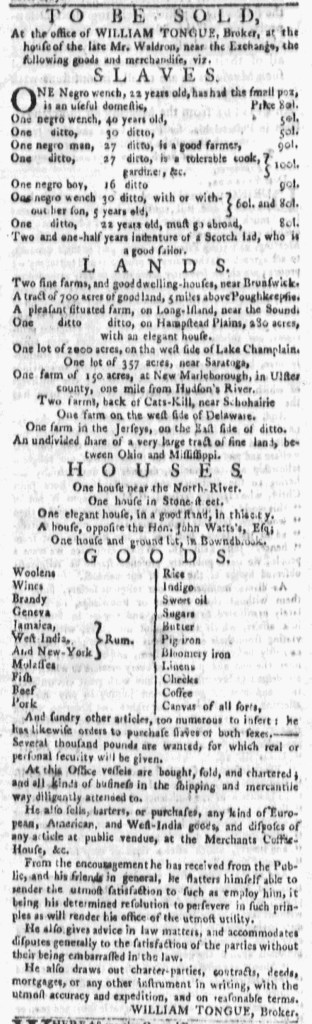
Auctioneers like Moore represented part of the infrastructure for perpetuating slavery and the slave trade in New York.  The printers who generated revenue by publishing these advertisements made significant contributions as well.  Brokers, like William Tongue, played an important role as well.  Tongue placed a lengthy advertisement enumerating “SLAVES,” “LANDS,” “HOUSES,” and “GOODS” for sale at his office “near the Exchange” in both the New-York Journal and Rivington’s New-York Gazetteer as well as the New-York Gazette and Weekly Mercury four days later.  He listed and gave prices for ten enslaved men, women, and children, ranging in age from five to forty.  They included a young woman who was “an useful domestic,” a man who was “a good farmer,” and a woman “with or without her son, 5 years old.”  Tongue also noted that he “has likewise orders to purchase slaves of both sexes.”

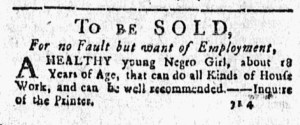
Yet auctioneers and brokers were not alone in enlisting the services of printers in publishing advertisements for the purpose of buying and selling enslaved people.  An anonymous advertiser offered a “LIKELY and handy Mulatto Boy” for sale in the New-York Journal.  That youth had experience “waiting at Table” and could “attend a Gentleman on traveling.”  The advertisement instructed reader to “Inquire of the Printer” for more details.  Another advertisement featured an enslaved woman, “twenty-six Years of Age,” and an enslaved boy, “of twelve Years of Age,” for sale, again with directions to “Enquire of the Printer.”  Still another described a “HEALTHY young Negro Girl … that can do all Kinds of House Work.”  While auctioneers and brokers earned their livelihoods through buying and selling enslaved people, other colonizers made purchases and sales of one or two enslaved people at a time.  Collectively, they made slavery a prevalent aspect of life in New York during the era of the American Revolution.
Welcome, Guest Curator Jack Driscoll

James “Jack” Driscoll is a Junior at Assumption University in Worcester, Massachusetts.  He is majoring in Criminology and minoring in History.  He hopes to one day work for the U.S. Marshal Service, doing case work on fugitives and providing security to prisoners in transport and in the courtroom.  He decided to pursue a history minor because ever since he was a kid he has always been very passionate about learning about the past because it serves as an explanation for the present.  At Assumption, he plays left tackle for the football team, one of his proudest achievements.  He consistently devotes hard work to that position top contribute to positive outcomes on the field for his entire team.  Jac made his contributions to the Adverts 250 Project and the Slavery Adverts 250 Project while enrolled in HIS 359 Revolutionary America, 1763-1815, in Fall 2024.

Welcome, guest curator Jack Driscoll!

Slavery Advertisements Published January 26, 1775

The Slavery Adverts 250 Project chronicles the role of newspaper advertising in perpetuating slavery in the era of the American Revolution. The project seeks to reveal the ubiquity of slavery in eighteenth-century life from New England to Georgia by republishing advertisements about enslaved people – for sale as individuals or in groups, wanted to purchase or for hire for short periods, runaways who liberated themselves, and those who were subsequently captured and confined in jails and workhouses – in daily digests on this site as well as in real time via the @SlaveAdverts250 Twitter feed, utilizing twenty-first-century media to stand in for the print media of the eighteenth century.
The project aims to provide modern audiences with a sense of just how often colonizers encountered these advertisements in their daily lives. Enslaved men, women, and children appeared in print somewhere in the colonies almost every single day. Those advertisements served as a constant backdrop for social, cultural, economic, and political life in colonial and revolutionary America. Colonizers who did not purport to own enslaved people were still confronted with slavery as well as invited to maintain the system by purchasing enslaved men, women, and children or assisting in the capture of so-called “runaways” who sought to free themselves from bondage. The frequency of these newspaper advertisements suggests just how embedded slavery was in colonial and revolutionary American culture in everyday interactions beyond the printed page.

These advertisements also testify to the experiences of enslaved men, women, and children, though readers must consider that those experiences have been remediated through descriptions offered by enslavers rather than enslaved people themselves. Often unnamed in the advertisements, enslaved men, women, and children were not invisible or unimportant in early America.

These advertisements appeared in colonial American newspapers 250 years ago today.

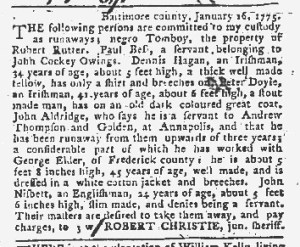
Maryland Gazette (January 26, 1775).

**********

Maryland Gazette (January 26, 1775).

**********

Maryland Gazette (January 26, 1775).

**********

Maryland Gazette (January 26, 1775).

**********

Maryland Gazette (January 26, 1775).

**********

Maryland Gazette (January 26, 1775).

**********

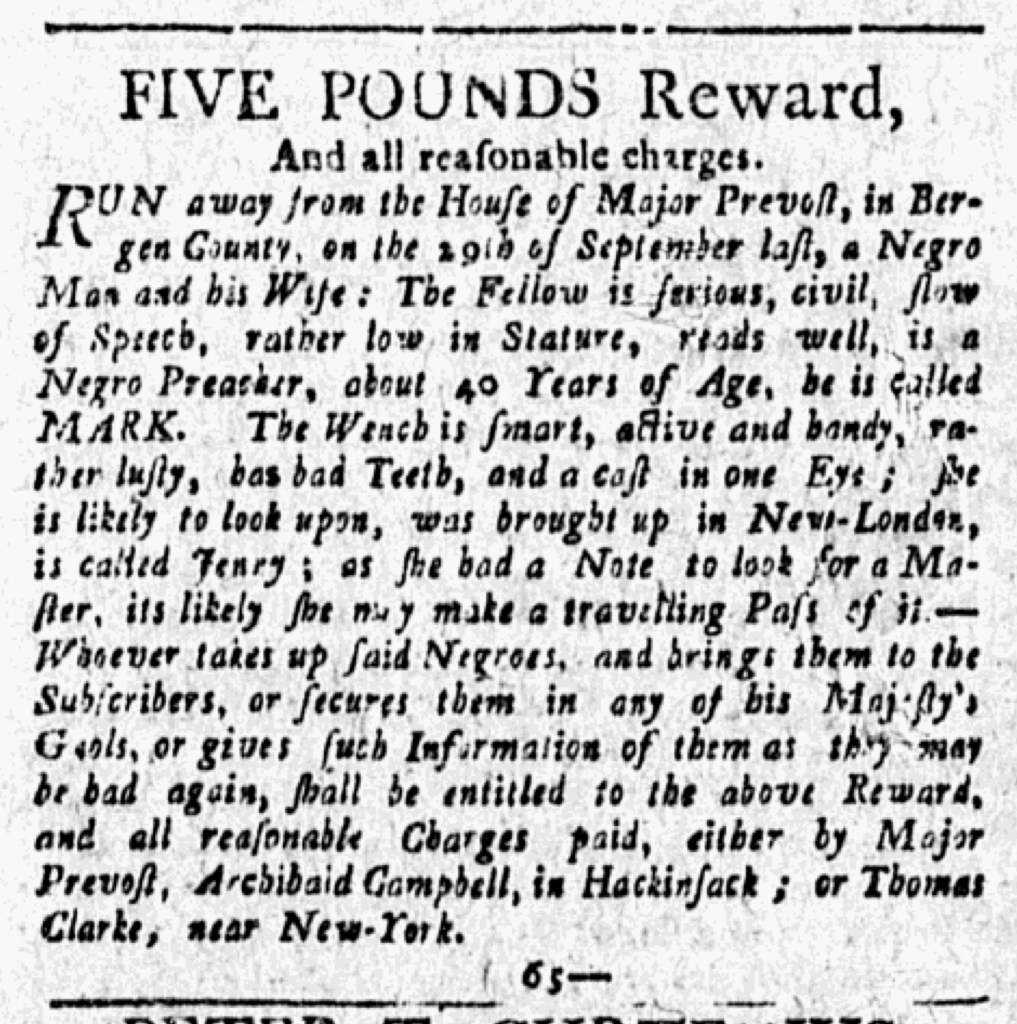
New-York Journal (January 26, 1775).

**********

New-York Journal (January 26, 1775).

**********

New-York Journal (January 26, 1775).

**********

Supplement to the New-York Journal (January 26, 1775).

**********

Supplement to the New-York Journal (January 26, 1775).

**********

Supplement to the New-York Journal (January 26, 1775).

**********

Rivington’s New-York Gazetteer (January 26, 1775).

**********

Rivington’s New-York Gazetteer (January 26, 1775).

**********

Rivington’s New-York Gazetteer (January 26, 1775).

**********

Virginia Gazette [Pinkney] (January 26, 1775).

**********

Virginia Gazette [Pinkney] (January 26, 1775).

**********

Virginia Gazette [Pinkney] (January 26, 1775).

**********

Virginia Gazette [Pinkney] (January 26, 1775).

**********

Virginia Gazette [Pinkney] (January 26, 1775).

**********

Virginia Gazette [Pinkney] (January 26, 1775).

**********

Virginia Gazette [Pinkney] (January 26, 1775).

January 25

What was advertised in a colonial American newspaper 250 years ago today?

Pennsylvania Ledger (January 25, 1775).

“PROPOSALS For Printing by Subscription, a FREE and IMPARTIAL WEEKLY NEWS-PAPER.”

As the imperial crisis intensified, the number of newspapers published in Philadelphia, the largest city in the colonies, grew significantly.  Throughout the early 1770s, readers had access to Dunlap’s Pennsylvania Packet, the Pennsylvania Gazette, and the Pennsylvania Journal.  Until February 1774, the Pennsylvania Chronicle had also circulated in Philadelphia.  Less than a year after that newspaper folded, Benjamin Towne commenced publication of the Pennsylvania Evening Post, the first tri-weekly newspaper attempted in that city, on January 24, 1775, and James Humphrey, Jr., distributed the first issue of the Pennsylvania Ledger four days later.  Enoch Story and Daniel Humphreys also advertised plans for another newspaper, the Pennsylvania Mercury.  They published their inaugural issue in April 1775, two weeks before the battles at Lexington and Concord.

On January 25, the Pennsylvania Journal carried the proposals for both the Pennsylvania Ledger and the Pennsylvania Mercury, placing them side by side on the final page.  As was customary, the printers gave an overview of why they wished to publish their newspapers, explained what subscribers could expect among the contents, and listed the conditions for subscribing.  Among the various purposes the Pennsylvania Mercury would serve, Story and Humphreys included, “To communicate advertisements of every kind.”  The printers of both proposed newspapers sought advertisements, an essential revenue stream for any printer publishing a newspaper.  After noting the prices for subscriptions to the Pennsylvania Ledger, Humphreys indicated, “Advertisements to be inserted on the same terms as is usual with the other papers in this city.”  For the Pennsylvania Mercury, Story and Humphreys declared, “The Rates of the Paper and Advertisements will be the same with those now printed in this City.”  Dunlap’s Pennsylvania Packet and the Pennsylvania Journal both gave the price for subscriptions – “Ten Shillings per Annum” – in their colophons, but none of the newspapers then printed in Philadelphia regularly published what they charged for advertising.  Apparently, according to the proposals for the Pennsylvania Ledger and the Pennsylvania Mercury, none offered better deals than others.

Story and Humphreys did give a bit more attention to advertising in their proposals.  “All Advertisements,” they promised, “shall be inserted in order as they come in, and shall appear in a fair and conspicuous manner.”  They did not mean that paid notices would literally appear one after the other in the order received at the printing office but rather that a compositor would set type in that order and integrate them into the layout of the newspaper without privileging any later arrivals over those submitted sooner.  After all, newspaper printers sometimes inserted notes that advertisements had been omitted due to lack of space.  Story and Humphreys signaled that they would not take anything into consideration beyond the order that advertisers delivered their notices when delaying publication of some.  They also acknowledged that compositors arranged content to make pieces of different lengths complete columns and fill pages.  During that process, they would not privilege any advertisements over others, displaying each “in a fair and conspicuous manner.”  With such appeals, Story and Humphreys solicited the trust of prospective advertisers who wanted a good return on the money they invested in disseminating information in the Pennsylvania Mercury.

Neither of these proposals for new newspapers discussed advertising extensively, but each did seek advertisers along with subscribers.  Whatever goals they expressed for circulating news as the political situation deteriorated, the viability of pursuing their ideals of publishing “improving, instructive and entertaining” information depended in large part on recruiting advertisers as well as enlisting subscribers.

Slavery Advertisements Published January 25, 1775

The Slavery Adverts 250 Project chronicles the role of newspaper advertising in perpetuating slavery in the era of the American Revolution. The project seeks to reveal the ubiquity of slavery in eighteenth-century life from New England to Georgia by republishing advertisements about enslaved people – for sale as individuals or in groups, wanted to purchase or for hire for short periods, runaways who liberated themselves, and those who were subsequently captured and confined in jails and workhouses – in daily digests on this site as well as in real time via the @SlaveAdverts250 Twitter feed, utilizing twenty-first-century media to stand in for the print media of the eighteenth century.
The project aims to provide modern audiences with a sense of just how often colonizers encountered these advertisements in their daily lives. Enslaved men, women, and children appeared in print somewhere in the colonies almost every single day. Those advertisements served as a constant backdrop for social, cultural, economic, and political life in colonial and revolutionary America. Colonizers who did not purport to own enslaved people were still confronted with slavery as well as invited to maintain the system by purchasing enslaved men, women, and children or assisting in the capture of so-called “runaways” who sought to free themselves from bondage. The frequency of these newspaper advertisements suggests just how embedded slavery was in colonial and revolutionary American culture in everyday interactions beyond the printed page.

These advertisements also testify to the experiences of enslaved men, women, and children, though readers must consider that those experiences have been remediated through descriptions offered by enslavers rather than enslaved people themselves. Often unnamed in the advertisements, enslaved men, women, and children were not invisible or unimportant in early America.

These advertisements appeared in colonial American newspapers 250 years ago today.

Connecticut Journal (January 25, 1775).

**********

Pennsylvania Gazette (January 25, 1775).

**********

Pennsylvania Journal (January 25, 1775).

January 24

What was advertised in a colonial American newspaper 250 years ago today?

Pennsylvania Evening Post (January 24, 1775).

“THE first Number of the PENNSYLVANIA EVENING POST is now laid before the respectable Public.”

On January 24, 1775, Benjamin Towne launched a new newspaper, the Pennsylvania Evening Post.  The printer distinguished this publication with a publication schedule that differed from all other newspapers in Philadelphia and throughout the colonies, distributing three issues a week on Tuesday, Thursday, and Saturday evenings rather than a single weekly issue.  In an address to “the respectable Public” that opened the inaugural edition, Towne asserted that this publication schedule “will … give particular Satisfaction to all Persons anxious for early Intelligence at this important Crisis.”  To that end, he explained that he timed his issues according to the arrival of the “Eastern Post” that carried newspapers and letters from New York and New England.

The first issue of the Pennsylvania Evening Post did not feature any advertisements, unlike other newspapers founded in the early 1770s, yet Towne sought to attract advertisers to defray the expenses of printing the newspaper.  Although he could not yet promote widespread circulation to entice advertisers, he did note that because “no Paper is published between Wednesday and Saturday, that on Thursday will be very convenient for Advertisements, which shall be punctually and conspicuously inserted.”  Readers in Philadelphia were accustomed to new editions of the Pennsylvania Gazette and the Pennsylvania Journal on Mondays and Dunlap’s Pennsylvania Packet on Wednesdays.  Towne anticipated publication of the Pennsylvania Ledger on Saturdays, realizing that James Humphreys, Jr., would soon print yet another newspaper in Philadelphia.  Humphreys distributed the first issue on January 28.  Still, Towne attempted to seize an advantage, advising advertisers that they could disseminate notices in the Pennsylvania Evening Post during a portion of the week without other publications in Philadelphia.

Towne charged the “usual Rates” for advertisements, though “All Advertisements of useful and ingenious Inventions in Manufactures and Agriculture shall be inserted gratis.”  Savvy readers knew that meant that Towne did his part to support the eighth article of the Continental Association.  It called on all colonizers, “in our several Stations, [to] encourage Frugality, Economy, and Industry; and promote Agriculture, Arts, and the Manufactures of this Country.”  In his “Station” as a printer, Towne could play an important role in delivering information about the “Manufactures of this Country” to the public, provided that advertisers supported his newspaper by supplying him with that information.

Pennsylvania Evening Post (January 24, 1775).

Not long after Towne published the first issue of the Pennsylvania Evening Post, he distributed a broadside that declared, “The first ATTEMPT in AMERICA.  On TUESDAY, the 24th of JANUARY, 1775, was published … An UNINFLUENCED and IMPARTIAL NEWSPAPER, ENTITLED THE Pennsylvania Evening Post, Which will be regularly PUBLISHED every TUESDAY, THURSDAY, and SATURDAY EVENINGS.”  The printer certainly sought to capitalize on the frequency of publication in promoting his newspaper.  Yet he was not entirely correct that his tri-weekly was the “first ATTEMPT” by an American printer.  The American Antiquarian Society’s copy of this broadside, previously bound in a volume with issues of the newspaper from 1775, includes a manuscript notation by Isaiah Thomas: “This is a mistake: a small newspaper, The Spy, was published 3 times weekly, in Boston in 1770.”  Towne may have been unaware that the Massachusetts Spy had been published three times a week in August, September, and October 1770 adjusting its schedule to twice a week in November 1770 and once a week in March 1771.  The Massachusetts Spy had been a tri-weekly just briefly, but Thomas remembered because he and Zechariah Fowle had been partners in the endeavor.  Although Towne was mistaken about the Pennsylvania Evening Post being the “first ATTEMPT” at a tri-weekly, he offered access to the news on a schedule not previously available to subscribers in Philadelphia.

Broadside: Benjamin Towne, “The First Attempt in America” (Philadelphia, 1775). Courtesy American Antiquarian Society.

Slavery Advertisements Published January 24, 1775

The Slavery Adverts 250 Project chronicles the role of newspaper advertising in perpetuating slavery in the era of the American Revolution. The project seeks to reveal the ubiquity of slavery in eighteenth-century life from New England to Georgia by republishing advertisements about enslaved people – for sale as individuals or in groups, wanted to purchase or for hire for short periods, runaways who liberated themselves, and those who were subsequently captured and confined in jails and workhouses – in daily digests on this site as well as in real time via the @SlaveAdverts250 Twitter feed, utilizing twenty-first-century media to stand in for the print media of the eighteenth century.
The project aims to provide modern audiences with a sense of just how often colonizers encountered these advertisements in their daily lives. Enslaved men, women, and children appeared in print somewhere in the colonies almost every single day. Those advertisements served as a constant backdrop for social, cultural, economic, and political life in colonial and revolutionary America. Colonizers who did not purport to own enslaved people were still confronted with slavery as well as invited to maintain the system by purchasing enslaved men, women, and children or assisting in the capture of so-called “runaways” who sought to free themselves from bondage. The frequency of these newspaper advertisements suggests just how embedded slavery was in colonial and revolutionary American culture in everyday interactions beyond the printed page.

These advertisements also testify to the experiences of enslaved men, women, and children, though readers must consider that those experiences have been remediated through descriptions offered by enslavers rather than enslaved people themselves. Often unnamed in the advertisements, enslaved men, women, and children were not invisible or unimportant in early America.

These advertisements appeared in colonial American newspapers 250 years ago today.

South-Carolina Gazette and Country Journal (January 24, 1775).

**********

South-Carolina Gazette and Country Journal (January 24, 1775).

**********

South-Carolina Gazette and Country Journal (January 24, 1775).

**********

South-Carolina Gazette and Country Journal (January 24, 1775).

**********

South-Carolina Gazette and Country Journal (January 24, 1775).

**********

South-Carolina Gazette and Country Journal (January 24, 1775).

**********

South-Carolina Gazette and Country Journal (January 24, 1775).

**********

South-Carolina Gazette and Country Journal (January 24, 1775).

**********

South-Carolina Gazette and Country Journal (January 24, 1775).

**********

South-Carolina Gazette and Country Journal (January 24, 1775).

**********

South-Carolina Gazette and Country Journal (January 24, 1775).

**********

Supplement to the South-Carolina Gazette and Country Journal (January 24, 1775).

**********

Supplement to the South-Carolina Gazette and Country Journal (January 24, 1775).

**********

Supplement to the South-Carolina Gazette and Country Journal (January 24, 1775).

**********

Supplement to the South-Carolina Gazette and Country Journal (January 24, 1775).

**********

Supplement to the South-Carolina Gazette and Country Journal (January 24, 1775).

**********

Supplement to the South-Carolina Gazette and Country Journal (January 24, 1775).

**********

Supplement to the South-Carolina Gazette and Country Journal (January 24, 1775).

**********

Supplement to the South-Carolina Gazette and Country Journal (January 24, 1775).

**********

Supplement to the South-Carolina Gazette and Country Journal (January 24, 1775).

**********

Supplement to the South-Carolina Gazette and Country Journal (January 24, 1775).

**********

Supplement to the South-Carolina Gazette and Country Journal (January 24, 1775).

**********

Supplement to the South-Carolina Gazette and Country Journal (January 24, 1775).

**********

Supplement to the South-Carolina Gazette and Country Journal (January 24, 1775).

**********

Supplement to the South-Carolina Gazette and Country Journal (January 24, 1775).

**********

Supplement to the South-Carolina Gazette and Country Journal (January 24, 1775).

January 23

What was advertised in a colonial American newspaper 250 years ago today?

Massachusetts Gazette and Boston Post-Boy (January 23, 1775).

“This Paper, has been printed with ink manufactured by said Geyer, for several Months past.”

When the Continental Association went into effect, colonizers looked to “domestic manufactures” or goods produced in the colonies as alternatives to imports.  The eighth article of that nonimportation, nonconsumption, and nonexportation agreement even stated that “we will, on our several Stations, encourage Frugality, Economy, and Industry; and promote Agriculture, Arts and the Manufactures of this Country.”  Henry Christian Geyer did just that in an advertisement that appeared in the January 23, 1775, edition of the Massachusetts Gazette and Boston Post-Boy.  He announced that he “manufactured” printing ink “in large or small Quantities, at his Shop near Liberty-Tree South-End of Boston.”  Devoting such “Industry” to the “Manufactures of this Country” testified to Geyer’s support of the American cause; noting the proximity of his shop and such an important symbol underscored his patriotism.

Yet Geyer had more to say about the matter.  He proclaimed to “the Public” that “the Royal American Magazine, was not printed with his Ink.”  His advertisement gave no indication why he singled out the Royal American Magazine and not any of the newspapers published in Boston or any of the city’s printing offices.  After all, if he had captured the entire market (except for the Royal American Magazine) then he had less need to place an advertisement.  He chose to shame Joseph Greenleaf, the publisher of the Royal American Magazine, for not purchasing his product, perhaps intending to bully him into buying Geyer’s printing ink or perhaps settling some score by embarrassing him in a public forum.

Geyer’s advertisement concluded with a nota bene that clarified that “This Paper, has been printed with Ink manufactured by said Geyer, for several Months past.”  Geyer may have written the nota bene himself, presenting a testimonial of the quality of the ink that readers could assess for themselves as they held the Massachusetts Gazette and Boston Post-Boy in their hands.  Alternately, Nathaniel Mills and John Hicks, the printers of the newspaper, could have added the nota beneon their own as a means of demonstrating that they supported domestic manufactures even before the Continental Association went into effect.

Slavery Advertisements Published January 23, 1775

The Slavery Adverts 250 Project chronicles the role of newspaper advertising in perpetuating slavery in the era of the American Revolution. The project seeks to reveal the ubiquity of slavery in eighteenth-century life from New England to Georgia by republishing advertisements about enslaved people – for sale as individuals or in groups, wanted to purchase or for hire for short periods, runaways who liberated themselves, and those who were subsequently captured and confined in jails and workhouses – in daily digests on this site as well as in real time via the @SlaveAdverts250 Twitter feed, utilizing twenty-first-century media to stand in for the print media of the eighteenth century.
The project aims to provide modern audiences with a sense of just how often colonizers encountered these advertisements in their daily lives. Enslaved men, women, and children appeared in print somewhere in the colonies almost every single day. Those advertisements served as a constant backdrop for social, cultural, economic, and political life in colonial and revolutionary America. Colonizers who did not purport to own enslaved people were still confronted with slavery as well as invited to maintain the system by purchasing enslaved men, women, and children or assisting in the capture of so-called “runaways” who sought to free themselves from bondage. The frequency of these newspaper advertisements suggests just how embedded slavery was in colonial and revolutionary American culture in everyday interactions beyond the printed page.

These advertisements also testify to the experiences of enslaved men, women, and children, though readers must consider that those experiences have been remediated through descriptions offered by enslavers rather than enslaved people themselves. Often unnamed in the advertisements, enslaved men, women, and children were not invisible or unimportant in early America.

These advertisements appeared in colonial American newspapers 250 years ago today.

Boston Evening-Post (January 23, 1775).

**********

Connecticut Courant (January 23, 1775).

**********

Connecticut Courant (January 23, 1775).

**********

Connecticut Courant (January 23, 1775).

**********

Dunlap’s Pennsylvania Packet (January 23, 1775).

**********

Newport Mercury (January 23, 1775).

**********

New-York Gazette and Weekly Mercury (January 23, 1775).

**********

New-York Gazette and Weekly Mercury (January 23, 1775).

**********

New-York Gazette and Weekly Mercury (January 23, 1775).

**********

New-York Gazette and Weekly Mercury (January 23, 1775).

**********

New-York Gazette and Weekly Mercury (January 23, 1775).

**********

South-Carolina Gazette (January 23, 1775).

**********

South-Carolina Gazette (January 23, 1775).

**********

South-Carolina Gazette (January 23, 1775).

**********

South-Carolina Gazette (January 23, 1775).

**********

South-Carolina Gazette (January 23, 1775).

**********

South-Carolina Gazette (January 23, 1775).

**********

Supplement to the South-Carolina Gazette (January 23, 1775).

**********

Supplement to the South-Carolina Gazette (January 23, 1775).

**********

Supplement to the South-Carolina Gazette (January 23, 1775).

**********

Supplement to the South-Carolina Gazette (January 23, 1775).

**********

Supplement to the South-Carolina Gazette (January 23, 1775).

**********

Supplement to the South-Carolina Gazette (January 23, 1775).

**********

Supplement to the South-Carolina Gazette (January 23, 1775).

**********

Supplement to the South-Carolina Gazette (January 23, 1775).

**********

Supplement to the South-Carolina Gazette (January 23, 1775).

**********

Supplement to the South-Carolina Gazette (January 23, 1775).

**********

Supplement to the South-Carolina Gazette (January 23, 1775).

January 22

What was advertised in a colonial American newspaper 250 years ago this week?

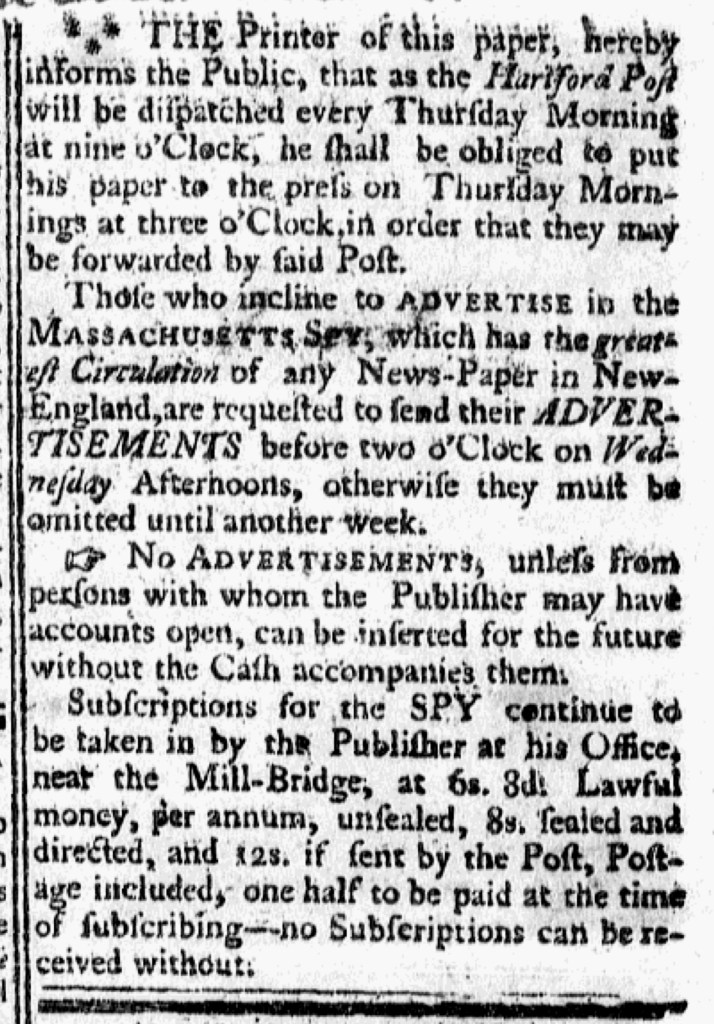
Massachusetts Spy (January 19, 1775).

“No ADVERTISEMENTS … can be inserted for the future without the Cash accompanies them.”

In a notice in the January 19, 1775, edition of the Massachusetts Spy, Isaiah Thomas, the printer, provided several important details about the practices he enacted for publishing his newspaper.  He opened by noting that “the Hartford Post will be dispatched every Thursday Morning at nine o’Clock.”  In order that that the Massachusetts Spy “may be forwarded by said Post,” Thomas “shall be obliged to put his paper to the press on Thursday Mornings at three o’Clock.”  Calling attention to such early mornings not only testified to the industriousness of the printer but also alerted the public that he could publish updates that arrived at his printing office merely hours before he distributed the new issue of his weekly newspaper.

Thomas also advised “[t]hose who incline to ADVERTISE in the MASSACHUSETTS SPY … to send their ADVERTISEMENTS before two o”Clock on Wednesday Afternoons, otherwise they must be omitted until another week.”  To convince them to advertise in in his newspaper, he proclaimed that it “has the greatest Circulation of any News-Paper in New-England.”  That meant that advertisers were likely to experience the greatest return on their investment by placing notices in the pages of the Massachusetts Spy.  Although compositors worked quickly, they did need some time to set type for individual advertisements and lay out all the news, editorials, advertisements, and other content for each issue.  While Thomas might welcome “Articles of Intelligence” that arrived very shortly before taking his newspaper to press, he insisted that advertisements required more time to prepare for publication.  Advertisers needed to plan accordingly.
In addition, Thomas declared, “No ADVERTISEMENTS, unless from persons with whom the Publisher may have accounts open, can be inserted for the future without the Cash accompanies them.”  He also asserted that subscriptions for the newspaper required “one half [of the annual fee] to be paid time of subscribing” and “no Subscriptions can be received without.”  Historians of the early American press often make general statements about printers extending generous credit to subscribers, expecting that some would never pay, because they understood that newspaper advertisements were a much more most significant revenue.  According to such accounts, printers supposedly insisted on receiving payment for advertisements in advance of publishing them.  While that may have been the case in some printing offices, several printers published notices indicating that they departed from such practices.  That Thomas put in place such a policy “for the future” suggests that it may have been a new policy or one that he had not previously enforced.  Similarly, Thomas joined other printers who extended credit yet also demanded that subscribers submit half of the annual fee in advance, updating the terms that he published in the colophon that appeared in each issue of the Massachusetts Spy.