January 8

What was advertised in a colonial American newspaper 250 years ago this week?

Rivington’s New-York Gazetteer (January 5, 1775).

“We being heartily disposed to comply with the association entered into by the late continental congress …”

After it went into effect on December 1, 1774, the Continental Association had an impact on some advertisements that appeared in colonial newspapers.  The tenth article of this nonimportation, nonexportation, and nonconsumption agreement enacted by the First Continental Congress allowed for the sale of goods that arrived between December 1, 1774, and February 1, 1775, but specified that local Committees of Inspection would oversee such transactions, not the importers.  In turn, the importers would be reimbursed for the cost of the goods, but any profits would be earmarked for the relief of Boston while its harbor remained closed because of the Boston Port Act.  The tenth article asserted that “a particular Account” of those goods would be “inserted in the publick Papers.”

That was the case for sales in Plymouth, Massachusetts, near the end of December.  In early January, Thomas Ellison, Jr., Henry Remsen, and several other importers in New York published their own account of goods they ordered the previous spring and summer and the upcoming sale overseen by Joseph Haller, Nicholas Hoffman, and other members of the Committee of Inspection.  Ellison, Remsen, and the others provided an inventory of the imported items.  They also carefully documented when they placed the orders for each item to demonstrate that they had submitted them before the First Continental Congress commenced its meetings in Philadelphia in September and certainly before delegates issued the Continental Association near the end of October.  Still, even though the ship that carried their orders left New York in July, it had returned on January 2, 1775.

The importers recognized their obligation: “we being heartily disposed to comply with the association entered into by the late continental congress, give this public notice, that the said goods will be sold at the Merchants Coffee-house.”  They listed the time and date of the sale and named the members of the Committee of Inspection.  They also provided a succinct inventory, such as “1 case checks, buttons, &c.” and “6 cases Manchester goods,” but did not compose the elaborate descriptions that appeared in many other advertisements before the Continental Association went into effect.  In that regard, their advertisement resembled those for the sales in Plymouth.  Importers who surrendered their goods to Committees of Inspection did not incorporate the marketing strategies commonly used under other circumstances.

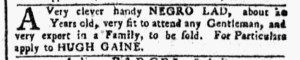
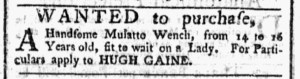
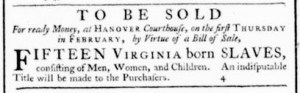
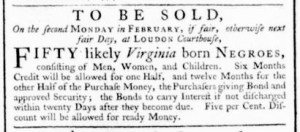
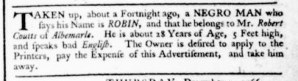
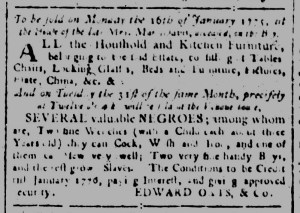
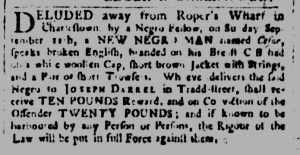
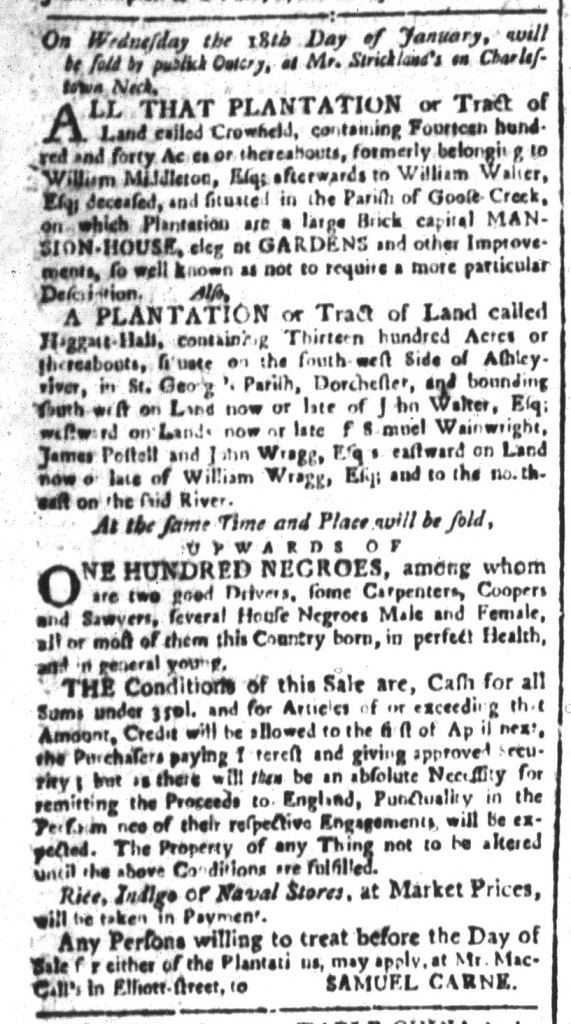
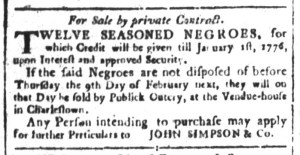
Slavery Advertisements Published January 8, 1776

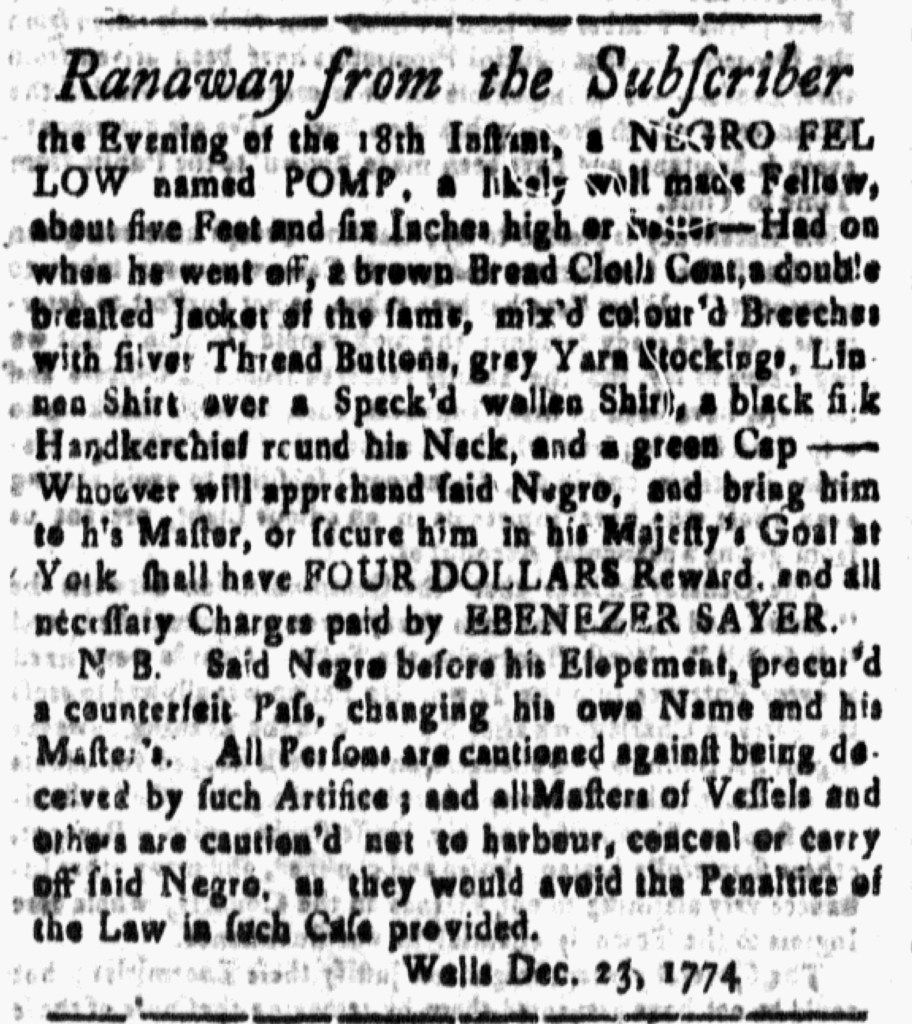
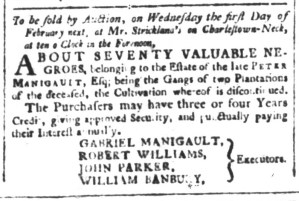
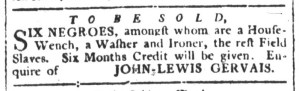
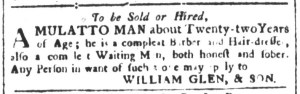
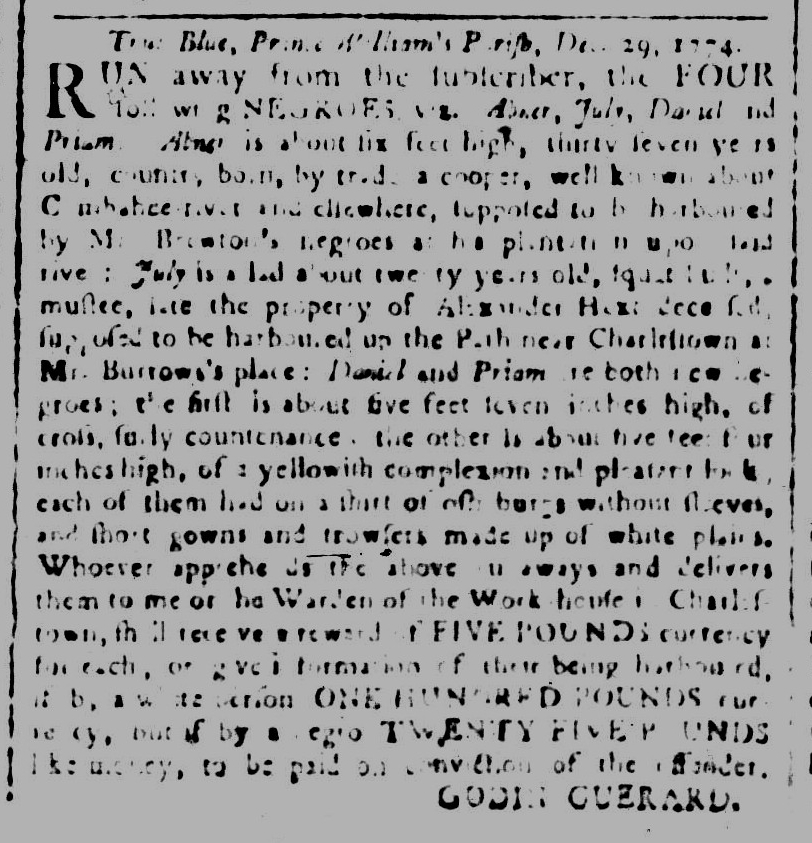
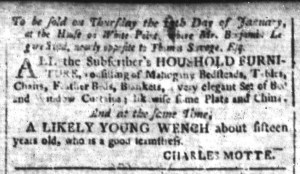
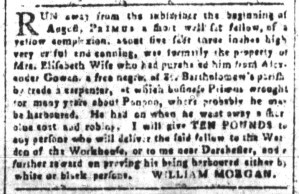
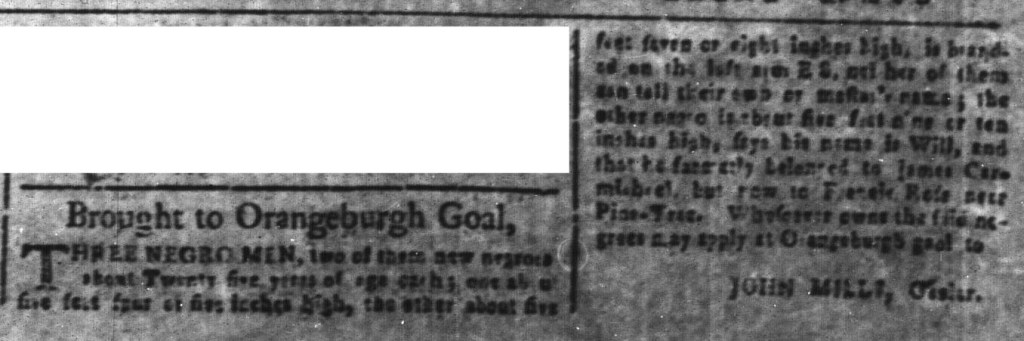
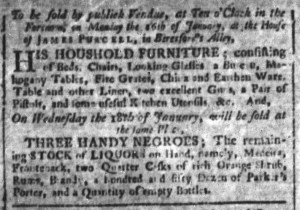
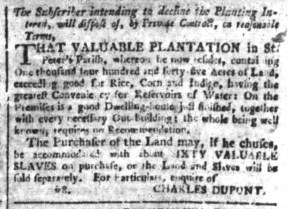
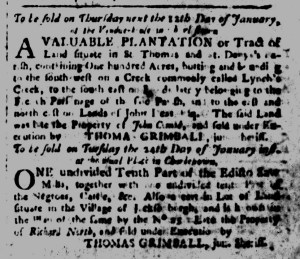
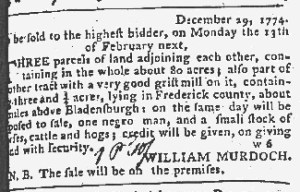
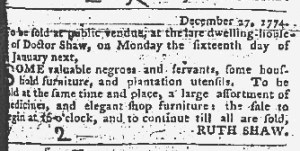
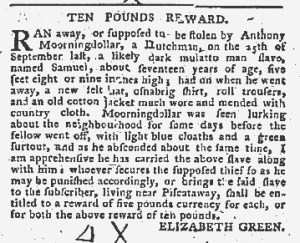
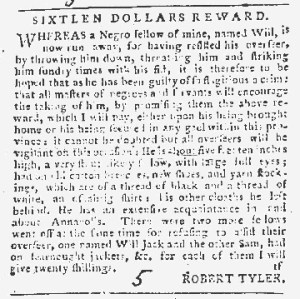
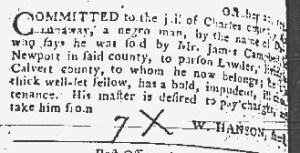
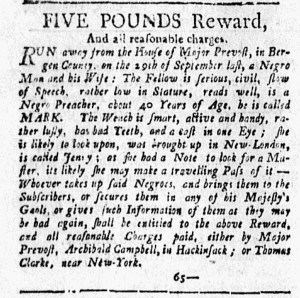
The Slavery Adverts 250 Project chronicles the role of newspaper advertising in perpetuating slavery in the era of the American Revolution. The project seeks to reveal the ubiquity of slavery in eighteenth-century life from New England to Georgia by republishing advertisements about enslaved people – for sale as individuals or in groups, wanted to purchase or for hire for short periods, runaways who liberated themselves, and those who were subsequently captured and confined in jails and workhouses – in daily digests on this site as well as in real time via the @SlaveAdverts250 Twitter feed, utilizing twenty-first-century media to stand in for the print media of the eighteenth century.

The project aims to provide modern audiences with a sense of just how often colonizers encountered these advertisements in their daily lives. Enslaved men, women, and children appeared in print somewhere in the colonies almost every single day. Those advertisements served as a constant backdrop for social, cultural, economic, and political life in colonial and revolutionary America. Colonizers who did not purport to own enslaved people were still confronted with slavery as well as invited to maintain the system by purchasing enslaved men, women, and children or assisting in the capture of so-called “runaways” who sought to free themselves from bondage. The frequency of these newspaper advertisements suggests just how embedded slavery was in colonial and revolutionary American culture in everyday interactions beyond the printed page.
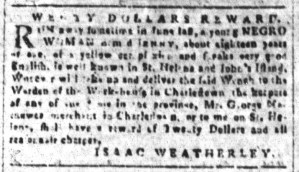
These advertisements also testify to the experiences of enslaved men, women, and children, though readers must consider that those experiences have been remediated through descriptions offered by enslavers rather than enslaved people themselves. Often unnamed in the advertisements, enslaved men, women, and children were not invisible or unimportant in early America.
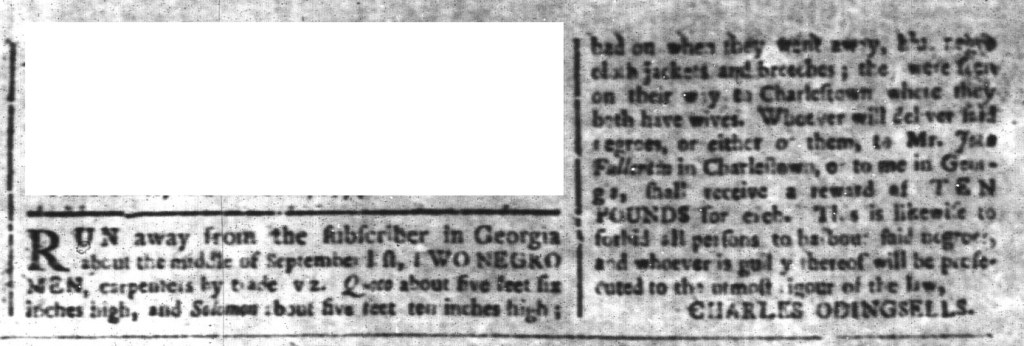
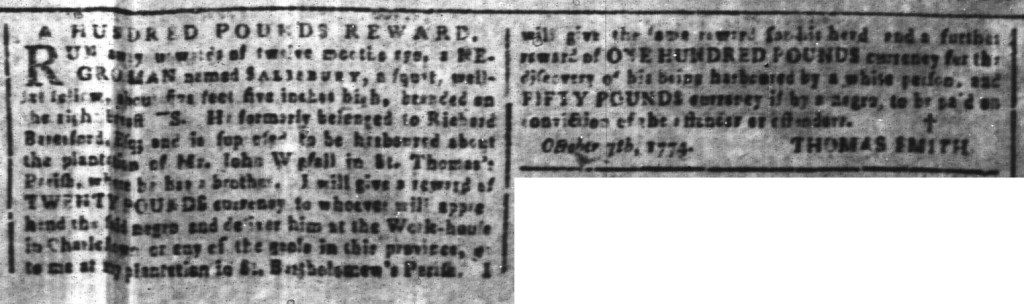
Massimo Sgambati made significant contributions to this entry as part of the Summer Scholars Program, funded by a fellowship from the D’Amour College of Liberal Arts and Sciences at Assumption University in Worcester, Massachusetts, in Summer 2025.

These advertisements appeared in revolutionary American newspapers 250 years ago today.

New-York Gazette and Weekly Mercury (January 8, 1776).

**********

New-York Gazette and Weekly Mercury (January 8, 1776).

**********

New-York Gazette and Weekly Mercury (January 8, 1776).

January 7

What was advertised in a colonial American newspaper 250 years ago today?

Virginia Gazette [Dixon and Hunter] (January 7, 1775).

“We now present the Publick with our Paper, as a Sample of what they are to expect from us in Future.”

When John Dixon and William Hunter commenced their partnership as publishers of the Virginia Gazette, they inserted a notice “To the PUBLICK” as the first item in the first column of the first page of the January 7, 1775, edition.  A month earlier, Alexander Purdie and John Dixon announced the end of their partnership, alerting readers that Dixon and Hunter would continue publishing the Virginia Gazette and that Purdie would endeavor to launch his own Virginia Gazette once he attracted enough subscribers.  The numbering for Dixon and Hunter’s newspaper continued uninterrupted, though there were some changes.  They distributed it on Saturdays instead of Thursdays.  For several years, Purdie and Dixon had published their Virginia Gazette on the same day that William Rind, Clementina Rind, and John Pinkney, in succession, took a competing Virginia Gazette to press.  Readers in Williamsburg now had access to newspapers on both Thursdays and Saturdays.  The new partners published their Virginia Gazette “early every Saturday Morning” so it could be “despatched by the several Posts on the same day” for “speedy Conveyance to the Subscribers.”

Dixon and Hunter also updated the combination masthead and colophon beyond merely changing the names of the printers.  The woodcut depicting the arms of the colony that previously adorned the Virginia Gazette now appeared within an ornate baroque border.  The new partners also incorporated a note about the services they provided: “ALL Persons may be supplied with this Paper at 12s6 a Year, and have Advertisements (of a moderate Length) inserted for 3s. the first Week, and 2s. each Week after. – Printing Work done at this Office in the neatest Manner, with Care and Expedition.”  Those lines transformed the masthead and colophon into an advertisement.  In their notice, Dixon and Hunter reported that only a few readers “have withdrawn their Subscriptions,” leaving them feeling confident about the prospects for their newspaper because they received “many Orders … from the Subscribers to this Gazette for continuing them on our List.”  At twelve shillings and six pence for an annual subscription, the price remained the same.  The price for advertising did as well.  Dixon and Hunter charged a shilling for setting type and two shillings for the space the first time an advertisement appeared and then two shillings for each subsequent insertion.

The new partners also signaled their editorial stance in their message “To the PUBLICK.”  They declared that they would published “Whatever may be sent us in Favour of LIBERTY, or for the PUBLICK GOOD … with Cheerfulness.”  In the event of “Scarcity of News,” they planned to fill the pages with “such moral Pieces, from the best Writers, as may contribute to the Improvement of Mankind in general” and, occasionally, “Pieces of Wit and Humour, that tend both to amuse and instruct.”  It went without saying that advertisements would also fill the pages of the Virginia Gazette.  Indeed, paid notices accounted for nearly half the content in Number 1222, the first issue published by Dixon and Hunter.

Slavery Advertisements Published January 7, 1775

The Slavery Adverts 250 Project chronicles the role of newspaper advertising in perpetuating slavery in the era of the American Revolution. The project seeks to reveal the ubiquity of slavery in eighteenth-century life from New England to Georgia by republishing advertisements about enslaved people – for sale as individuals or in groups, wanted to purchase or for hire for short periods, runaways who liberated themselves, and those who were subsequently captured and confined in jails and workhouses – in daily digests on this site as well as in real time via the @SlaveAdverts250 Twitter feed, utilizing twenty-first-century media to stand in for the print media of the eighteenth century.

The project aims to provide modern audiences with a sense of just how often colonizers encountered these advertisements in their daily lives. Enslaved men, women, and children appeared in print somewhere in the colonies almost every single day. Those advertisements served as a constant backdrop for social, cultural, economic, and political life in colonial and revolutionary America. Colonizers who did not purport to own enslaved people were still confronted with slavery as well as invited to maintain the system by purchasing enslaved men, women, and children or assisting in the capture of so-called “runaways” who sought to free themselves from bondage. The frequency of these newspaper advertisements suggests just how embedded slavery was in colonial and revolutionary American culture in everyday interactions beyond the printed page.

These advertisements also testify to the experiences of enslaved men, women, and children, though readers must consider that those experiences have been remediated through descriptions offered by enslavers rather than enslaved people themselves. Often unnamed in the advertisements, enslaved men, women, and children were not invisible or unimportant in early America.

These advertisements appeared in colonial American newspapers 250 years ago today.

Virginia Gazette [Dixon and Hunter] (January 7, 1775).

**********

Virginia Gazette [Dixon and Hunter] (January 7, 1775).

**********

Virginia Gazette [Dixon and Hunter] (January 7, 1775).

**********

Virginia Gazette [Dixon and Hunter] (January 7, 1775).

**********

Virginia Gazette [Dixon and Hunter] (January 7, 1775).

**********

Virginia Gazette [Dixon and Hunter] (January 7, 1775).

**********

Virginia Gazette [Dixon and Hunter] (January 7, 1775).

**********

Virginia Gazette [Dixon and Hunter] (January 7, 1775).

**********

Virginia Gazette [Dixon and Hunter] (January 7, 1775).

**********

Virginia Gazette [Dixon and Hunter] (January 7, 1775).

January 6

What was advertised in a colonial American newspaper 250 years ago today?

South-Carolina and American General Gazette (January 6, 1775).

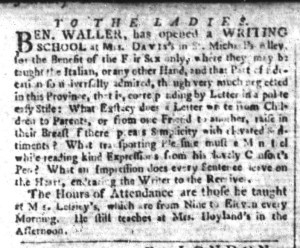
“That Part of Education so universally admired … corresponding by Letter in a polite easy Stile.”

Benjamin Waller taught penmanship and so much more to female pupils in Charleston on the eve of the American Revolution.  In an advertisement addressed “TO THE LADIES” in the January 6, 1775, edition of the South-Carolina and American General Gazette, the tutor announced that he “opened a WRITING SCHOOL … for the Benefit of the Fair Sex only.”  His students learned “the Italian, or any other Hand,” yet Waller’s lessons extended beyond writing to encompass style.  He devoted much of his advertisement to describing the merits of “that Part of Education so universally admired, though very much neglected in this Province, that is, corresponding by Letter in a polite easy Stile.”

Waller likely intended for such an allegation to incite anxiety among many of his prospective pupils.  After all, Charleston was one of the largest and most cosmopolitan urban ports in the colonies.  The local gentry prided themselves on being as fashionable and genteel as their counterparts in New York and Philadelphia.  In addition, they guarded against being considered a backwater outpost when compared to London and other European cities.  Some would have been uncomfortable with Waller’s assertion that writing letters “in a Polite easy Stile” was not widely practiced in South Carolina, questioning whether they fell short of the ideal and put their deficiencies on display each time they wrote to family and friends.

Those were not the only stakes.  Waller deployed a series of questions to illustrate what prospective pupils would gain from his instruction: “What Exstacy does a Letter wrote from Children to parents, or from one Friend to another, raise in their Breast if there appears Simplicity with elevated Sentiments?  What transporting Pleasure must as Man feel while reading kind Expressions from his lovely Consort’s Pen?  What an Impression does every Sentence leave on the Heart, endearing the Writer to the Receiver.”  Writing letters, Waller argued, was not merely a skill but an art, just as much as the drawing and painting lessons advertised by other tutors.  Women who were truly genteel could not take knowing how to write for granted; they also needed guidance, Waller suggested, in forming their thoughts and expressing them gracefully.

Slavery Advertisements Published January 6, 1775

The Slavery Adverts 250 Project chronicles the role of newspaper advertising in perpetuating slavery in the era of the American Revolution. The project seeks to reveal the ubiquity of slavery in eighteenth-century life from New England to Georgia by republishing advertisements about enslaved people – for sale as individuals or in groups, wanted to purchase or for hire for short periods, runaways who liberated themselves, and those who were subsequently captured and confined in jails and workhouses – in daily digests on this site as well as in real time via the @SlaveAdverts250 Twitter feed, utilizing twenty-first-century media to stand in for the print media of the eighteenth century.

The project aims to provide modern audiences with a sense of just how often colonizers encountered these advertisements in their daily lives. Enslaved men, women, and children appeared in print somewhere in the colonies almost every single day. Those advertisements served as a constant backdrop for social, cultural, economic, and political life in colonial and revolutionary America. Colonizers who did not purport to own enslaved people were still confronted with slavery as well as invited to maintain the system by purchasing enslaved men, women, and children or assisting in the capture of so-called “runaways” who sought to free themselves from bondage. The frequency of these newspaper advertisements suggests just how embedded slavery was in colonial and revolutionary American culture in everyday interactions beyond the printed page.

These advertisements also testify to the experiences of enslaved men, women, and children, though readers must consider that those experiences have been remediated through descriptions offered by enslavers rather than enslaved people themselves. Often unnamed in the advertisements, enslaved men, women, and children were not invisible or unimportant in early America.

These advertisements appeared in colonial American newspapers 250 years ago today.

New-Hampshire Gazette (January 6, 1775).

**********

South-Carolina and American General Gazette (January 6, 1775).

**********

South-Carolina and American General Gazette (January 6, 1775).

**********

South-Carolina and American General Gazette (January 6, 1775).

**********

South-Carolina and American General Gazette (January 6, 1775).

**********

South-Carolina and American General Gazette (January 6, 1775).

**********

South-Carolina and American General Gazette (January 6, 1775).

**********

South-Carolina and American General Gazette (January 6, 1775).

**********

South-Carolina and American General Gazette (January 6, 1775).

**********

South-Carolina and American General Gazette (January 6, 1775).

**********

South-Carolina and American General Gazette (January 6, 1775).

**********

South-Carolina and American General Gazette (January 6, 1775).

**********

South-Carolina and American General Gazette (January 6, 1775).

**********

South-Carolina and American General Gazette (January 6, 1775).

**********

South-Carolina and American General Gazette (January 6, 1775).

**********

South-Carolina and American General Gazette (January 6, 1775).

**********

South-Carolina and American General Gazette (January 6, 1775).

**********

South-Carolina and American General Gazette (January 6, 1775).

**********

South-Carolina and American General Gazette (January 6, 1775).

**********

South-Carolina and American General Gazette (January 6, 1775).

**********

South-Carolina and American General Gazette (January 6, 1775).

**********

South-Carolina and American General Gazette (January 6, 1775).

**********

South-Carolina and American General Gazette (January 6, 1775).

**********

South-Carolina and American General Gazette (January 6, 1775).

**********

South-Carolina and American General Gazette (January 6, 1775).

**********

South-Carolina and American General Gazette (January 6, 1775).

**********

South-Carolina and American General Gazette (January 6, 1775).

**********

South-Carolina and American General Gazette (January 6, 1775).

**********

South-Carolina and American General Gazette (January 6, 1775).

**********

South-Carolina and American General Gazette (January 6, 1775).

**********

South-Carolina and American General Gazette (January 6, 1775).

**********

South-Carolina and American General Gazette (January 6, 1775).

January 5

Who was the subject of an advertisement in a colonial American newspaper 250 years ago today?

Supplement to the South-Carolina Gazette and Country Journal (January 5, 1775).

“Several valuable NEGROES.”

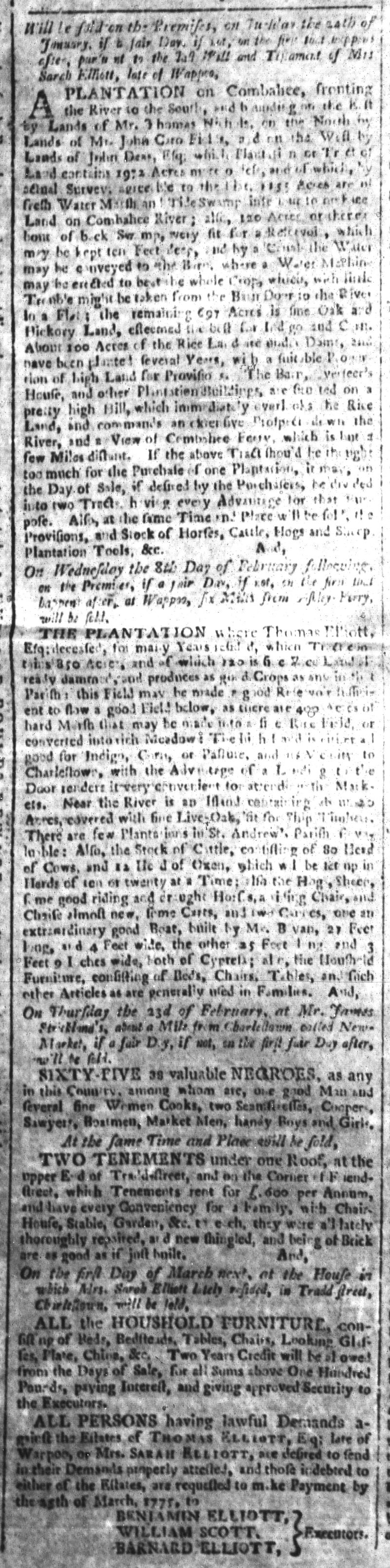
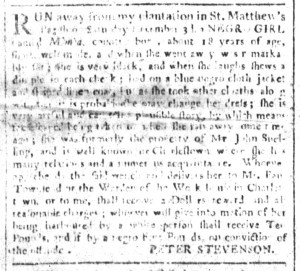
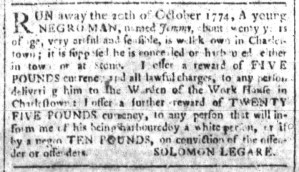
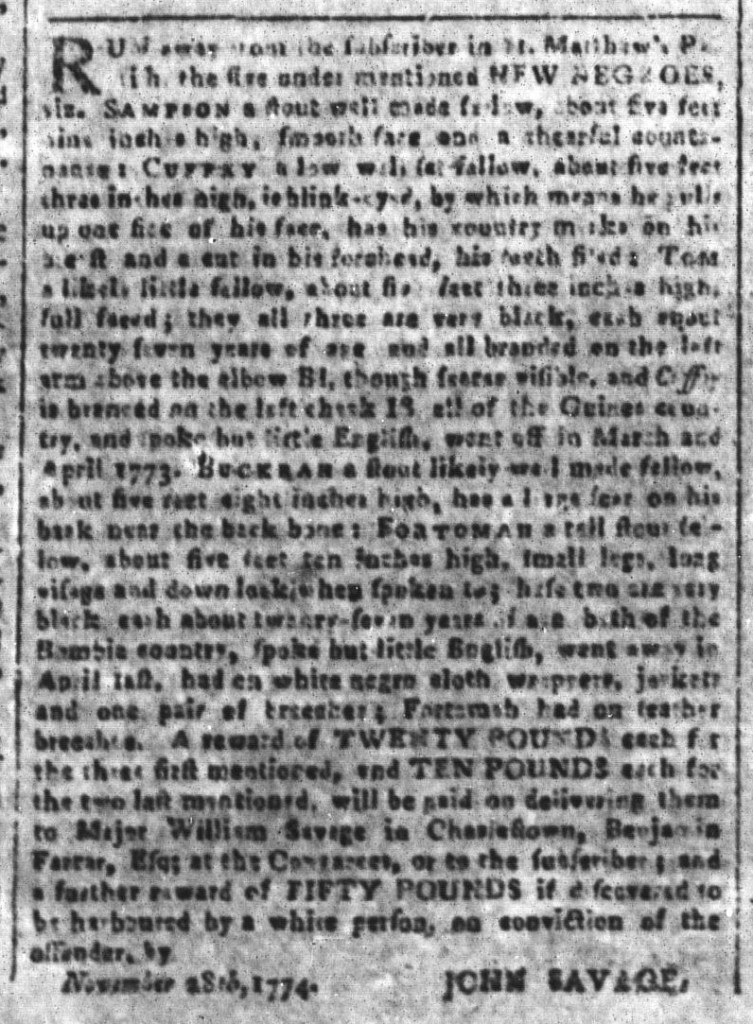
The first week of 1775 was a busy one in Charles Crouch’s printing office “on the Bay, the Corner of Elliott-street” in Charleston.  Crouch published the South-Carolina Gazette and Country Journal on Tuesday, January 3, distributing it to subscribers on the usual day.  The standard four-page issue, however, could not contain all the content that Crouch received for that edition.  Accordingly, he released a two-page supplement, composed entirely of advertisements, on the same day.  Yet Crouch’s press was not finished with the “freshest Advices, both Foreign and Domestic,” for the week.  Two days later, a two-page Supplement to the South-Carolina Gazette and Country Journal carried both news and advertising.  It featured updates from Boston, New York, and Philadelphia, as well as local news.  Advertising appeared on both sides of the broadsheet, accounting for just under half of the content.  Many of those advertisements ran in the standard edition or its supplement just two days earlier.  Thanks to the news that Crouch determined to publish immediately rather than wait nearly a week for the next issue, all the advertisements in the January 5 supplement circulated sooner than anticipated.

Initially, I did not notice that Crouch published the second supplement on January 5 rather than January 3.  Both supplements have been cataloged with the standard edition for that week in the database of digitized eighteenth-century newspapers I consult for this project.  It seemed strange to have two two-page supplements rather than one four-page supplement on a single day.  Although uncommon, that arrangement was not unknown, especially when a printer received breaking news after the supplement went to press.  When I downloaded the standard issue and the supplements, I was in enough of a hurry to move on to other tasks that I did not look closely enough at the mastheads to spot “THURSDAY, JANUARY 5” instead of “TUESDAY, JANUARY 3” on the second supplement.  I noticed only later when I worked more intensively with the advertisements, questioning why John Grafton’s advertisement ran twice on the same day.  On closer inspection, I discovered that it made its second appearance in the January 5 supplement.  I could have been frustrated that the database did not include a separate entry for the January 5 supplement, but I recognized that I had overlooked the date in the masthead more than once when working with the file I downloaded.  My own lack of attention to detail had almost led me into attributing incorrect dates to notices compiled for the Slavery Adverts 250 Project (including the advertisement featured above).  This incident served as a good reminder to work carefully with primary sources, including digitized primary sources, because minor errors do happen no matter how carefully and conscientiously catalogers, archivists, librarians, historians, and others go about the work of making documents more widely accessible.

Slavery Advertisements Published January 5, 1775

The Slavery Adverts 250 Project chronicles the role of newspaper advertising in perpetuating slavery in the era of the American Revolution. The project seeks to reveal the ubiquity of slavery in eighteenth-century life from New England to Georgia by republishing advertisements about enslaved people – for sale as individuals or in groups, wanted to purchase or for hire for short periods, runaways who liberated themselves, and those who were subsequently captured and confined in jails and workhouses – in daily digests on this site as well as in real time via the @SlaveAdverts250 Twitter feed, utilizing twenty-first-century media to stand in for the print media of the eighteenth century.

The project aims to provide modern audiences with a sense of just how often colonizers encountered these advertisements in their daily lives. Enslaved men, women, and children appeared in print somewhere in the colonies almost every single day. Those advertisements served as a constant backdrop for social, cultural, economic, and political life in colonial and revolutionary America. Colonizers who did not purport to own enslaved people were still confronted with slavery as well as invited to maintain the system by purchasing enslaved men, women, and children or assisting in the capture of so-called “runaways” who sought to free themselves from bondage. The frequency of these newspaper advertisements suggests just how embedded slavery was in colonial and revolutionary American culture in everyday interactions beyond the printed page.

These advertisements also testify to the experiences of enslaved men, women, and children, though readers must consider that those experiences have been remediated through descriptions offered by enslavers rather than enslaved people themselves. Often unnamed in the advertisements, enslaved men, women, and children were not invisible or unimportant in early America.

These advertisements appeared in colonial American newspapers 250 years ago today.

Maryland Gazette (January 5, 1775).

**********

Maryland Gazette (January 5, 1775).

**********

Maryland Gazette (January 5, 1775).

**********

Maryland Gazette (January 5, 1775).

**********

Maryland Gazette (January 5, 1775).

**********

Maryland Gazette (January 5, 1775).

**********

Maryland Gazette (January 5, 1775).

**********

Maryland Gazette (January 5, 1775).

**********

Maryland Gazette (January 5, 1775).

**********

Supplement to the New-York Journal (January 5, 1775).

**********

Supplement to the New-York Journal (January 5, 1775).

**********

Rivington’s New-York Gazetteer (January 5, 1775).

**********

Rivington’s New-York Gazetteer (January 5, 1775).

**********

Rivington’s New-York Gazetteer (January 5, 1775).

**********

Supplement to the South-Carolina Gazette (January 5, 1775).

**********

Supplement to the South-Carolina Gazette (January 5, 1775).

**********

Virginia Gazette [Pinkney] (January 5, 1775).

**********

Virginia Gazette [Pinkney] (January 5, 1775).

**********

Virginia Gazette [Pinkney] (January 5, 1775).

**********

Virginia Gazette [Pinkney] (January 5, 1775).

**********

Virginia Gazette [Pinkney] (January 5, 1775).

**********

Virginia Gazette [Pinkney] (January 5, 1775).

January 4

What was advertised in a colonial American newspaper 250 years ago today?

Pennsylvania Gazette (January 4, 1775).

“Printed proposals, with conditions and a specimen of the work, are given gratis.”

Robert Bell, one of the most significant publishers and booksellers of the eighteenth century, frequently ran advertisements in newspapers and disseminated subscription proposals, book catalogues, and other marketing media.  At the beginning of 1775, he promoted an “AMERICAN EDITION of LECTURES on the MATERIA MEDICA, as delivered by WILLIAM CULLEN, M.D. Professor of Medicine in the University of Edinburgh.”  Yet Bell supposedly did not envision this project on his own.  He pursued it, he declared, “At the desire of several PHYSICIANS.”  Given the initial interest expressed by “Gentlemen of that Profession,” Bell inserted an advertisement in the Pennsylvania Gazette in hopes of generating additional demand and determining the viability of publishing an American edition of the influential text.

To that end, he invited physicians and others to obtain “Printed proposals, with conditions and a specimen of the work” at his shop.  Those proposals may have taken the form of a handbill or a short pamphlet, similar to the proposals for A Dissent from the Church of England and the proposals for The Catholic Christian Instructed that Bell disseminated in 1774.  The latter pamphlet devoted two pages to a prospectus that described the purpose of the work, a page to “Conditions” for subscribing (such as number of pages, cost, and payment schedule), and a page to a “Specimen of the type” that demonstrated the quality of an important material aspect of the book.  Based on the description of the printed proposals in Bell’s newspaper advertisement, the proposals for Cullen’s Materia Medica likely had a similar format.

Bell called on “gentlemen, who are desirous of encouraging improvements in the divine art of healing,” to submit their name “speedily” so the book “may be carried into execution immediately.”  He warned against dallying and assuming that surplus copies would be offered for sale after the work went to press: “it will be printed only for those who possess so much animation as to encourage the work by their subscription.”  In other words, anyone who desired copies of this American edition of Cullen’s Materia Medica had only a limited time to pre-order them.  When Bell published the book in 1775, the imprint stated, “Printed for the SUBSCRIBERS,” though perhaps the savvy bookseller produced a small quantity of additional copies to sell to those who neglected to subscribe.  Yet there was no guarantee that he would do so.  Bell attempted to leverage scarcity of the proposed work to encourage customers to reserve copies in advance.

Slavery Advertisements Published January 4, 1775

The Slavery Adverts 250 Project chronicles the role of newspaper advertising in perpetuating slavery in the era of the American Revolution. The project seeks to reveal the ubiquity of slavery in eighteenth-century life from New England to Georgia by republishing advertisements about enslaved people – for sale as individuals or in groups, wanted to purchase or for hire for short periods, runaways who liberated themselves, and those who were subsequently captured and confined in jails and workhouses – in daily digests on this site as well as in real time via the @SlaveAdverts250 Twitter feed, utilizing twenty-first-century media to stand in for the print media of the eighteenth century.

The project aims to provide modern audiences with a sense of just how often colonizers encountered these advertisements in their daily lives. Enslaved men, women, and children appeared in print somewhere in the colonies almost every single day. Those advertisements served as a constant backdrop for social, cultural, economic, and political life in colonial and revolutionary America. Colonizers who did not purport to own enslaved people were still confronted with slavery as well as invited to maintain the system by purchasing enslaved men, women, and children or assisting in the capture of so-called “runaways” who sought to free themselves from bondage. The frequency of these newspaper advertisements suggests just how embedded slavery was in colonial and revolutionary American culture in everyday interactions beyond the printed page.

These advertisements also testify to the experiences of enslaved men, women, and children, though readers must consider that those experiences have been remediated through descriptions offered by enslavers rather than enslaved people themselves. Often unnamed in the advertisements, enslaved men, women, and children were not invisible or unimportant in early America.

These advertisements appeared in colonial American newspapers 250 years ago today.

Pennsylvania Gazette (January 4, 1775).

**********

Pennsylvania Gazette (January 4, 1775).