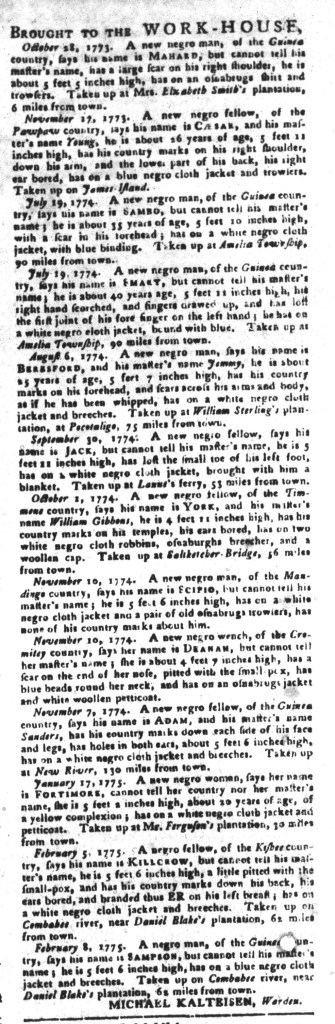
The Slavery Adverts 250 Project chronicles the role of newspaper advertising in perpetuating slavery in the era of the American Revolution. The project seeks to reveal the ubiquity of slavery in eighteenth-century life from New England to Georgia by republishing advertisements about enslaved people – for sale as individuals or in groups, wanted to purchase or for hire for short periods, runaways who liberated themselves, and those who were subsequently captured and confined in jails and workhouses – in daily digests on this site as well as in real time via the @SlaveAdverts250 Twitter feed, utilizing twenty-first-century media to stand in for the print media of the eighteenth century.
The project aims to provide modern audiences with a sense of just how often colonizers encountered these advertisements in their daily lives. Enslaved men, women, and children appeared in print somewhere in the colonies almost every single day. Those advertisements served as a constant backdrop for social, cultural, economic, and political life in colonial and revolutionary America. Colonizers who did not purport to own enslaved people were still confronted with slavery as well as invited to maintain the system by purchasing enslaved men, women, and children or assisting in the capture of so-called “runaways” who sought to free themselves from bondage. The frequency of these newspaper advertisements suggests just how embedded slavery was in colonial and revolutionary American culture in everyday interactions beyond the printed page.
These advertisements also testify to the experiences of enslaved men, women, and children, though readers must consider that those experiences have been remediated through descriptions offered by enslavers rather than enslaved people themselves. Often unnamed in the advertisements, enslaved men, women, and children were not invisible or unimportant in early America.
These advertisements appeared in colonial American newspapers 250 years ago today.
What was advertised in a colonial American newspaper 250 years ago today?
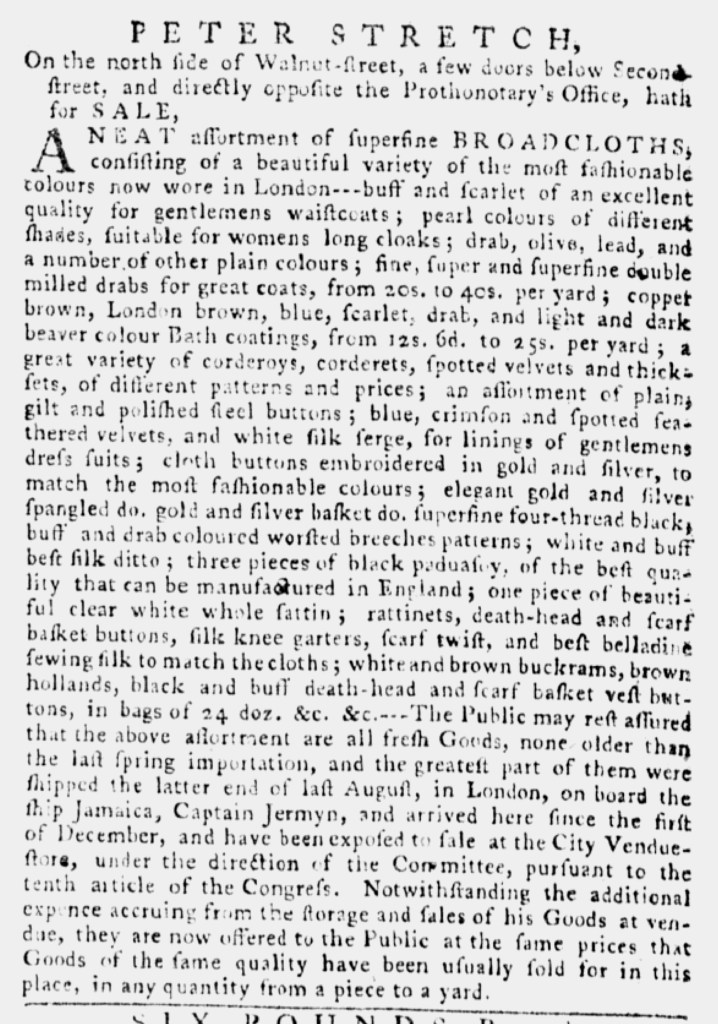
Pennsylvania Gazette (February 22, 1775).
“Goods … have been exposed to sale … under the direction of the Committee, pursuant to the tenth article of the Congress.”
Even as the imperial crisis intensified in February 1775, Peter Stretch expected that consumers in and near Philadelphia would respond to marketing appeals that connected the textiles and accessories that he imported and sold to current fashions in London. Such had been the case for quite some time before the political situation became so troubled. A transatlantic consumer revolution bound together England and the colonies in the eighteenth century, helping to fuel a process of Anglicization among subjects of the empire in British mainland North America. When it came to advertising, it made sense to Stretch to open his notice in the February 22 edition of the Pennsylvania Gazette with a “NEAT assortment of superfine BROADCLOTHS, consisting of a beautiful variety of the most fashionable colours now wore in London.”
He anticipated such an appeal would resonate with prospective customers even with the Continental Association in effect. The First Continental Congress enacted that nonimportation agreement in response to the Coercive Acts. Yet Stretch acknowledged those circumstances as well. He wanted consumers to know that he sold new merchandise rather than items that had lingered on the shelves or in the warehouse for years, so he assured readers that “the above assortment are all fresh Goods, one older than the last spring importation.” He went into more detail, explaining that “the greatest part of them were shipped the latter end of last August, in London, on board the ship Jamaica, Captain Jermyn.” That meant that his wares had been ordered and shipped before the First Continental Congress began its meetings in September and October 1774 and certainly before delegates devised the Continental Association.
However, the Jamaica “arrived here since the first of December,” the day the nonimportation agreement went into effect. The tenth article made provisions for imports that arrived in December 1774 and January 1775, allowing merchants to refuse and return the goods, turn them over to a local committee to store while the pact remained in force, or entrust them to the committee to sell with the original costs returned to the importer and any profits designated to the relief of Boston where the harbor had been closed and blockaded since June 1774. Stretch reported that he adhered to the Continental Association. His wares “have been exposed to sale at the City Vendue-store, under the direction of the Committee, pursuant to the tenth article of the Congress.” Having done its due diligence, the committee apparently returned items not sold at auction to Stretch, provided that he also observe the ninth article that prohibited price gouging or “tak[ing] Advantage of the Scarcity of Goods that may be occasioned by this Association.” Stretch pledged that he offered his merchandise “at the same prices that Goods of the same quality have been usually sold for in this place.” The merchant demonstrated to consumers that they could still acquire textiles “of the most fashionable colours now wore in London” without violating the Continental Association.
The Slavery Adverts 250 Project chronicles the role of newspaper advertising in perpetuating slavery in the era of the American Revolution. The project seeks to reveal the ubiquity of slavery in eighteenth-century life from New England to Georgia by republishing advertisements about enslaved people – for sale as individuals or in groups, wanted to purchase or for hire for short periods, runaways who liberated themselves, and those who were subsequently captured and confined in jails and workhouses – in daily digests on this site as well as in real time via the @SlaveAdverts250 Twitter feed, utilizing twenty-first-century media to stand in for the print media of the eighteenth century.
The project aims to provide modern audiences with a sense of just how often colonizers encountered these advertisements in their daily lives. Enslaved men, women, and children appeared in print somewhere in the colonies almost every single day. Those advertisements served as a constant backdrop for social, cultural, economic, and political life in colonial and revolutionary America. Colonizers who did not purport to own enslaved people were still confronted with slavery as well as invited to maintain the system by purchasing enslaved men, women, and children or assisting in the capture of so-called “runaways” who sought to free themselves from bondage. The frequency of these newspaper advertisements suggests just how embedded slavery was in colonial and revolutionary American culture in everyday interactions beyond the printed page.
These advertisements also testify to the experiences of enslaved men, women, and children, though readers must consider that those experiences have been remediated through descriptions offered by enslavers rather than enslaved people themselves. Often unnamed in the advertisements, enslaved men, women, and children were not invisible or unimportant in early America.
These advertisements appeared in colonial American newspapers 250 years ago today.
What was advertised in a colonial American newspaper 250 years ago today?
Essex Gazette (February 21, 1775).
“GARDEN SEEDS. Just imported … from LONDON.”
Each year the Adverts 250 Project chronicles the marketing efforts of women who sold garden seeds in Boston. The appearance of their advertisements in the several newspapers published in that city heralded the changing of the seasons from winter to spring. They participated in an annual ritual, not unlike printers who began advertising almanacs for the coming year each fall. Their advertisements in the public prints signaled to readers that spring was indeed on its way.
Those advertisements sometimes appeared as early as the middle of February in years before the Continental Association went into effect on December 1, 1774. The First Continental Congress devised that nonimportation agreement in response to the Coercive Acts. By the end of the third week of February 1775, neither Susanna Renken, who was often the first to advertise garden seeds in the Boston press, nor any of her sister seed sellers published any advertisements. In addition to the Continental Association constraining trade, the harbor had been closed to commerce because of the Boston Port Act since June 1, 1774. In Salem, however, W.P. Bartlett advertised a “fresh Assortment of GARDEN SEEDS” in the February 21 edition of the Essex Gazette.
Bartlett reported that the seeds were “JUST IMPORTED, in the Venus, from LONDON.” The “INWARD ENTRIES” from the custom house in the January 24 edition document the arrival of the Venus, establishing Bartlett received the shipment of seeds in the period between December 1, 1774, and February 1, 1775. The tenth article of the Continental Association made provision for goods that arrived during that period, specifying that importers could refuse them, surrender them to the local Committee of Inspection to store while the nonimportation agreement remained in force, or transfer them to the committee to sell to recover the costs with any profits donated for the relief of Boston.
Some advertisements in the Essex Gazette and other newspapers indicated that importers opted for the third option, but other advertisements suggest that some disregarded the Continental Association. In the same issue that carried Bartlett’s advertisement for garden seeds, Stephen Higginson hawked “English and India GOODS” that he “Just IMPORTED in the Venus … from London.” That certainly defied the Continental Association. What about the garden seeds that Bartlett peddled? Did they deserve special consideration since they contributed to the “Frugality, Economy, and Industry” and promotion of “Agriculture, Arts, and the Manufactures of this Country” called for by the eighth article of the Continental Association?
The Slavery Adverts 250 Project chronicles the role of newspaper advertising in perpetuating slavery in the era of the American Revolution. The project seeks to reveal the ubiquity of slavery in eighteenth-century life from New England to Georgia by republishing advertisements about enslaved people – for sale as individuals or in groups, wanted to purchase or for hire for short periods, runaways who liberated themselves, and those who were subsequently captured and confined in jails and workhouses – in daily digests on this site as well as in real time via the @SlaveAdverts250 Twitter feed, utilizing twenty-first-century media to stand in for the print media of the eighteenth century.
The project aims to provide modern audiences with a sense of just how often colonizers encountered these advertisements in their daily lives. Enslaved men, women, and children appeared in print somewhere in the colonies almost every single day. Those advertisements served as a constant backdrop for social, cultural, economic, and political life in colonial and revolutionary America. Colonizers who did not purport to own enslaved people were still confronted with slavery as well as invited to maintain the system by purchasing enslaved men, women, and children or assisting in the capture of so-called “runaways” who sought to free themselves from bondage. The frequency of these newspaper advertisements suggests just how embedded slavery was in colonial and revolutionary American culture in everyday interactions beyond the printed page.
These advertisements also testify to the experiences of enslaved men, women, and children, though readers must consider that those experiences have been remediated through descriptions offered by enslavers rather than enslaved people themselves. Often unnamed in the advertisements, enslaved men, women, and children were not invisible or unimportant in early America.
These advertisements appeared in colonial American newspapers 250 years ago today.
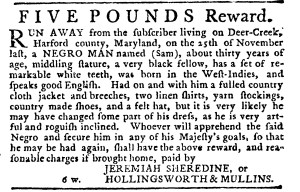
South-Carolina Gazette and Country Journal (February 21, 1775).
**********
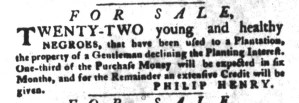
South-Carolina Gazette and Country Journal (February 21, 1775).
**********
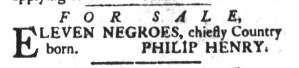
South-Carolina Gazette and Country Journal (February 21, 1775).
**********
South-Carolina Gazette and Country Journal (February 21, 1775).
**********
South-Carolina Gazette and Country Journal (February 21, 1775).
**********
South-Carolina Gazette and Country Journal (February 21, 1775).
**********
South-Carolina Gazette and Country Journal (February 21, 1775).
**********
South-Carolina Gazette and Country Journal (February 21, 1775).
**********
South-Carolina Gazette and Country Journal (February 21, 1775).
**********
South-Carolina Gazette and Country Journal (February 21, 1775).
**********
South-Carolina Gazette and Country Journal (February 21, 1775).
**********
South-Carolina Gazette and Country Journal (February 21, 1775).
**********
South-Carolina Gazette and Country Journal (February 21, 1775).
**********
South-Carolina Gazette and Country Journal (February 21, 1775).
**********
South-Carolina Gazette and Country Journal (February 21, 1775).
**********
South-Carolina Gazette and Country Journal (February 21, 1775).
**********
South-Carolina Gazette and Country Journal (February 21, 1775).
**********
South-Carolina Gazette and Country Journal (February 21, 1775).
**********
South-Carolina Gazette and Country Journal (February 21, 1775).
**********
South-Carolina Gazette and Country Journal (February 21, 1775).
What was advertised in a colonial American newspaper 250 years ago today?
Dunlap’s Pennsylvania Packet (February 20, 1775).
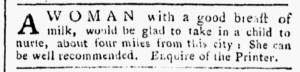
“A WOMAN with a good breast of milk, would be glad to take in a child to nurse.”
On February 20, 1775, an anonymous woman placed an advertisement offering her services as a wet nurse in Dunlap’s Pennsylvania Packet. In colonial and revolutionary America, women advertised their services as wet nurses while families often placed advertisements seeking wet nurses. Mothers who could not supply their own breast milk due to health issues acquired wet nurses. Families who lost mothers during childbirth also needed wet nurses. This was a common practice in the eighteenth century.
According to Janet Golden, some English physicians advised against wet nurses because they might be “sick or ill-tempered.”[1] William Buchan, for instance, advised looking for a “healthy woman, … one with an abundant supply of milk, healthy children, clean habits and a sound temperament.”[2] Those physicians looked down on women not breastfeeding their own children but doing it for others. In general, wet nursing caused an increase in infant mortality rate. Golden states, “Nearly every European commentator knew that wet nursing increased infant mortality. Wet-nursed infants were more likely to die than were infants suckled by their mothers, and the wet nursing system itself contributed to infant mortality by inducing poor women to abandon their own offspring in order to find employment suckling the children of others.”[3]
For women who were hired as wet nurses in colonial America, their earnings belonged to their husbands by law.[4] Wet nursing was not always a paid arrangement. Instead, neighbors sometimes helped their communities by nursing the babies of mothers who could not breastfeed due to postpartum ailments.[5] Some families felt more comfortable with a neighbor rather than a stranger. Mothers or their families would often look for neighbors or friends to breastfeed their babies, but that was not always possible. That created a market for other women to offer their services, which they would advertise in early American newspapers.
**********
ADDITIONAL COMMENTARY: Carl Robert Keyes
Even though the prescriptive literature authored by English physicians sometimes cautioned against entrusting infants to wet nurses, colonizers sometimes heeded those concerns and other times developed their own practices embedded in local circumstances in the eighteenth century. As Gabriela indicates, neighbors participated in communal wet nursing as one way of contributing to their communities.
Some also went against the prescriptive literature that condemned wealthy women for hiring wet nurses instead of fulfilling what the physicians considered their maternal obligations. Sending infants to foster with wet nurses in the countryside became a popular practice among many affluent families in Boston and other cities. “Some urban families,” Golden explains,” assumed that the city was an unhealthy environment, rife with both epidemic and endemic diseases. The countryside, many believed, provided a more salubrious setting, especially in the early months of life.”[6] Note that the anonymous “WOMAN with a good breast of milk” in the advertisement Gabriela selected emphasized that she resided about four miles from Philadelphia, near the busy port yet removed from the largest city in the colonies. Other women took a similar approach. According to Golden, “advertisements placed by women looking for babies to wet nurse reported their distance from the city.”[7]
In four short lines, the woman who placed today’s featured advertisement addressed several common concerns. She commented on her own health and the nourishment she could provide for an infant, asserting that she had a “good breast of milk.” Yet she did not ask prospective clients to take her word for it. Instead, she stated that she “can be well recommended,” presumably both for her character and for her health. At the same time, she testified to the healthiness of the environment where she provided her services, highlighting that she resided outside the city. The anonymous woman intended for each of those appeals to resonate with mothers and their families.
**********
[1] Janet Golden, A Social History of Wet Nursing in America: From Breast to Bottle (New York: Cambridge University Press, 1996), 15.
Gabriela Vargas is a senior double majoring in History and Elementary Education as she pursues a dual graduate degree in Special Education at Assumption University in Worcester, Massachusetts. She hopes to become a special education teacher and an education attorney. Gabriela has been involved in Campus Ministry as a bible study leader. She also co-founded Latinos Unidos, the first Latin club. She served as public relations representative for ALANA, the multi-cultural club on campus. She is currently the head editor for MUSE, the campus literary magazine. Gabriela also, published her first book, The Rhymes of My Times, when she was sixteen. She has also been involved in various community service and advocacy projects. Gabriela made her contributions to the Adverts 250 Project and the Slavery Adverts 250 Project while enrolled in HIS 359 Revolutionary America, 1763-1815, in Fall 2024.
The Slavery Adverts 250 Project chronicles the role of newspaper advertising in perpetuating slavery in the era of the American Revolution. The project seeks to reveal the ubiquity of slavery in eighteenth-century life from New England to Georgia by republishing advertisements about enslaved people – for sale as individuals or in groups, wanted to purchase or for hire for short periods, runaways who liberated themselves, and those who were subsequently captured and confined in jails and workhouses – in daily digests on this site as well as in real time via the @SlaveAdverts250 Twitter feed, utilizing twenty-first-century media to stand in for the print media of the eighteenth century.
The project aims to provide modern audiences with a sense of just how often colonizers encountered these advertisements in their daily lives. Enslaved men, women, and children appeared in print somewhere in the colonies almost every single day. Those advertisements served as a constant backdrop for social, cultural, economic, and political life in colonial and revolutionary America. Colonizers who did not purport to own enslaved people were still confronted with slavery as well as invited to maintain the system by purchasing enslaved men, women, and children or assisting in the capture of so-called “runaways” who sought to free themselves from bondage. The frequency of these newspaper advertisements suggests just how embedded slavery was in colonial and revolutionary American culture in everyday interactions beyond the printed page.
These advertisements also testify to the experiences of enslaved men, women, and children, though readers must consider that those experiences have been remediated through descriptions offered by enslavers rather than enslaved people themselves. Often unnamed in the advertisements, enslaved men, women, and children were not invisible or unimportant in early America.
These advertisements appeared in colonial American newspapers 250 years ago today.
Boston Evening-Post (February 20, 1775).
**********
Boston Evening-Post (February 20, 1775).
**********
Boston Evening-Post (February 20, 1775).
**********
Dunlap’s Pennsylvania Packet (February 20, 1775).
**********
Dunlap’s Pennsylvania Packet (February 20, 1775).
**********
Newport Mercury (February 20, 1775).
**********
Newport Mercury (February 20, 1775).
**********
Newport Mercury (February 20, 1775).
**********
Newport Mercury (February 20, 1775).
**********
New-York Gazette and Weekly Mercury (February 20, 1775).
**********
New-York Gazette and Weekly Mercury (February 20, 1775).
**********
New-York Gazette and Weekly Mercury (February 20, 1775).
**********
New-York Gazette and Weekly Mercury (February 20, 1775).
**********
New-York Gazette and Weekly Mercury (February 20, 1775).
**********
New-York Gazette and Weekly Mercury (February 20, 1775).
**********
South-Carolina Gazette (February 20, 1775).
**********
South-Carolina Gazette (February 20, 1775).
**********
South-Carolina Gazette (February 20, 1775).
**********
South-Carolina Gazette (February 20, 1775).
**********
South-Carolina Gazette (February 20, 1775).
**********
South-Carolina Gazette (February 20, 1775).
**********
South-Carolina Gazette (February 20, 1775).
**********
Supplement to the South-Carolina Gazette (February 20, 1775).
**********
Supplement to the South-Carolina Gazette (February 20, 1775).
**********
Supplement to the South-Carolina Gazette (February 20, 1775).
**********
Supplement to the South-Carolina Gazette (February 20, 1775).
**********
Supplement to the South-Carolina Gazette (February 20, 1775).
What was advertised in a colonial American newspaper 250 years ago this week?
Massachusetts Spy (February 16, 1775).
“THE PETITION of the American Continental Congress, to the KING.”
In February 1775, Isaiah Thomas, printer of the Massachusetts Spy, published and advertised “THE PETITION of the American Continental Congress, to the KING.” During its meetings in Philadelphia in September and October 1774, the delegates to the First Continental Congress drafted several documents. Almost as soon as they adjourned, William Bradford and Thomas Bradford, printers of the Pennsylvania Journal, advertised “EXTRACTS FROM THE VOTES AND PROCEEDINGS OF THE AMERICAN CONTINENTAL CONGRESS.” Over the next several weeks, printers in towns throughout the colonies published local editions to supplement coverage in their newspapers. By the end of November, the Bradfords published a more complete “JOURNAL OF THE PROCEEDINGS OF THE CONGRESS Held at PHILADELPHIA,” though not as many printers issued local editions of that pamphlet. After all, the Extracts already contained “The BILL of RIGHTS; a List of GRIEVANCES; occasional RESOLVES; the ASSOCIATION; and ADDRESS to the people of Great-Britain; and a MEMORIAL to the Inhabitants of the British American Colonies.”
Yet neither the Extracts nor the Proceedings included all the work undertaken by the First Continental Congress. In his advertisement, Thomas asserted that he published the Petition “For the benefit of those who have purchased the Votes and Proceedings of the Continental Congress, or the Extracts therefrom, as it is inserted in neither of said Pamphlets.” He encouraged colonizers to complete their collections of these important documents. As part of that marketing strategy, he noted that he printed the Petition “in a Pamphlet that it may be either bound of stitched up with the Votes and Proceedings.” Buyers had the option to collect the several pamphlets together under a single cover, though few seem to have done so. In a description of the copy now in the collections of the Princeton University Library, the William Reese Company declared, “We can locate only three copies of this rarity, those at the Library of Congress, Massachusetts Historical and American Antiquarian Society.” That colonizers did not bind the Petition with other pamphlets, however, does not necessarily mean that they did not purchase or read it. Thomas described the Petition as “Worthy the perusal of his Majesty and every subject in his dominions.” As the imperial crisis intensified in the winter and spring of 1775, readers may have been eager to consume as much as they could about the positions taken by the First Continental Congress, including this eight-page pamphlet for “two coppers.” In an advertisement for another political pamphlet claimed that such a “small price” made it affordable to “every person who is desirous” of reading about “our political Controversy.”
What was advertised in a colonial American newspaper 250 years ago today?
Pennsylvania Ledger (February 18, 1775).
“The Fountain and Three Tuns, … [an] old accustomed and commodious tavern.”
When William Dibley, an experienced tavernkeeper, became the proprietor of the Fountain and Three Tuns in Philadelphia in February 1775, he placed an advertisement in the Pennsylvania Ledger to promote some of the amenities available at his new location. He hoped that a variety of conveniences would encourage prospective patrons to visit the Fountain and Three Tuns.
Dibley made some of the most common appeals that appeared in advertisements for inns and taverns during the era of the American Revolution. He highlighted the hospitality that he offered to guests, pledging that they would receive “the most civil treatment.” He served “the best of liquors and provisions” in a “commodious tavern” that he had “considerably improved” or renovated for the comfort of his patrons.
Those improvements included updating the stables to accommodate sixty horses. Travelers who visited Philadelphia could expect to find space for their horses in Dibley’s stables while they enjoyed their time at the Fountain and Three Tuns. Those stables had easy access to the streets of Philadelphia via a “convenient passage either from Market or Chesnut streets.” For affluent patrons, the tavernkeeper also had a “house for carriages.”
The tavernkeeper provided other services to entice merchants and others to visit the Fountain and Three Tuns, including messengers dispatched to other towns every Wednesday. One “goes through Newark [in Delaware] to Nottingham [in Maryland],” carrying “packages and orders” to colonies to the south. The other headed to the west, going “through Goshen to Strasburg, in Lancaster County.” In addition, the “Virginia and Baltimore posts also call at the said inn every week.” Dibley positioned the Fountain and Three Tuns at the center of networks for conducting commerce.
Dibley certainly hoped that his reputation would attract former customers and “his Friends in particular” who knew him from the Cross Keys on Chestnut Street. His advertisement advised them that they could expect the same level of service at his new location. Yet the tavernkeeper did not merely wish to transfer his current clientele from one establishment to another. His extensive advertisement notified both locals and travelers of the many reasons they should choose the Fountain and Three Tuns over other inns and taverns in Philadelphia.