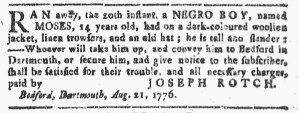
Slavery Advertisements Published September 3, 1776

The Slavery Adverts 250 Project chronicles the role of newspaper advertising in perpetuating slavery in the era of the American Revolution. The project seeks to reveal the ubiquity of slavery in eighteenth-century life from New England to Georgia by republishing advertisements about enslaved people – for sale as individuals or in groups, wanted to purchase or for hire for short periods, runaways who liberated themselves, and those who were subsequently captured and confined in jails and workhouses – in daily digests on this site as well as in real time via the @SlaveAdverts250 Twitter feed, utilizing twenty-first-century media to stand in for the print media of the eighteenth century.

The project aims to provide modern audiences with a sense of just how often colonizers encountered these advertisements in their daily lives. Enslaved men, women, and children appeared in print somewhere in the colonies almost every single day. Those advertisements served as a constant backdrop for social, cultural, economic, and political life in colonial and revolutionary America. Colonizers who did not purport to own enslaved people were still confronted with slavery as well as invited to maintain the system by purchasing enslaved men, women, and children or assisting in the capture of so-called “runaways” who sought to free themselves from bondage. The frequency of these newspaper advertisements suggests just how embedded slavery was in colonial and revolutionary American culture in everyday interactions beyond the printed page.

These advertisements also testify to the experiences of enslaved men, women, and children, though readers must consider that those experiences have been remediated through descriptions offered by enslavers rather than enslaved people themselves. Often unnamed in the advertisements, enslaved men, women, and children were not invisible or unimportant in early America.

These advertisements appeared in revolutionary American newspapers 250 years ago today.
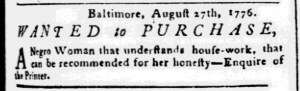
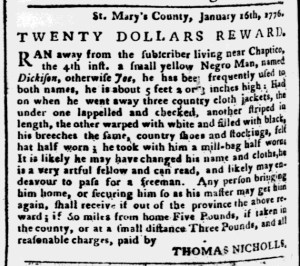
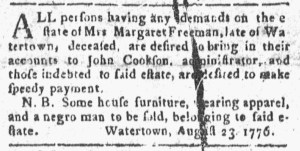
Dunlap’s Maryland Gazette (September 3, 1776).

**********

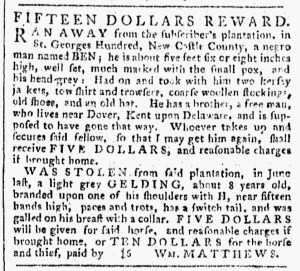
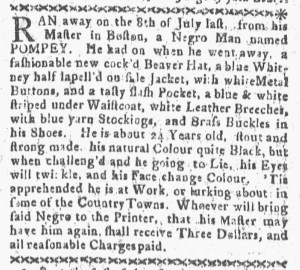
Dunlap’s Maryland Gazette (September 3, 1776).

**********

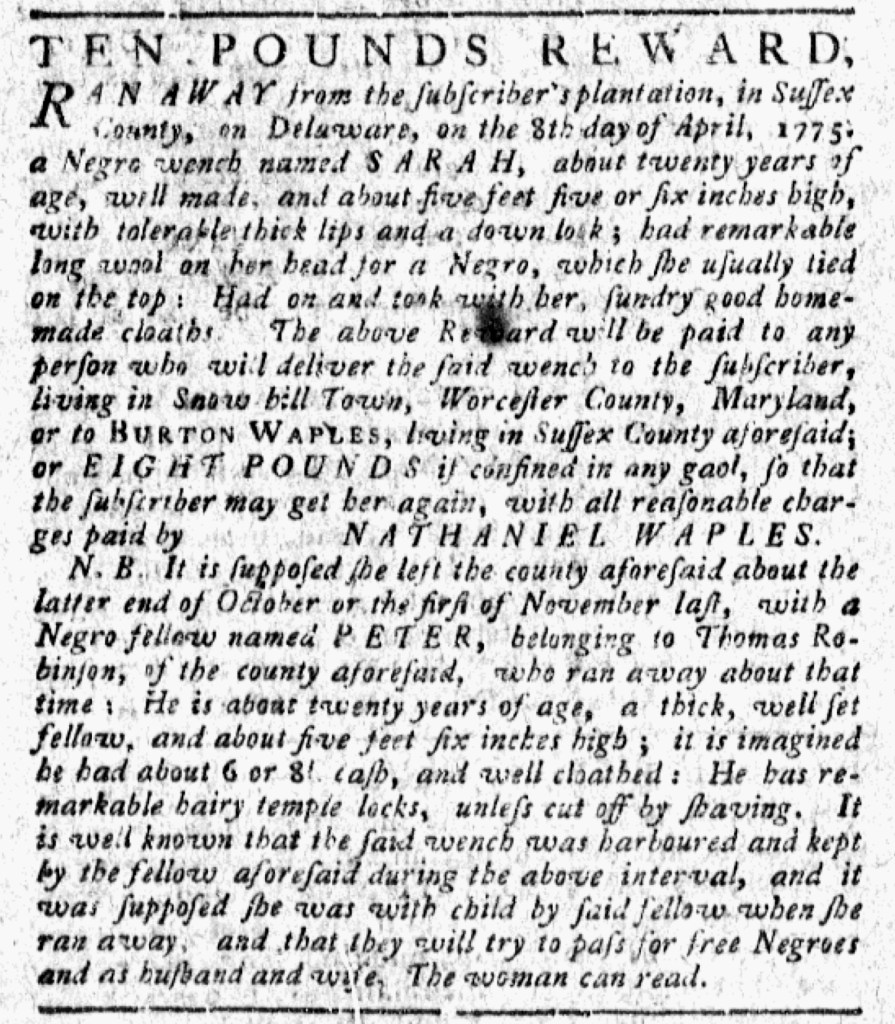
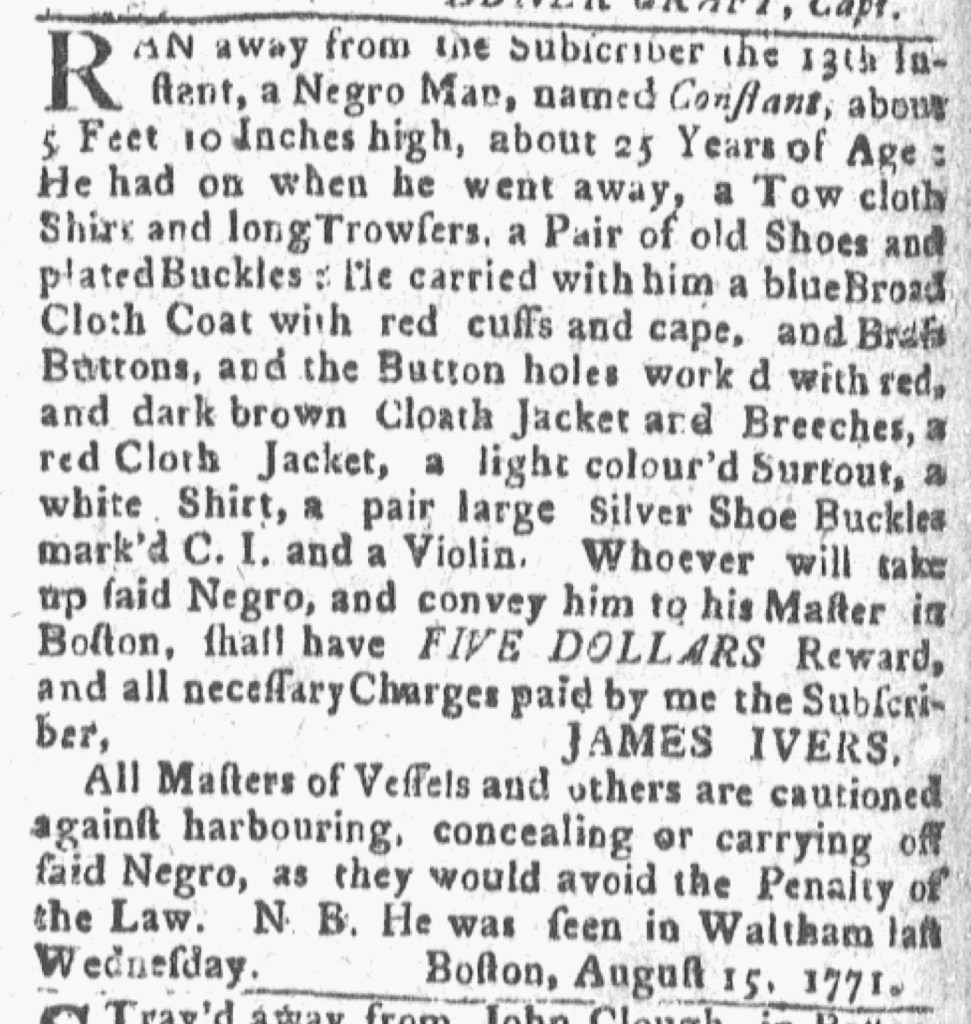
Dunlap’s Pennsylvania Packet (September 3, 1776).

**********

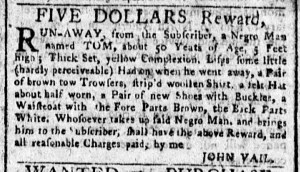
Postscript to Dunlap’s Pennsylvania Packet (September 3, 1776).

**********

Postscript to Dunlap’s Pennsylvania Packet (September 3, 1776).

September 2

What was advertised in a revolutionary American newspaper 250 years ago today?

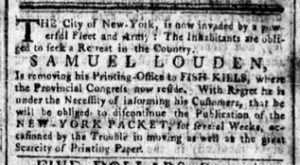
New-York Gazette and Weekly Mercury (September 2, 1776).

“THE City of New-York, is now invaded by a powerful Fleet and Army.”

Samuel Loudon summarized recent events in the first line of his advertisement in the September 2, 1776, edition of the New-York Gazette and Weekly Mercury.  Residents of the city and nearby towns already knew that the British had captured New York.  Most other readers likely learned about the British occupation of New York before reading Loudon’s advertisement, probably hearing about it before reading about it in any newspaper.

Still, delivering the news was an important precursor for what Loudon needed to share with subscribers to his newspaper, the New York Packet.  Due to the occupation, the “Inhabitants [of New York] are obliged to seek a Retreat in the Country.”  Among those who sight refuge in the countryside, Loudon “remov[ed] his Printing-Office to FISH KILLS, where the Provincial Congress now reside.”  That location offered safety as well as access to news about the state government, once he managed to open a printing office there.  “With regret,” Loudon continued, “he is under the Necessity of Informing his Customers, that he will be obliged to discontinue the Publication of the NEW-YORK PACKET, for several Weeks, occasioned. By the Trouble of moving as well as the great Scarcity of Printing Paper.”

Loudon had been publishing the New York Packet for only eight months before circumstances caused him to retreat to Fishkill.  He distributed the first issue on January 4, 1776, and suspended it with the August 29 edition, just before the British entered the city.  It took longer than he anticipated to resume publication.  According to Clarence S. Brigham, “The first Fishkill issue was undoubtedly that of Jan. 16, 1777, vol. 1, no. 36, but the earliest located is that of Feb. 6, 1777, vol. 1, no. 39.”[1]  Loudon continued the volume and issue numbering uninterrupted despite the suspension and relocation.  The British occupied New York throughout the remainder of the war.  Loudon remained in Fishkill, publishing his newspaper there until the end of August 1783.  He then returned to New York and continued the newspaper without changing the volume numbering in November 1783.  The war disrupted publication of the New York Packet, yet Loudon persevered.  He managed to continue supplying subscribers and other readers with news (and advertisements) despite the challenges of “removing his Printing-Office” beyond occupied New York.

**********

[1] Clarence S. Brigham, History and Bibliography of American Newspapers, 1690-1820 (Worcester, Massachusetts: American Antiquarian Society, 1947), 570.

Slavery Advertisements Published September 2, 1776

The Slavery Adverts 250 Project chronicles the role of newspaper advertising in perpetuating slavery in the era of the American Revolution. The project seeks to reveal the ubiquity of slavery in eighteenth-century life from New England to Georgia by republishing advertisements about enslaved people – for sale as individuals or in groups, wanted to purchase or for hire for short periods, runaways who liberated themselves, and those who were subsequently captured and confined in jails and workhouses – in daily digests on this site as well as in real time via the @SlaveAdverts250 Twitter feed, utilizing twenty-first-century media to stand in for the print media of the eighteenth century.

The project aims to provide modern audiences with a sense of just how often colonizers encountered these advertisements in their daily lives. Enslaved men, women, and children appeared in print somewhere in the colonies almost every single day. Those advertisements served as a constant backdrop for social, cultural, economic, and political life in colonial and revolutionary America. Colonizers who did not purport to own enslaved people were still confronted with slavery as well as invited to maintain the system by purchasing enslaved men, women, and children or assisting in the capture of so-called “runaways” who sought to free themselves from bondage. The frequency of these newspaper advertisements suggests just how embedded slavery was in colonial and revolutionary American culture in everyday interactions beyond the printed page.

These advertisements also testify to the experiences of enslaved men, women, and children, though readers must consider that those experiences have been remediated through descriptions offered by enslavers rather than enslaved people themselves. Often unnamed in the advertisements, enslaved men, women, and children were not invisible or unimportant in early America.

These advertisements appeared in revolutionary American newspapers 250 years ago today.

Boston-Gazette (September 2, 1776).

**********

Boston-Gazette (September 2, 1776).

**********

Boston-Gazette (September 2, 1776).

**********

Boston-Gazette (September 2, 1776).

**********

New-York Gazette and Weekly Mercury (September 2, 1776).

**********

New-York Gazette and Weekly Mercury (September 2, 1776).

**********

Newport Mercury (September 2, 1776).

September 1

What was advertised in a revolutionary American newspaper 250 years ago this week?

Providence Gazette (August 31, 1776).

“At the Sign of the Sugar-Loaf, the third House Northward of the Church in Providence.”

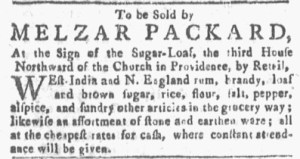
As fall approached in 1776, Melzar Packard took to the pages of the Providence Gazette to inform the public that he sold “West-India and N. England run, brandy, loaf and brown sugar, rice, flour, salt, pepper, allspice, and sundry other articles in the grocery way.”  He also stocked “an assortment of stone and earthen ware,” selling it all “at the cheapest rates.”

Some readers may have been familiar with Packard’s shop “At the Sign of the Sugar-Loaf.”  To help prospective customers find it, he gave additional directions: “the third House Northward of the Church in Providence.”  No American city or town used standardized street numbers in the 1770s.  The largest cities, Philadelphia and New York, would introduce them by the end of the century.  Until they became common, some entrepreneurs used signs to mark their locations and even more gave directions of some sort.  Like Packard, John Carter, the printer of the Providence Gazette, did both.  At the end of each issue, the colophon indicated that customers could find the printing office “at Shakespear’sHead, in Meeting-Street, near the Court-House.”  Most advertisers relied solely on giving directions, often invoking local landmarks.  In the August 31, 1776, edition of the Providence Gazette, for instance, Nathaniel Greene advertised merchandise available “At his Store on the West Side of the Great Bridge.”  Similarly, Charles Dabney hawked an array of textiles and other wares “At his Shop, a little to the Westward of the Great Bridge.”  Welcome Arnold sold groceries, housewares, and hardware “Near the new Baptist Meeting-House.”  When patients needed the services of Mary Bass, a midwife, they could find her “at Dr. Thomas Truman’s, in Broadstreet.”  Residents and visitors devised ways for navigating Providence (and other American cities and towns) before assigning street numbers became standard practice.  Sometimes they used signs to mark their location, but other times their directions only took customers to the general vicinity.