September 8

What was advertised in a revolutionary American newspaper 250 years ago this week?

Virginia Gazette [Dixon and Hunter] (September 7, 1776).

“Thread Laces, Shoe Thread, Observations on Civil Liberty.”

Matthew Anderson operated a store in Gloucester, Virginia, at the time that the Continental Congress declared independence.  He placed an advertisement in the September 7, 1776, edition of John Dixon and William Hunter’s Virginia Gazette, an advertisement that looked much like those that appeared before the imperial crisis and the Revolutionary War.  The lengthy list of goods he stocked testified to participation in the transatlantic consumer revolution.  Anderson sold everything from “Women’s Worsted Hose” and “Velvet Hoods” to “Thread Laces” and “common Sleeve Buttons” to “Desk and Cupboard Locks” and “Awl Blades” to “Punch Ladles” and “Queen’s China Dishes.”  If that was not enough to excite the imaginations of prospective customers, he also had “some other Trifles, too tedious to mention.”

Among the dozens of items that Anderson did mention, he listed some books.  He had a selection of “Psalters” and “Histories” that he did not name as well the popular “Watts’s Hymns and Psalms.”  He also stocked two books that resonated with current events.  Both had been widely advertised in other newspapers.  One was a work of political philosophy, Richard Price’s Observations on the Nature of Civil Liberty, the Principles of Government, and the Justice and Policy of the War in America.  Anderson shortened the title to “Observations on Civil Liberty.”  He may have sold an American edition published in Charleston, Philadelphia, New York, or Boston.  He also advertised “British Tyranny, or American Liberty triumphant,” a play that had also been printed and promoted in several cities and towns.  Most shopkeepers did not usually advertise such titles.  They tended to stick with almanacs and psalters, items with broad appeal that they had confidence customers would purchase, or popular devotional literature, like Watts’s hymns and psalms.  That Anderson included two books related to current events among his inventory (instead of relegating them “other Trifles, too tedious to mention”) may have been a way of signaling his political sentiments.  If so, that could have been an attempt to gain the approval of prospective customers who supported the American cause without taking a position that alienated other prospective customers who did not.  Anderson stocked the books, but he did not outright endorse their contents.  That allowed for flexibility in how he related to consumers who held a variety of views.
September 7

What was advertised in a revolutionary American newspaper 250 years ago today?

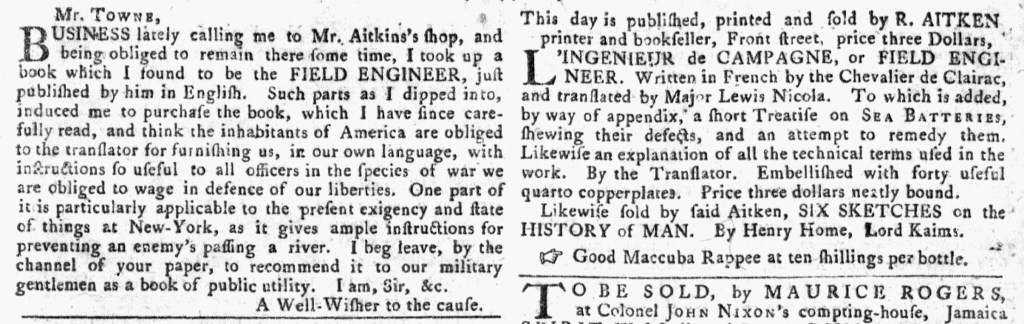
Pennsylvania Evening Post (September 7, 1776).

“I beg leave … to recommend it to our military gentlemen as a book of public utility.”

In an advertisement in the September 7, 1776, edition of the Pennsylvania Evening Post, Robert Aitken, a printer and bookseller, promoted “L’INGENIEUR de CAMPAGNE, or FIELD ENGINEER.  Written in French by the Chevalier de Clairac, and translated by Major Lewis Nicola.”  To make the work more enticing to prospective customers, Aitken supplemented it with “a short Treatise on SEA BATTERIES, shewing their defects, and an attempt to remedy them,” and “an explanation of all the technical terms used in the work.  By the Translator.”  The manual also included helpful illustrations, “forty useful quarto copperplates.”  It was one of many military manuals published and marketed in Philadelphia and other cities during the era of the American Revolution.

Quite conveniently, a letter to Benjamin Towne, the printer of the Pennsylvania Evening Post, signed by “A Well-Wisher to the cause” just happened to appear immediately to the left of Aitken’s advertisement.  The anonymous correspondent explained that during a recent visit to Aitken’s printing office for other business he “took up a book which I found to be the FIELD ENGINEER, just published by him in English.”  Enthralled by those parts that he “dipped into,” the “Well-Wisher to the cause” purchased the book and carefully read it.  Now he felt compelled to declare that “the inhabitants of America are obliged to the translator for furnishing us, in our own language, with instructions so useful to all officers in the species of war we are obliged to wage in defence of our liberties.”  The “Well-wisher to the cause” highlighted the part of the book he considered “particularly applicable to the present exigency and state of things at New-York, as it gives ample instructions for preventing an enemy’s passing a river.”  Following its defeat at the Battle of Long Island near the end of August, the Continental Army retreated from Brooklyn to Manhattan.  Many residents of the city had already fled to the countryside to escape the British invasion and occupation.  Patriots feared what would happen if General George Washington and the Continental Army could not prevent the British from crossing the Hudson River.  The “Well-Wisher to the cause” may have also worried about the prospects of British forces crossing the Delaware River to capture Philadelphia if they could not be stopped in New York.  “I beg leave, by the channel of your paper,” he wrote, “to recommend it,” The Field Engineer, “to our military gentlemen as a book of public utility.”  Whether or not Aitken coordinated with the “Well-Wisher to the cause” (or wrote the recommendation himself), the proximity of the letter to his advertisement reinforced his efforts to sell the book.

Slavery Advertisements Published September 7, 1776

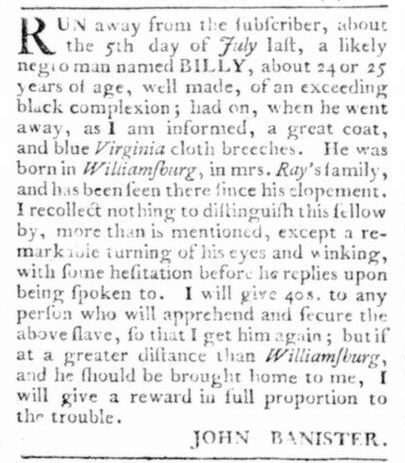
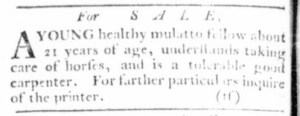
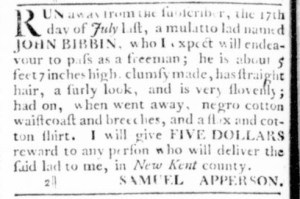
The Slavery Adverts 250 Project chronicles the role of newspaper advertising in perpetuating slavery in the era of the American Revolution. The project seeks to reveal the ubiquity of slavery in eighteenth-century life from New England to Georgia by republishing advertisements about enslaved people – for sale as individuals or in groups, wanted to purchase or for hire for short periods, runaways who liberated themselves, and those who were subsequently captured and confined in jails and workhouses – in daily digests on this site as well as in real time via the @SlaveAdverts250 Twitter feed, utilizing twenty-first-century media to stand in for the print media of the eighteenth century.

The project aims to provide modern audiences with a sense of just how often colonizers encountered these advertisements in their daily lives. Enslaved men, women, and children appeared in print somewhere in the colonies almost every single day. Those advertisements served as a constant backdrop for social, cultural, economic, and political life in colonial and revolutionary America. Colonizers who did not purport to own enslaved people were still confronted with slavery as well as invited to maintain the system by purchasing enslaved men, women, and children or assisting in the capture of so-called “runaways” who sought to free themselves from bondage. The frequency of these newspaper advertisements suggests just how embedded slavery was in colonial and revolutionary American culture in everyday interactions beyond the printed page.

These advertisements also testify to the experiences of enslaved men, women, and children, though readers must consider that those experiences have been remediated through descriptions offered by enslavers rather than enslaved people themselves. Often unnamed in the advertisements, enslaved men, women, and children were not invisible or unimportant in early America.

These advertisements appeared in revolutionary American newspapers 250 years ago today.

Freeman’s Journal (September 7, 1776).

**********

Pennsylvania Evening Post (September 7, 1776).

**********

Pennsylvania Evening Post (September 7, 1776).

**********

Virginia Gazette [Dixon and Hunter] (September 7, 1776).

**********

Virginia Gazette [Dixon and Hunter] (September 7, 1776).

**********

Virginia Gazette [Dixon and Hunter] (September 7, 1776).

**********

Virginia Gazette [Dixon and Hunter] (September 7, 1776).

September 6

What was advertised in a revolutionary American newspaper 250 years ago today?

Connecticut Gazette (September 6, 1776).

“Tea, Snuff, and sundry Sorts of Dry GOODS.”

As the summer of 1776 came to a close, Asa Spalding of Stonington took to the pages of the Connecticut Gazette to advertise that he sold “Tea, Snuff, and sundry Sorts of Dry GOODS.”  It was a rare advertisement for tea, even though the prohibition on selling and consuming tea had been relaxed several months earlier.  In a resolution enacted on April 13, 1776, the Second Continental Congress stated that “it was originally the design of Congress, that all India Tea, which had been imported agreeable to the [Continental] Association, might be sold and consumed.”

The time allowed for doing so had been too short, so the Second Continental Congress allowed that “all India Tea, imported as aforesaid [under the provisions of the Continental Association], expressly excepting all Teas imported by, or on account of the East India Company, now remaining on hand in these colonies, be sold and used.”  In addition, the resolution set prices to prevent sellers from gouging their customers since tea had become scarce.  Even though they allowed for selling and consuming tea already on hand, the Second Continental Congress continued to prohibit “the importation of India Tea from any part of the world; … except such as may make part of the cargoes of prizes taken by the ships of war or privateers belonging to these Colonies.”

The new rules for selling and drinking tea did not yield much advertising for tea.  The commodity did not often appear in newspaper advertisements.  Spaulding did elaborate on the origins of the tea (or the snuff and dry goods) that he sold, perhaps believing that prospective customers did not wish to probe too deeply.  After all, a resolution allowed for selling and consuming tea that met certain conditions.  It may have been most convenient for all parties to assume that the tea that Spaulding advertised had been imported under the conditions of the Continental Association or captured by an American vessel during the war.

Slavery Advertisements Published September 6, 1776

The Slavery Adverts 250 Project chronicles the role of newspaper advertising in perpetuating slavery in the era of the American Revolution. The project seeks to reveal the ubiquity of slavery in eighteenth-century life from New England to Georgia by republishing advertisements about enslaved people – for sale as individuals or in groups, wanted to purchase or for hire for short periods, runaways who liberated themselves, and those who were subsequently captured and confined in jails and workhouses – in daily digests on this site as well as in real time via the @SlaveAdverts250 Twitter feed, utilizing twenty-first-century media to stand in for the print media of the eighteenth century.

The project aims to provide modern audiences with a sense of just how often colonizers encountered these advertisements in their daily lives. Enslaved men, women, and children appeared in print somewhere in the colonies almost every single day. Those advertisements served as a constant backdrop for social, cultural, economic, and political life in colonial and revolutionary America. Colonizers who did not purport to own enslaved people were still confronted with slavery as well as invited to maintain the system by purchasing enslaved men, women, and children or assisting in the capture of so-called “runaways” who sought to free themselves from bondage. The frequency of these newspaper advertisements suggests just how embedded slavery was in colonial and revolutionary American culture in everyday interactions beyond the printed page.

These advertisements also testify to the experiences of enslaved men, women, and children, though readers must consider that those experiences have been remediated through descriptions offered by enslavers rather than enslaved people themselves. Often unnamed in the advertisements, enslaved men, women, and children were not invisible or unimportant in early America.

These advertisements appeared in revolutionary American newspapers 250 years ago today.

Virginia Gazette [Purdie] (September 6, 1776).

**********

Virginia Gazette [Purdie] (September 6, 1776).

**********

Virginia Gazette [Purdie] (September 6, 1776).

**********

Virginia Gazette [Purdie] (September 6, 1776).

**********

Virginia Gazette [Purdie] (September 6, 1776).

**********

Supplement to the Virginia Gazette [Purdie] (September 6, 1776).

September 5

What was advertised in a revolutionary American newspaper 250 years ago today?

New-England Chronicle (September 5, 1776).

“ISAIAH THOMAS … has removed his PRINTING OFFICE to SALEM.”

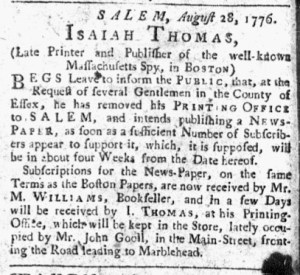
Isaiah Thomas had plans to establish a new newspaper in Salem in the fall of 1776.  He announced his intention in an advertisement in the September 5 edition of the New-England Chronicle, declaring that “at the Request of several Gentlemen in the County of Essex, he has removed his PRINTING OFFICE to SALEM” and would begin publishing a newspaper there “as soon as a sufficient Number of Subscribers appear to support it.”  Thomas described himself as the “Late Printer and Publisher of the well-known Massachusetts Spy, in BOSTON,” but he did not mention that he had also left Boston just before the battles at Lexington and Concord and printed the Massachusetts Spy in Worcester throughout the siege of Boston.   Not long after the British evacuated Boston in March 1776, Thomas made plans to return to the coast and leased the Massachusetts Spy to William Stearns and Daniel Bigelow.  He had more experience printing a newspaper that supported the American cause than he acknowledged in his advertisement.

To make his new newspaper competitive with others printed in and near Boston, Thomas pledged that customers could purchase subscriptions “on the same Terms as the Boston Papers.”  M. Williams, a bookseller, already collected subscriptions.  The printer anticipated that he would soon take in subscriptions at his printing office in the store previously occupied by John Gooll “in the Main-Street, fronting the Road leading to Marblehead.”  He estimated that it would take about four weeks to gather enough subscribers to support the newspaper.  Despite his efforts and experience, however, the new newspaper never materialized.  Thomas recounted what happened only briefly in his History of Printing in America(1810), stating that “many obstructions to the plan arising in consequence of the war” caused him to sell “the printing materials which he carried to that town.”  In 1778, he returned to Worcester, “took into possession the press which he had left there, and resumed the publication” of the Massachusetts Spy.[1]  People clamored for the news, as a notice from Stearns and Bigelow in the Massachusetts Spy demonstrated, yet that was not necessarily enough to make printing a newspaper a viable enterprise.  Whether or not Thomas attracted enough subscribers, a variety of challenges, including shortages of paper during the Revolutionary War, prevented him from launching a newspaper in Salem.

**********

[1] Isaiah Thomas, The History of Printing in America: With a Biography of Printers and an Account of Newspapers (1810; New York: Weathervane Books, 1970), 181.

Slavery Advertisements Published September 5, 1776

The Slavery Adverts 250 Project chronicles the role of newspaper advertising in perpetuating slavery in the era of the American Revolution. The project seeks to reveal the ubiquity of slavery in eighteenth-century life from New England to Georgia by republishing advertisements about enslaved people – for sale as individuals or in groups, wanted to purchase or for hire for short periods, runaways who liberated themselves, and those who were subsequently captured and confined in jails and workhouses – in daily digests on this site as well as in real time via the @SlaveAdverts250 Twitter feed, utilizing twenty-first-century media to stand in for the print media of the eighteenth century.

The project aims to provide modern audiences with a sense of just how often colonizers encountered these advertisements in their daily lives. Enslaved men, women, and children appeared in print somewhere in the colonies almost every single day. Those advertisements served as a constant backdrop for social, cultural, economic, and political life in colonial and revolutionary America. Colonizers who did not purport to own enslaved people were still confronted with slavery as well as invited to maintain the system by purchasing enslaved men, women, and children or assisting in the capture of so-called “runaways” who sought to free themselves from bondage. The frequency of these newspaper advertisements suggests just how embedded slavery was in colonial and revolutionary American culture in everyday interactions beyond the printed page.

These advertisements also testify to the experiences of enslaved men, women, and children, though readers must consider that those experiences have been remediated through descriptions offered by enslavers rather than enslaved people themselves. Often unnamed in the advertisements, enslaved men, women, and children were not invisible or unimportant in early America.

These advertisements appeared in revolutionary American newspapers 250 years ago today.

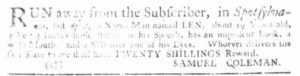
Continental Journal (September 5, 1776).

**********

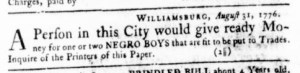
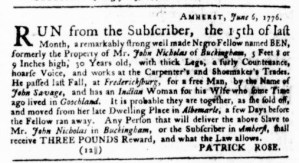
Maryland Gazette (September 5, 1776).

**********

Maryland Gazette (September 5, 1776).

**********

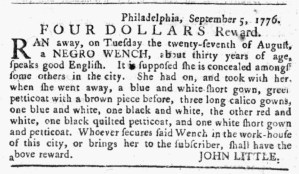
Pennsylvania Evening Post (September 5, 1776).

**********

Pennsylvania Evening Post (September 5, 1776).

September 4

What was advertised in a revolutionary American newspaper 250 years ago today?

Maryland Journal (September 4, 1776).

“DOCTOR FENDALL, OPERATOR upon the TEETH, is just arrived in this town.”

During the first week of September 1776, “DOCTOR FENDALL, OPERATOR upon the TEETH,” arrived in Baltimore and began seeking patients.  He placed an advertisement outlining his services in the Maryland Journal, announcing that he “cures the scurvy in the gums,” “prevents teeth from growing rotten,” “transplants natural teeth from one person to another,” “Makes and fixes artificial teeth,” and “extracts teeth and stumps.”  For each of those procedures, he offered additional details intended to reassure prospective patients of his skill and the effectiveness of his treatments.  When it came to artificial teeth, for instance, Fendall declared that he “makes and fixes [them] with the greatest exactness and nicety, without pain or the least inconvenience, so that they may eat, drink, or sleep with them in their mouths as natural ones.”  Even better, Fendall’s artificial teeth “cannot be discovered by the sharpest eye.”

In addition to an array of dental procedures, Fendall also hawked his own “DENTRIFICE” or toothpaste, entering the market of patent medicines.  He promised that his toothpaste was “quite free from any corrosive preparation” that would eat away at the teeth.  Instead, it would “restore the gums to their pristine state, … prevent the tooth-ach, and render the breath delicately sweet,” but only “if the tartarous substance is off the teeth.”  That suggested that patients who purchased Fendall’s toothpaste should first visit him for a cleaning.  Among his services, he highlighted that he “scales the teeth from that corrosive, tartarous, gritty substance, [which] impedes the gum from growing, infects the breath, and is one of the principal cause of the scurvy, which … eats away the gums, so that many peoples teeth fall out.”  Fendall hoped to make two sales at once, charging patients for cleaning their teeth and the toothpaste necessary to maintain the treatment.  He also advised that each pot of his toothpaste was “signed with his own hand to prevent fraud.”  Consumers could protect themselves from forgeries through that means of confirming the authenticity of the “DENTRIFICE” they purchased.

Fendall aimed to create a sense of urgency around scheduling appointments for procedures and purchasing his toothpaste.  He concluded his advertisement with a nota bene that warned, “His Stay in Town will be only one Week.”  He may have planned to stay longer, especially if prospective patients responded to his advertisement, but he wanted them to think that they could avail themselves of his services for a limited time only.  He tried to drum up as much business as quickly as possible to make his stay in Baltimore, however long it lasted, a viable venture.

Slavery Advertisements Published September 4, 1776

The Slavery Adverts 250 Project chronicles the role of newspaper advertising in perpetuating slavery in the era of the American Revolution. The project seeks to reveal the ubiquity of slavery in eighteenth-century life from New England to Georgia by republishing advertisements about enslaved people – for sale as individuals or in groups, wanted to purchase or for hire for short periods, runaways who liberated themselves, and those who were subsequently captured and confined in jails and workhouses – in daily digests on this site as well as in real time via the @SlaveAdverts250 Twitter feed, utilizing twenty-first-century media to stand in for the print media of the eighteenth century.

The project aims to provide modern audiences with a sense of just how often colonizers encountered these advertisements in their daily lives. Enslaved men, women, and children appeared in print somewhere in the colonies almost every single day. Those advertisements served as a constant backdrop for social, cultural, economic, and political life in colonial and revolutionary America. Colonizers who did not purport to own enslaved people were still confronted with slavery as well as invited to maintain the system by purchasing enslaved men, women, and children or assisting in the capture of so-called “runaways” who sought to free themselves from bondage. The frequency of these newspaper advertisements suggests just how embedded slavery was in colonial and revolutionary American culture in everyday interactions beyond the printed page.

These advertisements also testify to the experiences of enslaved men, women, and children, though readers must consider that those experiences have been remediated through descriptions offered by enslavers rather than enslaved people themselves. Often unnamed in the advertisements, enslaved men, women, and children were not invisible or unimportant in early America.

These advertisements appeared in revolutionary American newspapers 250 years ago today.

Pennsylvania Gazette (September 4, 1776).

**********

Pennsylvania Gazette (September 4, 1776).

**********

Pennsylvania Gazette (September 4, 1776).

**********

Pennsylvania Journal (September 4, 1776).

**********

South-Carolina and American General Gazette (September 4, 1776).

**********

South-Carolina and American General Gazette (September 4, 1776).

**********

South-Carolina and American General Gazette (September 4, 1776).

**********

South-Carolina and American General Gazette (September 4, 1776).

**********

South-Carolina and American General Gazette (September 4, 1776).

**********

South-Carolina and American General Gazette (September 4, 1776).

September 3

What was advertised in a revolutionary American newspaper 250 years ago today?

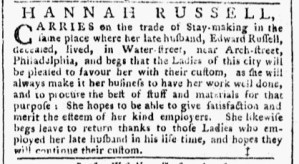
Dunlap’s Pennsylvania Packet (September 3, 1776).

“Thanks to those Ladies who employed her late husband in his life time.”

Hannah Russell, a staymaker in Philadelphia, wanted to maintain the clientele that her husband cultivated and, if possible, expand it.  In an advertisement in the September 3, 1776, edition of Dunlap’s Pennsylvania Packet, she announced that she “CARRIES on the trade of Stay-making in the same place where her late husband, Edward Russell, deceased, lived.”  She may have hoped that his death would garner some sympathy among prospective customers for a widow left to fend for herself.  She “beg[ged] that the Ladies of this city will be pleased to favour her with their custom,” pledging that she would “always make it her business to have her work well done, and to procure the best of stuff and materials for that purpose.”  Like other artisans who placed newspaper advertisements, Russell emphasized quality while also expressing her intention “to give satisfaction and merit the esteem of her kind employers.”

Russell concluded by expressing “thanks to those Ladies who employed her late husband in his life time.”  Building on that relationship, she hoped they would “continue their custom.”  Many of those former customers may have already worn corsets that Russell helped in constructing.  Many of them also likely knew Hannah.  Even though Edward had been the public face of the business, Hannah probably assisted him, both through interacting with customers and helping to make the stays that they ordered.  That she had the skills to run the business on her own following her husband’s death suggests that she had been making contributions when he was alive.  As a married woman, a feme covert under English common law, she played a supporting role, but that did not mean that she was absent from Edward’s workshop.  Rather than being his business, it was likely a family business, one that Hannah knew as well or almost as well as her husband.  Following his death, she attempted to leverage her prior experience and the relationships she and Edward forged with customers to encourage their clientele to continue getting their stays from the family’s workshop.