What was advertised in a colonial American newspaper 250 years ago today?
South-Carolina Gazette and Country Journal (January 31, 1775).
“She intends to carry on the UPHOLSTERY BUSINESS in all its branches, except paper hanging.”
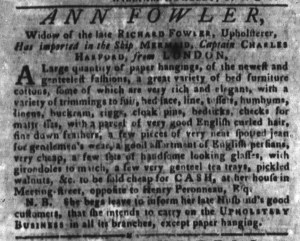
Ann Fowler, “Widow of the late RICHARD FOWLER, Upholsterer,” took to the pages of the South-Carolina Gazette and Country Journal to advertise a variety of merchandise that she sold out of her house on Meeting Street in Charleston. She indicated that she imported her wares “in the Ship MERMAID, Captain CHARLES HARFORD, from LONDON,” a vessel that arrived in port on December 29, 1774, according to the list of “ENTRIES INWARDS” at the custom house published in the January 3, 1775, edition of the South-Carolina Gazette and Country Journal. Those goods should have fallen under the jurisdiction of the Continental Association. Nevertheless, Fowler hawked a “Large quantity of paper hangings, of the newest and genteelest fashions, a great variety of bed furniture cottons, some of which are very rich and elegant, with a variety of trimmings to suit, [and] a few sets of handsome looking glasses, with girandoles to match.” The widow was not the only advertiser who placed notices about imported goods that looked the same as those published before the Continental Association went into effect.
Fowler appended a nota bene to “inform her late Husband’s good customers, that she intends to carry on the UPHOLSTERY BUSINESS in all its branches, except paper hanging.” Widows often took over the family business in colonial America, sometimes doing the same tasks their husbands had done and sometimes supervising employees. Even though Ann had not been the public face of the enterprise while Richard still lived, she likely had experience assisting him in his shop and interacting with any assistants that he hired. She hoped that she and her husband had cultivated relationships that would allow her to maintain their clientele, though they would have to look elsewhere when it came to “paper hanging” or installing wallpaper. Fowler sold papers hangings “of the newest and genteelest fashions,” but her customers needed to contract with someone else to paste them up. That may have been because she lacked experience with that aspect of the family business, her role having been primarily in the shop. On the other hand, perhaps she felt comfortable doing all sorts of upholstery work in the shop, a semi-public space that now belonged to her, but she did not consider it appropriate to enter the private spaces of her customers, especially male clients who lived alone. As a female entrepreneur, Fowler may have attempted to observe a sense of propriety that the public would find acceptable. Whether or not Fowler had prior experience installing paper hangings, she constrained herself in discontinuing that service following the death of her husband.
What was advertised in a colonial American newspaper 250 years ago today?
Massachusetts Gazette and Boston Post-Boy (January 30, 1775).
“The Royal American Magazine, was not printed with his Ink.”
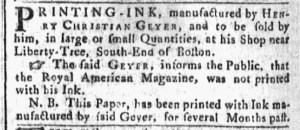
The final mention of the Royal American Magazine in newspaper advertisements published in January 1775 may not have been the kind of coverage that Joseph Greenleaf, the printer, desired. Henry Christian Geyer once again inserted his notice for printing ink that he made and sold “at his Shop near Liberty-Tree” in Boston in the January 30 edition of the Massachusetts Gazette and Boston Post-Boy. In it, he noted to the public that “the Royal American Magazine, was not printed with his Ink.”
Beyond that squabble, Greenleaf did advertise the Royal American Magazine on eight occasions in three of the five newspapers printed in Boston that January. On January 5, he ran notices in both the Massachusetts Gazette and Boston Weekly News-Letter and the Massachusetts Spy. In the former, he announced that he “JUST PUBLISHED … NUMBER XII. of The Royal American Magazine … For DECEMBER, 1774.” To entice curiosity, he noted that issue was “Embellished with elegant Engravings.” He also stated that he continued to accept subscriptions at his printing office. That advertisement ran in three consecutive issues. As was his custom, he ran a shorter advertisement in the Massachusetts Spy. Extending only three lines, it advised, “This day was published, by J. GREENLEAF, THE Royal American Magazine, or Universal Repository, No. XII. for DECEMBER, 1774.” That advertisement in the Massachusetts Spy ran only twice. Another version appeared in the January 16 edition of the Boston Evening-Post, much closer in format to the one in the Massachusetts Gazette and Boston Weekly News-Letter except but without the call for new subscriptions.
That Greenleaf disseminated the December edition of the magazine in early January was a feat. In the eighteenth century, monthly magazines came out at the end of the month that bore their date or early in the next month, unlike modern magazines released in advance of the dates on their covers. When Greenleaf acquired the Royal American Magazine from Isaiah Thomas in August 1774, publication had fallen behind by two months because of the “Distresses of the Town of Boston, by the shutting up of our Port.” Over the next several months, Greenleaf steadily caught up on the overdue issues, delivering the December issue to subscribers right on time at the beginning of January.
On January 23, Greenleaf inserted a new advertisement in the Boston Evening-Post, this time alerting readers that he published “A SUPPLEMENT to The Royal American Magazine … With the Title-Page and Index to Vol. I. for 1774.” That supplement consisted of a two-page address to the subscribers, a seven-page index, and the next twenty-four pages of Thomas Hutchinson’s History of the Province of Massachusetts-Bay, a monthly feature and premium for subscribers. In the address, Greenleaf explained that since the magazine had been “suspended near two months by the original undertaker, I have been obliged to publish one oftner than once in three weeks.” Furthermore, he considered it “necessary to apologize for the poor appearance of the work the last six months.” He did not have type “so good as I could wish” and could not acquire more because of the “non-importation agreement, which it was MY DUTY to comply with.” Fortunately, a friend assisted him in obtaining “almost new” type for continuing to publish the magazine. He also acknowledged that the ink “has been poor, but as it was of AMERICAN MANUFACTURE my customers were not only willing but desirous I should use it.” When Geyer published advertisements that mentioned Greenleaf did not use his ink in printing the Royal American Magazine, it may have been just as much an attempt to distance his product from the “poor” appearance of the magazine as it was an effort to shame Greenleaf into purchasing from him in the future. The index concluded with “DIRECTIONS to the BOOK-BINDER for placing the PLATES, &c. in the ROYAL AMERICAN MAGAZINE, for 1774.” Bookbinders usually incorporated the copperplate engravings that accompanied eighteenth-century magazines yet removed the advertising wrappers that enclosed them.
Curiously, when an advertisement about the supplement ran in the January 26 edition of the Massachusetts Gazette and Boston Weekly News-Letter, it looked identical to the one in the Boston Evening-Post. If that was indeed the case, it was not the first time that those printing offices seemed to share type that had already been set, a matter for further investigation.
What was advertised in a colonial American newspaper 250 years ago this week?
Massachusetts Spy (January 26, 1775).
“American Manufacture.”
An advertisement in the January 26, 1775, edition of the Massachusetts Spy informed readers of “SUNDRY Goods, Wares and Merchandize Imported in the Brigantine Venus … from London” that would be “SOLD agreeable to The American Congress Association.” That nonimportation agreement included provisions for selling goods imported between December 1, 1774, and February 1, 1775, yet it also called for encouraging “domestic manufactures” as alternatives to items acquired from Britain.
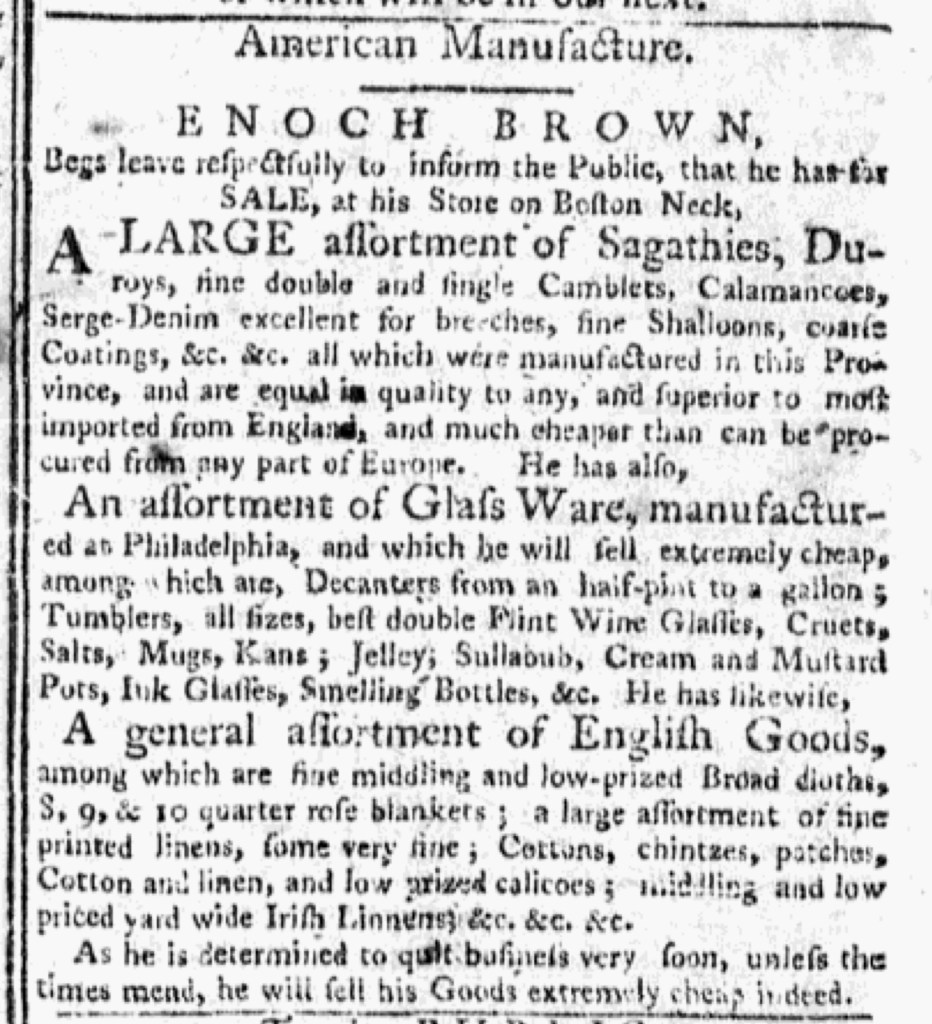
Enoch Brown emphasized such wares in his own advertisement in that same issue of the Massachusetts Spy. The headline proclaimed, “American Manufacture.” Brown reported that he stocked several kinds of textiles, a “LARGE assortment of Sagathies, Duroys, … Camblets, Calamancoes, Serge-Denim, [and] Shalloons … all which were manufactured in this Province.” Like many other retailers who encouraged consumers to “Buy American” during the imperial crisis, Brown emphasized that his customers would not have to make sacrifices when it came to price or quality for the sake of abiding by their political principles. These textiles, he insisted, “are equal in quality to any, and superior to most imported from England.” In addition, customers could purchase them “much cheaper than can be procured from any part of Europe.”
Yet that was not the extent of Brown’s wares produced in the colonies. He also stocked an “assortment of Glass Ware, manufactured at Philadelphia.” Perhaps he stocked some of the “AMERICAN GLASS” advertised by John Elliott and Company in the Pennsylvania Journal just as the Continental Association went into effect at the beginning of December 1774. Brown listed a variety of items, including decanters, wine glasses, and mustard pots, underscoring that “he will sell extremely cheap.”
Only after detailing products made in the colonies did Brown also mention a “general assortment of English Goods,” naming several textiles, such as “fine printed linens,” not included among those “manufactured in this Province.” He likely attempted to liquidate inventory that had been on his shelves before the nonimportation agreement commenced, intending to “quite business very soon, unless the times mend.” To that end, he vowed to “sell his Goods extremely cheap indeed.” In the process, he gave priority to “American Manufacture” in his advertisement, directing readers to options that would allow them to be responsible consumers who did their part in support of the Continental Association and the American cause.
What was advertised in a colonial American newspaper 250 years ago today?
Pennsylvania Ledger (January 28, 1775).
“POULSON’s AMERICAN INK-POWDER.”
Just four days after Benjamin Towne launched the Pennsylvania Evening Post, James Humphreys, Jr., commenced publication of the Pennsylvania Ledger on January 28, 1775. In less than a week, the number of English-language newspapers printed in Philadelphia increased from three to five, rivaling the number that came off the presses in Boston. No other city in the colonies had as many newspapers. Humphreys incorporated the colophon into the masthead, advising that he ran his printing office “in Front-street, at the Corner of Black-horse Alley:– Where Essays, Articles of News, Advertisements, &c. are gratefully received and impartially inserted.”
Unlike the first issue of the Pennsylvania Evening Post, the inaugural edition of the Pennsylvania Ledger carried advertisements. Humphreys placed some of them, one hawking “POLITICAL PAMPHLETS … on Both Sides of the Question,” another promoting an assortment of books he sold, and a final one seeking “an APPRENTICE to the Printing Business.” Nine other advertisers placed notices, all of them for consumer goods and services. They took a chance that the new newspaper had sufficient circulation to merit their investment in advertising in its pages.
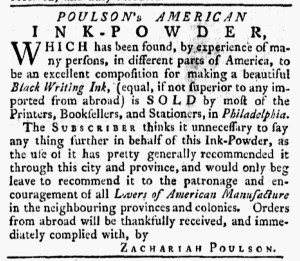
Among those advertisers, Zachariah Poulson marketed “POULSON’s AMERICAN INK-POWDER.” He asserted that “most of the Printers, Bookseller, and Stationers, in Philadelphia” stocked that product. Customers just needed to request it. With the deteriorating political situation in mind, especially the boycott of imported goods outlined in the Continental Association, Poulson called on “all Lovers of American Manufacture” in Pennsylvania and “in the neighbouring provinces and colonies” to choose his ink powder over any other.
Detail from Edward Pole’s Advertisement in the Pennsylvania Ledger (January 28, 1775).
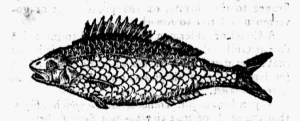
Edward Pole inserted the lengthiest advertisement (except for Humphreys’s notice cataloging the books he sold). It filled half a column, the first portion devoted to the merchandise available “at his GROCERY STORE, in Market-street” and the rest to “FISHING TACKLE of all sorts,” “FISHING RODS of various sorts and sizes,” and other fishing equipment. In advertisements in several newspapers published in Philadelphia (and, later, with ornate trade cards that he distributed), Pole regularly marketed himself as a sporting goods retailer. For the first issue of the Pennsylvania Ledger, he adorned his advertisement with a woodcut depicting a fish that previously appeared in his notices in Dunlap’s Pennsylvania Packet in May and June 1774.
Humphreys provided residents of Philadelphia and other towns greater access to news and editorials with the Pennsylvania Ledger, but that was not all. The publication of yet another newspaper in Philadelphia increased the circulation of advertising in the city and region, disseminating messages to consumers far and wide. Not long after Humphreys published that first issue, advertisers took to the pages of the Pennsylvania Ledger to publish notices for a variety of purposes, supplementing the information the editor selected for inclusion.
What was advertised in a colonial American newspaper 250 years ago today?
South-Carolina and American General Gazette (January 27, 1775).
“Not to trust or give Credit … to my Son JACOB BOMMER on my Account.”
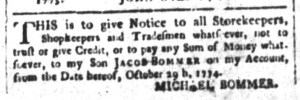
As the imperial crisis intensified and the colonies and Parliament were increasingly at odds in 1774, a rupture occurred in the relationship that Michael Bommer had with his son, Jacob. It may or may not have been the result of politics and disagreements over the Coercive Acts and how the colonies should respond. Just as likely, it had nothing to with politics. After all, colonizers continued to lead their daily lives even as momentous events unfolded around them. Fathers and sons quarreled about a variety of personal and financial issues that had little or nothing to do with politics.
Whatever the cause of their discord, it was significant enough to cause the father to take to the pages of the South-Carolina and American General Gazette with a notice “to all Storekeepers, Shopkeepers, and Tradesmen whatsoever, not to trust or give Credit, or to pay any Sum of Money whatsoever, to my Son JACOB BOMMER, on my Account, from the Date hereof, October 29th, 1774.” Three months later, the Bommers had not reconciled. Instead, the elder Bommer felt compelled to insert his advertisement in the January 27, 1775, edition of the South-Carolina and American General Gazette.
When he did so, he followed a format familiar to readers because it was so very regularly deployed by husbands against their wives in newspapers throughout the colonies. On the same day that Bommer’s notice appeared, for instance, Richard Mills informed readers of the New-Hampshire Gazette that he “hereby forbids any person crediting his Wife ANNA, on his Account, as he will not pay any Debts by her contracted.” Such notices offered a means for husbands to attempt to assert their authority in public after their wives had disdained that authority in private. On rare occasions, men adapted those sorts of newspaper notices when their relationships with other family members deteriorated. When Bommer did so, he protected his credit and finances, but at the expense of hinting at private affairs in the public prints. Such a spectacle had the potential to fuel gossip and draw more attention to the strife he and his son experienced.
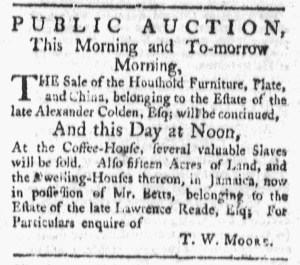
“PUBLIC AUCTION … several valuable Slaves will be sold.”
In this advertisement in Rivington’s New-York Gazetteer from January 26, 1775, T.W. Moore advertised a public auction being held “This Morning and To-Morrow Morning” to sell off the possessions of the late Alexander Colden to the highest bidder. In addition to these household items up for sale, Moore held another auction “this Day at Noon” for several enslaved people. This especially stood out to me because this shows public auctions, a competitive method, was a primary method of buying and selling goods, land, and even enslaved people in Revolutionary America. While people who were involved in the open market used auctions to sell off belongings and estates, enslavers used them as a way to reach a wider range of buyers in their efforts to make a profit off of enslaved people.
This advertisement shows that slave auctions happened even in New York. In “The Forgotten History of Slavery in New York,” Andrea C. Mosterman declares, “New York’s slavery past is still relatively unknown.” However, we can see by this advertisement, that these slaves for sale were an important part of Moore’s auctions. There was a high demand for enslaved people in New York before, during, and after the American Revolution. In 1788, Mosterman states, “Close to 75% of the free, white Kings County families enslaved people within their home.” The American Revolution did not result in freedom for everyone. Instead, some people would stand and look at other human beings being sold against their will along with everyday items like furniture and China dishes. By participating in these auctions, they treated enslaved people as property instead of as human beings.
**********
ADDITIONAL COMMENTARY: Carl Robert Keyes
In addition to selecting an advertisement to examine for the Adverts 250 Project, Jack is serving as guest curator for the Slavery Adverts 250 Project this week. Beyond this advertisement for “several valuable Slaves” up for bids at Moore’s auction on January 26, 1775, he identified eight other advertisements about enslaved people that appeared in the New-York Journal and Rivington’s New-York Gazetteer on the same day. As Jack makes clear, that auction was not an isolated incident. Instead, slavery was widely practiced in New York on the eve of the American Revolution and continued after thirteen colonies secured independence as a new nation.
Auctioneers like Moore represented part of the infrastructure for perpetuating slavery and the slave trade in New York. The printers who generated revenue by publishing these advertisements made significant contributions as well. Brokers, like William Tongue, played an important role as well. Tongue placed a lengthy advertisement enumerating “SLAVES,” “LANDS,” “HOUSES,” and “GOODS” for sale at his office “near the Exchange” in both the New-York Journal and Rivington’s New-York Gazetteer as well as the New-York Gazette and Weekly Mercury four days later. He listed and gave prices for ten enslaved men, women, and children, ranging in age from five to forty. They included a young woman who was “an useful domestic,” a man who was “a good farmer,” and a woman “with or without her son, 5 years old.” Tongue also noted that he “has likewise orders to purchase slaves of both sexes.”
Yet auctioneers and brokers were not alone in enlisting the services of printers in publishing advertisements for the purpose of buying and selling enslaved people. An anonymous advertiser offered a “LIKELY and handy Mulatto Boy” for sale in the New-York Journal. That youth had experience “waiting at Table” and could “attend a Gentleman on traveling.” The advertisement instructed reader to “Inquire of the Printer” for more details. Another advertisement featured an enslaved woman, “twenty-six Years of Age,” and an enslaved boy, “of twelve Years of Age,” for sale, again with directions to “Enquire of the Printer.” Still another described a “HEALTHY young Negro Girl … that can do all Kinds of House Work.” While auctioneers and brokers earned their livelihoods through buying and selling enslaved people, other colonizers made purchases and sales of one or two enslaved people at a time. Collectively, they made slavery a prevalent aspect of life in New York during the era of the American Revolution.
What was advertised in a colonial American newspaper 250 years ago today?
Pennsylvania Ledger (January 25, 1775).
“PROPOSALS For Printing by Subscription, a FREE and IMPARTIAL WEEKLY NEWS-PAPER.”
As the imperial crisis intensified, the number of newspapers published in Philadelphia, the largest city in the colonies, grew significantly. Throughout the early 1770s, readers had access to Dunlap’s Pennsylvania Packet, the Pennsylvania Gazette, and the Pennsylvania Journal. Until February 1774, the Pennsylvania Chronicle had also circulated in Philadelphia. Less than a year after that newspaper folded, Benjamin Towne commenced publication of the Pennsylvania Evening Post, the first tri-weekly newspaper attempted in that city, on January 24, 1775, and James Humphrey, Jr., distributed the first issue of the Pennsylvania Ledger four days later. Enoch Story and Daniel Humphreys also advertised plans for another newspaper, the Pennsylvania Mercury. They published their inaugural issue in April 1775, two weeks before the battles at Lexington and Concord.
On January 25, the Pennsylvania Journal carried the proposals for both the Pennsylvania Ledger and the Pennsylvania Mercury, placing them side by side on the final page. As was customary, the printers gave an overview of why they wished to publish their newspapers, explained what subscribers could expect among the contents, and listed the conditions for subscribing. Among the various purposes the Pennsylvania Mercury would serve, Story and Humphreys included, “To communicate advertisements of every kind.” The printers of both proposed newspapers sought advertisements, an essential revenue stream for any printer publishing a newspaper. After noting the prices for subscriptions to the Pennsylvania Ledger, Humphreys indicated, “Advertisements to be inserted on the same terms as is usual with the other papers in this city.” For the Pennsylvania Mercury, Story and Humphreys declared, “The Rates of the Paper and Advertisements will be the same with those now printed in this City.” Dunlap’s Pennsylvania Packet and the Pennsylvania Journal both gave the price for subscriptions – “Ten Shillings per Annum” – in their colophons, but none of the newspapers then printed in Philadelphia regularly published what they charged for advertising. Apparently, according to the proposals for the Pennsylvania Ledger and the Pennsylvania Mercury, none offered better deals than others.
Story and Humphreys did give a bit more attention to advertising in their proposals. “All Advertisements,” they promised, “shall be inserted in order as they come in, and shall appear in a fair and conspicuous manner.” They did not mean that paid notices would literally appear one after the other in the order received at the printing office but rather that a compositor would set type in that order and integrate them into the layout of the newspaper without privileging any later arrivals over those submitted sooner. After all, newspaper printers sometimes inserted notes that advertisements had been omitted due to lack of space. Story and Humphreys signaled that they would not take anything into consideration beyond the order that advertisers delivered their notices when delaying publication of some. They also acknowledged that compositors arranged content to make pieces of different lengths complete columns and fill pages. During that process, they would not privilege any advertisements over others, displaying each “in a fair and conspicuous manner.” With such appeals, Story and Humphreys solicited the trust of prospective advertisers who wanted a good return on the money they invested in disseminating information in the Pennsylvania Mercury.
Neither of these proposals for new newspapers discussed advertising extensively, but each did seek advertisers along with subscribers. Whatever goals they expressed for circulating news as the political situation deteriorated, the viability of pursuing their ideals of publishing “improving, instructive and entertaining” information depended in large part on recruiting advertisers as well as enlisting subscribers.
What was advertised in a colonial American newspaper 250 years ago today?
Pennsylvania Evening Post (January 24, 1775).
“THE first Number of the PENNSYLVANIA EVENING POST is now laid before the respectable Public.”
On January 24, 1775, Benjamin Towne launched a new newspaper, the Pennsylvania Evening Post. The printer distinguished this publication with a publication schedule that differed from all other newspapers in Philadelphia and throughout the colonies, distributing three issues a week on Tuesday, Thursday, and Saturday evenings rather than a single weekly issue. In an address to “the respectable Public” that opened the inaugural edition, Towne asserted that this publication schedule “will … give particular Satisfaction to all Persons anxious for early Intelligence at this important Crisis.” To that end, he explained that he timed his issues according to the arrival of the “Eastern Post” that carried newspapers and letters from New York and New England.
The first issue of the Pennsylvania Evening Post did not feature any advertisements, unlike other newspapers founded in the early 1770s, yet Towne sought to attract advertisers to defray the expenses of printing the newspaper. Although he could not yet promote widespread circulation to entice advertisers, he did note that because “no Paper is published between Wednesday and Saturday, that on Thursday will be very convenient for Advertisements, which shall be punctually and conspicuously inserted.” Readers in Philadelphia were accustomed to new editions of the Pennsylvania Gazette and the Pennsylvania Journal on Mondays and Dunlap’s Pennsylvania Packet on Wednesdays. Towne anticipated publication of the Pennsylvania Ledger on Saturdays, realizing that James Humphreys, Jr., would soon print yet another newspaper in Philadelphia. Humphreys distributed the first issue on January 28. Still, Towne attempted to seize an advantage, advising advertisers that they could disseminate notices in the Pennsylvania Evening Post during a portion of the week without other publications in Philadelphia.
Towne charged the “usual Rates” for advertisements, though “All Advertisements of useful and ingenious Inventions in Manufactures and Agriculture shall be inserted gratis.” Savvy readers knew that meant that Towne did his part to support the eighth article of the Continental Association. It called on all colonizers, “in our several Stations, [to] encourage Frugality, Economy, and Industry; and promote Agriculture, Arts, and the Manufactures of this Country.” In his “Station” as a printer, Towne could play an important role in delivering information about the “Manufactures of this Country” to the public, provided that advertisers supported his newspaper by supplying him with that information.
Pennsylvania Evening Post (January 24, 1775).
Not long after Towne published the first issue of the Pennsylvania Evening Post, he distributed a broadside that declared, “The first ATTEMPT in AMERICA. On TUESDAY, the 24th of JANUARY, 1775, was published … An UNINFLUENCED and IMPARTIAL NEWSPAPER, ENTITLED THE Pennsylvania Evening Post, Which will be regularly PUBLISHED every TUESDAY, THURSDAY, and SATURDAY EVENINGS.” The printer certainly sought to capitalize on the frequency of publication in promoting his newspaper. Yet he was not entirely correct that his tri-weekly was the “first ATTEMPT” by an American printer. The American Antiquarian Society’s copy of this broadside, previously bound in a volume with issues of the newspaper from 1775, includes a manuscript notation by Isaiah Thomas: “This is a mistake: a small newspaper, The Spy, was published 3 times weekly, in Boston in 1770.” Towne may have been unaware that the Massachusetts Spy had been published three times a week in August, September, and October 1770 adjusting its schedule to twice a week in November 1770 and once a week in March 1771. The Massachusetts Spy had been a tri-weekly just briefly, but Thomas remembered because he and Zechariah Fowle had been partners in the endeavor. Although Towne was mistaken about the Pennsylvania Evening Post being the “first ATTEMPT” at a tri-weekly, he offered access to the news on a schedule not previously available to subscribers in Philadelphia.
What was advertised in a colonial American newspaper 250 years ago today?
Massachusetts Gazette and Boston Post-Boy (January 23, 1775).
“This Paper, has been printed with ink manufactured by said Geyer, for several Months past.”
When the Continental Association went into effect, colonizers looked to “domestic manufactures” or goods produced in the colonies as alternatives to imports. The eighth article of that nonimportation, nonconsumption, and nonexportation agreement even stated that “we will, on our several Stations, encourage Frugality, Economy, and Industry; and promote Agriculture, Arts and the Manufactures of this Country.” Henry Christian Geyer did just that in an advertisement that appeared in the January 23, 1775, edition of the Massachusetts Gazette and Boston Post-Boy. He announced that he “manufactured” printing ink “in large or small Quantities, at his Shop near Liberty-Tree South-End of Boston.” Devoting such “Industry” to the “Manufactures of this Country” testified to Geyer’s support of the American cause; noting the proximity of his shop and such an important symbol underscored his patriotism.
Yet Geyer had more to say about the matter. He proclaimed to “the Public” that “the Royal American Magazine, was not printed with his Ink.” His advertisement gave no indication why he singled out the Royal American Magazine and not any of the newspapers published in Boston or any of the city’s printing offices. After all, if he had captured the entire market (except for the Royal American Magazine) then he had less need to place an advertisement. He chose to shame Joseph Greenleaf, the publisher of the Royal American Magazine, for not purchasing his product, perhaps intending to bully him into buying Geyer’s printing ink or perhaps settling some score by embarrassing him in a public forum.
Geyer’s advertisement concluded with a nota bene that clarified that “This Paper, has been printed with Ink manufactured by said Geyer, for several Months past.” Geyer may have written the nota bene himself, presenting a testimonial of the quality of the ink that readers could assess for themselves as they held the Massachusetts Gazette and Boston Post-Boy in their hands. Alternately, Nathaniel Mills and John Hicks, the printers of the newspaper, could have added the nota beneon their own as a means of demonstrating that they supported domestic manufactures even before the Continental Association went into effect.
What was advertised in a colonial American newspaper 250 years ago this week?
Massachusetts Spy (January 19, 1775).
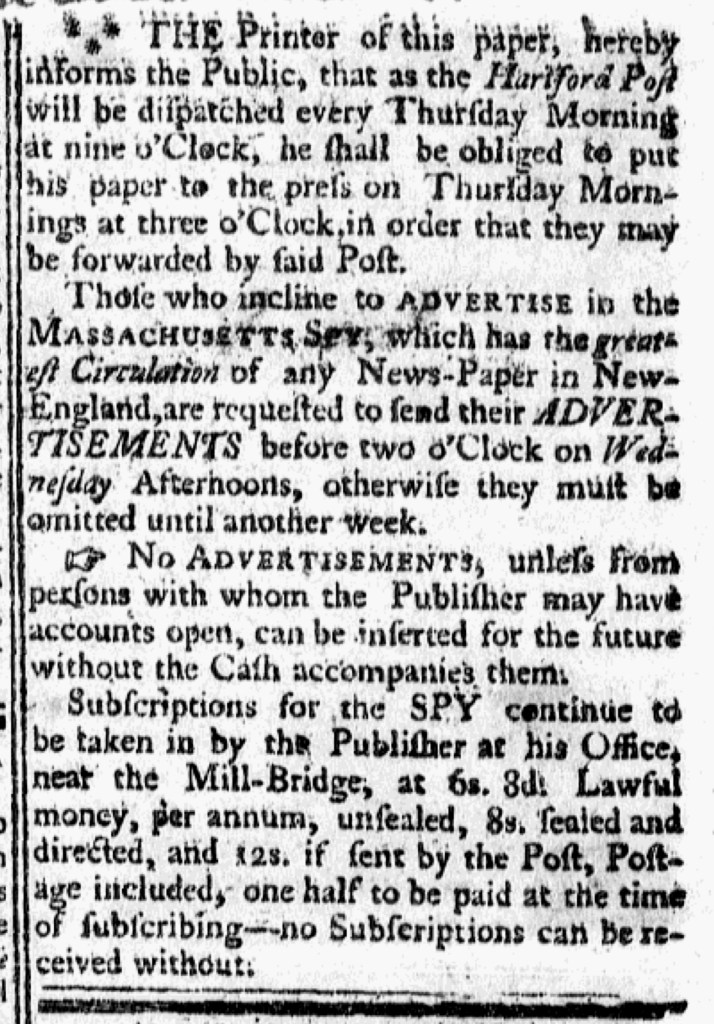
“No ADVERTISEMENTS … can be inserted for the future without the Cash accompanies them.”
In a notice in the January 19, 1775, edition of the Massachusetts Spy, Isaiah Thomas, the printer, provided several important details about the practices he enacted for publishing his newspaper. He opened by noting that “the Hartford Post will be dispatched every Thursday Morning at nine o’Clock.” In order that that the Massachusetts Spy “may be forwarded by said Post,” Thomas “shall be obliged to put his paper to the press on Thursday Mornings at three o’Clock.” Calling attention to such early mornings not only testified to the industriousness of the printer but also alerted the public that he could publish updates that arrived at his printing office merely hours before he distributed the new issue of his weekly newspaper.
Thomas also advised “[t]hose who incline to ADVERTISE in the MASSACHUSETTS SPY … to send their ADVERTISEMENTS before two o”Clock on Wednesday Afternoons, otherwise they must be omitted until another week.” To convince them to advertise in in his newspaper, he proclaimed that it “has the greatest Circulation of any News-Paper in New-England.” That meant that advertisers were likely to experience the greatest return on their investment by placing notices in the pages of the Massachusetts Spy. Although compositors worked quickly, they did need some time to set type for individual advertisements and lay out all the news, editorials, advertisements, and other content for each issue. While Thomas might welcome “Articles of Intelligence” that arrived very shortly before taking his newspaper to press, he insisted that advertisements required more time to prepare for publication. Advertisers needed to plan accordingly.
In addition, Thomas declared, “No ADVERTISEMENTS, unless from persons with whom the Publisher may have accounts open, can be inserted for the future without the Cash accompanies them.” He also asserted that subscriptions for the newspaper required “one half [of the annual fee] to be paid time of subscribing” and “no Subscriptions can be received without.” Historians of the early American press often make general statements about printers extending generous credit to subscribers, expecting that some would never pay, because they understood that newspaper advertisements were a much more most significant revenue. According to such accounts, printers supposedly insisted on receiving payment for advertisements in advance of publishing them. While that may have been the case in some printing offices, several printers published notices indicating that they departed from such practices. That Thomas put in place such a policy “for the future” suggests that it may have been a new policy or one that he had not previously enforced. Similarly, Thomas joined other printers who extended credit yet also demanded that subscribers submit half of the annual fee in advance, updating the terms that he published in the colophon that appeared in each issue of the Massachusetts Spy.