February 14

GUEST CURATOR:  Ashley Schofield

What was advertised in a colonial American newspaper 250 years ago today?

Essex Gazette (February 14, 1775).

“The great Misfortune of losing his House and Store by Fire, with almost every Thing in and about them.”

Peter Frye was a justice of the peace in Salem, Massachusetts, when the town had a fire on October 6, 1774. According to Donna Seger, Frye was a Tory. Tories were also known as Loyalists, colonists who remained loyal to the king and Parliament. In an advertisement that he placed four months after the fire, Frye points out his misfortune of losing his house, store, and belongings due to the fire. “He is now obliged to beg all of those who were then indebted to him by Bond, Note, or on Account” to pay him what they justly owed.

Frye called for sympathy amongst the people of Salem by stating his misfortune of losing his house, store, and belongings. He thought that some readers would hesitate to engage because he was a Tory, either overlooking or disregarding his plea. He knew he was asking a lot of the people to help him recover, so began by noting that he lost everything.

Advertisements calling on readers to settle accounts and debts were common, but most advertisements were due to regular business transactions, not due to fires. Additionally, he not only lost his house and store, but allegedly all that was in them. In this matter, Frye no longer had his ledgers and account books due to the fire, which meant he had no records to confirm who owed him and what amount.

Frye relied on the sympathy and the good consciences of the people of Salem to help him out in this time of tragedy to gain back what he had lost. As Donna Seger explains, “Frye had tried to find his way back to ‘friendship’ with his Salem neighbors, but they had never been able to forget his commercial and judicial dealings contrary to Patriot proclamations.” Due to his position as a Tory on the eve of the American Revolution, townspeople held a grudge against him. Seger notes that Frye left Salem, moving to Ipswich and then Britain.

**********

ADDITIONAL COMMENTARY: Carl Robert Keyes

I enjoyed working with Ashley on this entry for many reasons, including the confluence of primary and secondary sources that went into crafting it.  We began with negotiating whether I would approve Frye’s advertisement as Ashley’s selection for this project.  I encouraged students to choose advertisements about consumer goods and services to build on our readings and discussions about the consumer revolution, but I also told them that I would consider other kinds of advertisements if they made convincing cases for what they hoped to learn from them and why they should be included in the Adverts 250 Project.  Ashley convincingly argued that she did not previously know about the fire in Salem in 1774.   Frye’s advertisement offered an opportunity to learn about that piece of local history and its aftermath.

To fill in the details, she consulted Streets of Salem, a blog produced by Donna Seger, Professor of History at Salem State University.  Seger composes “[s]omewhat random but still timely posts about culture, history, and the material environment, from the perspectives of academia, Salem and beyond.”  In the nine years that I have been producing the Adverts 250 Project, I have consulted and linked to Streets of Salem on many occasions, so I was pleased that Ashley discovered that wonderful and engaging resource when researching Frye’s advertisement.  In the entry that gave so much information about Frye, Seger weaves together various primary sources, informed by Mary Beth Norton’s 1774: The Long Year of Revolution.  Ashley was already familiar with Norton from our discussions about the historiography of the American Revolution.  Seger’s post about “Tea, Fire and a new Congress” vividly illustrated how historians incorporate secondary sources into their research on primary sources, not only for background information but also in presenting an interpretation of what happened, why it mattered then, and why we consider it important now.

During the research, writing, and revision process, Ashley also had an opportunity to learn more about early American print culture and various kinds of advertisements, especially notices that called on colonizers to settle accounts.  As a result, she was able to make a distinction between the familiar and standard notices that so often appeared in the pages of early American newspapers and the appeal that Frye made as he attempted to recover from a fire that had devasted his household and business.  I sometimes select advertisements that deliver local news (including some that ran in the Essex Gazette right after the Salem fire) to feature on the Adverts 250 Project.  Ashley contributed to the project’s examination of those sorts of newspaper advertisements.
February 13

What was advertised in a colonial American newspaper 250 years ago today?

Supplement to the New-York Gazette and Weekly Mercury (February 13, 1775).

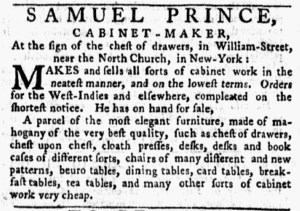
“Orders for the West-Indies and elsewhere, compleated on the shortest notice.”

Samuel Prince, a cabinetmaker, produced furniture in his workshop “At the sign of the chest of drawers, in William-Street, near the North Church, in New-York” in the 1770s.  In February 1775, he took to the pages of the New-York Gazette and Weekly Mercury to promote a “parcel of the most elegant furniture, made of mahogany,” imported from the West Indies, “of the very best quality.”  In addition to the “chest of drawers, … desks and book cases of different sorts, [and] chairs of many different and new patterns” that he had on hand, Prince made “all sorts of cabinet work in the neatest manner, and on the lowest terms.”

While he certainly sought customers in New York, he also indicated that he accepted “Orders for the West-Indies and elsewhere” and shipped the furniture to his clients.  That Prince addressed prospective customers in the West Indies testified to the circulation of the New-York Gazette and Weekly Mercury and other colonial newspapers.  The cabinetmaker had a reasonable expectation that prospective customers in faraway places would see his advertisement.

Prince promised that he “completed” orders “on the shortest notice, an appeal with additional significance since the Continental Association went into effect.  Devised by the First Continental Congress, that nonimportation, nonconsumption, and nonexportation agreement was designed to use commerce as leverage for convincing Parliament to repeal the Coercive Acts.  The fourth article specified that the “earnest Desire we have not to injure our Fellow Subjects in Great Britain, Ireland, or the West Indies, induces us to suspend a Non-exportation until the tenth Day of September 1775.”  If Parliament did not take satisfactory action by that time, “we will not, directly or indirectly, export any Merchandise, or Commodity whatsoever, to Great Britain, Ireland, or the West Indies.”  In other words, Prince and prospective clients in the West Indies had a short window of opportunity for placing orders, producing the furniture, and shipping it.  Prince did not violate the provisions of the Continental Association, but he likely had that looming deadline in mind when he pledged to fill orders “on the shortest notice.”

February 12

What was advertised in a colonial American newspaper 250 years ago this week?

Massachusetts Spy (February 9, 1775).

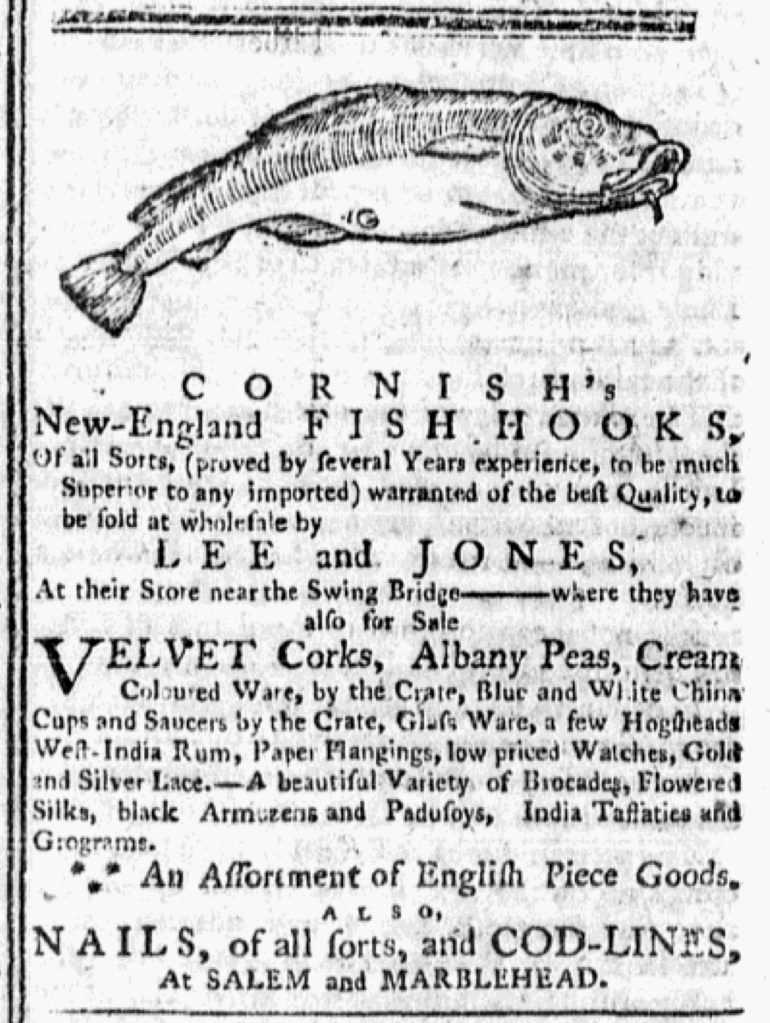
“CORNISH’s New-England FISH HOOKS.”

Lee and Jones stocked a variety of merchandise at “their Store near the Swing Bridge” in Boston in February 1775, but they made “CORNISH’s New-England FISH HOOKS” the centerpiece of their advertisement in the February 9 edition of the Massachusetts Spy.  Not only did they list that product first and devote the most space to describing it, but they also adorned their advertisement with a woodcut depicting a fish.  That image previously appeared in advertisements that Abraham Cornish placed in the Massachusetts Spy in March 1772 and March 1773.  Either Lee and Jones acquired the woodcut from Cornish when they composed the copy for their notice or Isaiah Thomas, the printer of the Massachusetts Spy, held the woodcut for Cornish and determined that advertisers promoting his product could use it in their notices.  It was not the first time that Lee and Jones distributed “CORNISH’s New-England Cod-Fish HOOKS.”

By the time that Lee and Jones ran their advertisement, Cornish had established a familiar brand.  In addition to advertising in the Massachusetts Spy, he also advertised in the Massachusetts Gazette and Boston Weekly News-Letter and Salem’s Essex Gazette.  His marketing efforts regularly touted the approval he received when “Fishermen … made trial of his Hooks” and found them “much superior to those imported from England.”  Lee and Jones deployed similar appeals when they proclaimed that the hooks had been “Proved by several Years experience, to be much Superior to any imported.”  Such assertions held even greater significance with the Continental Association, a nonimportation pact, in effect and the imperial crisis becoming even more dire.  In protest of the Coercive Acts passed in response to the Boston Tea Party, colonizers vowed not to import good from Britain.  The Continental Association called for encouraging domestic manufactures or goods produced in the colonies as alternatives to imported items.  Cornish has been making that case for his product for several years, as many readers likely remembered when they saw Lee and Jones’s advertisement for “CORNISH’s New-England FISH HOOKS.”

February 11

What was advertised in a colonial American newspaper 250 years ago today?

Supplement to the Pennsylvania Ledger (February 11, 1775).

“POLITICAL PAMPHLETS … on Both Sides of the Question.”

As the imperial crisis intensified in late 1774 and early 1775, most American newspapers became increasingly partisan, even those that claimed that they did not take a side in the contest between Patriots and Parliament.  Printers sometimes ran advertisements for pamphlets that did not align with the principles most often espoused in their publications, but few made a point of declaring that they did so.  James Rivington, printer of Rivington’s New-York Gazetteer and a noted Loyalist, took the most strident approach in a series of advertisements for “POLITICAL PUBLICATIONSwritten on the Whig and the Tory Side of the Question.”  Sporting headlines like “The American Contest” and “The American Controversy,” those advertisements listed several pamphlets, many of them written in response to others also advertised.

Yet Rivington was not alone.  In the supplement that accompanied the third issue of the new Pennsylvania Ledger, James Humphreys, Jr., the printer, inserted a short notice that announced, “Most of the POLITICAL PAMPHLETS That have been published, on Both Sides of the Question, May be had of the Printer hereof.”  On the first page, he once again ran the proposals for the newspaper, stating that he established a “Free and Impartial News Paper, open to All, and Influenced by None.”  Despite that assertion, “[i]t was supposed that Humhreys’s paper would be in the British interest,” according to Isaiah Thomas in his History of Printing in America (1810).[1]  He further explained that “in times more tranquil than those in which it appeared, [Humphreys] might have succeeded in his plan” to “conduct his paper with political impartiality.”[2]

When it came to marketing strategies for political pamphlets, printers associated with supporting the Tory “Side” took the more evenhanded approach of drawing attention to their commitment to selling and disseminating work on “Both Sides of the Question.”  In Rivington’s case, doing so was a matter of generating revenue as much as operating an impartial press and bookstore.  For Humphreys, on the other hand, doing so seemed to fall in line with the commitment he made in his proposals for the Pennsylvania Ledger.  Even taking those motivations into account, both printers may have considered it necessary to profess that they sold pamphlets on “Both Sides” to justify how many titles they sold that argued from the Tory perspective.

**********

[1] Isaiah Thomas, The History of Printing in America: With a Biography of Printers and an Account of Newspapers (1810; New York: Weathervane Books, 1970), 399.

[2] Thomas, History of Printing, 439.

February 10

What was advertised in a colonial American newspaper 250 years ago today?

South-Carolina and American General Gazette (February 10, 1775).

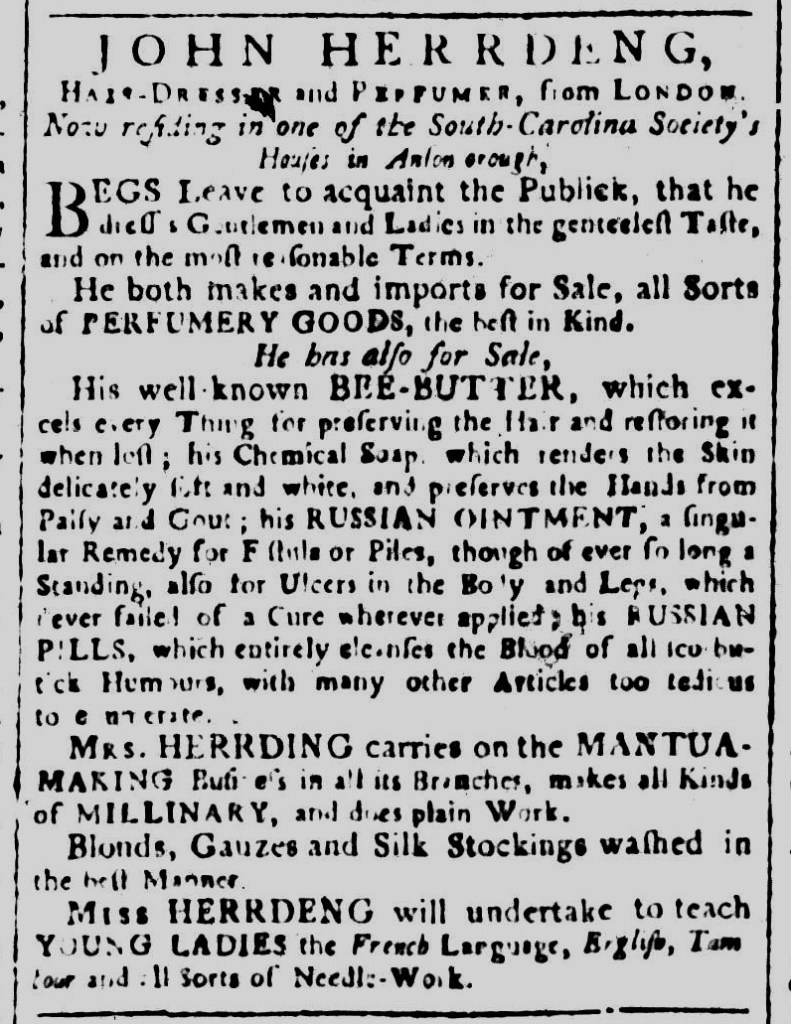
“JOHN HERRDENG, HAIR-DRESSER and PERFUMER.”

“MRS. HERRDING carries on the MANTUA-MAKING Business.”

“MISS HERRDENG will undertake to teach YOUNG LADIES the French Language.”

At a glance, the headline for an advertisement in the February 10, 1775, edition of the South-Carolina and American General Gazette promoted goods and services provided by John Herrdeng, a “HAIR-DRESSER and PERFUMER, from LONDON,” yet when they perused it more closely readers discovered that the notice also included entrepreneurial activities undertaken by other members of the Herrdeng household.  Descriptions of “PERFUMERY GOODS” and medicines that Herrdeng made and sold accounted for the first two thirds of the advertisements.  The final third outlined Mrs. Herrdeng’s “MANTUA-MAKING Business” and Miss Herrdeng offering lessons in French, English, and Needlework to the “YOUNG LADIES” of Charleston.

On occasion, the Adverts 250 Project has examined newspaper advertisements jointly placed by husbands and wives, brothers and sisters, or other relations residing in the same household.  This unusual advertisement, however, featured three family members who each pursued their own occupations.  As was often (but not always) the case, the man of the household received top billing.  Not only did the description of John Herrdeng’s goods and services take up the most space in the advertisement, his name, in larger font, appeared as the headline.  The order that the other members of the household appeared indicated their status and, likely, their experience.

Mrs. Herrdeng and Miss Herrdeng were not the only female entrepreneurs who advertised in that issue of the South-Carolina and American General Gazette.  Ann Fowler ran an advertisement for paper hangings and textiles that she also placed in the South-Carolina Gazette and Country Journal.  It filled almost as much space as the Herrdengs’ notice.  At the top of the column, Jane Thomson, a milliner, encouraged consumers to avail themselves of her services.  These advertisements made Fowler’s and Thomson’s presence in the marketplace much more visible in the public prints than Mrs. Herrdeng and Miss Herrdeng.  The Herrdengs made different decisions about how to depict themselves as entrepreneurs, yet their advertisement testifies to the contributions they made to their household beyond assisting a husband and father in his occupation.  The Herrdeng women practiced their own trades, engaged with their own clients, and resorted to advertising to facilitate their work.

February 9

What was advertised in a colonial American newspaper 250 years ago today?

Rivington’s New-York Gazetteer (February 9, 1774).

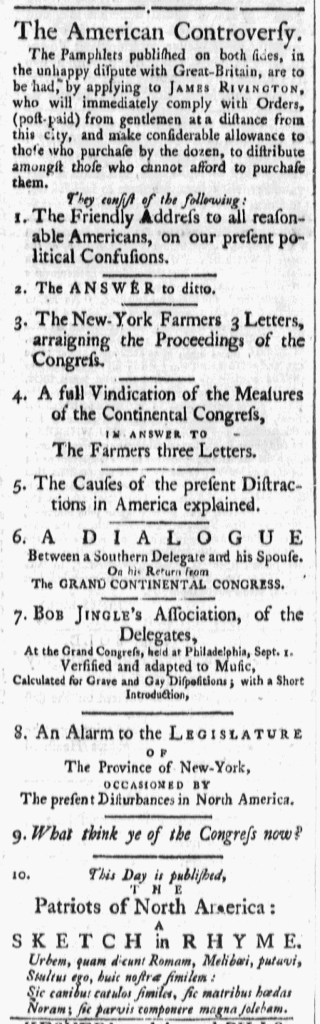
“Pamphlets published on both sides, in the unhappy dispute with Great-Britain.”

As the imperial crisis intensified in the winter of 1775, James Rivington continued to print a newspaper “at his OPEN and UNINFLUENCED PRESS” in New York.  He also ran a bookstore, peddling “Pamphlets published on both sides, in the unhappy dispute with Great-Britain.”  Both Patriot and Tory printers professed to operate free presses that delivered news and editorials from various perspectives, yet the public associated most newspapers with supporting one side over the other and even actively advocating for their cause.  Tory printers invoked freedom of the press as a means of justifying their participation in public discourse rather than allowing Patriot printers to have the only say.  When it came to advertising books and pamphlets about current events, Tory printers, especially Rivington, took the more balanced approach.

For Rivington, it was a matter of generating revenue as much as political principle.  He saw money to be made from printing and selling pamphlets about “The American Controversy.”  That was the headline he used for an advertisement that listed ten pamphlets in the February 9, 1775, edition of Rivington’s New-York Gazetteer.  He previously ran a similar advertisement for “POLITICAL PAMPHLETSon the Whig and Tory Side of the Question” and another about “The American Contest” that included some of the same pamphlets as well as others.  In his “American Controversy” advertisement, Rivington once again offered some familiar titles and new ones.  He made clear that the first two represented different positions, “The Friendly Address to all reasonable Americans, on our present political Confusions” and “The ANSWER to ditto,” though he did not indicate which took which side.

The printer positioned this venture as a service that kept the public better informed of the arguments “on both sides.”  He sought to disseminate his pamphlets beyond New York to “gentlemen at a distance from this city,” promising to “immediately comply with Orders.”  In turn, customers could do their part in making the pamphlets available far and wide since Rivington made “considerable allowance” or deep discounts “to those who purchase by the dozen, to distribute amongst those who cannot afford to purchase them.”  Though he portrayed himself as a fair dealer who marketed pamphlets “on both sides,” he did not express any expectation that customers would purchase or distribute both Patriot and Tory pamphlets.  Rivington presented readers with the freedom to consume (and further disseminate) the ideas they wished, seemingly hoping the public would allow him the same freedom in printing the content that he wished.  Whether he was sincere in such idealism or sought to justify printing editorials and pamphlets that many found objectionable, Rivington increasingly ran afoul of Patriots who did not share his outlook on freedom of the press when it came to disseminating news and opinion that favored the Tory side in “the unhappy dispute with Great-Britain.”

February 8

What was advertised in a colonial American newspaper 250 years ago today?

Connecticut Journal (February 8, 1775).

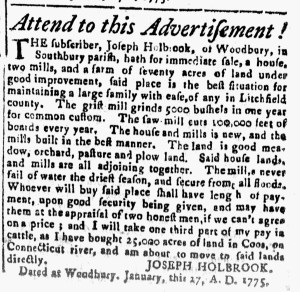
Attend to this Advertisement!

When Joseph Holbrook sought to sell a house, two mills, and a farm in Woodbury in the winter of 1775, he placed an advertisement in the Connecticut Journal and New-Haven Post-Boy.  In it, he assured prospective purchasers that “said place is the best situation for maintaining a large family with ease.”  The house and mills were new.  The gristmill “grinds 5000 bushels in one year for common custom,” while the sawmill “cuts 100,000 feet of boards every year.”  They operated throughout the year because the mills “never fail of water [during] the driest season,” nor did they flood at other times.  The land included “good meadow, orchard, pasture and plow land.”

Holbrook’s notice looked much like other advertisements in colonial newspapers except for a headline that proclaimed, “Attend to this Advertisement!”  That headline almost certainly drew the attention of readers, making them curious about what appeared in the notice.  Such a command distinguished Holbrook’s advertisement from others, not only because it gave instructions but because it had a headline at all.  Several notices in the February 8 edition of the Connecticut Journaldid not have headlines, just the first word in capital letters with a dropped capital for the first letter.  Some had the first line in larger font, such as one that began, “Pursuant to a Request made to,” and another that started, “This is to give notice to all.”  Among those with headlines, the name of the advertiser usually served that purpose.  One headline announced, “Jacob Dagget” in a larger font than anything else on that page.  Another used “JOSEPH HOWELL” as the primary headline with two secondary headlines, “Choice good Train & blubber Oil” and “Dry’d and pickled COD-FISH.”  Holbrook, however, did not resort to the usual wording and format for advertisements.  The headline for his advertisement, in italics and a larger font than its body, suggested that something of consequence followed the edict to “Attend to this Advertisement!”  The advertiser and the compositor deployed both copy and design to encourage readers to peruse what otherwise would have been an ordinary real estate notice.

February 7

What was advertised in a colonial American newspaper 250 years ago today?

Essex Gazette (February 7, 1775).

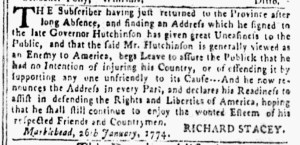
“He had no Intention of injuring his Country, or of defending any one unfriendly to its Cause.”

It was yet another public disavowal of an address honoring Thomas Hutchinson, the former governor of Massachusetts, that many colonizers signed when he returned to England.  This time, Richard Stacey inserted his recantation in the February 7, 1775, edition of the Essex Gazette.  Similar advertisements began appearing in that newspaper and sometimes newspapers printed in Boston as early as July 1774.  Stacey explained that he waited several months because he “just returned to the Province after long Absence” and only upon his arrival did he discover “an Address which he signed to the late Governor Hutchinson has given great Uneasiness to the Public.”  He further explained that the former governor “is generally viewed as an Enemy to America.”

That being the case, Stacey “begs Leave to assure the Publick that he had no Intention of injuring his Country, or of offending it by supporting any one unfriendly to its Cause.”  Accordingly, “he now renounces the Address in every Part, and declares his Readiness to assist in defending the Rights and Liberties of America.”  With such a proclamation, disseminated far and wide in the newspaper, Stacey desired “that he shall still continue to enjoy the wonted Esteem of his respected Friends and Countrymen.”  He considered the prospects of reconciling with friends, neighbors, and associates worth the expense of placing an advertisement in the Essex Gazette.

Was Stacey sincere?  Or did he merely seek to return to the good graces of his community and simply get along during difficult times?  That is impossible to determine from his advertisement.  It did differ from some that previously appeared in the public prints.  For instance, Stacey did not attempt to blame his error on having quickly read the address without considering its implications before signing it.  Instead, he did not comment on what had occurred at the time he signed the address but focused on the harm he had done by doing so.  Others offered lukewarm assurances that they did not truly support Hutchinson or the policies he had enforced, while Stacey proclaimed his “Readiness to assist in defending the Rights and Liberties of America.”  In addition, some signers published advertisements that clearly copied from the same script.  Stacey’s was entirely original.  That may have been the result of the time that had passed since others inserted their advertisement or the political situation deteriorating and thus requiring stronger assertions from signers of the address branded as Tories.  William Huntting Howell suggests that for some readers Stacey’s sincerity may have mattered much less than the fact that he felt compelled to express support for the “Cause” of “his Country” in print.[1]

**********

[1] William Huntting Howell, “Entering the Lists: The Politics of Ephemera in Eastern Massachusetts, 1774,” Early American Studies 9, no. 1 (Winter 2011): 191, 208-215.

February 6

What was advertised in a colonial American newspaper 250 years ago today?

Newport Mercury (February 6, 1775).

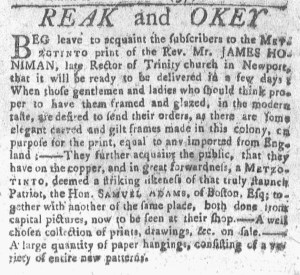
“A METZOTINTO … of that truly staunch Patriot, the Hon. SAMUEL ADAMS.”

On February 6, 1775, Charles Reak and Samuel Okey took to the pages of the Newport Mercury to advise “subscribers to the METZOTINTO print of the Rev. JAMES HONIMAN … that it will be ready to be delivered in a few days.”  As printers often did for books, Okey, a British printmaker who migrated to Rhode Island, gauged the market by seeking subscribers to his print of James Honyman, the former rector of Trinity Church in Newport, before executing it.  That allowed him to determine whether the project would be viable and how many prints to produce to meet the demand of subscribers who reserved copies.

The print has been dated November 2, 1774, based on a line beneath the title that reads, “Printed by Reak & Okey, Newport Rhode Island, Novr. 2 1774,” yet the newspaper advertisement suggests that even though the engraving may have ready on that day that Reak and Okey printed the portrait in the following months before distributing it in February 1775.  The advertisement gives further evidence that was the case.  The partners informed readers of a forthcoming print depicting “that truly staunch Patriot, the Hon, SAMUEL ADAMS, of Boston.”  Reak and Okey explained that they “have on copper, and in great forwardness” that mezzotint.  The engraving was complete, but printing took time.

When they did deliver copies of the Honyman mezzotint to subscribers, Reak and Okey offered more than just the print to “those gentlemen and ladies who should think proper to have them framed and glazed in the modern taste.”  They promoted “some elegant carved and gilt frames, made in this colony, on purpose for the print, equal to any imported from England.”  With the Continental Association in effect, Reak and Okey gave their customers access to frames without departing from that nonimportation agreement.  The copy in the collections of the Preservation Society of Newport County is “housed in a black painted wood frame with an interior gilt gesso border,” though the description does not give the provenance of the frame.

In their choices about their latest subject, John Adams, and the frames for the James Honyman mezzotint, Reak and Okey courted customers who supported the American cause as the imperial crisis intensified.  They joined other artists and publishers who commemorated the American Revolution even before the war began at Lexington and Concord, doing so with both an image of a “staunch Patriot” and frames imbued with political as well as artistic significance.

February 5

What was advertised in a colonial American newspaper 250 years ago this week?

Massachusetts Spy (February 2, 1775).

“BUTTONS. MADE and sold … at the Manufactory-house, Boston.”

John Clarke’s advertisement for buttons that he “MADE and sold … at the Manufactory-house” in Boston was one of several in the February 2, 1775, edition of the Massachusetts Spy that hawked goods produced in the colonies.  He advertised at a time that the harbor had been closed and blockaded for more than eight months because of the Boston Port Act, one of several measures that Parliament enacted in response to the Boston Tea Party.  The other Coercive Acts included the Massachusetts Government Act, the Administration of Justice Act, and the Quartering Act.  In turn, the colonies refused to import British goods, having previously pursued that strategy in response to the Stamp Act in 1765 and the duties imposed on certain goods in the Townshend Acts in the late 1760s.  The Continental Association, devised by the First Continental Congress, went into effect on December 1, 1774.  In addition to prohibiting imports, it called on colonizers to encourage “domestic manufactures” or goods produced in the colonies.

Clarke not only made buttons in Boston, he made “two sorts of new fashioned buttons.”  One was a “plain flat Button, with a corded edge round it, either gilt or plated.  The other bore an inscription, “UNION AND LIBERTY IN ALL AMERICA,” that made a statement.  Consumers could express political sentiments and sartorial sensibilities simultaneously.  (Similarly, the Adverts 250 Project previously examined another newspaper notice that included “glass buttons having the word liberty printed in them.”)  Clarke’s “Liberty button,” well worth the investment, cost just a little more than the “plain flat Button,” at twenty shillings per dozen compared to eighteen shillings per dozen.  Clarke also gave “good allowance to shopkeepers to sell again.”  In other words, he offered discounts to retailers who purchased his buttons and presented them to their customers.  After all, shopkeepers had their own part to play in promoting American products to consumers and supplying them with alternatives to goods imported from Britain.  When it came to buttons, what better way to do that than with the inscribed “Liberty button” made in Boston?