March 26

GUEST CURATOR: Sean Duda

What was advertised in a colonial American newspaper 250 years ago this week?

Supplement to the New-York Journal (March 23, 1769).

“A HARPSICHORD, completely fitted, Maker’s Name (Mahoon, London:).”

This brief advertisement offered a harpsichord for sale. Harpsichords are often referred to as the “predecessor” of the piano. When Romance music started to come about at the beginning of the nineteenth century, everyone started to move over to pianos. This was due to the fact that pianos were more expressive and had more dynamics. This became even more true when Beethoven started working with piano builders in the early nineteenth century to make louder pianos before he went completely deaf. One of the main drawbacks to the harpsichord, that the piano did not have, was that no matter how softly or forcefully a musician pushed down on a key of a harpsichord the volume rang with the same amount of sound at all times.

During the eighteenth century many of the wealthy and elite had a harpsichord in their homes for entertainment. Ed Crews writes that “harpsichords were expensive in Great Britain and its North American colonies. During the 1700s … most harpsichords in America were made in Great Britain. Because of the cost, the instrument was a status symbol. The powerful, the refined, and the wealthy made sure they had one in their homes.” The harpsichord in this advertisement was made in London. Poorer colonists sometimes learn to sing in church or learned to play instruments that were less costly and of lower overall quality compared to the harpsichords owned by their wealthier counterparts.

**********

ADDITIONAL COMMENTARY: Carl Robert Keyes

Working with undergraduate guest curators sometimes offers a brief respite from examining the featured advertisements in favor of reflecting on pedagogy. All of the guest curators currently working on the Adverts 250 Project are currently enrolled in my upper-lever Revolutionary America, 1763-1815, course at Assumption College in Worcester, Massachusetts. As long as they abide by the methodology for the project they may examine whichever advertisements they wish. However, as project manager I reserve the right to review and approve all advertisements included in the project. I encourage guest curators to submit their proposed advertisements for approval before they conduct further research or begin writing about them.

This results in guest curators frequently choosing advertisements that I would not have considered or passing over advertisements that I would like to include in the project. When Sean presented this exceptionally brief advertisement for my consideration I initially attempted to wave him off of it and on to another advertisement. I thought that it might be a difficult choice for someone working as a guest curator for the first time. As an alternative I directed him to an advertisement in the same column of the March 23, 1769, edition of the New-York Journal, a subscription notice for printing “AN HISTORICAL JOURNAL OF THE CAMPAIGNS IN NORTH AMERICA, For the Years 1757, 8, 9, and 60 … By CAPTAIN JOHN KNOX.” We covered the Seven Years War at the beginning of the semester, so I reasoned that Sean could readily make connections between course content and that advertisement.

Sean, however, explained that he had intentionally chosen the advertisement about the harpsichord. As a Music minor, he previously enrolled in a course that examined the history of music. He wanted to draw together material from classes in different disciplines. Once I heard Sean’s explanation I enthusiastically approved the advertisement for the harpsichord. His choice achieved one of my goals for incorporating undergraduate guest curators into the project to fulfill the requirements of my Revolutionary America course: challenging students to consider connections between the material they encounter in my class and what they have learned in other History courses and classes offered by other departments. In addition, Sean demonstrated another point that I make to guest curators when we first discuss the project. The advertisement for the harpsichord was deceptively brief. At the beginning of the semester most of Sean’s peers may have passed over it, questioning its significance. Yet Sean used it to tell a robust story about entertainment, status, and changing technologies in the era of the American Revolution.

March 25

GUEST CURATOR: Sean Duda

What was advertised in a colonial American newspaper 250 years ago today?

Providence Gazette (March 25, 1769).

“Pepper by the Bag.”

Joseph and William Russell advertised a few different commodities, such as pork, pepper, cordage, duck, indigo, and nails. Pepper was one of the biggest imports that came from Asia into Europe; it was one of the most valuable resources that the British imported from British India to Europe and the colonies in the seventeenth and eighteenth centuries. Pepper had been one of the bigger sources of conflict between the British and the Dutch in earlier years, according to K.N. Chaudhuri in The Trading World of Asia and the English East India Company, 1660-1760. Though the wrestling for dominance over India by European powers took place earlier than the Russells published their advertisement in the Providence Gazette, it bore great weight when observing the later outcomes and rewards that the British and the colonists reaped from those earlier efforts in securing a steady flow of resources from India, including textiles and pepper.

**********

ADDITIONAL COMMENTARY: Carl Robert Keyes

When it came time to select which advertisement to feature today, Sean had very few options. The Providence Gazette was the only newspaper published in colonial America on Saturday, March 25, 1769. While it often carried dozens of advertisements that filled the entire final page and often spilled over to other pages, only five paid notices ran in the March 25 edition. They did not amount to an entire column. Two were legal notices and one offered a forge for lease. Only two offered goods for sale: the advertisement placed by the Russells and an even shorter notice for “best English Hay and Hay-Seed” to be sold by Hezekiah Carpenter. Guest curator Zach Dubreuil already examined the Russells’ advertisement last week. While the methodology for the Adverts 250 Project usually specifies that an advertisement should be featured only once, I instructed Sean that he could work with this advertisement as long as he consulted with Zach to choose a different aspect to analyze.

Those five notices were not, however, the sole mention of advertising in the Providence Gazette that week. At the bottom of the column John Carter, the printer, inserted a short announcement: “Advertisements omitted, for Want of Room, shall be in our next.” The relative scarcity of advertising in that issue apparently was not for lack of notices submitted to the printing office, as often seemed to be the case with the Boston Chronicle, but rather too much other content that Carter considered more important at the moment. Printers needed to carefully manage such situations. Especially at times of political turmoil, they had an obligation to disseminate news to their readers as quickly as they acquired it or risk losing readers, yet revenues from advertising were essential to the continued operation of colonial newspapers. The notice that “Advertisements omitted … shall be in our next” informed clients who expected to see their advertisements in the March 25 edition that they would indeed appear the following week after only a brief hiatus. That strategy was not Carter’s only option. Printers throughout the colonies sometimes issued half sheet supplements comprised of advertising when news (and other advertisements) filled the standard issue. Carter may not have had sufficient additional paid notices to merit doing so, or he may not have had sufficient time to produce a supplement. Even though few advertisements ran in the March 25 issue, the printer still addressed the business of advertising in the pages of the newspaper.

March 24

GUEST CURATOR: Sean Duda

What was advertised in a colonial American newspaper 250 years ago this week?

Boston Chronicle (March 23-27, 1769).

“Several BARRELS of SOAP, and a variety of European GOODS.”

In this advertisement Elias Dupee is trying to sell a few different kinds of goods, including apparel and other goods useful around the house. He points out specifically that he has several “BARRELS of SOAP” as well as “a variety of European GOODS.” This soap may have been produced in the colonies since Dupee listed it separately. This is worth noting because soap was a very large import into the colonies from Britain; the colonists preferred to import soap from overseas instead of making soap themselves. In “Baubles of Britain,” T.H. Breen talks about how this was the case. He notes, “One English traveler discovered to her surprise that in rural North Carolina women seldom bothered to produce soap. It was not a question of the availability of raw materials. Good ashes could be had at no expense. But these rural women were consumers, and they preferred to purchase Irish soap ‘at the store at a monstrous price.’”[1] That the soap that Dupee advertised may have been made in the colonies points to a shift in the colonies moving towards more self-reliance at a time that they reduced imports to resist the taxes from the Townshend Acts.

**********

ADDITIONAL COMMENTARY: Carl Robert Keyes

Today Sean and I have deviated slightly from the Adverts 250 Project’s methodology in order to explore an aspect of early American newspaper publication that often confuses modern readers the first time they examine eighteenth-century newspapers: the date listed in the masthead and, sometimes, at the top of each page.

Consider the Boston Chronicle. The masthead for issue 78 includes this date: “From THURSDAY, MARCH 23, to MONDAY, MARCH 27, 1769.” The top of each page included the name of the newspaper and a date, “March 23—March 27.” What does this mean? When was that issue printed and distributed to subscribers? Does that date mean that it was printed on March 23 and readers should not expect another issue until March 27? Or does that date mean that the issue was printed on March 27 and covered the period since March 23? Twenty-first-century readers cannot make a determination in a glance. Sean and his peer were confused by the dates when they first encountered them, as was I when I began working with eighteenth-century newspapers.

Examining the content of issue 78 of the Boston Chronicle reveals when it was published. In particular, the dates listed in some of the advertisements prove useful, unlike the dates attached to some of the news items. For instance, news from Philadelphia was dates March 9, news from New York March 20, and news from New London March 17. The advertisement immediately below Dupee’s auction notice, however, reported that “a likely Negroe Fellow, (named CATO)” ran away from George Watson of Plymouth on March 25. That date indicates that issue 78 could not have been published on March 23. Instead, it was published on March 27 and contained all of the news, advertising, and other content for the period since the previous issue that bore the date “From MONDAY, March 20, to THURSDAY, MARCH 23, 1769.”

This example points to an aspect of working with undergraduate guest curators that I particularly enjoy: the fresh eyes that they bring to sources that have become very familiar to me. As I mentioned above, I also questioned the dates on newspapers like the Boston Chronicle when I first began examining eighteenth-century newspapers, but I have become so accustomed to that convention that I hardly remembered it until Sean and others raised questions about what appeared to be a confusing date. Over the course of this semester, as in past semesters, I have observed undergraduate guest curators achieve greater mastery of early American history, including gaining some of the expertise of print culture specialists. They have done so via exploration of primary sources they have selected on their own rather than merely responding to readings that I have gathered for them.

In the process, Sean and I decided to depart from the methodology that dictates that the featured advertisement must have appeared in a newspaper published exactly 250 years ago today. Instead, he chose one published 250 years ago this week so we could examine how colonists thought about the dates on newspapers in addition to the goods and services advertised in those newspaper.

**********

[1] T.H. Breen, “‘Baubles of Britain’: The American and Consumer Revolutions of the Eighteenth Century,” Past and Present 119 (May 1988): 79.

March 23

GUEST CURATOR: Zachary Dubreuil

What was advertised in a colonial American newspaper 250 years ago today?

Boston Chronicle (March 23, 1769).

“JUST PRINTED … PSALMS of DAVID.”

Religion played an important role in the colonies. This advertisement attempted to sell a book, “PSALMS of DAVID … By the Rev. Dr. WATTS.” Watts (1674-1748) was an English educator who later became a pastor. He wrote a series of essays and poetry on theological topics. According to the Poetry Foundation, “Watts published four volumes of poetry: Horae Lyricae; Hymns and Spiritual Songs (1707); Divine Songs Attempted in Easy Language for the Use of Children (1715); and The Psalms of David Imitated in the Language of the New Testament (1719).” In addition, “several of his Psalms are among the best-known poems in the English-speaking world. ‘Joy to the World’, for example, is Watts’s rendering of the second part of Psalm 98 in common meter.” Watts’s work is still being used today, like it was during colonial times. This advertisement for a religious book shows us how much many colonists valued religion.

**********

ADDITIONAL COMMENTARY: Carl Robert Keyes

John Mein’s advertisement for Isaac Watts’s Psalms of David Imitated in the Language of the New Testament was one of four notices that he inserted in the March 23, 1769, edition of the Boston Chronicle, the newspaper that Mein published with partner John Fleeming. The others included an advertisement for the second edition of Bickerstaff’s Boston Almanack, one for Mein and Fleeming’s Register for New-England and Nova-Scotia, and one in which Mein offered to purchase entire libraries or exchange books. These four advertisements comprised nearly two of the three columns of the final page of the issue.

Guest curator Luke DiCicco and I recently examined the advertisements for the Boston Almanack and the Register. When we published short summaries on Twitter, historian J. L. Bell questioned the number of advertisements placed by Mein and the amount of space that the printer occupied in his own publication. Did the Boston Chronicle lack other advertisers? Or did something else explain the disproportionate advertising related to Mein’s own ventures? After all, other printers regularly placed notices in their own newspapers, but not usually to the same extent.

Three factors likely played a role in the overabundance of advertising by the printer. The Boston Chronicle competed with several other newspapers. It had commenced publication less than a year and a half earlier, while the Boston Evening-Post, the Boston-Gazette, the Boston Post-Boy, and the Boston Weekly News-Letter had been around for years or even decades. From its inception, the Chronicle had fewer advertisements than any of the other newspapers printed in Boston. It took time to build a clientele of readers, subscribers, and advertisers. In 1769, many prospective advertisers likely considered placing their advertisements in other newspapers a better investment. Part of that may have been due to the second factor, Mein’s vocal Tory sentiments. The advertisement for the Register, especially the inclusion of “BRITISH LISTS,” celebrated the colonies’ connection to Britain at a time when many colonists engaged in resistance to abuses by Parliament, including the Townshend Acts. Some prospective advertisers may have been hesitant to hawk their wares in the Chronicle due to the political sympathies expressed by the printers, especially Mein. This hypothesis requires further research. Finally, if Mein still had surplus copies of the Boston Almanack and the Register twelve weeks into 1769 then he desperately needed to sell them. That alone may have justified giving so much space to the advertisements, especially since they promoted reference information good throughout the year, such as lists of colonial officials and the correct dates when the courts would be in session, rather than the astronomical calculations.

Mein’s advertisement for Watts’s Psalms of David was just one several that called attention to his various ventures. As printer of the Boston Chronicle, he exercised his prerogative over the content, filling much of the final page with notices related to his “LONDON BOOK-STORE” on King Street.

March 22

GUEST CURATOR: Zachary Dubreuil

Who was the subject of an advertisement in a colonial American newspaper 250 years ago today?

Georgia Gazette (March 22, 1769).

TO BE SOLD … ONE NEGROE GIRL.”

This advertisement from the Georgia Gazette talked about selling an enslaved person, “ONE NEGROE GIRL.” Newspapers from the southern colonies constantly had advertisements for selling enslaved people in the 1760s. So did many newspapers from northern colonies, but they did not have as many advertisements about enslaved people as the southern newspapers. This advertisement shows that Matthew Roche, the provost marshal, offered to sell a girl that was “seized” from James Lambert because he could not pay his bills, which meant anything that he owned, including human “property,” could be taken away. The girl that was seized had her whole life changed, especially if she had any family or friends who were not sold with her. This advertisement does not give a description of what the girl was like or anything about her features or her skills. It shows that Roche did not give her any identity and only cared that she was property.

**********

ADDITIONAL COMMENTARY: Carl Robert Keyes

Zach comments on the number of advertisements concerning enslaved people that ran in newspapers in the southern colonies in the 1760s. Indeed, this advertisement for “ONE NEGRO GIRL” was not the only one concerning enslaved men, women, and children in the March 22, 1769, edition of the Georgia Gazette. A total of ten such advertisements, spread over three of the four pages, appeared in that issue.

Six of those advertisements offered enslaved people for sale. Similar to the advertisement placed by the provost marshal, one advertisement for a “PUBLICK VENDUE” or auction promoted “ONE NEGROE GIRL” for sale. It listed her, however, among a variety of commodities put up for bids to settle the estate of Captain David Cutler Braddock, including “A PARCEL RAW DEER SKINS” and “some BEES-WAX.” Other advertisements sought to sell several enslaved people at once, though that would not have been any less disruptive to their lives and their relationships since there was no guarantee of being sold together. One brief advertisement offered “ FEW NEGROES belonging to the Estate of Martin Fenton.” Another estate notice included “ABOUT TWENTY-ONE VALUABLE PLANTATION SLAVES” along with “A STOCK OF CATTLE.” Henry Yonge also announced an auction, leading with “ABOUT FIFTEEN VALUABLE PLANTATION AND HOUSE SLAVES” before listing furniture, livestock, corn, and other provisions. Due to his own declining health, another advertiser aimed to sell his plantation, including “About THIRTY LIKELY NEGROES.” To make them more attractive to prospective buyers, he noted that “amongst them is a very good Bricklayer, a Driver, and two Sawyers.” Many of them were “fit for field or boat work.” The rest were “fine thriving children.” Like the “NEGRO GIRL” to be sold by the provost marshal, all of those children and the other enslaved people offered for sale in these advertisements faced fates largely determined by those who held them in bondage.

Acts of resistance, however, were possible. Two of the advertisements about enslaved people reported on those who had escaped. Two men, Perth and Ned, had run away “some time ago.” Thomas Morgan suspected that they “went to Halifax in St. George’s parish, where they are well known.” Shand and Henderson once again ran an advertisement about Cuffy and Bersheba, who had been gone for more than a month, having made their escape on February 9. Two other advertisements, on the other hand, described runaways who had been captured. A couple, Sampson and Molly, had been “TAKEN UP … on the Indian Country Path, about 20 miles from Augusta.” They had an infant “about two months old” with them. The arrival of the child may have provided the motivation to abscond. The final advertisement described Michael, “A TALL STOUT ABLE NEGROE FELLOW.” He had been imprisoned in the workhouse in Savannah for several months following his capture.

As Zach notes, advertisements about enslaved people were indeed a “constant” feature in many newspapers in the 1760s, especially newspapers published in the southern colonies. In the same era that colonists decried their figurative enslavement by Parliament in the pages of those same newspapers they also placed and read advertisements that contributed to the perpetuation of the enslavement of Africans and African Americans.

March 21

GUEST CURATOR: Zachary Dubreuil

What was advertised in a colonial American newspaper 250 years ago today?

Essex Gazette (March 21, 1769).

“CHOICE green Coffee.”

In this advertisement William Vans attempted to sell some items, including “CHOICE green Coffee.’ Green coffee had to do with the beans. Heather Baldus, the collections manager at George Washington’s Ferry Farm and Historic Kenmore, says, “In the 1700s, when you purchased coffee from your local merchant it most likely was in the form of bags of green beans.  The burden of turning those beans into the perfect cup of coffee was on the consumer.” When roasting the person doing it had to make sure that the beans were constantly turning so they would not burn. Then the person could use a coffee grinder, which was common and inexpensive in Europe, although most people in the colonies used a mortar and pestle to turn the beans into a powder. Finally, the person would put the amount they wanted with water, either boiling or infusing it. In addition to drinking coffee at home, some colonists went to coffeehouses. Coffeehouses began to pop up in colonial America in the eighteenth century. They were a mixture of a café, tavern, and inn. During the consumer revolution, coffee became a staple drink for early Americans.

**********

ADDITIONAL COMMENTARY: Carl Robert Keyes

At a glance, William Vans’s advertisement for “CHOICE green Coffee” and other goods appears to be the same advertisement from the Essex Gazette that guest curator Luke DiCicco examined last week, a second insertion that ran in a subsequent issue. For the most part, that was indeed the case, but the notice that ran in the March 21, 1769, edition did feature one notable difference compared to the first iteration. It did not include the place and date on the final line: “Salem, March 13, 1769.” What explains the alteration?

Most likely the compositor exercised discretion in dropping the final line of the advertisement, choosing to do so in order to make it fit in the final column on the last page of the March 21 issue. Six notices comprised that column. In addition to Vans’s advertisement, Benjamin Coats and Susanna Renken each ran advertisements for a “fresh Assortment of Garden Seeds,” Samuel Hall promoted a pamphlet for sale at the printing office, Benjamin Marston of Marblehead offered the Misery Islands for sale, and Peter Frye and Nathan Goodale published an estate notice following the death of Ebenezer Bowditch. All six advertisements ran in the March 14 issue. With the exception of Vans’s advertisement, all of them appeared in the March 21 edition exactly as they had the previous week.

Had the compositor not removed the final line from Vans’s notice, all six would not have fit in a single column. Most likely the compositor had looked for a convenient means of reducing the length of one of the advertisements. Two of them, Vans’s advertisement and the estate notice, included final lines listing place and date, lines easily removed without making it necessary to otherwise reset any type. The estate notice, however, needed the date because it specified that Frye and Goodale would continue to settle accounts at a local tavern “on the last Friday of this and of the five Months next ensuing.” Since such advertisements sometimes ran for weeks or months, the date at the end was imperative. Vans’s notice, on the other hand, did not require the date, facilitating the removal of that line. The compositor most likely made that decision without consulting the advertiser.

While these particulars may seem insignificant, they help to demonstrate the division of authority exercised by colonists involved in the production of newspaper advertisements in the eighteenth century. Advertisers usually generated copy, but compositors determined graphic design elements. In this case, the compositor made a slight alteration to the copy in the service of the format of the entire page on which the advertisement appeared.

March 20

GUEST CURATOR: Zachary Dubreuil

What was advertised in a colonial American newspaper 250 years ago today?

Boston Chronicle (March 20, 1769).

“Wants Employment.”

This advertisement caught my eye because of the “Wants Employment” part. Someone was looking for a job that involved “Writing, either in Merchants Books or any otherwise, consisting in Penmanship” or “tak[ing] Charge of a Store.” The advertiser claimed that he was good at writing. According to E. Jennifer Monaghan in Learning to Read and Write in Colonial America, students first learned “round hand,” which took several years, and “during this time the student might well be exposed to, without being expected to be fully master of, italic print and roman print.”[1] Since he mentions “Penmanship” this advertiser may have learned more than one “script.” It was difficult to learn how to write because students had so many different scripts to learn.

The end of the advertisement was in a different language. It says, “Ubi est Charitas?—Not in Town.—Honi soit qui mal y pense.” The first part is Latin for “Where is the love?” The second part is French for “Shame to him who thinks evil of it.” By inserting these quotations in other languages, the advertiser demonstrated that he was indeed well educated, the sort of person that a merchant would want handling accounts and letters. There is another aspect concerning how this advertiser tries to find a job. He says that anyone who sends him a message “shall be immediately waited on.” He is letting prospective employers know that he is punctual and eager to work.

**********

ADDITIONAL COMMENTARY: Carl Robert Keyes

Rather than elaborating on the advertisement that Zach has selected for today, I am devoting this entry to some comments on incorporating the Adverts 250 Project into my classes, collaborating with undergraduate guest curators, and how their work shapes the project. This is the fifth semester that I have invited students to contribute to the project to fulfill some of their course requirements. This work began in a Public History class (Spring 2016) and has continued in Colonial America (Fall 2016), Revolutionary America (Spring 2017), Public History (Spring 2018), and Revolutionary America (Spring 2019).

I ask each student to serve as guest curator for a week. They are responsible for creating an archive of all the newspapers for their week that have been digitized by Accessible Archives, Colonial Williamsburg, and Readex. Then they select an advertisement to feature each day of the week. I specify that one of those advertisements must concern the experiences of enslaved men, women, and children, giving the students an opportunity to enhance the work they simultaneously undertake as guest curators of the Slavery Adverts 250 Project. The other advertisements must focus on commodities or consumer goods and services. That allows us to continue examinations of the consumer revolution that constitute a major component of readings and discussions from class. However, advertisements that ran in eighteenth-century newspapers were many and varied. Many of them had purposes other than promoting the buying and selling of goods. So I allow each guest curator to select one “exception to the consumer goods and services” rule (in addition to an advertisement concerning enslaved people) that allows them to explore other aspects of life in colonial and revolutionary America. Today Zach has chosen an employment advertisement. Recently, guest curator Olivia Burke examined a “runaway wife” advertisement. In both cases, the guest curators learned more about early American history and culture.

Undergraduate guest curators often choose advertisements that I would not have selected on my own. Sometimes this can be frustrating, especially when they pass over advertisements that I find more interesting and want to examine in more detail. Yet that is also the purpose of engaging my students as junior colleagues. They exercise the authority to determine the direction of the project during their time as guest curators. They determine their own assignments in that they choose the content that they want to include and research in greater detail. They also determine an assignment for me. Most of the time I provide further analysis of some aspect of the advertisements they examine; this entry is a rare exception in that it discusses pedagogy and methodology rather than additional aspects of early American print culture and consumer culture. When I provide additional commentary about advertisements chosen by guest curators, this allows us to continue our conversations about the advertisements they found engaging. It helps us to work together as a team, as a mentor with junior colleagues, because the students have selected the content that we all address together.

**********

[1] E. Jennifer Monaghan, Learning to Read and Write in Colonial America (Amherst: University of Massachusetts Press, 2005), 287.

March 19

GUEST CURATOR: Zachary Dubreuil

What was advertised in a colonial American newspaper 250 years ago this week?

New-Hampshire Gazette (March 17, 1769).

“WATCHES PROPERLY AND EXPEDITIOUSLY REPAIR’D.”

This advertisement stood out to me because John Simnet sold watches and also provided a service related to watches. He “PROPERLY AND EXPEDITIOUSLY REPAIR’D” watches. Pocket watches were intricate and watchmakers were the only people that could fix them. Simnet promoted himself as a skilled artisan in this advertisement, making it known that he would be able to fix watches correctly and quickly. According to the National Association of Watch and Clock Collectors, “Most colonists with watchmaking skills sold and repaired imported watches instead of making them.” Simnet’s advertisement seems to demonstrate that trend. He emphasized repairing watches at the beginning and did not mention “Gold and Silver Watches for Sale” until the end. He may have made those watches during the time he lived in London and Dublin and brought them across the Atlantic to Portsmouth, New Hampshire. The National Association of Watch and Clock Collectors also states that advertisements “show that a small number of watches were made in America” in the mid 1770s.

**********

ADDITIONAL COMMENTARY: Carl Robert Keyes

To drum up business when he arrived in New England, John Simnet placed a series of advertisements in colonial newspapers. This notice from the March 17, 1769, edition of the New-Hampshire Gazette was a variation on others that he had previously inserted in the same newspaper, though it scaled back on some of the appeals to price, quality, and experience in the earlier advertisements.

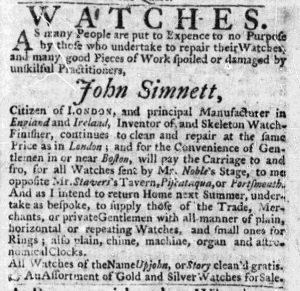
Boston Weekly News-Letter (February 16, 1769).

All of Simnet’s advertisements in the New-Hampshire Gazette, however, were rather restrained compared to the much lengthier advertisement that he inserted in the February 16, 1769, edition of the Boston Weekly News-Letter. In that notice he expended far more prose to convince prospective clients of his skills as a watchmaker. He lamented that “many People are put to Expence to no Purpose by those who undertake to repair their Watches,” suggested that some artisans who claimed to be skilled watchmakers charged fees for their efforts but did not produce results. Others, he proclaimed, caused further injury as a result of their attentions, leaving “many good Pieces of Work spoiled or damaged by unskilful Practitioners.” Such was not the case with Simnet! To demonstrate that prospective clients could entrust their watches to him, he provided his credentials: “Citizen of LONDON, and principal Manufacturer in England and Ireland, Inventor of and Skeleton Watch-Finisher.” He had acquired and refined his skills throughout his long experience as a watchmaker on the other side of the Atlantic. He made only a nod in that direction in his shorter advertisements in the New-Hampshire Gazette, noting in one that he had been “Twenty-Five Years Watch-maker in London” and in another describing himself as “Watch-Finisher, and Manufacturer of London and Dublin,” but not indicating his years of experience.

In his lengthier advertisement in the Boston Weekly News-Letter, Simnet also emphasized customer service to a greater degree. Attempting to enlarge his market beyond Portsmouth, New Hampshire, he addressed “Gentlemen in or near Boston.” Realizing that most would not travel to the neighboring colony just to have their watches cleaned or repaired, he offered them the “Convenience” of paying for “the Carriage to and fro, for all Watches sent by Mr. Noble’s Stage” to his shop “opposite Mr. Stavers’s Tavern.” This was an eighteenth-century version of mail order service. A savvy entrepreneur, Simnet absorbed the costs of shipping to make his services more attractive to faraway clients. He also offered a premium to colonists who owned watches made by certain manufacturers: “All Watches of the name Upjohn, or Story clean’d gratis.” Simnet did not specify his connection to those watchmakers, but that probably mattered little to prospective clients interested in this free service. For Simnet, it may have been merely a way to initiate or cement relationships with clients.

Why were Simnet’s advertisements in the New-Hampshire Gazette truncated compared to the one in the Boston Weekly News-Letter? Perhaps the watchmaker felt that he faced less competition in Portsmouth but needed to distinguish himself if he hoped to enlarge his market to include Boston and its environs. He advanced a variety of appeals in each advertisement, but some of them better demonstrated the marketing innovations he was capable of devising.

March 18

GUEST CURATOR: Zachary Dubreuil

What was advertised in a colonial American newspaper 250 years ago today?

Providence Gazette (March 18, 1769).

“Choice Indico.”

This advertisement shows that Joseph and William Russell had multiple items for sale, including pork, pepper, and nails. I selected “choice Indico” to examine in more detail. Indigo was used as a blue dye for clothing and other textiles. This highly priced dye was produced in the southern colonies. According to the New Georgia Encyclopedia, “By 1755 the Carolina colony alone was exporting around 200,000 pounds of indigo annually; Georgia was just beginning to export indigo, with 4,500 pounds exported that year. Georgia’s indigo exportation reached its peak in 1770, with more than 22,00 pounds.” Production of indigo collapsed in the colonies at the onset of the Revolutionary War because plantations in Central America and Florida were able to produce more crops per year based on their climate. Indigo dye was important to the colonies. Just like the potash from yesterday’s advertisement, producing indigo and exporting it helped colonists earn money to buy imported goods.

**********

ADDITIONAL COMMENTARY: Carl Robert Keyes

As we revised earlier drafts of his entry for today’s advertisement, Zach and I discussed the intended audience. He hypothesized that the Russells did not target end-use consumers but instead sought to attract the attention of masters of vessels who needed to supplies when they visited Providence. Zach suspected that much of the “CHOICE Barrel Pork,” cordage, “Nails of all Sorts” hawked by the Russells ended up aboard ships that sailed on commercial ventures from Providence to other places throughout the Atlantic world.

I agree with Zach for a couple of reasons. First, he offers a sound interpretation of the specific commodities offered by the Russells in this particular advertisement. I also agree with him because of the style of the advertisement and the many sorts of goods that it did not include. The Russells were prominent merchants in Providence. They regularly advertised in the Providence Gazette, ranking among the most prolific advertisers in that publication. Their advertisements often invited consumers to visit their shop and examine the variety of items they offered for sale. For instance, one previous advertisement announced “A most neat and general Assortment of SPRING and SUMMER GOODS,” although it did not describe any of the merchandise. In another advertisement they described their “large, neat, and compleat Assortment of English, India, and Hard-Ware GOODS” as “by far the largest and best Assortment in this Town.” Others went into elaborate detail about the Russells’s inventory. They were the first advertisers to experiment with full-page advertisements in the Providence Gazette. On such occasions they listed hundreds of items in stock at their shop “at the Sign of the Golden Eagle,” a landmark that became nearly exceptionally familiar in the public prints. In their advertisements placed as retailers, they often addressed prospective customers as “Gentlemen and Ladies both in Town and Country.”

These elements were missing from the Russells’s advertisement in the March 18, 1769, edition of the Providence Gazette. Based on the types of goods offered for the sale, the quantities, and the style of the advertisement, it appears that they sought different buyers than they addressed in many of their other advertisements. This time they operated as merchants providing supplies in bulk rather than as shopkeepers cultivating relationships with consumers.

March 17

GUEST CURATOR: Zachary Dubreuil

What was advertised in a colonial American newspaper 250 years ago today?

Connecticut Journal (March 17, 1769).

“Several Setts of POT-ASH KITTLES and COOLERS.”

When I looked at this advertisement I had no idea what “Pot-Ash” was or its uses. According to William E. Burns in Science and Technology in Colonial America, “Wood burned to ashes was the raw material for the creation of the most important alkali of the early modern chemical world, a crude form of potassium carbonate called potash.” Burns further explains that “potash making in America began as a profitable sideline to the necessary work of clearing trees from land for farming.” What were its uses? It was part of household soapmaking and glass manufacture. Burns says that “[s]mall amounts were even used in baking to help cakes rise.” How was potash made? It “was made was made by burning logs and other wood to ashes, then placing the ashes in a barrel lined with twigs and straw. … Potash makers poured water on top of the ashes, dissolving out the salts.” This resulted in lye that could be used to make soap. For other uses, the water containing potash lye “was then evaporated in an iron kettle and the remaining substance, ‘brown salt’ was heated in a smaller kettle until most of the original organic matter was gone.”[1] These were the “POT-ASH KITTLES” advertised by R. Walker of Stratford, Connecticut. Colonists made money by selling the potash.

**********

ADDITIONAL COMMENTARY: Carl Robert Keyes

As Zach indicates, many colonists participated in potash production by the late 1760s. In this notice from the Connecticut Journal, R. Walker advertised some of the equipment necessary for making potash. How significant was potash to the colonial American economy? Thomas L. Purvis states that the industry did not take off until the 1750s, even though the colonies had plenty of wood that could have been used to produce potash. In 1751, “Parliament exempted American potash from British import duties,” leading to the “large scale production of potash” in the colonies. While colonists used some of this potash in their own homes, they also exported it in significant quantities in the 1760s and 1770s.

Purvis reports that Philadelphia, Pennsylvania; Fredericksburg, Virginia; and Boston, Lancaster, and Marlborough, all in Massachusetts, briefly became centers of potash production. Partnerships arose at each location as entrepreneurs invested in the equipment necessary to make potash. In the first dozen years, however, they experienced narrow profit margins and most went out of business. However, prospects improved after 1763. By 1775, Purvis calculates, “Britain was receiving 66% of its imported potash from North America, including some brought from Nova Scotia.”[2]

Some readers of the Connecticut Journal may have been interested in acquiring Walker’s “POT-ASH KITTLES and COOLERS” in order to participate in the industry, but their ultimate goal likely was not merely supplying resources to Britain. Instead, by participating in the production of potash they stood to increase their income and, in turn, gain greater access to the expanding world of consumption. Many advertisements in colonial newspapers promoted assortments of imported textiles, housewares, and other goods. Those advertisements called on colonists to be consumers, but others offered them means of producing the resources that would enable to them to become even more enmeshed in the transatlantic consumer revolution of the eighteenth century.

**********

[1] William E. Burns, Science and Technology in Colonial America (Westport, CT: Greenwood Press, 2005), 25.

[2] Thomas L. Purvis, Colonial America, to 1763 (New York: Facts on File, 1999), 90.