April 5

GUEST CURATOR: Aidan Griffin

Who was the subject of an advertisement in a colonial American newspaper 250 years ago today?

Georgia Gazette (April 5, 1769).

“A PRIME CARGO OF NEW NEGROES.”

Advertisements about enslaved men, women, and children were common in most newspapers in most colonies in 1769. In the northern colonies, the amount of such advertisements was usually less than in southern colonies. This advertisement was in the Georgia Gazette, where slave advertisements were almost everywhere. These slaves in this advertisement came from Africa, specifically from Gambia. The transatlantic slave trade was brutal as Africans were packed in slave ships with little room left unfilled. This was just the beginning of the awfulness as the unhygienic conditions on the ships allows pathogens to thrive, causing regular outbreaks of various diseases that would easily spread to the slaves as they were transported together. Once a ship arrived at a colony, the suffering continued with the Africans being sold off, usually not with their family.

This advertisement is ironic because at this time the colonists were beginning to think of becoming independent from Britain in light of all the acts by Parliament, such as the Declaratory Act. At the same time, colonists imported slaves from Africa. As the colonists thought of getting their liberty and freedom, they were taking away the freedom of the enslaved men, women, and children, like the “NEW NEGROES” in this advertisement.

**********

ADDITIONAL COMMENTARY: Carl Robert Keyes

As Aidan notes, this advertisement reveals important details about the transatlantic slave trade and one voyage in particular. It includes enough information to locate this delivery of “NEW NEGROES” in the Slave Voyages database, where it is recorded as Voyage ID 77969. Considered together, the advertisement and the data compiled in Slave Voyages tell a more complete story of the captives and crew who crossed the Atlantic on the Britannia.

The voyage began in London on September 8, 1768. Stephen Deane commanded the vessel with a crew of twenty-two. The Britannia had four guns mounted to fend off any sort of attack. Deane sailed to Gambia, the principal place for purchasing Africans on this voyage. There, approximately 175 Africans boarded the Britannia before it sailed to Georgia, arriving in late March. (Slave Voyages lists April 5 as the arrival date, likely deriving the date from when the Georgia Gazette was published. The advertisement itself, however, lists March 31 as the date it was written. The Britannia likely arrived sometime in the previous week.) According to the advertisement in the Georgia Gazette, only “about one hundred and fifty” of the Africans arrived at the colony. One in seven did not survive the voyage. Many of them likely perished due to smallpox. The advertisement reported “one hundred and twenty … had the smallpox on board said vessel before they arrived here.” Although this “PRIME CARGO” was scheduled for sale in Savannah on April 11, the captives were first “performing a quarantine at Tybee” while they recovered enough to safely put them on display for colonial buyers. From the time the Britannia departed London until it arrived in Georgia, a little more than two hundred days passed. The records, however, do not provide enough information to determine the length of the Middle Passage that the survivors, “chiefly men,” endured.

According to Slave Voyages, the Britannia was one of three vessels that delivered human cargo to Georgia directly from Africa in 1769. In total, twenty-eight vessels made such voyages between Africa and mainland North America that year. The vast majority disembarked enslaved men, women, and children in Charleston, but others also arrived in New York and Virginia. This continuing trade did indeed stand in stark contrast to colonists decrying their own loss of liberty at the hands of Parliament in the late 1760s.

April 4

GUEST CURATOR: Aidan Griffin

What was advertised in a colonial American newspaper 250 years ago today?

Essex Gazette (April 4, 1769).

“His usual Assortment of West-India and English GOODS.”

British goods were popular in the colonies because Britain was the mother country. Colonists often preferred British products over American ones as they were better quality. British products became so popular that the colonists became British in a process that T.H. Breen calls the Anglicization of consumer culture. However, something happened that made British goods fall out of favor. “Parliament managed to politicize these consumer goods,” Breen states, “and when it did so, manufactured items suddenly took on a radical, new symbolic function.”[1] When this happened, no patriotic American would admit to buying any British goods because buying British goods was seen as unpatriotic at best and traitorous at worst. By watching who bought which goods, the colonists could find other patriots and determine who were loyalists. Colonists who were neutral could not remain neutral, as they were almost always forced to pick a side when making decisions about what to buy. The consumer revolution came before the American Revolution and became part of that movement. Breen argues that it was important for the Revolution to succeed since it gave the colonists common concerns about the politics of buying consumer goods.

**********

ADDITIONAL COMMENTARY: Carl Robert Keyes

In addition to promoting the “usual Assortment of West-India and English GOODS” in this advertisement, Francis Symonds also invited “both Gentlemen and Ladies” to enjoy the entertainment at “the BELL, near SALEM.” The Bell, named for the wooden sign in the shape of a bell that Symonds used to identify his establishment, was one of the most popular taverns in the vicinity, according to D. Hamilton Hurd’s History of Essex County, Massachusetts, with Biographical Sketches of Many of Its Pioneers and Prominent Men.

Published in 1888, Hurd’s History of Essex County identifies several events from the era of the American Revolution associated with the Bell. “Here was the appointed rallying place of the minute-men of the Revolution,” Hurd proclaims, “and from this corner they started out across the fields on their hurried march to Lexington.” Not long after, “the regiment commanded by Col. Timothy Pickering halted for refreshment” at the Bell “on the way to Bunker Hill.”

As notable as Hurd considered these events, one other captured my interest: “It was at the Bell tavern that the heroine of the novel, ‘Eliza Wharton, or the Coquette,’ … spent her last days and gathered about the tragic ending of her unfortunate life a veil of mystery and romance which long gave her a place among the memories of the simple and kindly villagers.” Hurd referred to Hannah Foster’s The Coquette (1797), one of the most popular American novels of the eighteenth century. In the late nineteenth century, Hurd claimed Foster’s novel was “a work almost forgotten, but of great interest to a former generation.”[2] The Coquette is anything but “almost forgotten” today. This morality tale is standard reading for anyone interested in early American literature or the history of the early republic, especially the histories of women, gender, and sexuality during the era. Scholars in these fields have recovered Foster’s work in the time since Hurd compiled his History of Essex County in 1888.

This provides an excellent example for students in my Revolutionary America class, the same students currently serving as guest curators, of the sort of primary source that may have been overlooked at one time but now, as the result of asking new kinds of questions and expanding the scope of our study of the past, provides valuable insights into life in early America. This is especially important to me as I strive to achieve one of my goals for my Revolutionary America course. I crosslist the course with the Women’s Studies Program and make a commitment to incorporating the experiences and perspectives of women from diverse backgrounds. It just so happens that Aidan selected an advertisement featuring the Bell Tavern on the same day we are discussing Linda Kerber’s classic “Republic Mother”[3] and Mary Beth Sievens’s “Female Consumerism and Household Authority in Early National New England,”[4] drawing lines both historical and historiographical from one to the other. In preparation for the class, I prepared primary sources and an overview of The Coquette to enrich our conversations. It was serendipity indeed that Aidan selected an advertisement related to The Coquette to examine today.

**********

[1] T.H. Breen, “‘Baubles of Britain’: The American and Consumer Revolutions of the Eighteenth Century,” Past and Present 119 (May 1988): 76.

[2] D. Hamilton Hurd, History of Essex County, Massachusetts, with Biographical Sketches of Many of Its Pioneers and Prominent Men, vol. 2 (Philadelphia: J.W. Lewis and Company, 1888), 1021.

[3] Linda Kerber, “The Republican Mother: Women and the Enlightenment – An American Perspective,” American Quarterly 28, no. 2 (Summer 1976): 187-205.

[4] Mary Beth Sievens, “Female Consumerism and Household Authority in Early National New England,” Early American Studies: An Interdisciplinary Journal 4, no. 2 (Fall 2006): 353-371.

April 3

GUEST CURATOR: Aidan Griffin

What was advertised in a colonial American newspaper 250 years ago today?

Boston Chronicle (April 3, 1769).

“A GRAND CONCERT of VOCAL and INSTRUMENTAL MUSIC.”

Music was popular in colonial America, just like it is today. In April 1769 “A GENTLEMAN from LONDON” performed a “GRAND CONCERT” in Boston. What kind of music did colonists hear? David K. Hildebrand lists four categories: theater music, dance music, church music, and military music. In early America, colonists heard “ballads, dance tunes, folk songs and parodies, comic opera arias, drum signals, psalms, minuets, and sonatas.” Which instruments were present in eighteenth-century America? Hilbebrand says that violins (fiddles) and flutes were the most popular, “[d]rums and trumpets, trombones and French horns, cellos, violas da gamba, clarinets, oboes and bassoons, glass armonicas, hammered dulcimers, [and] organs” were all played in the colonies, “in varying numbers. Women did not usually play these instruments. Hildebrand states, “A very tight self-regulation of activity in the name of ‘maintaining reputation’ limited musical options for women.” Wealthy women played harpsichords and English guitars. To learn more, visit “What was Colonial or ‘Early American’ Music?”

**********

ADDITIONAL COMMENTARY: Carl Robert Keyes

Boston Evening-Post (April 3, 1769).

The promoters of a “GRAND CONCERT of VOCAL and INSTRUMENTAL MUSIC” scheduled for April 14, 1769, did not confine their marketing efforts to the pages of the Boston Chronicle. On the same day, that this advertisement ran in that newspaper it also appeared in the Boston Evening-Post and the Boston-Gazette, increasing the number of readers and prospective patrons that would encounter it and consider attending.

Boston-Gazette (April 3, 1769).

These advertisements demonstrate an important aspect of the division of labor and creative input in early American advertising: advertisers generated copy and compositors determined the design elements. The copy in each iteration of the “GRAND CONCERT” advertisement remained constant, suggesting that the advertiser wrote the text, copied it several times, and submitted those copies to the various printing offices around Boston. The compositors then exercised their own discretion concerning how the advertisement looked on the page when they set the type. The version in the Boston Chronicle, for instance, announced a “GRAND CONCERT,” putting those words in all capitals and a font larger than almost everything else in the advertisement. “MUSIC” appeared in the largest font, making it the focal point of the advertisement. In contrast, “Grand Concert,” this time not in all capitals, was in the smallest font used in the advertisement in the Boston-Gazette. There, “Mr. HARTLEY” and “Vocal and Instrumental Musick” appeared in the largest font. The compositor for the Boston Evening-Post adopted yet another strategy, making “A grand CONCERT” the most prominent words in the advertisement. Other variations included different uses of italics and capitalization elsewhere in the advertisements as well as a manicule that appeared in the Boston Chronicle but not in the other two newspapers.

This division was not a hard and fast rule. On occasion, similarities in graphic design in multiple newspapers suggested that advertisers provided instructions or negotiated for particular design elements, but generally they did not. Much more often, compositors made copy submitted by advertisers conform to their own graphic design preferences, creating advertisements from multiple advertisers within a single publication that looked more similar to each other than advertisements from a single advertiser in multiple newspapers. In other words, the visual qualities of an advertisement depended greatly on which compositor set the type and which newspaper published that advertisement.

April 2

GUEST CURATOR: Aidan Griffin

What was advertised in a colonial American newspaper 250 years ago this week?

Boston Chronicle (March 30, 1769).

“Several BARRELS of SOAP.”

Elias Dupee advertised “several BARRELS of SOAP” and other goods for auction in the spring of 1769. This made me think about cleanliness shortly before the start of the Revolutionary War Pretty much everyone smelled. Deprived of our modern cleaning methods, like showering, people in colonial and revolutionary America used much simpler cleaning methods. According to Edward Park, “In America’s colonial days, getting clean meant sponging off, usually with just face and hands.” Bathhouses existed in the colonies, but they were not used for cleaning the body. They were used to cool down from the sweltering hot summers of the southern colonies. Also, washing in the northern colonies during the winter was more or less impossible because there was no heat to keep the cold out, so the cold could freeze the water or make it extremely cold. To learn more about the colonists’ cleanliness, visit “To Bathe or Not to Bathe: Coming Clean in Colonial America.”

**********

ADDITIONAL COMMENTARY: Carl Robert Keyes

Serving as guest curators for the Adverts 250 Project has given Aidan and the other students enrolled in my Revolutionary America class opportunities to examine consumer culture in eighteenth-century in greater detail. In readings, research projects, and discussions we have learned about the proliferation of goods during the consumer revolution, the social and political meanings colonists associated with those goods, and acts of political resistance undertaken through nonimportation agreements. Throughout most of our consideration of the many valences of consumer culture, we have taken into account the experiences of consumers on the one hand and shopkeepers, merchants, and artisans on the other, but we sometimes overlook other purveyors of goods, auctioneers like Elias Dupee.

When we take some time in class today to discuss the work that Aidan has completed so far during his week as guest curator, we will spend a few moments discussing the prevalence of vendues (or auctions) in eighteenth-century America. Retailers not always purchase their wares from merchants. Consumers did not always make their purchases from shopkeepers. Instead, as advertisements and other sources readily make apparent, auctions provided an alternate means of acquiring goods and participating in the consumer revolution (as did theft, another frequent subject of notices in the public prints). Dupee’s “New AUCTION-ROOM” was not the only such establishment in Boston in 1769. During the same week that Dupee placed his advertisement, “J. RUSSELL, Auctioneer” ran his own for “the Auction Room, in Queen Street.” John Gerrish also advertised an upcoming auction at “the VENDUE-OFFICE, NORTH END.” Both advertisements appeared in the Boston Evening-Post.

Residents of Boston had many options when it came to auctions. Dupee, Gerrish, and Russell were prolific advertisers in the local newspapers. In the late 1760s their notices appeared more frequently than advertisements placed by most merchants and shopkeepers, in part because conducting auctions allowed them to move merchandise quickly. No sooner did one auction end than these industrious vendue masters placed new advertisements listing the goods available at the next auction. Advertisements for goods incited interest and awareness of consumer culture among colonists. Auctioneers played a vital role in that process, their notices often achieving as much visibility as those placed by merchants and shopkeepers.

April 1

GUEST CURATOR: Aidan Griffin

What was advertised in a colonial American newspaper 250 years ago today?

Providence Gazette (April 1, 1769).

“Joseph Belcher … will take in Pay … old Pewter.”

“Pewter is an alloy of two metals, tin and lead,” explains Robert P. Rich. Pewter goods like plates, cups, and pitchers were common in colonial America, but there was a problem with pewtersmith’s supplies. The colonies lacked tin, one of the elements needed for making pewter, so it needed to be imported from Britain. However, not much tin was imported, which was designed to give British pewtersmiths an advantage over American pewtersmiths. This takes us back to the advertisement where Joseph Belcher said he would take old pewter as payment. Lacking one of the metals needed to make pewter, American pewtersmiths wanted old pieces of pewterware that they could use to make new pewterware. Rich notes that “due to the low metaling point of pewter metal, it could easily be melted down and re-cast into new forms with little loss of material.” To learn more visit “Recycling in Colonial America.”

**********

ADDITIONAL COMMENTARY: Carl Robert Keyes

The “(69)” on the final line of Joseph Belcher’s advertisement was not part of the copy submitted to the printing office by the pewtersmith. Instead, it was a notation inserted by the compositor. It indicated that Belcher’s advertisement first ran in issue “NUMB. 269” published on March 4, 1769. Other paid notices in the Providence Gazette included similar numbers on the final line, including “(71)” at the conclusion of an advertisement for an iron forge for lease and “(72)” alongside “STEPHEN ARNOLD, Proprietors Clerk” in a legal notice. These numbers helped the compositor and others keep track of how many times advertisements appeared so they could be discontinued at the end of the period specified by the advertiser. Other advertisements included “(T.b.c.)” rather than an issue number, perhaps indicating “to be continued” until such time that the advertiser sent instructions to discontinue those notices. Like many other printers throughout the colonies, John Carter had a portion of his bookkeeping practices on display within the pages of his newspaper.

In most cases the compositor could have simply compared the current issue number to the issue number listed in the advertisement to count how many times it had appeared. That system, however, had been disrupted in the Providence Gazette in the March 25 edition. Carter published more news than usual, squeezing out advertising. He acknowledged as much in a brief notice that assured readers and, especially, advertisers that “Advertisements omitted, for Want of Room, shall be in out next.” Belcher’s advertisement was one of those omitted. After its initial insertion on March 4, it ran in the next two issues before its brief hiatus and then returned for one last time in the April 1 edition.

This example raises questions about common practices related to advertisements in printing offices throughout the colonies. The issue numbers that appeared at the conclusion of so many advertisements were certainly a helpful tool for bookkeeping and other purposes or else compositors would not have expended the time and energy to include them. Yet they had to be used in combination with other records, such as ledgers and previous issues, in order to tell the whole story. Did printers and compositors generate other sorts of documents, such as weekly checklists, to aid in keeping track of which advertisements needed to be inserted in new issues or discontinued because advertisers agreed to pay for only a certain number of insertions? How closely did printers or others who kept the account books coordinate with the compositors that set the type and transferred (or not) advertisements from one issue to the next? Answering these questions would reveal more about the hierarchies and distribution of responsibilities in early American printing offices.

March 31

GUEST CURATOR: Aidan Griffin

What was advertised in a colonial American newspaper 250 years ago today?

New-London Gazette (March 31, 1769).

“Mulberry Trees, to the Number of Three-Thousand, to be sold at a reasonable Rate.”

If you know anything about the weather in New England, it might seem not that strange that William Hanks advertised mulberry trees in late March 1769. However, what surprised me was that these trees were used for silk production because silkworms love mulberry leaves. Attempts at silk production in America goes back really far. According to Bob Wyss, “Silkworms were first imported to Virginia as early as 1613.” Producing silk in Virginia makes sense as it is warmer there, but why in Connecticut? “In 1734 the Connecticut Colonial Assembly passed legislation offering financial incentives for silk growers.” Now this might seem difficult, but two people actually succeeded. “One was Nathaniel Aspinwall, a horticulturalist. In the 1750s Aspinwall planted mulberry trees at a nursery he owned in Long Island and later in Mansfield and New Haven, Connecticut. Aspinwall also raised and distributed to customers the silkworm eggs needed to produce the caterpillars and cocoons. The second individual was Ezra Stiles, president of Yale College, who kept a diary of his silk-raising activities from 1763 to 1790.” Soon, this interest in silk production turned into full-blown mania when prices for mulberry trees kept rising and rising. The mania ended in the early nineteenth century when the prices crashed. In such bitter irony, the crash hurt Connecticut the most. “No place was struck harder than Connecticut,” Wyss explains.

**********

ADDITIONAL COMMENTARY: Carl Robert Keyes

William Hanks’s advertisement for “Mulberry Trees … sold cheap for the speedy promoting the Culture of SILK” in Connecticut appeared on the same page as the “COUNTRY NEWS,” snippets of news from around the colony that supplemented letters to the editor and news from other places in North America and beyond. The “COUNTRY NEWS” also promoted silk production, noting the recent efforts of Hanks and others. In the previous year, the New-London Gazette reported, Hanks “raised Silk sufficient to make Three Women’s Gowns.” In addition, “Sundry Gentlemen in Windham and Lebanon have large Nurseries, and others Orchards of Mulberry Trees, which have been cultivated to bring on a Silk Manufactory.” Furthermore, “One Silk House is already erected in Lebanon.”

The “COUNTRY NEWS” did not, however, focus exclusively on silk. The printer inserted updates about vineyards as well, briefly noting that a “Gentleman in Windham is also cultivating a large Vineyard.” This section of the newspaper included an even longer overview of another colonist’s attempt to establish a local vineyard. That colonist was none other than William Hanks. “We are informed,” the New-London Gazette proclaimed, “that Mr. William Hanks of Mansfield, in this Colony, is now cultivating a large Vineyard; and as the Vines at present look very Promising, he hopes to be able in Two or Three Years to furnish the Public with Wines unadulterated with any Duties.”

The newspaper’s correspondent for that bit of news was probably none other than William Hanks himself. He likely submitted that information to the printing office at the same time as the copy for his advertisement. He then benefited from its appearance (along with the assertion that he had produced enough silk for three gowns) as a news item, one that simultaneously served as a puff piece that promoted the mulberry trees he advertised elsewhere in the newspaper. The final phrase in the report about his vineyard further enhanced Hanks’s marketing by giving it a political valence. In stressing that Hanks’s wine would be “unadulterated with any Duties,” the newspaper advanced “Buy American” sentiments consistent with calls to produce more goods in the colonies in order to correct a trade imbalance with Britain and to consume those goods as acts of resistance to the Townshend Acts and other abuses by Parliament. Readers of the New-London Gazette encountered this message in both the news and the advertisements as they moved from “Wines unadulterated with any Duties” in the “COUNTRY NEWS” to “Mulberry Trees … for the speedy promoting the Culture of SILK” among the paid notices.

March 30

GUEST CURATOR: Sean Duda

What was advertised in a colonial American newspaper 250 years ago today?

Massachusetts Gazette (March 30, 1769).

“WINE To be Sold by ROSANNA MOORE.”

Rosanna Moore advertised wine imported from other places around the Atlantic world, including Madeira, an island that lies about 450 miles off the western coast of Morocco. Wine, like many other goods, was a common import into the colonies. However, when colonists first came to Virgnia, they tried to make wine. According to Charles M. Holloway, “it was tobacco that made a market, but in the beginning wine looked more likely.” This was one of the contributing factors to the colony not doing well when it was first founded; the colonists could not trust the water source.” Holloway states that “settlers [were] often reduced to drinking from the wide muddy tidal stream, and … sometimes paid for the gamble with their lives.” Because of this, colonists relied on imported wines and they tried to make cider to replace wine. Eventually, the vineyards were actually profitable, but that would not be for a long time. Holloway gives a figure from 1768, a year before Moore’s advertisement: “Virginians exported to Britain a little more than thirteen tons of wine while importing 396,580 gallons of rum from overseas, and another 78,264 from other North American colonies.”

**********

ADDITIONAL COMMENTARY: Carl Robert Keyes

On many occasions Rosanna Moore would have been the only female entrepreneur advertising goods and services in Richard Draper’s Massachusetts Gazette, but that was not the case in the March 30, 1769, edition. Three other women also inserted advertisements in that issue. Elizabeth Clark, Elizabeth Greenleaf, and Anna Johnson each listed the “Assortment of Garden Seeds” they imported from London and offered for sale at their shops in Boston. Their notices appeared in a single column, one after another, forming a block of advertisements placed by women, making their presence in the public prints difficult to overlook.

Throughout the late winter and early spring of 1769, female seed sellers advertised in most of the newspapers published in Boston. It was an annual ritual that contributed to a rhythm of advertising. Just as advertisements for almanacs tapered off, a sign that the new year had come and gone, advertisements for garden seeds, the vast majority placed by women, began filling the pages of Boston’s newspapers. During the last week of March 1769, female seed sellers placed advertisements in all of the city’s newspapers except the Boston Chronicle. (Established within the past couple of years, the Chronicle had not cultivated the same volume of advertising as its competitors. All sorts of advertisers, including seed sellers, apparently preferred to pursue their marketing efforts in other publications.) Advertisements from Elizabeth Clark, Bethiah Oliver, Susanna Renken, and Elizabeth Greenleaf filled the entire final column on the last page of the Boston Evening-Post. Advertisements from Susanna Renken, Rebeckah Walker, Lydia Dyar, and Abigail Davidson appeared one after another in the Boston-Gazette, while Elizabeth Clark’s advertisement ran elsewhere on the same page. In Green and Russell’s Massachusetts Gazette (published on the same broadsheet as the Boston Post-Boy), Sarah Winsor, Susanna Renken, Anna Johnson, and Elizabeth Greenleaf occupied almost an entire column with their advertisements for imported seeds.

The merchandise offered by these female seed sellers differed from the “OLD Sterling MADEIRA … and other WINES” hawked by Moore. Renken, who noted in some of her advertisements that she had “a Box of China Ware to sell,” was the only one of those female seed sellers who regularly advertised other sorts of wares throughout the rest of the year. Although female shopkeepers comprised a significant minority of shopkeepers in port cities like Boston, New York, and Philadelphia, they did not advertise in proportion to their numbers. Female seed sellers appear to have been the exception. Perhaps the occupation became so feminized as to outweigh any concerns about trumpeting their presence in the marketplace as suppliers rather than consumers. Even as competitors, Clark, Davidson, Dyar, Greenleaf, Johnson, Oliver, Renken, and Walker participated in a common venture when they advertised seeds in Boston’s newspapers. Rosanna Moore, the lone female entrepreneur advertising anything other than seeds in late March 1769, remained an outlier.

March 29

GUEST CURATOR: Sean Duda

Who was the subject of an advertisement in a colonial American newspaper 250 years ago today?

Georgia Gazette (March 29, 1769).

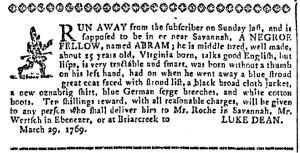
“RUN AWAY … A NEGRO FELLOW, named ABRAM.”

This advertisement contains the description of a runaway slave named Abram, including what he was wearing and distinguishing marks, and a reward for returning him. In running away, Abram participated in an his own act of resistance during a time of growing tensions between the British and the colonists. Unsurprisingly, many slaves were always looking for ways to become free. Noticing this sentiment, the governor of Virginia issued Lord Dunmore’s Proclamation on November 7, 1775. This proclamation offered freedom to slaves that belonged to people that were supporting or taking part in the war against the British, so long as they took up arms with the British against their masters. Many slaves took up this offer; according to Maya Jasanoff in Liberty’s Exiles: American Loyalists in the Revolutionary World, approximately 20,000 slaves joined up with the British. As for the Americans, many people who owned slaves had reservations against arming those that they had held in bondage. Jasanoff says only around 5,000 slaves fought for the colonists.[1] According to Ray Raphael, “Some who fought for the patriots were sent back into slavery at war’s end. … Patriot leaders in the South offered enslaved people as bounties to entice white recruits.”[2] It is not hard to see that slaves may have thought that their best shot at freedom would have been with the British instead of the colonists, who were not above using them as currency to entice more people to join their cause.

**********

ADDITIONAL COMMENTARY: Carl Robert Keyes

At a glance, the pages of the Georgia Gazette may appear rather static to modern eyes. Like most other colonial printers, James Johnston filled his newspaper with dense text and very few visual images. Yet careful attention to the issues published in early 1769 reveals variations in organization and typography that suggest Johnston and others who worked in his printing office experimented with how they presented the news and other content in the Georgia Gazette.

The March 29, 1769, edition, for instance, included another advertisement with the advertiser’s name in large gothic font, replicating an innovative visual element adopted by other advertisers in recent weeks. This time, John Johnston called on prospective customers to purchase bread.

Johnston also distributed advertisements throughout the entire issue, an organizational strategy repeated from other recent issues. Paid notices, along with the usual colophon, filled both columns of the last page. Every other page featured at least one advertisement. Two appeared at the bottom of the second column on the first page. Another, Johnston’s advertisement, ran at the top of the second column on the second page. Perhaps those on the first page served, in part, as filler to complete the column. Even so, Johnston made a choice not to continue with news coverage. The first item on the next page, news from Corsica, would have fit in the remaining space on the first page if Johnston had wished to continue with news rather than switch to advertising. Similarly, it would be difficult to argue that Johnston’s advertisement on the second page appeared there solely to neatly complete a column. Its position at the top of the column forced Johnston to continue the last item on the page, a moral tale, on the following page.

The advertisement about Abram making his escape ran in the first column on the third page, immediately following the conclusion of the moral tale. News from Savannah, including the usual lists from the customs house, appeared below it. Advertisements completed the column and the rest of the page. On the third page, Johnston switched between paid notices and other content multiple times rather than grouping all of the advertisements together. Readers holding open the newspaper to peruse the second and third pages encountered a hodgepodge of content, with advertisements in three of the four columns.

Some colonial printers chose to reserve advertising for the final pages of their newspapers, inserting paid notices only after all other content appeared. That was often Johnston’s strategy when he had only enough advertising to fill the last page. On occasions that he had more than would fit on the final page, however, he experimented with interspersing advertisements among news and other content throughout the rest of the issue. This strategy likely increased the chances readers noticed some of those advertisements since they were not consigned to space reserved solely for paid notices. Anyone seeking just the news had to make more effort to distinguish among the various types of content in the Georgia Gazette when Johnston spread out the advertisements.

**********

[1] Maya Jasanoff, Liberty’s Exiles: American Loyalists in the Revolutionary World (New York: Penguin, 2011), 361.

[2] Ray Raphael, Founding Myths: Stories that Hide Our Patriotic Past, rev. ed. (New York: New Press, 2014), 216.

March 28

GUEST CURATOR: Sean Duda

What was advertised in a colonial American newspaper 250 years ago today?

Essex Gazette (March 28, 1769).

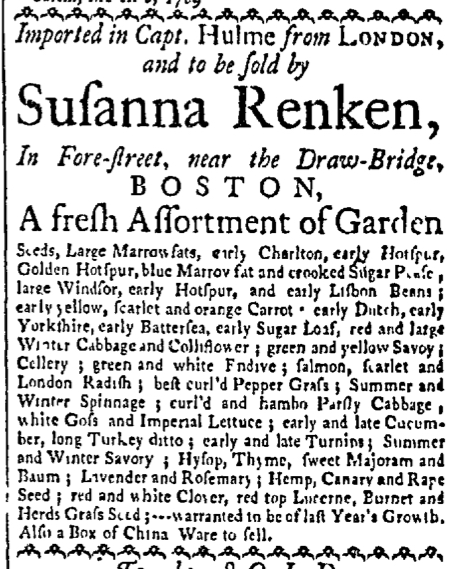
“A fresh Assortment of Garden Seeds.”

In this advertisement for seeds Benjamin Coats mentioned beans, peas, carrots, and many other vegetables. Gardening was a common practice in the colonies, and it was often women who kept the gardens for their families. In As Various as Their Land: The Everyday Lives of Eighteenth-Century Americans, Stephanie Grauman Wolf also uses advertisements about seeds to examine life in eighteenth-century America, including an advertisement from a Boston newspapers in 1748. She states, “The purchase of seeds involved women in a wider world of commerce than we might have supposed, and this involvement included selling extra produce.”[1] Gardening was one of the outlets that women used to interact with the wider world of trade in the eighteenth century. Wolf also notes that certain plants were more popular regionally: “Pease for ‘English pease porridge’ were supplanted by beans for “baked beans” in New England.”[2] She also notes that potatoes and tomatoes were popular in the northern colonies, while sweet potatoes were popular in the southern colonies.

**********

ADDITIONAL COMMENTARY: Carl Robert Keyes

When readers of the Essex Gazette finished perusing Benjamin Coats’s advertisement for a “fresh Assortment of Garden Seeds” they almost immediately encountered the same inventory listed in Susanna Renken’s advertisement, published in the same column just two advertisements below. Coats and Renken did not merely offer similar wares. The copy of their advertisements was identical, with the exception of their names, the locations of their shops, and a short addendum to Renken’s advertisement that announced she “Also [had] a Box of China Ware to sell.” Coats sold his seeds locally, “Near the School-House in SALEM,” but Renken attempted to enlarge her share of the market for seeds she sold “In Fore-street, near the Draw-Bridge, BOSTON.” The lists of seeds Coats and Renken offered for sale were identical, both in content and order. Purveyors of goods often began their advertisements by acknowledging the origins, often deploying formulaic language that included the names of the vessel and captain that had transported the goods to the local port. In this case, Coats and Renken used exactly the same language: “Imported in Capt. Hulme from LONDON, and to be sold by …”

Essex Gazette (March 28, 1769).

How did two advertisers end up publishing virtually identical copy? Examining the publication history of the advertisements provides some clues. Both advertisements first appeared in the Essex Gazette on March 14, 1769, and ran again on March 21 and 28. Prior to that, Renken’s advertisement ran in three Boston newspapers. It first appeared in the Boston Evening-Post and the Boston-Gazette on February 27, without the note about “China Ware,” and then continued weekly in each of those newspapers (March 6, 13, 20, and 27). It did not run in the Boston Post-Boy (published concurrently with Green and Russell’s Massachusetts Gazette) until March 6, a week after it first appeared in the other newspapers, but after that it also ran every week for the rest of the month. That one included the note about “China Ware,” suggesting that Renken may have clipped it from that newspaper and submitted it to the Essex Gazette with instructions to publish it without alteration.

Renken’s advertisement ran in newspapers printed in Boston and distributed far beyond that city eight times before she and Coats published nearly identical advertisements in the Essex Gazette. Coats certainly had plenty of opportunities to see the advertisement and either clip it or copy it to transform into an advertisement intended for his local newspaper. This would have been a particularly efficient means of generating copy if Renken had been his supplier, especially if he did not realize that she planned to expand her marketing campaign beyond Boston’s newspapers. Alternately, if both Coats and Renken dealt with the same commercial seed suppliers from England, they could have both copied from letters or printed lists provided by correspondents on the other side of the Atlantic. That does not explain, however, the time that elapsed between Renken’s first advertisement in Boston and Coats’s advertisement in the Essex Gazette two weeks later.

For the past several years Renken had aggressively advertised garden seeds in Boston’s newspapers in the spring. The Essex Gazette commenced publication in August 1768, making the spring of 1769 the first time that Renken could also advertise in that newspaper. Perhaps she initially overlooked it as a new option. If she did sell seeds wholesale to Coats for resale in Salem, that might have prompted her to think about better addressing the market for her merchandise in the nearby town. In that case, Coats probably would not have been pleased to see her advertisement appear simultaneously with his in his local newspaper, but he did have the advantage of proximity to prospective customers in Salem. Neither of them apparently felt so concerned about the similarities between their advertisements that they found it necessary to submit revisions for further insertions. Cooperation and competition between Coats and Renken seemed to exist side by side as their advertisements appeared one above the other.

**********

[1] Stephanie Grauman Wolf, As Various as Their Land: The Everyday Lives of Eighteenth-Century Americans (New York: harper Perennial, 1994), 90.

[2] Wolf, As Various as Their Land, 89.

March 27

GUEST CURATOR: Sean Duda

What was advertised in a colonial American newspaper 250 years ago today?

Massachusetts Gazette [Green and Russell] (March 27, 1769).
“TO BE SOLD BY Jolley Allen.”

Jolley Allen, a merchant from London, had been selling goods in Boston since 1755. In this advertisement he listed many things, from clothes to china to tea. I am interested in the man selling those goods. Allen was a known Loyalist. He had remained in Boston under the British occupation in 1775 and 1776. He planned to leave with his family on a private ship named Sally whose captain was Robert Campbell when the British and all of the other Loyalists planned to evacuate in March 1776. The Allens planned to leave on March 14, 1776. They boarded the ship for their voyage, planning to follow the British vessels to Nova Scotia. According to the New England Historical Society, on March 17 “it became clear just how inept Robert Campbell was. Over the next 24 hours, Campbell managed to collide with two other fleeing British ships, nearly capsize Sally and finally run it aground while the British ships sailed away for Nova Scotia.” The crew then anchored the ship near Provincetown, which was not under British control. Allen then lost all of his possessions to the residents of Provincetown. He later went back to his old home in Boston and found that his barber had taken up residence in his house. For a short time Allen rented a room in his former home. He eventually escaped to London in Febraury 1777, where he published “Account of the Sufferings and Losses of Jolley Allen, a Native of London” in hopes of being compensated for his losses during the American Revolution.

**********

ADDITIONAL COMMENTARY: Carl Robert Keyes

Almost without fail, Jolley Allen placed distinctive advertisements in Boston’s newspapers in the late 1760s. They were not distinctive so much for their contents. After all, Allen listed the same sorts of items stocked by shopkeepers throughout the city and throughout the colonies. Instead, his attention to graphic design made Allen’s advertisements distinctive. In most cases advertisers submitted copy to the printing office and compositors assumed responsibility for the format of newspaper advertisements. However, the consistency of graphic design elements in Allen’s advertisements across multiple newspapers, whether borders enclosing his lists of goods or ornamental type flanking his name in the headline, demonstrate that Allen negotiated with printers and compositors to have specific visual elements included in his advertisements. That made his advertisement in the March 27, 1769, edition of Green and Russell’s Massachusetts Gazette particularly noteworthy, in addition to its size. Filling two of three columns on the final page, Allen’s advertisement dominated the page.

Such attention to graphic design made Allen’s advertisements easy for prospective customers to recognize. Multiple iterations of his advertisements, especially over extended periods, also suggest that after initially agreeing with the printer and compositor on the format that Allen simply submitted a copy of an earlier advertisement cut from the newspaper, along with revisions marked or attached, when he wished to revive his marketing campaign. His advertisement from March 27, 1769, replicated almost exactly an advertisement that he previously ran nearly nine months earlier in the July 3, 1768, edition of the Boston Weekly News-Letter. The new version included a slightly altered headline, “TO BE SOLD BY Jolley Allen” rather than “Now ready for Sale, at the most reasonable Rate, BY Jolley Allen,” but the shopkeeper’s name still appeared in a much larger sized font than anything else in the newspapers with the exception of the masthead. Decorative ornaments forming diamonds flanked his name. The list of goods he offered for sale was almost exactly the same in terms of both content and order. For the few items missing from the previous version, he likely crossed them off the copy he submitted to the printing office. A limited number of new items appeared at the bottom of the first column and the top of the second, perhaps written in the margins or on a separate sheet by Allen. A final note to “Town and Country Customers” ran across both columns at the bottom, replicating the format of the earlier advertisement. In addition, manicules appeared in all the same places in both advertisements, including three printed upside down at the end of lines rather than at the beginning. This suggests that the compositor faithfully followed the graphic design elements present in the earlier advertisement.

Note the manicules enclosing Allen’s money back guarantee for tea. Massachusetts Gazette [Green and Russell] (March 27, 1769).
Allen likely had to invest some time in working with printers and compositors to achieve the format he desired for his advertisement the first time it ran in any of Boston’s newspapers. That facilitated the process for subsequent insertions since he could simply submit a copy from a previous publication with any revisions marked, trusting the compositor to replicate a design already established.