December 1

What was advertised in a revolutionary American newspaper 250 years ago today?
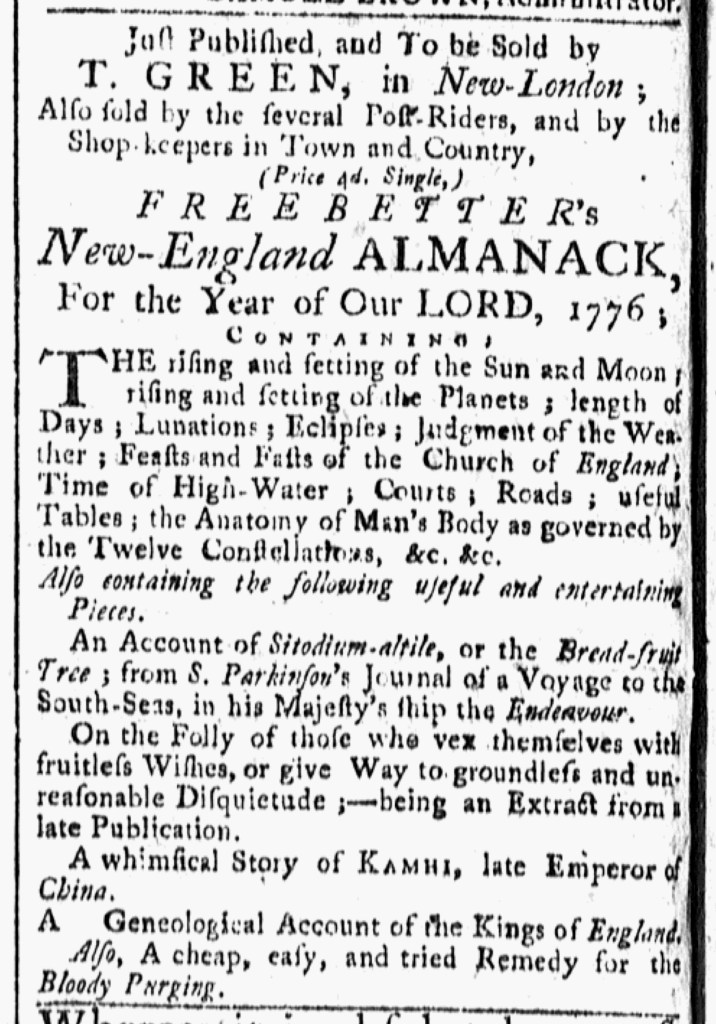
Connecticut Gazette (December 1, 1775).

“Sold by the several Post-Riders, and by the Shop-keepers in Town and Country.”

With only a month until the new year began, Timothy Green, the printer of the Connecticut Gazette, advertised “FREEBETTER’s New-England ALMANACK, For the Year of Our LORD, 1776.”  He emphasized items that usually appeared in almanacs and called attention to special features.  The former included the “rising and setting of the Sun and Moon; rising and setting of the Planets; length of Days; Lunations; Eclipses; Judgment of the Weather; Feasts and Fasts of the Chrich of England; Times of High-Water; Courts; Roads; useful Tables; [and] the Anatomy of Man’s Body as governed by the Twelve Constellations.”  The special features included a “whimsical Story of KAHM, late Emperor of China,” and a “Geneological Account of the Kings of England.”  They also included an “Account of Sitodium-altile, or the Bread-fruit Tree; from S. Parkinson’s Journal of a Voyage to the South-Seas, in his Majesty’s ship the Endeavour” and an essay on “the Folly of those who vex themselves with fruitless Wishes, or give Way to groundless and unreasonable Disquietude; –being an Extract from a late Publication.”  Green may have intended those excerpts as teasers to encourage readers to purchase the original works at his printing office in New London.

To acquire the almanac, however, customers did not have to visit Green or send an order to him.  Instead, he advised that “the several Post-Riders” with routes in the region and “the Shop-keepers in Town and Country” also sold “FREEBETTER’s New-England ALMANACK, For … 1776.”  The printer established a distribution network for the useful reference manual.  Shopkeepers often stocked a variety of almanacs so their customers could choose among popular titles.  Printers sometimes offered discount prices for purchasing multiple copies, usually by the dozen or by the hundred.  That allowed retailers to charge competitive prices to generate revenue with small markups over what they paid.  In this instance, Green did not indicate how much shopkeepers paid for the almanac, only that it sold for “4d. Single” or four pence for one copy.  That constrained shopkeepers when it came to marking up prices.  In addition to shopkeepers, “several Post-Riders” sold the almanac.  That arrangement meant greater convenience for customers and, printers hoped, increased sales and circulation.  In the 1770s, printers in New England began mentioning postriders in their advertisements for almanacs and other printed materials, perhaps acknowledging an existing practice or perhaps establishing a new means of engaging with customers.  The price that Green listed in his advertisement also kept customers aware of reasonable prices charged by post riders.

November 24

What was advertised in a revolutionary American newspaper 250 years ago today?

Thomas’s Massachusetts Spy (November 24, 1775).

“This Almanack contains … a very particular Account of … the Battle of Lexington.”

In the fall of 1775, Isaiah Thomas promoted “The NORTH-AMERICAN’s ALMANACK, For the Year 1776.”  He advertised the handy reference manual in the November 24 edition of his newspaper, Thomas’s Massachusetts Spy, Or, American Oracle of Liberty.  According to the imprint on the title page, the almanac was printed in “MASSACHUSETTS-BAY … by I[SAIAH] THOMAS, in WORCESTER, B[ENJAMIN] EDES,” the printer of the Boston-Gazette, “in WATERTOWN; and S[AMUEL] & E[BENEZER] HALL,” the printers of the New-England Chronicle, “in CAMBRIDGE.”  The advertisement also indicated that each of those printing offices stocked and sold the almanac.

Each of those printers earned reputations for their support of the American cause.  In this instance, their marketing efforts reflected their politics.  The advertisement noted that the almanac included “many interesting and entertaining matters” in addition to “what is necessary and useful,” singling out “a very particular Account of the commencement of Hostilities between Great-Britain and America, and the Battle of Lexington, by the Rev. Wm. Gordon.”  The contents listed on the title page included other items that resonated with current events, including “Description of a Tory and a Whig,” “Directions for preserving the Health of the Soldiers in the Camp,” and “Sir Richard Rum’s advice to the Soldiers, shewing the good effects of Spirituous Liquors when they are used with moderation, and their pernicious effects when they are used to excess, with a cure for Drunkenness.”  Such moral lessons often appeared in almanacs, but it had new significance as the siege of Boston continued.

Thomas and his fellow printers considered the account of the Battle of Lexington “worthy to be preserved by every American,” signaling that their almanac featured more than just “interesting and entertaining matters.”  Readers had a patriotic duty to purchase The North-American’s Almanack and then commemorate the first battle of the Revolutionary War and renew their commitment to defending American liberties each time they consulted the almanac.  The printers sought to disseminate it widely, selling it “by the Thousand, Hundred, Groce, Dozen or single,” intending that retailers purchase in volume for resale.  The price on the title page offered a discount, “6 Coppers Single, and 20 Shillings the Dozen,” and the printers may have negotiated even better deals for those purchasing in even greater quantity.  At the same time that they earned their livelihoods by selling almanacs, they also seized an opportunity to commemorate the Battle of Lexington.  Consumers, they asserted, had a patriotic duty to choose this almanac over any of the alternatives.

October 18

What was advertised in a revolutionary American newspaper 250 years ago today?

Pennsylvania Journal (October 18, 1775).

“An Elegy to the memory of the American Volunteers who fell … April 19, 1775.”

During the era of the American Revolution, advertisements for almanacs frequently appeared in newspapers from New England to Georgia each fall.  Such was the case in the Pennsylvania Journal in 1775.  James Adams, a printer in Delaware, inserted a notice that announced that he “JUST PUBLISHED … The WILMINGTON and PENNSYLVANIA ALMANACKS, For the year of our LORD, 1776.”

Adams followed a familiar format for advertising almanacs.  He indicated that both editions included “the usual astronomical calculations” that readers would find in any almanac as well as a variety of other enticing contents.  The Pennsylvania edition included “Pithy Sayings” for entertainment and “Tables of Interest at six and seven per cent” for reference as well as the “Continuation of William Penn’s Advice to his Children” and the “Conclusion of Wisdom’s Call to the young of both sexes.”  Adams published a portion of those pieces in the almanac for the previous year, anticipating that readers would purchase the subsequent edition for access to the essays in their entirety.  The almanac for 1776 also suggested “Substitutes for Tea,” certainly timely considering that the Continental Association remained in effect. Colonizers sought alternatives while they boycotted imported tea.

Current events played an even more prominent role in the Wilmington Almanack.  It featured an “Elegy to the memory of the American Volunteers, who fell in the engagement between the Massachusetts-Bay Militia and the British Troops, April 19, 1775.”  Six months after the battles at Lexington and Concord, Adams memorialized the minutemen who had died for the American cause during the first battles of the Revolutionary War.  In addition, the almanac featured “The Irishman’s Epistle to the Officers and troops at Boston,” “Liberty-Tree,” and “A droll Dialogue between a fisherman of Poole, in England, and a countryman, relative to the trade of America, and proposed victory over the Americans.”  Adams did not elaborate on those items, perhaps intentionally.  Presenting the titles of the pieces without further elaboration was standard practice in advertisements for almanacs, but in this case the printer may have intended to stoke curiosity that would lead to more sales.  For both almanacs, a concern for current events and a burst of patriotism influenced the contents and their marketing.

September 28

What was advertised in a revolutionary American newspaper 250 years ago today?

New-York Journal (September 28, 1775).

“The Words of Command used in the Manual Exercise, and an accurate Plan of Boston.”

Almost simultaneously with Hugh Gaine announcing in the New-York Gazette and Weekly Mercury that he had “Just PUBLISHED … HUTCHIN’s Improv’d; BEING AN ALMANACK … For the Year of our LORD 1776,” Frederick Shober and Samuel Loudon inserted an advertisement in the New-York Journal to alert the public that they had “Just published … The NEW-YORK and COUNTRY ALMANACK, For the Year of our Lord 1776.”  It included “all the necessary Articles usual in an Almanac, with the Addition of many curious Anecdotes, Receipts [or Recipes], [and] poetical Pieces.”  Unlike Gaine, Shober and Loudon did not provide an extensive list of the contents.  As printer of the New-York Gazette and Weekly Mercury, Gaine had access to as much space as he wished to devote to promoting an almanac he published.  Shober and Loudon, on the other hand, paid to run their advertisement in the New-York Journal.

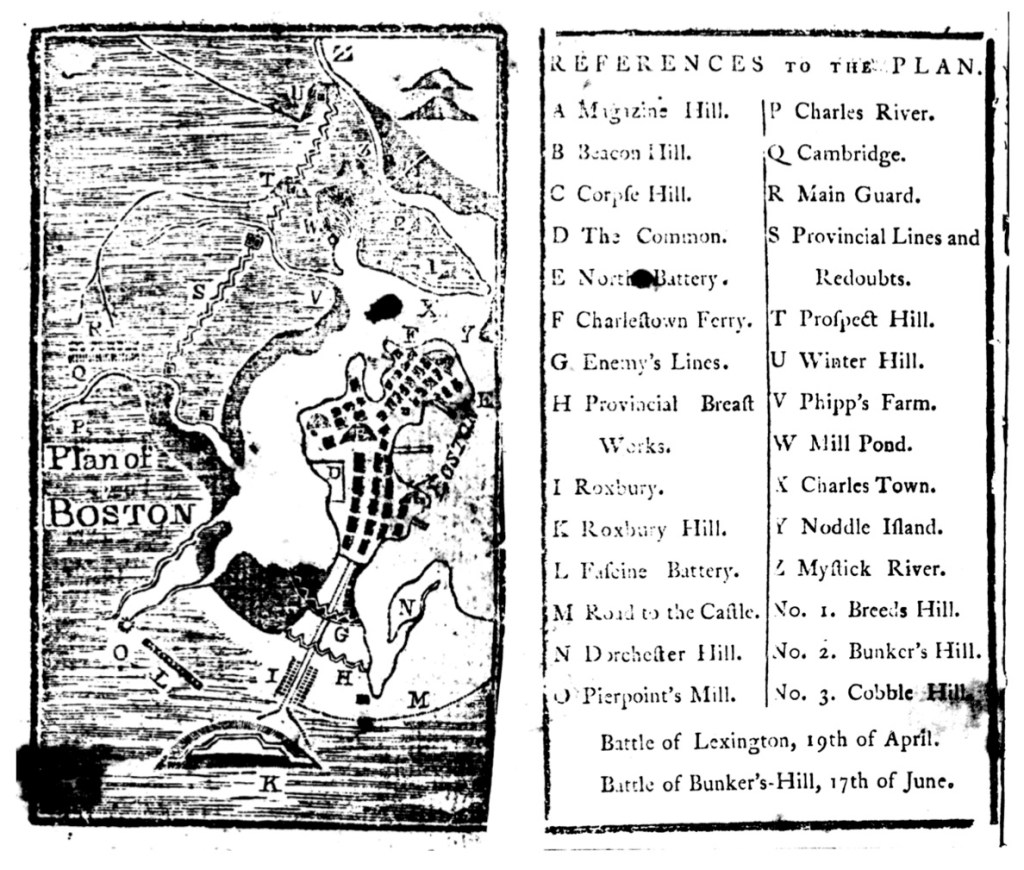
The partners did, however, specify two items that they wanted prospective customers to know they would find in the New-York and Country Almanack: “the Words of Command used in the Manual Exercise, and an accurate Plan of Boston with the different Situations of the Provincials, and the Ministerial Armies.”  Both reflected current events.  The “REFERENCES TO THE PLAN” (or legend for the map of Boston) in the almanac highlighted the “Battle of Lexington, 19th of April,” and the “Battle of Bunker’s-Hill, 17th of June.”  For readers beyond Massachusetts who did not directly experience those battles, that helped solidify in their minds the dates that they occurred.  By the time that Shober and Loudon took their almanac to press, maps of Boston had circulated widely in the July issue of the Pennsylvania Magazine (and Loudon had been among the booksellers to advertise them).  Nicholas Brooks and Bernard Romans also collaborated on a map that they likely distributed by the end of summer.  Those may have served as models for the “Plan of Boston” that Sober and Loudon commissioned for their almanac.  Gaine also directed attention to the “beautiful Plan of Boston, and the Provincial Camp” in his almanac.  The “whole Process of making SALT PETRE, recommended by the Hon. the Continental Congress” and a “Method of making Gun-Powder” accompanied their map.  In Shober and Loudon’s almanac, the “Words of Command,” taken from the widely published Manual Exercise, supplemented the map.  In both cases, the events of the Revolutionary War inspired the contents of the almanacs and became selling points in marketing them.

“Plan of Boston” [left] and “References to the Plan” [right], in The New-York and Country Almanack for the Year of Our Lord 1776 (New York: Shober and Loudon, 1775). Courtesy American Antiquarian Society.

September 25

What was advertised in a revolutionary American newspaper 250 years ago today?

New-York Gazette and Weekly Mercury (September 25, 1775).

“Illustrated with a beautiful Plan of Boston, and the Provincial Camp.”

When fall arrived, it was time to market almanacs for the coming year.  It was an annual ritual in American newspapers from New England to Georgia.  Hugh Gaine, the printer of the New-York Gazette and Weekly Mercury, began advertising “HUTCHIN’s Improv’d: BEING AN ALMANACK … For the Year of our LORD 1776” on September 18, 1775, and then inserted his extensive notice in subsequent issues.  The almanac’s contents included the usual astronomical data, such as “Length of Days and Nights” as well as a schedule of the courts, a description of roads to other cities and towns, and “useful Tables, chronological Observations and entertaining Remarks.”  Gaine enumerated thirty-one of those items, such as a “Very comical, humorous, and entertaining Adventure of a young LADY that used to walk in her sleep,” an essay on the “evil Consequences of Sloth and Idleness,” and a “Method for destroying Caterpillars on Trees.”

If all of that was not enough to entice customers, Gaine made sure that they knew that the almanac was “Illustrated with a beautiful Plan of Boston, and the Provincial Camp.”  That proclamation led the advertisement, appearing immediately above the title of the almanac.  Gaine then devoted the greatest amount of space to describing the map: “13. A very neat Plan of the Town of Boston, shewing at one View, the Provincial Camp, Boston Neck, Fortification, Commons, Battery, Magazines, Charlestown Ferry, Mill Pond, Fort Hill, Corps Hill, Liberty Tree, Windmill Point, South Battery, Long Wharf, Island Wharf, Hancock’s [Wharf], Charlestown, Bunker’s Hill, Winter Hill, Cobble Hill, Forts, Prospect Hill, Provincial Lines, Lower Fort, Upper [Fort], Main Guard, Cambridge College, Charles River, Pierpont’s Mill, Fascine Battery, Roxbury Hill Lines, General Gage’s Lines, Dorchester Hill and Point, and Mystick River.”  As the siege of Boston continued, Daine realized that colonizers in Boston would be interested in supplementing what they read in newspapers and heard from others with a map that would help them envision and better understand recent events.

What was the source for the map?  According to the catalog description for the almanac by PBA Galleries, Auctioneers and Appraisers, the map, “titled a ‘Plan of Boston,’ details Boston’s Shawmut Peninsula and with a smaller inset of the greater Boston area.  Both maps appear to be based on the ‘New and Correct Plan of the Town of Boston and Provincial Camp,’ which appeared in the Pennsylvania Magazine for July, 1775.”  The image that Aitken marketed to spur magazine sales found its way into another periodical publication.  Another printer used it to generate demand for an item produced on his press.

Gaine also listed “11. The whole Process of making SALT PETRE, recommended by the Hon. The Continental Congress, for the making of which there is a Bounty now given both in this and the neighbouring Provinces” and “12. The Method of making Gun-Powder, which at this Juncture may be carried into Execution in a small Way, by almost every Framer in his own Habitation.”  The auction catalog further clarifies that the almanac contains “the Resolution of Congress, July 28, 1775 on the necessity of making gunpowder in the colonies, signed in print by John Hancock, with a recipe for gunpowder on the reverse of the map.”  More than ever, current events played a part in compiling the contents and then marketing almanacs.

“Plan of Boston,” in Hutchins Improved: Being an Almanack and Ephemeris … For the Year of Our Lord 1776 (New York: Hugh Gaine, 1775). Courtesy PBA Galleries, Auctioneers and Appraisers.

September 13

What was advertised in a revolutionary American newspaper 250 years ago today?

Thomas’s Massachusetts Spy (September 13, 1775).

Furnish him with correct lists of the names of all gentlemen in office, proper for such a publication.”

The September 13, 1775, edition of Thomas’s Massachusetts Spy consisted almost entirely of news selected by the Isaiah Thomas.  It featured only a few advertisements.  Among them, one promoted one of printer’s upcoming projects.  He announced that he “intends publishing as soon as may be, a compleat ALMANACK and REGISTER for the ensuing year.”  The “REGISTER” portion would contain listings of officials, an especially useful resource at the beginning of the Revolutionary War.  Yet there had been so much upheaval in the five months since the battles at Lexington and Concord that Thomas needed assistance with this endeavor.  To that end, he asserted that he “will be much obliged to gentlemen in this and the neighbouring provinces … to furnish him with correct lists of the names of all gentlemen in office, proper for such a publication.”  He hoped that they would do so “with all convenient speed” so he had sufficient time to compile the almanac and register, take the combined volume to press, and market it before the new year.

Yet that was not the only information that Thomas wished to update in this annual publication.  He also requested that correspondents submit “[w]hatever alterations there may have been in the names of persons who keep public houses, since the publication of the Almanack last year.”  Taverns were important gathering places for discussing politics and current events as well as convenient places to deliver letters and newspapers.  Thomas likely desired that information to aid in conducting his own business, not solely for publishing in the almanac and register.  Other Patriot printers in Massachusetts joined Thomas in compiling an accurate list of the proprietors of public houses.  The notice indicated that Benjamin Edes, “Printer and Watertown,” and Samuel Hall and Ebenezer Hall, “Printers in Cambridge,” also collected that information.  Edes printed the Boston-Gazette and Country Journal, having briefly suspended the newspaper and moving out of Boston to Watertown once the fighting began.  The Halls printed the New-England Chronicle.  Until recently, they had published the Essex Gazette in Salem.  They relocated to Cambridge and renamed their newspaper as the newspapers in Boston ceased or suspended publication.  Although Thomas, Edes, and the Halls would eventually compete to sell almanacs, they pursued a common cause in compiling a listing of public houses.

Printers sometimes called on readers to participate in this eighteenth-century version of crowdsourcing.  A year earlier, Nathaniel Mills and John Hicks, printers of the Massachusetts Gazette and Boston Post-Boy, ran a notice to “beg the Favour” of tavernkeepers to submit their names for Bickerstaff’s Boston Almanack, for the Year of Our Redemption 1775.  Not long after that, they made a similar request for “Lists for their REGISTER,” asking “Gentlemen (both in this and the neighbouring Governments) that have been appointed into Office, either Civil, Military or Ecclesiastical” to submit their names for inclusion.  When Thomas issued his request in the fall of 1775, he utilized a familiar practice.

August 24

What was advertised in a revolutionary American newspaper 250 years ago today?

Pennsylvania Evening Post (August 24, 1775).

“A dictionary, explaining the most difficult terms made use of in fortification, gunnery, and the whole compass of the military art.”

It was one of the first mentions of an almanac for 1776 in an American newspaper.  The initial notices usually began appearing sometime in August, scattered here and there in different newspapers, and then more printers advertised almanacs for the coming year during the fall.  The number and frequency of advertisements accelerated each year as printers engaged in fierce competition to market and sell the popular reference manuals.

Benjamin Towne, the printer of the Pennsylvania Evening Post, inserted a notice about an almanac for 1776 in the August 24, 1775, edition of his newspaper, making him one of the first that year.  “In the press, and shortly will be published, by the Printer of this paper,” he announced, “The CONSTITUTIONAL ALMANACK.”  The notice appeared immediately after news from the Second Continental Congress, but without the usual line to separate it from other content.  An advertisement offering a reward for a runaway indenture servant ran below the notice about the almanac, a horizontal line demarcating where one ended and the other began.  Similar lines separated the advertisements on the final page of that edition.  Towne resorted to a tactic sometimes deployed by printers when they promoted their own work, placing his notice ahead of any of the paid advertisements and adopting a format that made it look like a news item.  Even if readers did not peruse all the advertisements, they likely read Towne’s notice about his almanac and then realized that they had reached the end of the news.

The printer’s notice included information that he considered newsworthy.  “As a dictionary, explaining the most difficult terms made use of in fortification, gunnery, and the whole compass of the military art, will be subjoined,” Towne declared, “it is presumed this Almanack will be considered a valuable VADE MECUM at this important juncture.”  Prospective customers would benefit from treating the combined almanac and dictionary as a handbook kept constantly at the ready for consultation as more news about the siege of Boston reached them and especially if the news included accounts of new encounters between British regulars and American soldiers.  Following the battles at Lexington and Concord in April and the Battle of Bunker Hill in June, colonizers did not know when they might need to consult a dictionary of “fortification, gunnery, and the whole compass of the military art” to understand the news they read or heard.  The dictionary that accompanied it certainly distinguished Towne’s almanac from others published in the past.

December 4

What was advertised in a colonial American newspaper 250 years ago this week?

Virginia Gazette [Purdie and Dixon] (December 1, 1774).

“Our Press shall be as free as any in America.”

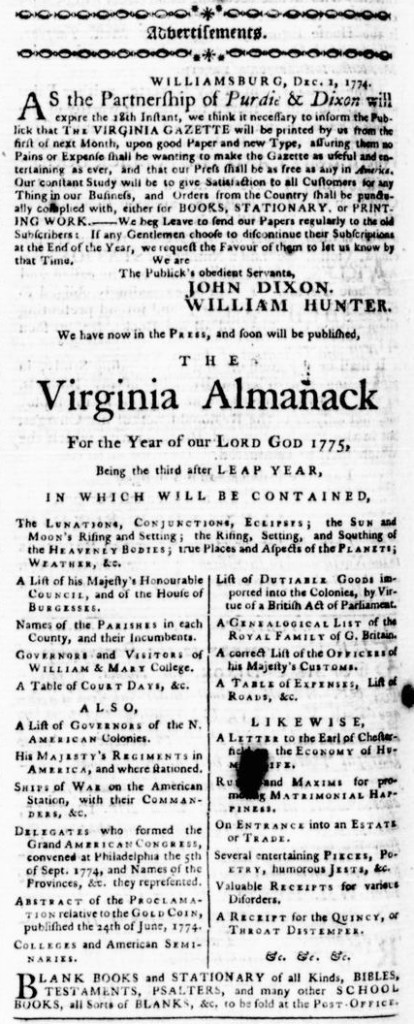
The first page of the December 1, 1774, edition of the Virginia Gazette featured two notices about the future endeavors of the partners who printed that newspaper.  In the first, Alexander Purdie announced his withdrawal from that partnership and outlined his plans to publish another newspaper on his own as soon as he garnered enough subscribers to make it a viable venture.  In the other, John Dixon expressed his appreciation for customers who had supported the partnership and revealed that he would continue to publish the Virginia Gazette with a new partner, William Hunter.

Although those were the only advertisements on the first page, they were not the only advertisements in that issue, nor the end of the notices inserted by the printers.  The remainder of the advertisements appeared after news and essays, commencing in the final column of the second page.  A notice placed by Dixon and Hunter led those advertisements, making clear that the new partnership would actively serve current and prospective customers.  They asserted that their newspaper “will be printed … upon good Paper and new Type.”  Beyond that investment that would benefit readers, Dixon and Hunter pledged that “no Pains or Expense shall be wanting to make this Gazette as useful and entertaining as ever.”  In other words, the newspaper would maintain the same quality that readers expected when the new management went into place.  Furthermore, they proclaimed that “our Press shall be as free as any in America.”  They hoped that would convince customers to continue their patronage, yet did not make assumptions.  “We beg Leave,” they declared, “to send put Papers regularly to the old Subscribers,” but recognized that some might not wish to renew.”  “If any Gentlemen choose to discontinue their Subscriptions at the end of the Year,” they instructed, “we request the Favour of them to let us know by that Time.”  The new partners also promoted other branches of their business, offering “BOOKS, STATIONARY, or PRINTING WORK” to residents of Williamsburg who visited their shop and customers in the country who sent orders.

That, however, did not conclude their advertisement.  Instead, Dixon and Hunter alerted readers that they would soon publish “THE Virginia Almanack For the Year of our LORD GOD 1775.”  The list of contents, intended to entice prospective customers, occupied more space than their announcement about upcoming changes in the partnership.  It contained the usual astronomical data and a selection of informative and “entertaining PIECES” along with several items related to current events.  Those included a list of “DELEGATES who formed the Grand AMERICAN CONGRESS convened at Philadelphia the 5th of Sept, 1774, and Names of the Provinces, &c. they represented,” a “List of DUTIABLE GOODS imported into the Colonies, by Virtue of a British Act of Parliament,” “His MAJESTY’S REGIMENT in AMERICA, and where stationed,” and “SHIPS of WAR on the American Station, with their COMMANDERS.”  The imperial crisis loomed large among the materials selected for inclusion in Dixon and Hunter’s almanac.  Before they began publishing the Virginia Gazette together, they disseminated information about the troubled relationship between the colonies and Britain in an almanac that customers would consult throughout the entire year of 1775.

November 17

What was advertised in a colonial American newspaper 250 years ago today?

Massachusetts Spy (November 17, 1774).

“To the whole is added, The ASSOCIATION of the Grand AMERICAN CONGRESS.”

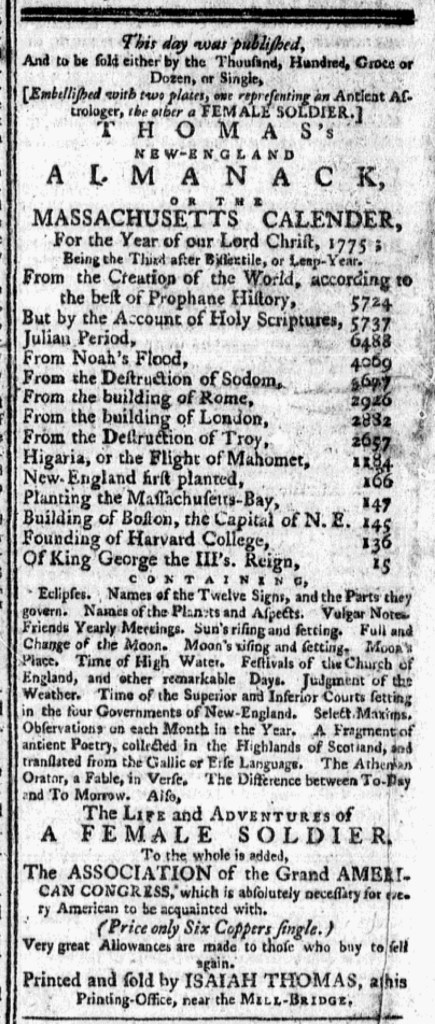
Like many colonial printers, Isaiah Thomas generated significant revenue from publishing almanacs.  From the most affluent to the most humble households in port cities and in the countryside, each year colonizers acquired these handy reference manuals that included all kinds of information.  Thomas’s “NEW-ENGLAND ALMANACK, OR THE MASSACHUSETTS CALENDER, For the Year of our Lord Christ, 1775,” for instance, had everything from the tides or “Time of High Water” to a schedule of “the Superior and Inferior Courts setting in the four Governments of New-England” to poetry.  Thomas “Embellished” the almanac with two images, “one representing an Antient Astrologer, the other a FEMALE SOLDIER.”  The latter corresponded to the “LIFE and ADVENTURES of A FEMALE SOLDIER” that the printer promoted among the content of his almanac.  Practically every almanac included the tides and many listed the dates for important meetings in Connecticut, Massachusetts, New Hampshire, and Rhode Island, so Thomas and other printers sought ways to distinguish their almanacs from others, including images and novel stories.

Thomas anticipated doing brisk business with the contents that he selected for his almanac.  He announced that he sold it “by the Thousand, Hundred, Groce or Dozen, or Single,” offering peddlers, booksellers, and shopkeepers the opportunity to purchase in volume for resale.  A single copy cost “Six Coppers,” yet Thomas promised that “Very great Allowances are made to those who buy to sell again.”  In addition to turning a profit on his almanac, this patriot printer also wanted it disseminated widely because of a particular item that he inserted among the contents.  His almanac included “The ASSOCIATION of the Grand AMERICAN CONGRESS.”  He referred to the Continental Association, a nonimportation agreement recently adopted by the First Continental Congress when it met in Philadelphia in September and October 1774.  The inclusion of the Continental Association distinguished Thomas’s almanac from others advertised in the same issue of the Massachusetts Spy, including “BICKERSTAFF’S BOSTON ALMANACK” published by Nathaniel Mills and John Hicks and “LOW’S ALMANACK” published by John Kneeland.  That newspaper also featured advertisements for two different editions of “EXTRACTS from the Votes and Proceedings of the American Continental CONGRESS,” which included the Continental Association.  Whether or not readers happened to purchase that political pamphlet, Thomas provided easy access to what they needed to know about the nonimportation agreement in an almanac that they would consult for a variety of purposes throughout the coming year.  He asserted that the Continental Association “is absolutely necessary for every American to be acquainted with” … and since so many colonizers already planned to purchase an almanac for 1775 they might as well become acquainted with the Continental Association by purchasing Thomas’s almanac, the one that he sought to distribute “by the Thousand, Hundred, Groce or Dozen” to get into as many households as possible.

October 24

What was advertised in a colonial American newspaper 250 years ago today?

Boston Evening-Post (October 24, 1774).

This much esteemed Almanack will contain … the FIRST CHARTER granted to the Province of Massachusetts-Bay.”

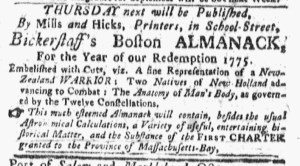
On October 24, 1774, Nathaniel Mills and John Hicks, the printers of the Massachusetts Gazette and Boston Post-Boy, took to the pages of their own newspaper as well as the Boston Evening-Post to announce that they would publish “Bickerstaff’s Boston ALMANACK, For the Year of our Redemption 1775” later in the week.  A few weeks earlier, “Isaac Bickerstaff” ran a notice promoting the almanac and requesting that proprietors of “new Houses of Entertainment” submit their names to the printing office “immediately” for inclusion in the list of taverns in the forthcoming almanac.  Although the imaginary Bickerstaff was the purported author, Benjamin West provided the astronomical calculations and the printers compiled the rest of the contents.

Once Mills and Hicks were tavernkeepers a few weeks to submit updates before they moved forward with printing the almanac.  As they prepared for publication, they promoted the images that accompanied the pamphlet.  Three woodcuts “Embellished” it: “A fine Representation of a New-Zealand WARRIOR: Two Natives of New Holland advancing to Combat: [and] The Anatomy of Man’s Body, as governed by the Twelve Constellations.”  The anatomy was a standard image incorporated into many almanacs, while the depictions of indigenous warriors from Australia (known at the time as New Holland) and New Zealand reflected the fascination with James Cook’s voyage aboard the Endeavour from 1768 through 1771.  Accounts of that mission to the Pacific Ocean to observe the transit of Venus across the sun in 1769 had been advertised widely in American newspapers in recent years.  Whether or not they purchased books that documented Cook’s endeavor, readers were likely familiar with it from newspaper accounts and conversation.

Yet Mills and Hicks did not focus solely on images depicting people in faraway places to market their almanac.  They also referenced current events and local politics.  “This much esteemed Almanack,” the printers declared, “will contain … a Variety of useful, entertaining historical Matter, and the Substance of the FIRST CHARTER granted to the Province of Massachusetts-Bay.”  That charter, granted by Charles I in 1669, had particular importance in the fall of 1774 because Parliament recently revoked the more recent charter, granted by William and Mary in 1691, via the Massachusetts Government Act, one of the Coercive Acts passed in retaliation for the Boston Tea Party.  That legislation gave more authority to a governor appointed by the king, significantly reducing the role that colonizers formerly played in governing themselves under both charters.  In publishing the “FIRST CHARTER” and disseminating it widely in a pamphlet that readers would consult throughout the coming year, Mills and Hicks gave colonizers ready access to an important historical document and provided a ready reminder of the ideals of government that had been long practiced in the colony and recently overturned by a spiteful Parliament.  The printers practiced politics in choosing to include the charter among the contents of the almanac.