January 16

What was advertised in a revolutionary American newspaper 250 years ago today?
Henrich Millers Pennsylvanischer Staatsbote (January 16, 1776).

“COMMON SENSE; ADDRESSED TO THE INHABITANTS OF AMERICA.”

On January 16, 1776, Robert Bell’s advertisement for the first edition of Thomas Paine’s Comon Sense made its third appearance in the Pennsylvania Evening Post.  That newspaper, the only triweekly published in Philadelphia at the time, was the first to carry Bell’s advertisement.  It ran on January 9, 13, and 16, but not on January 11.  During that week, Bell also inserted an advertisement for Common Sense in each of the other five newspapers printed in Philadelphia at the time. On January 16, Henrich Millers Pennsylvanische Staatsbote was the last to feature it, the only advertisement in that newspaper printed in English rather than German.  Bell, already known for his savvy marketing, made sure that German settlers who could read English saw the political pamphlet advertised in the newspaper they were most likely to consult.

By that time, many of them may have already heard about the incendiary Common Sense, the way it mocked monarchy, and the arguments it made in favor of the colonies declaring independence.  Throughout most of the imperial crisis, colonizers blamed Parliament for perpetrating various abuses.  They sought redress for their grievances from the king. Over time, however, many identified George III as the author of their misfortune.  The monarch, after all, possessed ultimate responsibility for what occurred in his realm.  The Declaration of Independence listed more than two dozen grievances, assigning them all to the king rather than Parliament.  The publication of Common Sense in January 1776 played a significant role in shifting attitudes about the role the king played in the imperial crisis and the war that began with the skirmishes at Lexington and Concord in April 1775.

Among the observations and arguments that Paine advanced, he stated that “in America THE LAW IS KING.  For as in absolute governments, the King is law, so in free countries the law ought to be King and there ought to be no other.”  It was an ideal embraced by the founding generation … and it is an ideal under threat today as the nation commemorates 250 years since the Revolutionary War and the Declaration of Independence.  Citizens and the legislators who represent them must hold those who seek to be absolute rulers accountable to the rule of law so the republic remains a place where “THE LAW IS KING.”

January 13

What was advertised in a revolutionary American newspaper 250 years ago today?

Pennsylvania Ledger (January 13, 1776).

“COMMON SENSE; ADDRESSED TO THE INHABITANTS OF AMERICA.”

Robert Bell, one of the most prominent printers and booksellers in America, already had experience with extensive advertising campaigns by the time he published and marketed Thomas Paine’s Common Sense in January 1776.  Within a week, Bell inserted advertisements for what would become the most influential political pamphlet of the era of the American Revolution in all six newspapers printed in Philadelphia.

He started with the Pennsylvania Evening Post on January 9, then placed nearly identical advertisements in the Pennsylvania Gazette and the Pennsylvania Journal on January 10.  On January 13, the advertisement ran in the Pennsylvania Ledger (and once again in the Pennsylvania Evening Post, the city’s only triweekly rather than weekly newspaper).  Bell also ran the advertisement in Dunlap’s Pennsylvania Packet on January 15.  His notice had a privileged place in Pennsylvania Ledger (the first item in the first column on the first page) and Dunlap’s Pennsylvania Packet (the first advertisement following the news).

Even the Henrich Millers Pennsylvanischer Staaatsbote carried the advertisement on January 16, one week after Bell’s first advertisement appeared in the Pennsylvania Evening Post.  It was the only advertisement in English, even though the newspaper’s masthead advised that “All ADVERTISEMENTS to be inserted in this Paper, or printed single by HENRY MILLER, Publisher hereof, are by him translated gratis.”  Perhaps, since the pamphlet had not yet been translated into German, Bell instructed Miller to publish the advertisement in English to entice bilingual German colonizers.  Later in 1776, Melchior Steiner and Carl Cist, who had recently advertised that they printed in English, German, and other languages, published a German translation, Gesunde Vernunft.

The arguments and ideas that Paine presented in Common Sense caused a popular uproar.  Steiner and Cist’s German translation was only one of many local editions; printers in other cities and towns, especially in New York and New England, produced and advertised their own editions of the pamphlet.  Yet neither Paine nor Bell knew in advance that Common Sense would have such a reception.  It was not long before the author and the publisher had a falling out, causing Paine to work with William Bradford and Thomas Bradford, the printers of the Pennsylvania Journal, on the second edition.  Before that, however, Bell applied his long experience advertising books to promoting Common Sense in the public prints when he published the first edition.

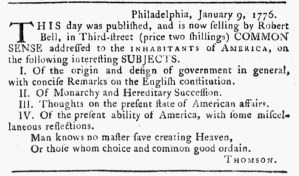
January 9

What was advertised in a revolutionary American newspaper 250 years ago today?

Pennsylvania Evening Post (January 9, 1776).

“THIS day was published … COMMON SENSE addressed to the INHABITANTS of AMERICA.”

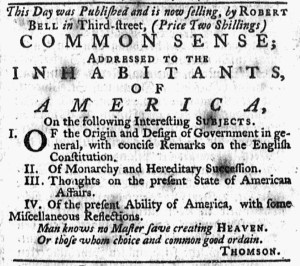
On January 9, 1776, the first advertisement for Thomas Paine’s Common Sense appeared in an American newspaper.  The notice did not include Paine’s name.  Instead, it stated that Robert Bell, the prominent printer and bookseller, “published, and is now selling … COMMON SENSE addressed to the INHABITANTS of AMERICA, on the following subjects.”  The advertisement then listed the headings for the several sections in the first edition: “I. Of the origin and design of government in general, with concise Remarks on the English constitution.  II. Of Monarchy and Hereditary Succession.  III. Thoughts on the present state of American affairs.  IV. Of the present ability of America, with some miscellaneous reflections.”

Over the next several months, printers in many towns would publish and advertise local editions of Common Sense, making it the most widely disseminated political pamphlet during the era of the American Revolution (though, as Trish Loughran convincingly demonstrates, the number of copies has been wildly exaggerated).[1]  Historians also consider Common Sense the most persuasive pamphlet that advocated for the American cause.  Even though hostilities commenced at Lexington and Concord in April 1775, many Americans still hoped that the king would intervene to address their grievances.  The plain language of Common Sense (along with unflattering depictions of monarchy) played a significant role in convincing many colonizers to support independence over a redress of grievances.  Paine made a strong case for “the present ability of America” to establish a new government and trading relationships beyond the British Empire.

There seems to be some confusion about the publication date for Common Sense.  Some sources claim that it was published on January 10, 1776.  I suspect that is because advertisements for the pamphlet first appeared in the January 10 editions of the Pennsylvania Gazette, the newspaper Benjamin Franklin formerly operated, and the Pennsylvania Journal, published by Patriot printers William Bradford and Thomas Bradford.  Those advertisements featured almost identical copy (but different choices for the format made by the compositors), including the phrase “THIS DAY IS PUBLISHED” in the Pennsylvania Gazette and “This Day was Published” in the Pennsylvania Journal.  I have previously examined other instances of similar phrases, demonstrating that they did not literally refer to the publication date but instead meant that a book or pamphlet was now available for purchase.  When the advertisement ran in the Pennsylvania Ledger on January 13 and in the Wochentliche Pennsylvanische Staatsbote on January 16, both versions stated, “This Day was Published.”  Eighteenth-century readers knew how to interpret the phrase.  I wonder if some scholars consulted the more famous and the more venerable Pennsylvania Gazette (founded 1728) and Pennsylvania Journal (founded 1742), saw a phrase that suggested the date of the newspaper was indeed the publication date for Common Sense, and overlooked a newspaper that had been in production for a little less than a year when it carried its first advertisement for Common Sense.  (Benjamin Towne distributed the first issue of the Pennsylvania Evening Post on January 24, 1775.)  Bell may have been selling copies of Common Sense before January 9.  The advertisement in the Pennsylvania Evening Post does not definitively demonstrate that the pamphlet was published on January 9, but it does show when marketing for the pamphlet began and that Bell published it no later than January 9, 1776.

**********

[1] Trish Loughran, “Disseminating Common Sense: Thomas Paine and the Problem of the Early National Bestseller,” American Literature 78., no. 1 (March 2006), 1-28.

August 13

What was advertised in a revolutionary American newspaper 250 years ago this week?

“EXTRACTS from the Proceedings of the AMERICAN CONTINENTAL Congress.”

Providence Gazette (August 12, 1775).

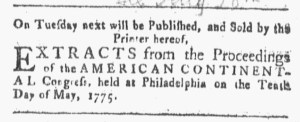
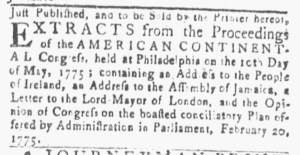
In the first advertisement that readers encountered in the August 12, 1775, edition of the Providence Gazette, John Carter announced “On Tuesday next will be Published, and Sold by the Printer hereof, EXTRACTS from the Proceedings of the AMERICAN CONTINENTAL Congress, held at Philadelphia on the Tenth Day of May, 1775.”  In the next issue, he inserted an updated advertisement confirming that he had indeed published the work and had copies available for sale.  Carter also listed some of the contents to entice prospective customers: “An Address to the People of Ireland, an Address to the Assembly of Jamaica, a Letter to the Lord Mayor of London, and the Opinion of Congress on the boasted conciliatory Plan offered by Administration in Parliament, February 20, 1775.”  Once again, the printer placed his notice first among the advertisements.  That was not merely an attempt to increase sales by drawing more attention to it.  In both instances, Carter treated his advertisement for Extracts from the Proceedings of the American Continental Congress as a bridge between news and advertising.  The book he hawked provided more extensive coverage of the news that he published in his weekly newspaper.

Providence Gazette (August 19, 1775).

Carter was the first printer to advertise extracts from the meeting of the Second Continental Congress.  In the fall of 1774, printers throughout the colonies advertised local editions of a similar volume that documented the First Continental Congress’s meetings in September and October.  William Bradford and Thomas Bradford, the printers of the Pennsylvania Journal, ran an advertisement almost as soon as the meetings adjourned.  Newspaper notices radiated out from Philadelphia as printers in other towns acquired copies and produced local editions for their own customers.  The Bradfords eventually published a Journal of the Proceedings of the Congress.  Only one other printer, Hugh Gaine in New York, produced and advertised a local edition.

In this case, Carter was the first printer to publish and advertise extracts from the Second Continental Congress, doing so in faraway Providence rather than in Philadelphia where the delegates met.  He did so during the brief adjournment that lasted from August 2 through September 13, 1775.  His Extracts, a pamphlet of twenty-two pages, included only the items listed in his second advertisement.  The Bradfords did publish a complete Journal of the Proceedings of the Congress that covered May 10 through August 1, but advertisements for that 239-page volume began appearing in December.  The scope of the project meant that it took the Bradfords some time to accomplish it.  The timing of the advertisements demonstrates that Carter did not merely reprint a set of extracts selected by printers in Philadelphia and then reproduced from town to town as local printing offices received copies.  Instead, he acquired the contents of his Extracts through other means, chose which items to include, and marketed the pamphlet to readers in Rhode Island.

August 8

What was advertised in a revolutionary American newspaper 250 years ago today?

Dunlap’s Maryland Gazette (August 8, 1775).

“A SERMON, PREACHED … the DAY recommended by the Honorable CONTINENTAL CONGRESS for A GENERAL FAST.”

On July 20, 1775, the “DAY recommended by the Honorable CONTINENTAL CONGRESS for A GENERAL FAST Throughout the TWELVE UNITED COLONIES of NORTH-AMERICA,” Thomas Coombe delivered a sermon to “the Congregations of CHIRST CHURCH and ST. PETER’s” in Philadelphia.[1]  Less than three weeks later, John Dunlap advertised a local edition of the sermon “PUBLISHED BY REQUEST” and sold in Baltimore in Dunlap’s Maryland Gazette.  He also printed a Philadelphia edition of the sermon, which apparently sold well enough to convince him to publish a second edition.  Solomon Southwick, printer of the Newport Mercury, produced yet another edition, as did James Magee in Belfast, Ireland.

According to researchers at the William Reese Company, a prominent antiquarian rare book dealer specializing in American, Coombe “was an Anglican minister and Loyalist in Philadelphia, and formerly the Chaplain for the Marquis of Rockingham.”  Both the advertisement and the title page noted the latter credential.  The sermon “calls for restraint amongst the citizenry of Philadelphia in the wake of the opening battles of the American Revolution.”  After the colonies declared independence, Coombe was imprisoned for his political stance, but “allowed to return to England in 1779.”  Publishing and disseminating this sermon, like various other sermons advertised during the summer of 1775, allowed the public greater access to discussions about how to respond to the imperial crisis after hostilities commenced in Massachusetts.  Colonizers read newspapers that carried reports about current events and editorials, examined pamphlets that outlined perspectives drawn from political philosophy ancient and modern, and participated in town meetings and everyday conversations about the deteriorating relationship between the colonies and Britain.  Sermons that circulated in print gave them even greater access to public discourse.  Just as they read news about events they had not witnessed when they perused newspapers, they became members of a congregation or audience when then read sermons printed and sold by early American printers.

Dunlap did something savvy in marketing the Baltimore edition of Coombe’s sermon.  He devoted the entire first page of the August 8, 1775, edition of Dunlap’s Maryland Gazette to the first portion of the sermon.  It spilled over onto the second page, along with a note: “To be Concluded in our next.)”  The printer gave readers a taste of the sermon.  Those who could not wait a week for the next issue or who wanted a copy in a single pamphlet could purchase the sermon at Dunlap’s printing office.  Those who did wait for the August 15 edition of the newspaper were disappointed.  The first page featured a portion of “The SPEECH of EDMUND BURKE, Esq; on moving his Resolutions for Conciliation with the Colonies, March 22, 1775,” along with a familiar note, “[To be Continued.]”  The remainder of Coombe’s sermon did not appear in that issue, nor in the Postscript, additional pages, that supplemented it.  Dunlap did continue Burke’s speech in the August 22 edition, but he neglected to provide the remainder of Coombe’s sermon.  The advertisement for the sermon, however, did appear on August 15 and August 22, enticing readers who wanted to finish what they had started.

**********

[1] Why twelve “UNITED COLONIES” instead of thirteen?  Georgia had not yet sent delegates to the Second Continental Congress.

April 20

What was advertised in colonial American newspaper 250 years ago today?

Norwich Packet (April 20, 1775).

“Ebenezer Punderson … has repeatedly drank Tea … in open Contempt and Defiance of the Continental Association.”

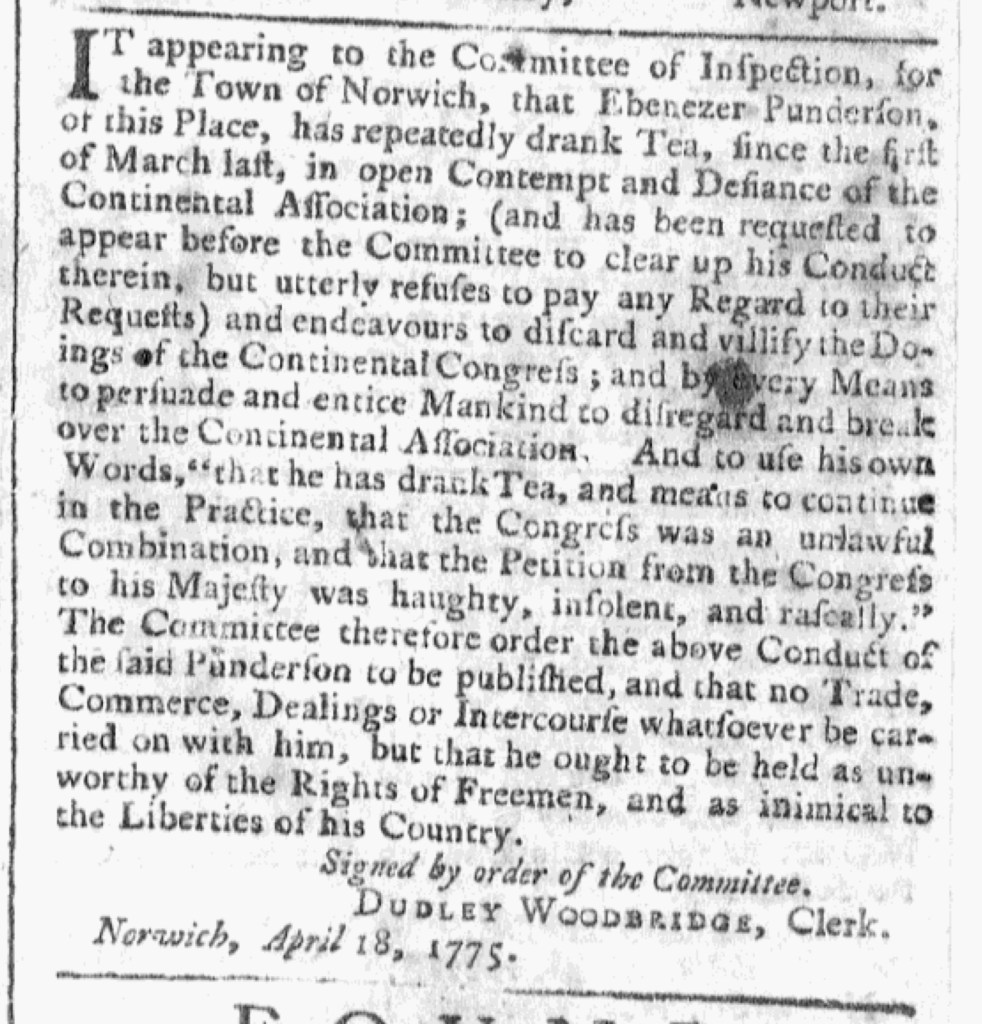
Ebenezer Punderson went too far and now it was time for consequences.  He brazenly and repeatedly violated the Continental Association, the nonimportation and nonconsumption agreement enacted by the Continental Congress in response to the Coercive Acts.  As a result of his actions, the Committee of Inspection in Norwich, Connecticut, placed an advertisement in the April 20, 1775, edition of the Norwich Packet to document his behavior and advise the community to shun Punderson.

The committee reported that Punderson “has repeatedly drank Tea … in open Contempt and Defiance of the Continental Association.”  When the committee sought to investigate the matter, he “utterly refuse[d] to pay any Regard to their Requests” to appear before it.  Even worse, he “endeavours to discard and vilify the Doings of the Continental Congress; and by every Means to persuade and entice Mankind to disregard and break over the Continental Association.”  His refusal to abide by the Continental Association damaged the movement and had the potential to do even more harm by inspiring others to ignore it as well.  In addition, he stridently declared that he had no intention of adhering to the agreement, insulting the Continental Congress in the process:  “to use his own words, ‘that he has drank Tea, and means to continue in that Practice, that the Congress was an unlawful Combination, and that the Petition from the Congress to his Majesty was haughty, insolent, and rascally.’”

The Committee of Inspection, in turn, determined that it was Punderson who was haughty, insolent, and rascally.  It ordered that the “Conduct of the said Punderson be published, and that no Trade, Commerce, Dealings or Intercourse whatsoever be carried on with him.”  Furthermore, the committee declared that “he ought to be held as unworthy of the Rights of Freemen, and as inimical to the Liberties of his Country.”  Punderson acted in opposition to the patriot cause.  The Committee of Inspection intended to see him pay for his transgressions.

Norwich Packet (April 20, 1775).

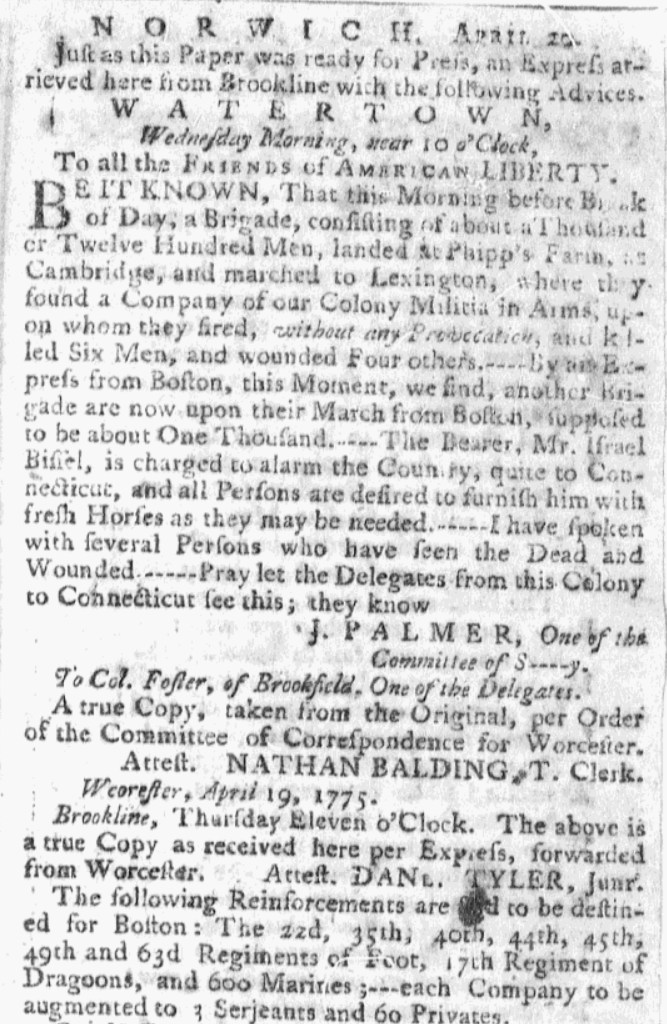
Punderson chose the wrong time to draw attention to himself.  Some of the first coverage of the battle at Lexington to appear in American newspapers ran at the top of the column that featured the advertisement about his offenses.  “Just as this Paper was ready for Press,” the printers declared, “an Express arrived here from Brookline with the following Advices” from J. Palmer, “One of the Committee of S[afet]y,” and dispatched to “Col. Foster, of Brookfield.”  The missive reported that before dawn on the morning of April 19 “a Brigade [of British troops] … marched to Lexington, where they found a Company of our Colony Militia in Arms, upon whom they fired, without any Provocation, and killed Six Men, and wounded Four others.”  Palmer stated that he had “spoken with several Persons who have seen the Dead and Wounded.”  He also relayed news that another Brigade “are now on their March from Boston.”  Israel Bissell carried the message, “charged to alarm the Country” in western Massachusetts all the way to Connecticut.  The printers published this account from a “true Copy, taken from the Original, per Order of the Committee of Correspondence for Worcester.”  The details were sparse, yet the “FRIENDS of AMERICAN LIBERTY” reading the Norwich Packet now knew that fighting had commenced near Boston.  That news quite likely had an impact on their attitude when they read about Punderson’s offenses further down the column.

April 19

What was advertised in a revolutionary American newspaper 250 years ago today?

Pennsylvania Journal (April 19, 1775).

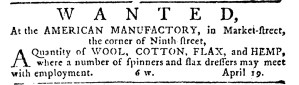
“WANTED, at the AMERICAN MANUFACTORY … A Quantity of WOOL, COTTON, FLAX, and HEMP.”

In the middle of March 1775, supporters of a “FUND for establishing and carrying on an AMERICAN MANUFACTORY, of LINEN, WOOLLEN,” and textiles made of other items met at Carpenters’ Hall in Philadelphia to learn more about the undertaking.  They pledged their support by signing their names to “Subscription Papers” or “general Proposals,” either at the meeting or at the London Coffee House in advance.  The organizers and the “Subscribers” sought to encourage “domestic manufactures” (products made in the colonies) as alternatives to imported goods.  Entrepreneurs had been pursuing that goal for more than a decade during the imperial crisis, though many devoted more effort during the times that colonizers adopted nonimportation agreements as political leverage.  In the spring of 1775, those involved with the “AMERICAN MANUFACTORY” did so as part of the Continental Association.  Its eighth article called for “encourage[ing] Frugality, Economy, and Industry; and promot[ing] Agriculture, Arts, and the Manufacturers of this Country.”

A month later, advertisements concerning the venture simultaneously appeared in the Pennsylvania Gazette and the Pennsylvania Journal on April 19.  “WANTED, At the AMERICAN MANUFACTORY,” the notices advised, “A Quantity of WOOL, COTTON, FLAX, and HEMP.”  Readers could demonstrate their commitment to the cause by supplying the resources necessary to produce textiles in the colony.  The advertisement also noted that “a number of spinners and flax dressers may meet with employment” at the manufactory, contributing to the success of the Continental Association while earning their livelihoods.

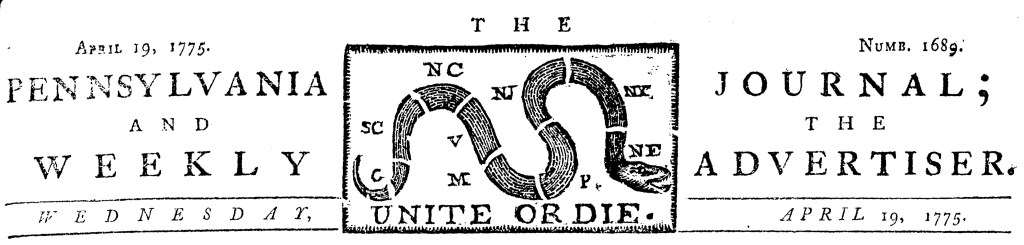
When the printers of the Pennsylvania Gazette and the Pennsylvania Journal distributed the weekly issue of their newspapers on April 19, they were not yet aware of the momentous events that happened at Lexington and Concord in Massachusetts that morning, though it would not take long for word to spread to Philadelphia and throughout the colonies.  Historians have long debated when the American Revolution began, echoing the question that John Adams posed to Thomas Jefferson in 1815: “What do We mean by the Revolution?  The War?  That was no part of the Revolution.  It was only an Effect and Consequence of it.  The Revolution was in the Minds of the People, and this was effected, from 1760 to 1775, in the course of fifteen Years before a drop of blood was drawn at Lexington.”  Establishing the “AMERICAN MANUFACTORY” in Philadelphia before the war, according to Adams, was part of the revolution.  Today, however, the 250th anniversary of the battles at Lexington and Concord offers a convenient moment for commemorating the American Revolution by aligning it with the Revolutionary War that secured independence for a new nation composed of thirteen former colonies.  For readers of the Pennsylvania Journal in 1775, the political cartoon depicting a severed snake with the motto “UNITE OR DIE” had already been spreading its message for many months.  The masthead, the articles and letters, and many of the advertisements had been part of a revolution that was already occurring “in the Minds of the People.”

Pennsylvania Journal (April 19, 1775).

April 17

What was advertised in a colonial American newspaper 250 years ago today?

Boston Evening-Post (April 17, 1775).

“THE Massachusetts Spy … will be published … in the Town and County of Worcester.”

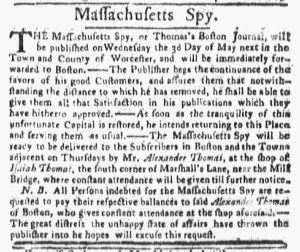
Isaiah Thomas published the last issue of the Massachusetts Spy in Boston on April 6, 1775.  Eleven days later, advertisements in the Boston Evening-Post and the Massachusetts Gazette and Boston Post-Boy informed readers that the “Massachusetts Spy, or Thomas’s Boston Journal, will be published on Wednesday the 3d Day of May next in the Town and County of Worcester, and will be immediately forwarded to Boston.”  Why did Thomas suddenly suspend publishing the Massachusetts Spy, founded in 1770, and relocate to Worcester with plans to revive the newspaper there?

In his History of Printing in America, published in 1810, Thomas declared, “It became at length apparent to all reflecting men that hostilities must soon take place between Great Britain and her American colonies.”  Through the editorial stance he took in the Massachusetts Spy, the patriot printer “had rendered himself very obnoxious to the friends of the British administration; and, in consequence, the tories, and some of the British soldiery in the town, openly threatened him with the effects of their resentment.”  Along with other residents of Boston, Thomas had endured all sorts of “Distresses,” as he called them, following the closure of the harbor in retaliation for the destruction of the tea, but now his own safety was at stake.  “For these and other reasons, he was induced to pack up, privately, a press and types, and to send them in the night over the Charles river to Charlestown, whence they were conveyed to Worcester.”  Thomas was smart with his timing for getting out of Boston: “This was only a few days before the affair at Lexington.”[1]  The printer smuggled a press out of Boston just before the Revolutionary War began with the skirmishes at Lexington and Concord followed by the siege of Boston.

Near the end of February, the Massachusetts Spy carried subscription proposals for a “New Weekly NEWS-PAPER … To be entitled, The WORCESTER GAZETTE.”  Thomas had made arrangements with “a number of gentlemen in the county of Worcester, zealously engaged in the cause of the country … to open a printing house, and to publish a newspaper there, in the course of the ensuing spring.”  It would be the town’s first printing office and first newspaper.  Thomas planned “to send a press, with a suitable person to manage the concerns of it,” having previously gained experience setting up Henry-Walter Tinges as a junior partner who oversaw their printing office in Newburyport and printed the Essex Journal.  “The war commencing sooner than expected,” however, Thomas “was obliged to leave Boston, and came himself to Worcester, opened a printing house, and on the 3d of May, 1775, executed the first printing done in the town.”[2]

As he prepared to open that printing office, his advertisement in newspapers still published in Boston advised the public that the “Publisher [of the Massachusetts Spy] begs the continuance of the favors of his good Customers, and assures then that notwithstanding the distance to which he has removed, he shall be able to give them all that Satisfaction in his publications which they have hitherto approved.”  Furthermore, he planned to return to Boston “[a]s soon as the tranquility of this unfortunate Capital is restored,” not knowing at the time that he would remain in Worcester after the war ended.  For the moment, he designated a local agent, Alexander Thomas, who oversaw his shop in Boston and saw to the delivery of new issues of the Massachusetts Spy on Thursdays, the day after the printer published them in Worcester.  He also requested that “All Persons indebted for the Massachusetts Spy … pay their respective balances.” Like other printers, Thomas extended credit to his customers, but the “great distress [of] the unhappy state of affairs” made it necessary to call on them to make payment.”  Thomas faced a new chapter, one that the Adverts 250 Projectwill chronicle as it examines advertisements placed in revolutionary American newspapers.

**********

[1] Isaiah Thomas, The History of Printing in America: With a Biography of Printers and an Account of Newspapers (1810; New York: Weathervane Press, 1970), 168.

[2] Thomas, History of Printing, 180-181.

December 20

What was advertised in a colonial American newspaper 250 years ago this week?

Massachusetts Spy (December 17, 1772).

“It is requested that those thoughts may be published, at this alarming season.”

In November and December 1772, an author who identified himself as “A BRITISH BOSTONIAN” placed a newspaper advertisement addressed to “the Inhabitants of the Town of BOSTON” in which he proposed publishing “a concise Essay upon the Beauties of LIBERTY in its Political and Sacred branches.”  As a relative newcomer to the city, he considered it “very unpolite [for] a stranger to take this freedom” of publishing “The AMERICAN ALARM, Or, a Confirmation of the Boston Plea, for the Rights and Liberties of the People” without first requesting “the approbational leave of the Gentlemen of Boston.”  The “Gentlemen” of the city could demonstrate their approbation or support for the project by entering their names on the subscription lists kept by printers David Kneeland and Nathaniel Davis.

Although historians and bibliographers formerly attributed American Alarm to Isaac Skillman, the pastor at the Second Baptist Church of Boston, John M. Bumsted and Charles E. Clark convincingly demonstrate that John Allen, “a Baptist minister and a recent émigré from England, politically disenchanted and personally discredited,” penned both American Alarm and An Oration, Upon the Beauties of Liberty, Or the Essential Rights of the Americans.[1]  Kneeland and Davis printed these “small but inflammatory political pamphlets” in 1773, suggesting that the advertisement in the Boston-Gazette and the Massachusetts Spy helped in recruiting subscribers for American Alarm.[2]  Bumsted and Clark describe the Oration as “one of the best-selling pamphlets of the pre-Revolutionary crisis, passing through seven editions in four cities between 1773 and 1775.”[3]

They devote less attention to American Alarm, but do provide essential context for understanding events that would have resonated with newspaper readers and prospective subscribers to the pamphlet when they encountered the advertisement.  Allen wrote American Alarm in response to Governor Thomas Hutchinson’s announcements that the colonial legislature would no longer pay the salaries of the governor and judges.  Instead, those officers would receive their salaries from the Crown, an arrangement that many colonizers believed made the governor and judges beholden to the monarch and, especially, Parliament.  According to the British Bostonian, “The plan is laid, the foundation is fixed, to make them [the governor and judges] dependant for place and payment, upon the arbitrary will, and power of the British ministry; upon that power that has for years been seeking the destruction of your RIGHTS.”[4]

Bumsted and Clark describe Allen as “New England’s Tom Paine,” a counterpart to the author of the political pamphlet, Common Sense, widely considered to have had the most significant impact in convincing colonizers to declare independence.  Bumsted and Clark assert that some colonizers did not need as much pushing in that direction as their leaders.  The arguments made by the British Bostonian and the popularity of American Alarm and, especially, the Oration “suggest that in attitude if not in ideology, a large portion of the population may have been well in advance of its leadership” in 1772 and 1773.[5]  Those colonizers expressed their politics by buying the pamphlets and imbibing their contents.  Though he may have exaggerated how much support and encouragement he initially received, Allen asserted that after he delivered “my thoughts in public, upon the Beauties of LIBERTY” that listeners “requested that those thoughts may be published, at this alarming season.”

**********

[1] John M. Bumsted and Charles E. Clark, “New-England’s Tom Paine:  John Allen and the Spirit of Liberty,” William and Mary Quarterly, 3rd ser., 21, no. 4 (October 1964): 562.

[2] Bumsted and Clark, “New-England’s Tom Paine,” 561.

[3] Bumsted and Clark, “New-England’s Tom Paine,” 561.

[4] British Bostonian [John Allen], The American Alarm, or the Bostonian Plea, for the Rights, and Liberties of the People (Boston:  D. Kneeland and N. Davis, 1773), 17.

[5] Bumsted and Clark, “New-England’s Tom Paine,” 570.

February 24

What was advertised in a colonial American newspaper 250 years ago this week?

New-York Journal (February 21, 1771).

“Celebrating the Repeal of the oppressive Stamp-Act.”

Just as Americans participated in the commodification of events associated with the American Revolution several years before the skirmishes at Concord and Lexington, they also staged commemorations of those events long before declaring independence.  After the repeal of the Stamp Act in March 1766, for instance, colonists marked the anniversary the following year and continued to do so.  They celebrated not only the repeal of that odious measure but also the successful organizing and resistance strategies that convinced Parliament to repeal it.  Many among the gentry engaged in legislative resistance, including the House of Burgesses passing the Virginia Resolves and representatives from several colonies signing petitions at the Stamp Act Congress.  Merchants pursued economic resistance, leveraging commercial pressure on their counterparts on the other side of the Atlantic by refusing to import goods while the Stamp Act remained in effect.  Popular protests erupted throughout the colonies, from Halifax, Nova Scotia, to Savannah, Georgia.  In newspapers, circular letters, pamphlets, broadsides, and handbills, the colonial press covered all of these actions.

As the fifth anniversary of the repeal approached, an advertisement addressed to “all the Friends of LIBERTY” appeared in the February 24, 1771, edition of the New-York Journal.  “THIS early Notice is given,” the advertisement proclaimed,” that for celebrating the Repeal of the oppressive Stamp-Act, ample Provision will be made on the 18th March next, at HAMPDEN-HALL, that the Anniversary may be kept, with proper Festivity and Decency.”  Celebrating such anniversaries was important.  Doing so helped to keep colonists vigilant when it came to other abuses.  In the time since the repeal of the Stamp Act, the colonies experienced another round of objectionable taxation in the form of duties on imported goods imposed by the Townshend Acts.  Widespread resistance, including another round of nonimportation agreements, eventually resulted in the repeal of most of those duties, but the tax on tea remained.  In addition, British soldiers were quartered in Boston, a factor that contributed to the Boston Massacre in March 1770.  Newspapers throughout the colonies covered that event and the subsequent trials, many of them also carrying advertisements for pamphlets and prints related to the murders in Boston.  When colonists in New York gathered to commemorate the fifth anniversary of the repeal of the Stamp Act, “so general and important a Cause,” they likely recollected other events that occurred since, each of them as “oppressive” as the Stamp Act.  The anniversary of that first major victory against Parliament provided an opportunity for reflection on other challenges the colonies experienced and continued to face.