January 3

What was advertised in a revolutionary American newspaper 250 years ago today?
Pennsylvania Journal (January 3, 1776).

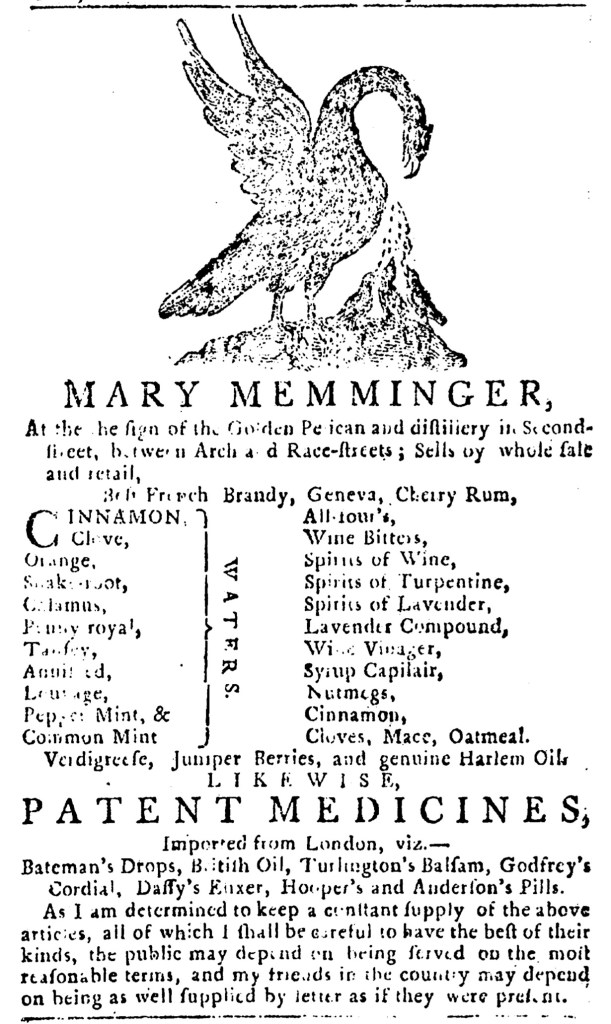
“MARY MEMMINGER, At the sign of the Golden Pelican.”

In the final issue of the Pennsylvania Journal published in 1775 and continuing in January 1776, Mary Memminger advertised the remedies available at her apothecary shop “At the sign of the Golden Pelican” on Second Street in Philadelphia.  Memminger described her shop as a “distillery,” suggesting that she may have produced some of the “WATERS” (including cinnamon, clove, orange, peppermint, and “Common Mint”) and “Spirits of Wine,” “Spirits of Turpentine,” and “Spirits of Lavender.”  She also stocked popular “PATENT MEDICINES, Imported from London,” listing “Bateman’s Drops, British Oil, Turlington’s Balsam, Godfrey’s Cordial, Daffy’s Elixer, [and] Hooper’s and Anderson’s Pills.”  Memminger apparently tended closely to her advertising.  The first time her notice appeared, it featured an error, truncating “Godrey’s Cordial, Daffy’s Elixer” to “Godfrey’s Elixer.”  The compositor fixed the mistake, a rare instance of an updated version of a newspaper advertisement for consumer goods and services after the type had been set.

Memminger did not indicate when she received the patent medicines “Imported from London,” whether they arrived in the colonies before the Continental Association went into effect on December 1, 1774.  Apothecaries and others who sold patent medicines often gave assurances that they were “fresh,” recent arrivals that had not lingered on shelves or in storerooms for months, yet Memminger left it to readers to draw their own conclusions.  She did assert that she was “determined to keep a constant supply of the above articles, all of which I shall be careful to have the best of their kinds,” perhaps indicating a willingness to make exceptions when it came to certain imported items.  Memminger made the health of her clients her priority, promising that “the public may depend on being served on the most reasonable terms, and my friends in the country may depend on being as well supplied by letter as if they were present.”  As a symbol of the care she provided, a woodcut dominated her advertisement (and the entire final page of the January 3, 1776, edition of the Pennsylvania Journal).  As William H. Helfand explains, it depicted “a pelican piercing her breast to nourish her young.”  Perhaps it replicated the “sign of the Golden Pelican” that marked Memminger’s location.  While other apothecaries, like Philip Godfrid Kast and Oliver Smith, deployed images that incorporated mortars and pestles, Memminger declined to include a tool of the trade in favor of emphasizing a symbol of motherly care and sacrifice tending to the welfare of others.

September 7

What was advertised in a revolutionary American newspaper 250 years ago today?

Massachusetts Gazette and Boston Weekly News-Letter (September 7, 1775).

“At the Sign of the Unicorn and Mortar … the best and freshest drugs and medicines.”

An unsigned advertisement in the September 7, 1775, edition of the Massachusetts Gazette and Boston Weekly News-Letter promoted “ALL kinds of the best and freshest drugs and medicines” available “At the Sign of the Unicorn and Mortar in Marlborough Street.”  Silvester Gardiner advertised “Drugs and Medicines, both Chymical and Galenical,” and “Doctor’s Boxes” and “Surgeon’s Chests” for ships that he sold “at the Sign of the Unicorn and Mortar inMarlborough-Street” in the Boston Evening-Post as early as June 18, 1744.  He continued running advertisements that featured both his name and his shop sign for seven years, but by the middle of the 1750s advertisements that directed prospective customers to the Unicorn and Mortar no longer included the name of the proprietor.  Perhaps Gardiner believed that his name had become synonymous with the image that branded his shop.  If so, he may have been the apothecary who placed the advertisement in the fall of 1775.  On the other hand, another entrepreneur may have acquired the shop and the sign at some point and determined that it made good business sense to continue selling medicines at a familiar location marked with a familiar image.

The Unicorn and Mortar was a popular device among apothecaries in colonial America.  Just as Boston had a shop “At the Sign of the Unicorn and Mortar,” so did Hartford, New York, Philadelphia, Providence, and Salem.  The partnership of Gardiner and Jepson sold a “complete Assortment” of medicines “at the Sign of the Unicorn and Mortar, in Queen-Street, HARTFORD,” according to advertisements in the May 5, 1759, edition of the Connecticut Gazette, published in New Haven, and the March 21, 1760, edition of the New-London Summary.  Hartford did not have its own newspaper until 1764, so Gardiner and Jepson resorted to newspapers published in other towns to encourage the public to associate the Unicorn and Mortar with their business.  The experienced Silvester Gardiner may have taken William Jepson as a junior partner to run the shop in Hartford.  A few years later, Jepson, “Surgeon and Apothecary, at the Unicorn and Mortar, in Queen Street, Hartford,” ran advertisements on his own, starting with the December 21, 1767, edition of the Connecticut Courant.  Within a decade, Hezekiah Merrill, “APOTHECARY and BOOKSELLER,” advertised his own shop “at the Sign of the Unicorn and Mortar, a few Rods South of the Court-House in Hartford.”  He ran a full-page advertisement in the December 21, 1773, edition of the Connecticut Courant and many less extensive advertisements in other issues.  When Merrill opened his “New STORE” he did not refer to it as the Unicorn and Mortar.  Perhaps he eventually acquired the sign from Jepson, whose advertisements no longer appeared, and hoped to leverage the familiar image at a new location.  Residents of Hartford recognized the Unicorn and Mortar and associated it with medicines no matter who ran the shop, whether Gardiner and Jepson, Jepson alone, or Merrill.

Apothecaries in other towns also marked their locations with the Unicorn and Mortar.  Patrick Carryl announced that he moved “to the Sign of the Unicorn and Mortar” in the May 23, 1748, edition of the New-York Gazette.  He ran advertisements for more than a decade, always associating his name with his shop sign.  John Prince ran an advertisement in the February 6, 1764, edition of the Boston Post-Boy to announce that “he has lately Opened his Shop at the Sign of the Unicorn and Mortar, near the Town-House in Salem.”  John Sparhawk operated his own apothecary shop “At the Unicorn and Mortar, in Market-Street, near the Coffee-House,” in Philadelphia, according to his advertisement in the December 18, 1766, edition of the Pennsylvania Gazette.  By the time he advertised in the Pennsylvania Chronicle on March 4, 1771, he gave the full name as the “London Book-store, and Unicorn and Mortar.”  In that notice and others, he promoted a “NEAT edition of TISSOT’s Advice to the People respecting their Health” in addition to “Drugs and Medicines of all kinds as usual.”  Building his brand, Sparhawk placed many newspaper advertisements that mentioned the Unicorn and Mortar over the course of several years.  Benjamin Bowen and Benjamin Stelle sold “MEDICINES … at the well-known Apothecary’s Shop … at the Sign of the Unicorn and Mortar,” according to their advertisement in the August 25, 1770, edition of the Providence Gazette.  Apothecaries in other towns likely marked their locations with a sign depicting the Unicorn and Mortar.  It became a familiar emblem that consumers easily recognized by the time that the anonymous advertiser ran a notice in the Massachusetts Gazette and Boston Weekly News-Letter in the fall of 1775.

April 25

What was advertised in a revolutionary American newspaper 250 years ago today?

Essex Gazette (April 25, 1775).

“MEDICINES … at the Sign of the Lion and Mortar.”

Jonathan Waldo placed an advertisement for imported “DRUGS and MEDICINES” available at his shop on King Street in Salem, Massachusetts, in the Essex Gazette on April 11, 1775.  He presumably paid a fee that included setting the type and running the notice in three consecutive issues before discontinuing it, a standard arrangement according to the pricing schemes in the colophons of several early American newspapers.  That meant that his advertisement appeared again on April 18, the eve of the skirmishes at Lexington and Concord that started the Revolutionary War, and finally on April 25.  That issue included coverage of “the Troops of his Britannick Majesty commenc[ing] Hostilities upon the People of this Province.”  Samuel Hall and Ebenezer Hall would print only one more issue of the Essex Gazette in Salem before moving to Cambridge and continuing the newspaper as the New-England Chronicle.  What happened to Waldo during the war?  According to Donna Seger, the apothecary served as a major in the Salem Militia and his business “survived through the Revolution through a dual strategy of continuing to import apparently-contraband British medicine and concocting his own American substitutions.”

Seger describes Waldo as a savvy entrepreneur who diversified his business after the war, noting that “the Revolution seems to have inspired ‘innovation’ and reaped more profits” for the apothecary once he began marketing less expensive American versions of popular British patent medicines.  His advertisement from the spring of 1775 indicates that he also made shrewd decisions before the war began, including setting up shop “at the Sign of the Lion and Mortar, lately improved by Dr. KAST.”  Philip Godrid Kast was a well-known and successful apothecary who had marked his shop with “the Sign of the Lyon and Mortarfor many years.  It almost certainly became a familiar sight for residents of Salem as they traversed the streets of the town and attracted notice from visitors.  Kast even included an image of the sign on an engraved trade card dated to 1774, further associating the “Sign of the Lyon & Mortar” with his business when he distributed it to current and prospective customers.  Waldo apparently took possession of the sign when he moved into the shop previously occupied by Kast.  He could have commissioned a new device to represent his business.  Nathaniel Dabney, for instance, sold medicines “at the Head of HIPPOCRATES, in Salem,” and included an illustration of the bust of the physician from ancient Greece in some of his advertisements.  Yet the “Sign of the Lion and Mortar” was both appropriate for Waldo’s occupation and had a reputation associated with it that he wished to leverage.  Waldo likely hoped to gain some of Kast’s customers when he took over the shop.  Keeping the “Sign of the Lion and Mortar” on display testified to the continuity of service that he provided.

April 1

What was advertised in a colonial American newspaper 250 years ago today?

Pennsylvania Evening Post (April 1, 1775).

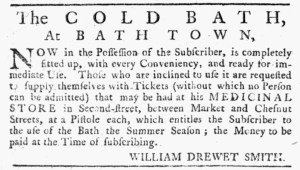
“The COLD BATH, At BATH TOWN.”

William Drewet Smith, a “Chemist and Druggist,” diversified his business interests in the spring of 1775.  He operated a shop “At HIPPOCRATES’s HEAD” on Second Street Philadelphia, selling a “general Assortment of Druggs and patent medicines, surgeons instruments, [and] shop furniture.”  In an advertisement in the March 25 edition of the Pennsylvania Ledger, he promoted one of those patent medicines, “Baron SCHOMBERG’s Grand Prophylactic LIMIMENT” to prevent venereal diseases and treat the symptoms of those who did not practice prevention soon enough.  In that same issue, he inserted a second advertisement, that one hawking “Baron Van Haake’s royal letters pattent composition, for manuring land” to farmers and gardeners.

A week later, Smith ran yet another notice to announce that he was now the proprietor of the “COLD BATH, At BATH TOWN.”  The facility, he reported, “is completely fitted up, with every Conveniency, and ready for immediate Use.”  Those seeking entry needed to buy tickets (“without which no Person can be admitted”).  The apothecary sold them for “a Pistole each” at his “MEDICINAL STORE.”  Those who intended to travel to Bath, about sixty-five miles north of Philadelphia, could obtain their tickets before making the trip.  Rather than a single admission, each ticket entitled the bearer “to the use of the Bath [throughout] the Summer Season,” but they had to pay the entire balance “at the Time of subscribing.”  Smith did not allow guests to avail themselves of the amenities at his spa on credit.

Advertising in both the Pennsylvania Evening Post and the Pennsylvania Ledger, Smith joined the ranks of eighteenth-century entrepreneurs who marketed health tourism in America.  The apothecary probably figured that it made sense to branch out in that direction.  When clients visited his shop in Philadelphia, especially clients of means who had the leisure to travel, he could recommend the rejuvenating waters at the “COLD BATH” and the benefits of being away from the bustling urban port to supplement the medicines that he supplied.  He likely believed that his reputation and experience as a “Chemist and Druggist” made him a trustworthy provider of other health services in the eyes of the public.

March 25

What was advertised in a colonial American newspaper 250 years ago today?

Pennsylvania Ledger (March 25, 1775).

“Certificates of its success shall be speedily inserted in this and the other Papers on the continent.”

William Drewet Smith, “Chemist and Druggist,” ran an apothecary shop “At HIPPOCRATES’s Head, in Second-street” in Philadelphia in the 1770s.  He expected that prospective customers would associate Hippocrates, the ancient Greek physician known as the “Father of Medicine,” with the “general Assortment of Drugs and patent medicines, surgeons instruments, [and] shop furniture” that he sold.  Yet those were not the only items that Smith peddled.

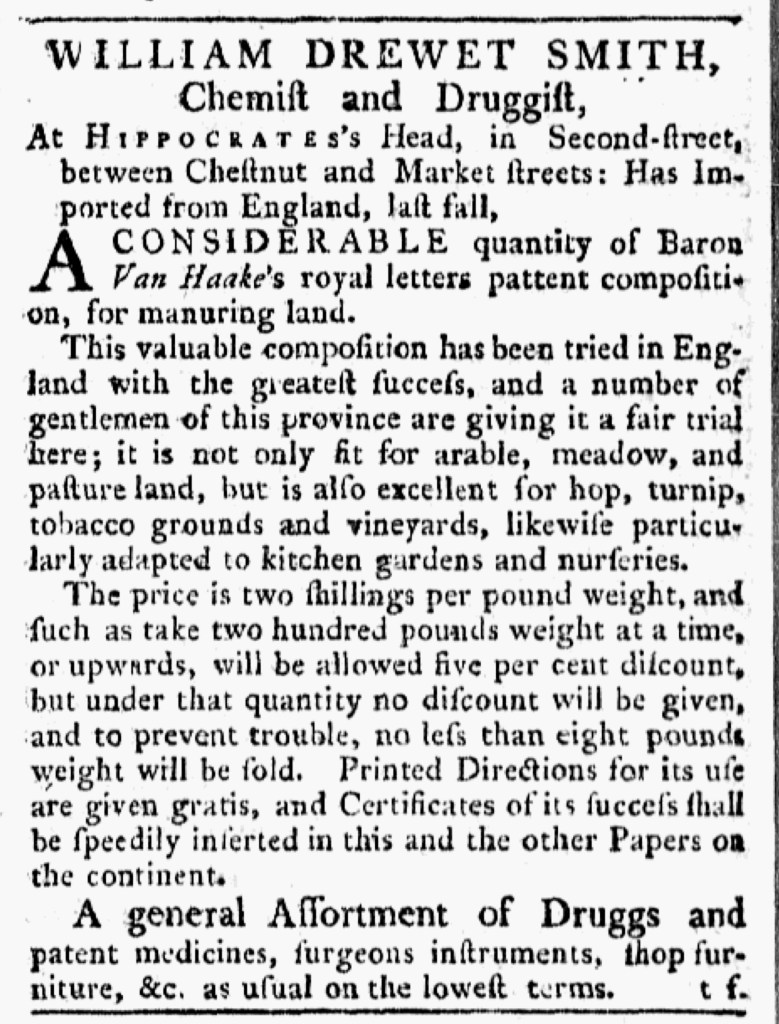
The apothecary ran an advertisement for “Baron Van Haake’s royal letter pattent composition, for manuring land” in the March 25, 1775, edition of the Pennsylvania Ledger.  In addition to medicines for treating the body, the Smith sold this compound for nurturing soil and raising crops.  For those not familiar with its use, the chemist explained that the “valuable composition has been tried in England with the greatest success.”  In addition, “a number of gentlemen of this province are giving it a fair trial here.”  Trials demonstrated that the treatment “is not only fit for arable, meadow, and pasture land, but is also excellent for hop, turnip, tobacco grounds and vineyards” as well as “kitchen gardens and nurseries.”  In other words, any farmer, any gardener, or anybody else who raised crops or plants of any kind needed to try Varon Van Haake’s composition to see for themselves its positive impact on their endeavors.

Smith stated that he included “printed Directions for its use” free with every sale.  He also planned to insert “Certificates of its success” (or testimonials from satisfied customers) “in this and the other Papers on the continent,” suggesting that he was already in possession of such endorsements.  To further entice prospective customers, he offered a “five per cent discount” to customers who “take two hundred pounds weight at a time, or upwards.”  He also mentioned that he imported this product from England “last fall,” signaling to readers that he acquired it before the Continental Association went into effect so they could purchase it with a clear conscience.

Elsewhere in the same issue of the Pennsylvania Ledger, Smith published a lengthy advertisement for “Baron SCHOMBERG’s Grand Prophylactic LINIMENT” that supposedly prevented and cured “most venerial complaints.”  He included a statement from the “ingenious” chemist responsible for the liniment and noted that he provided printed directions “for its particular use.”  When it came to advertising Baron Van Haake’s composition for treating soil, Smith applied marketing strategies already familiar from the patent medicines that he sold.

August 16

What was advertised in a colonial American newspaper 250 years ago today?

Connecticut Courant (August 16, 1774).

“His Abilities in his Profession of Physic, Surgery and Midwifry, he flatters himself, gave Satisfaction.”

Richard Tidmarsh, a physician and apothecary, often did not remain long in the communities he served, though in an advertisement he placed in the Connecticut Courant in August 1774 he suggested that he would settle in Hartford “probably, for Life” if he managed to cultivate a clientele that would allow him to remain there.  In January 1771, he liquidated the contents of his apothecary shop in Philadelphia (and sold an enslaved man).  Tidmarsh relocated to Hartford before arriving in New Haven in May 1773.  A little over a year later, he “returned to Hartford, where his Abilities in his Profession of Physic, Surgery and Midwifry, he flatters himself, gave Satisfaction.”  He felt confident enough in his reputation for the services he rendered to that community that he encouraged the public to recall the time he spent there.  Furthermore, he expected that his “long practical Experience, will render him a useful and acceptable Member of Society.”

Near the beginning of his notice, Tidmarsh promoted an “Assortment of fresh, genuine DRUGS & MEDICINES” that he sold for even lower prices than in the past.  He listed many of them, including popular patent medicines, at the end of his advertisement.  He also noted that he “faithfully prepared” both “Physician’s Prescriptions, and family Recipe’s,” compounding them in his shop formerly occupied by Dr. Jepson on Queen Street.  Yet Tidmarsh did not limit his endeavors to providing medical care and selling medicines.  He devoted a significant portion of his advertisement to proposals for “instruct[ing] young Gentlemen whose Education and Genius seem adapted to Study, modern Theory and practical System of Physic, Surgery and Midwifry.”  Tidmarsh envisioned a thorough education for his students.  Rather than “the customary Time of a few Months” to two years that allowed for “but a very superficial Knowledge of the Materia Medica, and bare Idea of Diseases,” even under the tutelage of “the most accurate and extensive Practitioner.”  The physician and apothecary implied that he would work with his students over longer periods, pledging that “Young Men, desirous of enlarging their Opportunities in the medical Branches” could learn from him “on reasonable Terms.”  Such an education need not be expensive while extending it over several years would help support Tidmarsh in his intention to permanently settle in Hartford.

The enterprising physician and apothecary made yet another appeal to justify public support for his return to Hartford.  “Poor Persons, unable to see a Physician for Advice,” he proclaimed, “may have the Subscriber’s Opinion gratis,” an act of philanthropy designed to enhance his standing in the community and worthy of “encouragement” from clients who could afford to pay for his services.  In addition, Tidmarsh stood to profit from his “Poor” clients who purchased “Medicines adapted for their Disorders” from him.  He did not gouge them on the prices to balance the free consultations, instead preparing prescriptions “as cheap as any Apothecary.”  All in all, Tidmarsh sought to give “the Inhabitants of HARTFORD, and the Public in General” all sorts of reasons to welcome him back to town and support his various enterprises so he could remain there to provide services “of public Utility to Posterity.”

May 1

What was advertised in a colonial American newspaper 250 years ago this week?

Massachusetts Spy (May 28, 1774).

“Medicine Boxes … are put up in the neatest Manner.”

The woodcut that adorned John Joy’s advertisement in the April 28, 1774, edition of the Massachusetts Spy alerted readers to the type of merchandise that the apothecary sold before they even read the copy.  It depicted a lion wearing a crown and working a mortar and pestle atop a column.  The woodcut ran the entire length of the advertisement, as if Joy or the compositor or perhaps the two working together intentionally designed the image and copy to fit together that way.  A sign with a similar image may or may not have marked Joy’s location at “the North-Corner of William’s Court, BOSTON,” but he did not make specific mention of a sign.  Other advertisers who commissioned woodcuts for their newspaper notices often did so when the image matched the device customers saw at their shop.  Whatever the case, the image made Joy’s advertisement much more visible to prospective customers than M.B. Goldthwait’s notice about a “fresh supply of DRUGS and MEDICINES” and “SURGEONS INSTRUMENTS, Of all Kinds.”

Massachusetts Spy (April 28, 1774).

The copy declared that Joy “Has just received from LONDON, A large and compleat Assortment of Drugs and Medicines, Of the best Quality.”  The lion with the crown asserted both those imperial connections and the quality of the remedies that Joy sold.  In addition, he stocked “Surgeons Instruments, of every Kind, finished in the neatest Manner” as well as “a full Assortment of Groceries and Dye Stuffs.”  Not unlike modern retail pharmacies, Joy diversified his enterprise to cultivate multiple revenue streams, including medicines, medical equipment, home health care supplies, and groceries.  To that end, he also prepared “Medicine Boxes of various Prices, for Ships or private Families,” pledging that they “are put up in the neatest Manner.”  Goldthwait also prepared “Doctor’s Boxes … for Masters of Vessels and private Families” and included “every necessary direction” for using the contents.  These first aid kits included both medicine and supplies.  Selling them allowed apothecaries to enhance their revenues since buyers acquired a variety of items that they did not yet need and might never use but purchased against the chance of injury or illness.  After all, it was better to have them on hand than not at all.  Joy also operated a precursor to the mail order pharmacy, alerting “Prac[ti]tioners and others” that they may be supplied with large or small Quantities, by Letter or otherwise [such as sending a servant enslaved messenger], as well as though they were present.”  Joy and other apothecaries frequently promoted such convenience as part of their marketing efforts.  Like the image of the crowned lion working a mortar and pestle, that appeal distinguished Joy’s advertisement from the notice placed by his competitor.

November 3

What was advertised in a colonial American newspaper 250 years ago today?

Pennsylvania Journal (November 3, 1773).

“Dr. Keyser’s Pills … warranted genuine.”

Townsend Speakman and Christopher Carter, “CHYMISTS and DRUGGISTS,” advertised widely in October and November 1773.  They placed advertisements simultaneously in the Pennsylvania Chronicle, the Pennsylvania Gazette, the Pennsylvania Journal, and the Pennsylvania Packet.  Each of those advertisements promoted raisins, figs, and currants as well as “an Assortment of the freshest DRUGS and PATENT MEDICINES.”  They offered the “most saleable Articles in large Quantities” to shopkeepers and others who planned to retail them.  Printers, for instance, often supplemented revenues from other sources by peddling patent medicines.

On November 1, the Pennsylvania Packet ran an abbreviated version of Speakman and Carter’s advertisement.  In notices in the other three newspapers during that week, the apothecaries highlighted a “Parcel of Keyser’s famous Pills, from the Importer in London, with full Directions for their Use.”  They pledged that “the Public may be assured these Pills are the genuine Sort,” and to demonstrate that was indeed the case “they have inserted the Copy of a Certificate received with [the pills], the Original of which may be seen by any Purchaser.”  The copy of that certificate comprised the final third of the advertisement.  In it, James Cowper, “Doctor of Physic,” declared himself “the only legal Proprietor of a Medicine, called KEYSER’S PILLS, in England.”  Furthermore, he certified that Speakman and Carter, “Chymists and Druggists, in Philadelphia, are my only Correspondents to whom I send the above Pills in that Part of the World.”  Consumers did not need to worry about purchasing counterfeit pills if they acquired them from Speakman and Carter.

According to another advertisement in the Pennsylvania Journal, however, customers in Philadelphia had another option for obtaining Keyser’s Pills without worrying about getting duped by unscrupulous sellers.  That advertisement appeared immediately below Speakman and Carter’s advertisement, a rather cheeky placement considering that it listed William Bradford and Thomas Bradford, printers of the Pennsylvania Journal, as local agents who sold the pills.  Speakman and Carter paid the Bradfords to run their advertisement, complete with the certificate, and they may have expected competition but not efforts to outright undermine their marketing strategy.  The advertisement replicated James Rivington’s “Every One their own Physician” notice from Rivington’s New-York Gazetteer, along with a few additions.  In addition to listing the Bradfords as local agents, a letter from Rivington to the Bradfords followed the testimonials.

Just as Speakman and Carter reprinted Cowper’s certificate in its entirety, the Bradfords published Rivington’s entire letter.  He noted that he saw “an advertisement in the Philadelphia Papers, relating to Dr. Keyser’s Pills, importing that they were procured from Dr. Cowper, of London, and warranted genuine.”  Rivington could do one better.  “I think it very proper the Public should be assured,” he trumpeted, “that the Pills, which you have had from me, and now advertize for sale, were imported by me, immediately from Mr. Keyser himself, at Paris.”  In addition, Rivington offered to show Keyser’s “letters and correspondence for some years past … to any person, who may require a sight of them.”  Furthermore, Rivington was also vigilant about counterfeits, reporting that he “detected a counterfeit sort, exposed to sale in New-York, of which Mr. Keyser has sent me a written declaration.”  Rivington concluded by inviting the Bradfords to insert his letter in their newspaper so “the Public may be once more informed you have the Pills sent directly from Mr. Keyser” to New York and then forwarded to Philadelphia.

It was not the first time that printers who sold Keyser’s Pills became embroiled in disputes over who stocked authentic medicines.  In the summer of 1772, printers in South Carolina pursued a feud in their newspapers, sometimes alluding to notices placed by their competitors and sometimes responding to them directly.  Among the many purveyors of Keyser’s Pills, a great many claimed that they carried genuine medicines and possessed some sort of exclusive right to market them in their town.

October 23

What was advertised in a colonial American newspaper 250 years ago today?

Maryland Journal (October 23, 1773).

“APOTHECARY in MARKET-STREET.”

Robert Bass ran an apothecary shop in Philadelphia in the early 1770s.  Along with several other apothecaries, he regularly advertised in the various newspapers published in the Quaker City.  In the fall of 1773, he expanded his marketing efforts to include the Maryland Journal and Baltimore Advertiser.  That newspaper, the first in Baltimore, commenced publication near the end of August.  Previously, residents of that growing port and nearby towns relied on the Maryland Gazette, printed in Annapolis, and newspapers from Philadelphia as their local newspapers.  Merchants, shopkeepers, and artisans in Baltimore sometimes placed advertisements in those publications.  Similarly, advertisers based in Philadelphia, including apothecaries, often mentioned that they served customers in the countryside and promptly filled orders that they received from a distance.  When Bass placed advertisements in the Pennsylvania Chronicle or the Pennsylvania Gazette, for instance, he expected that prospective customers in Baltimore (and many other towns) would see them.

The founding of the Maryland Journal altered the print culture landscape in the region.  The newspapers that previously served Baltimore and its environs continued to circulate there, but residents had more immediate access to a local newspaper.  Hoping to retain his share of the market or perhaps even make gains via advertising in the new publication, Bass quickly decided to place notices in the Maryland Journal.  His advertisement received a privileged place in the October 23 edition.  It appeared as the first item in the first column on the first page, below a masthead for “NEW ADVERTISEMENTS.”  The apothecary advised that he had just acquired “a very large supply of capital DRUGS and PATENT MEDICINES, to serve the fall and winter seasons.”  In addition, he “properly compounded” prescriptions at his shop.  Unfortunately for Bass, he was not the only advertiser who offered such services.  Two columns over, Patrick Kennedy, “Surgeon and Apothecary,” hawked “a large assortment of patent medicines” and declared that he “carefully prepared” prescriptions at his shop in Baltimore.  Readers who lived relatively close to Kennedy’s shop may have preferred to obtain their medicines from him as a matter of convenience, but for prospective customers in the countryside it may not have mattered whether they sent orders to Baltimore or Philadelphia.  Bass even expected that some readers would visit his shop, advising that he gave “constant attendance every day except Sundays.”  Although Baltimore now had its own newspaper, Bass did not consider it a separate local market.  Instead, he attempted to use the new publication to maintain or even expand his share of a regional market.  Whatever the outcome may have been, he considered it worth the investment of placing an advertisement in some of the first issues of the Maryland Journal.

October 5

What was advertised in a colonial American newspaper 250 years ago today?

Connecticut Courant (October 5, 1773).

“At the Sign of the Unicorn & Mortar.”

Hezekiah Merrill ran an apothecary shop in Hartford in the early 1770s.  In October 1773, he placed advertisements in the Connecticut Courant to promote the variety of patent medicines that he sold, including Bateman’s Drops and Cordials, Turlington’s Balsam of Life, and Hooper’s Female Pills.  Each of those remedies would have been as familiar to eighteenth-century readers as popular over-the-counter medications are to modern consumers.  Merrill, like others who sold the same patent medicines, did not believe that they required descriptions when advertising them.  The apothecary also stocked books at his shop.

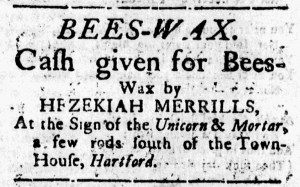
Merrill marked the location of his shop with “the Sign of the Unicorn & Mortar,” an appropriate image for an apothecary, and further advised prospective customers that they could find it “a few rods south of the Town-House.” Residents of Hartford regularly passed the shop and its sign, making it a familiar sight in their daily routines.  For visitors from the countryside, the sign made Merrill’s location unmistakable as they navigated town.  The apothecary encouraged consumers to associate the image of the Unicorn and Mortar with his business, treating it as a logo of sorts.  He inserted two advertisements in the October 5, 1773, edition of the Connecticut Courant, both of them invoking his shop sign.  A longer one on the first page listed the patent medicines and other merchandise, while a shorter one on the third page solicited beeswax in exchange for cash.  Just as residents of Hartford frequently glimpsed the sign, readers of the Connecticut Courant encountered “the Sign of the Unicorn & Mortar” more than once when they perused that issue.

Today, those advertisements testify to some of the sights that colonizers saw as they traversed the streets of colonial Hartford.  According to Thomas Hilldrup’s advertisement in the same issue of the Connecticut Courant, “the sign of the Dial” adorned the shop where he cleaned and repaired watches near the court house.  Other purveyors of goods and services in Hartford almost certainly displayed signs, contributing to the visual landscape of commercial activity in the town.  Few of those signs survive today, except for the descriptions of them in newspaper advertisements.