March 21

What was advertised in a colonial American newspaper 250 years ago today?

Boston-Gazette (March 21, 1774).

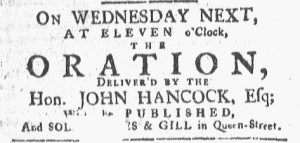
“THE ORATION DELIVER’D BY THE Hon. JOHN HANCOCK, Esq; Will be PUBLISHED.”

Many colonizers commemorated events that were part of the American Revolution before the Revolutionary War began.  For instance, residents of Boston acknowledged the anniversary of the “horrid Massacre on the 5th of March 1770” each year.  That description of the Boston Massacre came from coverage of the fourth anniversary commemorations in the March 7, 1774, edition of the Boston-Gazette.  Benjamin Edes and John Gill, the printers, reported that “the Freeholders and other Inhabitants of this Town met at Faneuil-Hall.”  They selected Samuel Adams as moderator for the meeting.  Adams, in turn, recognized John Hancock to deliver “an ORATION, on the dangerous Tendency of Standing Armies being placed in free and populous Cities” and sought to “perpetuate the Memory of the horrid Massacre … by a Party of Soldiers belonging to the 29th Regiment, commanded by Capt. Thomas Preston.”

According to the printers, a “prodigious Crowd of People attended to hear the Oration, which was received with universal applause.”  In turn, two committees were appointed, one to select a speaker to deliver the oration the following year and the other “to return the Orator the Thanks of the Town for his elegant and spirited Oration, and also to request a Copy of it for the Press.”  Already, the annual commemoration including publishing the oration for further dissemination throughout the city and beyond.  Edes and Gill further reported that the anniversary occurred on Saturday, “the Evening of which is considered by many Persons as the Commencement of the Sabbath,” so the display of the “Exhibition Portraits of the Murderers, and the slaughtered Citizens” was delayed until Monday evening, the same day the printers distributed that issue of the Boston-Gazette.

Two weeks later, on March 21, Edes and Gill ran a notice in their own newspaper to alert readers that “ON WEDNESDAY NEXT … THE ORATION DELIVER’D BY THE Hon. JOHN HANCOCK, Esq; Will be PUBLISHED” at their printing office.  They even specified the time, “ELEVEN o’Clock,” so prospective customers would know exactly when they could obtain their copies.  The printers staged an eighteenth-century precursor to a release party.  In hopes of inciting greater demand and gaining even more attention for Hancock’s arguments about the rights of colonizers, Edes and Gill also ran advertisements in the Boston Evening-Post and the Massachusetts Gazette and Boston Post-Boy on March 21.  The next issue of the Massachusetts Gazette and Boston Weekly News-Letter carried a notice that the oration had been published and was available from “EDES & GILL in Queen-Street.”  Each year, printers published the oration marking the anniversary of the Boston Massacre and advertised it widely.  Commodification of the event went hand in hand with commemoration.

March 14

What was advertised in a colonial American newspaper 250 years ago today?

New-York Gazette and Weekly Mercury (March 14, 1774).

“ANNIVERSARY of the REPEAL of the STAMP-ACT … will be celebrated.”

Many colonizers commemorated events associated with the American Revolution even before the Revolutionary War.  During the years of the imperial crisis, residents of Boston staged annual commemorations honoring those killed in the Boston Massacre and residents of New York held annual dinners to mark the anniversary of the repeal of the Stamp Act. To mark the eighth anniversary of the latter, colonizers in New York had choices about which celebration to attend in 1774.  Advertisements for two of those events appeared in the March 14 edition of the New-York Gazette and Weekly Mercury.

For one, “18th of MARCH” served as the headline.  Many readers certainly recognized that date without having to peruse the rest of the advertisement.  For those who did not, the notice provided a reminder of its significance: “ON Friday next … at the house of Mr. DE LA MONTAGNIE, will be celebrated the ANNIVERSARY OF THE REPEAL OF THE STAMP-ACT, by those gentlemen, and their friends, who associated there last year.”  De la Montagnie hosted a celebration each year, promoting it in the public prints.  In 1774, he served dinner three hours earlier than the previous year.  Given recent developments, including the destruction of tea in Boston, perhaps he determined that his guests needed more time to commemorate the repeal of the Stamp Act and air their grievances about new abuses perpetrated by Parliament.

New-York Gazette and Weekly Mercury (March 14, 1774).

The other advertisement also deployed the date as the headline: “FRIDAY next, The 18th of MARCH.”  It also clarified that was “the ANNIVERSARY of the REPEAL of the STAMP-ACT.”  In this instance, the event “will be celebrated at PROTESTANT-HALL” and “all the SONS of LIBERTY are heartily invited.”  While the two celebrations competed for guests, they worked in concert in cultivating a culture of commemoration among colonizers in New York.  Many years after those events, John Adams famously asked in a letter to Thomas Jefferson, “What do WE mean by the Revolution?”  Answering his own question, Adams asserted, “The Revolution was in the Minds of the People, and this was effected, from 1760 to 1775.”  That occurred, in part, through the annual commemorations of significant events and promoting them in the public prints.

April 6

What was advertised in a colonial American newspaper 250 years ago today?

Essex Gazette (April 6, 1773).

An ORATION … to COMMEMORATE THE BLODDY TRAGEDY of the FIFTH of MARCH, 1770.”

On the occasion of the third anniversary of the Boston Massacre, Dr. Benjamin Church delivered an address “upon the dangerous Tendency of Standing Armies, and in Commemoration of the horrid Massacre perpetrated by a Party of the 29th Regiment on the Fifth of March 1770.”  According to coverage in the Boston Evening-Post and the Boston-Gazette on March 8 and reprinted in the Essex Gazette the next day, Church “had the universal Applause of his Audience; and his Fellow Citizens voted him their Thanks, and unanimously requested a Copy of his Oration for the Press.”  John Greenleaf quickly printed Church’s Oration, followed by Benjamin Edes and John Gill, printers of the Boston-Gazette, promoting a “THIRD EDITION, corrected by the AUTHOR.”  Commodification of the Boston Massacre occurred simultaneously with commemoration of it, as had been the case with the first and second anniversaries.

Samuel Hall and Ebenezer Hall, printers of the Essex Gazette in Salem, participated in both the commemoration and the commodification of the Boston Massacre.  In addition to reprinting coverage of the events that marked the anniversary in Boston, they ran an editorial from Marblehead in the March 23 edition.  “THE respectable metropolis of this province,” the anonymous author began, “has certainly acted worthy of itself in establishing, as a monument against ‘the foul oppression of quartering troops in populous cities, in times of peace,’ the MASSACRE ANNIVERSARY.  It must ever do it honour, and serve to convince relentless oppressors, that such measures will produce disgrace to themselves, as well as distress to an injured people.”  The author concluded with a call for colonizers beyond Boston to commemorate the Boston Massacre and remember its significance.  “And while the city solemnizes the fifth of Marchwith its yearly oration,” the author asserted, “may every town in the province observe it in some suitable way; and by keeping up a memento of measures the most cruel and oppressive, be ever guarding its inhabitants against the intriguing designs of Pensioners, Despots, and Tyrants.”

Elsewhere on the same page, the Halls presented an opportunity for consumers to do their part in guarding against “cruel and oppressive” measures by doing their part to commemorate the Boston Massacre through purchasing Church’s Oration.  They apparently sold the correct edition printed by Edes and Gill, declaring that “To-Morrow Morning will be published, and sold by the Printers hereof, An ORATION … to COMMEMORATE THE BLODDY TRAGEDY of the FIFTH of MARCH, 1770.  By DR. BENJAMIN CHURCH.”  The anonymous author from Marblehead gave an endorsement for Church’s Oration as well as the addresses delivered in 1771 and 1772 in the editorial.  “The Gentlemen who exhibited on the two first of these anniversaries,” the author noted, “gave great satisfaction to their hearers, as was evident from the applause they received; and the last performance [by Church] expresses so much true sense, and this conceived in such a delicate stile, that no one can read it without respect for the celebrated author.”  The editorialist from Marblehead likely had a copy of Church’s Oration printed by Greenleaf, allowing for extensive quotations and reflections on how they accurately described the crisis the colonies faced.

That editorial bolstered the advertisement for Church’s Oration that the Halls inserted in that issue and subsequent advertisements that appeared in the next three issues of the Essex Gazette.  More than a month after the anniversary, the Halls continued to hawk the pamphlet, extending the commemoration and helping to keep the dangers of quartering soldiers in Boston visible to their readers who resided outside that city.

March 22

What was advertised in a colonial American newspaper 250 years ago today?

Boston-Gazette (March 22, 1773).

An ORATION … to COMMEMORATE the BLOODY TRAGEDY of the FIFTH of MARCH 1770.”

Within a week of Benjamin Edes and John Gill announcing that “Dr. CHURCH’S ORATION will be Published by the Printers hereof as soon as possible,” advertisements for that pamphlet appeared in three of Boston’s newspapers.  Edes and Gill referred to the address that Dr. Benjamin Church delivered “At the Request of the Inhabitants of the Town of BOSTON” on the third anniversary of the Boston Massacre “to COMMEMORATE the BLOODY TRAGEDY.”  Edes and Gill reported on the commemorations in their newspaper, the Boston-Gazette, on March 8, 1773, reporting that Church spoke about “the dangerous Tendency of Standing Armies” to the “universal Applause of his Audience.”  Furthermore, “his Fellow Citizens voted him their Thanks, and unanimously requested a Copy of his Oration for the Press.”  In the next weekly issue of the Boston-Gazette, Edes and Gill advised the public that they would soon publish Church’s Oration.

Boston Evening-Post (March 22, 1773).

Three days later, the Massachusetts Gazette and Boston Weekly News-Letter carried a notice that the “THIRD EDITION, corrected by the AUTHOR” was “Just Publish’d” and sold by Edes and Gill as well as Thomas Fleet and John Fleet, the printers of the Boston Evening-Post.  Apparently, Joseph Greenleaf was the first printer to take Church’s Oration to press, but Edes and Gill produced a superior edition.  In promoting the third edition, the printers gave their advertisement a privileged place in the Boston-Gazette.  It appeared as the first item in the first column on the first page of the March 22 issue, making it difficult for readers to overlook.  The same day, the Fleets ran the same notice in the Boston Evening-Post.  Although not as prominently displayed as in the Boston-Gazette, the placement likely received special attention.  Rather than nestled among the dozens of advertisements on the third and fourth pages, it ran as the sole advertisement on the second page.  As readers moved from “Proceedings of the Town of Westminster” to news from London that arrived in the colonies via New York, they encountered the advertisement for Church’s Oration.  In its own way, that notice served as news, continuing the coverage of current events and shaping how colonizers viewed their place within the empire.

March 18

What was advertised in a colonial American newspaper 250 years ago today?

Massachusetts Gazette and Boston Weekly News-Letter (March 18, 1773).

“An ORATION … to Commemorate the bloody Tragedy of the Fifth of March 1770.”

In their first issues published after the commemorations of the third anniversary of the Boston Massacre, the Boston Evening-Post and the Boston-Gazette reported that Dr. Benjamin Church delivered an oration “on the dangerous Tendency of Standing Armies being placed in free and populous cities.”  According to that coverage, Church’s oration “was received with universal Applause: and his Fellow Citizens unanimously voted him their Thanks, and requested a Copy of his Oration for the Press.”  The previous year, printers in Boston published and advertised the oration that Dr. Joseph Warren delivered on March 5, 1772, to commemorate the second anniversary of the Boston Massacre.  They also hawked copies of the oration that James Lovell delivered following the first anniversary of “the Massacre in Boston.”  Annual commemorations of the Boston Massacre quickly became a tradition, as did producing and promoting memorabilia associated with the commemorations.

Following coverage in the March 8 edition, the Boston-Gazette carried a short notice on March 15 to inform readers that “Dr. CHURCH’S ORATION will be Published by the Printers hereof as soon as possible.”  Three days later, a notice in the Massachusetts Gazette and Boston Weekly News-Letter announced the sale of the Oration by “T. & J. FLEET,” printers of the Boston Evening-Post, and “EDES & GILL,” printers of the Boston-Gazette.  That advertisement indicated that Edes and Gill printed “The THIRD EDITION, corrected by the AUTHOR.”  How did they go from promising to publish the address “as soon as possible” to issuing a corrected third edition three days later?  It appears that Edes and Gill competed with Joseph Greenleaf and the editions that he produced “at the NEW PRINTING-OFFICE, in HANOVER-STREET, near CONCERT HALL.”  Seeking to beat the competition, Greenleaf likely rushed his edition to press.  Apparently, he met sufficient demand to produce a second edition without advertising.  Harbottle Dorr, the merchant now famous for annotating and indexing newspaper coverage of the imperial crisis that resulted in the American Revolution, for instance, purchased a copy of Church’s Oration printed by Greenleaf.

Printers in Boston recognized that demand existed for memorabilia associated with commemorating the Boston Massacre.  They likewise believed that they could incite even more interest through advertising, keeping the events of “the bloody Tragedy of the Fifth of March 1770” in the public discourse long after the anniversary passed.  Publishing and promoting memorabilia, in turn, contributed to shaping perceptions of the relationship between Britain and the colonies.

March 8

What was advertised in a colonial American newspaper 250 years ago today?

New-York Gazette and Weekly Mercury (March 8, 1773).

“Will be celebrated the ANNIVERSART OF THE REPEAL OF THE STAMP-ACT.”

It was an annual event.  Patriots in New York gathered to celebrate the “ANNIVERSARY OF THE REPEAL OF THE STAMP ACT.”  Newspaper notices summoned them, including in 1770, 1771, 1772, and, once again 1773.  At that time, seven years had passed since colonial resistance contributed to Parliament’s decision to repeal the legislation, while simultaneously passing the Declaratory Act to save face.  Patriots gathered each year to commemorate their victory, encourage further vigilance, and call on others to make common cause with them.  The notice in the March 8, 1773, edition of the New-York Gazette and Weekly Mercury invited “those Gentlemen … who associated [at Abraham de la Montaigne’s tavern] last Year” as well as “their Friends” to join the festivities.  Occasionally, advertisements in newspapers published in other cities also promoted similar commemorations.  In 1771, for instance, a notice in the Boston-Gazette informed the public that “The Feast of ST. PATRICK is to be celebrated, together with the Repeal of the STAMP-ACT … at the Green Dragon.”

In addition to commemorating that triumph over oppressive legislation, colonizers also marked the anniversary of the Boston Massacre.  On March 8, 1773, the same day that the New-York Gazette and Weekly Mercury carried the notice about the upcoming dinner to celebrate the repeal of the Stamp Act, the Boston Evening-Post reported that on “the Anniversary of the 5th of March,” the day that British soldiers fired into a crown and “barbarously murdered” several colonizers in 1770, the committee that organized the commemoration the previous year “engaged Dr. BENJAMIN CHURCH, to deliver an ORATION, on the dangerous Tendency of Standing Armies being placed in free and populous Cities, and to perpetuate the Memory of the horrid Massacre.”  Church delivered the address “at the Old South Meeting, where the people crowded in such Numbers, that it was with Difficulty the Orator reached the Pulpit.”  According to the article, Church’s “Fellow Citizens … requested a Copy of his Oration for the Press.”  In the coming weeks, readers would encounter advertisements for the address.

In the evening, a “Select Number of the Friends of Constitutional Liberty” displayed a lantern with a pane painted with “a lively Representation of the bloody Massacre” perpetrated three years earlier.  When lit, the lantern cast eerie shadows depicting the event near the spot where it occurred.  The side panels included other images; on the right, a personification of America, “sitting in as Mourning Posture, looking down and the Spectators,” and, on the left, a “Monument, sacred to the Memory” of the victims.  The organizers extinguished the lantern at “a Quarter after Nine, the Time of the Evening when the bloody Scene was acted.”  Then, “most of the Bells in Town toll’d till Ten.”  The Boston-Gazette carried similar coverage the same day, as did the Massachusetts Gazette and Boston Weekly News-Letter and the Massachusetts Spy in their next issues on March 11.  Residents of Boston would have been familiar with these commemorations before they appeared in the newspapers.  The printers published the accounts to inform readers in other towns and for printers in other cities to reprint and disseminate to even greater numbers of colonizers.  The Essex Gazette, published in Salem, reprinted the account on March 9, the day after it first appeared in the Boston-Gazette.

Commemorations of the events that resulted in thirteen colonies declaring independence began before the fighting started at Lexington and Concord in April 1775.  As acts of resistance, colonizers marked significant events associated with the American Revolution even before they knew that the outcome would indeed be a revolution.  Such commemorations may have helped convince some colonizers of the merits of separating from Great Britain.

May 6

What was advertised in a colonial American newspaper 250 years ago this week?

Massachusetts Gazette and Boston Post-Boy (May 4, 1772).

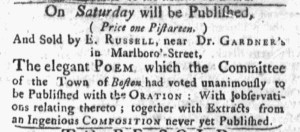
“The elegant POEM, which the Committee of the Town of Boston had voted unanimously to be Published with the ORATION.”

The May 4, 1772, edition of the Massachusetts Gazette and Boston Post-Boy carried a brief advertisement for “The elegant POEM, which the Committee of the Town of Boston had voted unanimously to be Published with the ORATION.”  The “ORATION” referred to the address that Dr. Joseph Warren delivered on the second anniversary of the Boston Massacre, an address already published and advertised in several newspapers in Boston and beyond.  Why, if “the Committee of the Town of Boston had voted unanimously” to publish it with Warren’s oration, had that not occurred?

The advertisement did not name the author of the poem, but many readers knew that James Allen wrote it.  Both the American Antiquarian Society and the Massachusetts Historical Society state that the poem “was suppressed due to doubts about Allen’s patriotism and later was republished by Allen’s friends, with extracts from another of his poems, as ‘The Retrospect.’”  That narrative draws on commentary that accompanied the poems as well as Samuel Kettell’sSpecimens of American Poetry (1829) and Evert A. Duyckinck and George L. Duyckinck’s Cyclopaedia of American Literature (1856).  More recently, Lewis Leary argues that Allen’s “friends” had motives other than commemorating the Bloody Massacre in King Street or demonstrating Allen’s patriotism in the wake of the committee composed of Samuel Adams, John Hancock, and other prominent patriots reversing course about publishing the poem in the wake of chatter that called into question Allen’s politics.

According to Leary, Allen’s poem about the Boston Massacre and “The Retrospect” must be considered together, especially because “the extracts from ‘The Retrospect’ are unabashedly loyalist, praising Britain’s military force, her selfless defense of her colonies, and benevolent rule over them.”  Furthermore, the commentary by Allen’s supposed friends “does indeed clear ‘the authors character as to his politics’ and exhibits his ‘political soundness,’ but that character and that soundness are loyalist, not patriot.”[1]

Postscript to the Censor (May 2, 1772).

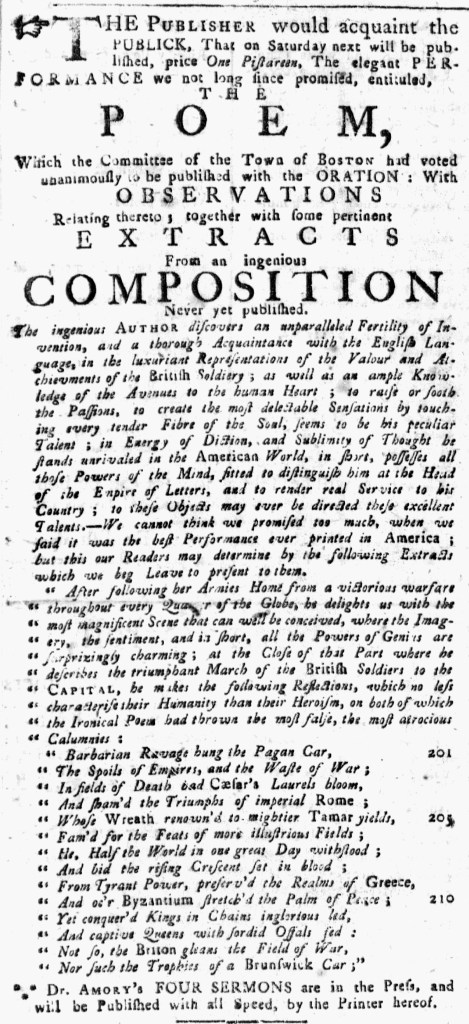
Significantly, Ezekiel Russell published the pamphlet that contained Allen’s poem, “The Retrospect,” and commentary from Allen’s “friends.”  He also published the Censor, a weekly political magazine that supported the British government and expressed Tory sympathies.  The Postscript that accompanied the final issue of the Censor included a much more extensive advertisement for Allen’s poem, one that included extracts from both the commentary and “The Retrospect.”  The portion of the commentary inserted in the advertisement describes how Allen “describes the triumphant March of the British Soldiers to the CAPITAL” and then “makes the following Reflections, which no less characterise their Humanity than their Heroism” in “The Retrospect.”  The advertisement praises the “ingeniousAUTHOR” for his “luxuriant Representations of the Valour and Achievement of the British Soldiery.”

Leary argues that Allen’s “friends” sought to discredit Adams, Hancock, and other patriots for being so easily fooled by his poem about the Boston Massacre that seemed to say what they wanted to hear.  In that regard, the “publication of his Poem and its antithetical counterpart seems to have been one among many minor skirmishes in the verbal battles between Tories and Patriots on the eve of the Revolution, in which skirmish Allen seems to have been more pawn than participant.”  To that end, the “purpose of his ‘friends’ seems clearly to have been to discomfit the committee for its vacillation on the publication of the poem and to expose patriot leaders in Boston as men who could be duped by a skillful manipulator of words.”  Allen’s “friends,” according to Leary, did seek to clarify his politics, but with the intention of “certify[ing] him, certainly to his embarrassment, a Loyalist clever enough to mislead his patriot townspeople.”[2]

Still, that may not tell the entire story.  Leary argues that “what evidence is available suggests that James Allen as a younger man, like many colonials, had been enthusiastically a loyal British subject, grateful for Britain’s protection of her colonies, but that after the horror of the massacre in Boston on March 5, 1770, had become at thirty-six a patriot who could bitterly challenge the British.”[3]  In 1785, Allen’s poem about the Boston Massacre appeared in a collection of orations that commemorated the event, including Warren’s address.  By then, the editors who compiled the anthology recognized that Allen wrote the poem “when his feelings, like those of every other free-born American were alive at the inhuman murders of their countrymen.”[4]  The controversy had passed, Allen’s poem no longer questioned as an insincere lamentation belied by his earlier work.

**********

[1] Lewis Leary, “The ‘Friends’ of James Allen, or, How Partial Truth Is No Truth at All,” Early American Literature 15, no. 2 (Fall 1980): 166-167.

[2] Leary, “‘Friends’ of James Allen,” 168-169.

[3] Leary, “‘Friends’ of James Allen,” 168.

[4] Quoted in Leary, “‘Friends’ of James Allen,” 170.

April 12

What was advertised in a colonial American newspaper 250 years ago this week?

Massachusetts Gazette and Boston Weekly News-Letter (April 9, 1772).

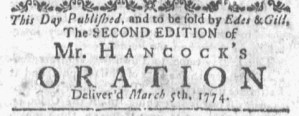
“The Second Edition.”

In the spring of 1772, Benjamin Edes and John Gill marked the second anniversary of the Boston Massacre by printing “AN ORATION DELIVERED MARCH 5th … TO COMMEMORATE THE BLOODY TRAGEDY Of the FIFTH of March, 1770.”  Dr. Joseph Warren gave the address to “the INHABITANTS OF THE TOWN OF BOSTON.”  Edes and Gill advertised the pamphlet widely, starting with a lengthy notice in their own Boston-Gazette on March 23.  The next day, the Essex Gazette carried an advertisement alerting readers in Salem and nearby towns that Samuel Hall stocked copies of Warren’s oration “published in Boston.”  Over the next week, Edes and Gill ran advertisements in other newspapers, including the Massachusetts Gazette and Boston Weekly News-Letter on March 26 and the Boston Evening-Post on April 1.

Did those advertisements work?  Perhaps.  Edes and Gill sold enough copies of Warren’s oration that they printed a second edition and began advertising it in the Massachusetts Gazette and Boston Weekly News-Letter on April 9.  Their new advertisement, much more extensive than the one that previously appeared in that newspaper, proclaimed that “The Second Edition” was “THIS DAY PUBLISHED … by EDES and GILL.”  It informed prospective customers that they could acquire the address for nine pence.  It also included two other details that appeared in Edes and Gill’s original advertisement in the Boston-Gazette but not in subsequent advertisements in other newspapers, a quotation in Latin by Virgil and a note that the printers also had on hand “A few of Mr. LOVELL’S ORATIONS Deliver’d last April, on the same Occasion.”  Why did Edes and Gill decide to include Lovell’s address from the first anniversary of the Boston Massacre in this new advertisement?  Did they believe that the advertisements in several newspapers incited such demand for the address that Warren recently delivered that they had a good chance of selling surplus copies of Lovell’s oration?  That Edes and Gill expanded their advertising campaign for “The Second Edition” of Warren’s oration suggests that they considered their first round of notices successful and effective.

April 1

What was advertised in a colonial American newspaper 250 years ago this week?

Boston Evening-Post (March 30, 1772).

“An ORATION … to commemorate the BLOODY TRAGEDY.”

On the second anniversary of the Boston Massacre, Dr. Joseph Warren delivered “An ORATION … at the Request of the Inhabitants of the Town of BOSTON, to commemorate the BLOODY TRAGEDY of the FIFTH of MARCH, 1770.”  Colonizers gathered to listen to the address, but attending that gathering was not their only means of participating in the commemoration of such a significant event.  Benjamin Edes and John Gill, printers of the Boston-Gazette, published Warren’s “ORATION” and marketed it widely in Massachusetts.

They placed their first advertisement in their own newspaper less than three weeks after Warren addressed “the Inhabitants of the Town.”  Their lengthy notice in the March 23, 1772, edition of the Boston-Gazette included an extensive excerpt about “the ruinous Consequences of standing Armies to free Communities.”  Edes and Gill also stated that they stocked “A few of Mr. LOVELL’S ORATIONS Deliver’d last April, on the same Occasion.”  Prospective customers had an opportunity to collect memorabilia related to the “FATAL FIFTH OF MARCH 1770.”  The following day, Samuel Hall, one of the printers of the Essex Gazette, informed readers that he sold copies of Warren’s address “published in Boston.”  His advertisement did not include an excerpt from the address, nor did subsequent advertisements that Edes and Gill placed in other newspapers in Boston.  They inserted a brief notice in the Massachusetts Gazette and Boston Weekly News-Letter on March 26 and then repeated it in the Boston Evening-Post on March 30.

Edes and Gill advertised widely.  That increased the chances that consumers would see their notices and contemplate purchasing copies of Warren’s “ORATION,” but those patriot printers likely aimed for more than generating sales.  Their advertisements in several newspapers contributed to a culture of commemoration of the American Revolution years before the skirmishes at Lexington and Concord.  Their work in the printing office, publishing newspapers and marketing pamphlets that commemorated the Boston Massacre, played an important role in shaping public opinion as colonizers considered current events and the possibility of declaring independence.

March 26

What was advertised in a colonial American newspaper 250 years ago today?

Massachusetts Gazette and Boston Weekly News-Letter (March 26, 1772).

“An ORATION … to commemorate the BLOODY TRAGEDY.”

Encouragement to participate in the commemoration of the second anniversary of the Boston Massacre by purchasing a copy of the oration delivered by Joseph Warren to mark the occasion continued in the March 26, 1772, edition of the Massachusetts Gazette and Boston Weekly News-Letter.  Three days earlier, Benjamin Edes and John Gill announced in their own newspaper, the Boston-Gazette, that they had just published “AN ORATION DELIVERED MARCH 5TH, 1772 … TO COMMEMORATE THE BLOODY TRAGEDY.”  The following day, a notice in the Essex Gazette, published in Salem, alerted readers that “Yesterday was published in Boston, and now to be sold by Samuel Hall … An ORATION … to commemorate the BLOODY TRAGEDY.”  That advertisement was much shorter than the one in the Boston-Gazette.  Edes and Gill included a lengthy excerpt from Warren’s address in their notice as a means of inciting greater interest and enticing prospective customers.

As proprietors of the Boston-Gazette, Edes and Gill had access to as much space in that newspaper for promoting the goods and services available at their printing office as they wished.  On the other hand, they presumably had to pay to insert an advertisement in another newspaper, though they could have worked out some other arrangement with fellow printer Richard Draper when they advertised Warren’s oration in the Massachusetts Gazette and Boston Weekly News-Letter.  The advertisement in that newspaper was much shorter, consisting of only six lines without any of the excerpt about “the ruinous Consequences of standing Armies to free Communities.”  There may have been limits to what Draper was willing to publish, either paid or gratis.  After all, the excerpt from the oration amounted to an editorial even though it appeared among advertisements.  Draper’s newspaper tended to take a more supportive stance toward the British government, especially compared to the strident critiques that regularly ran in the Boston-Gazette.  Among the printers in Boston, Edes and Gill were some of the most ardent in supporting and promoting the Patriot cause.  For them to advertise “An ORATION … to commemorate the BLOODY TRAGEDY” in the Massachusetts Gazette and Boston Weekly News-Letter at all had political significance likely not lost on readers.