August 3

What was advertised in a revolutionary American newspaper 250 years ago today?
Rivington’s New-York Gazetteer (August 3, 1775)

“MAP … Shewing the SEAT of the present unhappy CIVIL WAR in NORTH-AMERICA.”

On August 3, 1775, Rivington’s New-York Gazetteer carried a subscription proposal for a “COMPLETE and ELEGANT MAP” that extended from Boston to Worcester to the west, Providence to the south, and Salem to the north, “Shewing the SEAT of the present unhappy CIVIL WAR in NORTH-AMERICA.”  The “AUTHOR,” Bernard Romans, realized that colonizers who read and discussed news about the battles at Lexington and Concord in April, the siege of Boston that followed, and the Battle of Bunker Hill would likely be interested in learning more about the geography of New England.  Among the conditions, he specified that “all places where any remarkable event has hitherto occurred, and the provincial lines, &c. shall be particularly pointed out.”  The map itself featured an inset that depicted “BOSTON and itsENVIRONS” that did indeed have its own legend identifying important places, “Provincial Lines,” and “Enemy Lines” as well as an illustration that provided “A View of the Lines thrown upon BOSTON NECK: by the Ministerial Army.”

Romans made support for the American cause an integral part of his marketing effort.  He followed the list of conditions for subscribing (that included the price and descriptions of “good paper and large scale”) with a reflection on the imperial crisis: “Hail, O Liberty! thou glorious, thou inestimable blessing: Banished from almost every part of the old world, America, thy darling, received thee as her beloved: Her arms shall protect thee, – her sons will cherish thee!”  When Romans published the map, it included a dedication “To the Hone. Jno. Hancock Esqre. President of ye Continental Congress … By his Most Obedient Humble Servant.”  As Patriots purchased, collected, and consulted political pamphlets, journals of the proceedings of the First Continental Congress, orations about the Boston Massacre, and sermons about the present state of affairs, Romans presented them with yet another piece of memorabilia that helped them in better understanding current events.  The map was a commemorative item produced and sold even before the colonies declared independence.

**********

The Massachusetts Historical Society has digitized Romans’s map, accompanied by a brief overview of its significance and a short essay about Romans and other cartographers active during the era of the American Revolution.

March 29

What was advertised in a colonial American newspaper 250 years ago today?

Essex Journal (March 29, 1775).

“A DISCOURSE … Preached … In Cammemoration of the MASSACRE at BOSTON.”

In March 1775, residents of Boston once again participated in an annual commemoration of the Boston Massacre, marking its fifth anniversary.  Joseph Warren delivered the oration, just as he had done three years earlier.  As had been the case in years past, local printers published and marketed copies of the address.  Printers in other towns also produced and advertised their own editions of Warren’s oration, helping to keep its memory alive as colonizers dealt with the effects of the Coercive Acts that Parliament imposed in retaliation for the Boston Tea Party.

Colonizers in other towns joined in commemorating the Boston Massacre and critiquing Parliament.  Oliver Noble, “Pastor of a Church in NEWBURY,” delivered a sermon that did so, “PREACH[ING] AT THE REQUEST of a Number of Respectable Gentlemen of said Town.”  In turn, Noble partnered with Ezra Lunt and Henry-Walter Tinges, the printers of the Essex Journal, to publish the sermon “at the General Desire of the Hearers.”  The extensive title, which doubled as the advertising copy, gave an overview of its contents and purpose: “SOME STRICTURES upon the sacred Story recorded in the Book of ESTHER, shewing the Power and Oppression of State Ministers, tending to the Ruin and Destruction of GOD’s People:– And the remarkable Interpositions of Divine Providence in Favour of the Oppressed; IN A Discourse … In Cammemoration of the MASSACRE at BOSTON.”  An advertisement ran in the March 29 edition of the Essex Journal, encouraging colonizers to acquire their own copies.  Those who had heard Noble preach could experience the sermon again every time they read it, remembering how the minister delivered each “STRICTURE” and how other “Hearers” reacted.  Others who had not been fortunate to be present for the commemoration did not have to miss it entirely if they purchased and read Noble’s Discourse.

Relations between the colonies and Britain had deteriorated to the worst point yet during the imperial crisis.  Although they did not know it, a war would start within weeks of Noble preaching his sermon in commemoration of the Boston Massacre and advertising it in the Essex Journal, a war that began because colonizers wanted redress of their grievances and eventually became a war for independence.  Commemoration and commodification of the events that were part of that conflict began before the fighting started.

March 27

What was advertised in a colonial American newspaper 250 years ago today?

Newport Mercury (March 27, 1775).

“Worth the Perusal of each TRUE SON OF LIBERTY.”

In the years after British soldiers fired into a crowd of protestors and killed several colonizers on March 5, 1770, the residents of Boston staged an annual commemoration of the “horrid MASSACRE.”  They called on a prominent patriot to give an “ORATION” about what occurred and the dangers of having British soldiers quartered in urban ports during times of peace.  Colonizers did not need to be present for the oration to experience it for themselves.  Each year, printers published and marketed the oration, commodifying an event that played an important role in the imperial crisis becoming a revolution.

New-York Gazette and Weekly Mercury (March 27, 1775).

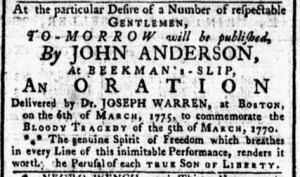
In the first several years, printers in Boston published the oration and newspapers in Massachusetts carried advertisements for it.  In 1775, however, printers in other colonies produced their own editions of Joseph Warren’s oration commemorating the fifth anniversary of the Boston Massacre.  Benjamin Edes and John Gill, the printers of the Boston-Gazette, and Joseph Greenleaf, the publisher of the Royal American Magazine, partnered in printing and advertising a Boston edition.  Not long after, Solomon Southwick, the printer of the Newport Mercury, advertised his own edition, giving the notice a privileged place as the first item in the first column on the first page of the March 27 edition of his newspaper.  On that same day, John Anderson inserted a notice in the New-York Gazette and Weekly Mercury to alert readers of the imminent publication of a local edition undertaken “At the particular Desire of a Number of respectable GENTLEMEN.”  Patriots expressed intertest in obtaining their own copies of Warren’s oration; in turn, printers believed they could generate even greater demand.  To that end, Anderson declared, “The genuine Spirit of Freedom which breathes in every Line of this inimitable Performance, renders it worth the Perusal of each TRUE SON OF LIBERTY.”

The political climate had shifted since printers in Boston disseminated John Hancock’s oration commemorating the fourth anniversary of the Boston Massacre.  Since then, colonizers experienced how Parliament reacted to the destruction of tea during what has become known as the Boston Tea Party.  The Coercive Acts, including the Boston Port Act that closed the harbor until residents paid restitution, prompted delegates from throughout the colonies to gather in Philadelphia for the First Continental Congress in the fall of 1774.  They adopted a nonimportation agreement, the Continental Association, that remained in effect in the spring of 1775.  Given the events that transpired in 1774 and early 1775, it made sense that the anniversary of the “BLOODY TRAGEDY of the 5th of MARCH, 1770” garnered greater attention beyond Massachusetts.

March 23

What was advertised in a colonial American newspaper 250 years ago today?

Massachusetts Spy (March 23, 1775).

“A FINE mezzotinto print of that truly worthy Patriot S.A.”

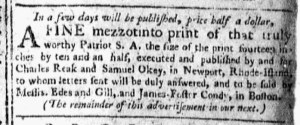
When Charles Reak and Samuel Okey set about publishing a “FINE mezzotinto print of that truly worthy Patriot” Samuel Adams in the spring of 1775, they believed that they could generate interest in their project in Boston.  Accordingly, they placed advertisements in the March 23 edition of the Massachusetts Spy and the March 26 edition of the Boston-Gazette. Reak and Okey chose among the five newspapers published in Boston at the time, selecting the two that consistently took the strongest stance in favor of the American cause during the imperial crisis that eventually became a war for independence.  The savvy entrepreneurs knew which publications would put their notice before the eyes of readers most likely to form a market for a print of the influential and vocal advocate for American liberties.

The advertisement did not go into much detail about the print.  It did not even name Adams, trusting that prospective customers would recognize him from the description and his initials, “S.A.”  They did give the size, “fourteen inches by ten and an half,” so readers could envision framing and displaying the print.  A note at the end of Reak and Okey’s notice in the Massachusetts Spy suggested that they had provided more information to the printing office and “[t]he remainder of this advertisement [will appear] in our next [issue].”  The Boston-Gazette, however, carried the same copy without any additions.  The Massachusetts Spy did not run any version of the advertisement again, neither the original nor an updated variation.  Isaiah Thomas, the printer, published only two more issues in Boston before the political situation got too hot for him to remain there.  He re-established the Massachusetts Spy in Worcester, safely away from British authorities, in May.  The Boston-Gazette did run Reak and Okey’s advertisement one more time, on April 3, but Benjamin Edes and John Gill, the printers (and local agents designated to sell the print of Adams) suspended the newspaper after publishing the April 17 edition.  Following the skirmishes at Lexington and Concord on April 19, they dissolved their partnership.  Edes moved to Watertown and continued publishing the newspaper from there in June.  The outbreak of hostilities almost certainly disrupted Reak and Okey’s plans for advertising and distributing their print of Samuel Adams.

March 17

What was advertised in a colonial American newspaper 250 years ago today?

Massachusetts Gazette and Boston Weekly News-Letter (March 17, 1775).

“AN ORATION … to commemorate the bloody Tragedy of March 5th 1770.”

In the spring of 1771, patriots marked the first anniversary of the “BLOODY TRAGEDY” now known as the Boston Massacre with “AN ORATION Delivered … at the Request of the Inhabitants of the Town of Boston … By JAMES LOVELL.”  That started an annual tradition, with Joseph Warren giving the oration in 1772, Benjamin Church in 1773, and John Hancock in 1774.  Gathering for the oration became an annual ritual.  So did publishing and marketing it.

For the fifth anniversary, the “ORATION … to commemorate the bloody Tragedy of March 5th 1770” was once again “delivered by JOSEPH WARREN.”  Less than two weeks later, advertisements in the March 17 edition of the Massachusetts Gazette and Boston Weekly News-Letter informed readers where they could acquire copies.  One indicated that Benjamin Edes and John Gill, the printers of the Boston-Gazette, sold the oration, implying that they also published it.  According to the imprint, Edes and Gill printed the address in partnership with Joseph Greenleaf, the proprietor of the Royal American Magazine.

Another advertisement gave readers another option: “In the MASSACHUSETTS SPY, of this Day is published, the WHOLE of the ORATION, delivered by JOSEPH WARREN, Esq; on March 6th , 1775, to commemorate the bloody Tragedy of March 5th, 1770.”  Isaiah Thomas, the printer of the Massachusetts Spy, did indeed devote three of the four columns of the third page of his newspaper to Warren’s oration.  In an introduction, he reported that it was “this day published, in a pamphlet” and available for sale in addition to appearing in the newspaper.  The printer offered multiple ways for readers to engage with the oration.  He (and Edes and Gill and Greenleaf) also offered consumers an opportunity to purchase a commemorative item.  Readers who previously purchased the orations by Lovell, Warren, Church, and Hancock on previous anniversaries may have been motivated to add to their collections.

The printer of the Massachusetts Gazette and Boston Weekly News-Letter gave the advertisements a privileged place, likely intended to increase the chances that readers took note of them.  They appeared one after the other immediately after the weekly account of local marriages and deaths.  That meant that the advertisements served as a transition between news items and paid notices.  Readers who perused the news yet merely glanced through the advertisements may have been more likely to take note of these first notices as they realized that the remainder of the page featured advertising.  A manicule also helped call attention to them, signaling their importance in a town experiencing the distresses of the Boston Port Act and the other Coercive Acts.

March 6

What was advertised in a colonial American newspaper 250 years ago today?

New-York Gazette and Weekly Mercury (March 6, 1775).

Will be celebrated the Anniversary of the repeal of the STAMP-ACT.”

A manicule directed readers to take note of upcoming festivities to commemorate the “18th of MARCH” as they perused the advertisements in the March 6, 1775, edition of the New-York Gazette and Weekly Mercury.  Although that date is not familiar to most Americans in the twenty-first century, it certainly resonated with colonizers who associated it with the repeal of the Stamp Act on March 18, 1766.  Just as Americans today recognize the “4th of July” as Independence Day, “9/11” as the day terrorists hijacked four airplanes and used them as weapons to kill thousands of people, and “January 6” as the day insurrectionists attacked the United States Capitol at the bidding of a demagogue who refused to participate in a peaceful transfer of power after losing a free and fair election, colonizers knew the significance of the “18th of MARCH” without further explanation.

The Sons of Liberty and other supporters of the American cause had been gathering to celebrate “the Anniversary of the repeal of the STAMP-ACT” for many years, including in 1770, 1771, 1772, 1773, and 1774.  As the ninth anniversary approached, they prepared to dine “at the house of Mrs. De La Montagnie” with “those gentlemen and their friends, who associated there last year.”  The tavern operated by the De La Montagne family had often been the site of these commemorations.  “Mr. DE LA MONTAGNIE” served as host in 1774; following his death, his widow continued the tradition.  The celebrants did not know it at the time, but it would be the last time they commemorated the repeal of the Stamp Act before what would eventually become a war for independence began.  Just a month and a day later, the skirmishes at Lexington and Concord would occur.  While “those gentlemen and their friends” who marked the anniversary of the repeal of the Stamp Act did not yet know the significant of the “19th of April,” they did understand that the imperial crisis had intensified.  For many years they had already been commemorating the events that precipitated the American Revolution.  As John Adams suggested after the war, “The Revolution was in the Minds of the People … before a drop of blood was drawn at Lexington.”

February 6

What was advertised in a colonial American newspaper 250 years ago today?

Newport Mercury (February 6, 1775).

“A METZOTINTO … of that truly staunch Patriot, the Hon. SAMUEL ADAMS.”

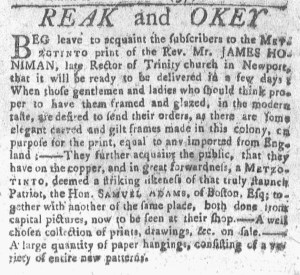
On February 6, 1775, Charles Reak and Samuel Okey took to the pages of the Newport Mercury to advise “subscribers to the METZOTINTO print of the Rev. JAMES HONIMAN … that it will be ready to be delivered in a few days.”  As printers often did for books, Okey, a British printmaker who migrated to Rhode Island, gauged the market by seeking subscribers to his print of James Honyman, the former rector of Trinity Church in Newport, before executing it.  That allowed him to determine whether the project would be viable and how many prints to produce to meet the demand of subscribers who reserved copies.

The print has been dated November 2, 1774, based on a line beneath the title that reads, “Printed by Reak & Okey, Newport Rhode Island, Novr. 2 1774,” yet the newspaper advertisement suggests that even though the engraving may have ready on that day that Reak and Okey printed the portrait in the following months before distributing it in February 1775.  The advertisement gives further evidence that was the case.  The partners informed readers of a forthcoming print depicting “that truly staunch Patriot, the Hon, SAMUEL ADAMS, of Boston.”  Reak and Okey explained that they “have on copper, and in great forwardness” that mezzotint.  The engraving was complete, but printing took time.

When they did deliver copies of the Honyman mezzotint to subscribers, Reak and Okey offered more than just the print to “those gentlemen and ladies who should think proper to have them framed and glazed in the modern taste.”  They promoted “some elegant carved and gilt frames, made in this colony, on purpose for the print, equal to any imported from England.”  With the Continental Association in effect, Reak and Okey gave their customers access to frames without departing from that nonimportation agreement.  The copy in the collections of the Preservation Society of Newport County is “housed in a black painted wood frame with an interior gilt gesso border,” though the description does not give the provenance of the frame.

In their choices about their latest subject, John Adams, and the frames for the James Honyman mezzotint, Reak and Okey courted customers who supported the American cause as the imperial crisis intensified.  They joined other artists and publishers who commemorated the American Revolution even before the war began at Lexington and Concord, doing so with both an image of a “staunch Patriot” and frames imbued with political as well as artistic significance.

April 19

What was advertised in a colonial American newspaper 250 years ago today?

South-Carolina Gazette and Country Journal (April 19, 1774).

“BOHEA, GREEN, and HYSON TEA.”

Not all colonizers dispensed with advertising, selling, and drinking tea as an immediate response to the Boston Tea Party, especially if the tea in question had not been subject to import duties.  In April 1774, Pott Shaw advertised “BOHEA, GREEN, and HYSON TEA, warranted of the finest Quality,” in the South-Carolina Gazette and Country Journal.  Shaw did not reveal when the tea arrived in the colony, by what means, or its origins, leaving those details to prospective customers to ask about, if they chose to do so, when they made their purchases.  Buying and selling this particular commodity occurred in the context of conversations about the politics of tea.

The April 19 edition of the South-Carolina Gazette and Country Journal carried some of the same updates about possible reactions to the Boston Tea Party that appeared in the Connecticut Courant a week earlier.  Throughout the colonies, printers reprinted news from one newspaper to another.  In this instance, both newspapers carried an “Extract of a letter from London, January 24,” that originally ran in newspapers in Philadelphia.  It briefly stated, “Three men of war are ordered to be in readiness to sail for Boston, and exact payment for the TEA,” without providing additional information, including who had written the letter.  Readers had to decide for themselves whether the report was accurate or merely rumor.  Another news item, this one having arrived via New York, reported that the “intentions of the British administration, relative to the American duty on tea, are not yet fixed.”  Readers in Charleston and Hartford read both these dispatches from London.  They also encountered advertisements for tea in the same issues that carried that news.

Readers of the South-Carolina Gazette and Country Journal also read about commemorations of events that contributed to the imperial crisis.  From Boston, they learned that “the horrid tragedy of the 5th of March,” the Boston Massacre, “was observed with the usual solemnity” on its fourth anniversary.  That article described “a portrait of that inhuman and cruel massacre” put on display and the ringing of bells throughout the city for an entire hour.  An update from New York followed, describing dinners that celebrated the “anniversary of the repeal of the STAMP-ACT.”  Abuses perpetrated by both British soldiers and Parliament received attention alongside news about tea.

For the moment, however, that did not result in merchants, shopkeepers, and others refraining from advertising and selling tea in South Carolina or Connecticut or other colonies.  The beverage was exceptionally popular, making it difficult to curtail consumption.  Eventually, colonizers did enact boycotts, but some people still devised ways to evade them, at least according to Peter Oliver’s account.  Although some entrepreneurs opted not to sell (or at least not to advertise) tea following the Boston Tea Party, it did not immediately disappear from shelves or newspaper advertisements.

April 11

What was advertised in a colonial American newspaper 250 years ago today?

Boston-Gazette (April 11, 1774).

“The SECOND EDITION of Mr. HANCOCK’S ORATION.”

Benjamin Edes and John Gill, printers of the Boston-Gazette, gave their advertisement for the “SECOND EDITION of Mr. HANCOCK’S ORATION Deliver’d March 5th” a privileged place in their newspaper.  Readers did not need further explanation to understand that “March 5th” referred to the date of the Boston Massacre and that Hancock had been selected to give the annual address that memorialized the victims and raised an alarm about the danger of quartering an army in an urban center, like Boston, during times of peace.

Still, Edes and Gill, who printed the “ORATION” as well as the newspaper, did what they could to draw attention to the second edition.  The first time they announced it was “This Day Published,” in the April 4, 1774, edition of the Boston-Gazette, they ran the notice immediately below news and editorials.  Even if readers chose not to peruse other advertisements closely once they realized they had finished the news, they likely took note of the advertisement for the “ORATION” in its place of transition from one kind of content to another.  In the next issue of the weekly newspaper, the notice ran at the bottom of the last column on the first page, the only advertisement on that page.  Once again, the patriot printers increased the likelihood that readers would spot that advertisement and accept an invitation to demonstrate their own commitment to the patriot cause by purchasing copies for themselves.

That Edes and Gill published a “SECOND EDITION” testified to the demand for the first edition.  It sold well enough to justify another printing.  Edes and Gill took it to press just a few months after the Boston Tea Party and just a few weeks after another destruction of tea.  Although that second Boston Tea Party is not nearly as well known today, it was certainly among the current events that would have been on the minds of colonizers as they participated in commemorating the fourth anniversary of the Boston Massacre, discussed the politics of tea, and decried various abuses perpetrated by Parliament.  Purchasing and reading Hancock’s “ORATION” was part of the growing resistance to British rule in the colonies, a means for consumers to practice politics in the marketplace and imbibe the rhetoric of a noted patriot long after the Boston Massacre’s annual commemorative events concluded.

April 5

What advertised in a colonial American newspaper 250 years ago today?

Essex Gazette (April 5, 1774).

To be sold by the Printers hereof, Mr. Hancock’s ORATION, On the Fifth of March.”

Immediately above the record of ships “Entered-In,” “Outward-Bound,” and “Cleared-Out” from the customs house in Boston in the April 5, 1774, edition of the Essex Gazette, Samuel Hall and Ebenezer Hall, the printers, inserted a brief notice, just three lines, alerting readers that they sold “Mr. Hancock’s ORATION, On the Fifth of March.”  The Halls did not need to provide further elaboration for readers to understand the announcement.  For colonizers in New England in the 1770s, the phrase “Fifth of March” conjured images like the phrase “Boston Massacre” evokes today.  They needed no explanation that the advertisement referred to John Hancock delivering the annual address to commemorate the event, to honor those killed when British soldiers from the 29th Regiment under the command of Captain Thomas Preston fired into a crowd of protesters, to condemn quartering troops in colonial cities during times of peace, and to advocate for American liberties.

As had become customary by the fourth anniversary of the Boston Massacre, the town voted to have the oration published and advertisements appeared in newspapers printed in Boston.  Yet they did not appear solely in newspapers in that town.  Other newspapers in New England sometimes carried them as well, none more often that the Essex Gazette, published in nearby Salem.  Samuel Hall had a long history of publishing news and opinion that favored sentiments expressed by Patriots.  On the first anniversary of the Boston Massacre, for instance, he included thick black mourning borders on the first page of his newspaper and published “a solemn and perpetual MEMORIAL Of the Tyranny of the British Administration of Government in the Years 1768, 1769, and 1770,” especially “THE FIFTH OF MARCH, … the Anniversary of Preston’s Massacre–in King-Street–Boston, N. England–1770.”  When Benjamin Edes and John Gill, among the most ardent of Patriots among the printers in Boston, published Hancock’s oration in 1774, the Halls acquired copies to disseminate in Salem and beyond.  In so doing, they participated in the commodification of the Boston Massacre while simultaneously commemorating it and encouraging others to side with the Patriots as relations with Parliament further deteriorated following the Boston Tea Party the previous December.