May 1

What was advertised in a revolutionary American newspaper 250 years ago today?

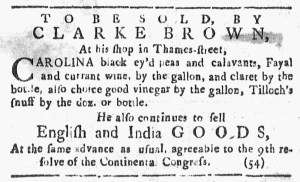
Newport Mercury (May 1, 1775).

“English and India GOODS, At the same advance as usual, agreeable to the 9th resolve of the Continental Congress.”

An advertisement that Clarke Brown first placed in the Newport Mercury on January 16, 1775, a little over six weeks after the Continental Association went into effect, ran for several months.  It appeared once again on May 1, just two weeks after the battles at Lexington and Concord.  In it, Browne promoted several commodities, including peas, wine, and snuff, and advised the public that he “continues to sell English and India GOODS.”  He very carefully clarified that he set prices for those imported wares “At the same advance as usual, agreeable to the 9th resolve of the Continental Congress.”

Readers knew that Brown referred to the Continental Association, a nonimportation agreement enacted by the First Continental Congress in response to the Coercive Acts.  To prevent price gouging once merchants and shopkeepers ceased importing new inventory from Britain, the ninth article specified that “Venders of Goods or Merchandise will not take Advantage of the Scarcity of Goods that may be occasioned by this Associacion, but will sell the same at the Rates we have been respectively accustomed to do for twelve Months last past.”  When Brown declared that he set prices “at the same advance as usual,” he meant that he did not increase the markup but instead held prices steady.  He offered assurances to prospective customers.  Just as significantly, he wanted readers, whether they shopped at his store or not, to know that he abided by the ninth article of the Continental Association.  After all, it specified penalties for those who did not: “if any Venders of Goods or Merchandise shall sell any such Goods on higher Terms … no Person ought, nor will any of us deal with any such Person … at any Time thereafter, for any Commodity whatever.”  Brown’s good standing in the community, not just his ability to earn his livelihood, depended on convincing the public that he charged fair prices consistent with the expectations of the Continental Association.

April 22

What was advertised in a revolutionary American newspaper 250 years ago today?

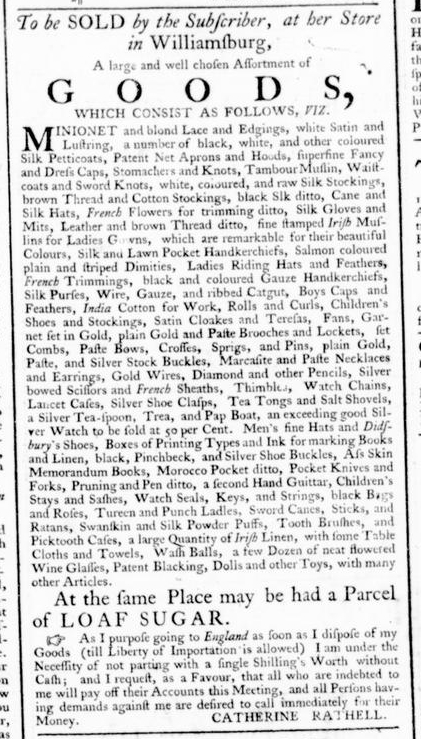
Virginia Gazette [Dixon and Hunter] (April 22, 1775).

“I purpose going to England as soon as I dispose of my Goods (till Liberty of Importation is allowed).”

In the spring of 1775, Catherine Rathell advertised a “large and well chosen Assortment of GOODS” available at her store in Williamsburg in John Dixon and William Hunter’s Virginia Gazette.  She demonstrated the choices available to consumers with a lengthy list that included “black, white, and other coloured Silk Petticoats,” “fine stamped Irish Muslims for Ladies Gowns, which are remarkable for their beautiful Colours,” “plain Gold and Paste Brooches and Lockets,” “a few Dozen of neat flowered Wine Glasses,” and “Dolls and other Toys.”

Rathell did not mention when she acquired her merchandise.  Taglines that proclaimed, “Just Imported,” or some variation of that sentiment no longer appeared in American newspapers as often as they had in recent years.  The Continental Association, a nonimportation agreement devised by the First Continental Congress in response to the Coercive Acts, had been in effect since December 1, 1774.  The shopkeeper did not state that her inventory arrived in the colony before that date, yet she suggested that was the case when she declared that she planned to go to England “as soon as I dispose of my Goods (till Liberty of Importation is allowed).”  In acknowledging the Continental Association, Rathell implied that she abided by it.

She also indicated the effect it had on her business.  She did not consider it viable to continue operating her store in Williamsburg.  She planned to close it as soon as she could liquidate her wares and visit England until regular trade resumed, not knowing when she composed her advertisement that a war for independence would disrupt commerce even more significantly.  For the moment, she insisted on cash sales instead of credit, “not parting with a single Shilling’s Worth” with payment in hand, and settling accounts with both those indebted to her and others “having demands against” her.  Except for “an exceeding good Silver Watch to be sold at 50 per Cent,” Rathell did not mention any discounts, but prospective customers may have recognized an opportunity to bargain with a shopkeeper determined to leave the colony.

April 20

What was advertised in colonial American newspaper 250 years ago today?

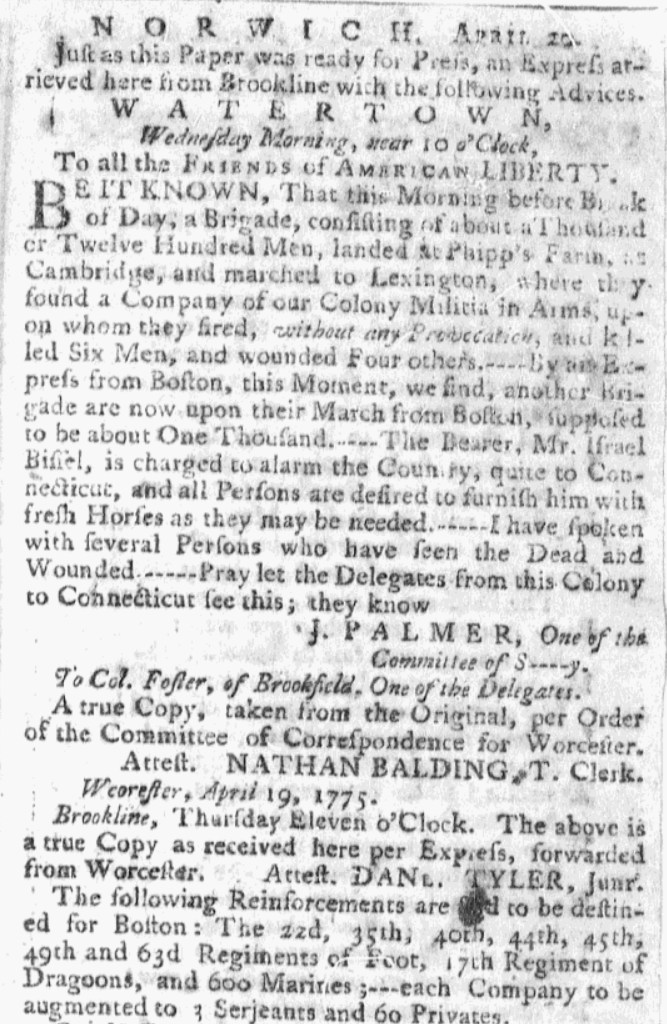
Norwich Packet (April 20, 1775).

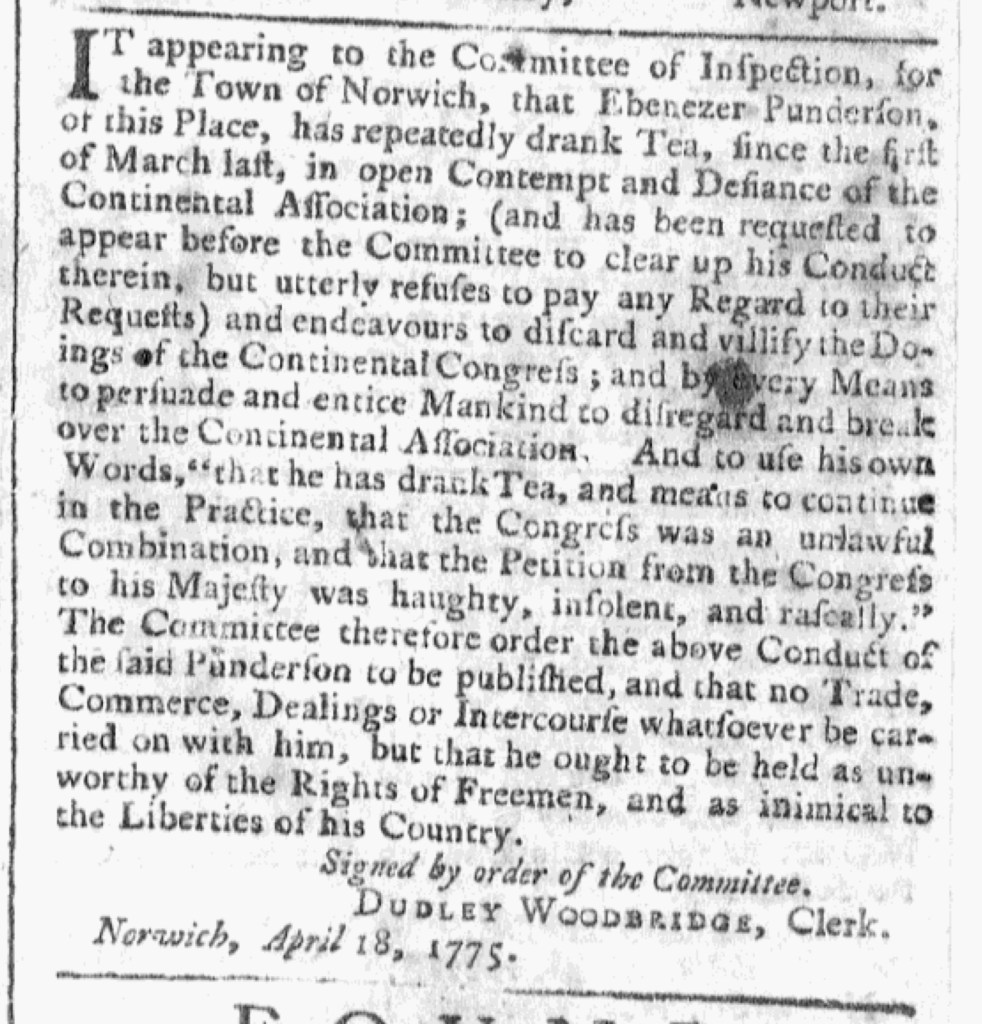
“Ebenezer Punderson … has repeatedly drank Tea … in open Contempt and Defiance of the Continental Association.”

Ebenezer Punderson went too far and now it was time for consequences.  He brazenly and repeatedly violated the Continental Association, the nonimportation and nonconsumption agreement enacted by the Continental Congress in response to the Coercive Acts.  As a result of his actions, the Committee of Inspection in Norwich, Connecticut, placed an advertisement in the April 20, 1775, edition of the Norwich Packet to document his behavior and advise the community to shun Punderson.

The committee reported that Punderson “has repeatedly drank Tea … in open Contempt and Defiance of the Continental Association.”  When the committee sought to investigate the matter, he “utterly refuse[d] to pay any Regard to their Requests” to appear before it.  Even worse, he “endeavours to discard and vilify the Doings of the Continental Congress; and by every Means to persuade and entice Mankind to disregard and break over the Continental Association.”  His refusal to abide by the Continental Association damaged the movement and had the potential to do even more harm by inspiring others to ignore it as well.  In addition, he stridently declared that he had no intention of adhering to the agreement, insulting the Continental Congress in the process:  “to use his own words, ‘that he has drank Tea, and means to continue in that Practice, that the Congress was an unlawful Combination, and that the Petition from the Congress to his Majesty was haughty, insolent, and rascally.’”

The Committee of Inspection, in turn, determined that it was Punderson who was haughty, insolent, and rascally.  It ordered that the “Conduct of the said Punderson be published, and that no Trade, Commerce, Dealings or Intercourse whatsoever be carried on with him.”  Furthermore, the committee declared that “he ought to be held as unworthy of the Rights of Freemen, and as inimical to the Liberties of his Country.”  Punderson acted in opposition to the patriot cause.  The Committee of Inspection intended to see him pay for his transgressions.

Norwich Packet (April 20, 1775).

Punderson chose the wrong time to draw attention to himself.  Some of the first coverage of the battle at Lexington to appear in American newspapers ran at the top of the column that featured the advertisement about his offenses.  “Just as this Paper was ready for Press,” the printers declared, “an Express arrived here from Brookline with the following Advices” from J. Palmer, “One of the Committee of S[afet]y,” and dispatched to “Col. Foster, of Brookfield.”  The missive reported that before dawn on the morning of April 19 “a Brigade [of British troops] … marched to Lexington, where they found a Company of our Colony Militia in Arms, upon whom they fired, without any Provocation, and killed Six Men, and wounded Four others.”  Palmer stated that he had “spoken with several Persons who have seen the Dead and Wounded.”  He also relayed news that another Brigade “are now on their March from Boston.”  Israel Bissell carried the message, “charged to alarm the Country” in western Massachusetts all the way to Connecticut.  The printers published this account from a “true Copy, taken from the Original, per Order of the Committee of Correspondence for Worcester.”  The details were sparse, yet the “FRIENDS of AMERICAN LIBERTY” reading the Norwich Packet now knew that fighting had commenced near Boston.  That news quite likely had an impact on their attitude when they read about Punderson’s offenses further down the column.

April 19

What was advertised in a revolutionary American newspaper 250 years ago today?

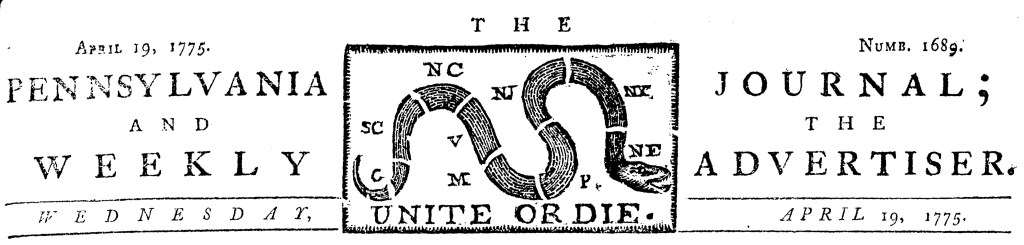
Pennsylvania Journal (April 19, 1775).

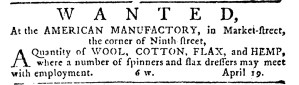
“WANTED, at the AMERICAN MANUFACTORY … A Quantity of WOOL, COTTON, FLAX, and HEMP.”

In the middle of March 1775, supporters of a “FUND for establishing and carrying on an AMERICAN MANUFACTORY, of LINEN, WOOLLEN,” and textiles made of other items met at Carpenters’ Hall in Philadelphia to learn more about the undertaking.  They pledged their support by signing their names to “Subscription Papers” or “general Proposals,” either at the meeting or at the London Coffee House in advance.  The organizers and the “Subscribers” sought to encourage “domestic manufactures” (products made in the colonies) as alternatives to imported goods.  Entrepreneurs had been pursuing that goal for more than a decade during the imperial crisis, though many devoted more effort during the times that colonizers adopted nonimportation agreements as political leverage.  In the spring of 1775, those involved with the “AMERICAN MANUFACTORY” did so as part of the Continental Association.  Its eighth article called for “encourage[ing] Frugality, Economy, and Industry; and promot[ing] Agriculture, Arts, and the Manufacturers of this Country.”

A month later, advertisements concerning the venture simultaneously appeared in the Pennsylvania Gazette and the Pennsylvania Journal on April 19.  “WANTED, At the AMERICAN MANUFACTORY,” the notices advised, “A Quantity of WOOL, COTTON, FLAX, and HEMP.”  Readers could demonstrate their commitment to the cause by supplying the resources necessary to produce textiles in the colony.  The advertisement also noted that “a number of spinners and flax dressers may meet with employment” at the manufactory, contributing to the success of the Continental Association while earning their livelihoods.

When the printers of the Pennsylvania Gazette and the Pennsylvania Journal distributed the weekly issue of their newspapers on April 19, they were not yet aware of the momentous events that happened at Lexington and Concord in Massachusetts that morning, though it would not take long for word to spread to Philadelphia and throughout the colonies.  Historians have long debated when the American Revolution began, echoing the question that John Adams posed to Thomas Jefferson in 1815: “What do We mean by the Revolution?  The War?  That was no part of the Revolution.  It was only an Effect and Consequence of it.  The Revolution was in the Minds of the People, and this was effected, from 1760 to 1775, in the course of fifteen Years before a drop of blood was drawn at Lexington.”  Establishing the “AMERICAN MANUFACTORY” in Philadelphia before the war, according to Adams, was part of the revolution.  Today, however, the 250th anniversary of the battles at Lexington and Concord offers a convenient moment for commemorating the American Revolution by aligning it with the Revolutionary War that secured independence for a new nation composed of thirteen former colonies.  For readers of the Pennsylvania Journal in 1775, the political cartoon depicting a severed snake with the motto “UNITE OR DIE” had already been spreading its message for many months.  The masthead, the articles and letters, and many of the advertisements had been part of a revolution that was already occurring “in the Minds of the People.”

Pennsylvania Journal (April 19, 1775).

April 15

What was advertised in a colonial American newspaper 250 years ago today?

Pennsylvania Ledger (April 15, 1775).

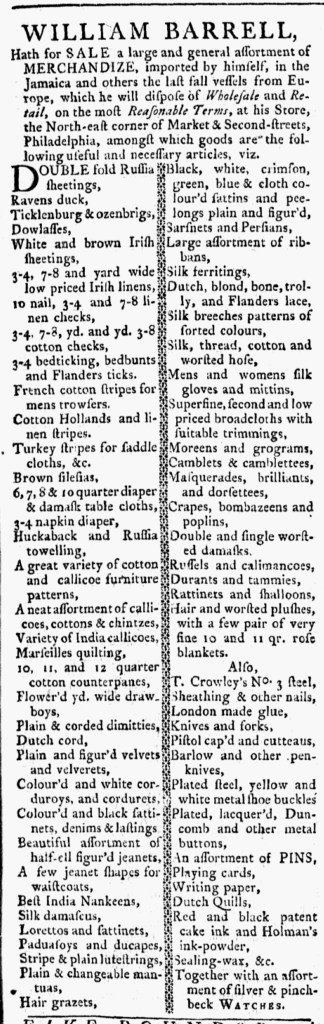
“MERCHANDIZE, imported [in] the last fall vessels from Europe.”

William Barrell’s advertisement in the April 15, 1775, edition of the Pennsylvania Ledger looked much like many of the advertisements that merchants and shopkeepers had been placing in American newspapers for the past couple of decades.  That was even though the Continental Association, a nonimportation agreement devised by the First Continental Congress, had been in effect since December 1, 1774.  Colonizers sought to use economic leverage to convince Parliament to repeal the Coercive Acts.

The notice filled most of the first column on the first page, making it difficult for readers to miss.  Barrell promoted a “large and general assortment of MERCHANDIZE.”  To demonstrate the choices available to consumers, he included an extensive catalog that accounted for most of the space occupied by the advertisement.  He did not opt for dense paragraphs of text, instead arranging with the compositor to divide the list of his inventory into two columns with a line comprised of printing ornaments running down the center.  One, two or three related items appeared on each line.  Barrell stocked all sorts of textiles, everything from “Ticklenburg & ozenbrigs” to “Colour’d and white corduroys, and cordurets” to Crapes, bombazeens and poplins.”  He also carried “Mens and womens silk gloves and mittins,” “Playing cards,” and “Plated, lacquer’d Duncomb and other metal buttons.”  Prospective customers had access to the same variety of goods as they did before the nonimportation agreement.

In his introduction to his list of “useful and necessary articles,” Barrell made a standard appeal to price, stating that he sold his wares “on the most Reasonable Terms.”  He also noted that he imported them via the “last fall vessels from Europe.”  The savvy merchant carefully alerted the public that he was not breaking the Continental Association by selling goods imported since December 1.  Instead, he continued to stock and sell only items that arrived in Philadelphia before the Continental Association went into effect.  In that regard, his advertisement did differ from those published at other times.  Merchants and shopkeepers often emphasized that they peddled new inventory that just arrived.  Customers could select from among the latest styles.  In this instance, however, Barrell realized that consumers would accept, even embrace, goods that had been on the shelves for a few months, especially if he emphasized that they had not been there for too long, just since the arrival of the “last fall vessels.”

April 10

What was advertised in a colonial American newspaper 250 years ago today?

New-York Gazette and Weekly Mercury (April 10, 1775).

“Turn them speedily into cash, before the trade opens with Great-Britain.”

In the spring of 1775, Samuel Loudon, a bookseller and stationer, took to the pages of the New-York Gazette and Weekly Mercury to promote his current inventory.  His advertisement included a catalog listing many of the titles currently in stock as well as “a Variety of Religious books too tedious to mention” and “a variety of History and Romance.”  He also carried writing supplies, including “Quills, Writing Paper, Blank Books, Wafers and Sealing Wax.”

Loudon hoped to make a deal with customers “who take a quantity,” whether for themselves or to retail at their own shops, offering to sell the books “nearly at prime cost” or just a small markup.  He stated that he wished to “turn them speedily into cash, before the trade opens with Great-Britain” because he wanted to be in a better position to “lay in a fresh assortment.”  Despite the volume of newspaper advertisements and subscription proposals for books and pamphlets published by American printers, most books purchased and read by colonizers were printed in England and imported to the colonies.  At that moment, however, Americans participated in a nonimportation agreement, the Continental Association, enacted in response to the Coercive Acts.  Loudon acknowledged that he did not currently have access to new books, yet he looked to the future with optimism and planned to place orders as soon as Parliament repealed the offensive legislation and trade returned to normal.

In that regard, his advertisement echoed the one that John Minshull placed for looking glasses and engravings in the New-York Journal a few days earlier, though Minshull, likely a Loyalist, may have adhered to the nonimportation agreement out of necessity rather than enthusiasm.  Loudon “was decidedly a whig,” according to Patriot printer Isaiah Thomas, so his support may the Continental Association could have been more genuine despite any frustration with the disruptions it caused for his business.  Not long after he placed his advertisement in the New-York Gazette and Weekly Mercury, he purchased “printing materials, and opened a printing house.”  He commenced publishing “a newspaper devoted to the cause of the country” in January 1776.[1]  Neither Loudon nor Minshull saw trade resume with Britain in the way they imagined.  They did not know when they submitted their advertisements to the printing offices that resistance would soon become revolution following the battles at Lexington and Concord in Massachusetts.

**********

[1] Isaiah Thomas, The History of Printing in America: With a Biography of Printers and an Account of Newspapers (1810; New York: Weathervane Books, 1970), 482.

April 6

What was advertised in a colonial American newspaper 250 years ago today?

Supplement to the New-York Journal (April 6, 1775).

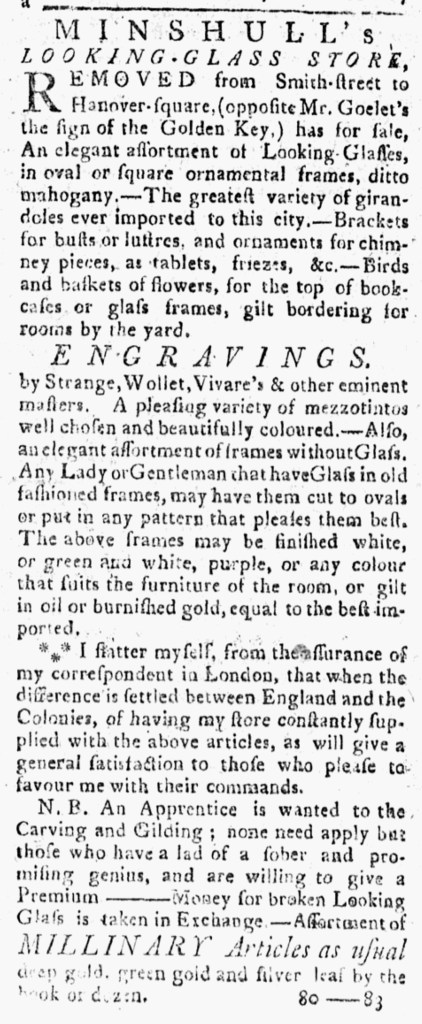
“Assurance … that when the difference is settled between England and the colonies, of having my store constantly supplied.”

In the spring of 1775, the proprietor of “MINSHULL’s LOOKING-GLASS STORE” ran a newspaper advertisement to announce that he had “REMOVED” from Smith Street to a new location “opposite Mr. Goelet’s [at] the sign of the Golden Key” on Hanover Square in New York.  In addition to an “elegant assortment” of looking glasses, he stocked other items for decorating homes and offices, including brackets for displaying busts, arrangements of flowers and birds “for the top of bookcases,” and the “greatest variety of girandoles” or candleholders “ever imported to the city.”  He also devoted a separate paragraph, with its own headline, to a “pleasing variety” of mezzotint “ENGRAVINGS” and the choices for frames.

John Minshull confided that he had “assurances of my correspondent in London, that when the difference is settled between England and the Colonies, of having my store constantly supplied with the above articles, as will give a general satisfaction” to his customers.  Readers realized that he referred to the imperial crisis and the effects of the Continental Association, the nonimportation agreement devised by the First Continental Congress in response to the Coercive Acts.  Minshull did not state that he imported his inventory before that pact went into effect on December 1, 1774.  Instead, he allowed readers to make that assumption, especially when he noted that he would not receive any new merchandise from England until the colonies and Parliament reached an accord.

That did not happen.  Within weeks of Minshull placing his advertisement, the Revolutionary War began with the Battles of Lexington and Concord in Massachusetts.  A little over a year later, the British occupied New York and remained in the city until 1783.  Yet Minshull persevered, continued operating his shop, and, according to an advertisement in the November 8, 1780, edition of the Royal Gazette, “imported in the Fleet from England, A large Assortment of LOOKING GLASSES, adapted to the present mode of Town and Country.”  He apparently managed to maintain his connections with his correspondents and suppliers in London.

Perhaps Minshull abided by the Continental Association in 1775 as a matter of political principle.  Perhaps he did so merely to stay in the good graces of his customers and the community.  The latter seems more likely since, according to Luke Beckerdite, “a ‘John Michalsal’ was included in a list of Loyalists” in 1775 and “a ‘John Minchull’ subsequently fled to Shelburne, Nova Scotia,” a haven for Loyalists during and immediately after the war.  From August 1782 through February 1783, ran an advertisement in the Royal Gazette for his “remaining Stock” that he sold “Cheap! Cheap! Cheap!”  It appears that Minshull had a going-out-of-business sale before evacuating from New York when the war ended.  Before that, he resumed business as usual when circumstances changed under the British occupation, weathering the storm and attempting to earn his livelihood during uncertain times.  When the “difference [was] settled between England and the Colonies,” he no longer sold looking glasses or anything else in New York.

March 14

What was advertised in a colonial American newspaper 250 years ago today?

Pennsylvania Evening Post (March 14, 1775).

“A FUND for establishing and carrying on an AMERICAN MANUFACTORY.”

The organizers of a “FUND for establishing and carrying on an AMERICAN MANUFACTORY, of LINEN, WOOLLEN,” and other textiles in Philadelphia and its hinterland called a meeting to rally support.  In an advertisement that first appeared in the March 11, 1775, edition of the Pennsylvania Evening Post, they announced that all “Subscribers” to that enterprise should meet “at the CARPENTERS HALL” on March 16 “to consider of a Plan for carrying the same into Execution.”  It was an especially appropriate place to meet considering that the organizers sought to put into effect one of the provisions of the Continental Association that the First Continental Congress had devised when the delegates held their meetings at Carpenters’ Hall in September and October 1774.  In addition to boycotting goods imported from Britain, the eighth article specified that colonizers should “encourage Frugality, Economy, and Industry; and promote Agriculture, Arts, and the Manufactures of this Country, especially that of Wool.”

Apparently, “general Proposals” had been printed and disseminated ahead of the meeting, perhaps by Benjamin Towne, the printer of the Pennsylvania Evening Post, or perhaps in the printing office operated by William Bradford and Thomas Bradford.  The notice stated that “one of the Subscription Papers [had been] left with WILLIAM BRADFORD, at the London Coffee-House.”  In addition, the Pennsylvania Journal, the newspaper printed by the Bradfords also carried the notice on the eve of the meeting.  No matter which printer produced the “Subscription Papers,” it was not too late for colonizers to sign their names and show their support for “this important and very interesting Undertaking” by becoming “Subscribers.”  They could visit the London Coffee House to add their names, but those who “may not have an Opportunity of Subscribing before the Day of meeting” could arrive early at Carpenters’ Hall to add their names.  For two hours before the meeting was scheduled to begin at three o’clock, some of the organizers would be present “for that Purpose.”  With subscription papers circulating, prospective supporters could examine who had already committed to the project.  That had the potential to inspire others to do so, provided colonizers actively engaged with printed materials that circulated in Philadelphia as the imperial crisis intensified.  Newspaper advertisements and subscription papers delivered news about the proposed “AMERICAN MANUFACTORY” that encouraged colonizers who encountered them to get involved by signing their names, attending meetings, and making donations.

March 8

What was advertised in a colonial American newspaper 250 years ago today?

Pennsylvania Gazette (March 8, 1775).

“The importation of Goods from Britain being stopped, obliges the said ACKEROYD to dispose of his stock on hand.”

With the Continental Association in effect throughout the colonies, John Ackeroyd decided that doing business in Philadelphia was no longer viable for him.  He concluded an advertisement in the March 8, 1775, edition of the Pennsylvania Gazette with a note that the “importation of Goods from Britain being stopped, obliges the said ACKEROYD to dispose of his stock on hand and return to England as soon as he can.”  To that end, he called on customers and associates to settle “all accounts past due to him.”  Ackeroyd did not reveal his own politics in his newspaper notice, but he made clear that he believed the Continental Association had a devastating effect on his business.  That he planned to return to England suggests that he may have favored the Tory perspective.

Whatever his views, Ackeroyd abided by the Continental Association, though he utilized a loophole to do so.  That nonimportation agreement went into effect on December 1.  Ackeroyd advertised that he sought to sell “the remainder of his GOODS, imported in the London Packet, Capt. Cook, from London.”  When the London Packet arrive in Philadelphia to deliver those goods?  The “INWARD ENTRIES” for the custom house in the December 12, 1774, edition of Dunlap’s Pennsylvania Packet included Cooke’s vessel.  That should have meant that importers had to refuse their shipments or surrender all goods aboard the London Packet to the local committee of inspection, according to the provisions of the tenth article of the Continental Association.  The entry, however, did not state that Cooke arrived from London.  Instead, it reported, “Ship London Packet, J. Cooke, Lewis on Del.”  The London Packet apparently landed the goods at Lewes, a town at the mouth of the Delaware Bay, before December 1 and then continued up the Delaware River to Philadelphia.  That technicality would have allowed Ackeroyd to accept and then sell “GOODS … from London” without involving the local committee of inspection.  Consumers may have embraced such cleverness … or found it violated the spirit of the Continental Association if not the letter of that pact.

March 4

What was advertised in a colonial American newspaper 250 years ago today?

Pennsylvania Evening Post (March 4, 1775).

“WATCH MAIN SPRINGS MADE in Philadelphia.”

The headline proclaimed, “WATCH MAIN SPRINGS.”  Matthia Eyre, “SPRING MAKER from London,” hoped that would draw attention to his advertisement in the March 4, 1775, edition of the Pennsylvania Evening Post.  He informed readers, especially “Watchmakers in this and the neighbouring Provinces,” that he sold spring he produced in the colonies at the house on Third Street in Philadelphia.  In addition, watchmaker John Wood also stocked Eyre’s watch springs at his shop on Front Street.

Eyre asserted that “Watchmakers and others may be supplied with any Quantity of Springs much cheaper than can be afforded when imported from England.”  The price in combination with the “good Quality of the Springs” prompted the “Manufacturer” to suggest that he merited the “Encouragement” of watchmakers who needed parts.  Eyre likely composed his advertisement with confidence that both prospective customers and the public would consider his appeals in the context of current events, including the nonimportation agreement currently in place to protest the Coercive Acts.

The First Continental Congress devised the Continental Association in the fall of 1774.  The first article of that pact prohibited importing “any such Goods, Wares, or Merchandise, as shall have been exported from Great Britain.”  The eighth article, in turn, called for “encourag[ing] Frugality, Economy, and Industry; and promot[ing] Agriculture, Arts, and the Manufactures of this Country.”  Eyre offered an alternative to the watch springs that colonizers were no longer supposed to import, making it easier for them to abide by the Continental Association.  They could do so without sacrificing the quality of the parts they used in their work.  In addition, they had a duty to support a local “Manufacturer” in those troubling times.

Yet those “Watchmakers in this and the neighbouring Provinces” were not the only colonizers who read Eyre’s advertisement.  The spring maker enhanced his reputation in his community while simultaneously providing an example of American industriousness that answered the challenges of that tense political moment.  Readers could hardly peruse Eyre’s notice without having the Continental Association in mind.  He signaled to them that he answered the call, one of many artisans prepared to serve the American cause through his efforts in his workshop.