February 22

GUEST CURATOR:  Madison Sandusky

What was advertised in a revolutionary American newspaper 250 years ago today?
Pennsylvania Evening Post (February 22, 1776).

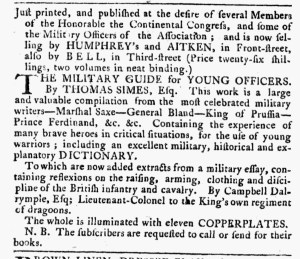
“THE MILITARY GUIDE for YOUNG OFFICERS.  By THOMAS SIMES, Esq.”

Several printers in Philadelphia advertised “THE MILITARY GUIDE for YOUNG OFFICERS” by Thomas Simes in February 1776.  The manual was published in 1776 and contained a compilation of “works of several military authors, including Humphrey Bland and the comte de Saxe.”  When the American Revolution began in 1775, military manuals, such as the one Simes wrote, became popular among young men preparing to join the war and those who had already joined. According to the American Revolution Institute of the Society of the Cincinnati, “to meet the demand for military texts, a flood of printings began to appear from the American presses.”  Additionally, the advertisement above, published in the Pennsylvania Evening Post, which was a newspaper located in Philadelphia, displays how that flood of printing was “centered in Philadelphia, where more than thirty works on military subjects were published in the years 1775 and 1776 alone.”  The advertisement briefly summarizes the book, stating that it included “the experience of many brave heroes in critical situations, for the use of young warriors” to entice the target audience of young men who would serve as officers to purchase the book as a helpful guide. The advertisement even noted that the guide came with its own “explanatory DICTIONARY,” a bonus section. One signer of the Declaration of Independence, William Floyd, owned a copy of Simes’s guide, which can be taken as an indicator of both the quality and popularity of its contents.

**********

ADDITIONAL COMMENTARY:  Carl Robert Keyes

Robert Bell, the publisher of the first edition of Thomas Paine’s Common Sense, continued his feud with William Bradford and Thomas Bradford, the printers of the Pennsylvania Journal, with a new advertisement in the February 22, 1776, edition of the Pennsylvania Evening Post.  Dissatisfied with Bell’s bookkeeping, Paine collaborated with the Bradfords on an expanded edition of his popular political pamphlet, yet Bell took an unauthorized second edition to press and simultaneously published diatribes about Paine and the Bradfords.  His latest advertisement would be the last in the series that attacked the author and his fellow printers.  It filled more than a column, starting on the third page of the February 22 issue of the Pennsylvania Evening Post and overflowing onto the fourth page.  The advertisement for Thomas Simes’s Military Guide for Young Officers, jointly published by Bell, Robert Aitken, and James Humphreys, Jr., immediately followed Bell’s advertisement.  In the column to the right, the Bradfords promoted their “NEW EDITION of COMMON SENSE, With ADDITIONS and IMPROVEMENTS,” and warned that the “Pamphlet advertised by Robert Bell intitled ADDITIONS to COMMON SENSE … consists of Pieces taken out of News Papers, and not written by the Author of COMMON SENSE.”

The advertisement for Simes’s Military Guide for Young Officers thus appeared in the middle of the controversy over the publication of new editions of Common Sense.  Unlike Bell’s questionable decision to produce a second edition of the political pamphlet and then attempt to capitalize off it by publishing another pamphlet of “ADDITIONS” drawn from newspapers rather than written by Paine, he collaborated with Aitken and Humphreys in producing the military manual “at the desire of several Members of the Honorable the Continental Congress, and some of the Military Officers of the Association.”  Bell (along with Aitken and Humphreys) had the right endorsements for an American edition of a manual previously published in London and the printers attempted to leverage that in marketing Simes’s Military Guide for Young Officers to prospective customers who, as Madison notes, could choose from among many similar works published in Philadelphia at the time.  In the Pennsylvania Evening Post, the advertisement appeared in the middle of the various notices in the February 22 edition, but two days later it had a privileged place in the Pennsylvania Ledger.  Humphreys, the printer of that newspaper, placed the advertisement on the first page, making it the first item in the first column.  The printers of the Pennsylvania Gazette gave the advertisement the same treatment in the February 28 edition of their newspaper.  The flamboyant Bell took a more measured approach to marketing the military manual compared to some of the other books and pamphlets he printed and, especially, his new editions of Common Sense.  Perhaps his partners in the endeavor took the lead in marketing Simes’s Military Guide for Young Officers.
December 2

What was advertised in a revolutionary American newspaper 250 years ago today?

Pennsylvania Ledger (December 2, 1775).

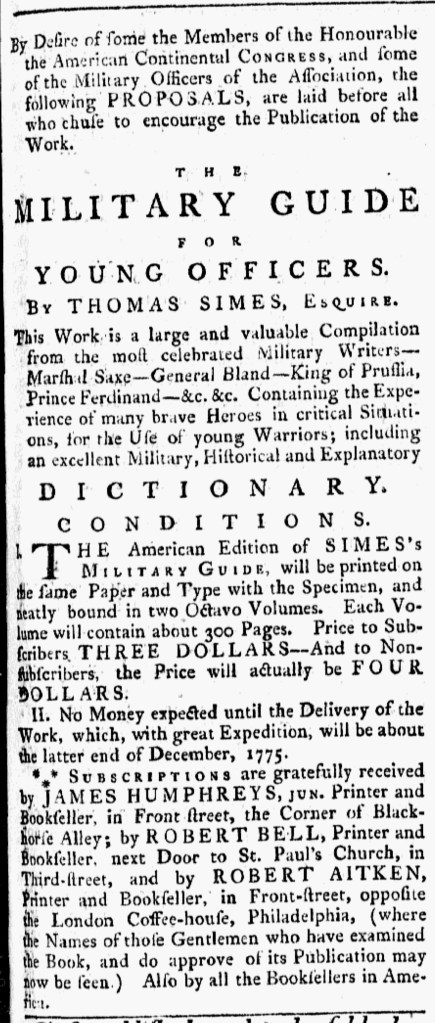
“THE American Edition of SIMES’s MILITARY GUIDE.”

In December 1775, James Humphreys, Jr., Robert Bell, and Robert Aitken collaborated in advertising and publishing The Military Guide for Young Officers by Thomas Simes, making yet another military manual available to the public following the momentous events at Lexington and Concord the previous April.  More recent developments, both military and political, convinced printers that a market existed for military manuals.  According to the introduction to “Books in the Field: Studying the Art of War in Revolutionary America,” an exhibition sponsored by the American Revolution Institute of the Society of the Cincinnati, “a flood of printing began to appear from the American presses.  Much of this activity was centered in Philadelphia, where more than thirty works on military subjects were published in the years 1775 and 1776 alone.”

Of the three of the printer-booksellers who partnered in publishing Simes’s Military Guide, Humphreys was the only one who published a newspaper.  He gave their advertisement a privileged place at the top of the first column on the first page of the December 2, 1775, edition of the Pennsylvania Ledger.  Rather than advertising a book already available for sale, the printer-booksellers distributed subscription proposals, doing so, they claimed, “By Desire of some the Members of the Honourable American Continental CONGRESS, and some of the Military Officers of the Association.”  Readers who wished to reserve copies of the work became subscribers by submitting their names to any of those three printer-booksellers, though they also indicated that “SUBSCRIPTIONS are gratefully received … by all the Booksellers in America.”  Printers, authors, and others in the book trades had more than one reason for circulating subscription proposals.  They hoped to incite greater demand while also learning if sufficient interest existed to make a project viable and, if so, how many copies to produce.

This subscription proposal featured an overview of the contents of the military guide: “a large and valuable Compilation from the most celebrated Miliary Writers … Containing the Experience of many brave Heroes in critical Situations, for the Use of young Warriors” as well as “an excellent Military, Historical and Explanatory DICTIONARY.”  This “American Edition … will be printed on the same Paper and Type with the Specimen, and neatly bound in two Octavo Volumes.”  Apparently, Humphreys, Bell, and Aitken had specimens or samples of the paper and type on display at their printing offices so prospective subscribers could examine them and assess the material quality of the work for themselves before committing to ordering copies.  Printers often circulated specimens along with subscription proposals.  The partners planned to print some surplus copies, expecting that demand would warrant doing so, but encouraged subscribers with a discount.  Those who reserved their copies paid three dollars, but for “Non-subscribers, the Price will actually be FOUR DOLLARS.”  Subscribers did not need to part with their money “until the Delivery of the Work,” anticipated for “the latter end of December, 1775.”  Humphreys, Bell, and Aitken did not take the military manual to press as quickly as they expected.  The imprint on the title page gives the date of publication as 1776.  The partners made one final pitch in the subscription proposals, announcing that “the Names of those Gentlemen who have examined the Book, and do approve of its Publication may now be seen” at Aitken’s printing office.  These marketing efforts apparently helped the partners attract enough subscribers to publish the proposed work.  Not all subscription proposals met with such success.  Current events likely played a role in the outcome when Humphreys, Bell, and Aitken proposed an American edition of The Miliary Guide for Young Officers.

October 2

What was advertised in a revolutionary American newspaper 250 years ago today?

Dunlap’s Pennsylvania Packet (October 2, 1775).

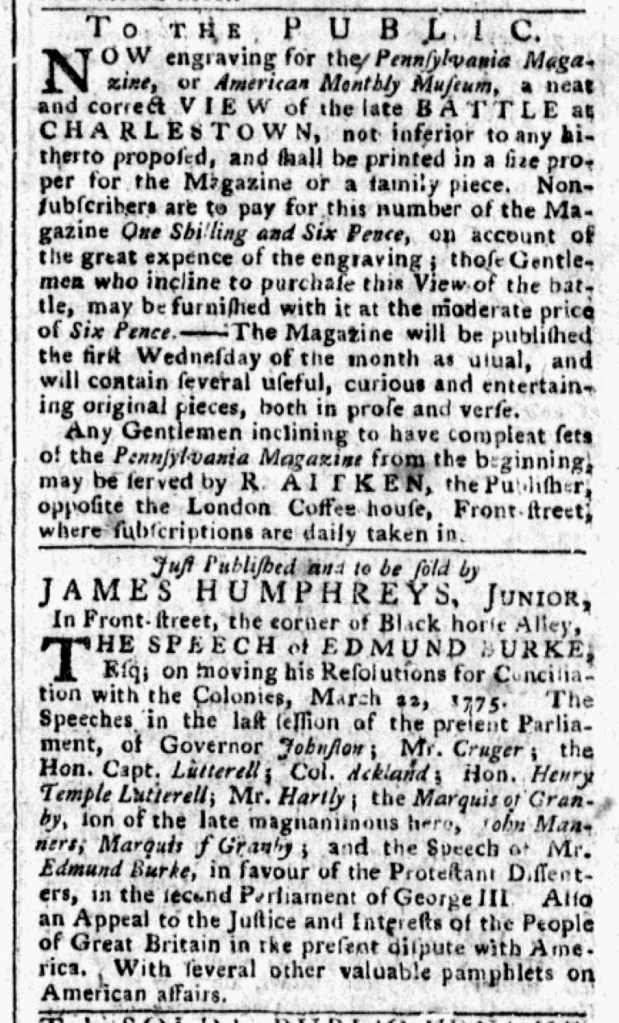
“THE SPEECH of EDMUND BURKE, Esq; on moving his Resolutions for Conciliation with the Colonies.”

Interest in current events continued to influence some of the products advertised to colonial consumers in the October 2, 1775, edition of Dunlap’s Pennsylvania Packet.  Robert Aitken once again ran his advertisement promoting a “neat and correct VIEW of the late BATTLE at CHARLESTOWN,” now known as the Battle of Bunker Hill.  Subscribers to the Pennsylvania Magazine would receive the print as a premium, while others could purchase it separately.

Immediately below Aitken’s advertisement, James Humphreys, Jr., announced that he sold “THE SPEECH of EDMUND BURKE, Esq; on moving his Resolutions for Conciliation with the Colonies, March 22, 1775.”  In that speech, delivered less than a month before the battles at Lexington and Concord, Burke presented peace and strengthening ties with the colonies as preferable to war.  The colonies, after all, were an important market for British goods.  Burke proposed allowing the colonies to elect their own representatives to send to Parliament as well as establishing a General Assembly with the authority to regulate taxes that would meet in the colonies.  By that time, colonizers already recognized Burke as a friend and advocate for their cause.  In April 1774, he had delivered a speech in favor of repealing duties on tea.

Humphreys also advertised a collection of speeches made “in the last session of the present Parliament” by “Governor Johnston; Mr. Cruger; the Hon. Capt. Lutterell; Col. Ackland,” and several others.  That anthology included another speech by Burke, that one “in favour of the Protestant Dissenters” and religious liberty from 1773 during “the second Parliament of George III.”  In addition, Humphreys stocked an “Appeal to the Justice and Interests of the People of Great Britain in the present dispute with America” by Arthur Lee, born in Virginia yet serving as an agent for Massachusetts in London in 1775.  Humphreys concluded with a note that he also sold “several other valuable pamphlets on American affairs.”  He most likely marketed American editions published by James Rivington, the printer of Rivington’s New-York Gazetteer often derided as a Tory who supported Parliament.  Yet Rivington printed, advertised, and disseminated pamphlets representing a range of views, considering each of them opportunities to generate revenue.  Among the “valuable pamphlets” that Humphreys named in his advertisement, he selected only those that supported the American cause, though he may have made a broader range of perspectives available without listing them in the public prints.  Whatever the case, he anticipated that pamphlets about current events would attract customers.

September 3

What was advertised in a revolutionary American newspaper 250 years ago this week?

Pennsylvania Ledger (September 2, 1775).

“LETTERS, Written by the late Right Honourable, the Earl of Chesterfield, To his Son.”

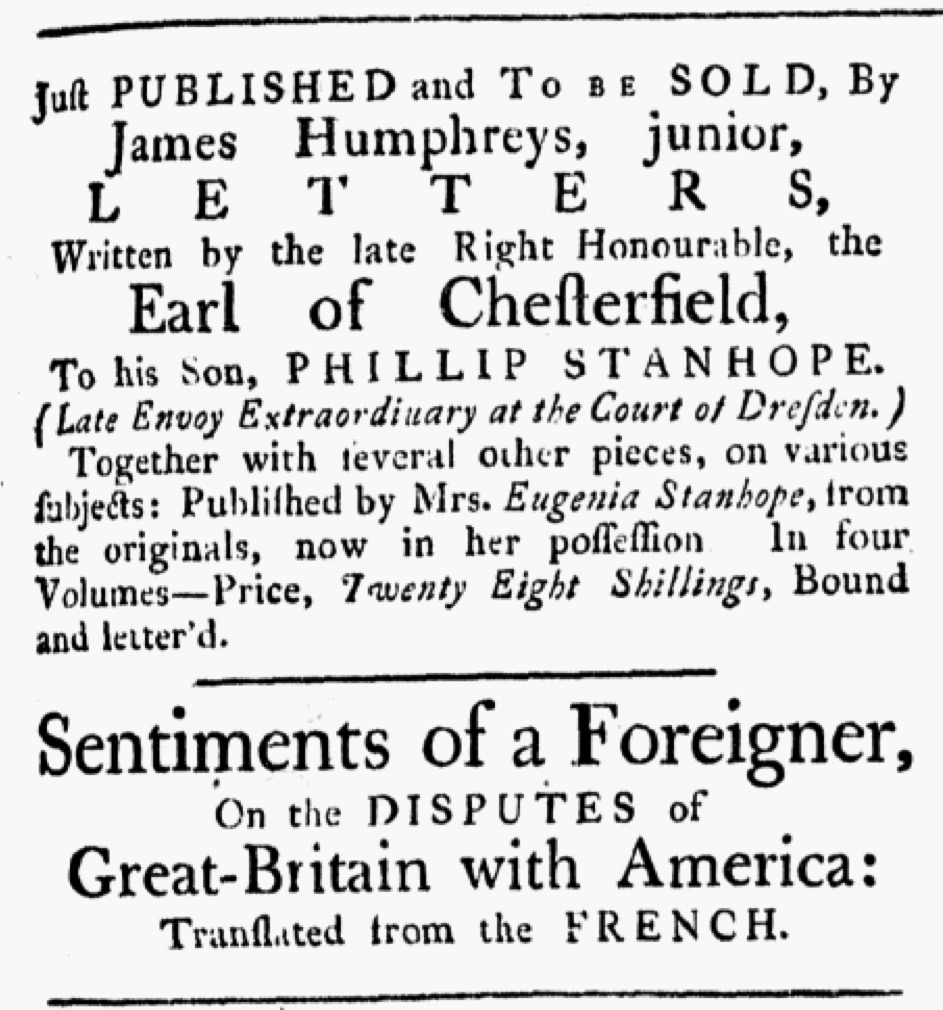
James Humphreys, Jr., led the September 2, 1775, edition of the Pennsylvania Ledger with an advertisement for Letters by the Late Right Honourable, the Earl of Chesterfield, to His Son, Phillip Stanhope.  Although the header proclaimed, “Just PUBLISHED and TO BE SOLD, By James Humphreys, junior,” the printer of the Pennsylvania Ledger merely sold copies of a book printed by others.  As was often the case, the phrase “Just PUBLISHED” meant that a book, pamphlet, print, or other items was now available for purchase, but advertisers expected readers to separate “Just PUBLISHED” and “TO BE SOLD.”  Only the latter applied to the advertiser.  In this case, Humphreys likely stocked copies of an American edition printed by Hugh Gaine and James Rivington in New York.

Prospective customers did not care nearly as much about who printed the book as they did about the contents.  The advertisement (drawn from the extended title of the work) indicated that it consisted of four volumes that contained the Earl of Chesterfield’s letters “Together with several other pieces, on various subjects: Published by Mrs. Eugenia Stanhope, from the original, now in her possession.”  The earl had written 448 letters to his son between 1737, when the boy was five, and his death in 1768.  At that time, the early learned that his son had been secretly wed for a decade and had two sons of his own.  The earl provided for his grandsons but did not support their mother.  In turn, she published the collection of letters.

The letters caused a stir in both Britain and America.  They presented a guide to manners for gentlemen to navigate aristocratic society, prompting colonizers concerned with demonstrating their own gentility to take note of the advice the earl offered to his son.  Yet readers did not universally celebrate the attitude and conduct the early advocated.  Some critiqued what they considered cynical and amoral values contained within the letters.  While Gaine and Rivington may have found eager audiences for the letters in New York and Humphreys in Philadelphia, readers from New England, the descendants of Puritans, were much more skeptical.  Gwen Fries notes that John Adams refused to send Abigail a copy in 1776, advising her that the letters were “stained with libertine Morals and base Principles.”  When she did read them a few years later, she agreed that they contained “the most immoral, pernicious and Libertine principals.”  In confining his advertising copy to the extended title of the work, Humphreys did not take a position.  He likely suspected that even those who had heard that the letters included some unsavory advice would be curious to assess what Chesterfield wrote for themselves.  Many others in Philadelphia, the largest and most cosmopolitan city in the colonies, may not have cared much at all about the sorts of objections raised by readers in Boston.

July 26

What was advertised in a revolutionary American newspaper 250 years ago today?

Pennsylvania Gazette (July 26, 1775).

“A SERMON, on the present Situation of American Affairs … to distribute … among the Military Associators.”

A few days ago, I examined an advertisement for “A sermon on the present Situation of American Affairs” by William Smith that ran in the July 21, 1775, edition of the South-Carolina and American General Gazette.  I concluded that Wells likely sold copies of the pamphlet printed by James Humphreys, Jr., in Philadelphia and shipped to his “GREAT STATIONARY & BOOK STORE” in Charleston.  An advertisement in the July 26, 1775, edition of the Pennsylvania Gazette suggests that was indeed the case.

That notice listed several printers who stocked the sermon.  It gave top billing to James Humphreys, Jr., and noted that “the other Printers in Philadelphia” also sold the sermon.  Radiating outward from the city, the list next named Matthias Slough and Francis Bailey in Lancaster and then Hugh Gaine, the printer of the New-York Gazette and Weekly Mercury, in New York.  The list concluded with “Mr. ROBERT WELLS, in Charlestown, South-Carolina.”  Humphreys apparently dispatched copies to associates both in his own city and in other towns and colonies.

Another aspect of that advertisement indicates that Wells most likely sold copies of the sermon printed by Humphreys in Philadelphia.  Wells did not mention the price in his advertisement, but Humphreys gave prices for a single copy and multiple copies: nine pence for one copy, six shillings for a dozen, and six dollars for one hundred copies.  That pricing structure concluded with a note that Humphreys intended the discount for purchasing in volume as a benefit “for such Persons as may desire to distribute them among the Military Associators.”  He encouraged officers and other Patriots to disseminate the sermon widely by making a gift of it to those who volunteered to defend American liberties.  Humphreys was not alone in envisioning that officers would give books and pamphlets about current affairs as gifts.  George Washington had recently ordered eight copies of Thomas Hanson’s Prussian Evolutions in Actual Engagements to distribute among his subordinates.

The details in Humphreys’s advertisement strengthen the case that Wells did not publish his own edition of Smith’s sermon but instead advertised and sold copies that Humphreys printed in Philadelphia and distributed to printers and booksellers in several cities and towns.  Doing so contributed to the creation of what Benedict Anderson terms an “imagined community” grounded in print.  Newspapers played an important role as printers reprinted news and editorials from one to another, yet colonizers also had access to pamphlets, tracts, and sermons that circulated widely.  They did not have to be present when Smith delivered his sermon to engage with the ideas and arguments that the minister offered for consideration.

May 27

What was advertised in a revolutionary American newspaper 250 years ago today?

Pennsylvania Ledger (May 27, 1775).

“Essays, Articles of News, Advertisements, &c. are gratefully received and impartially inserted.”

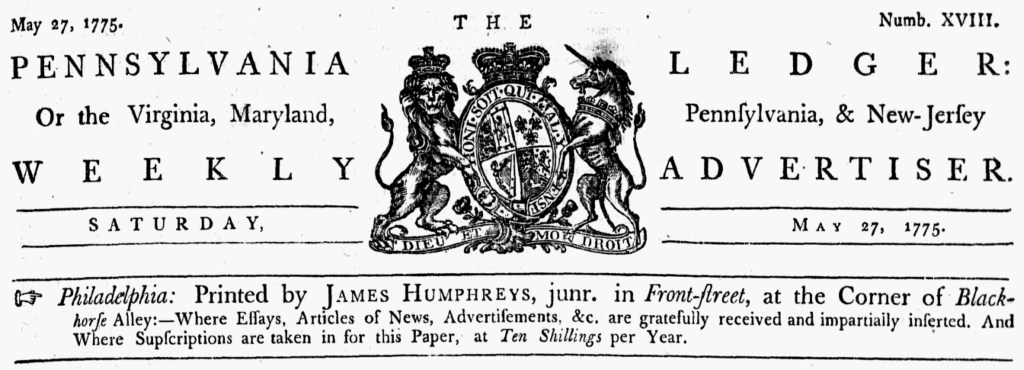
Among newspapers published during the era of the American Revolution, those that included a colophon usually featured it at the bottom of the final page.  A few, including the Pennsylvania Ledger, incorporated the colophon into the masthead.  James Humphreys, Jr., the printer, also used the colophon as a perpetual advertisement for subscriptions and advertisements.  After all, the full title of the newspaper was the Pennsylvania Ledger: Or the Virginia, Maryland, Pennsylvania, & New Jersey Weekly Advertiser.  Accordingly, the colophon gave more than just place of publication and the name of the printer (“Philadelphia: Printed by JAMES HUMPHREYS, junr. in Front-street, at the Corner of Black-horse Alley”); it also informed readers that “Essays, Articles of News, Advertisements, &c. are gratefully received and impartially inserted” and “Subscriptions are taken in for this Paper, at Ten Shillings per Year.”  The enhanced colophon did not, however, give prices for advertising, though Humphreys stated that he set “the same terms as is usual with the other papers in the city” in the subscription proposals he distributed in January 1775.

What did Humphreys mean when he declared that he “impartially inserted” essays (or editorials), news, and advertisements?  In the proposals t, he asserted that “a number of worthy and reputable Gentlemen” in Philadelphia had encouraged him “to establish a Free and Impartial NEWS PAPER, open to All, and influenced by None.”  Furthermore, he proclaimed that he was “determined to act on the most impartial principles, and not render himself liable to be influenced by any party whatever.”  Such idealism stood in stark contrast to the partisanship of most newspapers as the imperial crisis intensified.  Humphreys’s determination to print essays and news from various perspectives amounted to sufficient proof for many Patriots that the printer was a Loyalist since he did not uniformly promote the American cause.  Decades later, Isaiah Thomas, the patriot printer who published the Massachusetts Spy at the same time Humphreys published the Pennsylvania Ledger, took a more evenhanded approach in his History of Printing of America: “The publisher announced his intention to conduct his paper with political impartiality; and perhaps, in times more tranquil than those in which it appeared, he might have succeeded in his plan.  …  The impartiality of the Ledger did not comport with the temper of the times.”[1]  Thomas seemed to consider Humphreys’s commitment to freedom of the press authentic rather than a rationalization for printing Loyalist views.  He was not so kind in his descriptions of other printers whose politics did not align with his own.

Still, the “temper of the times” likely prompted Humphreys to adjust his own advertising for political pamphlets available at his printing office.  When it came to “impartially insert[ing]” advertisements submitted by others, he gave assurances that he neither took an editorial stance when it came to the information they disseminated nor gave some more prominent placement on the page than others.  He did not rank newspapers notices but instead gave advertisers equal access to his press.

**********

[1] Isaiah Thomas, The History of Printing in America: With a Biography of Printers and an Account of Newspapers (1810; New York: Weathervane Books, 1970), 439-440.

May 20

What was advertised in a revolutionary American newspaper 250 years ago today?

Pennsylvania Ledger (May 20, 1775).

“POLITICAL PAMPHLETS, ON Both Sides of the Question.”

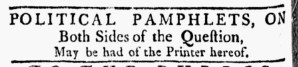
When he launched the Pennsylvania Ledger in the winter of 1775, James Humphreys, Jr., distributed proposals declaring that it would be a “Free and Impartial News Paper, open to All, and Influenced by None.”  With high hopes for operating an impartial press as the imperial crisis intensified, he soon advertised “POLITICAL PAMPHLETS … on Both Sides of the Question” in February 1775.  Several months later, he ran a notice advising that “POLITICAL PAMPHLETS, ON Both Sides of the Question, May be had of the Printer hereof” in the May 20 edition.  Doing so required both courage and commitment, especially considering recent events.

Humphreys published that advertisement a month after the battles at Lexington and Concord.  The siege of Boston continued, yet he did not allow news of the battles or the siege to dissuade him from hawking pamphlets on “Both Sides of the Question.”  Perhaps more significantly, James Rivington, the printer who also published pamphlets “on both sides, in the unhappy dispute with Great-Britain” at his “OPEN and UNINFLUENCED PRESS” in New York, had been hung in effigy in New Brunswick, New Jersey, by colonizers dissatisfied with what they considered his Loyalist sympathies.  Rivington covered that event in his newspaper, Rivington’s New-York Gazetteer, even including a woodcut depicting the scene.  Given that printers exchanged newspapers with their counterparts in other cities and towns, Humphreys likely read about the effigy; even if he did not, he almost certainly heard about it.  Even more recently, Rivington published a notice in which he acknowledged that “many Publications have appeared from my Press which have given great Offence … to many of my Fellow Citizens,” asserted that “Nothing which I have ever done, has proceeded from any Sentiments in the least unfriendly to the Liberties of this Continent,” and pledged “to conduct my Press upon such Principles as shall not give Offence to the Inhabitants of the Colonies.”  Despite his effort to clarify that he had not pursued a political agenda but instead followed his “duty as a Printer” to encourage “the Liberty of the Press,” the Sons of Liberty attacked his home and office on May 10.  Rivington took refuge on a British naval vessel.  Assistants continued publishing the newspaper, inserting his notice about his true intentions twice more.  Rivington had already discontinued advertising political pamphlets representing both sides of what he had previously called “The American Controversy” and “THE AMERICAN CONTEST.”

Although Humphreys advertised political pamphlets from “Both Sides” on May 20, word of what happened to Rivington may have prompted him to reconsider his courage in the weeks and months that followed.  He discontinued that advertisement.  In the next issue, he marketed only one pamphlet for sale at his printing office, The Group, a satire by Mercy Otis Warren that depicted a “SCENE AT BOSTON.”  That publication unabashedly supported the American cause.  A week later, that advertisement appeared on the first page of the Pennsylvania Ledger (as it had in the May 20 edition that carried the advertisement for political pamphlets on the final page), next to an advertisement for a multi-volume set of Political Disquisitions recommended for “all the friends of Constitutional Liberty, whether Britons or Americans.”  Still, the editorial perspective of the Pennsylvania Ledger, according to Isaiah Thomas, “was under the influence of the British government” and Humphreys eventually “refused to bear arms in favor of his country, and against the government of England.”[1]  He experienced sufficient difficulty that he suspended the newspaper at the end of November 1776.  In May 1775, a year and a half earlier, he grappled with what kinds of publications he would promote among the advertisements in his newspaper, first forging ahead with notices for pamphlets representing multiple perspectives and then emphasizing those that supported the American cause, perhaps doing so in hopes of avoiding the treatment that Rivington received.

**********

[1] Isaiah Thomas, The History of Printing in America: With a Biography of Printers and an Account of Newspapers (1810; New York: Weathervane Books, 1970), 398.

March 3

What was advertised in a colonial American newspaper 250 years ago today?

South-Carolina and American General Gazette (March 3, 1775).

“PENNSYLVANIA LEDGER … His First Number may be seen at all the Printing Offices in Charlestown.”

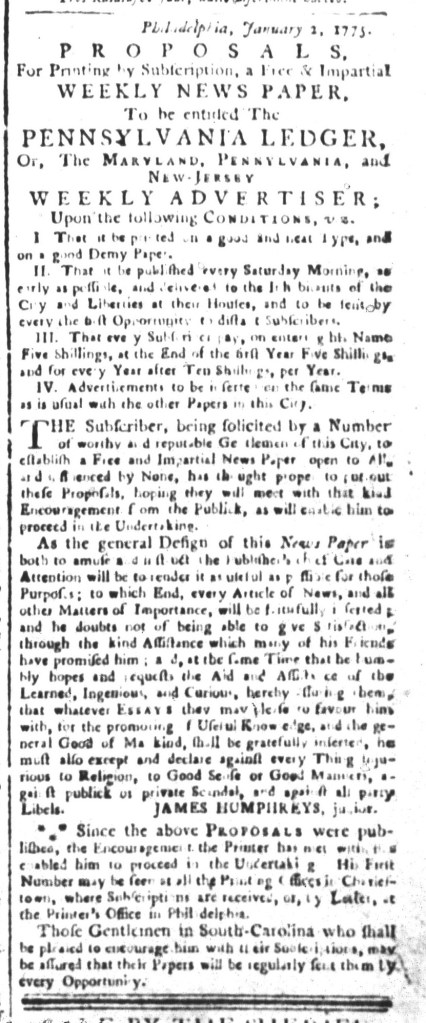
When James Humphreys, Jr., launched the Pennsylvania Ledger in 1775, he sought local subscribers by placing the proposals for his “Free & Impartial WEEKLY NEWSPAPER” in other newspapers published in Philadelphia.  Given the extended title – Pennsylvania Ledger, Or, the Maryland, Pennsylvania, and New-Jersey Weekly Advertiser (in the proposals) or Pennsylvania Ledger: Or the Virginia, Maryland, Pennsylvania, and New-Jersey Weekly Advertiser (on the masthead) – it made sense to promote the newspaper to prospective subscribers and advertisers in towns in Pennsylvania and neighboring colonies.  After all, colonial newspapers served vast regions.

Yet they circulated even more widely than the expansive title of the Pennsylvania Ledger suggested.  Realizing that was the case, Humphreys sent the proposals for the Pennsylvania Ledger to R. Wells and Son, the printers of the South-Carolina and American General Gazette, in Charleston.  Dated “Philadelphia, January 2, 1775,” the proposals ran in the February 24 and March 3 editions.  By that time, Humphreys had already commenced publication of his newspaper.  A note at the end of the advertisement acknowledged that was the case: “Since the above PROPOSALS were published, the Encouragement the Printer has met with has enabled him to proceed in the Undertaking.  His First Number,” published on January 28, “may be seen at all the Printing Offices in Charlestown, where Subscriptions are received.”  Wells and Son acted as local agents for Humphreys, a common practice among eighteenth-century printers who also participated in exchange networks for sharing newspapers and reprinting content.

Another note directed to readers of the South-Carolina and American General Gazette advised, “Those Gentlemen in South-Carolina who shall be pleased to encourage [Humphreys] with their Subscriptions, may be assured that their Papers will be regularly sent them by every Opportunity.”  That the January 28 edition was available for inspection at a local printing office by February 24 testified to Humphreys’s commitment to delivering newspapers to distant subscribers in a timely manner.  While he certainly welcomed individual subscribers, the printer likely hoped that his newspaper would attract the attention of the proprietors of establishments where merchants and others gathered to do business.  Coffeehouses, for instance, often supplied newspapers from near and far for patrons to peruse news about current events and consult the shipping news for updates about commerce in the British Atlantic world.  Humphreys had a reasonable expectation that publishing proposals for the Pennsylvania Ledger would yield subscribers in South Carolina.

February 25

Who was the subject of an advertisement in a colonial American newspaper 250 years ago today?

Pennsylvania Ledger (February 25, 1775).

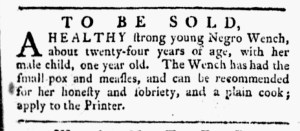
“A HEALTHY strong young Negro [Woman] … with her male child, one year old.”

Five issues.  It took only five issues for an advertisement offering enslaved people for sale to appear in the Pennsylvania Ledger.  James Humphreys, Jr., launched the newspaper on January 28, 1775.  Four weeks later, he printed an advertisement about a “HEALTHY strong young Negro [Woman], about twenty-four years of age,” to be sold “with her male child, one year old.”  The Pennsylvania Ledger was still such a new publication when it carried this advertisement that the proposals and conditions for subscribing appeared as the first item in the first column on the first page.  An advertisement for a political pamphlet ran immediately below the proposals, followed by the advertisement for the enslaved young woman and her child.  Readers encountered them before news reprinted from the Maryland Gazette or any of the other content in that issue.

Humphreys did not merely print and disseminate the advertisement.  He also acted as a broker in the sale.  The notice instructed interested parties to “apply to the Printer.”  What role Humphreys would play when someone did “apply” to him was not apparent in the advertisement.  He may have referred prospective buyers to the advertiser, he may have provided more details about the sale, including price and credit, or he may have been empowered to agree to a sale should a buyer meet the terms specified by the enslaver who offered the woman and child for sale.  Whatever role he played, Humphreys was actively involved in the sale beyond printing the advertisement in his newspaper.

He may have even consulted with the advertiser in composing the advertisement, though it was formulaic enough that an enslaver looking to sell human property likely did not need such assistance.  After all, such “enquire of the printer” advertisements appeared regularly in newspapers published during the era of the American Revolution.  The anonymous advertiser noted that the enslaved woman “has had the small-pox and measles,” a guarantee of her health in the future since she would not contract those diseases again, and “can be well recommended fort her honesty and sobriety.”  In addition, she was a “plain cook.”  Such language was just as common in advertisements for enslaved people as directions to “apply to the Printer” who would act as a broker in the sale.

For more on such advertisements, see Jordan Taylor’s “Enquire of the Printer: The Slave Trade and Early American Newspaper Advertising.”

February 11

What was advertised in a colonial American newspaper 250 years ago today?

Supplement to the Pennsylvania Ledger (February 11, 1775).

“POLITICAL PAMPHLETS … on Both Sides of the Question.”

As the imperial crisis intensified in late 1774 and early 1775, most American newspapers became increasingly partisan, even those that claimed that they did not take a side in the contest between Patriots and Parliament.  Printers sometimes ran advertisements for pamphlets that did not align with the principles most often espoused in their publications, but few made a point of declaring that they did so.  James Rivington, printer of Rivington’s New-York Gazetteer and a noted Loyalist, took the most strident approach in a series of advertisements for “POLITICAL PUBLICATIONSwritten on the Whig and the Tory Side of the Question.”  Sporting headlines like “The American Contest” and “The American Controversy,” those advertisements listed several pamphlets, many of them written in response to others also advertised.

Yet Rivington was not alone.  In the supplement that accompanied the third issue of the new Pennsylvania Ledger, James Humphreys, Jr., the printer, inserted a short notice that announced, “Most of the POLITICAL PAMPHLETS That have been published, on Both Sides of the Question, May be had of the Printer hereof.”  On the first page, he once again ran the proposals for the newspaper, stating that he established a “Free and Impartial News Paper, open to All, and Influenced by None.”  Despite that assertion, “[i]t was supposed that Humhreys’s paper would be in the British interest,” according to Isaiah Thomas in his History of Printing in America (1810).[1]  He further explained that “in times more tranquil than those in which it appeared, [Humphreys] might have succeeded in his plan” to “conduct his paper with political impartiality.”[2]

When it came to marketing strategies for political pamphlets, printers associated with supporting the Tory “Side” took the more evenhanded approach of drawing attention to their commitment to selling and disseminating work on “Both Sides of the Question.”  In Rivington’s case, doing so was a matter of generating revenue as much as operating an impartial press and bookstore.  For Humphreys, on the other hand, doing so seemed to fall in line with the commitment he made in his proposals for the Pennsylvania Ledger.  Even taking those motivations into account, both printers may have considered it necessary to profess that they sold pamphlets on “Both Sides” to justify how many titles they sold that argued from the Tory perspective.

**********

[1] Isaiah Thomas, The History of Printing in America: With a Biography of Printers and an Account of Newspapers (1810; New York: Weathervane Books, 1970), 399.

[2] Thomas, History of Printing, 439.