December 23

What was advertised in a revolutionary American newspaper 250 years ago today?

Virginia Gazette [Dixon and Hunter] (December 23, 1775).

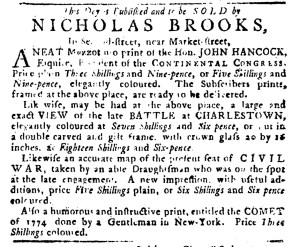
“A large and exact VIEW of the late BATTLE at CHARLESTOWN.”

Like other printers, John Dixon and William Hunter sold books, pamphlets, almanacs, stationery, and other merchandise to supplement the revenues they generated from newspaper subscriptions, advertisements, and job printing.  They frequently placed advertisements in their newspaper, the Virginia Gazette, to generate demand for those wares.  The December 23, 1775, edition, for instance, included three of their advertisements, one for “SONG BOOKS and SCHOOL BOOKS For SALE at this OFFICE” and another for the “Virginia ALMANACK” for 1776 with calculations “Fitting VIRGINIA, MARYLAND, [and] NORTH CAROLINA” by “the ingenious Mr. DAVID RITTENHOUSE of Philadelphia,” the same mathematician who did the calculations for Father Abraham’s Almanack marketed in Philadelphia and Baltimore.

Their third advertisement promoted memorabilia related to the hostilities that erupted at Lexington and Concord earlier in the year.  “Just come to Hand, and to be SOLD at this PRINTING-OFFICE,” Dixon and Hunter proclaimed, “A large and exact VIEW of the late BATTLE at CHARLESTOWN,” now known as the Battle of Bunker Hill.  The copies they stocked were “Elegantly coloured” and sold for “one Dollar.”  Dixon and Hunter apparently carried a print, “An Exact View,” engraved by Bernard Romans and published by Nicholas Brooks, rather than a striking similar (and perhaps pirated) print, “A Correct View,” that Robert Aitken included in a recent issue of the Pennsylvania Magazine, or American Monthly Museum and sold separately.  Romans and Brooks had advertised widely and designated local agents to accept subscriptions for the print.  Dixon and Hunter also advertised another collaboration between Romans and Brooks, “an accurate MAP of The present SEAT of CIVIL WAR, Taken by an able Draughtsman, who was on the Spot at the late Engagement.”  The map also sold for “one Dollar.”  Previous efforts to market the map included a broadside subscription proposal that listed local agents in various towns, including “Purdie and Dixon, Williamsburgh.”  Romans and Brooks apparently had not consulted with all the printers, booksellers, and other men they named as local agents when they drew up the list or else they would have known that Alexander Purdie and John Dixon had dissolved their partnership in December 1774.  Dixon took on Hunter as his new partner while Purdie set about publishing his own Virginia Gazette.  Those details may have mattered less to Romans and Brooks than their expectation that printers, booksellers, and others with reputations for supporting the American cause would indeed aid them in marketing and selling a map depicting the conflict underway in Massachusetts.  Whether or not Purdie or Dixon and Hunter collected subscriptions, local agents in Williamsburg did eventually sell the print and the map that supplemented newspaper accounts and encouraged feelings of patriotism among the consumers who purchased them.

November 27

What was advertised in a revolutionary American newspaper 250 years ago today?

Norwich Packet (November 27, 1775).

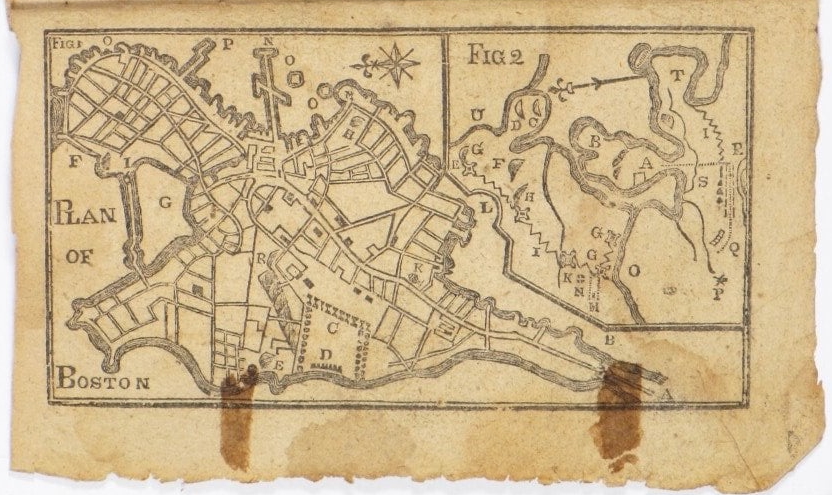
“Illustrated with a beautiful PLAN OF BOSTON, AND THE PROVINCIAL CAMP.”

When Alexander Robertson, James Robertson, and John Trumbull, printers of the Norwich Packet, advertised Bickerstaff’s New-England Almanack, For the Year of Our Lord, 1776, they promoted the “beautiful PLAN OF BOSTON, AND THE PROVINCIAL CAMP” that accompanied the handy reference volume.  Like many other almanacs for 1776 (published in the final months of 1775), this one featured items related to the events that had transpired since the battles at Lexington and Concord on April 19.  In addition to the map of Boston, it also contained the “Method of making Gun-Powder, which at this Juncture may be carried into Execution in a small Way, by almost every Farmer in his own Habitation.”  In a resolution passed in late June, the Second Continental Congress encouraged colonizers to contribute to the American cause by manufacturing gunpowder and saltpeter in small batches.

As a marketing strategy, the printers highlighted the “PLAN OF BOSTON, AND THE PROVINCIAL CAMP” that depicted the ongoing siege of Boston by the American army under the command of George Washington.  Along with the headline in the advertisement, they listed the elements of the “very neat Plan of the Town of Boston, shewing at one View, the Provincial Camp, Boston Neck, Fortifications, Commons, Battery, Magazine, … Liberty Tree, … Bunker’s Hill, … Provincial Lines, … Roxbury Hill Lines, Ministerial Army’s Lines,” and many other significant sites in the area.  The Robertsons and Trumbull declared that this map was “Equally accurate with that sold in the southern Colonies at one Spanish Dollar.”  Consumers did indeed have other options for purchasing similar maps, either separately or inserted in the Pennsylvania Magazine or inserted in another almanac.  Indeed, the map that accompanied Bickerstaff’s New-England Almanack looked almost identical to the one that illustrated “HUTCHIN’s Improv’d,” printed and sold by Hugh Gaine in New York.  Maps of Boston proliferated in 1775 as printers sought to generate revenues while keeping the public informed about current events and consumers sought materials beyond news reports to help them envision and understand what occurred in Massachusetts as resistance became revolution.

“Plan of Boston,” in Bickerstaff’s New-England Almanack, for the Year of Our Lord, 1776 (Norwich, Connecticut: Robertsons and Trumbull, 1775). Courtesy Boston Rare Maps.

November 1

What was advertised in a revolutionary American newspaper 250 years ago today?

Pennsylvania Journal (November 1, 1775).

“A NEAT Mezzotinto print of the Hon. JOHN HANCOCK.”

“A large and exact VIEW of the late BATTLE at CHARLESTOWN.”

“An accurate map of the present seat of CIVIL WAR.”

Nicholas Brooks produced and marketed items that commemorated the American Revolution before the colonies declared independence.  In an advertisement in the November 1, 1775, edition of the Pennsylvania Journal, for instance, he packaged together three prints previously advertised separately, each of them related to imperial crisis that had boiled over into a war.  For this notice, Brooks presented them as a collection of prints for consumers who wished to demonstrate their support for the American cause by purchasing and displaying one or more of them.

Brooks announced that a “NEAT Mezzotinto print of the Hon JOHN HANCOCK, Esquire, President of the CONTINENTAL CONGRESS,” that had previously been proposed in other advertisements had been published and was now for sale at his shop on Second Street in Philadelphia.  The subscribers who had reserved copies in advance could pick up their framed copies or arrange for delivery.  Others who had not placed advanced orders could acquire the print for three shillings and nine pence or pay two extra shillings for one “elegantly coloured.”

“Likewise, may be had at the above place,” Brooks reported, “a large and exact VIEW of the late BATTLE at CHARLESTOWN,” depicting what has become known as the Battle of Bunker Hill.  This print competed with an imitation bearing a similar title, “a neat and correct VIEW of the late BATTLE at CHARLESTOWN,” that Robert Aitken inserted in the Pennsylvania Magazine and sold separately.  Brooks, who had long experience selling framed prints, offered choices for his “exact VIEW.”  Customers could opt for an “elegantly coloured” version for seven shillings and six pence” or have it “put in a double carved and gilt frame, with glass 20 by 16 inches,” for eighteen shillings and six pence.  The eleven shillings for the frame, half again the cost of the print, indicated that Brooks anticipated that customers would display the “exact VIEW” proudly in their homes or offices.

He also promoted “an accurate map of the present seat of CIVIL WAR, taken by an able Draughtsman,” Bernard Romans, “who was on the spot of the late engagement.”  Brooks revised copy from earlier advertisements: “The draught was taken by the most skillful draughtsman in all America, and who was on the spot at the engagements of Lexington and Bunker’s Hill.”  The map showed a portion of New England that included Boston, Salem, Providence, and Worcester.   This print, he declared, was a “new impression, with useful additions,” though he did not specify how it differed from the one he previously marketed and sold.  As with the others, customers had a choice of a plain version for five shillings or a “coloured” one for six shillings and six pence.

Brooks added one more item, “a humorous and instructive print, entitled the COMET of 1774, done by a Gentleman in New-York.”  Did this print offer some sort of satirical commentary on current events?  Or was it unrelated to the prints of Hancock, the Battle of Bunker Hill, and the “CIVIL WAR” in New England?  Whatever the additional print depicted, Brooks made the prints that commemorated the American Revolution the focus of his advertisement, gathering together three items previously promoted individually.  In so doing, he not only offered each print to customers as separate purchases but also suggested that they could consider them part of a collection.  Consumers who really wanted to demonstrate their patriotism could easily acquire all three at his shop.

October 16

What was advertised in a revolutionary American newspaper 250 years ago today?

New-York Journal (October 16, 1775).

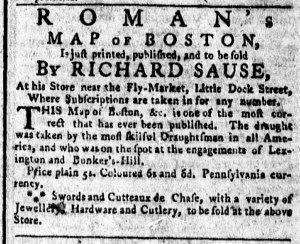
“THIS Map of Boston, &c. is one of the most correct that has ever been published.”

Richard Sause, a cutler in New York, became a local agent in that city when Nicholas Brooks and Bernard Romans collaborated on a map of Boston.  Brooks, a shopkeeper in Philadelphia, described himself as “the printer of said Maps” in newspaper advertisements, though he likely meant that he was the publisher who collaborated with Romans, a noted cartographer.  Sause had not been among the original list of local agents in an advertisement that appeared in Rivington’s New-York Gazetteer in August 1775, nor had he been on the list on a broadside subscription proposal that circulated in the summer and fall.  When Brooks and Romans launched a second project, “An Exact VIEW of the late BATTLE at CHARLESTOWN,” the subscription proposal in the Pennsylvania Ledger included “Mr. Richard Sause in New-York” among the local agents.  Brooks and Romans apparently supplied him with copies of the map as well as the print depicting what is now known as the Battle of Bunker Hill.

Sause, a frequent advertiser, was already familiar to consumers in New York.  A woodcut depicting various kinds of cutlery available at his “Jewlery, Hardware, and Cutlery Store” often adorned his advertisements in newspapers printed in that city.  In the summer and fall of 1775, he emphasized “SMALL SWORDS” in his advertisements.  Following the outbreak of hostilities at Lexington and Concord in April, residents of New York and other towns did not know what to expect.  Many prepared to defend their liberties should the British turn their attention to them.  Sause made sure that Patriots in New York knew that he could supply them with various kinds of small swords.  He even made a pitch for those items at the end of his advertisement for Romans’s map of Boston: “Swords and Cutteaux de Chase [a short sword], with a variety of Jewellery, Hardware and Cutlery, to be sold at the above Store.”

Yet the “MAP OF BOSTON” was the main attraction in that advertisement.  In addition to the headline in capital letters, Sause’s notice billed the map as “one of the most correct that has ever been published.”  To help make sales, he emphasized that the “draught [draft] was taken by the most skilful Draughtsman in all America.”  Buyers could depend on its accuracy because Romans “was on the spot at the engagements of Lexington and Bunker’s-Hill.”  Current events certainly played a role in Sause expanding his business to incorporate a new revenue stream, yet marketing and selling both Brooks and Romans’s map of Boston and prints depicting the Battle of Bunker Hill also gave him an opportunity to participate in politics via the marketplace.

September 28

What was advertised in a revolutionary American newspaper 250 years ago today?

New-York Journal (September 28, 1775).

“The Words of Command used in the Manual Exercise, and an accurate Plan of Boston.”

Almost simultaneously with Hugh Gaine announcing in the New-York Gazette and Weekly Mercury that he had “Just PUBLISHED … HUTCHIN’s Improv’d; BEING AN ALMANACK … For the Year of our LORD 1776,” Frederick Shober and Samuel Loudon inserted an advertisement in the New-York Journal to alert the public that they had “Just published … The NEW-YORK and COUNTRY ALMANACK, For the Year of our Lord 1776.”  It included “all the necessary Articles usual in an Almanac, with the Addition of many curious Anecdotes, Receipts [or Recipes], [and] poetical Pieces.”  Unlike Gaine, Shober and Loudon did not provide an extensive list of the contents.  As printer of the New-York Gazette and Weekly Mercury, Gaine had access to as much space as he wished to devote to promoting an almanac he published.  Shober and Loudon, on the other hand, paid to run their advertisement in the New-York Journal.

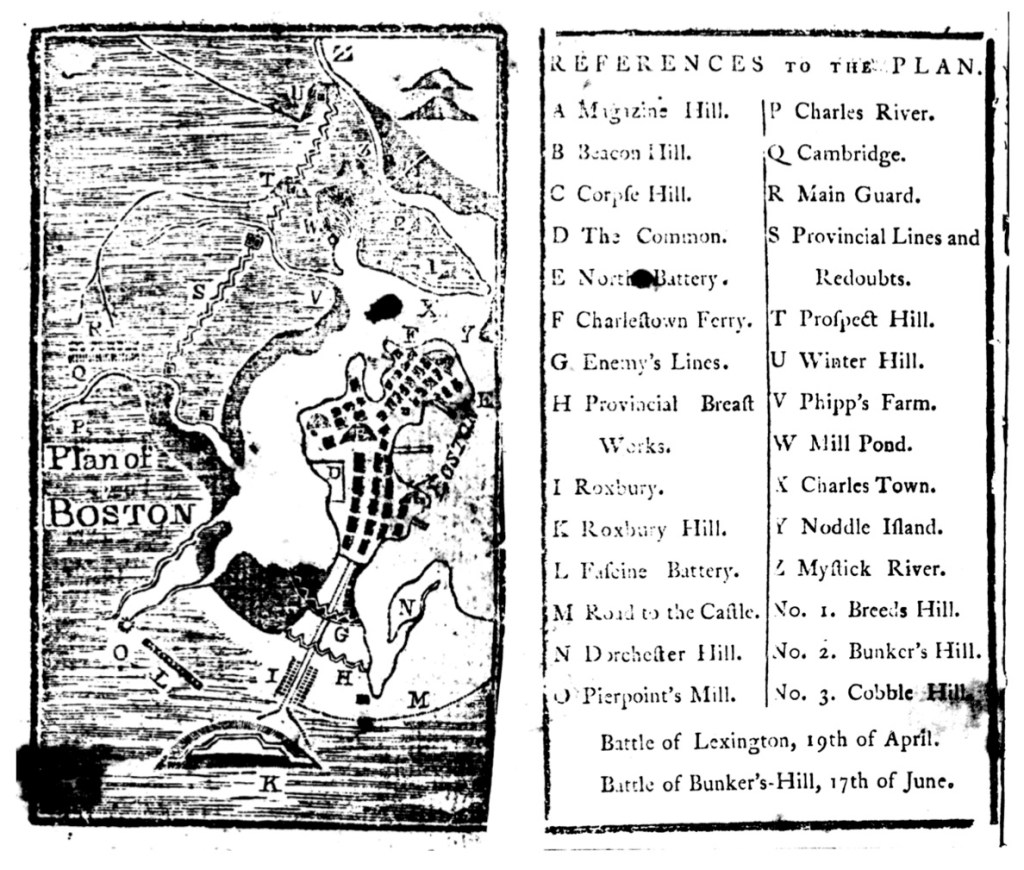
The partners did, however, specify two items that they wanted prospective customers to know they would find in the New-York and Country Almanack: “the Words of Command used in the Manual Exercise, and an accurate Plan of Boston with the different Situations of the Provincials, and the Ministerial Armies.”  Both reflected current events.  The “REFERENCES TO THE PLAN” (or legend for the map of Boston) in the almanac highlighted the “Battle of Lexington, 19th of April,” and the “Battle of Bunker’s-Hill, 17th of June.”  For readers beyond Massachusetts who did not directly experience those battles, that helped solidify in their minds the dates that they occurred.  By the time that Shober and Loudon took their almanac to press, maps of Boston had circulated widely in the July issue of the Pennsylvania Magazine (and Loudon had been among the booksellers to advertise them).  Nicholas Brooks and Bernard Romans also collaborated on a map that they likely distributed by the end of summer.  Those may have served as models for the “Plan of Boston” that Sober and Loudon commissioned for their almanac.  Gaine also directed attention to the “beautiful Plan of Boston, and the Provincial Camp” in his almanac.  The “whole Process of making SALT PETRE, recommended by the Hon. the Continental Congress” and a “Method of making Gun-Powder” accompanied their map.  In Shober and Loudon’s almanac, the “Words of Command,” taken from the widely published Manual Exercise, supplemented the map.  In both cases, the events of the Revolutionary War inspired the contents of the almanacs and became selling points in marketing them.

“Plan of Boston” [left] and “References to the Plan” [right], in The New-York and Country Almanack for the Year of Our Lord 1776 (New York: Shober and Loudon, 1775). Courtesy American Antiquarian Society.

September 25

What was advertised in a revolutionary American newspaper 250 years ago today?

New-York Gazette and Weekly Mercury (September 25, 1775).

“Illustrated with a beautiful Plan of Boston, and the Provincial Camp.”

When fall arrived, it was time to market almanacs for the coming year.  It was an annual ritual in American newspapers from New England to Georgia.  Hugh Gaine, the printer of the New-York Gazette and Weekly Mercury, began advertising “HUTCHIN’s Improv’d: BEING AN ALMANACK … For the Year of our LORD 1776” on September 18, 1775, and then inserted his extensive notice in subsequent issues.  The almanac’s contents included the usual astronomical data, such as “Length of Days and Nights” as well as a schedule of the courts, a description of roads to other cities and towns, and “useful Tables, chronological Observations and entertaining Remarks.”  Gaine enumerated thirty-one of those items, such as a “Very comical, humorous, and entertaining Adventure of a young LADY that used to walk in her sleep,” an essay on the “evil Consequences of Sloth and Idleness,” and a “Method for destroying Caterpillars on Trees.”

If all of that was not enough to entice customers, Gaine made sure that they knew that the almanac was “Illustrated with a beautiful Plan of Boston, and the Provincial Camp.”  That proclamation led the advertisement, appearing immediately above the title of the almanac.  Gaine then devoted the greatest amount of space to describing the map: “13. A very neat Plan of the Town of Boston, shewing at one View, the Provincial Camp, Boston Neck, Fortification, Commons, Battery, Magazines, Charlestown Ferry, Mill Pond, Fort Hill, Corps Hill, Liberty Tree, Windmill Point, South Battery, Long Wharf, Island Wharf, Hancock’s [Wharf], Charlestown, Bunker’s Hill, Winter Hill, Cobble Hill, Forts, Prospect Hill, Provincial Lines, Lower Fort, Upper [Fort], Main Guard, Cambridge College, Charles River, Pierpont’s Mill, Fascine Battery, Roxbury Hill Lines, General Gage’s Lines, Dorchester Hill and Point, and Mystick River.”  As the siege of Boston continued, Daine realized that colonizers in Boston would be interested in supplementing what they read in newspapers and heard from others with a map that would help them envision and better understand recent events.

What was the source for the map?  According to the catalog description for the almanac by PBA Galleries, Auctioneers and Appraisers, the map, “titled a ‘Plan of Boston,’ details Boston’s Shawmut Peninsula and with a smaller inset of the greater Boston area.  Both maps appear to be based on the ‘New and Correct Plan of the Town of Boston and Provincial Camp,’ which appeared in the Pennsylvania Magazine for July, 1775.”  The image that Aitken marketed to spur magazine sales found its way into another periodical publication.  Another printer used it to generate demand for an item produced on his press.

Gaine also listed “11. The whole Process of making SALT PETRE, recommended by the Hon. The Continental Congress, for the making of which there is a Bounty now given both in this and the neighbouring Provinces” and “12. The Method of making Gun-Powder, which at this Juncture may be carried into Execution in a small Way, by almost every Framer in his own Habitation.”  The auction catalog further clarifies that the almanac contains “the Resolution of Congress, July 28, 1775 on the necessity of making gunpowder in the colonies, signed in print by John Hancock, with a recipe for gunpowder on the reverse of the map.”  More than ever, current events played a part in compiling the contents and then marketing almanacs.

“Plan of Boston,” in Hutchins Improved: Being an Almanack and Ephemeris … For the Year of Our Lord 1776 (New York: Hugh Gaine, 1775). Courtesy PBA Galleries, Auctioneers and Appraisers.

August 21

What was advertised in a revolutionary American newspaper 250 years ago today?

New-York Gazette and Weekly Mercury (August 21, 1775).

“To the last Number for July, is affix’d a new and correct Plan of the TOWN of BOSTON, and PROVINCIAL CAMP.”

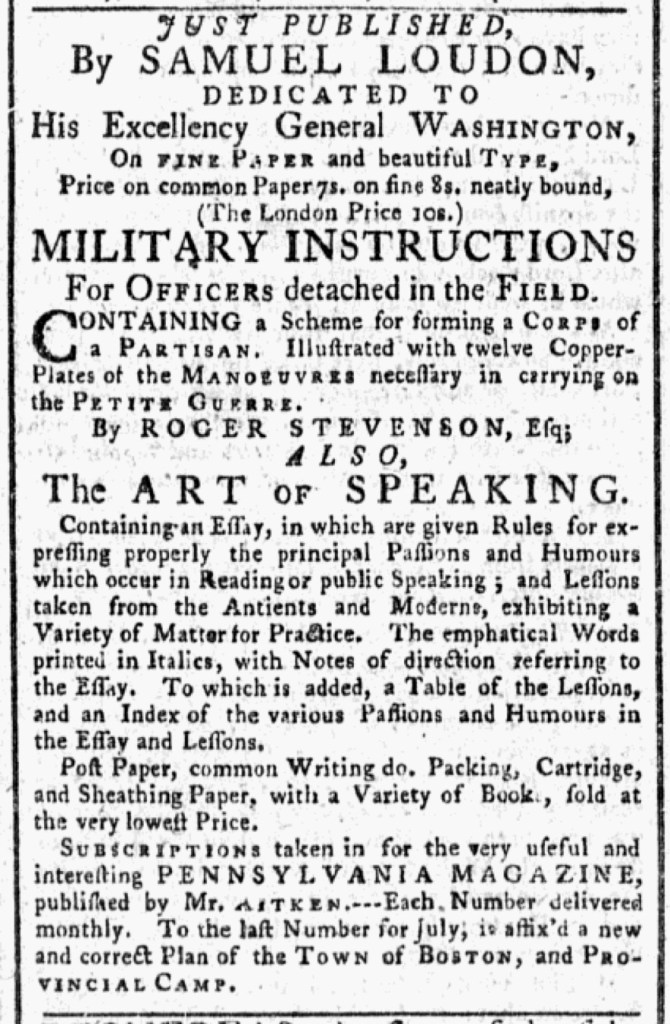
In the summer of 1775, Samuel Loudon, a bookseller in New York, stocked books printed by Robert Aitken in Philadelphia.  He advertised Military Instructions for Officers Detached in the Field, “DEDICATED TO His Excellency General Washington,” and The Art of Speaking in the August 21, 1775, edition of the New-York Gazette and Weekly Mercury.  He also noted that he stocked an assortment of paper and a “Variety of Books” that he “sold at the very lowest Price.”

Loudon concluded his advertisement by promoting another of Aitken’s projects.  The bookseller advised the public that he collected subscriptions “for that very useful and interesting “PENNSYLVANIA MAGAZINE, published by Mr. AITKEN.”  The Pennsylvania Magazine, or, American Monthly Museum commenced publication with its January 1775 issue, briefly overlapping with the Royal American Magazine.  Upon the demise of the latter, it became the only magazine published in the colonies.

To incite interest, Loudon noted that “the last Number for July” featured a “new and correct Plan of the TOWN of BOSTON, and PROVINCIAL CAMP.”  According to the Norman B. Leventhal Map and Education Center at the Boston Public Library, this map “was the earliest printed depiction of Boston after the battle of Bunker Hill, June 17, 1775.”  It includes an inset that “shows the location of the location of the battle, as well as provincial (American) lines in the communities surrounding Boston.”  This demonstrated “the commanding position enjoyed by the Continental Army.”

Getting a free map of Boston following the Battle of Bunker Hill was certainly an incentive to subscribe to the Pennsylvania Magazine!  But was it the first map of Boston created after that battle?  Perhaps, but it might better be described as one of the first depictions of Boston after the Battle of Bunker Hill.  A note in the Leventhal Center’s online catalog states, “This date is inferred,” likely because the map was “Engrav’d for the Pennsylva. Magazine” for July 1775.  Yet the assertion that it was the earliest printed depiction of Boston after the Battle of Bunker Hill may rely on an assumption that colonial printers published magazines at the beginning of the month when they instead issued monthly issues at the end of the month or early in the following month.  Thus, Aitken distributed the July 1775 issue of the Pennsylvania Magazine at the same time that he, Nicholas Brooks, and others advertised Bernard Romans’s map of Boston, a map that also featured an inset showing the “Provincial Lines” during the siege of the city and the site of the Battle of Bunker Hill.  Aitken may have consulted with Romans when preparing a map to accompany the magazine.  For prospective subscribers, it may not have mattered whether they acquired the first map of Boston published after the Battle of Bunker Hill, only that they had access to the map … and at a bargain price since it came as a premium with their subscription to the Pennsylvania Magazine rather than purchasing Romans’s map separately.

“A New and Correct Plan of the Town of Boston, and Provincial Camp” (1775). Courtesy Norman B. Leventhal Map and Education Center at the Boston Public Library.

August 19

What was advertised in a revolutionary American newspaper 250 years ago today?

Pennsylvania Ledger (August 19, 1775).

“Map of Boston … the engagements of Lexington and Bunker’s Hill.”

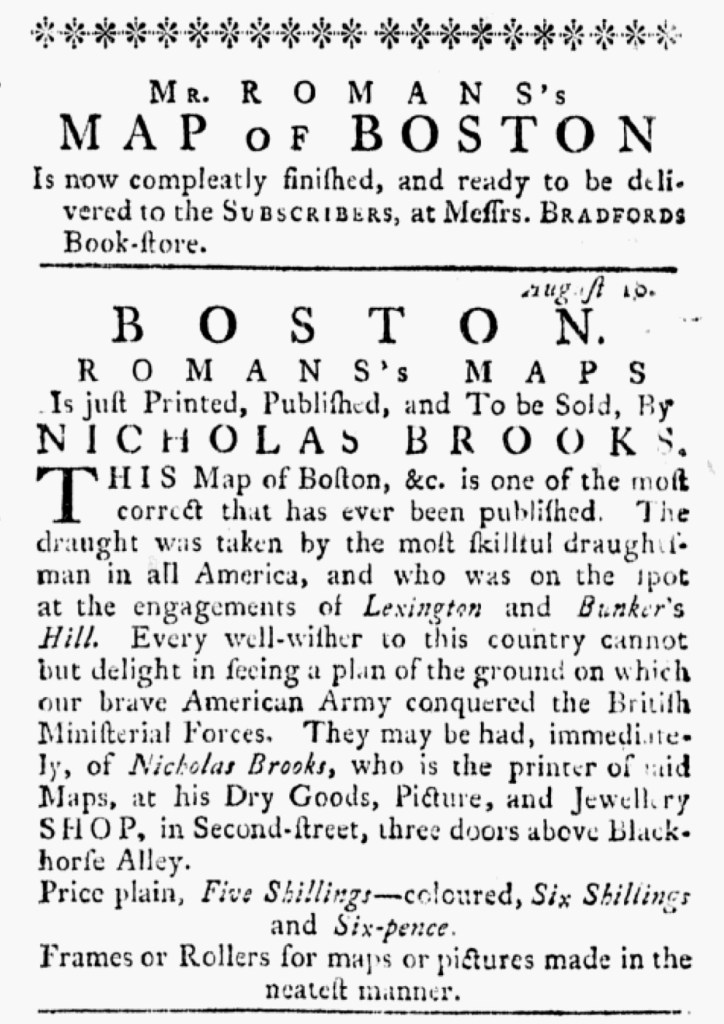
More advertisements for “MR. ROMANS’s MAP OF BOSTON” appeared in the August 19, 1774, edition of the Pennsylvania Ledger.  Bernard Romans, the cartographer who created a “MAP, FROM BOSTON TO WORCESTER, PROVIDENCE AND SALEM. Shewing the SEAT of the present unhappy CIVIL WAR in NORTH-AMERICA,” and Nicholas Brooks, the publisher, previously promoted the project with a broadside subscription proposal that began circulating in the middle of July and scattered references to the map at the end of advertisements in the Pennsylvania Ledger.  Two weeks earlier, for instance, Brooks ran an advertisement that featured an extensive list of merchandise available at his shop and added a nota bene of a single line: “Romans’s map of the seat of war near Boston, &c.”  Robert Aitken mentioned the map in a slightly longer nota bene when he advertised Military Instructions for Officers Detached in the Field.  An advertisement in Rivington’s New-York Gazetteer replicated the copy from the broadside.

Once the map was “completely finished, and ready to be delivered to the SUBSCRIBERS,” as William Bradford and Thomas Bradford put it in their advertisement, or “just Printed, Published, and To be Sold,” as Brooks proclaimed in his own notice, it received greater attention in newspaper notices.  Although many similar projects utilized subscription proposals in newspapers to generate demand attract orders in advance of publication, Romans and Brooks relied on their broadside subscription proposal during their first round of marketing and later added newspaper advertisements once the map was available for sale.

Just four months after the battles at Lexington and Concord, a remarkably short interval for such an endeavor, Brooks advertised copies of Romans’s map of Boston for sale at his “Dry Goods, Picture, and Jewellery SHOP” in Philadelphia.  He touted the quality of the map, declaring it “one of the most correct that has ever been published” and emphasiziong that the “draught was taken by the most skillful draughtsman in all America.”  As if that was not enough to sell it, Romans “was on the spot at the engagements of Lexington and Bunker’s Hill.”  Brooks marketed an eyewitness account of those important battles.  Furthermore, he asserted that consumers had a patriotic duty to examine the map, which they could do by purchasing it.  “Every well-wisher to this country,” Brooks trumpeted, “cannot but delight in seeing a plan of the ground on which our brave American Army conquered the British Ministerial Forces.”  Commemoration and commodification of the American Revolution occurred before the Continental Congress declared independence.

August 3

What was advertised in a revolutionary American newspaper 250 years ago today?

Rivington’s New-York Gazetteer (August 3, 1775)

“MAP … Shewing the SEAT of the present unhappy CIVIL WAR in NORTH-AMERICA.”

On August 3, 1775, Rivington’s New-York Gazetteer carried a subscription proposal for a “COMPLETE and ELEGANT MAP” that extended from Boston to Worcester to the west, Providence to the south, and Salem to the north, “Shewing the SEAT of the present unhappy CIVIL WAR in NORTH-AMERICA.”  The “AUTHOR,” Bernard Romans, realized that colonizers who read and discussed news about the battles at Lexington and Concord in April, the siege of Boston that followed, and the Battle of Bunker Hill would likely be interested in learning more about the geography of New England.  Among the conditions, he specified that “all places where any remarkable event has hitherto occurred, and the provincial lines, &c. shall be particularly pointed out.”  The map itself featured an inset that depicted “BOSTON and itsENVIRONS” that did indeed have its own legend identifying important places, “Provincial Lines,” and “Enemy Lines” as well as an illustration that provided “A View of the Lines thrown upon BOSTON NECK: by the Ministerial Army.”

Romans made support for the American cause an integral part of his marketing effort.  He followed the list of conditions for subscribing (that included the price and descriptions of “good paper and large scale”) with a reflection on the imperial crisis: “Hail, O Liberty! thou glorious, thou inestimable blessing: Banished from almost every part of the old world, America, thy darling, received thee as her beloved: Her arms shall protect thee, – her sons will cherish thee!”  When Romans published the map, it included a dedication “To the Hone. Jno. Hancock Esqre. President of ye Continental Congress … By his Most Obedient Humble Servant.”  As Patriots purchased, collected, and consulted political pamphlets, journals of the proceedings of the First Continental Congress, orations about the Boston Massacre, and sermons about the present state of affairs, Romans presented them with yet another piece of memorabilia that helped them in better understanding current events.  The map was a commemorative item produced and sold even before the colonies declared independence.

**********

The Massachusetts Historical Society has digitized Romans’s map, accompanied by a brief overview of its significance and a short essay about Romans and other cartographers active during the era of the American Revolution.