October 10

GUEST CURATOR: Jordan Russo

What was advertised in a colonial American newspaper 250 years ago today?

oct-10-10101766-new-london-gazette
New-London Gazette (October 10, 1766).

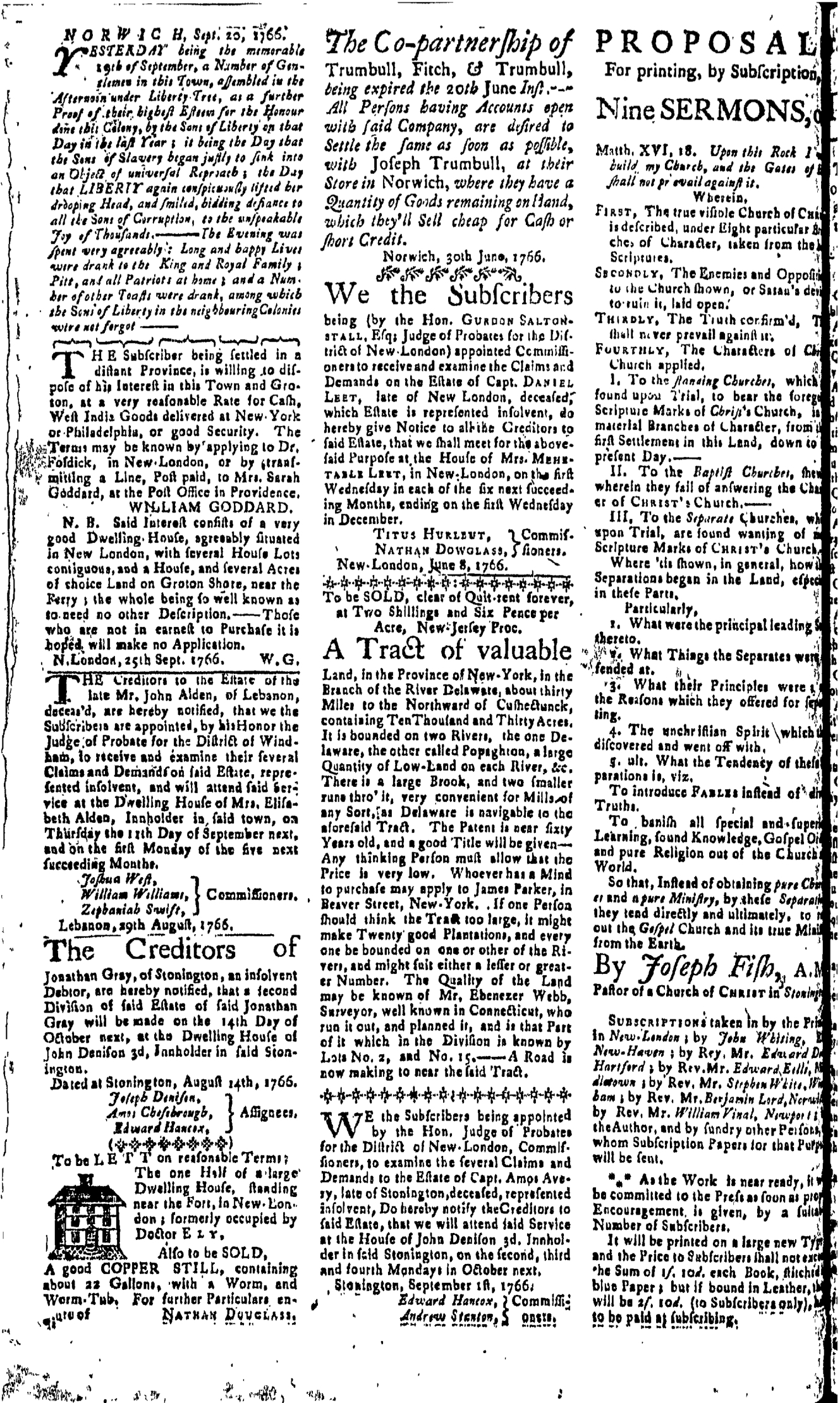
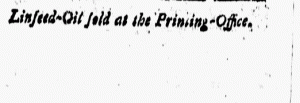
“Linseed-Oil … for ready CASH.”

Lindseed oil has many uses today, but this advertisement made me wonder how colonists used linseed oil in the eighteenth century. According to the historians at Historic Jamestowne, linseed oil was “used in wood treatments, paint and animal fodder.” Linseed oil had many uses so it is understandable why people would need it back then as well.

“For ready CASH” meant that the customer needed to have money for that item right as they bought it. “In colonial America,” according to David Walbert, “nobody had enough cash. There wasn’t enough cash to go around — not enough to cover the value of all the goods and services that were available to be bought and sold.” The advertisement I examined yesterday included some of the goods the colonists wanted to purchase, such as necklaces, ribbons, and teas.” It also stated that the shopkeeper sold those goods “for CASH only.” Both Jolley Allen and the company selling the linseed oil wanted cash right away for the goods they sold. They did not want to give credit over time to colonists it seems.

**********

ADDITIONAL COMMENTARY: Carl Robert Keyes

Linseed oil (or flaxseed oil) is a byproduct of flax production, which made it a widely available product in colonial America because farmers grew flax to process and ultimately weave into linen in small-scale production. Flax possessed many advantages. For instance, it “has the greatest tensile strength of any natural fiber,” except for ramie. On the other hand, “its overwhelming disadvantage [was] the amount of labor, skilled and otherwise, required from sowing to harvest.” Furthermore, processing flax was “an extremely labor-intensive process” that involved many steps, as explained in greater detail by Historic Jamestowne. After harvest, the first step was removing the seeds in a process called rippling, which involved putting flax bundles through coarse combs. Jordan has chosen an advertisement that appears rather plain; it belies the amount of labor involved in producing linseed oil before offering it for sale.

I found the placement of this advertisement rather interesting. Except for the colophon, it was the last item that appeared in the final column of the October 10, 1766, issue of the New-London Gazette. The printer devoted more than half of the issue (the first two pages in their entirety, excepting the masthead, and most of the first column on the third page) to reprinting “The EXAMINATION of Doctor Benjamin Franklin, before an August Assembly, relating to the Repeal of the Stamp-Act.” As we saw last week, colonial printers deployed a bit of subterfuge to publish Franklin’s testimony before Parliament.

The Stamp Act intensified many colonists’ desire to become self-sufficient rather than rely on goods, especially textiles, imported from England and elsewhere. Both news items and advertisements promoted domestic manufactures as a means of reducing Parliament’s influence in North American affairs. However, schemes for the mass production of linen in the colonies continued to fall short because, as Michele Mormul explains, “they lacked funding and labor was too expensive.”

The October 10, 1766, issue of the New-London Gazette opened with explicitly political news coverage. The advertisement for linseed oil that concluded the issue may not appear particularly partisan at first glance, but some colonists may have drawn connections between the recent argument with Parliament, calls for nonimportation and domestic manufactures, and linseed oil’s connections to flax cultivation and linen production. Take into consideration the placement of the advertisement relative to the Franklin’s testimony as well. Although they appeared first and last, spatially they were not separated on the broadsheet newspaper when laid flat. In that case, the advertisement in the third column of the final page appeared next to the first column of Franklin’s testimony on the first page. When a reader held the newspaper open to peruse the second and third pages, observers would have seen the first and final pages, with the advertisement for linseed oil leading into the political news.
October 5

GUEST CURATOR: Elizabeth Curley

What was advertised in a colonial American newspaper 250 years ago this week?

oct-5-1041766-new-london-gazette
New-London Gazette (October 3, 1766).

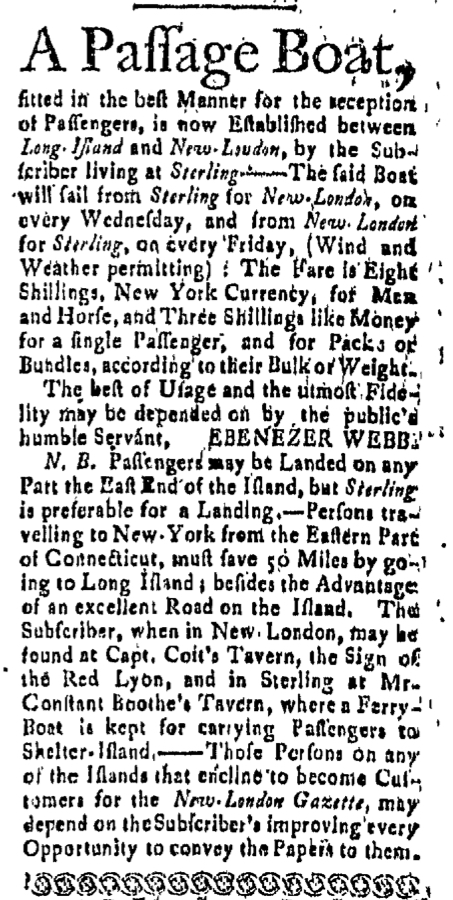
“A Passage Boat … is now Established between Long-Island and New-London.”

A “Passage Boat” between New London, Connecticut, and Long Island, New York, was a quicker way of travelling than by over land. Ebenezer Webb pointed out that passengers would save fifty miles when they traveled to New York. Webb also developed a schedule and a system of rates, which allowed passengers to be able to plan their passage. Printing the schedule in an advertisement allowed prospective customers to save it if needed for future reference. Webb also made sure to include where he could be found at both locations; he gave the locations of the taverns and which days he would be in what area.   He also let potential customers know that if they would like to become customers of the New-London Gazette, he would drop them off on any of the islands off the coast of Long Island. Those islands included Shelter Island, Plum Island, and Gardiners Island. Another courtesy that passengers in Sterling could enjoy was a “Ferry-Boat” for carrying them to Shelter Island. Webb listed three different rates, which needed to be paid in New York currency. The different rates included “Man and Horse” for eight shillings, a “single Passenger” for three shillings, and for “Packs or Bundles” of goods it depended on their weight.

**********

ADDITIONAL COMMENTARY: Carl Robert Keyes

Today’s advertisement provides important information about ferry service between Connecticut and Long Island during the colonial period, reminding us that the most efficient forms of travel in the eighteenth century differed from modern conveniences made possible by a much more complex transportation infrastructure. As Elizabeth notes, colonists who needed to travel from New London to New York could shave fifty miles off their journey, plus benefit from “the excellent Road on the Island,” if they opted for Webb’s “Passage Boat” service rather than traveling via a land route. In comparison, ferry service today does not seem to offer the same advantages, given the conveniences of travel by car, bus, and train.

I found the final portion of this advertisement to be especially interesting for what it suggests about the business practices and distribution of the New-London Gazette. Webb noted that he would deliver the newspaper to “Those Person on any of the Islands that encline to become Customers.” Despite the distance between New London and those islands (and their separation by Long Island Sound), the New-London Gazette would have been a local newspaper for residents of the islands, at least as much of a local newspaper as those printed in New York. The printer of the New-London Gazette certainly welcomed opportunities to increase distribution to paying subscribers and would have approved of Webb’s efforts to deliver newspapers to Shelter Island and other locales. Given that they were associates in that regard, might the printer have given Webb a discount on advertisements for the ferry service? After all, Webb’s success could also drum up additional business for the New-London Gazette, a mutually beneficial relationship.

October 3

GUEST CURATOR: Elizabeth Curley

What was advertised in a colonial American newspaper 250 years ago today?

oct-3-1031766-new-london-gazette
New-London Gazette (October 3, 1766).

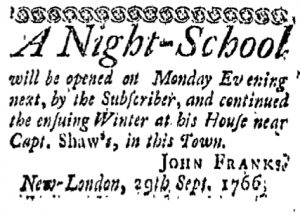
“A Night-School will be opened on Monday Evening.”

Evening schools allowed children and adults who would not have normally attained an education to get the opportunity. In my Education class, Schools and American Society (taught by Prof. Casey Handfield), we discussed educational disparity in colonial America.[1] Children’s formal education in the colonies was limited, often to a select group of middling and elite white males. However, there were many other forms of education that took place in the colonies, such as apprenticeship, indentured servitude, and dame schools. Apprenticeship was a way for many children to learn a skill over time; although their formal education may have been limited, they learned a skill that provided them with a livelihood once they were older and finished the apprenticeship. Some forms of indentured servitude also allowed for learning a skill from the master. At dame schools, children learned basic skills from women (usually childless or older and widowed). However, most of these women had little formal schooling themselves, but would teach based on religious ideals.

Evening schools were another important form of education in colonial times, as I learned from also consulting Robert Francis Seybolt’s Evening School in Colonial America.[2] Some of the colonists sent their apprentices or indentured servants to night school during the winter months. Because the days were shorter, less light meant fewer work hours. This allowed some apprentices and servants to learn a skill during the day and then go to an evening school to learn basic writing, reading, and math skills. Apprentices and servants who got to go to evening schools would have been very lucky to learn both a skill that would provide them with a livelihood and the skills to make their future business successful.

Evening schools in the colonies originated in the Dutch colony of New Netherland in 1661. Once that colony became part of the New York in 1674, the evening schools were slowly taken over by English night schools. In Boston, the first mention of an evening school was in 1724 in the Boston Gazette. According to Seybolt, these two port cities, New York and Boston, were the first to establish this sort of schools, with inland towns and villages getting them later.

John Franks advertised his school in the New-London Gazette. He taught it in his home. Starting the classes in October and continuing every Monday for the whole of winter provided Franks’ students ample time for work during the week and then once darkness fell and the work day was done they could go to class.

**********

ADDITIONAL COMMENTARY: Carl Robert Keyes

Elizabeth is a veteran guest curator for the Adverts 250 Project, having already taken on these responsibilities for two weeks as part of my introductory Public History course last spring. As a result, she came to the project this time already possessing familiarity with the advantages and disadvantages of working with digitized sources. Rather than using my additional commentary to elaborate on her analysis of the advertisement she selected for today, I’ve decided instead to discuss one of the challenges inherent in using digital surrogates for the New-London Gazette.

Oct 3 - Page 3 New-London Gazette.jpg
Third Page of New-London Gazette (October 3, 1766).
oct-3-page-4-new-london-gazette
Fourth Page of New-London Gazette (October 3, 1766).

First, it’s necessary to understand the material aspects of the original October 3, 1766, issue of this newspaper. Like other colonial newspapers, each issue consisted of four pages created by printing on both sides of a broadsheet and then folding it in half. While some surviving issues have remained separate, many others have been gathered together, arranged chronologically, and bound into large volumes, either by printers or subscribers in the eighteenth century or by archivists and librarians at some point since. As a result, when historians consult eighteenth-century newspapers, they often work what look like oversized books that must be supported in special wooden cradles in order to preserve the bindings and avoid damage to the individual issues.

As a result of binding so many newspapers together, sometimes it is difficult to read the material in the column printed closest to the fold. Without sufficient space devoted to the margin that could later be used by the bookbinder, the binding draws the pages too close together to read (or photograph or digitize) all of the printing on the page. On the other hand, the distinctive appearance of a newspaper in a tightly bound volume makes it easy to determine at a glance which were even- and odd-numbered pages when reading the newspaper on microfilm or a computer screen. Both media eliminate other aspects of the material text that readers would otherwise use when working with an original issue. Have a look at the third and fourth pages of the issue that included today’s advertisement.

It is easy to tell which side of the page was adjacent to the binding, which also makes it easy to determine which was an even-numbered page and which was an odd-numbered page. Note that the advertisement Elizabeth chose appeared far away from the original fold of the newspaper and, thus, far away from the binding of the bound volume. This helped to make it legible when it was photographed and digitized. On the other hand, news items and advertisements that appeared close to the binding have been partially obscured. It is difficult to read them. Keyword searches using current technologies do not effectively “read” those items either. Readers working with the original bound volume of newspapers can shift position to view the page from a slightly different angle or carefully open the volume just a little wider, but these options are not available to researchers using microfilm or digital surrogates. The image of the page as it appears is the only possible image available to them.

As I have argued many times, digitization is wonderful, but it is not perfect. Sometimes it introduces new problems or eliminates possible solutions that working with original documents would allow. As an Education and History major, Elizabeth is especially interested in advertisements about colonial education. That John Franks’ advertisement for “A Night-School” was is legible for Elizabeth and other historians to consult is a wonderful circumstance that was in no way guaranteed by the historical and technological processes that have contributed to the production, preservation, and dissemination of the original documents.

**********

[1] See also Joel Spring, American Education, 16th ed. (McGraw Hill, 2013)

[2] Robert Francis Seybolt, The Evening School in Colonial America (Urbana: University of Illinois, 1925).

September 5

What was advertised in a colonial American newspaper 250 years ago today?

Sep 5 - 9:5:1766 New-London Gazette
New-London Gazette (September 5, 1766).

“They have a Quantity of Goods remaining on Hand which they’ll Sell cheap.”

Trumbull, Fitch, and Trumbull ended their partnership on June 20, 1766. More than two months later they continued to advertise that their common enterprise had been terminated as they encouraged “All Persons having Accounts open with said Company” to settle them with Joseph Trumbull, one of the partners, “as soon as possible.”

Apparently the former partnership still had inventory remaining to be sold. Trumbull, Fitch, and Trumbull were certainly interested in receiving what they were owed by former customers, but their advertisement also indicated that any reader and potential customer could visit the store they had operated in Norwich and purchase the remaining merchandise. To make this an even more attractive prospect, they noted that “they have a Quantity of Goods remaining on Hand which they’ll Sell cheap for Cash or short Credit.”

The advertisement did not indicate how the current prices compared to what they had been during the partnership, but readers could assume that Trumbull, Fitch, and Trumbull were motivated to sell as they went their separate ways. In effect, the former partners operated an eighteenth-century precursor to a “going out of business” sale, though their advertising was not nearly as bold or flashy as modern promotions of similar events.

Still, this reminds us that some of the most basic marketing techniques were not invented in the twentieth century. Instead, over the last century or so marketers have further developed incipient strategies already deployed in the colonial America. A twenty-first-century version of today’s featured advertisement would likely focus exclusively on offering low prices in order to liquidate inventory (and leave the settling of accounts to be pursued via other means), refining the method used by Trumbull, Fitch, and Trumbull a quarter millennium ago.

August 15

What was advertised in a colonial American newspaper 250 years ago today?

Aug 15 - 8:15:1766 New-London Gazette
New-London Gazette (August 15, 1766).

“STOLEN out of the Subscriber’s House in the Night … Two silver Watches.”

As a general rule, most advertisements featured on the Adverts 250 Project promoted consumer goods and services. As its primary purpose, the project explores how eighteenth-century advertising incited consumer demand and convinced colonists to purchase an expanding array of goods and services.

Today’s advertisement, however, demonstrates that buying new goods from shopkeepers and merchants was not the only way that colonists could participate in the consumer economy. Some purchased used goods (which were sometimes advertised, but also changed hands in an informal economy that did not rely on public commercial notices), but others resorted to theft to obtain the items they desired or intended to sell for their own gain.

In Simon Rhodes’ case, a thief made off with “Two Silver Watches” and “a pair of Silver wrought Buckles with Steel Chapes and Tongues.”

Rhodes wanted his watches and buckles back, so much so that he paid to insert this advertisement in the New-London Gazette at least three times. (It appeared on August 15, 22, and 29. It may have appeared in earlier issues, but they are no longer extant.) He also offered a reward of five dollars to anybody who captured “the Thief or Thieves, so that the above things may be had, and he or they brought to Justice.” At the very least, Rhodes wanted to make it difficult for the thief or thieves to benefit from the crime. He requested that if any readers noticed his stolen property “offered for Sale” that “they may be stopped.” In addition, his descriptions of the stolen goods, including their flaws and repairs, were designed to make it more difficult to sell them.

May 23

What was advertised in a colonial newspaper 250 years ago today?

May 23 - 5:23:1766 New-London Gazette
New-London Gazette (May 23, 1766).

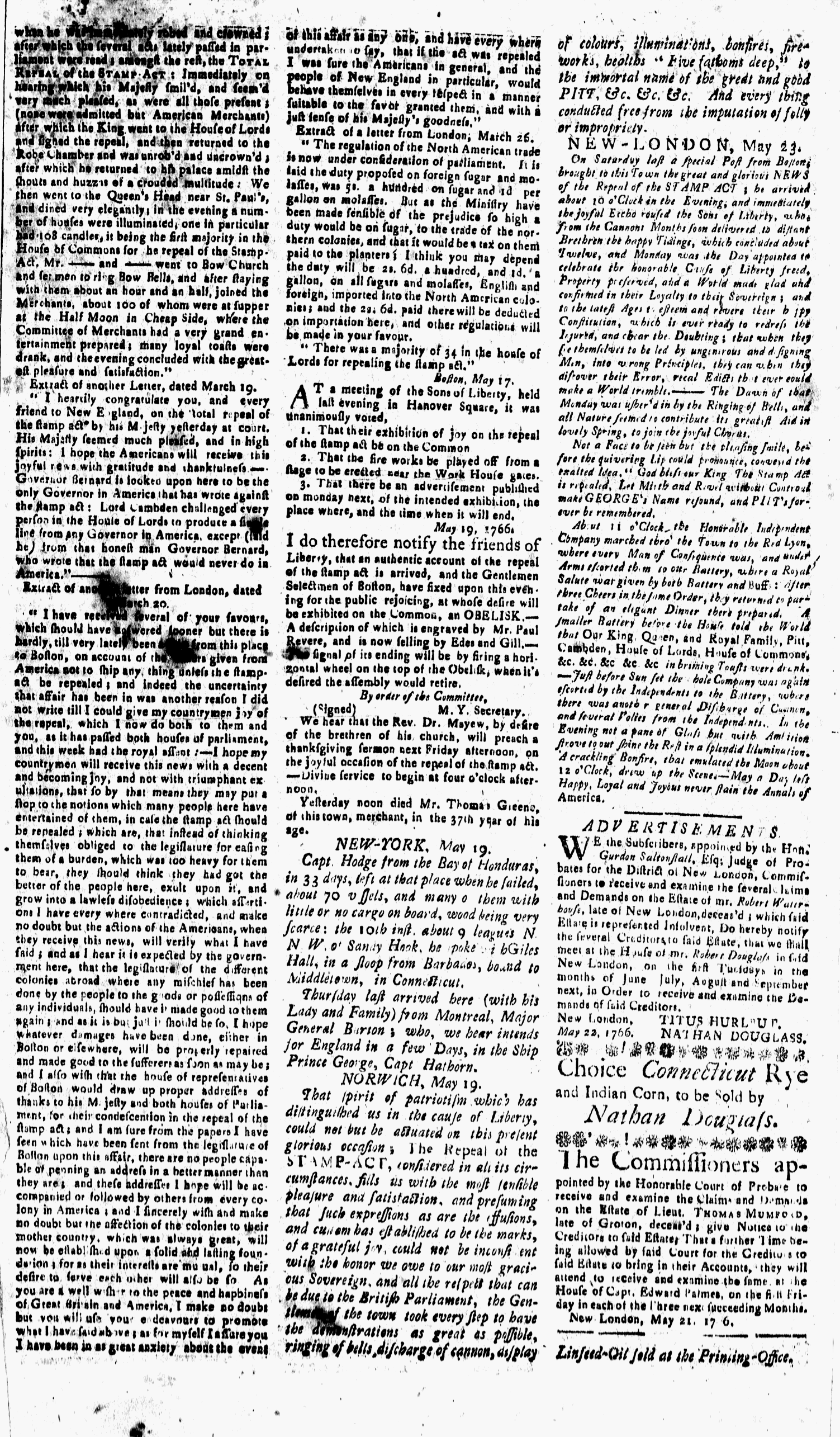
This brief advertisement for linseed oil may have caught readers’ attention because it filled a space that otherwise would have been a conspicuously blank space at the bottom of the last column on the third page of the May 23, 1766, issue of the New-London Gazette. The printer needed some sort of content to fill out the column. This advertisement served that purpose, plus it might have helped to generate additional revenue if readers opted to visit the “Printing-Office” to purchase linseed oil.

May 23 - 5:23:1766 entire page New-London Gazette
New-London Gazette (May 23, 1766).

Did the printer intend to announce linseed oil for sale before setting type for this page? Might there have been plans for a longer and more detailed advertisement had space permitted? There’s no way to know. This brief advertisement might have been planned all along; it may not have merely been a convenient means of completing the page. After all, there were other ways to fill that space, including additional use of the ornamental type that provided a border for Nathan Douglass’s advertisement for “Choice Connecticut Rye and Indian Corn” or inserting slightly more space between the other advertisements on the page.

Just thirty-six characters and four spaces, this advertisement certainly took less time and effort to set than most others, especially the lengthy lists of merchandise that often filled the pages of colonial newspapers. Charming in its brevity, this advertisement demonstrates that eighteenth-century advertisements came in vastly different lengths and featured varying levels of sophistication.

February 15

GUEST CURATOR:  Elizabeth Curley

What was advertised in a colonial newspaper 250 years ago today?

Feb 15 - 2:14:1766 New-London Gazette
New-London Gazette (February 14, 1766).

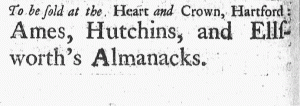
“Ames’s Almanacks for the Present Year, to be Sold by T. Green.”

An almanac is “an annual publication containing a calendar for the coming year, the times of such events and phenomena as anniversaries, sunrises and sunsets, phases of the moon, tides, etc., and other statistical information and related topics.” In today’s society we do not see an almanac in everyone’s back pocket and purse; however back in the 1700s they were a lot more popular.

Here in the New-London Gazette, T. Green is advertising Ames’s Almanack for the “present year” which was 1766. Nathaniel Ames is considered to be the first person to publish an almanac in colonial America. The first annual publishing was done in 1725 and was published in Bridgewater, Massachusetts, until he moved to the South Shore later in his life. Ames’s Almanack was for many yeas considered the greatest with it publishing more then 60,000 copies. That’s quite a large number of copies for a colonial work. He started an industry that would spawn the likes of Poor Richard’s Almanack (Ben Franklin, 1733, Pennsylvania) and Rhode-Island Almanack (James Franklin, 1727, Rhode Island)

Almanacs were a major part of day-to-day life for people during the colonial time. They helped “everyday” people such as farmers, shopkeepers, and black/silversmiths know a little about each day. They would include astrological information, some details of the previous years weather, tide flow charts, copies of poems and stories, and historical essays. They also promoted reading throughout the countryside, and commerce for people such as T. Green. One family could purchase an almanac annually and it would give them access to literary works and a variety of useful information.

**********

ADDITIONAL COMMENTARY:  Carl Robert Keyes

Elizabeth is correct when she notes the ubiquity of almanacs in colonial America. They were cheap print. These small, inexpensive pocket references could be found in households from the grandest to the most humble and were published locally in large numbers from an early date.

Oct 25 - 10:25:1765 New-London Gazette
New-London Gazette (October 25, 1765).

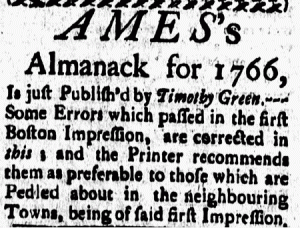
This is not the first time that an advertisement for Ames’s Almanack in the New-London Gazette has been featured by the Adverts 250 Project. In fact, it was the second advertisement I selected when this project was still confined to #Adverts250 on Twitter. This earlier advertisement demonstrates how far in advance almanacs were printed. By the end of October, Timothy Green advertised that his imprint of the almanac did not include “Some Errors which passed in the first Boston Impression” and marketed the version of Ames’s Almanack he printed as “preferable to those which are Pedled about in the neighbouring Towns.”

Not unlike purchasing calendars in the modern era, it is reasonable to expect that colonial consumers bought almanacs before the first of the year or as shortly thereafter as possible. To gain the full value of a calendar or an almanac requires using it throughout the entire period it covers. I previously featured an advertisement for almanacs placed three weeks into the new year. Elizabeth selected an advertisement for almanacs placed nearly seven weeks into the new year!

Jan 21 - 1:20:1766 Connecticut Courant
New-London Gazette (February 14, 1766).

What is happening here? It could be that the advertisement is filler, especially given its brevity, but it is also possible that Green ended up with a surplus and sought to continue to sell as many almanacs as possible to those who had not yet purchased them or desired additional copies. This advertisement could have been both padding that filled the page and the issue and an attempt to recoup his investment in printing Ames’s Almanack. This was the very first advertisement to appear in this issue of the New-London Gazette. Subscribers who read the news would have had to also read this advertisement to register that the advertising section had begun. Even if they did not continue with the other advertisements, at least they would have seen this one. It was the printer’s prerogative to place advertisements for his own goods and services wherever he wished in the issue.

February 9

GUEST CURATOR:  Kathryn J. Severance

What was advertised in a colonial newspaper 250 years ago this week?

Feb 8 - 2:7:1766 New-London Gazette
New-London Gazette (February 7, 1766)

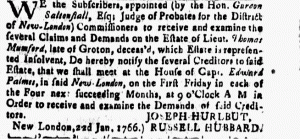
“We the subscribers, appointed … Commissioners to receive and examine the several Claims and Demands on the Estate of Lieut. Thomas Mumford, late of Groton, deceased.”

This advertisement is of a different nature than many others featured within the Adverts 250 Project. This is due to the fact that it is not advertising goods or services. Instead, this advertisement is a probate notice, a type of memorandum about managing the estate of the deceased. In this particular case, the deceased individual was Thomas Mumford. Joseph Hurlbut and Russell Hubbard were appointed by a judge as executors of his estate.

From this example, we can conclude that probate notices were constructed very differently than advertisements for goods and services were. The text within the notice seems as if it is printed in small type, unlike many of the advertisements for goods that I came across in my time examining Colonial newspaper advertisements for this project. This may be because the text is lengthier and formed in complete sentences, rather than in list format, as some of the advertisements for goods were.

**********

ADDITIONAL COMMENTARY:  Carl Robert Keyes

This advertisement reminds us of one of the many different purposes that colonists turned to the public prints to publish notices of various sorts. As I explained when I inaugurated the Adverts 250 Project, I am primarily interested in advertisements for goods and services, their methods of marketing wares to potential customers, and their role in the consumer revolution of the eighteenth century. This eliminates a fair number of advertisements from consideration for inclusion here. However, I have instructed my students that during their time as guest curators they are permitted to choose one of these other kinds of advertisements per week. If it caught their attention and helped them to learn more about early American society and print culture, then it was fair game.

Kathryn makes some important observations about this probate notice. Even though it includes some italics and capitals (exclusively for people and place names), it does not vary the font size or experiment with white space at all. It appears very dense, even more dense than many of the advertisements for goods and services. As Kathryn points out, advertisements listing assorted goods also included a lot of text, but often the format provided more variation. Probate notices, on the other hand, followed a rather standard formula (both for the wording of the text and its format). The responsibility for drawing readers to advertisements promoting goods and services fell on the advertisers. On the other hand, the “Commissioners” appointed “to receive and examine the several Claims and Demands on [an] Estate” may very well have felt that it was the responsibility of the “several Creditors” to stay informed of any legal notices appearing in the local newspaper. In publishing a probate notice the commissioners had fulfilled their responsibility. They were not required to devise flashy advertisements.

The Messy Marriage of Joanna and Robert Hebbard Further Considered

A few weeks ago I featured two advertisements that revealed some of the domestic squabbles in the Hebbard household, first a runaway wife notice from Robert Hebbard warning others against “trusting, trading or dealing with” his wife, Joanna, and the other, published a week later, a rejoinder from Aaron Cleaveland testifying to Joanna’s character and excoriating her husband.  Certainly these advertisements did not tell the Hebbards’ entire story.

Jan 17 - 1:17:1766 New-London Gazette
New-London Gazette (January 17, 1766).

J.L. Bell has investigated the lives and times of Robert and Joanna Hebbard in greater detail over the course of the past three days at Boston 1775.  I promised to keep my eyes open for further advertisements from or about the Hebbards, but I have not yet turned up any.  Bell, however, has used a variety of other sources to flesh out the lives and relationships of members of the Hebbard and Cleaveland families.  Follow these links to learn more about Joanna Hebbard and her travails in eighteenth-century America.

Part 1.  “Joanna Hebbard, hath for some time past Eloped from Me”

Part 2.  “To make a just return to his injurious Advertisement”

Part 3.  “Joanna Cleveland’s ‘Leap in the Dark’”

Jan 24 - 1:24:1766 New-London Gazette
New-London Gazette (January 24, 1766).

February 1

GUEST CURATOR:  Maia Campbell

What was advertised in a colonial newspaper 250 years ago this week?

Feb 1 - 1:31:1766 New-London Gazette
New-London Gazette (January 31, 1766)

“CASH is given for clean Linen RAGS, Old Sail-Cloth and Junk, at the Printing-Office in New-London.”

What struck me about this advertisement is the need expressed by the New-London Printing-Office for “Linen RAGS, Old Sail-Cloth and Junk.” At first glance, it might seem perplexing that the New-London Printing-Office would be interested in acquiring such objects. However, during the colonial time period these objects were directly associated with the printing universe. In opposition to paper today that is made from wood, all of these types of items would be used in the composition of the paper used for the newspaper. Junk most likely refers to scrap rope that would be used along with the rags and old sail-cloth.

Also, the New-London Printing-Office could attract a surplus of “Old Sail-Cloth.” New London, Connecticut, was a sea town, making it easy for sailors to give their unneeded materials to the New-London Gazette.

I was intrigued by this clever and efficient way to use old cloth instead of simply disposing of it.

**********

ADDITIONAL COMMENTARY:  Carl Robert Keyes

I have previously passed over similar advertisements dozens of times when I made my selections about which to feature. I didn’t think that there was much especially interesting or noteworthy about printers’ ubiquitous call for rags. Maia helped me to realize why this advertisement merits a second glance and further examination.

I work with eighteenth-century newspapers on a regular basis. I am accustomed to both their appearance and the way they feel in my hands. I also know a little bit more about the histories of printing and papermaking in early America than the average person off the street.

But for Maia and the other students in my Public History class, this is all new! This advertisement presented an opportunity to talk about the origins of the materials that printers used, including paper made from rags rather than wood (a transition that did not take place until well into the nineteenth century). Just as eighteenth-century newspapers look a bit different than their twenty-first-century counterparts, they were created from different materials.

This advertisement also prompted us to talk about eighteenth-century lexicon versus modern meanings of words. I suggested to Maia, based on context in the advertisement, that “Junk” likely referred to other textile scraps. I was close, but further research revealed that “Junk” meant “an old rope” in the eighteenth century, at least according to the Royal Standard English Dictionary published in 1788.[1]

**********

[1] William Perry, Royal Standard English Dictionary (Worcester, MA: Isaiah Thomas, 1788), 313.