October 12

What was advertised in a revolutionary American newspaper 250 years ago today?
New-York Journal (October 12, 1775).

“I Acknowledge that I have at several times spoken in favour of the laws of Taxation.”

Lemuel Bower wanted to return to the good graces of his community in the fall of 1775.  Events that occurred since the previous April – the battles at Lexington and Concord, the siege of Boston, the Battle of Bunker Hill, the Second Continental Congress appointing George Washington as commander in chief of the Continental Army, an American invasion of Quebec – had intensified feelings about the imperial crisis and, apparently, made for a difficult situation for Bower since he had expressed Tory sentiments in the past.  In hopes of moving beyond that, he composed a statement that appeared in the October 12, 1775, edition of the New-York Journal.

“I Acknowledge,” Bower confessed, “I have at several times spoken in favour of the laws of Taxation, and against the measures pursued by America to procure Redress, and have thereby justly merited the displeasure of my country.”  To remedy that, “I beg forgiveness, and so solemnly promise to submit to the rules of the Continental and Provincial Congresses,” including abiding by the nonimportation and nonconsumption provisions in the Continental Association.  Furthermore, Bower pledged, “I never will speak or act in opposition to their order, but will conduct according to their directions, to the utmost of my power.”  He did not state that he had a change of heart, only that he would quietly act as supporters of the American cause were supposed to act rather than engage in vocal opposition.  As William Huntting Howell has argued, such compliance, especially when expressed in a public forum, may have been more important to most Patriots than whether Bower truly agreed with them.[1]  How he acted and what he said was more important than what he believed as long as he kept his thoughts to himself.

Bower did indeed express his regrets and his promise to behave better in a public forum.  He concluded his statement with a note that “this I desire should be published in the public prints.  When it appeared in the New-York Journal, it ran immediately below a notice from the Committee of Inspection and Observation in Stanford, New York, that labeled two Loyalists as “enemies to the liberties of their country” and instructed the public “to break off all commerce, dealings and connections with them.”  That was the treatment that Bower sought to avoid!  That notice appeared immediately below news from throughout the colony.  Bower’s statement ran immediately above paid advertisements.  The two statements concerning the political principles of colonizers thus served as a transition from news to advertising in that issue of the New-York Journal.  Did John Holt, the printer, treat them as paid notices?  Did he require Bower to pay to insert his statement?  Or did the Patriot printer publish one or both gratis?  Perhaps he printed the statement from the Committee of Inspection and Observation for free but made Bower pay to publish his penance.  Whatever the case, Bower’s statement was not clearly a news item nor an advertisement but could have been considered both simultaneously by eighteenth-century readers.

**********

[1] William Huntting Howell, “Entering the Lists: The Politics of Ephemera in Eastern Massachusetts, 1774,” Early American Studies 9, no. 1 (Winter 2011): 187-217.

September 27

What was advertised in a revolutionary American newspaper 250 years ago today?

Pennsylvania Journal (September 27, 1775).

 “AMERICANS VIRTUALLY Represented IN ENGLAND: (A SATYRICAL PRINT.)”

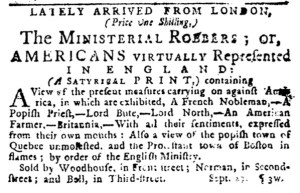
As the imperial crisis intensified and hostilities commenced in Massachusetts in the spring of 1775, American colonizers had supporters in London.  In addition, some artists, engravers, and printers, whatever their own politics may have been, hoped to generate revenue by creating and publishing political cartoons that lambasted the British ministry for the abuses it perpetrated in the colonies.  Some of those prints found their way to eager audiences on the other side of the Atlantic.  In the fall of 1775, William Woodhouse, a bookseller and bookbinder, John Norman, an architect engraver building his reputation, and Robert Bell, the renowned bookseller and publisher, advertised a “SATYRICAL PRINT” that “LATELY ARRIVED FROM LONDON.”

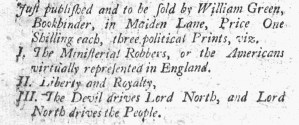
The trio promoted “The MINISTERIAL ROBBERS; or, AMERICANS VIRTUALLY Represented IN ENGLAND,” echoing one of the complaints that colonizers made about being taxed by Parliament without having actual representatives serve in Parliament.  Based on the description of the print in the advertisement, Woodhouse, Norman, and Bell stocked “Virtual Representation, 1775” or a variation of it.  According to the newspaper notice, the image depicted a “View of the present measures carrying on against America, in which are exhibited, A French Nobleman,– A Popish Priest,– Lord Bute,– Lord North,– An American Farmer,– [and] Britannia.”  For each character, “their sentiments, expressed from their own mouths,” appeared as well.

Lord Bute, the former prime minister who inaugurated the plan of regulating American commerce to pay debts incurred during the Seven Years War, appeared at the center of the image, aiming a blunderbuss at two American farmers.  For his “sentiments,” he proclaimed, “Deliver your Property.”  Lord North, the current prime minister, stood next to Bute, pointing at one of the farmers and exclaiming, “I Give you that man’s money for my use.”  In turn, the first farmer stoutly declared, “I will not be Robbed.”  The second expressed solidarity: “I shall be wounded with you.”

The advertisement indicated that the print also showed a “view of the popish town of Quebec unmolested, and the Protestant town of Boston in flames; by order of the English ministry.”  Those parts of the political cartoon unfavorably compared the Quebec Act to the Coercive Acts (including the Boston Port Act and the Massachusetts Government Act), all passed by Parliament in 1774.  The Quebec Act angered colonizers because it extended certain rights to Catholics in territory gained from the French at the end of the Seven Years War.  In the print, the town of Quebec sat high atop its bluff, the flag of Great Britain prominently unfurled, in the upper left with the “French Nobleman” and “Popish Priest” in the foreground.  The legend labeled it as “The French Roman Catholick Town of Quebeck.”  The anti-Catholicism was palpable; the kneeling priest exclaiming “Te Deum” in Latin and holding a cross in one hand and a gallows in the other, playing on Protestant fears of the dangers they faced from their “Popish” enemies.

While Quebec appeared “unmolested” and even favored by Bute, North, and their allies in Parliament, the “English Protestant Town of Boston” appeared in the distance behind the American farmers in the upper right.  The town was indeed on fire, a reference to the battles fought in the vicinity as well as a metaphor for the way Parliament treated the town to punish residents for the Boston Tea Party.  As the advertisement indicated, Britannia, the personification of the empire, made an appearance in the print.  She wore a blindfold and exclaimed, “I am Blinded.”  She looked to be in motion, one foot at the edge of “The Pit Prepared for Others” and her next step surely causing her to fall into it.  There seemed to be no saving Britannia as Bute and North harassed the American farmers and their French and Catholic “Accomplices” watched with satisfaction.

The description of the “SATYRICAL PRINT” in the Pennsylvania Journal merely previewed the levels of meaning contained within the image, yet in likely piqued the curiosity of colonizers who supported the American cause and worried about their own liberties as events continued to unfold in Boston.  Such a powerful piece of propaganda supplemented newspaper reports, maps of the Battle of Bunker Hill, and political treatises circulating in the fall of 1775.

“Virtual Representation, 1775” (London, 1775). Courtesy Boston Public Library.

July 14

What was advertised in a revolutionary American newspaper 250 years ago today?

North-Carolina Gazette (July 14, 1775).

“THE CRISIS. A PERIODICAL Paper lately published in London, in 8 Numbers.”

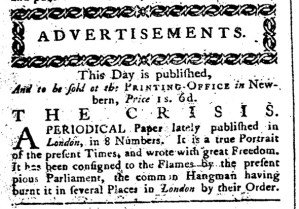
Along with continued coverage of the Battle of Bunker Hill, the July 14, 1775, edition of the North-Carolina Gazettecarried an advertisement for The Crisis, a “PERIODICAL Paper lately published in London, in 8 Numbers.”  According to Neil L. York, The Crisis, published between January 1775 and October 1776, “was the longest-running weekly pamphlet series printed in the British Atlantic World during those years.”  (That London publication should not be confused with Thomas Paine’s “American Crisis,” a series of essays published in the United States between 1776 and 1783.)  The Crisis eventually included ninety-two editions, but James Davis, printer of the North-Carolina Gazette, had access to only the first eight.  According to his advertisement, he collected them together into a single volume.

Davis used the pamphlet’s colorful history in marketing it to readers in North Carolina.  “It is a true Portrait of the present Times,” he declared, “and wrote with great Freedom.  It has been consigned to the Flames by the present pious Parliament, the common Hangman having burnt it in several Places in London by their Order.”  York provides this overview: “The Crisis was condemned informally by leaders in the British government, and then formally in court, as a dangerous example of seditious libel [due to the depictions of George III].  Copies of it were publicly burned, and yet publication continued uninterrupted.”  American Patriots had their supporters among the British public, including authors and printers who “played on shared beliefs and shared fears: beliefs in the existence of fundamental rights … and the fear that loss of those rights in Britain’s American colonies could lead to their loss in Britain itself.”  York posits that the “men behind The Crisis were determined to interest the British public in American affairs and were no doubt pleased when various issues were reprinted in the colonies.”  Indeed, newspapers reprinted some of the essays in their entirety.  Printers also recognized opportunities to generate revenue while disseminating The Crisis to colonizers.  Advertisements for individual numbers of the pamphlet peppered the pages of American newspapers in the spring and summer of 1775 as printers in several colonies distributed new issues as they came to hand.  The day before Davis ran his advertisement in the North-Carolina Gazette, John Anderson announced in a notice in the New-York Journal that “on Monday will be published No. 9 of the CRISIS.”  Instead of printing one issue at a time, Davis packaged the first eight issues together for readers, hoping that providing such convenient access would entice them to buy the volume.

**********

This entry marks the final appearance of the North-Carolina Gazette in the Adverts 250 Project.  Few issues of that newspaper survive.  Only seven, all of them from 1775, have been digitized for greater access via databases of early American newspapers.  I have selected advertisements from the North-Carolina Gazette as often as possible to present a more complete representation of newspapers from throughout the colonies.

April 3

What was advertised in a colonial American newspaper 250 years ago today?

Newport Mercury (April 3, 1775).

“No TEA – till duty FREE.”

When Thomas Green advertised a variety of grocery items in the April 3, 1775, edition of the Newport Mercury, he listed “SUGAR, FLOUR, COFFEE, … CHOCOLATE, … PEPPER, … NUTMEGS, CLOVES, and MACE.”  Tea, one of the commodities that so often appeared in such lists, was conspicuously absent.  Many shopkeepers had refused to stock, advertise, or sell tea in the aftermath of the Boston Tea Party in December 1773, just as many consumers refrained from purchasing tea.  Abstaining from tea was not universal, however, as some advertisers did continue to include it in their advertisements even after the colonies received word of the Boston Port Act, the Massachusetts Government Act, and the other Coercive Acts that Parliament passed in response to the destruction of the tea by colonizers who masqueraded as Indigenous Americans.  Tea even merited particular notice in the Continental Association, the nonimportation pact devised by the First Continental Congress during its meetings in Philadelphia in September and October 1774, yet Peter Oliver, a noted Loyalist judge in Boston, alleged in his Origin and Progress of the American Rebellion that colonizers, especially women, manufactured all sorts of justifications for continuing to drink tea.

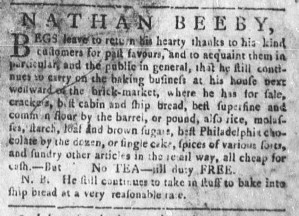
Nathan Beeby, a baker in Newport, took a stand regarding tea in the same issue of the newspaper that carried Green’s advertisement.  He thanked his “kind customers for past favours” and advised the public that “he still continues to carry on the baking business at his house, where he has for sale, crackers, best cabin and ship bread, [and] best superfine and common flour by the barrel, or pound.”  He also peddled “rice, molasses, starch, loaf and brown sugars, best Philadelphia chocolate …, spices of various sorts, and sundry other articles in the retail way.”  As many retailers did at the time, he specified that he did not extended credit, accepting only cash, and then he added: “– But     No TEA – till duty FREE.”  Green left it to readers to realize that tea did not appear in his advertisement, while Beeby made a point of announcing that he did not stock or sell the problematic commodity.  The amount of space that appeared between “But” and “No TEA” amounted to a dramatic pause, further emphasizing Beeby’s commitment and perhaps serving as a reminder to readers of the pledges they made to refuse to consume that beverage.  The baker practiced politics in his advertisement, using the space he purchased in the Newport Mercury to participate in public discourse.

February 9

What was advertised in a colonial American newspaper 250 years ago today?

Rivington’s New-York Gazetteer (February 9, 1774).

“Pamphlets published on both sides, in the unhappy dispute with Great-Britain.”

As the imperial crisis intensified in the winter of 1775, James Rivington continued to print a newspaper “at his OPEN and UNINFLUENCED PRESS” in New York.  He also ran a bookstore, peddling “Pamphlets published on both sides, in the unhappy dispute with Great-Britain.”  Both Patriot and Tory printers professed to operate free presses that delivered news and editorials from various perspectives, yet the public associated most newspapers with supporting one side over the other and even actively advocating for their cause.  Tory printers invoked freedom of the press as a means of justifying their participation in public discourse rather than allowing Patriot printers to have the only say.  When it came to advertising books and pamphlets about current events, Tory printers, especially Rivington, took the more balanced approach.

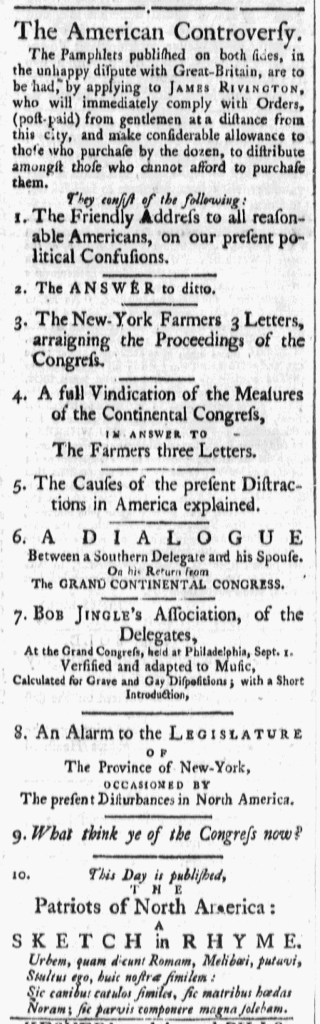
For Rivington, it was a matter of generating revenue as much as political principle.  He saw money to be made from printing and selling pamphlets about “The American Controversy.”  That was the headline he used for an advertisement that listed ten pamphlets in the February 9, 1775, edition of Rivington’s New-York Gazetteer.  He previously ran a similar advertisement for “POLITICAL PAMPHLETSon the Whig and Tory Side of the Question” and another about “The American Contest” that included some of the same pamphlets as well as others.  In his “American Controversy” advertisement, Rivington once again offered some familiar titles and new ones.  He made clear that the first two represented different positions, “The Friendly Address to all reasonable Americans, on our present political Confusions” and “The ANSWER to ditto,” though he did not indicate which took which side.

The printer positioned this venture as a service that kept the public better informed of the arguments “on both sides.”  He sought to disseminate his pamphlets beyond New York to “gentlemen at a distance from this city,” promising to “immediately comply with Orders.”  In turn, customers could do their part in making the pamphlets available far and wide since Rivington made “considerable allowance” or deep discounts “to those who purchase by the dozen, to distribute amongst those who cannot afford to purchase them.”  Though he portrayed himself as a fair dealer who marketed pamphlets “on both sides,” he did not express any expectation that customers would purchase or distribute both Patriot and Tory pamphlets.  Rivington presented readers with the freedom to consume (and further disseminate) the ideas they wished, seemingly hoping the public would allow him the same freedom in printing the content that he wished.  Whether he was sincere in such idealism or sought to justify printing editorials and pamphlets that many found objectionable, Rivington increasingly ran afoul of Patriots who did not share his outlook on freedom of the press when it came to disseminating news and opinion that favored the Tory side in “the unhappy dispute with Great-Britain.”

February 7

What was advertised in a colonial American newspaper 250 years ago today?

Essex Gazette (February 7, 1775).

“He had no Intention of injuring his Country, or of defending any one unfriendly to its Cause.”

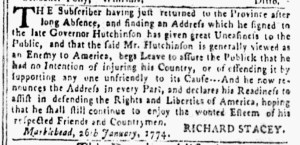
It was yet another public disavowal of an address honoring Thomas Hutchinson, the former governor of Massachusetts, that many colonizers signed when he returned to England.  This time, Richard Stacey inserted his recantation in the February 7, 1775, edition of the Essex Gazette.  Similar advertisements began appearing in that newspaper and sometimes newspapers printed in Boston as early as July 1774.  Stacey explained that he waited several months because he “just returned to the Province after long Absence” and only upon his arrival did he discover “an Address which he signed to the late Governor Hutchinson has given great Uneasiness to the Public.”  He further explained that the former governor “is generally viewed as an Enemy to America.”

That being the case, Stacey “begs Leave to assure the Publick that he had no Intention of injuring his Country, or of offending it by supporting any one unfriendly to its Cause.”  Accordingly, “he now renounces the Address in every Part, and declares his Readiness to assist in defending the Rights and Liberties of America.”  With such a proclamation, disseminated far and wide in the newspaper, Stacey desired “that he shall still continue to enjoy the wonted Esteem of his respected Friends and Countrymen.”  He considered the prospects of reconciling with friends, neighbors, and associates worth the expense of placing an advertisement in the Essex Gazette.

Was Stacey sincere?  Or did he merely seek to return to the good graces of his community and simply get along during difficult times?  That is impossible to determine from his advertisement.  It did differ from some that previously appeared in the public prints.  For instance, Stacey did not attempt to blame his error on having quickly read the address without considering its implications before signing it.  Instead, he did not comment on what had occurred at the time he signed the address but focused on the harm he had done by doing so.  Others offered lukewarm assurances that they did not truly support Hutchinson or the policies he had enforced, while Stacey proclaimed his “Readiness to assist in defending the Rights and Liberties of America.”  In addition, some signers published advertisements that clearly copied from the same script.  Stacey’s was entirely original.  That may have been the result of the time that had passed since others inserted their advertisement or the political situation deteriorating and thus requiring stronger assertions from signers of the address branded as Tories.  William Huntting Howell suggests that for some readers Stacey’s sincerity may have mattered much less than the fact that he felt compelled to express support for the “Cause” of “his Country” in print.[1]

**********

[1] William Huntting Howell, “Entering the Lists: The Politics of Ephemera in Eastern Massachusetts, 1774,” Early American Studies 9, no. 1 (Winter 2011): 191, 208-215.

January 2

What was advertised in a colonial American newspaper 250 years ago today?

Boston-Gazette (January 2, 1775).

The GRAND AMERICAN CONTINENTAL ASSOCIATION … to be pasted up in every Family.”

In the first issue of the Boston-Gazette published in 1775, Benjamin Edes and John Gill, the printers, opened with a notice concerning the Continental Association as the first item in the first column on the first page.  The First Continental Congress had devised that nonimportation, nonconsumption, and nonexportation pact when it met in Philadelphia in September and October 1774, intending for it to go into effect on December 1.  The Continental Association answered the Boston Port Act, the Massachusetts Government Act, and the other Coercive Acts that Parliament had passed in retaliation for the Boston Tea Party, perhaps not expecting a unified response from the colonies.  The First Continental Congress, however, devised a plan that allowed consumers from New England to Georgia to express their political principles through the decisions they made in the marketplace., drawing inspiration from the nonimportation agreements that went into effect to protest the Stamp Act and the duties on imported goods in the Townshend Acts.

Edes and Gill helped to raise awareness of the Continental Association not only through newspaper coverage but also by disseminating copies far and wide.  “ANY Town or District within this Province,” their notice advised, “may be supplied by Edes and Gill, on the shortest Notice, with the GRAND AMERICAN CONTINENTAL ASSOCIATION, printed on one Side of a Sheet of Paper.”  They offered the pact as a broadside “on purpose to be pasted up in every Family.”  The printers wished for local governments to purchase their edition of the Continental Association and distribute them to households for constant reference.  Putting the pact on display demonstrated support for the American cause against Parliament or at least signaled an intention to comply.  Posting it in homes as well as public spaces made it easy to consult, reminding everyone that they had a part to play in the protest.  The Continental Association made decisions about participating in the marketplace inherently political, making it impossible for any individual or household to take a neutral stance.  Edes and Gill recognized that was the case.  Although they stood to generate revenue from selling broadside copies of the Continental Association by the dozen or gross, the political stance they consistently advanced throughout the imperial crisis suggested that increasing awareness of the pact and encouraging compliance with it motivated them as much or even more.

January 1

What was advertised in a colonial American newspaper 250 years ago this week?

Rivington’s New-York Gazetteer (December 29, 1774).

“The American Contest.”

In the final issue of Rivington’s New-York Gazetteer for 1774, James Rivington continued advertising pamphlets “written on the Whig and Tory Side of the Question.”  He inserted an advertisement similar to the “POLITICAL PUBLICATIONS” catalog that he ran on December 15.  Both listed nine tracts that Rivington sold to readers or to “Gentlemen living at a Distance … to distribute amongst their Friends.”  Some of the titles appeared a second time.  Rivington eliminated some, added others, and reorganized the order accordingly.

For instance, a pamphlet documenting the Continental Association, a nonimportation agreement adopted by the First Continental Congress had been first in the previous iteration, but Rivington listed it fourth in the new one.  A new entry led the catalog: “The Congress Canvassed, OR, An Examination into the Conduct of the Delegates, At the Grand Continental Congress, Addressed to the Merchants of New-York, By the FARMER, A.W.”  Rivington had previously advertised that he would soon publish that piece, having included “Free Thoughts on the Proceedings of the Continental Congress” among the “POLITICAL PUBLICATIONS” in his earlier catalog.  That item appeared once again, paired this time with “A full Vindication of the Measures of the Continental Congress IN ANSWER TO Free Thoughts on the Proceedings of the said Congress.”  Again, Rivington had previously advertised “A full Vindication” separately, but collated together “Free Thoughts” and the pamphlet that responded to it in the new catalog.  The enterprising printer aimed to help prospective customers craft a narrative when selecting among his offerings.

Rivington gave this catalog a new headline.  Instead of “POLITICAL PUBLICATIONS,” he called it “The American Contest.”  That dramatic flourish did not exaggerate the tensions in New York and other colonies as the imperial crisis intensified.  Within months, the Revolutionary War would commence with battles at Lexington and Concord in Massachusetts.  As Rivington reported on current events and political debates, he often took a more balance approach than many of his fellow printers who made their support for the Patriot cause very plain.  The masthead for his newspaper proclaimed that it was “PRINTED at his OPEN and UNINFLUENCED PRESS.”  Rivington enacted the same policy for the pamphlets he printed, marketed, and sold.  No other American printer so vigorously represented both perspectives in “The American Contest” in the advertisements in their newspapers.

**********

January 1, 1775, fell on a Sunday.  Colonial printers distributed newspapers every day except Sunday.  The Adverts 250 Project will commence examining advertisements from 1775 tomorrow.

December 18

What was advertised in a colonial American newspaper 250 years ago this week?

Rivington’s New-York Gazetteer (December 15, 1774).

“POLITICAL PUBLICATIONS … written on the Whig and Tory Side of the Question.”

In chronicling the momentous events of 1774, the Adverts 250 Project has frequently featured advertisements for books, pamphlets, and other items related to the imperial crisis as it intensified following the Boston Tea Party and the Coercive Acts passed by Parliament in retaliation.  Most printers increasingly privileged the Patriot’s perspective, both in terms of the news and editorials they selected for their newspapers and the works that they published, advertised, and sold.  Yet they did not uniformly do so.

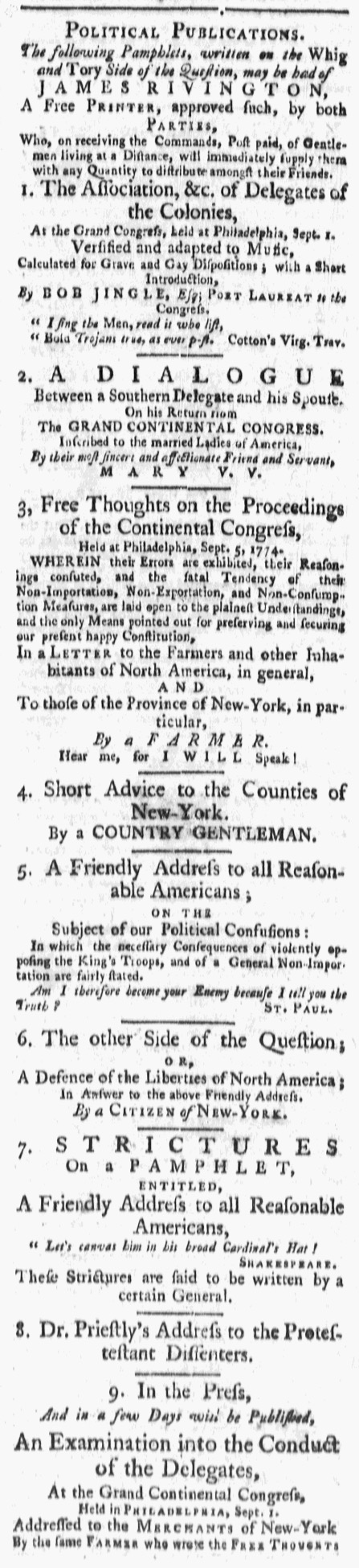
James Rivington, a Loyalist, proclaimed in the masthead of Rivington’s New-York Gazetteer that his newspaper was “PRINTED at his OPEN and UNINFLUENCED PRESS.”  In Revolutionary Networks: The Business and Politics of Printing the News, 1763-1789, Joseph M. Adelman notes that “Rivington’s bookselling career was about making money rather than promoting a political ideology, so much so that he wanted to capitalize on relatively popular anti-imperial political tracts.”[1]  One of his advertisements in the December 15, 1774, edition of his newspaper listed nine “POLITICAL PUBLICATIONS” that he sold.  He explained that he stocked pamphlets “written on the Whig and Tory Side of the Question.”  He demonstrated that was the case in the descriptions of some of those tracts.  For instance, he carried “A Friendly Address to all Reasonable Americans; ON THE Subject of our Political Confusions: In which the necessary Consequences of violently opposing the King’s Troops, and of a General Non-Importation are fairly stated” and “The other Side of the Question; OR, A Defence of the Liberties of North America; In Answer to the above Friendly Address.”  Debates over current events extended beyond the town common and newspaper editorials into pamphlet wars during the imperial crisis.

Those nine “POLITICAL PUBLICATIONS” included “Free Thoughts on the Proceedings of the Continental Congress,” in which “a FARMER” commented on the widely published and advertised account of the meetings held in Philadelphia in September and October.  In that pamphlet, “their Errors are exhibited, their Reasonings confuted, and the fatal tendency of their Non-Importation, Non-Exportation, and Non-Consumption Measures, are laid open to the plainest Understandings, and the only Means pointed out for preserving and securing our present happy Constitution.”  On the first page of the same issue, Rivington advertised “A full Vindication of the Measures of the Continental Congress, IN ANSWER TO Free Thoughts on the Proceedings of the said Congress.”  The advertisement mocked “a FARMER” and his pamphlet, stating that in this response “his Sophistry is exposed, his Cavils confuted, his Artifices detected, and his Wit ridiculed.”  Rivington added his own note: “The Printer, with humble Deference, presumes that this answer will meet with a gracious reception at the hands of every reader who has expressed disapprobation to the Freethoughts of Farmer.”  For those who appreciated that pamphlet, however, Rivington announced that he would soon publish “THE CONGRESS CANVASSED; OR, An Examination into the Conduct of the Delegates … By the FARMER … Who wrote Free Thoughts on their Proceedings.”  Rivington believed that political controversy meant business as he published, advertised, and sold works “on the Whig and Tory Side of the Question.”  Seeking to maximize revenues, he suggested that “Gentlemen living at a Distance” submit orders for “any Quantity to distribute amongst their Friends.”

Rivington simultaneously asserted that he was “A Free PRINTER, approved such, by both PARTIES,” yet many observers did not care for his “OPEN and UNINFLUENCED” approach that undermined the Patriots’ perspective.  Adelman explains that “Patriots eventually targeted Rivington and intended to destroy his business, by force if necessary.”  In December 1774, as Rivington published these advertisements, an anonymous group of Patriots sent a letter to Stephen Ward and Stephen Hopkins in Newport.  They “urged Ward and Hopkin to obtain a general agreement in Rhode Island not to purchase his New-York Gazetteer or deal with anyone advertising in it.”[2]  Less than a year later, a contingent from the Sons of Liberty marched from New Haven to New York to capture Loyalist leaders and silence Rivington.  They seized his types, reportedly melting them down for shot, and destroyed his press.  Seeking to represent both sides (and generate revenues while doing so) came with consequences for the printer.

**********

[1] Joseph M. Adelman, Revolutionary Networks: The Business and Politics of Printing the News, 1763-1789 (Baltimore: Johns Hopkins University Press, 2019), 127.

[2] Adelman, Revolutionary Networks, 129.

December 12

What was advertised in a colonial American newspaper 250 years ago today?

New-York Gazette and Weekly Mercury (December 12, 1774).

“He will meet with due encouragement … by every real friend to American manufactures.”

Nicholas Cox, a hatter, made several appeals to consumers in his advertisement in the December 12, 1774, edition of the New-York Gazette and Weekly Mercury.  He commenced with a standard expression of gratitude for “the encouragement he had met with from the respectable publick since he commenc’d business.”  Many purveyors of goods and services did so in their advertisements, signaling to readers that other consumers already considered them worthy of their business.  It was a familiar means of bolstering an advertiser’s reputation.

The hatter also incorporated commentary specific to his trade, proclaiming that he “manufactures the new invented and greatly approved of CAP-HATS.”  For those unaware of this innovation, eh explained that by “outward appearance they are entirely like other hats, having only the addition of a cap fix’d in the bowl, which can be drawn out occasionally.”  In such instances, it “buttons under the chin, keeping the neck and ears entirely free from rain or snow.”  Cox marketed this new style, a very practical element, as “so very necessary for all those whose business exposes them to the inclemency of the weather.”  According to Kate Haulman, colonizers debated whether they should carry umbrellas, “stylistic spoils of empire hailing from India,” in the 1760s and 1770s.  “Some regarded umbrellas as ridiculous and frivolous,” she notes, “serving no purpose that a good hat could not supply.”[1]  Cox produced and sold such hats for men of business who sought to eschew the effeminacy and luxury associated with umbrellas.

His next appeal made an even more explicitly political argument to prospective customers.  He made “the best black and white superfine FELT and WOOL HATS,” like the tricorne hat depicted in the woodcut that adorned his advertisement.  Cox asserted that patriotic consumers had a duty to support his business when they made choices about where to acquire their hats.  He expressed confidence that he “will meet with due encouragement at this spirited time, by every real friend to American manufactures.”  The Continental Association, a boycott of British goods adopted in response to the Coercive Acts, had recently gone into effect.  Cox offered an alternative to colonizers who desired to acquire hats yet wished to remain patriotically correct, either according to their own principles or at least to avoid the ire of others who observed the purchases they made.  Furthermore, his customers did not have sacrifice quality for principles.  The hatter pledged that “he will warrant [his hats] to be far superior to the best imported from England.” That being the case, the crown that appeared above the tricorne hat at the top of his advertisement may have testified to the superior quality of his hats, a general sense of pride in being part of the British Empire, or reverence for the monarch whom many colonizers still hoped would intervene on their behalf in their altercation with Parliament.

In addition to those appeals, Cox included two more common marketing strategies.  He promised a “[g]reat abatement … to those who take a quantity at a time.”  In other words, he gave discounts for buying multiple hats, both for consumers and for retailers who intended to sell them in their own shops.  He also provided a free ancillary service: “Customers hats brush’d at all times, gratis.”  Cox saw to the care and maintenance of the hats he made and sold long after the time of purchase.  He cultivated relationships with customers by encouraging them to return to his shop for assistance in keeping their hats in good order.  Overall, Cox resorted to a variety of familiar and specific appeals when advertising his hats, distinguishing him from competitors who did not put as much effort into marketing their wares.

**********

[1] Kate Haulman, “Fashion and the Culture Wars of Revolutionary Philadelphia,” William and Mary Quarterly, 3rd ser., 62, no 4 (October 2005): 632.