March 26

What was advertised in a colonial American newspaper 250 years ago today?
Providence Gazette (March 26, 1774).

“The Sign of the ELEPHANT.”

The advertising campaign for “HILL’s ready Money Variety Store” at the “Sign of the Elephant” in Providence went through stages in the winter and spring of 1774.  An initial advertisement in the January 22 edition of the Providence Gazette promoted a “compleat Assortment of English, Scotch and India GOODS,” listing about a dozen items available at the store.  It also promised “every other Article usually imported, too many to be enumerated in this Week’s Paper.”  That suggested that a portion of the advertisement had been omitted but would appear in a subsequent issue.

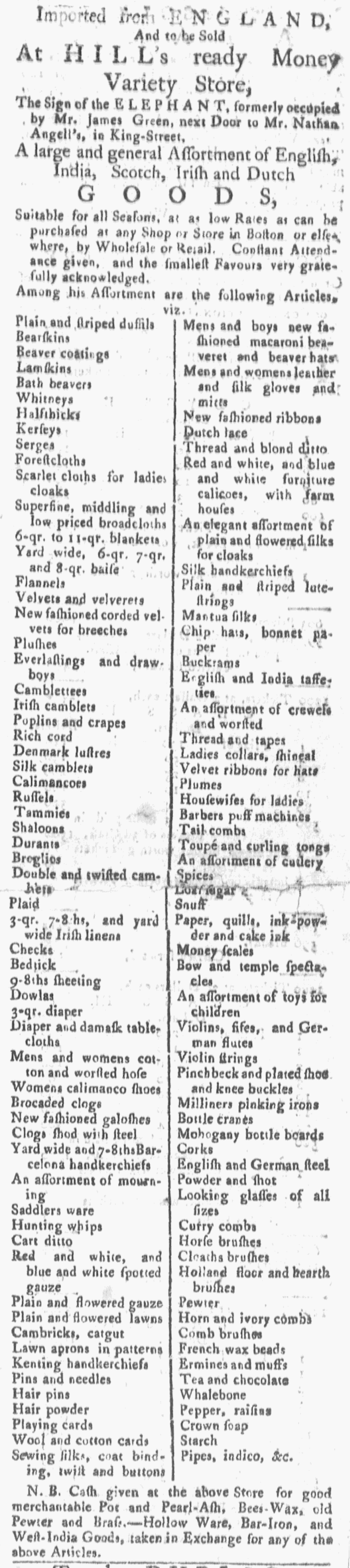
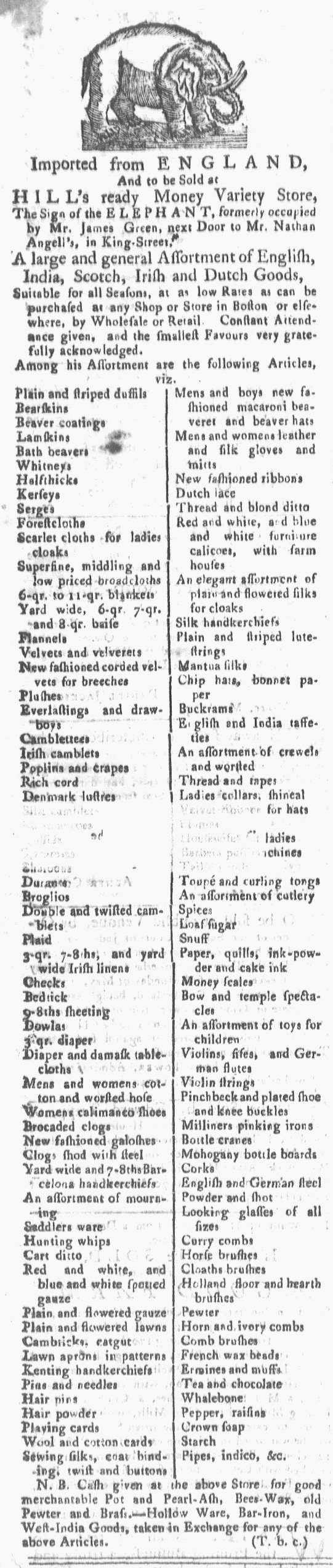
The initial advertisement ran for three weeks before a much longer version replaced it on February 12.  That notice almost filled an entire column since it extensively “enumerated” Hill’s inventory, everything from “Scarlet cloths for ladies cloaks” and “New fashioned corded velvets for breeches” to “Mens and boys new fashioned macaroni beaveret and beaver hats” and “Velvet ribbons for hats” to “Looking glasses of all sizes” and “An assortment of toys for children.”  The compositor divided the advertisement into two columns, listing one item per line to make it easier for readers to peruse and identify items of interest.  That advertisement ran for six consecutive weeks.

On March 26, Hill placed a new version.  The inventory remained the same, but it featured a new introduction and, most significantly, a woodcut depicting an elephant.  Hill intensified his effort to associate a logo with his business, presenting readers of the Providence Gazette with an image of an elephant to make his “Variety Store” even more memorable.  Except for the device that appeared in the masthead each week, it was the only image that appeared in that edition of the Providence Gazette.  With the addition of the woodcut, Hill’s advertisement filled an entire column in the newspaper.  Yet the image may have been the more powerful marketing strategy than the list that demonstrated choices for consumers.  By selecting an elephant, Hill emphasized goods, especially textiles, imported from India.  Most likely, none of the colonizers in Providence had ever glimpsed that exotic creature in real life.  Primitive as the woodcut might seem to modern eyes, it may have been one of the few visual depictions of an elephant that readers of the Providence Gazette ever encountered.  The novelty served an importance purpose in Hill’s marketing efforts.

March 19

What was advertised in a colonial American newspaper 250 years ago today?

Providence Gazette (March 19, 1774).

“… and many other Articles, as cheap as usual.”

Were advertisements in early American newspapers effective?  Did they work?  Did readers become consumers because advertisements incited demand?  Did consumers select where they would shop because of the advertisements they encountered in the public prints.  There are no easy answers to those questions.

What can be asserted with more certainty is that many merchants, shopkeepers, artisans, and others who provided goods and services considered advertising worth the investment, so much so that they placed advertisements for years.  Consider Nicholas Tillinghast and William Holroyd of Providence.  As spring approached in 1774, they once again took to the pages of the Providence Gazette, this time promoting an assortment of “GARDEN SEEDS” as well as a “Variety of English and West India GOODS.”  Perhaps seeing James Green’s advertisement for similar merchandise in the March 5 edition prompted them to insert their own notice in the next edition for fear of losing former and prospective customers to a competitor.

By that time, Tillinghast and Holroyd had been advertising in the Providence Gazette for years.  The Adverts 250 Projecthas not featured every advertisement that they published, but it has examined several of them.  On November 24, 1770, the partners announced that they “newly opened the Shop … at the Sign of the Elephant … where they have to sell a Variety of Articles.”  A year later, they once again hawked “a Variety of well assorted GOODS,” noting that they stocked too many items “to be particularly mentioned in an Advertisement.”  On May 16, 1772, they asserted that they sold a “Variety [of] ARTICLES … at as cheap a Rate as any Goods, of the same Quality, can be purchased in this Town.”  They did not merely announce that they had merchandise for sale.  Instead, Tillinghast and Holroyd repeatedly underscored that they offered choices to consumers and sometimes used prices to encourage prospective customers to choose their store over others.  They did so once again in August 1773 when they directed “their old Customers and the Public” to a new shop “which they have built.”  Their inventory consisted of “English Piece Goods, and Hard Ware of various Sorts, West-India Goods, Groceries and Wines of several Sorts.”  The partners resorted to a familiar refrain: “the Particulars of which would be tedious to enumerate in an Advertisement.”  Instead, they “can be better recounted to any who shall be pleased to make personal Application.”  Tillinghast and Holroyd promised attentive customer service.

Did advertising work?  Tillinghast and Holroyd thought that it worked well enough to justify placing yet another notice in the Providence Gazette in March 1774.  If they suspected that advertising did not yield a return on their investment, would they have continued doing so?

March 12

What was advertised in a colonial American newspaper 250 years ago today?

Providence Gazette (March 12, 1774).

“As cheap … as can be bought at any Shop in NEW-ENGLAND.”

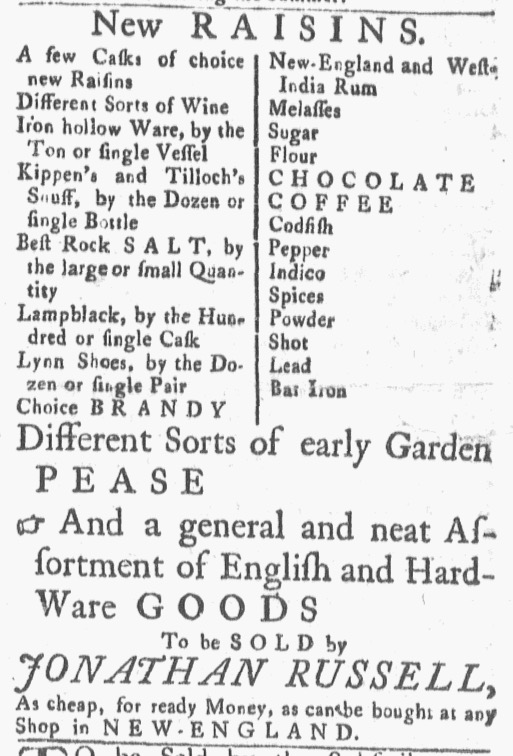
Jonathan Russell offered a variety of goods to prospective customers in his advertisement in the March 12, 1774, edition of the Providence Gazette.  The headline promised “New RAISINS.”  A list of other items appeared below the headline, followed by a note about “Different Sorts of early Garden PEASE” and another about a “general and neat Assortment of English and Hard-Ware GOODS.”  Both ran in the same size font as the headline, suggesting that Russell may have instructed the compositor to place greater emphasis on that portion of his inventory.  Although he did not enumerate the “English and Hard-Ware GOODS,” he underscored the choices available to consumers when he asserted that he stocked a “general and neat Assortment.”

Some of the items in the list of goods also attracted attention because they appeared in capital letters.  “Best Rock SALT,” “Choice BRANDY,” “CHOCOLATE,” and “COFFEE” stood out among the “Kippen’s and Tilloch’s Snuff, by the Dozen or single Bottle,” “Lampblack, by the Hundred or single Cask,” “Lynn Shoes, by the Dozen or single Pair,” flour, codfish, and other commodities.  Notably, Russell peddled “CHOCOLATE” and “COFFEE,” but did not mention tea at all. Capitalizing “CHOCOLATE” and “COFFEE” called attention to the fact that tea was absent from his inventory as colonizers continued to debate the politics of consuming that beverage just a few months after the Boston Tea Party.

Russell concluded his advertisement with an appeal to price, claiming that customers could purchase his wares “As cheap … as can be bought at any Shop in NEW-ENGLAND.”  He did not place himself in competition solely with James Green, “HILL’s ready Money Variety Store,” and other merchants and shopkeepers in Providence.  Instead, he declared that his low prices matched those in Newport, Portsmouth, and Boston.  Prospective customers did not need to visit other shops in Providence or send away to merchants and shopkeepers in other towns to get better deals.  Although not as extensive as other advertisements in the same issue of the Providence Gazette, Russell’s notice incorporated consumer choice and competitive prices and even seemed to offer political commentary for those who read carefully.

March 5

What was advertised in a colonial American newspaper 250 years ago today?

Providence Gazette (March 5, 1774).

“The Advertiser once had a small Sign of a Sugarloaf affixed to his little Shop.”

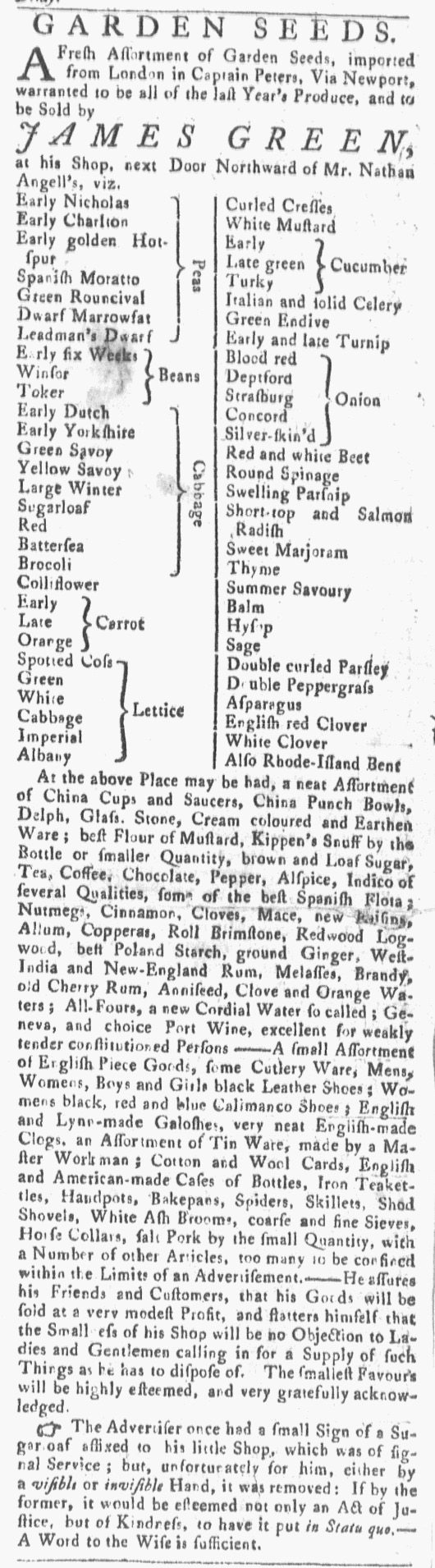
As spring approached in 1774, advertisements for “GARDEN SEEDS” appeared in newspapers in New England.  John White was the first to advertise in Boston, soon joined by Susanna Renken, Elizabeth Clark, Elizabeth Greenleaf, Elizabeth Nowell, and other women who annually announced they sold seeds in the city’s newspapers.  As Abel Buell hawked firearms in the Connecticut Journal, Nathan Beers promoted “Garden Seeds, Both of English and American Growth.”  In Rhode Island, James Green placed an extensive advertisement for a “Fresh Assortment of Garden Seeds” in the Providence Gazette, as he had done the previous year.  The format distinguished it from other notices, the various types of peas, beans, cabbage, carrot, lettuce, cucumber, and onion clustered together and labeled by category.

Unlike most other seed sellers, Green also marketed all sorts of housewares, garments, and groceries in his advertisement.  That significantly contributed to the length of a notice that extended more than two-thirds of a column.  Green stocked everything from “a neat Assortment of China Cups and Saucers” and “Womens black, red and blue Calimanco Shoes” to “best Four of Mustard” and “Kippen’s Snuff by the Bottle or smaller Quantity.”  Yet that was not all.  He asserted that his inventory included “a Number of other Articles, too many to be confined within the Limits of an Advertisement.”  A newspaper notice could not contain all the choices Green made available to consumers!  The shopkeeper also made an appeal to price, “assur[ing] his Friends and Customers, that his Goods will be sold at a very modest Profit.”  Conversationally, he confided that he “flatters himself that the Smallness of his Shop will be no Objection to Ladies and Gentlemen calling in for a Supply of such Things he has to dispose of.”

All of that was standard for advertisements in newspapers published throughout the colonies.  A final note, however, discussed unusual circumstances that agitated the shopkeeper.  “The Advertiser once had a small Sign of a Sugarloaf affixed to his little Shop,” Green noted.  In marking his location, it “was of signal Service.”  Yet the sign no longer adorned his shop: “unfortunately for him, either by a visible or invisible Hand, it was removed.”  Perhaps bad weather, an “invisible Hand, had carried it away, but if that was not the case, if some prankster had taken it then Green petitioned for its return: “it would be esteemed not only an Act of Justice, but of Kindness, to have it put in Status quo.”  Using an eighteenth-century version of “no questions asked,” he declared that “A Word to the Wise is sufficient.”  If anyone knew what had happened to the sign, he hoped that they would encourage whoever had it to put it back where it belonged.  Green was not interested in the details of where his sign had been or who took it, only its return to its rightful place as the emblem designating his place of business.  The shopkeeper made an aside in his newspaper advertisement to tend to other forms of marketing associated with his shop in Providence.

February 26

What was advertised in a colonial American newspaper 250 years ago today?

Providence Gazette (February 26, 1774).

“He also attends the Sick as usual, either in Town or Country, upon the shortest Notice, with the greatest Care and Fidelity.”

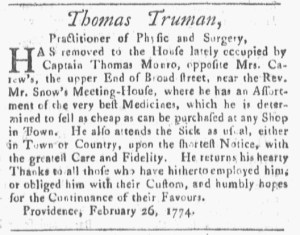
More than a year after he first positioned himself as the successor to “Doctor SAMUEL CAREW, late of Providence, deceased,” Thomas Truman, “Practitioner of Physic and Surgery,” continued to practice in that town.  As February 1774 came to an end, he once again took to the pages of the Providence Gazette, this time to announce that he “removed” to a new location.  In directing prospective patients to “the House lately occupied by Captain Thomas Munro, opposite Mrs. Carew’s, the upper End of Broad-street, near the Rev. Mr. Snow’s Meeting-House,” he reminded readers of his former affiliation with the deceased doctor.  Mentioning the widow may have jogged the memories of some who had known Truman “during his Apprenticeship with Doctor CAREW.”  When he first sought to establish himself in Providence, Truman faced competition from others who advertised their services as physicians, including Ebenezer Richmond and Daniel Hewes.

Truman’s advertisements may have helped him secure his place.  He expressed “his hearty Thanks to all those who have hitherto employed him … and humbly hopes for the Continuance of their Favours.”  He apparently considered advertising effective enough to justify subsequent investments.  Upon moving to his new location, he advised that he stocked “an Assortment of the very best Medicines, which he is determined to sell as cheap as can be purchased at any Shop in Town.”  Truman realized that for one segment of his business he competed not only with other practitioners but also with apothecaries who compounded medicines and even merchants and shopkeepers who imported patent medicines.  In addition, he “attends the Sick as usual, either in Town or Country, upon the shortest Notice, with the greatest Care and Fidelity.”  Truman wanted readers to remember him when they fell ill.  No matter where they happened to reside, he pledged to provide exemplary care as quickly as possible.  An occasion advertisement in the Providence Gazette enhanced his visibility among prospective patients beyond the reputation he earned through word of mouth.

February 19

What was advertised in a colonial American newspaper 250 years ago today?

Providence Gazette (February 19, 1774).

“He has procured an European Dyer.”

Stephen Potter, a clothier in Coventry, Rhode Island, gave the public advance notice about a service he would soon offer.  In an advertisement that first appeared in the February 12, 1774, edition of the Providence Gazette and then continued on February 19 and 26, he advised “his old Customers, and all others” that he “begins colouring the first of March next.”

That expanded the range of services that the fuller provided when he processed woolen cloth “at his Clothier’s Works,” but Potter did not do so on his own.  Instead, he hired an employee (or perhaps acquired an indentured servant) who possessed skills that he did not.  As he explained to prospective customers, Potter “procured an European Dyer” who could “dye any Colour in Cloth or Yarn.”  The clothier highlighted the fact that his new dyer produced “a compleat Green.”

Entrepreneurs did not usually credit others who worked in their shops when they ran advertisements in colonial newspapers, but a few did so when they believed that acknowledging those who labored beside them or on their behalf helped in marketing the goods and services they sold.  In this instance, Potter’s “old Customers,” in particular, “and all others,” in general, likely knew that dying woolen goods was not a skill that he possessed.  As he sought to expand his business, Potter deemed it necessary to credit the “European Dyer” who recently joined “his Clothier’s Works.”

That did not prevent Potter from promoting his own contributions to the business, declaring that he “engages to dress his Work in the neatest Manner.”  Customers could expect the highest quality of both the fulling and the dying of cloth entrusted to Potter.  That Potter offered dying as an ancillary service distinguished his operation from other clothiers in the area.  That included John Waterman, a competitor who simultaneously ran advertisements in the Providence Gazette.

February 12

What was advertised in a colonial American newspaper 250 years ago today?

Providence Gazette (February 12, 1774).

“As low Rates as can be purchased at any Shop or Store in Boston or elsewhere.”

When the proprietor of “HILL’s Variety Store” took to the pages of the Providence Gazette near the end of January 1774, his advertisement promoted a “compleat Assortment of English, Scotch and India Goods,” listed about a dozen items, and promised “every other Article usually imported, too many to be enumerated in this Week’s Paper.”  That final note suggested that either the printer had truncated the advertisement due to space constraints or the advertiser had not yet compiled a more complete inventory to insert in the public prints.  It may very well have been the latter, considering that three weeks passed before a more extensive advertisement appeared in the Providence Gazette.

And more extensive it certainly was!  That advertisement filled nearly an entire column in the February 12 edition.  The merchant devoted most of that space to a catalog of “English, India, Scotch, Irish and Dutch GOODS,” demonstrating the range of choices available to consumers.  Divided into two columns with only one item per line, making it easier for readers to navigate than the dense paragraphs of text in some advertisements, this notice included many kinds of textiles and accessories, “Womens calamanco shoes,” “Mens and boys new fashioned macaroni beaveret and beaver hats,” “Mens and womens leather and silk gloves and mitts,” “Pinchbeck and plated shoe and knee buckles,” “Violins, fifes, and German flutes,” and even an “assortment of toys for children.”  Prospective customers could expect to discover much more at “HILL’s ready Money and Variety Store.”  (The variation on the name suggested that they would need to pay at the time of sale rather than purchase on credit, but a note at the end of the advertisements indicated “Hollow Ware, Bar-Iron, and West-India Goods, taken in Exchange for any of the above Articles.”)  The list of goods began with a clarification that “Among his Assortment are the following Articles,” while the catalog concluded with “&c.” (an abbreviation for et cetera) to signal that even more was available at the store.

Yet such appeals to consumer choice were not the only marketing strategies deployed by the merchant.  A preamble to his inventory reported that he sold his goods both wholesale and retail “at as low Rates as can be purchased at any Shop or Store in Boston or elsewhere.”  He realized that he did not compete solely with local merchants and shopkeepers but also with their counterparts in Boston, Newport, New York, and other towns.  He did not want shopkeepers in the countryside turning to importers in other ports to supply their inventory.  Such wholesale purchases could amount to significant revenue.  At the same time, he did not ignore consumers interested in retail purchases.  The merchant stated that “the smallest Favours” or purchases would be “gratefully acknowledged.”  Between the selection and the prices, he hoped prospective customers would come to the “Sign of the ELEPHANT” in King Street to acquire goods they needed to supplement inventories at their own shops or that they wanted for their own use.

February 5

Who were the subjects of advertisements in a colonial American newspaper 250 years ago today?

Providence Gazette (February 5, 1774).

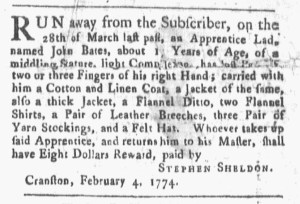
“RUN away … an Apprentice Lad, named John Bates.”

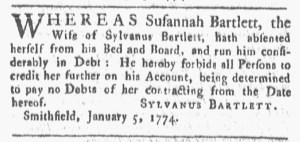
“Susannah Bartlett, the Wife of Sylvanus Bartlett, hath absented herself.”

“RUN away … a Servant Man, named Kimbal Ramsdill, a pretended Carpenter or Joiner.”

Colonizers used various kinds of “runaway” advertisements in their efforts to maintain social order.  Such was the case in the February 5, 1774, edition of the Providence Gazette.  Several colonizers published stories of subordinates who ran away, giving directions about how others should interact with them if they happened to encounter them.

In the first of those advertisements that readers saw if they perused the newspaper from the first page to the last, Stephen Sheldon of Cranston announced, “RUN away … an Apprentice Lad, named John Bates.”  The apprentice had departed on March 28, 1773, nearly a year earlier, but Sheldon hoped that his advertisement would result in recovering him.  He offered “Eight Dollars Reward” to “Whoever takes up said Apprentice, and returns him to his Master.”  He also provided a physical description to aid in identifying the runaway, including an especially distinctive feature.  The young man “has lost two or three Fingers on his right Hand.”

Providence Gazette (February 5, 1774).

The next advertisement revealed marital discord in the Bartlett household in Smithfield.  “Susannah Bartlett, the Wife of Sylvanus Bartlett,” the husband proclaimed, “hath absented herself from his Bed and Board, and run him considerably in Debt.”  Accordingly, he no longer assumed responsibility for her expenses.  Invoking language that appeared in such advertisements throughout the colonies, Sylvanus declared that he “hereby forbids all Persons to credit her further on his Account, being determined to pay no Debts of her contracting.”  As had been the case with Sheldon running an advertisement about Bates, Sylvanus had much greater access to the public prints than Susannah, so readers of the Providence Gazette knew only one side of the story.  The apprentice and the wife may have had good reasons to leave the Sheldon and Bartlett households.

Providence Gazette (February 5, 1774).

In another advertisement, Benjamin Cargill of Pomfret, Connecticut, described Kimbal Ramsdill, a “Servant Man” and a “Pretended Carpenter or Joiner” who had “RUN away” the previous December.  Cargill indicated that Ramsdill often misrepresented himself, not only in terms of his trade but also his origins.  “The above Fellow,” he stated in a nota bene, “pretends at Times he was born at Lynn, and at other Times at Newbury.”  Indeed, he was “much given to Lying, and apt to tell of his having Land in different Parts.”  In this instance, Cargill did not ask readers to accept his word alone that Ramsdill engaged in unsavory behavior.  He reported that the indentured servant “hath lately been convicted of Stealing, and publicly whipped seven Lashes, the Marks of which perhaps may yet be seen.”  Cargill promised “Ten Dollars Reward” to “Whoever will take up said Servant, and secure him in any of his Majesty’s Goals [Jails].”

The advertisements in the Providence Gazette and other colonial newspapers did not merely market goods and services to consumers.  Many of them instead delivered news about local events, including cases of runaway apprentices, wives, and indentured servants.  The colonizers who placed those advertisements did so for their own purposes, but also thought they did the community a service by warning about men and women who did not abide by behavior considered appropriate to their status or, sometimes, had even been convicted of crimes.  While there are many reasons not to lump John Bates, Susannah Bartlett, and Kimbal Ramsfill together, the men who placed advertisements about them belonged to a common category of colonizers who used the power of the press in their efforts to impose order on subordinates who they reported had misbehaved.

January 29

What was advertised in a colonial American newspaper 250 years ago today?

Providence Gazette (January 29, 1774).

“Had the Fire got to any Height, it would have raged to an unknown Degree, for Want of Buckets to supply the Engines.”

Newspaper advertisements often delivered local news that did not appear elsewhere in the publication.  Such was the case in the wake of a fire in Providence that took place on January 21, 1774.  The following day the Providence Gazettereported, “Yesterday Evening the Town was alarmed by the Cry of Fire, which proved to be in the Pot-Ash Works, on the West Side of the Bridge; but by timely Assistance it was suppressed before much Damage had ensued.”  John Carter, the printer, downplayed the danger, perhaps unintentionally.  He did not have much time to gather information about the fire before the newspaper went to press, so important details did not appear in the Providence Gazette until the next issue.  When they did, they ran among the paid notices rather than in the news that Carter compiled.

On January 29, the newspaper carried an advertisement that transmitted an “Order of the Engine-Company, No. 1,” to residents of the town.  The dateline indicated it had been written the day after the fire, the same day as the previous issue of the Providence Gazette, but too late to appear in the weekly publication.  “WHEREAS it was observed at the Place of the Fire last Evening,” the advertisement proclaimed, “that the greater Part of the People attending had no Buckets; and it is generally thought, that had the Fire got to any Height it would have raged to an unknown Degree, for Want of Buckets to supply the Engines: Therefore all Families, for their own Preservation, are required to provide themselves with Buckets immediately.”  Carter’s initial reporter emphasized “timely Assistance” that “suppressed” the fire “before much Damage had ensued,” but this subsequent advertisement underscored how catastrophic the fire could have been as a result of so many residents not being prepared to provide the right kind of assistance.  Not only had they been negligent, they also disregarded a local ordinance.  The Engine Company instructed “all Families” to acquire buckets so they could provide aid in the future not only “for their own Preservation” but also to “avoid the Penalty of the Law.”  The advertisement concluded with a warning about “an Examination being intended to be made throughout the Town, and the Law put into Execution.”

Those details likely spread by word of mouth in the week between the fire and the advertisement running in the Providence Gazette, so Carter may not have considered it necessary to include the additional details among the local news.  In addition, having received the Engine Company’s advertisement in the printing office, he probably thought it a sufficient update.  Readers who lived at any distance would have been less likely to hear that so many people who showed up to the fire could not assist in putting it out because they did not bring buckets, so the advertisement did indeed present new news to them.  As was so often the case, collating information in news articles and advertisements yielded more complete coverage of local events.

January 22

What was advertised in a colonial American newspaper 250 years ago today?

Providence Gazette (January 22, 1774).

“Every other Article usually imported, too many to be enumerated in this Week’s Paper.”

The proprietor of “HILL’s Variety Store” at “the Sign of the ELEPHANT” advertised a “compleat Assortment of English, Scotch and India GOODS” in the January 22, 1774, edition of the Providence Gazette.  To incite interest in his wares, Hill proclaimed that he set prices “as low as can be purchased at any Shop or Store in Boston,” provided that customers paid cash rather than buying on credit.  Boston was a larger port that welcomed a greater number of vessels carrying imported goods, but that did not mean that shoppers there benefitted from better bargains than Hill made available in Providence.  The shopkeeper also listed several items, including several textiles, “new-fashioned Galloshes,” and “low-priced scarlet Broadcloths for Ladies Cloaks,” and promised “every other Article usually imported, too many to be enumerated in this Week’s Paper.”

That suggested that perhaps the printer, John Carter, abbreviated an advertisement received in the printing office due to lack of space.  Though that happened rarely, printers sometimes exercised such editorial discretion, especially when merchants and shopkeeper submitted their notices just before the newspaper went to press.  Alternately, Hill may not have prepared a longer advertisement intended for the January 22 edition but instead wanted to alert local consumers that his “Variety Store” was open for business, planning to compose an advertisement with a more complete inventory in time for the next issue.  On January 29, however, a slightly revised notice ran in the Providence Gazette.  The list of merchandise now concluded: “with every other Article usually imported, Wholesale and Retail.”  The same copy appeared on February 5.

It was not until February 12 that a longer advertisement ran in the Providence Gazette.  That one featured a far greater number of items, divided into two columns, that extended nearly an entire column.  In addition to listing dozens of items, it revised the name of the business to “HILL’s ready Money Variety Store,” underscoring that the proprietor did not allow credit.  The sequence of these advertisements suggests that it was not lack of space that resulted in the note about “too many [items] to be enumerated in this Week’s Paper” the first time the notice ran.  Hill may have had grand designs for updating his advertisement soon after it first appeared, but did not do so.  Once he submitted the copy, however, the longer advertisement ran for six consecutive weeks before he updated it once again on March 26, that time adding a woodcut depicting an elephant to match the sign that marked the location of the “ready Money Variety Store.”  The Adverts 250 Project will feature that advertisement in a future entry.