What was advertised in a colonial American newspaper 250 years ago today?
Providence Gazette (July 9, 1774).
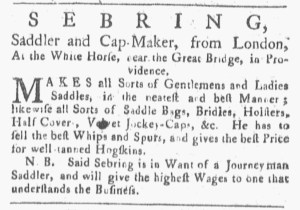
“MAKES all Sorts of Gentlemens and Ladies Saddles, in the neatest and best Manner.”
John Sebring, a “Saddler and Cap-Maker, from London,” once again took to the pages of the Providence Gazette in the summer of 1774. As had been his practice in the past, he deployed solely his last name as a headline for his advertisement, presumably believing that a mononym gave him greater cachet with prospective customers. He declared that he “MAKES all Sorts of Gentlemens and Ladies Saddles, in the neatest and best Manner” as well as “all Sorts of Saddle Bags, Bridles, Holsters, Half Covers, Velvet Jockey-Caps,” and other items. He intended for readers to associate quality with the name Sebring.
In addition to the mononym, Sebring apparently believed that his experience in London enhanced the image he presented to the public, though it had been some time since he resided and worked in that cosmopolitan center of the empire. When they proclaimed that they were “from London,” artisans often linked those origins to superior training or more intimate knowledge of current styles or both. Sebring did in his previous newspaper notices. By the time he placed his advertisement in the July 9, 1774, edition of the Providence Gazette, however, he had been in that town for at least twenty months. That may have caused him to place less emphasis on his supposed knowledge of London fashions. In previous advertisements, he used the phrase “newest Fashion” to describe the saddles and other items he made in his workshop “At the White Horse, near the Great Bridge,” implying that his connections to London gave him insight into the latest styles there. He even included the phrase twice in a notice he ran the previous summer. In this advertisement, however, he focused on quality instead of (rather than in addition to) fashion. Perhaps Sebring realized that many prospective customers knew he had not worked in London recently so his familiarity with the styles there came secondhand. The training and experience he gained in London, however, did not change as time passed, making it worthwhile to continue to remind prospective customers of his origins.
What was advertised in a colonial American newspaper 250 years ago today?
Providence Gazette (June 25, 1774).
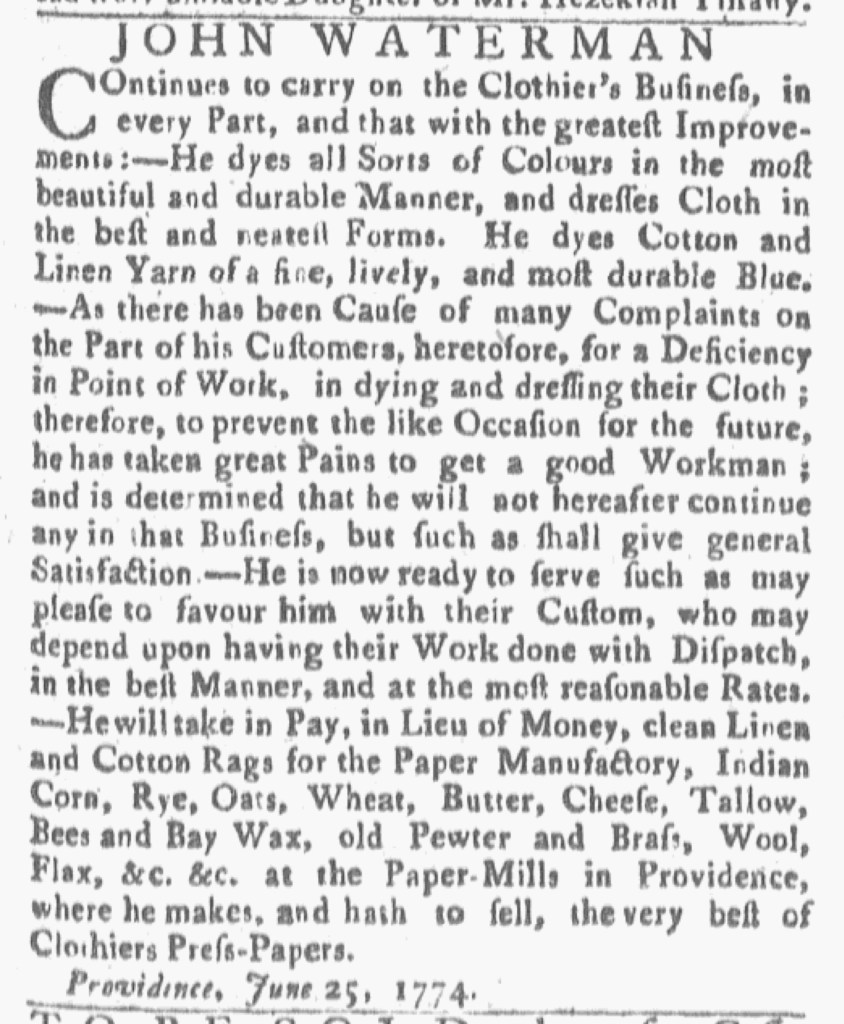
“There has been Cause of many Complaints on the Part of his Customers.”
In the summer of 1774, John Waterman ran an advertisement in the Providence Gazette to inform the public that he “Continues to carry on the Clothier’s Business, in every Part, … with the greatest Improvements.” Among the services he provided, he “dyes all Sorts of Colours in the most beautiful and durable Manner, and dresses Cloth in the best and neatest Forms.” In particular, he “dyes Cotton and Linen Yarn of a fine, lively, and most durable Blue.” Waterman did not go into detail about the “Improvements” he made to his business, but some of them likely involved hiring new employees. At the start of the year, he had placed an advertisement seeking a clothier “well experienced in all Parts of the Business” to work at the “new and most compleat Works in the Colony.”
In this new advertisement, Waterman confessed that “there has been Cause of many Complaints on the Part of his Customers, heretofore, for a Deficiency … in dying and dressing their Cloth.” Apparently, launching his new enterprise had not gone as smoothly as Waterman hoped. To remedy the situation, he assured the public that he “has taken great Pains to get a good Workman.” Furthermore, he asserted that he “is determined that he will not hereafter continue any in that Business, but such as shall give general Satisfaction.” In other words, he would no longer employee workers who produced shoddy work, deferring to the judgment of his customers when it came to deciding what was unacceptable. In an effort to redeem his reputation, Waterman acknowledged legitimate concerns voiced by previous customers and pledged that he had taken appropriate action to address them.
That being the case, the clothier proclaimed that he “is now ready to serve such as may please to favour him with their Custom.” Waterman promised that they “may depend upon having their Work done with Dispatch, in the best Manner, and at the most reasonable Rates,” combining appeals to efficiency, quality, and price. He asked former and prospective customers to forgive any misstarts that previously occurred and trust that his business now provided exemplary service.
What was advertised in a colonial American newspaper 250 years ago today?
Providence Gazette (June 18, 1774).
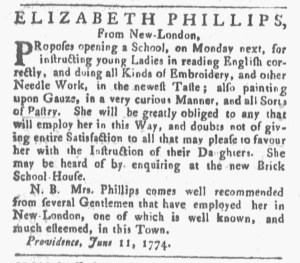
“Mrs. Phillips comes well recommended from several Gentlemen that have employed her in New-London.”
References upon request. That was part of the marketing strategy deployed by Elizabeth Phillips when she relocated from New London to Providence. Upon her arrival in Rhode Island, she placed an advertisement in the Providence Gazette to inform her new neighbors that she “PRoposes opening a School … for instructing young Ladies in reading English correctly, and doing all Kinds of Embroidery, and other Needle Work, in the newest Taste.” Her curriculum also included “painting upon Gauze, in a very curious Manner, and [making] all Sorts of Pastry.” Her pupils learned a variety of feminine arts.
The schoolmistress declared that she “will be greatly obliged to any that will employ her in this Way, and doubts not of giving entire Satisfaction to all that may please to favour her with the Instruction of their Daughters.” Yet the newcomer realized that the public in Providence did not know her and lacked familiarity with her reputation for running a school. Phillips sought to counter that with a nota bene in which she claimed that she “comes well recommended from several Gentlemen that have employed her in New-London.” Parents of prospective students did not have to take her word for it since “one of which is well known, and much esteemed, in this Town.” Phillips did not reveal the identity of this gentleman in the public prints, but readers could learn more “by enquiring at the new Brick School-House.” When they did, that gave the schoolmistress opportunities to share examples of the embroidery and painting she taught in addition to revealing who could speak on her behalf. She likely supposed that engaging with the parents of prospective students in person would garner enrollments just as effectively as recommendations from previous employers, so offering references on request served as a means of initiating those interactions.
What was advertised in a colonial American newspaper 250 years ago today?
Providence Gazette (May 14, 1774).
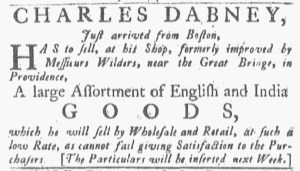
“[The Particulars will be inserted next Week.]”
Charles Dabney took out an advertisement in the Providence Gazette to announce that he stocked a “large Assortment of English and India GOODS” at his shop near the Great Bridge. He offered his wares “Wholesale and Retail, at such a low Rate, as cannot fail giving Satisfaction to the Purchasers.” In other words, customers would be happy with the bargains they got when they visited Dabney’s shop. He intended to provide a list of his merchandise to demonstrate the choices he made available to consumers, but his initial advertisement in the May 14, 1774, edition did not include “The Particulars.” Instead, the notice stated that those details “will be inserted next Week.” Who made that decision? Perhaps Dabney did not have time to draw up a list of that “large Assortment” before the May 14 edition went to press. Perhaps John Carter, the printer of the Providence Gazette, determined that he did not have space for all the content submitted that week. Dabney’s advertisement may have been the item easiest to truncate.
Whatever the explanation, the complete advertisement did not appear the following week. Politics and current events crowded out most advertisements, including even the short version of Dabney’s notice. A note from the printer advised, “To make Room for the interesting Advices in this Day’s Gazette, we are obliged to omit several Advertisements.” Those “interesting Advices” included the “Substance of the DEBATES on the BOSTON PORT-BILL” in the House of Commons in London. Parliament closed the port of Boston in retribution for the destruction of the tea that occurred the previous December. That news, which filled the entire front page and overflowed onto the second, arrived in Boston via several vessels from London. Carter then reprinted it from Boston’s newspapers. The second page also featured an editorial by “JUSTICE” that ran in the London’s Public Advertiser” and news from Philadelphia and Boston. The updates from Boston continued on third page, followed by a resolution in support of “the Province of the Massachusetts Bay” adopted at a “Town-Meeting held at Providence, on the 17thDay of May.” Advertising filled only two-thirds of the final column. More coverage of the debate over the Boston Port Act filled almost the entire final page. Two advertisements appeared at the bottom of the last column.
Dabney’s advertisement did finally appear in its entirety on May 28, but news about the imperial crisis, especially the repercussions of the Boston Tea Party, took priority. That arrangement may have helped to draw more eyes to Dabney’s notice when it did run. Colonizers looking for more news about the Boston Port Act and reactions to it in other colonies, including those who were not subscribers or regular readers, may have eagerly perused new issues of the Providence Gazette. They certainly found more news on May 28, but they also encountered Dabney’s advertisement with its extensive list of merchandise.
What was advertised in a colonial American newspaper 250 years ago today?
Providence Gazette (May 7, 1774).
“His Customers may depend on having their Work done as neat as at Boston.”
When the mononymous Wright, “TAYLOR and HABIT-MAKER, from Boston,” arrived in Providence, he ran a newspaper advertisement to introduce himself to prospective clients in and near the growing port. He advised the public that he “has taken a Shop opposite Messieurs Joseph and William Russell’s Store,” a prime location because everyone knew where the town’s most prominent merchants did business. Readers might not know much about Wright, at least not yet, but they could certainly find their way to his new shop if they wished to find out more.
For his part, Wright sought to incite interest that would help in cultivating a clientele by telling the public more about himself and his plans for his new enterprise. He reported that he “served his Apprenticeship to one of the best Taylors in Boston,” but did not give a name. Whether they arrived from the other side of the Atlantic or from another colony, artisans often promoted the training they received in their trade, hoping that would give them some standing with prospective customers while they worked to establish their reputations in the local market. Wright also asserted that he pursued “the Taylor’s Business, in all its Branches,” indicating that he was capable of any sort of work undertaken by tailors. His apprenticeship had been extensive and complete.
The newcomer also emphasized quality and customer service. He promised that he produced garments “in the neatest and best Manner.” Indeed, given his prior experience, he pledged that “His Customers may depend on having their Work done as neat as at Boston, or elsewhere.” Just because Boston and New York and Philadelphia were larger and more cosmopolitan did not mean that their tailors produced better work, at least not according to Wright as he appealed to prospective clients in Providence. He may have even intended for the mononym to testify to the cachet associated with hiring him. Wright was confident that he “shall give Satisfaction to all that may please to favour him with their Custom.” Whether or not that was actually the case could not be gleaned from his advertisement, but the tailor did demonstrate that he was familiar with the various conventions for marketing his services commonly adopted by members of his trade during the era of the American Revolution.
What was advertised in a colonial American newspaper 250 years ago today?
Providence Gazette (April 30, 1774).
“They desire their old Customers and others to call at their Shop.”
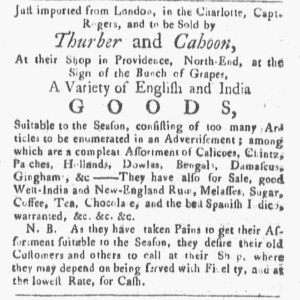
In the spring of 1774, Thurber and Cahoon advertised a “Variety of English and India GOODS” available at their shop “at the Sign of the Bunch of Grapes,” a familiar sight in Providence’s North End. They stocked items “Just imported from London, in the Charlotte, Capt. Rogers.” Merchants and shopkeepers often provided such information about the origins of their merchandise, allowing consumers to determine for themselves when they received their wares and whether items had been lingering on the shelves or in storerooms. Thurber and Cahoon, veteran advertisers, first placed this notice in the April 30, 1774, edition of the Providence Gazette. One of their competitors, Thomas Green, also received a shipment via the Charlotte. His advertisement for a “large and general Assortment of English and India GOODS” opened with similar copy: “Just imported in the Charlotte, Capt. Rogers, from London.”
Thurber and Cahoon asserted that their new selection was “Suitable to the Season” and “consist[ed] of too many Articles to be enumerated in an Advertisement.” Merchants and shopkeepers often made such claims, encouraging prospective customers to view the merchandise for themselves. They promised an array of choices without going into details (and costing a lot more money for purchasing space in the newspaper). In contrast, “HILL’s ready Money Variety Store” continued running an advertisement that filled an entire column because it “enumerated” so many of the items for sale there, yet the proprietor could not claim that his wares just arrived. Thurber and Cahoon did spare a couple of lines for textiles, noting that they carried a “compleat Assortment of Calicoes, Chintz, Patches, Hollands, Dowlas, Bengals, Damascus, Gingham, &c.” The common abbreviation for et cetera suggested even more textiles that Thurber and Cahoon considered “too many” for their advertisement. They also mentioned several grocery items, including “Melasses, Sugar, Coffee, Tea, [and] Chocolate,” but did not specify when they received those items. In particular, they did not give specifics about when and how they received their tea, leaving it to prospective customers to determine if they wished to purchase that item even after reading about the politics of tea elsewhere on the same page of that issue of the Providence Gazette.
In a nota bene, Thurber and Cahoon made a final appeal, one intended especially for their existing clientele. “As they have taken great Pains to get their Assortment suitable to the Season” by acquiring goods consumers wanted or needed for late spring and the summer, the merchants declared, “they desire their old Customers and others to call at their Shop.” They pledged good customer service, stating that visitors to Sign of the Bunch of Grapes “may depend on being served with Fidelity.” They could also depend on finding bargains, paying the “lowest Rate” for goods, provided they paid in cash rather than credit. Thurber and Cahoon incorporated a variety of marketing appeals into an advertisement that occupied a single “square” of space in the Providence Gazette.
What was advertised in a colonial American newspaper 250 years ago today?
Providence Gazette (April 23, 1774).
“Subscribers Names may be annexed to the Work.”
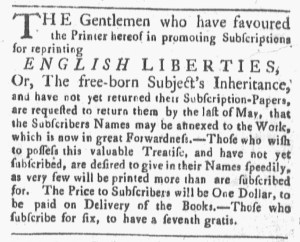
When John Carter, the printer of the Providence Gazette, set about publishing a new edition of English Liberties, Or the Free-Born Subject’s Inheritance: Containing Magna Charta, Charta de Foresta, the Statute de Tallagio non Concedendo, the Habeas Corpus Act, and Several Other Statutes, with Comments on Each of Them, he started with subscription proposals. Early American printers often did not take books directly to press. Instead, they disseminated proposals that described their intended projects, simultaneously seeking to gauge the market and to incite demand. In requesting that subscribers reserve their copies in advance, sometimes asking them to pay a deposit, printers determined whether publishing proposed books would be viable ventures and, if so, how many copies to print to avoid producing surplus copies that cut into profits. Subscription proposals ran as advertisements in newspapers and, for some proposed works, “Subscription-Papers” circulated separately as handbills, broadsides, and pamphlets.
Many printers recruited local agents to assist them in collecting the names of subscribers and how many copies each wished to reserve. Carter did so with English Liberties. In an update in the April 23, 1774, edition of the Providence Gazette, he advised that the book “is now in great Forwardness.” Most likely much of the type had been set and supplies, such as paper, acquired by the printing office. Carter instructed the “Gentlemen who have favoured the Printer hereof in promoting Subscriptions … to return [their subscription papers] by the last of May.” He needed to receive them by that time so “the Subscribers Names may be annexed to the Work.” That was a popular strategy for inciting demand among prospective customers, promising that their names would appear along with others who also subscribed. They became part of a community of readers, even if they never met, and, in this instance, a community of citizens committed to those “ENGLISH LIBERTIES” that had been “The free-born Subject’s Inheritance” for generations. Printers suggested to those who had not yet subscribed that they needed to do so if they wished to be recognized alongside their friends and acquaintances and the most prominent members of their communities who already made a statement about the causes that they supported by subscribing for one or more copies.
Carter deployed other marketing strategies to encourage subscriptions for English Liberties. He warned that “very few will be printed more than are subscribed for,” so anyone who even had an inkling that they might want a copy should not depend on waiting to purchase the book after it went to press. In addition, Carter offered a premium: “Those who subscribe for six, to have a seventh gratis.” Subscribers who purchased multiple copies would receive a free one as a reward.
Carter did indeed insert a list of “SUBSCRIBERS NAMES” at the end of the book. They appeared in somewhat alphabetical order, with last names starting with “A” coming first, followed by “B,” and so on. Carter indicated the town for subscribers who did not reside in Providence and, within each letter, clustered subscribers from the same town together. That made it easier for subscribers to determine which of their neighbors had joined them in supporting the enterprise. Most were from towns in Rhode Island, Massachusetts, and Connecticut, but some subscribed from greater distances, including Robert Johnston of Chester County in Pennsylvania and Thomas Tillyer in Philadelphia. The roster of subscribers included nearly five hundred names, mostly men, but also Mrs. Elizabeth Belvher of Wrentham, Massachusetts, several lawyers and ministers, and even Darius Sessions, the deputy governor of Rhode Island. For those who subscribed for multiple copies, Carter listed how many. A few purchased two or three copies, but more commonly subscribers purchased six, a sign of the effectiveness of the printer’s marketing strategy.
Not all subscription proposals resulted in publishing books. Printers sometimes learned that they could not generate sufficient demand. In this case, however, the combination of the subject matter’s relationship to the political climate, widespread distribution of subscription papers to local agents, publishing the names of subscribers, and free copies for those who purchased at least six contributed to the success of the venture, though it had taken more than a year.
What was advertised in a colonial American newspaper 250 years ago today?
Providence Gazette (April 16, 1774).
“New-England Rum and Melasses, Claret and Lisbon Wine.”
Joseph Russell and William Russell regularly advertised in the Providence Gazette in the 1760s and 1770s. In the spring of 1774, the merchants inserted a notice that listed a variety of commodities, including “Jamaica and Barbados Rum, New-England Rum and Melasses, Claret and Lisbon Wine, Coffee, Sugar, Indico, Alspice, large Rock Salt, [and] choice Connecticut Beef and Pork, in Barrels and Half Barrels.” They did not happen to include tea among their inventory, at least not among the items they enumerated in their newspaper advertisement, even though they frequently stocked it in the past. Just over a year earlier, they led one of their advertisements with “Excellent Bohea Team, which for Smell and Flavor exceeds almost any ever imported, by the Chest, Hundred, or dozen Pounds.” Perhaps the crisis around tea – the Boston Tea Party and the efforts of the Sons of Liberty to turn away ships carrying tea in other port cities – convinced them not to advertise that commodity. As they often did, the Russells concluded with a promise of various “English and Hard-Ware Goods.”
Compared to many of the advertisements they ran in the 1760s, their notices became more restrained in the 1770s. Their advertisement for the spring of 1774 filled the standard “square,” roughly equivalent in length to most other paid notices in the Providence Gazette. In contrast, their advertisement in the March 19, 1768, edition listed dozens of items. The Russells demonstrated that “their assortment is very large” and “customers will have the advantage of a fine choice” with an advertisement that extended more than a column. On previous occasions, they ran full-page advertisements, including in the November 22, 1766, and November 7, 1767, editions of the Providence Gazette. Many of their advertisements from the 1760s tended to look like the one for “HILL’s ready Money Variety Store” that appeared in the spring of 1774. Why did the Russells opt for less elaborate advertisements when facing such competition? Perhaps they felt secure in their reputation, deciding that shorter notices made customers sufficiently aware of their merchandise. In 1772, the prominent merchants built “the second brick edifice and the first three-story structure in Providence,” making them and their business even more visible to residents of the growing port. As their wealth increased and their status reached new heights, the Russells had other means of attracting attention to their enterprise beyond newspaper advertisements, yet they still considered streamlined notices valuable investments in advancing their entrepreneurial activities.
What was advertised in a colonial American newspaper 250 years ago today?
Providence Gazette (April 9, 1774).
“… to be sold by the Printer hereof.”
Advertisements filled the final column on the third page and the entire last page of the April 9, 1774, edition of the Providence Gazette. They generated significant revenue for John Carter, the printer, yet not all the advertisements were paid notices. Like many other printers, Carter used his newspaper to disseminate his own advertisements. He inserted five of the notices that appeared in that issue.
Those advertisements related to a variety of aspects of operating Carter’s printing office “at Shakespear’s Head, in Meeting-Street, near the Court-House.” In one, he called on “ALL Persons indebted for this Gazette one Year, or more” and anyone else indebted to him for other services “to make immediate Payment.” In another, Carter sought a “trusty and well-behaved Lad, about 13 or 14 Years of Age” as “an Apprentice to the Printing Business.” Candidates needed to be able to “read well, and write tolerably.” In yet another, a headline in a larger font than anything else in that issue, even the title of the newspaper in the masthead, proclaimed, “RAGS.” Carter offered the “best Prices … for clean Linen Rags, of any Kind, and old Sail-Cloth, to supply the PAPER MANUFACTORY in Providence.” The printer intended to recycle rags into paper that he would then use to publish subsequent editions of the Providence Gazette.
Providence Gazette (April 9, 1774).
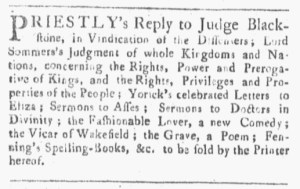
Other advertisements promoted items for sale at the printing office. Most printers also sold books. A few came from their own presses or other colonial presses, but most were imported from England. Carter listed several titles for readers with diverse interests, from “PRIESTLY’s Reply to Judge Blackstone, in Vindication of the Dissenters” to “the Fashionable Lover, a new Comedy” to “the Grave, a Poem” to “Fenning’s Spelling-Books.” An “&c.” (an abbreviation for et cetera) indicated that he stocked many more books, pamphlets, and broadsides. A shorter advertisement stated, “BLANKS of various Kinds to be sold by the Printer hereof.” Carter printed and sold forms for common legal and commercial transactions. Even the colophon doubled as an advertisement, informing readers that “all Manner of Printing-Work is performed with Care and Expedition.”
Carter took advantage of his access to the press to tend to the different parts of operating a busy printing office. While his advertisements did not generate revenue in the same manner as the paid notices placed by merchants, shopkeepers, artisans, estate executors, lottery managers, and others, they supported his business in other ways and some likely resulted in revenue from the sale of books and blanks or the settling of accounts. Collectively, they gave Carter a very visible presence in the pages of the Providence Gazette.
What was advertised in a colonial American newspaper 250 years ago today?
Providence Gazette (April 2, 1774).
“Genteel Boarding, FOR Gentlemen, Strangers and others.”
Thomas Russell provided “Genteel Boarding … at the House lately occupied by Mr. Benjamin Bagnall, deceased, near the State-House” in Boston. He did not, however, place his advertisement in the Boston-Gazette or the Massachusetts Spyor any of the several other newspapers printed in that city. Instead, he ran it in the Providence Gazette for six weeks in the spring of 1774. For “Gentlemen, Strangers and others” who planned to visit Boston, Russell presented an option for accommodations and made planning their journey that much easier.
To convince prospective guests that his establishment was a good choice, he assured readers that the house was “a very noted Place for this Business” as well as “well known to be a large and commodious House.” For anyone not familiar with its reputation, including those who lived any distance from Boston, they “have only to apply, to be convinced how agreeably they can be accommodated.” Russell’s hospitality and the amenities he offered, he suggested, would become immediately apparent upon meeting.
Boston and other American towns had not yet adopted standardized street numbers, so Russell provided travelers with general directions to get them to the vicinity of the house and enough information to find it once they spoke with some locals. Anyone who made their way to the “State-House” could then ask anyone they encountered about Russell’s boarding house, though they might more efficiently find it by invoking Benjamin Bagnall’s name since Russell apparently only recently acquired the property. Describing the landmark according to local knowledge would get guests to Russell’s door.
In promoting his boarding house, Russell joined entrepreneurs who ran taverns and inns who advertised in newspapers published in other cities. While they certainly welcomed local custom, they believed that marketing their establishments in publications in other towns would generate additional business. Russell seemed certain enough of it that he invested in advertising in the Providence Gazette for six weeks rather than starting with the standard three-week run for his advertisement. With the arrival of spring, he likely anticipated more travelers from Providence and its environs making their way to Boston. Russell stood ready to provide them with lodgings.