July 28

What was advertised in a revolutionary American newspaper 250 years ago today?
Essex Journal (July 28, 1775).

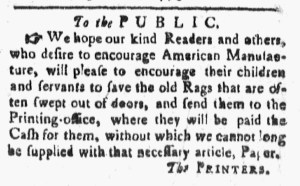
“Encourage their children and servants to save the old Rags … and send them to the Printing-office.”

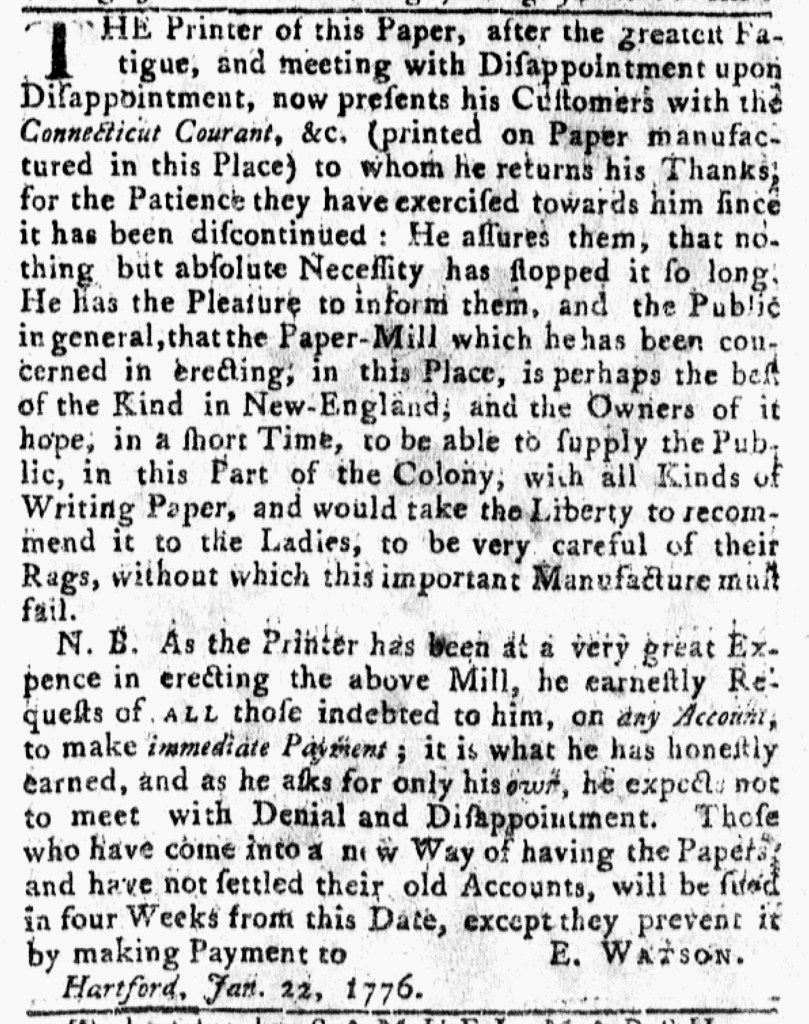
John Mycall and Henry-Walter Tinges, the printers of the Essex Journal in Newburyport, Massachusetts, concluded the July 28, 1775, edition of their newspaper with an advertisement that presented colonizers an opportunity to aid the American cause.  “We hope our kind Readers and others, who desire to encourage American Manufacture,” Mycall and Tinges declared, “will please to encourage their children and servants to save the old Rags that are often swept out of doors, and send them to the Printing-office.”  The printers offered cash for the rags, explaining that without them “we cannot long be supplied with that necessary article, Paper.”  Mycall and Tinges oversaw a recycling venture imperative in producing an essential article for continuing to publish their newspaper and anything else.  They were not the only printers in the region who experienced a disruption in acquiring paper in the months after the battles at Lexington and Concord.  Daniel Fowle, the printer of the New-Hampshire Gazette, had a similar experience.

Throughout the imperial crisis, collecting rags to recycle into paper had been imbued with political significance.  Producing paper in the colonies meant that printers did not need to import as much paper from England.  As nonimportation agreements went into effect in 1768, Christopher Leffingwell of Norwich, Connecticut, described collecting rags as “an entire Saving to the COUNTRY” and encouraged “every Friend and lover thereof [to] save every Scrap” of discarded linen.  For years, John Keating regularly promoted his “Paper Manufactory” in New York’s newspapers, arguing that economic resistance during the “present alarming situation of the colonies” was the “safest and most efficacious method of convincing the Ministry of Great-Britain of their error.”  He suggested that each household designate a “certain place” for collecting rags and cultivate a habit that would “establish this valuable manufactory upon a permanent foundation.”  Who undertook such work?  John Dunlap, the printer of the Pennsylvania Packet, hoped “to prevail upon our LADIES to grant us a little of their industry and assistance,” believing that “the welfare of their country will influence them” to do their part in collecting rags to recycle into paper.  Mycall and Tinges extended the call to include “children and servants.”  As men mustered to defend their liberties, women, children, and servants had their own role to play.  They could contribute to the American cause by supporting “American Manufacture,” including collecting rags to transform into the newspapers and pamphlets that disseminated the rhetoric of the Revolution.

October 23

What was advertised in a colonial American newspaper 250 years ago this week?

Supplement to the New-York Journal (October 20, 1774).

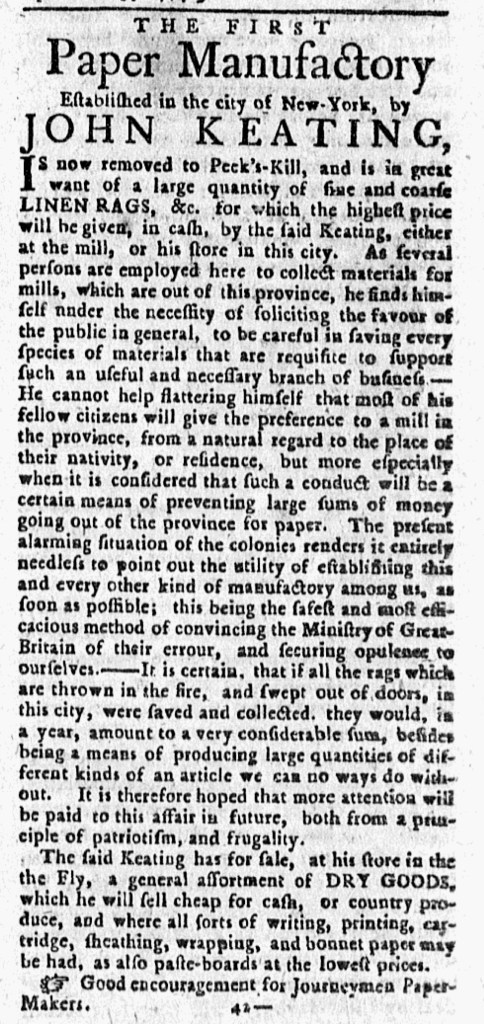
“This being the safest and most efficacious method of convincing the Ministry of Great-Britain of their errour.”

John Keating frequently advertised the “FIRST Paper Manufactory Established in the city of New-York” in the late 1760s and early 1770s.  He often updated his advertisement, yet he incorporated familiar themes about patriotism and supporting the local economy.  He also encouraged readers to save linen rags to make into paper, underscoring that they could play an important role in the production of paper made in the colonies as well as its consumption.

Such was the case in an advertisement in the supplement that accompanied the October 20, 1774, edition of the New-York Journal.  Keating opened with an announcement that his enterprise “is in great want of a large quantity of fine and coarse LINEN RAGS.”  He encouraged “the public in general, to be careful in saving every species of materials that are requisite to support such a useful and necessary branch of business.”  In previous advertisements, he offered instructions for collecting and saving rags as part of the rituals of household management, entrusting women in particular with supplying the resources necessary for the operation of the local paper mill and, in the process, lauding the patriotic spirit of those who heeded his call.  In this instance, he did not distinguish men and women, instead stating that when it came to choosing which paper to consume “that most of his fellow citizens will give the preference to a mill in the province … when it is considered that such a conduct will be a certain means of preventing large sums of money going out of the province.”  In addition to supporting the local economy, Keating asserted that the “present alarming situation of the colonies renders it entirely needless to point out the utility of establishing this and every other kind of manufactory among us, as soon as possible.”  Such a plan, he declared, was “the safest and most efficacious method of convincing the Ministry of Great-Britain of their error, and securing opulence to ourselves.”  Keating effortlessly connected politics, commerce, and the livelihoods and good fortune of colonizers who benefited from domestic manufactures as alternatives to imported goods.  He did so once again with a plea “that more attention will be paid to this affair in the future, both from a principle of patriotism, and frugality.”  In so doing, Keating presented a multitude of reasons for readers to support American industry and buy American products as the imperial crisis intensified.

April 9

What was advertised in a colonial American newspaper 250 years ago today?

Providence Gazette (April 9, 1774).

“… to be sold by the Printer hereof.”

Advertisements filled the final column on the third page and the entire last page of the April 9, 1774, edition of the Providence Gazette.  They generated significant revenue for John Carter, the printer, yet not all the advertisements were paid notices.  Like many other printers, Carter used his newspaper to disseminate his own advertisements.  He inserted five of the notices that appeared in that issue.

Those advertisements related to a variety of aspects of operating Carter’s printing office “at Shakespear’s Head, in Meeting-Street, near the Court-House.”  In one, he called on “ALL Persons indebted for this Gazette one Year, or more” and anyone else indebted to him for other services “to make immediate Payment.”  In another, Carter sought a “trusty and well-behaved Lad, about 13 or 14 Years of Age” as “an Apprentice to the Printing Business.”  Candidates needed to be able to “read well, and write tolerably.”  In yet another, a headline in a larger font than anything else in that issue, even the title of the newspaper in the masthead, proclaimed, “RAGS.”  Carter offered the “best Prices … for clean Linen Rags, of any Kind, and old Sail-Cloth, to supply the PAPER MANUFACTORY in Providence.”  The printer intended to recycle rags into paper that he would then use to publish subsequent editions of the Providence Gazette.

Providence Gazette (April 9, 1774).

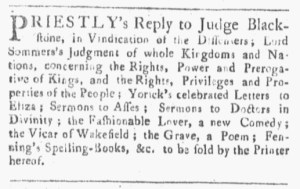
Other advertisements promoted items for sale at the printing office.  Most printers also sold books.  A few came from their own presses or other colonial presses, but most were imported from England.  Carter listed several titles for readers with diverse interests, from “PRIESTLY’s Reply to Judge Blackstone, in Vindication of the Dissenters” to “the Fashionable Lover, a new Comedy” to “the Grave, a Poem” to “Fenning’s Spelling-Books.”  An “&c.” (an abbreviation for et cetera) indicated that he stocked many more books, pamphlets, and broadsides.  A shorter advertisement stated, “BLANKS of various Kinds to be sold by the Printer hereof.”  Carter printed and sold forms for common legal and commercial transactions.  Even the colophon doubled as an advertisement, informing readers that “all Manner of Printing-Work is performed with Care and Expedition.”

Carter took advantage of his access to the press to tend to the different parts of operating a busy printing office.  While his advertisements did not generate revenue in the same manner as the paid notices placed by merchants, shopkeepers, artisans, estate executors, lottery managers, and others, they supported his business in other ways and some likely resulted in revenue from the sale of books and blanks or the settling of accounts.  Collectively, they gave Carter a very visible presence in the pages of the Providence Gazette.

March 24

GUEST CURATOR:  Madison Kenney

What was advertised in a colonial American newspaper 250 years ago today?

New-York Journal (March 24, 1774).

“The best Price given for ALL SORTS OF LINEN RAGS.”

John Keating, the owner of a “PAPER MANUFACTORY” in New York, uses politics as an advertising strategy. In 1774, “The demand for paper in America, is of late so greatly increased, that very large sums are continually sent abroad, for the purchase of it.” Keating attempted to take advantage of the political tension with Britain by connecting the donation of spare rags to make into paper with patriotism. He argued, “All those who really wish to promote the interest of America … will contribute their aid to the success of the paper manufactory in this place.”

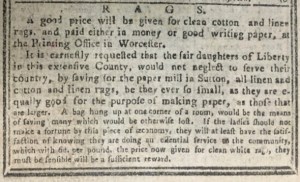
Advertisements asking families to save linen rags to support American printing were not uncommon during the era of the American Revolution. An advertisement printed on the back of Thomas’s Massachusetts, New-Hampshire, and Connecticut Almanack for the Year of our Lord Christ 1779 claims “ fair daughters of Liberty…would not neglect to serve their country, by saving for the paper mill in Sutton, all linen and cotton and linen rags.” Again, entrepreneurs who made paper or printed on it used patriotism to pressure households to support American industry by donating rags. Kayla Haveles argues that printing was “as vital to revolution as guns and gunpowder” because the colonists used it to spread ideology and attack the British.

Thomas’s Massachusetts, Connecticut, and New-Hampshire Almanack for the Year of Our Lord Christ 1779 (Worcester: Isaiah Thomas, 1778).

Additionally, the frequency of these advertisements highlights the contributions of women in the Revolution. Both advertisements focus on saving rags in the home. Keating’s advertisement asked every family to save spare rags in their household. Women were responsible for the housework so Keating’s call to action targeted women. The advertisement on the back of the almanac asked “daughters of Liberty” to save rags. Both advertisements are examples of how women contributed to the Revolution by supporting the American economy.

**********

ADDITIONAL COMMENTARY:  Carl Robert Keyes

John Keating had been placing similar advertisements for the “NEW-YORK Paper MANUFACTORY” for years by the time this advertisement appeared in the March 24, 1774, edition of the New-York Journal.  The Adverts 250 Project first featured one of his advertisements that offered “Ready Money for clean Rags” that ran in that newspaper on February 18, 1768.  During the six years in between, Keating maintained an almost constant presence in the public prints, encouraging colonizers, especially women, to collect rags for paper production and explaining the patriotic benefits of their efforts.  He advertised at times when relationships with Parliament deteriorated, including when nonimportation agreements went into effect to protest various legislation, as well as when the situation cooled and most merchants, shopkeepers, and consumers returned to business as usual.  Keating remained a steady voice in favor of “domestic manufactures” or goods produced in the colonies.

In this instance, Keating ran his advertisement at a time of crisis.  Throughout the colonies, the destruction of the tea in Boston the previous December remained a topic of conversation, including in New York.  The Sons of Liberty anticipated the arrival of the Nancy with a cargo of tea that they did not want landed in their city.  Keating’s advertisement, which had been running since before the Boston Tea Party, appeared on the last page of the March 24 issue, interspersed among other advertisements.  A notice that the Sons of Liberty would meet every Thursday evening “till the Arrival and Departure of the TEA SHIP,” on the other hand, made its second appearance, this time in the first column on the first page.  Only tables showing prices current and sunrise, sunset, and high tide preceded the announcement.  Its placement made it more likely that readers would see it, while also framing how they read other advertisements in the issue.  Most readers likely did not need that notice from the Sons of Liberty to influence their reaction to Keating’s advertisement calling on “all those who really wish to promote the interest of America” to do their part, considering how widely colonizers discussed the politics of tea at the time.  Still, the combination of print culture and public discourse occurring everywhere from the town common to taverns made Keating’s appeals to patriotism even more urgent.

March 30

What weas advertised in a colonial American newspaper 250 years ago today?

Supplement to the Pennsylvania Packet (March 30, 1772).

“Prevail upon our LADIES to grant us a little of their industry and assistance.”

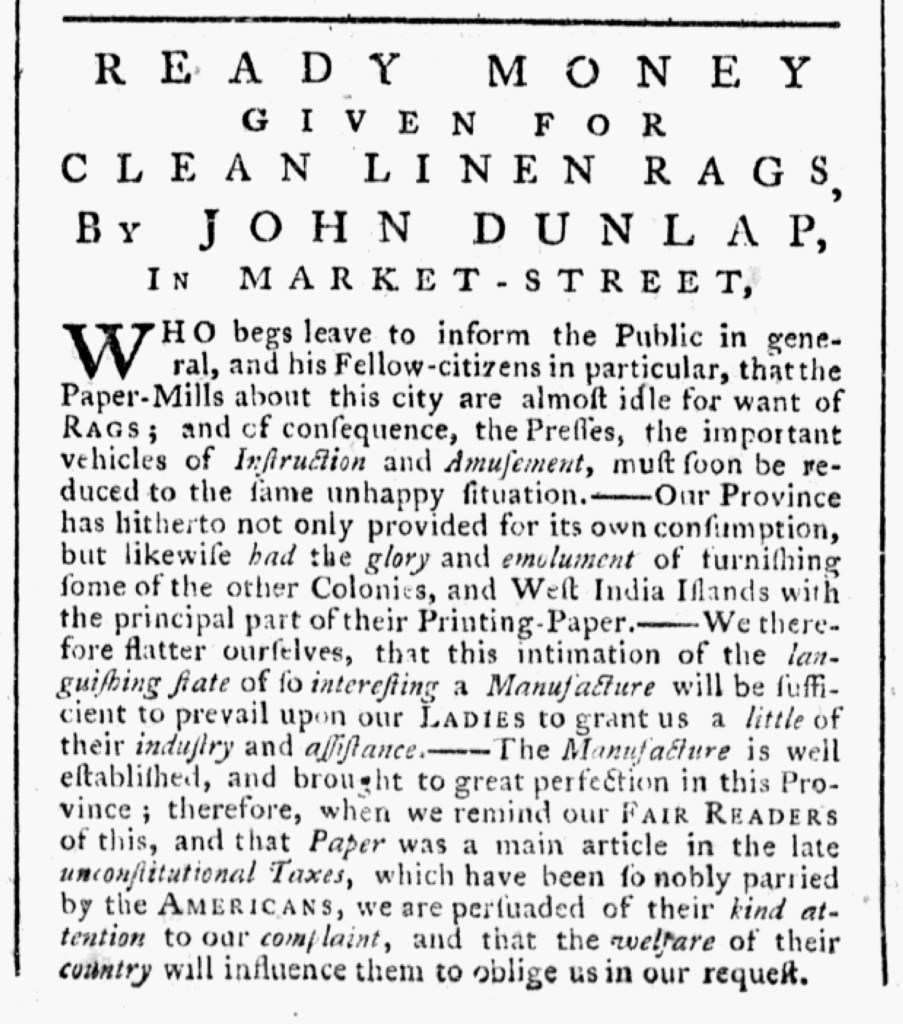
Women played a vital role in supporting the early American press.  So claimed John Dunlap, printer of the Pennsylvania Packet, in a notice calling on colonizers to exchange “CLEAN LINEN RAGS” for “READY MONEY” at his printing office on Market Street in Philadelphia.  What was the connection between rags and newspapers?  Printers produced their publications on paper made from linen.  The papermakers who supplied them needed “CLEAN LINEN RAGS” to transform into paper for printing items of “Instruction and Amusement” for the public.

Dunlap commenced his notice by addressing “the Public in general, and his Fellow-citizens in particular,” suggesting that colonizers had a civic responsibility to support the press by participating in the production of paper through collecting rags.  He claimed that until recently papermakers in Pennsylvania not only produced enough “Printing-Paper” to serve that colony “but likewise had the glory and emolument of furnishing some of the other Colonies, and West India Islands” with a significant amount of their “Printing-Paper.”  Recently, however, the “Paper-Mills about this city are almost idle for want of RAGS,” thus putting printing offices in danger of a similar fate.

He then pivoted to addressing the “LADIES,” the “FAIR READERS” of the Pennsylvania Packet, imploring them “to grant us a little of their industry and assistance” by collecting rags to recycle into paper.  Dunlap reminded that that paper “was a main article in the late unconstitutional Taxes, which have been so nobly parried by the AMERICANS.”  Readers, both women and men, needed little reminder that Parliament imposed duties on imported paper and other goods in the Townshend Acts.  In response, American merchants and shopkeepers coordinated nonimportation agreements, leveraging commerce into acts of protests.  At the same time, colonizers promoted “domestic manufactures,” including paper, to replace imported goods they refused to consume.  Such protests played a role in convincing Parliament to repeal most of the import duties.

Yet readers of the Pennsylvania Packet still had a responsibility in maintaining the press.  “FAIR READERS” acted as “Fellow-citizens” when they gave their “kind attention” to Dunlap’s “complaint” about the scarcity of rags.  Women could attend to “the welfare of their country,” Dunlap asserted, by heeding his request.  Just as decisions about consumption became political acts for women during the imperial crisis that led to the American Revolution so too did mundane chores like collecting rags.  Women’s work in that regard became imperative to the continued operation of American presses in the era of the American Revolution.

July 2

What was advertised in a colonial American newspaper 250 years ago today?

Essex Gazette (July 2, 1771).

“To be sold by the Printer hereof.”

Samuel Hall, printer of the Essex Gazette, frequently supplemented the news accounts, letters, and paid notices in his newspaper with advertisements of his own.  In doing so, he simultaneously promoted various enterprises undertaken at his printing office in Salem and generated content to fill otherwise empty space.  Throughout the colonies, printers adopted similar strategies in their newspapers.

Consider the July 2, 1771, edition of the Essex Gazette.  Hall interspersed three of his own notices among the paid advertisements.  The first announced, “A good Assortment of PAPER, by the Ream or Quire, as cheap as at any Shop or Store in Boston; together with most other Sorts of Stationary, to be sold by the Printer hereof.”  Extending only four lines, this notice appeared near the bottom of the second column on the third page.  Another of Hall’s notice ran at the top of the final column on that page.  That one advised prospective customers that Hall sold copies of “the Rev. Dr. Pemberton’s Sermon in the Ordination of the Rev. Mr. Story of Marblehead.”  It also listed related items “annexed” to the sermon in the pamphlet.  Like many other printers, Hall pursued multiple revenue streams at his printing office, selling books and stationery to supplement the proceeds from newspaper subscriptions, advertisements, and job printing.

Essex Gazette (July 2, 1771).

In his third notice, Hall declared, “CASH given for RAGS, at the Printing Office in Salem.”  Printers frequently collected rags, a necessary resource for the production of the paper they needed to pursue their occupation.  Even more than his other notices in the July 2 issue, the placement of Hall’s call for rags suggests that it also served as filler to complete the page.  It appeared at the bottom of the final column.  The compositor also inserted decorative type to fill the remaining space, furthering testifying to the utility of running that particular notice.  Access to the press meant that printers could run advertisements promoting their own endeavors whenever they wished, but that was not the only reason they inserted notices into their publications.  Sometimes they sought to quickly and efficiently fill remaining space with short notices already on hand.  The type remained set for easy insertion whenever necessary, a strategy for streamlining the production of newspapers in eighteenth-century America.

March 12

What was advertised in a colonial American newspaper 250 years ago today?

Mar 12 - 3:12:1770 New-York Gazette and Weekly Mercury
New-York Gazette and Weekly Mercury (March 12, 1770).

“… from a Principle of Love to their Country.”

John Keating became a familiar figure in advertisements that appeared in the New-York Gazette and Weekly Mercury and other newspapers in the late 1760s and early 1770s.  He operated a paper manufactory and presented his enterprise as providing a patriotic alternative to paper imported from Britain.  He objected to the duties that Parliament levied on imported paper in the Townshend Acts while simultaneously noting that consumers could foil such attempts to tax them by purchasing paper made locally.  He also frequently took the pages of the New York’s newspapers to encourage colonists to participate in the production of paper by collecting rags and turning them over to him to be transformed into paper, as he did in the March 12, 1770, edition of the New-York Gazette and Weekly Mercury.

His entreaty commenced with a prologue that could have been part of a political tract rather than a newspaper advertisement: “THE Imposition of a Tax upon Goods imported from Great-Britain to her Colonies, altho’ a palpable Violation of their most sacred Rights, was not more injurious to them, than in itself impolitic, absurd and detrimental to Great-Britain, herself: Yet, notwithstanding the Absurdity of the Measure, the Contrivers of it had Cunning enough to lay the Tax upon Articles of necessary to us, that it was with Reason supposed we could not do without them, and therefore should be compelled by our Wants, to submit to the Imposition.”  From there, Keating outlined the nonimportation agreements that went into effect in several colonies, noting that “Friends to their Country” could play an important role in continuing to make paper available if only they would collect their rags and turn them over to the paper manufactory.  Keating estimated that there “are Rags abundantly sufficient for the Purpose” that colonists should save “from a Principle of Love to their Country.”

Keating frequently made such appeals, but on this occasion his exhortation may have gained additional urgency.  It ran next to a news item dated “BOSTON, March 1” that reported “the melancholy Affair at the North End.”  The Massachusetts Historical Society provides this summary of events that took place on February 22: “Ebenezer Richardson, a customs informer, fired a musket through a broken window in his house at a crowd of young men and boys who had been taunting customers of a store selling British imports.”  In addition to wounding others, Richardson killed Christopher Seider, age eleven.  His funeral on February 26 was a significant event.  According to the report in the New-York Gazette and Weekly Mercury, “a great Multitude of People assembled in the Houses and Streets to see the Funeral Procession, which departed “from Liberty-Tree.”  Killed less than two weeks before the Boston Massacre, Seider could be considered the first casualty of the American Revolution.  News of that “Bloody Massacre,” as Paul Revere labeled it, did not yet appear in the New-York Gazette and Weekly Mercury, but the death of Seider may have been sufficient to put Keating’s calls for colonists to collect rags into new perspective.  He offered a practical means for “Service they would do their Country, in whose Welfare their own is involved.”

**********

For a more complete accounting of the death and burial of Christopher Seider, see the series of articles by J.L. Bell on Boston 1775.

July 29

What was advertised in a colonial American newspaper 250 years ago today?

Jul 29 - 7:29:1768 New-Hampshire Gazette
New-Hampshire Gazette (July 29, 1768).

“RAGS taken in at the Printing Office, and good Sermons or other Pamphlets given as pay for them.”

Calls for rags regularly appeared in the pages of colonial newspapers, sometimes issued by printers and other times issued by proprietors of paper manufactories. Readers did not require any explanation that their used rags would be recycled into paper, perhaps even paper that would become issues of the very newspaper in which they encountered notices encouraging them to collect and contribute their rags.

Although they sometimes expected their fellow colonists to donate rags that had exceeded their usefulness, printers and papermakers often offered a variety of inducements to convince readers to send their rags. Sometimes they offered to pay cash. Other times they played on political sentiments, especially in the wake of the Stamp Act and the Townshend Act, noting that local production of paper decreased dependence on imported paper while simultaneously bolstering the local economy. The success of such endeavors depended not only on readers acting as consumers of that paper but also as providers of the necessary supplies.

In their brief advertisement in the July 29, 1768, edition of the New-Hampshire Gazette, printers Daniel Fowle and Robert Fowle took a different approach. They offered to barter: “RAGS taken in at the Printing Office, and good Sermons or other Pamphlets given as pay for them.” The Fowles did not elaborate on which sermons or other pamphlets they traded, but they likely considered this an opportunity to achieve two goals simultaneously. In the process of acquiring a commodity essential in producing paper they could also reduce their surplus stock of pamphlets that had not sold as well as they had hoped. Two weeks earlier Robert Fowle published a lengthy advertisement that listed dozens of books as well as “a very great variety of single Sermons and other Pamphlets.” If the printers could not convince colonists to purchase these wares then they might as well offer them in trade. Operating a printing office required such flexibility.

July 14

What was advertised in a colonial American newspaper 250 years ago today?

Jul 14 - 7:14:1768 New-York Journal
New-York Journal (July 14, 1768).

“Ready Money for clean Linen Rags.”

When John Keating placed an advertisement for the New-York Paper Manufactory in the July 14, 1768, edition of the New-York Journal, he did not merely seek customers. Instead, he sought supplies, rags in particular, necessary for the functioning of his enterprise. Throughout the colonies, newspaper readers frequently encountered calls for rags. Printers often inserted brief, generic notices that requested readers submit clean rags that could be made into paper. In the second half of the 1760s, in the wake of the Stamp Act and the Townshend Act, the calls for rags became lengthier and more elaborate, especially as the proprietors of the New-York Paper Manufactory and its counterparts in other colonies linked economic and political purposes to the formerly mundane process of collecting rags for paper production.

Keating made the stakes clear when he addressed “All those who have the Welfare of the Country at Heart.” Rather than think of linen rags as useless or contemplate the small sums they might yield in trade, he insisted that readers consider “the Benefit which will accrue to the Public in general if the Manufactory is supplied with Rags.” Increasing the volume of paper produced locally would reduce dependence on imports. Turning over rags to Keating and the New-York Paper Manufactory would “enable us to make a sufficient Quantity of Paper for our own Consumption, and by this Means keep in the Province the Sums of Money, which is annually remitted for this single Commodity.” In other words, colonists sent too much of their money to England, never to see it again due to an imbalance in trade, when they purchased paper that could otherwise be produced locally. In addition, the New-York Paper Manufactory created jobs: “by manufacturing of it here, Numbers of poor People are daily employ’d.” Overall, supporting the New-York Paper Manufactory amounted to an expression “of public Utility.”

John Keating was part of an incipient “Buy American” campaign that emerged in the 1760s and increasingly found expression in newspaper advertisements as the imperial crisis intensified. Just as consumption practices took on political valences, so too did some of the most mundane of daily activities, such as the decision to save rags for “the Welfare of the Country” rather than discard them.

February 18

What was advertised in a colonial American newspaper 250 years ago today?

Feb 18 - 2:18:1768 New-York Journal
New-York Journal (February 18, 1768).

“All those that really have the Welfare of their Country at Heart, are desired to consider seriously, the Importance of a Paper Manufactory to this Government.”

The Townshend Act assessed new taxes on all sorts of imported paper. When it went into effect on November 20, 1767, many colonists vowed to encourage and purchase domestic manufactures, especially paper, as a means of resisting Parliament overreaching its authority. Calls for colonists to collect linen rags and turn them over to local papermakers, not uncommon before the Townshend Act, took on a new tone once the legislation went into effect.

The “Manufacturers of PAPER at Milton” in Massachusetts placed an advertisement in the Boston-Gazette in late November 1767. In it, they addressed “All Persons dispos’d in this Wat to encourage so useful a Manufacture.” The “Manufacturers” aimed to collect enough rags quickly enough to replenish the “large Quantities of Paper” that “fortunately arriv’d from Europe before the Duties could be demanded.” Ultimately, the “Manufacturers” wished to produce so much paper that colonists would never have to purchase imported paper again (and thus avoid paying the new taxes), but that required the cooperation of consumers participating in the production process by saving their rags for that purpose.

In January 1768, Christopher Leffingwell placed a similar advertisement in the New-London Gazette. He issued a call for “CLEAN LINEN RAGS” to residents of Connecticut, calling collection of the castoffs “an entire Saving to the COUNTRY.” He encouraged “every Friend and Lover” of America to do their part, no matter how small. Leffingwell suggested that producing paper locally benefited the entire colony; the economy benefited by keeping funds within the colony rather than remitting them across the ocean as new taxes. With the assistance of colonists who collected rags, Leffingwell could “supply them with as good Paper as is imported from Abroad, and as cheap.”

John Keating joined this chorus in February 1768. In an advertisement in the New-York Journal he even more explicitly linked the production and consumption of paper to the current political situation than Leffingwell or the “Manufacturers of PAPER at Milton.” He opened his notice by proclaiming, “All those that really have the Welfare of their Country at Heart, are desired to consider seriously, the Importance of a Paper Manufactory to this Government.” Purchasing paper made in America represented a double savings: first on the cost of imported paper and then by avoiding “a most arbitrary and oppressive Duty” that “further drain’d” the colony of funds that would never return.

Keating acknowledged that collecting rags might seem small and inconsequential, yet he assured colonists that collectively their efforts would yield significant results. He recommended that they cultivate a habit of setting aside their rags by hanging a small scrap in a visible place “in every House” as a reminder. Readers who followed that advice transformed domestic spaces into political venues; otherwise mundane actions took on political meaning as both members of the household and visitors noticed clean linen rags hung as reminders to encourage domestic production and consumption. In the end, Keating predicted that this “would have the desired Effect, and supply us with Paper at home sufficient for our own Use … whereas now we are obliged to send Money abroad, not only to pay for Paper at a high Price, but an oppressive Duty upon it into the Bargain.” Keating not only advanced a “Buy American” campaign but also encouraged colonists to participate in the production of domestic manufacturers for the common good.