December 8

What was advertised in a revolutionary American newspaper 250 years ago today?

Connecticut Gazette (December 8, 1775).

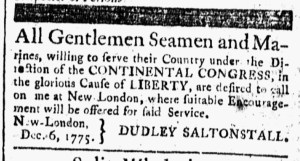
“All Gentlemen Seamen and Marines, willing to serve their Country … are desired to call on me.”

A variety of advertisements ran in the December 8, 1775, edition of the Connecticut Gazette.  Some marketed consumer goods and services, one described an indentured servant who ran away, one offered a “convenient Dwelling-House for Sale,” and a couple concerned strayed livestock.  The advertisement that appeared first after the news, however, was a recruiting notice.  A thick black line helped to draw attention to it, though that visual element that signified mourning was part of the memorial to “Mrs. FAITH HUNTINGTON, the late amiable Consort of Col. JEDEDIAH HUNTINGTON of Norwich … and greatly beloved Daughter of the Honorable Governor [Jonathan] TRUMBULL,” the only governor who supported the American cause at the beginning of the Revolutionary War.  The memorial attributed Huntington’s death to the distress she experienced during her husband’s absence from their home while he dedicated himself to military service, declaring that the “Authors of American Oppression and the public Calamity, are accountable for her death.”  That assertion may have helped rally readers to respond to the recruiting notice that appeared immediately after the memorial.  “All Gentlemen Seamen and Marines, willing to serve their Country under the Direction of the CONTINENTAL CONGRESS, in the glorious Cause of LIBERTY,” it proclaimed, “are desired to call on me at New-London, where suitable Encouragement will be offered for said Service.”  Dudley Saltonstall signed the notice.

Who was Dudley Saltonstall?  The finding aid for the Dudley Saltonstall Papers at the Penobscot Marine Museum notes that Saltonstall “sailed as a privateer during the Seven Years’ War.  At the beginning of the Revolutionary War, he was one of the first men commissioned by Connecticut as a Navy captain.”  His brother-in-law, Silas Deane, a delegate to the First Continental Congress and the Second Continental Congress, recommended Saltonstall.  He also had a career as a slave trader.  In 1779, he had command of an expedition “sent to dislodge the British from Castine, Maine.”  The Penobscot Expedition resulted in failure, the entire American fleet lost, and Saltonstall court martialed and dismissed from the Continental Navy.  Although Saltonstall is now best known for the Penobscot Expedition, at the time he placed this recruiting notice in the Connecticut Gazette he was putting together a crew for other ventures.  A few months later, he sailed for the Bahamas to acquire gunpowder.  The fleet captured Nassau, but only after the governor moved most of the gunpowder.

November 1

What was advertised in a revolutionary American newspaper 250 years ago today?

Pennsylvania Journal (November 1, 1775).

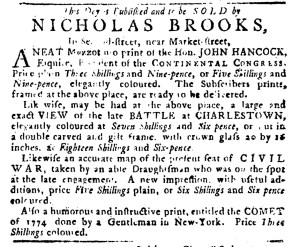
“A NEAT Mezzotinto print of the Hon. JOHN HANCOCK.”

“A large and exact VIEW of the late BATTLE at CHARLESTOWN.”

“An accurate map of the present seat of CIVIL WAR.”

Nicholas Brooks produced and marketed items that commemorated the American Revolution before the colonies declared independence.  In an advertisement in the November 1, 1775, edition of the Pennsylvania Journal, for instance, he packaged together three prints previously advertised separately, each of them related to imperial crisis that had boiled over into a war.  For this notice, Brooks presented them as a collection of prints for consumers who wished to demonstrate their support for the American cause by purchasing and displaying one or more of them.

Brooks announced that a “NEAT Mezzotinto print of the Hon JOHN HANCOCK, Esquire, President of the CONTINENTAL CONGRESS,” that had previously been proposed in other advertisements had been published and was now for sale at his shop on Second Street in Philadelphia.  The subscribers who had reserved copies in advance could pick up their framed copies or arrange for delivery.  Others who had not placed advanced orders could acquire the print for three shillings and nine pence or pay two extra shillings for one “elegantly coloured.”

“Likewise, may be had at the above place,” Brooks reported, “a large and exact VIEW of the late BATTLE at CHARLESTOWN,” depicting what has become known as the Battle of Bunker Hill.  This print competed with an imitation bearing a similar title, “a neat and correct VIEW of the late BATTLE at CHARLESTOWN,” that Robert Aitken inserted in the Pennsylvania Magazine and sold separately.  Brooks, who had long experience selling framed prints, offered choices for his “exact VIEW.”  Customers could opt for an “elegantly coloured” version for seven shillings and six pence” or have it “put in a double carved and gilt frame, with glass 20 by 16 inches,” for eighteen shillings and six pence.  The eleven shillings for the frame, half again the cost of the print, indicated that Brooks anticipated that customers would display the “exact VIEW” proudly in their homes or offices.

He also promoted “an accurate map of the present seat of CIVIL WAR, taken by an able Draughtsman,” Bernard Romans, “who was on the spot of the late engagement.”  Brooks revised copy from earlier advertisements: “The draught was taken by the most skillful draughtsman in all America, and who was on the spot at the engagements of Lexington and Bunker’s Hill.”  The map showed a portion of New England that included Boston, Salem, Providence, and Worcester.   This print, he declared, was a “new impression, with useful additions,” though he did not specify how it differed from the one he previously marketed and sold.  As with the others, customers had a choice of a plain version for five shillings or a “coloured” one for six shillings and six pence.

Brooks added one more item, “a humorous and instructive print, entitled the COMET of 1774, done by a Gentleman in New-York.”  Did this print offer some sort of satirical commentary on current events?  Or was it unrelated to the prints of Hancock, the Battle of Bunker Hill, and the “CIVIL WAR” in New England?  Whatever the additional print depicted, Brooks made the prints that commemorated the American Revolution the focus of his advertisement, gathering together three items previously promoted individually.  In so doing, he not only offered each print to customers as separate purchases but also suggested that they could consider them part of a collection.  Consumers who really wanted to demonstrate their patriotism could easily acquire all three at his shop.

October 19

What was advertised in a revolutionary American newspaper 250 years ago today?

Maryland Gazette (October 19, 1775).

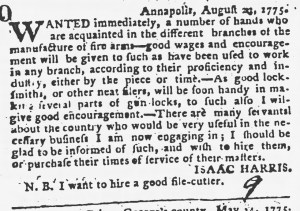
“WANTED immediately, a number of hands who are acquainted in the different branches of the manufacture of fire arms.”

In the late summer and early fall of 1775, Isaac Harris took to the pages of the Maryland Gazette with a call for “a number of hands who are acquainted in the different branches of the manufacture of fire arms.”  The timing of Harris’s advertisement, dated August 23, coincided with a new stage of the imperial crisis that started more than a decade earlier when Parliament attempted to regulate trade with the colonies following the conclusion of the Seven Years War.  The crisis had intensified at various moments, including passage of the Stamp Act in 1765 and imposition of duties on certain imported goods via the Townshend Acts in the late 1760s.  Events in Boston had often fueled the crisis, including the Boston Massacre in March 1770 and the destruction of tea by dumping it into the harbor in December 1773.  Parliament responded with the Coercive Acts, including the Boston Port Act and the Massachusetts Government Act, to punish the unruly Patriots, yet colonizers in other places believed that they could also be subject to similar treatment.

Yet only recently had hostilities commenced when Harris composed his advertisement and submitted it to the printing office in Annapolis.  News of the battles at Lexington and Concord in April 1775, the ensuing siege of Boston, the Battle of Bunker Hill in June 1775, and the appointment of George Washington as commander-in-chief of the Continental Army inspired colonizers to make preparations to defend their liberties.  Harris may have been among their ranks as he set about making firearms in Maryland.  He offered “good wages” to workers with experience in any aspect of producing firearms, paying them “according to their proficiency and industry, either by the piece or time.”  In addition, he thought that “good locksmiths, or other neat filers, will be soon handy in making several parts of gun locks.”  Colonizers with experience in other occupations could apply their skill to this endeavor.  Harris also sought indentured servants to join this enterprise, offering to hire them or “purchase their times of service [from] their masters.”  According to his advertisement, Harris planned to make a significant investment in acquiring the labor to support what he called “the necessary business” of making firearms.  Readers almost certainly made a connection between Harris’s plan to make firearms and the events that continued to unfold in Massachusetts.

October 10

What was advertised in a revolutionary American newspaper 250 years ago today?

Dunlap’s Maryland Gazette (October 10, 1775).

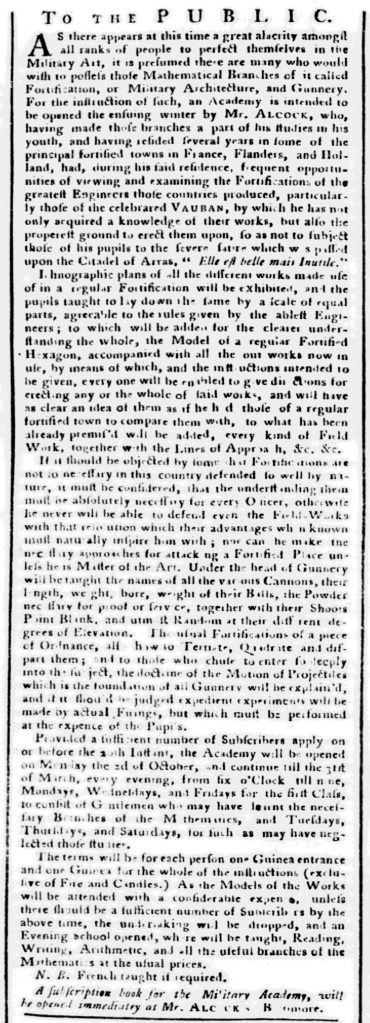
A subscription book for the Military Academy, will be opened immediately.”

In the fall of 1775, Mr. Alcock advertised an academy with a specialized curriculum.  “AS there appears at this time a great alacrity amongst all ranks of people to perfect themselves in the Military Art,” he declared to readers of the Dunlap’s Maryland Gazette and the Maryland Journal, “it is presumed there are so many who would wish to possess those Mathematical Branches of it called Fortification, or Military Architecture, and Gunnery.”  To that end, Alcock, announced his plans to open a school to teach those subjects.  For his qualifications, he noted that he “made those branches a part of his studies in his youth.”  In addition, he “resided several years in some of the principal fortified towns in France, Flanders, and Holland.”  While there, he took advantage of “frequent opportunities of viewing and examining the Fortifications of the greatest Engineers those countries produced.”  In the first year of the Revolutionary War, Alcock was not the only colonizer to advertise a school of this sort.  In the summer of 1775, John Vinal advertised that he taught “the Doctrine of Projectiles, or Art of GUNNERY,” at his school in Newburyport, Massachusetts.

In advance of opening his academy in Baltimore on October 2, Alcock began advertising in early September.  His lengthy notice appeared in the Maryland Journal on September 6, 13, and 20.  It may have run in Dunlap’s Maryland Gazette as early as September 5, but that issue, if it survives, has not been digitized for wider accessibility.  Alcock’s advertisement did appear in that newspaper for at least five weeks from September 12 through October 10.  With the last two insertions, he likely hoped to pick up stragglers who had not yet enrolled yet had not missed so many classes to join the academy.  From the start, Alcock advised that a “subscription book for the Military Academy, will be opened immediately,” allowing students to commit to enrolling by signing their names.  Prospective students could also peruse the list to see who else in their community planned to attend.  Alcock intended to divide his pupils into two classes, one cohort consisting of “Gentlemen who may have learnt the necessary Branches of the Mathematics” on Mondays, Wednesdays, and Fridays and another series of classes “for such as may have neglected those studies” on Tuesdays, Thursdays, and Saturdays.

Yet Alcock would offer the course on fortifications and gunnery only if “a sufficient number of Subscribers” enrolled.  Those interested in this enterprise needed to encourage their friends and neighbors to sign up or else risk having the classes canceled.  If Alcock did not have enough students, “the undertaking will be dropped and an Evening School opened, where will be taught, Reading, Writing, Arithmetic, and all the useful branches of the Mathematics at the usual prices.”  The schoolmaster did not want to resort to that.  Accordingly, he attempted to convince prospective students of the necessity of his lessons.  “If it should be objected by some that Fortifications are not so necessary in this country defended so well by nature,” he argued, “it must be considered, that the understanding them must be absolutely necessary for every Officer, otherwise he never will be able to defend even the Field-Works with that resolution which their which their advantages when known must naturally inspire him; nor can he make the necessary approaches for attacking a Fortified Place unless he is Master of the Art.”  Prospective students apparently did not find that convincing.  On November 7, Alcock returned to Dunlap’s Maryland Gazette to advertise an evening school “where will be taught Reading, Writing, and Arithmetic” as well as “French, and the most useful branches of the Mathematics, at the usual prices.”  Either he never attracted enough students to open his “Military Academy” or classes fizzled out shortly after they began.

September 25

What was advertised in a revolutionary American newspaper 250 years ago today?

New-York Gazette and Weekly Mercury (September 25, 1775).

“Illustrated with a beautiful Plan of Boston, and the Provincial Camp.”

When fall arrived, it was time to market almanacs for the coming year.  It was an annual ritual in American newspapers from New England to Georgia.  Hugh Gaine, the printer of the New-York Gazette and Weekly Mercury, began advertising “HUTCHIN’s Improv’d: BEING AN ALMANACK … For the Year of our LORD 1776” on September 18, 1775, and then inserted his extensive notice in subsequent issues.  The almanac’s contents included the usual astronomical data, such as “Length of Days and Nights” as well as a schedule of the courts, a description of roads to other cities and towns, and “useful Tables, chronological Observations and entertaining Remarks.”  Gaine enumerated thirty-one of those items, such as a “Very comical, humorous, and entertaining Adventure of a young LADY that used to walk in her sleep,” an essay on the “evil Consequences of Sloth and Idleness,” and a “Method for destroying Caterpillars on Trees.”

If all of that was not enough to entice customers, Gaine made sure that they knew that the almanac was “Illustrated with a beautiful Plan of Boston, and the Provincial Camp.”  That proclamation led the advertisement, appearing immediately above the title of the almanac.  Gaine then devoted the greatest amount of space to describing the map: “13. A very neat Plan of the Town of Boston, shewing at one View, the Provincial Camp, Boston Neck, Fortification, Commons, Battery, Magazines, Charlestown Ferry, Mill Pond, Fort Hill, Corps Hill, Liberty Tree, Windmill Point, South Battery, Long Wharf, Island Wharf, Hancock’s [Wharf], Charlestown, Bunker’s Hill, Winter Hill, Cobble Hill, Forts, Prospect Hill, Provincial Lines, Lower Fort, Upper [Fort], Main Guard, Cambridge College, Charles River, Pierpont’s Mill, Fascine Battery, Roxbury Hill Lines, General Gage’s Lines, Dorchester Hill and Point, and Mystick River.”  As the siege of Boston continued, Daine realized that colonizers in Boston would be interested in supplementing what they read in newspapers and heard from others with a map that would help them envision and better understand recent events.

What was the source for the map?  According to the catalog description for the almanac by PBA Galleries, Auctioneers and Appraisers, the map, “titled a ‘Plan of Boston,’ details Boston’s Shawmut Peninsula and with a smaller inset of the greater Boston area.  Both maps appear to be based on the ‘New and Correct Plan of the Town of Boston and Provincial Camp,’ which appeared in the Pennsylvania Magazine for July, 1775.”  The image that Aitken marketed to spur magazine sales found its way into another periodical publication.  Another printer used it to generate demand for an item produced on his press.

Gaine also listed “11. The whole Process of making SALT PETRE, recommended by the Hon. The Continental Congress, for the making of which there is a Bounty now given both in this and the neighbouring Provinces” and “12. The Method of making Gun-Powder, which at this Juncture may be carried into Execution in a small Way, by almost every Framer in his own Habitation.”  The auction catalog further clarifies that the almanac contains “the Resolution of Congress, July 28, 1775 on the necessity of making gunpowder in the colonies, signed in print by John Hancock, with a recipe for gunpowder on the reverse of the map.”  More than ever, current events played a part in compiling the contents and then marketing almanacs.

“Plan of Boston,” in Hutchins Improved: Being an Almanack and Ephemeris … For the Year of Our Lord 1776 (New York: Hugh Gaine, 1775). Courtesy PBA Galleries, Auctioneers and Appraisers.

September 16

What was advertised in a revolutionary American newspaper 250 years ago today?

Pennsylvania Ledger (September 16, 1775).

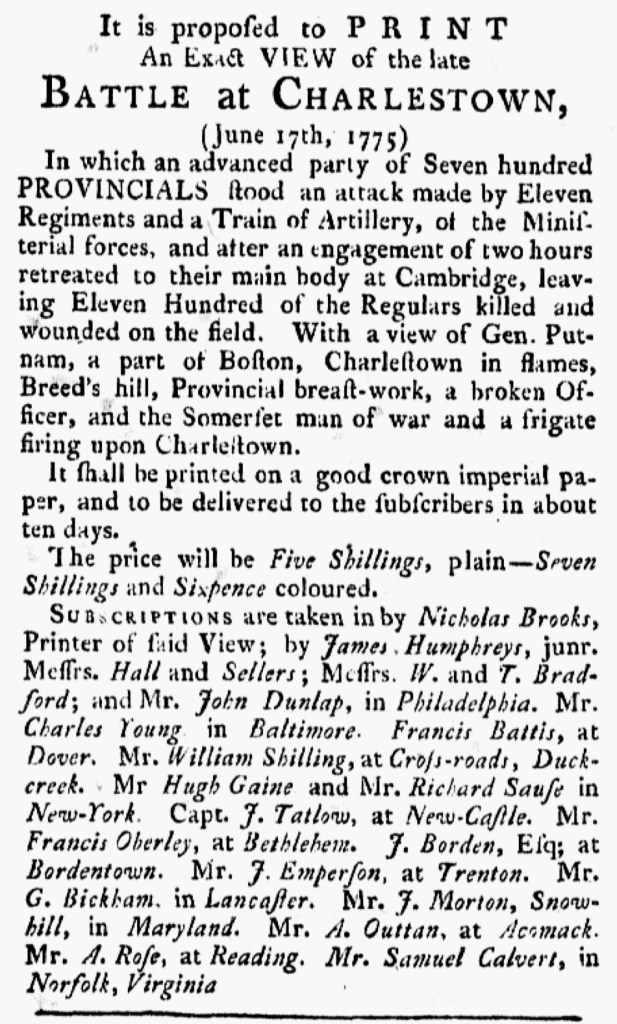
“It is proposed to PRINT An Exact VIEW of the late BATTLE at CHARLESTOWN.”

Bernard Romans, a cartographer, apparently met with sufficient success in marketing and publishing his “MAP, FROM BOSTON TO WORCESTER, PROVIDENCE AND SALEM” in the summer of 1775 that he launched a similar project as fall arrived.  He placed a subscription proposal for a print depicting “An Exact VIEW of the late BATTLE at CHARLESTOWN,” known today as the Battle of Bunker Hill, in the September 16, 1775, edition of the Pennsylvania Ledger.  The proposal stated that it “shall be printed on a good crown imperial paper” at a price of five shillings, “plain,” or seven shilling and six pence, “coloured.”

In promoting the print, Romans summarized the battle, though most readers likely already knew the details.  “[A]n advanced party of Seven hundred PROVINCIALS,” the cartographer narrated, “stood an attack made by Eleven Regiments and a Train of Artillery, of the Ministerial forces, and after an engagement of two hours retreated to their main body at Cambridge, leaving Eleven Hundred of the Regulars killed and wounded on the field.”  Even though the British prevailed, it was such a costly victory in terms of casualties that officers that British General Henry Clinton wrote in his diary, “A dear bought victory, another such would have ruined us.”  The Americans had reason to feel proud despite retreating.  Romans hoped to capitalize on that even as he aimed to publish a print that helped colonizers far from Boston visualize the battle.  The print included “a view of Gen. [Israel] Putnam,” an American officer, “a part of Boston, Charlestown in flames, Breed’s hill, Provincial breast-work, a broken Officer, and the Somerset man of war and a frigate firing upon Charlestown.”

As had been the case with his map, Romans collaborated with Nicholas Brooks, a shopkeeper and “Printer of said View” as well as local agents in several cities and towns from New York to Virginia.  The subscription proposal indicated that the print would be ready “to be delivered to the subscribers in about ten days,” not nearly enough time to disseminate the proposal and collect the names of subscribers before making the first impressions.  In both instances, Romans likely felt confident that consumers would be so interested in purchasing items that commemorated the newest chapter in the struggle against Britain that the demand for the map and the print would justify the expense of producing initial copies as well as prompt him to issue even more as local agents submitted their lists of subscribers.

September 2

What was advertised in a revolutionary American newspaper 250 years ago today?

Constitutional Gazette (September 2, 1775).

“A collection of the most elegant swords ever before made in America.”

John Anderson’s call for advertisers to insert notices in the Constitutional Gazette yielded more results.  He touted the circulation of his new newspaper in the August 23, 1775, edition, asserting that the “Public will easily perceive the advantage of advertising in the Constitutional Gazette.”  Three days later, Abraham Delanoy ran an advertisement for pickled lobsters and fried oysters, adorning it with the woodcut depicting a lobster trap and an oyster cage that accompanied his advertisements in other newspapers.  Like printers of other newspapers, Anderson also inserted several advertisements that promoted the goods and services available at his printing office.

For the September 2 edition, other advertisers submitted notices.  Roger Haddock and William Malcolm described the contents of a chest stolen from onboard the Thistle on August 30 and offered a reward for apprehending the thief and returning the missing items.  Peter Garson and Caleb Hall advertised a house and land at “Peek’s-Kill, on the post-road, within three quarters of a mile of a convenient landing” that they considered “suitable for a merchant, trader, or mechanick.”  In collaboration with Mrs. Joyce and other local printers, Anderson once again hawked “JOYCE’s Grand American Balsam,” a patent medicine that alleviated a variety of disorders.  He also continued advertising a pamphlet, “Self defensive WAR lawful.”

In addition, Charles Oliver Bruff, a goldsmith and jeweler with experience advertising in other newspapers, placed an advertisement for “SWORDS.”  Although Delanoy republished copy from his previous advertisements, Bruff generated new copy for his advertisement in the Constitutional Gazette.  “Those Gentlemen who are forming themselves into Companies in Defence of their LIBERTIES,” he proclaimed, “that are not provided with SWORDS, May be suited therewith by applying to Charles Oliver Bruff.”  Such an appeal kept with the tone of Anderson’s Constitutional Gazette.  Bruff presented several options for the pommel, including William Pitt’s head with the motto “Magna Charta and Freedom” and John Wilkes’s head and the motto “Wilkes and Liberty.”  Both men had been vocal advocates of American rights in Britain.  Bruff was not the first advertiser in the colonies to honor Pitt and Wilkes with commemorative items.  The goldsmith and jeweler declared that he stocked “the most elegant swords ever made in America, all manufactured by said BRUFF.”  His advertisement fit the times now that hostilities had commenced in Massachusetts and George Washington took command of the Continental Army laying siege to Boston.  As Anderson sought to expand advertising in the Constitutional Gazette, Bruff’s advertisement for swords addressed to gentlemen defending “their LIBERTIES” complemented his own advertisement for John Carmichael’s sermon, “Self defensive WAR lawful.”

August 12

What was advertised in a revolutionary American newspaper 250 years ago today?

Pennsylvania Ledger (August 12, 1775).

“MILITARY INSTRUCTIONS FOR OFFICERS DETACHED IN THE FIELD.”

On August 12, 1775, Robert Aitken, a printer in Philadelphia, launched a new advertising campaign to promote his American edition of Military Instructions for Office Detached in the Field by Roger Stevenson.  He began with advertisements in the Pennsylvania Evening Post and the Pennsylvania Ledger.  Two days later, he placed the same advertisement in Dunlap’s Pennsylvania Packet and then in the Pennsylvania Gazette another two days after that. Aitken’s new advertisement significantly expanded on the notice that he had published in June.

This time, for example, the printer announced that his American edition was “Dedicated to His Excellency GEORGE WASHINGTON, Esq; General and Commander in Chief of the Army of the United Colonies of North-America.”  The book itself featured a short dedication essay that extended four pages.  In the new advertisement, Aitken promoted some of the usual qualities that printers, publishers, and booksellers often highlighted, noting that the book was printed “On fine Paper, [with] a beautiful new Type” and the “twelve useful Plates” or illustrations “of the Manœuvres” supplemented the text.  Each bound copy cost six shillings and six pence, though Aitken also marketed a “few copies on a superfine paper” for one dollar to those who desired even higher quality.  The price was a bargain, the printer noted, with a bound copy of the London edition selling for ten shillings.

Beyond those details, Aitken incorporated an address “TO THE PUBLIC” into this advertisement, though he did not generate the copy himself.  Instead, he borrowed liberally from the preface of the book, making minor revisions here and there.  In effect, he gave prospective customers a preview of what they would read once they purchased Military Instructions for Officers Detached in the Field.  In the preface, Stevenson lamented that “inferior officers have had no source from whence they could derive instruction on the duties of their sphere in the field,” but he aimed to remedy that with this volume.  He almost certainly had not intended, however, that it would be used by officers in the “Army of the United Colonies of North-America” as they defended their liberties in what would eventually become a war for independence.  Aitken saw an opportunity to generate revenues in the wake of the battles at Lexington and Concord.

In a nota bene, the printer added that he stocked “A complete and elegant MAP of the country, shewing the Seat of the present unhappy Civil War in North-America.”  Bernard Romans, a prominent cartographer, distributed broadside subscription proposals a month earlier, listing Aitken among the many local agents who collected names of subscribers who ordered copies in advance.   The printer gave details about the map not included in the broadside subscription proposal and that had not appeared in newspaper notices.  The map featured a “beautiful Draught of the Provincial CAMP: Likewise, A perspective View of BOSTON, and Gen. Gage’s LINE.”  Current events certainly shaped which items Aitken produced, advertised, and sold at his printing office in Philadelphia.

August 11

What was advertised in a revolutionary American newspaper 250 years ago today?

Essex Journal (August 11, 1775).

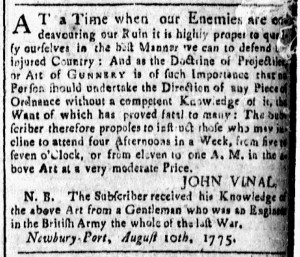
“The Doctrine of Projectiles, or Art of GUNNERY.”

In the spring of 1775, John Vinal advertised a “private School for the Youth of both Sexes” to open in Newburyport, Massachusetts, on April 3.  His notice in the March 29 edition of the Essex Journal specified two locations, “the room he improved last Summer, nearly opposite Mr. Davenport’s Tavern,” with lessons commencing “at 11 o’Clock, A.M.” and “the Town School-House” from “5 to 7 o’Clock, P.M.” for “those who can best attend in the Afternoon.”  The term began just two weeks before the battles at Lexington and Concord.  Four months later, Vinal advertised a very different kind of instruction: “the Doctrine of Projectiles, or Art of GUNNERY.”

Circumstances had certainly changed in Newburyport, in Massachusetts, and throughout the colonies since Vinal announced the opening of his school.  The siege of Boston and the Battle of Bunker Hill followed the skirmishes at Lexington and Concord.  The Second Continental Congress convened in Philadelphia and appointed George Washington to command the Continental Army.  Colonizers from New England to Georgia held local and provincial meetings to determine their own responses.  “AT a Time when our Enemies are endeavouring our Ruin,” Vinal proclaimed, “it is highly proper to qualify ourselves in the best Manner we can to defend out injured Country.”  To that end, some colonizers advertised military manuals and others recruited men to join artillery companies or other regiments to defend their liberties.  Making his own contribution to those efforts, Vinal offered to “instruct those who may incline” to learn about the “Art of GUNNERY.”  He explained that “no Person should undertake the Direction of any Piece of Ordnance without a competent Knowledge of it,” warning that “the Want of which has proved fatal to many.”  What qualifications did the schoolmaster possess to teach “the Doctrine of Projectiles” rather than reading, writing, and arithmetic?  He asserted that he “received his Knowledge … from a Gentleman who was an Engineer in the British Army the whole of the last War,” meaning the Seven Years War.  Britain and the American colonies had worked together to defeat the French and their Indigenous allies in pursuit of imperial interests, but now the expertise of that “Engineer in the British Army” would support the American cause at a time when Parliament and British regulars had become “Enemies … endeavouring our Ruin.”

As had been the case with his “School for Youth of both Sexes,” Vinal provided lessons at two times.  Students could “attend four Afternoons in a Week, from five to seven o’Clock.”  Either the term for his school concluded or this endeavor displaced the lessons he otherwise would have offered.  He also stated that he taught about ordnance “from eleven to one A.M.”  Given the schedule for his school, he likely meant “eleven A.M. to one P.M.” rather than suggesting that he taught the class in the middle of the night.  Hopefully his lessons emphasized greater precision!

July 27

What was advertised in a revolutionary American newspaper 250 years ago today?

New-England Chronicle (July 27, 1775).

“An easy Plan of Discipline for a MILITIA. By TIMOTHY PICKERING.”

As the imperial crisis intensified when the Coercive Acts went into effect in 1774, the Massachusetts Provincial Congress recommended publication of a manual for training militia throughout the colony, The Manual Exercise as Ordered by His Majesty in 1764: Together with Plans and Explanations of the Method Generally Practis’d at Reviews and Field-Days.  Over the next several months, several printers in New England published their own editions.  Advertisements for The Manual Exercise appeared frequently in newspapers throughout the region.  Printers beyond New England followed their lead.  After the battles at Lexington and Concord, advertisements for other military manuals proliferated, including advertisements for Thomas Hanson’s Prussian Evolutions in Actual Engagements published by subscription in Philadelphia.

Samuel Hall and Ebenezer Hall, printers of the New-England Chronicle, published and advertised yet another military manual, An Easy Plan of Discipline for a Militia by Timothy Pickering, Jr.  An advertisement for the work appeared in the July 27, 1775, edition of their newspaper.  The Halls indicated that they had copies available at their printing office in Cambridge, where they had only recently moved from Salem and renamed and continued publishing the Essex Gazette. In addition, Joseph Hiller, a watchmaker in Salem, also sold the manual.  The advertisement consisted primarily of an extensive list of the contents, demonstrating to prospective customers what they could expect to find in the volume, followed by a short note that the “methods of performing the evolutions or manœuvres, wheelings, &c. are exhibited in 14 octavo copper-plate prints.”  The illustrations were an important addition that would aid readers in understanding the various maneuvers described in the book.

In addition to the advertisement the Halls inserted in the New-England Chronicle, Pickering pursued another means of marketing the book.  He sent a copy directly to George Washington with a request that he consider “recommending or permitting its use among the officers & soldiers under your command.”  Pickering flattered the commander of the Continental Army following his appointment to the post by the Second Continental Congress, declaring that the army had been “committed to your excellency’s care & direction” “to the joy of every American.”  Pickering asserted his own “duty & inclination” inspired him to compose the manual and present it to the general for his consideration.  He deemed it a “service [to] my country” that he hoped “may well prove advantageous in an army hastily assembled.”  Washington did indeed take note.  According to the American Revolution Institute, “Washington promoted the use of several published works, including Timothy Pickering’s An Easy Plan of Discipline for a Militia and Thomas Hanson’s The Prussian Evolutions” during the early years of the Revolutionary War.  In 1779, Baron von Steuben’s Regulations for the Order and Discipline of the Troops of the United States became the first official manual of the Continental Army.  Until then, Pickering’s manual was a popular choice for training American soldiers.