August 28

What was advertised in a colonial American newspaper 250 years ago today?
Aug 28 - 8:28:1767 New-Hampshire Gazette
New-Hampshire Gazette (August 28, 1767).

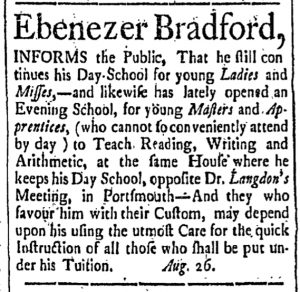
“Has lately opened an Evening School, for young Masters and Apprentices.

Schoolmaster Ebenezer Bradford emphasized efficiency and convenience in the advertisement he inserted in the New-Hampshire Gazette late in the summer of 1767. He reminded the residents of Portsmouth that he “continues his Day School for young Ladies and Misses,” but he also announced a new service for other students. He had “lately opened” an “Evening School, for young Masters and Apprentices.”

Bradford not only segregated his classroom by sex but also by when his pupils were likely to be available for lessons. Knowing that “young Masters and Apprentices” had responsibilities that kept them occupied throughout the day, he taught alternate evening classes to fit their schedules. Night courses for working professionals offered by modern colleges and universities have precursors extending back to the colonial period. Then, as now, educators sought to attract students and generate revenues by recognizing that not all prospective students could enroll during daytime hours.

In addition to that convenience, Bradford also acknowledged that potential pupils, especially those attending evening classes, wished to complete their course of study as quickly as possible. He did not give any indication on how long it might take for him “to Teach Reading, Writing and Arithmetic,” but he did pledge that every student would receive his “utmost Care” for “quick Instruction.” Again, modern methods for marketing certain educational programs have antecedents in the eighteenth century. Many colleges and universities promote some of their accelerated programs by emphasizing how quickly they can be completed, allowing students to disrupt other aspects of their lives as little as possible.

Bradford provided a practical education that covered the basics, unlike some schoolmasters that advertised a “polite” education, listed a variety of genteel subjects, and elaborately described various amenities in their classrooms. While other schoolmasters marketed an overall experience to prospective pupils and their parents, Bradford instead communicated his understanding that some students were primarily concerned with learning or enhancing basic skills quickly and efficiently. He catered to students who desired few frills but instead wished to resume their regular lives and schedules in as short a time as possible.

June 9

What was advertised in a colonial American newspaper 250 years ago today?

Jun 9 - 6:9:1767 South-Carolina Gazette and Country Journal Page 2
South-Carolina Gazette and Country Journal (June 9, 1767).

“He first introduced into this Province the most expeditious Method of teaching Writing.”

Osborne Straton was not the only schoolmaster who advertised his services in the newspapers printed in Charleston, South Carolina, in 1767. He needed to distinguish his instruction from that provided by W. Adams and William Johnson, both of whom inserted much more extensive notices in the public prints. Rather than going into as much detail about his curriculum and teaching methods, Straton advanced two other reasons “Parents and Guardians” should enroll their children in “the British Academy on the Green, at the West End of BROAD-STREET.”

First, he underscored his experience, implying that the parents of prospective students should choose his academy because his competitors were newcomers who had not yet gained the public trust. Straton had been teaching in Charleston for half a decade; he considered it “his Duty to remind the Public, That A.D. 1762, he first introduced into this Province the most expeditious Method of teaching Writing, Drawing, &c. &c. in all their Branches.” His methods were particularly designed “to qualify Youth for Business in general,” a goal that Straton identified in an advertisement published several months earlier. He noted his long experience in that notice as well, stating that he had “forty years experience as head book-keeper in some of the first counting-houses in Europe” before migrating to South Carolina and becoming a schoolmaster. According to Straton, his experience, both in business and in teaching local youth, should cause parents to give him precedence over other schoolmasters.

Straton also argued that he served the public good in addition to earning a living by charging tuition of students who could afford it. He pledged to “Instruct six poor Children Gratis, every Thursday and Saturday in the Afternoon.” This was not the first time he made such an offer. Several weeks earlier he announced that “one youth may be qualified for business gratis, on a private benevolence,” an eighteenth-century scholarship of sorts. In making a new commitment to teach several poor children, Straton again played on his ties to the community established over the course of several years. He set a philanthropic example to make his academy more appealing to prospective students and their parents, suggesting that service rather than revenues motivated his instruction.

Compared to his competitors, Straton’s advertisement was relatively short. Despite its length, he included two appeals that made his academy both distinctive and attractive to residents of Charleston as they considered several options. Other schoolmasters might have offered effective instruction, but for Straton the work seemed to be a vocation rather than a mere occupation.

April 24

What was advertised in a colonial American newspaper 250 years ago today?

Apr 24 - 4:24:1767 South-Carolina and American General Gazette
South-Carolina and American General Gazette (April 24, 1767).

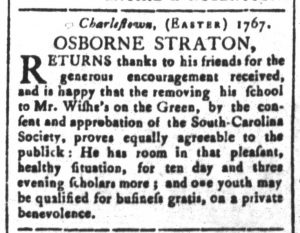
“He has room … for ten day and three evening scholars more.”

In recent weeks the guest curators of the Adverts 250 Project have examined advertisements placed by some of Savannah’s schoolmasters in the Georgia Gazette. Both schoolmasters promoted the subjects they taught, which were limited mostly to the basics of reading, writing, and arithmetic (though one also provided instruction in Latin). Meanwhile, Osborne Straton, a schoolmaster in Charleston, took a different approach in advertising his school. He did not discuss his curriculum at all, but instead noted the location – “on the Green” – and described the surroundings as a “pleasant, healthy situation.”

Most schoolmasters and schoolmistresses placed advertisements to attract pupils they expected to pay tuition. Such was the case with Straton, who indicated that he had slots to accommodate ten more “scholars” in the classes he offered during the day and three more for evening classes. One fortunate student, however, might have qualified to attend Straton’s classes on a scholarship: “one youth may be qualified for business gratis, on a private benevolence.”

Straton did not reveal the identity of the benefactor, but it might have been a civic organization mentioned earlier in his advertisement. He implied that moving his school to a new location “on the Green” had been done “by the consent and approbation of the South-Carolina Society.” Perhaps the members sponsored his school, formally or informally. The society or one of its members may have provided for the “private benevolence” as a means of bolstering the futures of the student, the city, and the colony. Alternately, someone else may have provided the funds to offer an education to a youth who otherwise might not have afforded it. The schoolmaster himself may have opted not to charge tuition of one of his charges, leveraging the decision into a public relations opportunity.

Regardless of the source of the “private benevolence,” Straton possessed a means to distinguish his school from others when he advertised for students. His association with a philanthropic venture positioned him as an instructor capable of overseeing the moral development of his students as well as their academic work.

April 22

GUEST CURATOR: Jonathan Bisceglia

What was advertised in a colonial American newspaper 250 years ago today?

Apr 22 - 4:22:1767 Georgia Gazette
Georgia Gazette (April 22, 1767).

“HAVING OPENED A SCHOOL … TEACHING READING, WRITING, and ARITHMETICK.”

I chose this advertisement because I plan on being an educator – a teacher, professor, or a public historian – so this advertisement is quite close to heart. It is important to note that this advertisement comes from a newspaper printed in the southern colonies, the Georgia Gazette. This education offered in this advertisement differs from the schooling some children in the region received. “The sons of a planter typically would be taught the basics at home,” state the curators at Stratford Hall. Discussions in “Schools in American Society,” an Education course taught by Professor Casey Handfield at Assumption College, confirmed that this was typical in southern colonies. On the other hand, in Learning to Read and Write in Colonial America, E. Jennifer Monaghan argues the northern colonies had significantly more extensive schooling, including pubic schooling in New England, due to the religious focus on education dating back to the seventeenth century.

Also it should not be overlooked that the advertisement included the subjects to be taught. Due to the nature of these subjects it appears as though the school was for younger children who needed the basics but not a “genteel” education. When it came to children of the elite, according to historians at Stratford Hall, “The boys studied higher math, Greek, Latin, science, celestial navigation (navigatin[g] ships by the stars), geography, history, fencing, social etiquette, and plantation management.” In addition, “The school days for girls were somewhat different. Girls learned enough reading, writing, and arithmetic to read their Bibles and be able to record household expenses.” This distinction is important because it separates the typical roles that men and women would play in life from an early start. This is important because it gives modern historians a view of gender roles in colonial society.

**********

ADDITIONAL COMMENTARY: Carl Robert Keyes

As Jonathan notes, John Francklin taught the basics: reading, writing, and arithmetic. James Whitefield, a competitor who also advertised in the Georgia Gazette, offered only a slightly more extensive curriculum. He listed Latin among the subjects taught at his school. Neither schoolmaster advertised additional subjects often promoted as “genteel education” in newspapers printed in other cities, the sorts of subjects Jonathan already listed.

In addition to the north-south divide that distinguished educational opportunities in the different colonial regions, urban culture also played a role in determining which subjects were offered (or, at least, advertised) to potential students. Schoolmasters and schoolmistresses in both Philadelphia and Charleston, both large and bustling port cities, advertised day and boarding schools where students learned a variety of advanced academic subjects as well as ancillary skills (like dancing and personal comportment) in addition to reading, writing, and arithmetic.

In colonial America’s larger cities, some instructors advertised independently of any affiliation with schoolmasters and schoolmistresses whose curriculum focused on general education. For instance, French language tutors frequently advertised their services, often offering one-on-one instruction with their pupils. Dancing masters also advertised regularly in newspapers printed in larger cities. In addition to one-on-one instruction, many also ran their own academies where they tended to teach female students during one portion of the day and male students at alternate times. Some dancing masters doubled as fencing instructors, further enhancing the genteel arts their charges developed. Although some French tutors and dancing and fencing masters were itinerants, many tended to remain in the larger colonial cities for several years, presumably because they cultivated a clientele that kept them employed.

Surveying advertisements for education in newspapers printed throughout the colonies in the decade before the Revolution reveals certain disparities. From New Hampshire to Georgia, colonists used consumer culture to assert their status and identity, anxious lest their counterparts in England think they lived in provincial backwaters. While advertisements for goods demonstrate standardization of products available to purchase during this period, advertisements for services – especially education – suggest uneven opportunities. Schoolmasters and schoolmistresses everywhere taught the basics, but, not surprisingly, instructors with specialized skills most often promoted their services to potential pupils in larger cities. They relied not only on larger populations but also elites conscious of demonstrating their status and middling sorts with aspirations for social mobility. Readers of the Pennsylvania Gazette and the South-Carolina Gazette regularly encountered advertisements for education that looked much different than today’s advertisement from the Georgia Gazette.

April 15

GUEST CURATOR: Shannon Dewar

What was advertised in a colonial American newspaper 250 years ago today?

Apr 15 - 4:15:1767 Georgia Gazette
Georgia Gazette (April 15, 1767).

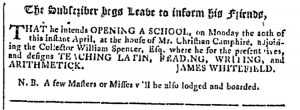
“THAT he intends OPENING A SCHOOL.”

Southern Education. James Whitefield’s advertisement announced that he planned to open a school. Regarding the content of the education provided, Whitefield “designs TEACHING LATIN, READING, WRITING, and ARITHMETICK.” I would like to discuss schools in this period, especially in the Lower South.

Note that this advertisement mentions it was a boarding school. Plantations in Georgia and other southern colonies were spaced out so daily travel for school was virtually impossible for some. Boarding schools provided an option for those who lived outside Savannah, Charleston, and other large towns.

It is also important to add that these services of education had to be purchased, as, according to Robert A. Peterson, “government had, for all practical purchases, no hand at all in education,” especially in the southern colonies. Education was something individuals had to acquire for themselves and their children. It came at a price. Free public education was not yet available for all. Children were taught at home, but those with money had other chances for education, including attending – or even being “lodged and boarded” – at a school like the one James Whitefield opened.

**********

ADDITIONAL COMMENTARY: Carl Robert Keyes

James Whitefield placed one of two advertisements about “OPENING A SCHOOL” in Savannah the April 15, 1767, issue of the Georgia Gazette. John Francklin inserted the other. Both planned for their lessons to commence the following Monday.

At a glance, the advertisements from these competing schoolmasters might give the impression of extensive educational opportunities in Savannah, yet the services they offered and their methods for promoting them to prospective students and their parents paled in comparison to advertisements for day and boarding schools in larger port cities, especially Philadelphia, New York, and Charleston.

Whitefield and Francklin each taught the basics: reading, writing, and arithmetic. Whitefield angled for a more elite clientele, listing Latin first among the subjects he taught, but he did not supplement that subject with other languages or additional subjects that many of his counterparts in larger cities promoted. Studying Latin was usually reserved for the better sorts, so some students (or their parents) may have chosen Whitefield’s school over Francklin’s for the perceived prestige of the slightly more extensive curriculum, even if they did not take Latin lessons after enrolling. Whitefield indicated that he had the capacity to take on boarders, “A few Masters or Misses,” but it was unlikely that female students would have been exposed to studying Latin.

Neither schoolmaster described their curriculum beyond listing the subjects they taught. Neither explained the care they took in the moral development of their charges. Neither described the amenities associated with the homes where they taught. Both limited their advertisements to seven lines, making them brief announcements compared to the marketing undertaken by schoolmasters in the major urban ports in the 1760s and 1770s.

Whitefield and Francklin offered valuable services to the residents of Savannah, but their efforts to provide educational opportunities appear embryonic compared to those available in larger cities. Part of this was most certainly a function of Georgia being such a young colony, founded only thirty-five years earlier. Even when colonists had more choices, they had to purchase them, as Shannon points out, which did not necessarily make education more accessible to most colonists even if they lived in close proximity to multiple schoolmasters and schoolmistresses who offered the most extensive lessons, moral guidance, and amenities. In the late colonial era, just as today, Americans had uneven access to educational opportunities, determined in part by both geography and status.

January 13

What was advertised in a colonial American newspaper 250 years ago today?

jan-13-1131767-south-carolina-gazette-and-country-journal-page-2
South-Carolina Gazette and Country Journal (January 13, 1767).

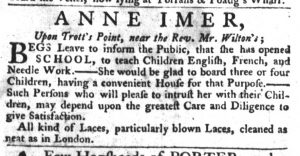
“ANNE IMER … has opened SCHOOL.”

Less than two weeks into the new year, Charleston’s schoolmasters encouraged parents to enroll their children in classes. The January 13, 1767, issue of the South-Carolina Gazette and Country Journal and its supplement included five notices promoting educational opportunities. Advertisements placed by schoolmasters and tutors of various sorts frequently appeared in the city’s newspapers in the 1760s, but not usually so many in a single issue. The start of the year, however, was an opportune time to seek new students as colonists thought about how to make the new year more prosperous than the last. As the advertisements indicate, parents who could afford to educate their children had many choices. Schoolmasters faced stiff competition from their peers, a factor that caused each to market more than just their curriculum.

William Hutchins, who operated a day school where students learned reading, writing, and arithmetic, asserted that he took “the greatest Care” in shaping the “Morals and Behaviour” of his students. For the convenience of scholars who could not attend during the day, he also kept an evening school.

Schoolmistress Anne Imer was the only educator who taught a subject specifically aimed at female students. She listed three subjects in her curriculum: “English, French, and Needle Work.” Most likely her charges learned needlework as a genteel pursuit for refined young ladies, a complement to their instruction in the French language, rather than solely as a practical skill. Imer also offered “to board three or four Children, having a convenient House for that Purpose.”

D’Ellient and Alexander welcomed both “Day boarders” and fulltime boarding students to their school, “where the English, French, Latin and Greek Languages, Writing and Arithmetick are taught as usual.” They offered a more refined education than Hutchins, as well as several amenities suited to the status of their students. The schoolmasters indicated that they had hired “a prudent Housekeeper” in order to provide satisfactory “boarding, lodging and washing of young Gentlemen from the Country.” They also provided lunch for “Day boarders,” students who lived in Charleston but far enough from the school that it was “inconvenient for them to return Home to dine.”

Walter Coningham supplemented the standard curriculum (reading, writing, and arithmetic) at his “Grammar-School” with lessons in Greek and Latin. Unlike others who taught foreign languages, he described his methods for parents of prospective students to review in advance. Like Imer, he accepted a limited number of boarders, though most of his pupils seemed to have been day students.

The enigmatic Pike (who never revealed his first name in any of his advertisements in Charleston or, later, Philadelphia) offered a very different curriculum, dancing and fencing. These genteel pursuits supplemented the knowledge students gained at other schools and academies. He invited male and female students to learn “proper address, the Minuet, Country Dances” or “any Branch of dancing they chuse.” Instruction in “the Use of the SMALL-SWORD,” however, was reserved for men.

The schoolmasters who placed these advertisements offered services and amenities in addition to instruction in the subjects they taught. In describing the ancillary aspects of they education they provided, these advertisers allowed prospective students and their parents to select the school that best fit their budget, status, and aspirations.

January 9

What was advertised in a colonial American newspaper 250 years ago today?

jan-9-191767-south-carolina-and-american-general-gazette-page-4
South-Carolina and American General Gazette (January 9, 1767).

“He … proposes opening his school after the holidays.”

Osborne Straton planned to start a new session at his school “after the holidays,” to commence three days after this advertisement appeared in the South-Carolina and American General Gazette. In his attempt to attract students, he noted that he already had four years of teaching experience under his belt. For the past two years, he “had the honour of being intrusted with the tuition of the youth” from many households within the colony. He suggested that parents of prospective new students should “refer to the opinion of those that have employed him.” Straton was confident that he had earned a positive reputation as a teacher during his relatively short time in South Carolina.

In addition to relying on the endorsements from others, the schoolmaster presented further qualifications that were rather unique. Straton explained that he had been “regularly bred a merchant at London” and possessed “forty years experience as head book-keeper in some of the first counting-houses in Europe.” Straton taught what he knew from experience, arguing that he had many “opportunities of ratifying theory by practice.” Teaching was not an abstract occupation for him. He did not rely solely on so-called book learning passed down from the tutors who had educated him. Instead, he incorporated his own experiences from an earlier (yet extensive) career into his classroom and his curriculum in his efforts “to qualify youth for business.”

Straton identified two outcomes parents could expect after enrolling their children in his school. One was a lofty goal – “to open and enlarge the human understanding” – but the other had a purpose many parents might have found might more practical – “to qualify youth for business.” In his advertisement 250 years ago, Osborne Straton did the same dance that many liberal arts colleges, programs, and departments are doing in their marketing efforts today, striking a balance between exhorting the personal benefits of a liberal arts education and demonstrating the preparation for a profession derived from the training undertaken in the process of earning an undergraduate degree.

January 2

What was advertised in a colonial American newspaper 250 years ago today?

jan-2-121767-south-carolina-and-american-general-gazette-page-2
South-Carolina and American General Gazette (January 2, 1767).

“He now teaches LATIN in his Grammar School.”

At the turn of the new year, Walter Coningham sought students for his “Grammar School” in Charleston. He deployed several strategies to convince the parents to enroll their children in his academy.

Coningham opened his advertisements with a message of appreciation for fathers of his current and former students, stating that he “gratefully acknowledges the many favours he has received from those gentlemen who entrusted him with their childrens education.” While probably sincere, this public thank you also allowed the schoolmaster to underscore that other colonists previously sent their children to his school and had been satisfied with the results.

He then announced a new element of his curriculum – Latin – and described his teaching methods. He used “a plan entirely new” that immersed students in the language by consulting “books without English translations.” He assured parents that this method was “both easy and beneficial for the scholar,” but he understood that some readers might harbor some doubts on that account. Accordingly, he offered “ocular demonstration” of the “improvements his scholars make” in studying Latin through “the performance of those now under is care.” In other words, Coningham offered demonstrations. He invited those with reservations about his methods to observe his current students and decide for themselves how well they learned Latin. That he made this offer at all suggested his own confidence in the effectiveness of his pedagogy.

Coningham then elaborated on his curriculum – Greek, Latin, English, writing, and arithmetic – before noting that he cared for the mind, body, and spirit of his students, especially any boarders who were under his supervision at all times of the day and night. He promised that his students would be “improved in their morals” as well as undertake “necessary exercises, during their leisure hours.” (Coningham did not indicate the nature of these “necessary exercises.” Elsewhere on the same page Mr. Pike – a dancing and fencing master who never volunteered a first name in his advertisements in Charleston in the 1760s or in Philadelphia in the 1770s – stated that several days throughout the week he “employs in teaching at the principal boarding schools.” Was it possible that Coningham hired Pike and included fencing and dancing in his curriculum?)

Marketing is a major part of modern education. Anyone who works for a college or university is well aware of the institutional obsession with “the brand” in recent years, yet efforts to promote and to sell education through a variety of hooks and promises are not new to the twentieth and twenty-first centuries. Eighteenth-century educators also developed advertising to entice prospective students and their parents.

August 14

What was advertised in a colonial American newspaper 250 years ago today?

Aug 14 - 8:14:1766 Pennsylvania Gazette
Pennsylvania Gazette (August 14, 1766).

“Mr. Garner, from his approved Conduct in the teaching of Youth, having had many Solicitations to open an Academy …”

Joseph Garner was a well-known teacher who regularly advertised his schools and academies in Philadelphia’s newspapers. Although he addressed the topics students could expect to learn under his tutelage, he also emphasized the environment in which they would study. Students needed to be in surroundings, Garner suggested, that would contribute to their intellectual and moral growth.

Consider his description of the boarding school and its amenities in today’s advertisement. “The House is very extensive,” he proclaimed, so extensive “as to admit of many Boarders, without interrupting each other in their private Studies.” Pupils undertook those studies in “very elegant” rooms. Such surroundings lent themselves well “to the Design of carrying polite Literature into Execution.”

Garner understood that the youth he instructed also needed respite from their studies on occasion. To that end, the “commodious House” had “a large Yard, fit for the Relaxation of Youth after School Hours.” He assured parents of prospective students that this yard was “well inclosed.” Garner safeguarded the children entrusted to his care from the perils of the city, “where Vice is only too often so predominant.” Even when his pupils took a break from reading “polite Literature,” Garner provided an environment that nurtured morality and virtue rather than allowing them “the Liberty of the Streets.” In other words, he kept a close eye on his charges and did not allow them to potentially find trouble as they went gallivanting around the busy port city.

Garner also sought other teachers to assist instructing students. His list of qualifications placed greater emphasis on personal attributes than expertise. In addition to being “well versed in the Languages,” teachers also needed to be “of moral Behaviour, and unexceptionable Character.”

For Garner and the parents who enrolled their children in his academy, the purpose of education was more than the accumulation of knowledge. It was also intended to shape youth into moral men.

May 6

What was advertised in a colonial newspaper 250 years ago this week?

May 6 - 5:5:1766 Newport Mercury
Newport Mercury (May 5, 1766).

“He has as usual, an Assortment of ENGLISH GOODS.”

Thomas Green’s notice that he intended to open a school does not look much different from other advertisements offering similar services in the decade prior to the Revolution, at least not until the final sentence. After rehearsing the subjects to be taught and assuring parents that their “Scholars” and “small Readers” that he would instruct his charges “with the greatest Alacrity,” he also announced that “He has, as usual, an Assortment of ENGLISH GOODS, &c. at a reasonable Rate.”

How did Green earn his living? Was he primarily a shopkeeper who sought to supplement his income by trying his hand at teaching? Or was he a teacher or tutor who sold some imported goods on the side to help make ends meet when he his school was not fully enrolled? This advertisement does not offer any definitive answers, but Newport was a small enough town in 1766 (even though it ranked as one of the most significant ports in British mainland North America) that most readers would have been familiar with his occupation(s). In his reference to retailing imported goods, he noted he did so “as usual,” suggesting that readers were already aware of his business activities.

As many American towns and cities continued to grow throughout the eighteenth century and into the nineteenth, the residents increasingly lived among strangers. “THOMAS GREEN, In Banister’s Row” did not seem to think of himself as a stranger to others in Newport. Just the opposite, his advertisement suggests that he believed the majority of residents were at least acquainted with him in some fashion.