What was advertised in a colonial American newspaper 250 years ago today?
South-Carolina Gazette and Country Journal (October 22, 1771).
“Several scandalous and malicious written bills stuck up in many public places about town.”
William Tweed was angry. As he strolled through the streets of Charleston in the fall of 1771, he discovered that an anonymous antagonist had posted small broadsides, written by hand rather than printed, that attacked him. In response, he turned to the public prints to achieve some sort of remedy. In an advertisement in the October 22 edition of the South-Carolina Gazette and Country Journal, he expressed his frustration that “several scandalous and malicious written bills” had been “stuck up in many public places about town, tending to injure his character and reputation with the public.” To remedy the situation, he offered a generous “One Hundred Pounds reward” to “Whoever will discover the author thereof, so that he may be brought to justice.”
Tweed meant business. He placed the same advertisement in the South-Carolina and American Gazette on October 21 and in the South-Carolina Gazette on October 24. In the course of three days, it ran in each newspaper published in the city, maximizing the number of readers likely to see it. Considering the size of the reward that Tweed offered, he probably did not think twice about how much it cost to run the advertisement simultaneously in three newspapers.
Tweed likely removed the handwritten bills wherever and whenever he encountered them, but his advertisements may have called additional attention to the accusations they made against him. Newspaper readers who had not otherwise been aware of the bills may have sensed a good story, one that Tweed did not commit to print, and asked their friends and associates if they knew more about what had transpired than appeared in the advertisements. Even as Tweed attempted to leverage the power of print for damage control, he may have given the handbills new life and greater reach as colonists gossiped about what occurred. On the other hand, discovering the author of those missives gave him a better chance to defend himself and rehabilitate his character and reputation. That, apparently, was worth the risk of drawing attention to the incident in a series of newspaper advertisements.
What was advertised in a colonial American newspaper 250 years ago this week?
South-Carolina Gazette and Country Journal (October 15, 1771).
“JOSEPH ATKINSON … HAS imported a new and general ASSORTMENT of EUROPEAN MANUFACTORIES.”
Joseph Atkinson’s advertisement in the South-Carolina Gazette and Country Journal almost certainly caught the attention of readers. After all, it comprised nearly two-thirds of the front page of the October 15, 1771, edition. Immediately below the masthead, it filled the first two columns before news from London in the remaining column. In addition, Atkinson’s name served as a headline, printed in larger font than even the name of the newspaper in the masthead.
Other graphic design elements also demanded notice. Atkinson’s name and an introduction to the imported goods available at his store near the New Exchange in Charleston ran across two columns, making that portion of the advertisement even more distinctive. Most of the notice, however, was divided into two columns that matched the width of others throughout the rest of the issue. In those columns, Atkinson listed his merchandise. Instead of dense paragraphs of text common in many advertisements of the period, he placed only one or two items on each line. That left a significant amount of white space, having the simultaneous effects of making the list easier to read and separating it visually from other content. A line of ornamental type ran between the two columns, an additional flourish.
Atkinson’s advertisement served as a catalog for prospective customers. Indeed, the size and format suggest the possibility that it did not appear solely in the South-Carolina Gazette and Country Journal. Instead, the merchant may have hired Charles Crouch, the printer, to produce handbills or broadsides to distribute or post around town. In that case, Crouch would have streamlined his efforts in creating marketing materials for Atkinson, choosing to set type just once in a format that fit the newspaper but also lent itself well to printing handbills and broadsides. Unfortunately, such items were more ephemeral than newspapers, making them much less likely to have survived to today.
What was advertised in a colonial American newspaper 250 years ago today?
South-Carolina Gazette and Country Journal (October 8, 1771).
“Yorkshire STUFFS for Negro [Women’s] Gowns.”
The partnership of Powell, Hopton, and Company announced the sale of “A Cargo of One Hundred and Thirty-three HEALTHY and PRIME NEGROES” recently arrived from Gambia in an advertisement in the October 8, 1771, edition of the South-Carolina Gazette and Country Journal. Elsewhere in the same issue, an anonymous advertiser offered to hire out an enslaved woman as a wet nurse “by the month,” instructing interested parties to “Enquire of the Printer” for more information. Both the unnamed advertiser and Powell, Hopton, and Company sought to generate revenues by participating in the slave trade.
John Davies also stood to profit from the slave trade, though not from selling or leasing enslaved people. Instead, he peddled goods to enslavers. In his advertisement, Davies hawked “SUNDRY MERCHANDIZE” imported from London, calling special attention to “a large ASSORTMENT of Yorkshire STUFFS for Negro [Women’s] Gowns.” Other merchants and shopkeepers placed extensive advertisements that listed dozens of items available at their stores and warehouses, hoping to entice consumers with the many choices available to them. For Davies and his prospective customers, however, choice was largely irrelevant. The enslaved women who would wear garments made of the textiles Davies sold were not consumers; they did not do the shopping or select the cloth according to their own tastes and budgets. Davies did not need to make the same marketing appeals to the enslavers who purchased his “Yorkshire STUFFS” as other advertisers made to prospective customers.
Davies received his merchandise from London via the Magna Charta, a vessel named for a royal charter understood as protecting individual English freedoms. The tension between liberty and enslavement contained within his advertisement apparently did not register with Davies as he attempted to earn his livelihood through supplying enslavers who bought his goods and also purchased the human cargo that arrived in Charleston on ships from Africa. The slave trade had so many tentacles that colonists did not have to buy and sell enslaved people in order to profit from it.
Who was the subject of an advertisement in a colonial American newspaper 250 years ago today?
South-Carolina Gazette and Country Journal (October 1, 1771).
“RUN-AWAY … a negro man named JACK.”
One part of the mission of the Slavery Adverts 250 Project is to understand the lives of enslaved people through information gathered from “RUN-AWAY” advertisements. In late September 1771, an enslaved man named Jack liberated himself by running away from Meyer Moses, a colonist who bore the name of the biblical figure who liberated the enslaved Israelites yet ironically sought to return Jack to bondage. This advertisement not only details the fascinating biography of Jack, but also remains a testimony to hope. Jack’s escape, a struggle against immense opposition, runs parallel to what we know of his medical history. The ad states Jack was, “much pitted in the face with the small pox, one of his feet frost-bitten.” According to Elizabeth Fenn, medical data from that era suggests the mortality rate of smallpox was quite high; if the hemorrhaging pustules overlapped, one stood a 60 percent chance of dying. Certainly, Jack’s self-liberation was just the latest in a series of struggles that he had overcome. The advertisement reveals that Jack “speaks good English.” This skill, as David Waldstreicher notes, might have been a powerful tool to secure passage on a ship, as the advertisement stated Jack planned on doing.[1] Waldstreicher also observes that self-liberated people, such as Jack, were often self-fashioning. Clothing choice, such as the “soldier’s coat” Jack wore, was central to the success of enslaved people pursuing freedom, allowing them to try to blend in as free.[2]
**********
ADDITIONAL COMMENTARY: Carl Robert Keyes
For the next three months, the Adverts 250 Project and the Slavery Adverts 250 Project will feature work undertaken by students who enrolled in my Research Methods: Vast Early America course at Assumption University in Spring 2021. Required of all History majors in the spring of their junior year to prepare them to pursue their own projects under the direction of a faculty mentor in the capstone seminar in the fall of their senior year, Research Methods focuses on important skills: accessing and interpreting primary sources and understanding and evaluating secondary sources. Students complete an historiographical essay for their final project in Research Methods, but throughout the semester they complete smaller projects that help them develop their skills.
To that end, I invite my students to serve as guest curators for the digital humanities projects I have created. As guest curator, Carl Allard, the author of today’s entry, was responsible for navigating four databases of digitized eighteenth-century American newspapers to create an archive of issues originally published between September 26 and October 2, 1771. From there, he selected an advertisement to feature on the Adverts 250 Project. He conducted research to identify secondary sources beyond those we examined in class and then drafted a short entry. I reviewed that draft and offered suggestions for revisions. Carl then set about editing and resubmitting his entry. As he worked on his entry, he also made contributions to the Slavery Adverts 250 Project, composing the tweets to accompany the advertisements that appear on the project this week. He selected a key quotation from each advertisement and inserted a citation that included the name of the newspaper and publication date. Throughout the process, he adhered to filename conventions and other methodologies not usually visible to readers and followers but imperative for the behind-the-scenes production of the Adverts 250 Project and the Slavery Adverts 250 Project. As a result, his classmates, my research assistant, and I could all easily access and consult data Carl contributed to the projects as we each completed our own duties in presenting them to the public.
Each student whose work will be featured in the next three months developed the same skills and made similar contributions. In that regard they were not merely students but junior colleagues who assumed significant responsibilities in the ongoing production of these digital humanities projects. They did not simply learn about the past; instead, they spent the semester “doing history” as they prepared to once again “do history” this semester in their capstone seminar. I very much appreciate the hard work and dedication of each of the guest curators from my Research Methods class.
**********
[1] David Waldstreicher, “Reading the Runaways: Self-Fashioning, Print Culture, and Confidence in Slavery in the Eighteenth-Century Mid-Atlantic,” William and Mary Quarterly, 3rd ser., 56, no. 2 (April 1999): 259-260.
[2] David Waldstreicher, “Reading the Runaways,” 253.
What was advertised in a colonial American newspaper 250 years ago today?
South-Carolina Gazette and Country Journal (September 24, 1771).
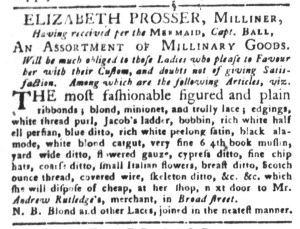
“AN ASSORTMENT OF MILLINARY GOODS.”
Elizabeth Prosser, a milliner, took to the pages of the South-Carolina Gazette and Country Journal to advertise “AN ASSORTMENT OF MILLINARY GOODS” available at her shop on Broad Street in Charleston. She informed prospective customers that her wares recently arrived “per the MERMAID, Capt. BALL.” Merchants, shopkeepers, and others who sold imported goods often noted the ships that transported their merchandise across the Atlantic as a means of demonstrating to consumers that they had new items among their inventory. New also implied fashionable, but Prosser explicitly made the connection. She proclaimed that she carried “the most fashionable” millinery goods for “those Ladies who please to Favour her with their Custom.”
At the same time that she addressed readers of the South-Carolina Gazette and Country Journal, Prosser attempted to cultivate a clientele among readers of the South-Carolina Gazette. Her advertisement appeared in both newspapers on September 24, 1771. Purveyors of goods and services frequently advertised in multiple newspapers, seeking to reach more prospective customers and increase their share of the market. Prosser apparently considered it worth the expense to place the same advertisement in two newspapers simultaneously. She did not, however, decide to insert her advertisement in the third newspaper published in Charleston at the time, the South-Carolina and American General Gazette.
If she had done so, her advertisement might have appeared alongside one placed by a competitor. In the September 24 edition of that newspaper, Jane Thomson advertised “A fresh Supply of MILLINARY GOODS” that she “received by the Mermaid, Capt. Ball, from LONDON.” Thomson did not advertise in the other two newspapers. That limited the competition between the milliners, at least in the public prints, but it also meant that readers of all three newspapers encountered advertising by female entrepreneurs who joined their male counterparts in marketing a vast array of imported goods. Prosser addressed the “Ladies” in her notice, but women did not participate in the marketplace merely as consumers. Prosser, Thomson, and many other female entrepreneurs conducted business as “she-merchants,” shopkeepers, and artisans during the era of the American Revolution.
What was advertised in a colonial American newspaper 250 years ago today?
South-Carolina Gazette and Country Journal (July 30, 1771).
“Carries on the BOOK-BINDING and STATIONARY BUSINESS, in all its Branches.”
The term “classified ads” accurately describes newspaper notices published in later periods, but it misrepresents advertising in eighteenth-century newspapers. Printers did not “classify” advertisements in the sense of assigning them to categories and then grouping or organizing them to make it easier for readers to navigate their contents. Instead, advertisements appeared as a hodgepodge fashion, requiring more careful reading to discern their purposes.
Consider, for example, advertisements about enslaved people. Printers could have readily identified four categories or classifications: enslaved people for sale, enslaved people wanted to purchase or to hire, “runaways” who liberated themselves, and captured fugitives seeking freedom held in workhouse and jails. Printers did not cluster such advertisements together on the pages of their newspapers. Consider the July 30, 1771, edition of the South-Carolina Gazette and Country Journal. It included three advertisements offering rewards for the capture and return of enslaved people who liberated themselves. One ran near the top of the third column on the third page, another at the top of the second column on the last page, and the final one at the bottom of that column. Two “Brought to the WORK-HOUSE” advertisements describing Black men also appeared in that issue, one at the bottom of the third column on the third page and the other in the middle of the third column on the last page. The printer made no effort to classify these advertisements and place them in close proximity.
In some cases, it would have been practically impossible to classify advertisements because advertisers often placed notices with multiple purposes in mind. When Mary Gordon, “Administratrix to the Estate of Mr. James Gordon,” departed South Carolina “for the Benefit of her Health,” she appointed James Taylor to overseer the estate. Taylor placed an advertisement to that effect, calling on anyone with outstanding accounts to settle them. Taylor also used the opportunity to promote his own business, inserting a note that he “carries on the BOOK-BINDING and STATIONARY BUSINESS, in all its Branches, almost opposite the State-House.” While this advertisement could have been considered an estate notice based on its primary purpose, it also aimed to attract customers for a business unrelated to the estate. In that regard, it defied classification.
Although it may seem reasonable to describe advertisements in eighteenth-century newspapers as “classified ads,” at least initially, further examination reveals that doing so amounts to a mischaracterization of the contents and organization of those newspapers. It also writes the history of newspaper advertising backwards, grafting later developments onto the early American press.
What was advertised in a colonial American newspaper 250 years ago today?
Supplement to the South-Carolina Gazette and Country Journal (June 25, 1771).
“Boxes of Medicines for Plantation Use … will also contain a Phial of his famous FEVER DROPS.”
When apothecary Thomas Stinson purchased the shop and inventory of another apothecary, he placed an advertisement in the South-Carolina Gazette and Country Journal to inform prospective customers. He pledged that he gave “constant Attendance” at the shop, standing ready to serve their needs. In addition, he provided assurances that “his DRUGS and MEDICINES … are all fresh and good.” Stinson directed his advertisement to various kinds of customers. He addressed “his Friends and the Public,” consumers making purchases for their households, but he also sought customers who bought in greater volume. “Gentlemen Practitioners, both in Town and Country,” Stinson declared, “may be supplied with any Quantity of Medicines on the usual reasonable Terms.”
In addition, Stinson offered a service to plantation owners and overseers, “Boxes of Medicines for Plantation Use” that they could administer on their own. He produced and marketed an eighteenth-century version of first aid kits. Apothecaries often mentioned similar services in their advertisements, preparing boxes containing a variety of remedies for all sorts of symptoms for families, mariners, and plantations. Buyers benefited from the convenience of having medicines and supplies on hand when need arose, while apothecaries augmented their revenues by moving inventory that customers did not yet need and, because they bought the boxes as a precaution, might not ever need.
Stinson devoted more attention to the contents of his medicine boxes than most apothecaries, describing two of the items they contained. Each box contained a vial of “his ELIXIR for all Kinds of cholicky Complaints” and a vial of “his famous FEVER DROPS.” Stinson proclaimed that this nostrum was already “well known in many Parts of this Province, where it has been found effectual.” Stinson asserted that users would not experience negative side effects, having been “innocent even to sucking Babes” when administered to them. Some readers may have been skeptical about both the reputation and effectiveness of Stinson’s “famous FEVER DROPS.” Including his fever drops and his elixir in the medicine box as part of the package allowed the apothecary to boost sales of items that plantation owners and overseers might not have ordered separately. In turn, he could make even more elaborate claims about how widely his distributed those medicines that competed with patent medicines imported from England. While many apothecaries sold medicine boxes, Stinson adapted his medicine boxes for an additional purpose, marketing the potions and panaceas he produced.
What was advertised in a colonial American newspaper 250 years ago today?
Supplement to the South-Carolina Gazette and Country Journal (June 11, 1771).
“She continues to make up EVERY ARTICLE in the MILINARY WAY.”
Readers encountered many advertisements that listed dozens of consumer goods when they perused the June 11, 1771, edition of the South-Carolina Gazette and Country Journal and the supplement that accompanied it. Indeed, rather than news accounts the first items on the first page consisted of advertisements for “a general and very compleat ASSORTMENT of GOODS, just imported … from London” that listed many kinds of textiles, garments, and adornments. Male entrepreneurs placed most of those advertisements, but women also made an appearance in the public prints. Jane Thomson ran her own notice for a “neat assortment of MILINARY GOODS.”
Thomson stocked everything from “pink, green, white, sky blue, and black English persians” to “women and girls silk and leather gloves and mitts” to “blond lace, single and double edged.” After listing dozens of items, she proclaimed that her inventory also included “many other articles, too tedious to enumerate.” She offered as many choices to consumers as her male competitors. In addition to retailing those goods, Thomson informed prospective clients that she “continues to make up EVERY ARTICLE in the MILINARY WAY, and FINE JOINS LACE as usual.” That made her a producer as well as a purveyor of goods.
Editorials in early American newspapers often framed women solely as consumers, usually to critique their activities in the marketplace, but Thomson demonstrated that women filled other roles during the consumer revolution. They ran their own businesses, negotiated with English merchants who supplied their inventory, kept ledgers and other records, collected debts, produced goods, placed advertisements, and mentored other women. Thomson informed readers that she sought “one GIRL a[s] an apprentice,” someone she could train as a milliner who might eventually operate her own business.
Many more women pursued shopkeeping and other occupations in eighteenth-century American than placed newspaper advertisements. As a result, the public prints did not give a complete accounting of the presence of women in the marketplace as producers and purveyors of consumer goods. As they went about their daily business, however, colonists certainly knew that many of their female friends, relatives, and neighbors operated businesses of one kind or another. Jane Thomson’s advertisement only hints at the number of women who made or sold goods in Charleston in the early 1770s.
What was advertised in a colonial American newspaper 250 years ago today?
Supplement to the South-Carolina Gazette and Country Journal (May 7, 1771).
“Booksellers in Boston, New-York, Philadelphia, or … Charles-Town.”
Like many other colonial printers, Charles Crouch also sold books, pamphlets, and broadsides. In the pages of the South-Carolina Gazette and Country Journal, he advertised titles available at his “Great Stationary and Book Shop.” He also acted as a local agent for printers and booksellers in other cities, publishing subscription notices and handling local sales. He did so on behalf of Robert Bell, the flamboyant bookseller responsible for publishing a three-volume American edition of “ROBERTSON’s celebrated History of CHARLES the Fifth.” Bell coordinated an advertising campaign that extended from New England to South Carolina. Local agents simultaneously published his subscription notice inviting readers to participate in an “elegant XENOPHONTICK BANQUET” through purchasing his American edition.
When Wells inserted that advertisement in the South-Carolina Gazette and Country Journal and listed himself as a local agent, he contributed to the creation of a community that extended far beyond Charleston. Yet settling in for the “XENOPHONTICK BANQUET” was not the only means of joining a larger community that Wells offered to readers and prospective customers. He appended to Bell’s subscription notice a brief note that he also sold “The Trial of the Soldiers of the 29th Regiment, for the Murders committed at Boston,” printed by John Fleeming in Boston, and “A Funeral Sermon on the Death of the Rev. Mr. Whitefield, by the Rev. Mr. Zubly,” printed by James Johnston in Savannah. Those two items commemorated two of the most significant events of 1770, the Boston Massacre on March 5 and the death of George Whitefield on September 30. Both events received extensive coverage in the colonial press. Both of them also generated commemorative items ranging from broadsides and prints to sermons and orations.
In a single advertisement, Wells linked consumers in South Carolina to geographically dispersed communities that shared common interests not defined by the places individual members resided. Colonists from New England to Georgia mourned Whitefield, just as they expressed outrage over British soldiers firing into a crowd and killing several people in Boston. Many colonists also sought to participate in genteel communities defined in part by the books they read, joining in the “grand Feast of historical Entertainment” that booksellers in Boston, New York, Philadelphia, Charleston, and other towns offered to them. Wells did not merely advertise three titles available at his shop; he marketed a sense of community.
What was advertised in a colonial American newspaper 250 years ago today?
South-Carolina Gazette and Country Journal Extraordinary (April 27, 1771).
“He carries on his Business as usual, at his Shop in Broad-Street.”
A standard issue for most newspapers published in colonial America consisted of four pages created by printing two pages on each side of a broadsheet and then folding it in half. This did not always provide sufficient space for all of the news and advertising on hand, so printers adopted a variety of strategies for producing supplements. In the past week, the Adverts 250 Project has examined some of the decisions made by printers who had too much content and not enough space. On April 24, 1771, Robert Wells, printer of the South-Carolina and American General Gazette, distributed a smaller sheet that consisted entirely of advertising along with the standard issue for the week. The following day, Richard Draper, printer of the Massachusetts Gazette and Boston Weekly News-Letter, inserted a note that “for want of Room” several advertisements “must be deferred till next Week.” He did, however, issue a supplement that contained “Fresh London Articles” that he received from the captain of a ship that just arrived in port. In that supplement, Draper scooped other newspapers.
Charles Crouch, printer of the South-Carolina Gazette and Country Journal, took another approach. On April 27, he published an Extraordinary containing both news and advertising that served as a midweek supplement to his newspaper. Prior to the American Revolution, most newspapers operated on a weekly publication schedule. When printers did publish supplements, they usually did so on the same day as the standard issue and distributed them together. Both Draper and Wells did so with their supplements. On occasion, however, printers produced supplements, extraordinaries, or postscripts midway through the week. In such instances, supplements consisted of either news or news and advertising, but rarely just advertising. Typically, breaking news justified publishing and disseminating midweek supplements, but printers determined that advertising supplements could wait until the usual publication day.
Crouch devoted an entire half sheet to his two-page supplement, unlike Draper and Wells who each opted to conserve resources with smaller sheets. Crouch could have devised a smaller sheet that featured only news accounts. Instead, he published news and advertising, further disseminating notices about consumer goods and services, real estate for sale, and ships preparing to sail to England and other colonies. Did those advertisers pay for the additional insertion? Or did those advertisements appear gratis? Answering those questions requires consulting Crouch’s ledgers or other sources beyond the newspaper. Either way, the midweek supplement increased the amount of advertising (and news) circulating in South Carolina near the end of April 1771.