August 22

What was advertised in a colonial American newspaper 250 years ago today?
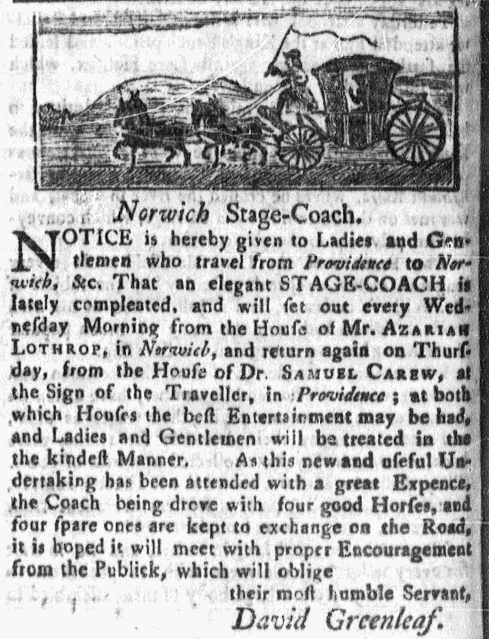
Aug 22 - 8:22:1768 Massachusetts Gazette Green and Russell
Massachusetts Gazette [Green & Russell] (August 22, 1768).
“Norwich Stage-Coach.”

As the summer of 1768 drew to a close, David Greenleaf established a new “Stage-Coach” line between Norwich, Connecticut, and Providence, Rhode Island. The stagecoach made one trip each week, covering a distance of almost fifty miles in each direction. Passengers could depart “from the House of Mr. AZARIAH LOTHROP, in Norwich” on Wednesday mornings and arrive at “the House of Dr. SAMUEL CAREW, at the Sign of the Traveller, in Providence” later in the day. The stagecoach made the return trip on Thursdays. Greenleaf saw to the comfort of the travelers who availed themselves of this new service, providing an “elegant STAGE-COACH” drawn by “four good Horses.” To make the trip as speedy as possible, Greenleaf also arranged for “four spare ones … to exchange on the Road.” In addition, he carefully selected the terminals for this new stagecoach line. Lothrop and Carew both offered “the best Entertainment” for passengers while they waited to make the journey. Greenleaf made the entire journey an experience, promising that “Ladies and Gentlemen will be treated in the kindest Manner.”

Greenleaf made a significant investment in this venture. He implicitly said as much in his description of the new stagecoach and the many horses. He more explicitly made the point when he argued that since “this new and useful Undertaking has been attended with a great Expence” that he hoped “it will meet with proper Encouragement from the Publick.” Advertising in the Massachusetts Gazette added to his Greenleaf’s expenses, but he certainly expected a return on that investment. To increase the effectiveness of his advertisement, he needed to increase the likelihood that readers would notice it. To that end, he incurred the extra expense of commissioning a woodcut that depicted a stagecoach drawn by four horses. The image also included a driver with a whip guiding the horses and a passenger peering out from the stagecoach. Compared to other woodcuts that accompanied advertisements, Greenleaf’s image was detailed and well executed. The vignette would have been difficult for readers of the Massachusetts Gazette to overlook. The quality of his coach and service did not matter if prospective customers did not know that the “Norwich Stage-Coach” existed. Enhancing the advertisement with a notable woodcut helped to bring Greenleaf’s new venture to the attention of colonists who planned to travel between Norwich and Providence and beyond.

August 1

What was advertised in a colonial American newspaper 250 years ago today?

Aug 1 - 8:1:1768 New-York Gazette Weekly Mercury
New-York Gazette and Weekly Mercury (August 1, 1768).

“One of the most beautiful Animals, call’d, The LEOPARD.”

In addition to an array of consumer goods and services, newspaper advertisements also promoted a variety of entertainments and leisure activities, from concerts and plays to fireworks and exotic animals. Readers of the August 1, 1768, edition of the New-York Gazette and Weekly Mercury could not have missed Abraham Van Dyck’s advertisement that invited them to view a leopard that had just arrived in the city. The relatively large woodcut that accompanied the advertisement crudely depicted the large cat, inciting even greater interest than Van Dyck’s description of the animal.

Van Dyck introduced New Yorkers to a spectacle previously unknown to them, “one of the most beautiful Animals.” He could not assume that prospective viewers were already familiar with leopards, prompting him to publish a short description to supplement the woodcut. Van Dyck explained that the leopard was “adorned all over with very neat and different spots, black and white.” It had “large sparkling Eyes, and long Whiskers on both Sides of his Jaws.” In comparison to an animal that may have been more familiar to many colonists, “This Leopard is much in Shape, Nature, and Colour, like unto a Panther.” To augment the excitement of viewing this exotic beast, Van Dyck noted that the leopard was “greedy in catching his Prey by leaping at it,” but those tantalized by this description did not need to worry about their safety when they went to see this exotic creature. “Gentlemen and Ladies may have a full View of the Leopard,” Van Dyck promised, as he is well secured with a Chain.”

The leopard was not Van Dyck’s only attraction. He informed readers that he had “several other Animals, which will be seen at the same Time,” though he did not indicate which other animals comprised the rest of the show. The leopard was the star, the exotic beast that Van Dyck expected would draw viewers willing to pay a shilling to glimpse a creature so out of the ordinary compared to the sights they encountered on most days. The woodcut underscored that the leopard was a true curiosity that readers did not want to miss.

July 12

What was advertised in a colonial American newspaper 250 years ago today?

Jul 12 - 7:12:1768 South-Carolina Gazette and Country Journal
South-Carolina Gazette and Country Journal (July 12, 1768).

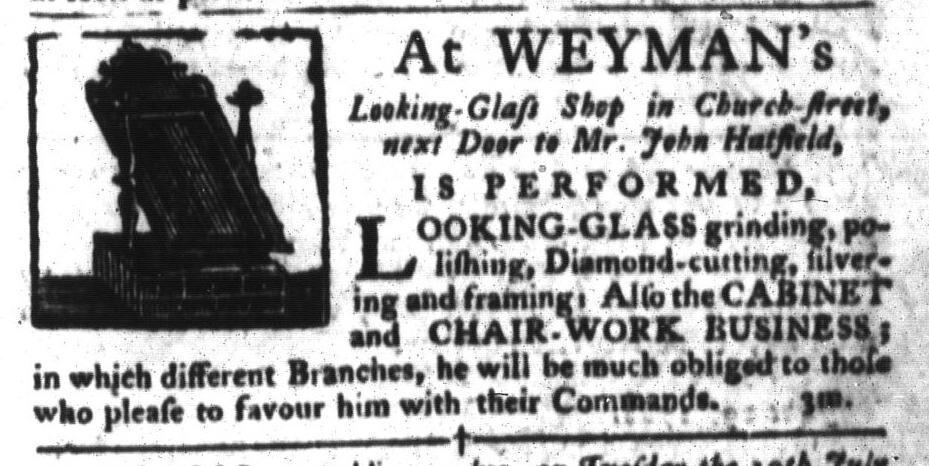
“At WEYMAN’s Looking-Glass Shop.”

Edward Weyman’s advertisements for his “Looking-Glass Shop in Church-street” in Charleston were easily recognizable when they appeared in the South-Carolina Gazette and Country Journal. In addition to using to his surname as a headline, Weyman included an image of a looking glass mounted in an elaborately carved frame. While Weyman’s woodcut certainly was not a sophisticated engraving, the processes of remediating the image over the years – photography and digitization – likely make it appear more crude than it looked to colonists who read the newspaper when it was first published or even to modern researchers who consult original copies in libraries and archives rather than the digital surrogates more widely accessible in the twenty-first century. This process is compounded when printing images from the digital ones, a process that tends to create even darker and denser images. In other words, Weyman’s woodcut may look like a dark mass to modern eyes, but that is contingent in part on the format in which it is presented for our consumption. Eighteenth-century viewers would have seen a crisper image. They would have more easily noticed the lines and details that do not translate well via subsequent remediation. It remains important not to overstate the quality of this and other woodcuts, but at the same time we should avoid denigrating them as excessively crude unnecessarily.

Besides, Weyman’s woodcut served its purpose. Other than the masthead, only three images appeared in the July 12, 1768, edition of the South-Carolina Gazette and Country Journal. Two of them were stock images that belonged to the printer: a woodcut of a house that accompanied a real estate advertisement and a woodcut of a slave that accompanied a fugitive advertisement. Weyman’s woodcut of a looking glass was the only one commissioned by the advertiser, the only one used exclusively by a particular advertiser rather than interchangeably in advertisements of the corresponding genre. Weyman advertised frequently, making his woodcut a familiar image to regular readers of the South-Carolina Gazette and Country Journal. In effect, it created a logo or a brand that readers could immediately identify. Its mere repetition over weeks and months, especially as an especially distinctive visual element, likely secured a place for Weyman in the minds of readers. Even if they did not need or want looking glasses when they glimpsed his advertisements, they were likely to remember his workshop when they were in the market to make such purchases.

June 26

What was advertised in a colonial American newspaper 250 years ago this week?

Jun 26 - 6:23:1768 Pennsylvania Gazette
Pennsylvania Gazette (June 23, 1768).

“The BUNCH of GRAPES.”

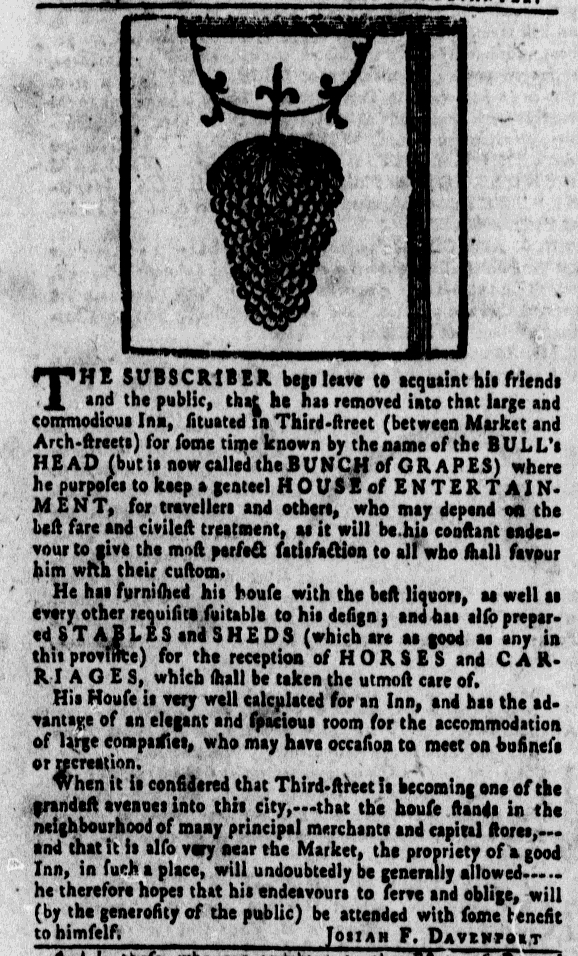
When Josiah F. Davenport opened the Bunch of Grapes inn and tavern in Philadelphia in the late spring of 1768 he placed advertisements in newspapers published in both New York and Philadelphia, alerting travelers and local residents alike to the many entertainments and amenities he provided. Davenport’s first advertisements in the Pennsylvania Chronicle included a woodcut that presumably depicted the sign that marked the location of his establishment: a bunch of grapes suspended from a signpost. Such a specialized woodcut, specific to Davenport’s business, certainly enhanced the advertisement and increased the probability that it would attract the attention of potential patrons, but it was also an additional expense. Unlike the woodcuts of horses, houses, ships, and slaves that were part of any newspaper printer’s collection of type, other woodcuts that appeared in eighteenth-century advertisements belonged to the advertisers who had commissioned them.

Such was the case with Davenport’s woodcut that replicated his sign. He likely considered it an important investment when it came to building his brand, especially since the Bunch of Grapes occupied an inn “for some time known by the name of the BULL’s HEAD.” The success of his new enterprise depended in part on those previously familiar with the former tavern now associating the same location with the Bunch of Grapes. Both the sign and the woodcut aided in strengthening his brand recognition among residents of Philadelphia he hoped would visit his “genteel HOUSE of ENTERTAINEMNT … for the best fare and civilest treatment,” whether they gathered for “business or recreation.”

Yet there were limits to how much Davenport considered necessary to invest in visual representations of his brand. He did not commission separate woodcuts to accompany his advertisements that appeared in newspapers published in Philadelphia. Instead, he had one woodcut that first accompanied his advertisements in the Pennsylvania Chronicle before reappearing in advertisements in the Pennsylvania Gazette. A notch or indentation in the upright portion of the signpost confirms that Davenport shuttled a single woodcut between printing offices. He was not the only advertiser who made that choice. In New York, Gerardus Duyckninck inserted his elaborate woodcut in multiple newspapers, one after the other in succession. Although an effective means of making advertisements distinctive, woodcuts incurred additional expenses. Some advertisers who commissioned them attempted to maximize the returns on their investments by rotating them through several newspapers.

June 6

What was advertised in a colonial American newspaper 250 years ago today?

Jun 6 - 6:6:1768 New-York Gazette Weekly Post-Boy
New-York Gazette: Or, the Weekly Post- Boy (June 6, 1768).

“His House is very well calculated for an Inn.”

When Josiah F. Davenport opened an inn on Third Street in Philadelphia, he advertised in newspapers published in both Philadelphia and New York. Doing so made sense since he billed “the Bunch of Grapes” as “a genteel House of Entertainment, for Travellers and others, who may depend on the best Fare and civilest Treatment.” Davenport positioned his tavern and inn as a destination not only for visitors to the city but also for local residents “who may have Occasion to meet on Business or Recreation.” In addition to the “best Liquors” and the “elegant and spacious” accommodations for guests, Davenport also promoted the location. He proclaimed that Third Street “is becoming one of the grandest Avenues into this City.” The Bunch of Grapes “stands in the Neighbourhood of many principal Merchants and capital Stores.” Furthermore, it was also located “very near the Market.” Visitors traveling to Philadelphia on business could lodge in an establishment close to their associates, one that also happened to be in a swank neighborhood. Local patrons could also take advantage of the convenient location for conducting business or enjoying the various entertainments at the Bunch of Grapes.

Jun 6 - 6:6:1768 Pennsylvania Chronicle
Pennsylvania Chronicle (June 6, 1768).

Davenport submitted identical copy to the New-York Gazette: Or, the Weekly Post-Boy and the Pennsylvania Chronicle (but the compositors for each made their own decisions about capitalization and italics throughout the advertisement). He also adorned the notice in the Chronicle with a woodcut depicting the sign that marked his establishment, a bunch of grapes suspended from a signpost. He acknowledged that the “large and commodious Inn” he now operated had been “for some time known by the Name of the Bull’s Head.” However, it was now known as the Bunch of Grapes under the management of the new proprietor. The new sign and an image in one of the city’s newspapers helped to cement the switch in branding for the inn. This was especially important considering that the Bull’s Head had established its own reputation for operating at that location.

Davenport realized that the success of the Bunch of Grapes depended on attracting a mixture of customers, both residents of Philadelphia who patronized his “House of Entertainment” for an afternoon or evening and visitors from other places who spent one or more nights. Accordingly, he highlighted a variety of amenities and, especially, the location of the inn in newspapers published in more than one city. Through his marketing efforts, he encouraged travelers to think of the Bunch of Grapes, rather than Philadelphia, as their destination.

May 30

What was advertised in a colonial American newspaper 250 years ago today?

May 30 - 5:30:1768 New-York Gazette Weekly Mercury
New-York Gazette: Or, the Weekly Mercury (May 30, 1768).

“At the Sign of the Looking Glass & Druggist Pot.”

To adorn many of the advertisements for his “UNIVERSAL STORE,” Gerardus Duyckinck commissioned perhaps the most impressive woodcut that accompanied any advertisements in newspapers published throughout the American colonies in the 1760s. In an advertisement that extended approximately two-thirds of a column, Duyckink promoted the “Medley of Goods” he sold “At the Sign of the Looking Glass & Druggist Pot” in New York, yet it was not the amount of space the notice occupied on the page that distinguished it from others. The intricately carved woodcut likely replicated his shop sign, depicting a looking glass in an ornate frame suspended below an urn. A larger rococo frame, equally ornate, enclosed most of the copy, including a nota bene that instructed potential customers how to read the list of merchandise contained in the notice: “The above advertisement, being only the Heads, which consists of a Variety of Articles, almost every particular in each Branch can be commanded at the above Store.” In other words, Duyckinck did not publish an exhaustive list of his wares. Instead, he used a series of headers to categorize the items among his inventory, truly a “Medley of Goods.”

Prospective customers first encountered Duyckinck’s elaborate woodcut in the October 29, 1767, edition of the New-York Journal. It ran for several weeks before Duyckinck discontinued it. In the spring of 1768 it reappeared, with evidence of wear and significantly revised copy in the cartouche, but this time in the New-York Gazette: Or, the Weekly Mercury. While the printers of both newspapers had some standard woodcuts – images of horses, houses, ships, and slaves – among their type, specialized images belonged to the advertisers. Some advertisers, like clockmaker Burrows Dowdney, invested in multiple woodcuts in order to insert them in more than one newspaper simultaneously. Duyckinck may not have considered this an option; given the amount of detail evident in his woodcut, the cost for commissioning others may have been prohibitive. Instead, he rotated the image from newspaper to newspaper, placing it before the eyes of as many readers and prospective customers as possible. Doing so likely yielded the best possible return on his investment in an innovative means of making his newspaper advertisements distinctive from anything else that appeared in the public prints.

May 29

What was advertised in a colonial American newspaper 250 years ago this week?

May 29 - 5:26:1768 Pennsylvania Gazette
Pennsylvania Gazette (May 26, 1768).

“Said Humphreys makes, and has now on Hand, a large Quantity of good Sickles, Scythes.”

Stephen Paschall and Benjamin Humphreys jointly placed an advertisement in the May 26, 1768, edition of the Pennsylvania Gazette. In it, they promoted several items they both manufactured, including “Screws for Clothiers, Timber-Carriages, Tobacconists, [and] Packing” and “Iron Work for Grist-Mills, Saw-Mills, and Fulling-Mills.” In addition, Paschall announced that he made and sold bellows for blacksmith forges on Market Street, between Fourth and Fifth Streets. Similarly, Humphreys marketed sickles, scythes, and other cutlery that he made and sold at the corner of Ninth and Market Streets.

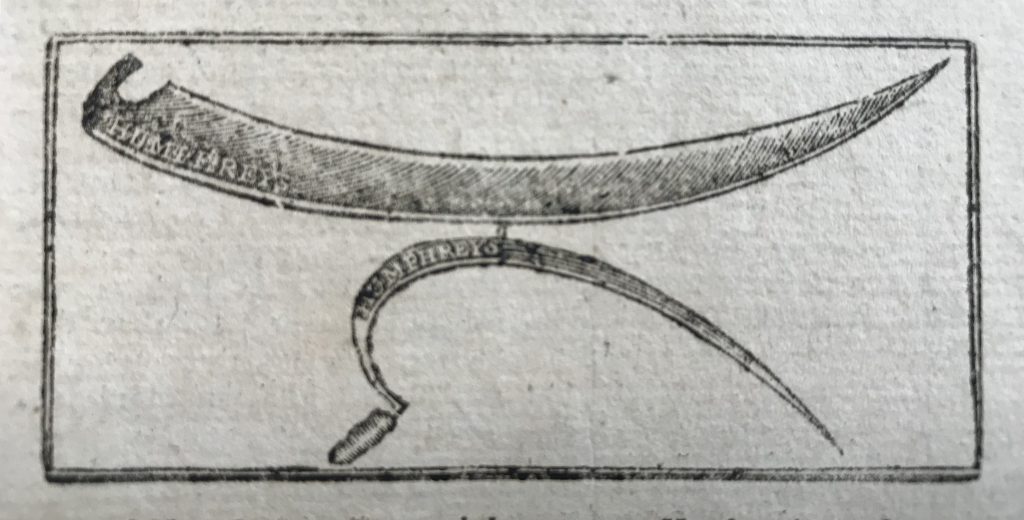
Their advertisement included a visual image uniquely associated with Humphreys’s business: a woodcut of a sickle mounted on a handle suspended from a scythe blade. This image likely approximated a sign that marked Humphreys’s workshop. That would explain why a single link connected the two blades. Each blade also bore the name HUMPHREYS, identifying the artisan but also marking his place of business. Humphreys did not advise prospective customers that his workshop was located at the Sign of the Scythe and Sickle, but given that he expressed concern that his “Distance from Market” might “discourage his Friends, and others” from visiting his shop he may have considered it most important to list the cross streets by name and allow the woodcut to speak for itself in terms of the sign that marked his location. Relatively few American shop signs that predate the Revolution survive, but woodcuts that accompanied newspaper advertisements suggest some of the marketing images colonists encountered as they traversed the streets of cities and towns.

For modern researchers, this image raises a cautionary tale about the shortcomings of consulting digital surrogates to the exclusion of original sources. I downloaded a PDF of the entire May 26, 1768, issue of the Pennsylvania Gazette from Readex’s America’s Historical Newspapers database. As the image above reveals, the photography and remediation of the original source make it difficult to discern that the name HUMPHREYS does indeed appear on the blades. This was a detail I overlooked the first time I read the advertisement and only noticed when I gave the woodcut additional scrutiny. To determine whether I had mistaken the shading of the blades with a depiction of the artisan’s name, I visited the American Antiquarian Society to examine an original issue. The photograph below confirms that the name HUMPHREYS appears quite legibly, much more so than the digital surrogate suggests. In many ways, working with microfilm and digital images can be much more efficient than consulting originals. Both formats provide greater access while also preserving original documents. But they must be used judiciously. Sometimes examining the original yields information otherwise unavailable, as was the case with Benjamin Humphrey’s woodcut in the Pennsylvania Gazette.

May 29 - 5:26:1768 Detail AAS Pennsylvania Gazette
Detail of Paschall and Humphreys Advertisement in May 26, 1768 edition of the Pennsylvania Gazette. Courtesy American Antiquarian Society.

May 15

What was advertised in an American newspaper 250 years ago this week?

May 15 - 5:12:1768 Pennsylvania Gazette Supplement
Supplement to the Pennsylvania Gazette (May 12, 1768).

“BURROWS DOWDNEY, Clock and Watch Maker, in Front-street.”

Relatively few advertisements in eighteenth-century newspapers included visual images. Those that did tended to feature stock images that belonged to the printer and could be inserted interchangeably in advertisements from the appropriate genre, such as woodcuts of horses, houses, slaves, and ships. Woodcuts of houses could be used in any real estate notice. Woodcuts depicting runaway slaves could be used in any notice alerting colonists about fugitives that might be in their midst.

Some advertisers, however, did invest in woodcuts to enliven their advertisements, distinguishing them from others that consisted solely of text or that were decorated with generic images readers were accustomed to seeing in the pages of the public prints. Unlike the stock images, these woodcuts belonged to advertisers rather than printers. Even if the image happened to match the contents of other advertisements, such woodcuts appeared only in connection to those who had commissioned them. For instance, clock- and watchmakers regularly advertised in the pages of the Pennsylvania Gazette, yet the woodcut depicting the face of a clock appeared solely in notices placed by Burrows Dowdney. That unique image made his advertisements distinctive and memorable for potential customers, especially since it was sometimes the only image on a page otherwise composed of text (as was the case on the final page of the supplement that accompanied the May 12, 1768, edition of the Pennsylvania Gazette).

Many of the woodcuts commissioned by advertisers dominated the notices in which they appeared, but that was especially true for Dowdney’s advertisement. The image of the clock dial accounted for approximately half of the space his notice occupied on the page. Readers would have been able to identify his occupation and wares at a glance, even if “CLOCKS” and “WATCHES” had not been listed in all capitals in the copy that appeared to the right of the image. Printing technologies of the period did not particularly facilitate including images in advertisements, yet some advertisers still invested both money and energy in experimenting with woodcuts that would set their advertisements apart from others that flooded the pages of eighteenth-century newspapers.

April 17

What was advertised in a colonial American newspaper 250 years ago this week?

Apr 17 - 4:11:1768 Boston Post-Boy
Boston Post-Boy (April 11, 1768).

“Two young HORSES.”

Samuel Harnden placed an advertisement seeking to sell “two young HORSES” in the April 11, 1768, edition of the Boston Post-Boy.  An image of a horse accompanied his advertisement, distinguishing it from most others.  More than thirty advertisements appeared in that issue, but only four featured images of any sort.  In addition to Harnden’s advertisement, a real estate notice included a woodcut of a house and two others concerning maritime trade and transportation incorporated woodcuts of ships.  Otherwise, the issue was devoid of visual images, with the exception of the masthead. A ship at sea and a post rider flanked the newspaper title at the top of the first page of each issue of the Boston Post-Boy.

Visual images constitute an important aspect of twenty-first-century media, in general, and advertising, in particular.  Printing technologies of the eighteenth century, however, made visual images in newspapers relatively rare.  In addition to their type, printers also had a limited number of stock images, woodcuts that could accompany some of the most common types of advertisements. Most of these generic images were represented in the April 11, 1768, edition of the Boston Post-Boy, but advertisements also frequently included woodcuts of slaves in addition to horses, houses, and ships.  Since they belonged to printers and could be used interchangeably for advertisements with the same purpose, such images were not associated with any particular advertisers.  However, some advertisers did invest in woodcuts that represented their businesses, often replicating their shop signs.  Compared to the stock images, significantly fewer paid notices had woodcuts commissioned by the advertiser.

Woodcuts were not the only way to introduce visual variation into eighteenth-century newspapers.  Printers typically possessed a variety of printing ornaments that could be deployed to add visual interest to the page, though the extent of ornamental printing varied from newspaper to newspaper.  The compositors in Green and Russell’s printing shop, for instance, did not tend to insert much ornamental printing into the pages of the Boston Post-Boy, but their counterparts in Edes and Gill’s shop used ornaments to separate news items and advertisements.  In the process, they presented a more sophisticated graphic design.  Given the scarcity of visual images in eighteenth-century newspapers, readers may have been even more attuned to the variations in ornamental printing than modern readers who quickly become overwhelmed by the density of the text in both news items and advertisements.

February 27

What was advertised in a colonial American newspaper 250 years ago today?

Feb 27 - 2:27:1768 Providence Gazette
Providence Gazette (February 27, 1768).

“At the Sign of the Brazen Lion.”

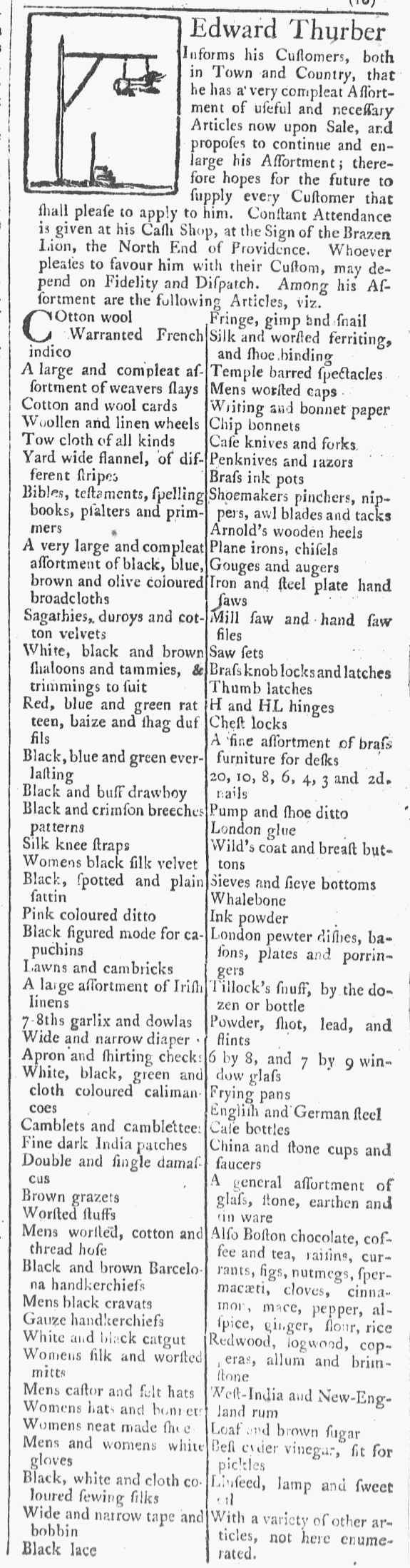
Its length alone would have made Edward Thurber’s advertisement in the February 27, 1768, edition of the Providence Gazette difficult to miss. Listing dozens of items he offered for sale, it extended for nearly an entire column. Yet Thurber did not rely solely on the amount of space the advertisement occupied to attract the attention of potential customers. He incorporated a bit of visual flair by inserting a woodcut.

For quite some time he had been advertising in the Providence Gazette, but usually in conjunction with Benjamin Thurber. Their shared notices informed readers that they operated separate shops even though they worked together to acquire merchandise. Benjamin could be found at the Sign of the Bunch of Grapes and Edward at the Sign of the Brazen Lion. They did not insert any images in their joint advertisements, but when Edward commenced advertising on his own he commissioned a woodcut that depicted his Sign of the Brazen Lion. Perhaps he had more creative freedom on his own. Maybe Benjamin had not wished to invest in a corresponding woodcut of the Sign of the Bunch of Grapes. Maybe the partners thought that two woodcuts in a single advertisement would have appeared too crowded or too confusing. Maybe they mutually determined that when they bought space in the local newspaper that they wanted to fill it with copy rather than woodcuts. Whatever their reasons, the Thurbers did not experiment with visual images in their joint advertisements. That changed when Edward advertised separately.

Although it did inject a visual element into his advertisement, Edward’s woodcut was rather primitive compared to some that accompanied advertisements in newspapers published in larger cities, especially New York and Philadelphia. His woodcut quite literally depicted a signpost with a crudely carved lion suspended from it. While not the most impressive woodcut, it does testify to a sight that colonists would have glimpsed as they traversed the streets of Providence. Apparently Edward Thurber’s sign was not a board painted with the image of a lion but rather a piece of wood carved into either a two- or three-dimensional lion. In and of itself, such a sign would have been a significant investment, but well worth the price as it became a brand consistently used on the exterior of the shop and in newspaper advertisements. Edward Thurber further advanced his use of this brand in his advertising by including a woodcut that visually reiterated the copy that directed potential customers to “the Sign of the Brazen Lion.”