February 27

What was advertised in a colonial American newspaper 250 years ago today?
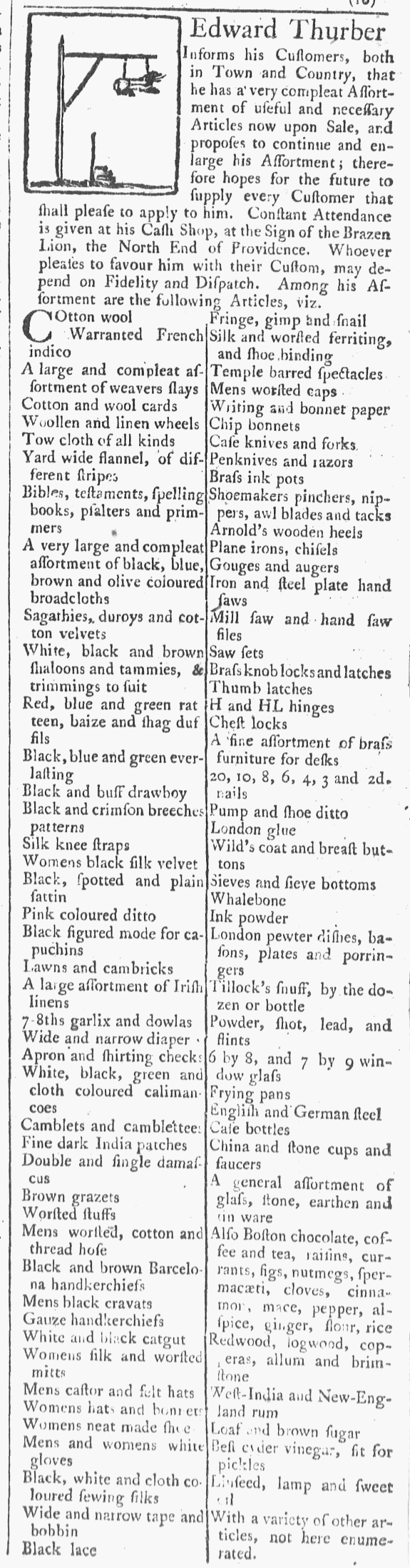
Feb 27 - 2:27:1768 Providence Gazette
Providence Gazette (February 27, 1768).

“At the Sign of the Brazen Lion.”

Its length alone would have made Edward Thurber’s advertisement in the February 27, 1768, edition of the Providence Gazette difficult to miss. Listing dozens of items he offered for sale, it extended for nearly an entire column. Yet Thurber did not rely solely on the amount of space the advertisement occupied to attract the attention of potential customers. He incorporated a bit of visual flair by inserting a woodcut.

For quite some time he had been advertising in the Providence Gazette, but usually in conjunction with Benjamin Thurber. Their shared notices informed readers that they operated separate shops even though they worked together to acquire merchandise. Benjamin could be found at the Sign of the Bunch of Grapes and Edward at the Sign of the Brazen Lion. They did not insert any images in their joint advertisements, but when Edward commenced advertising on his own he commissioned a woodcut that depicted his Sign of the Brazen Lion. Perhaps he had more creative freedom on his own. Maybe Benjamin had not wished to invest in a corresponding woodcut of the Sign of the Bunch of Grapes. Maybe the partners thought that two woodcuts in a single advertisement would have appeared too crowded or too confusing. Maybe they mutually determined that when they bought space in the local newspaper that they wanted to fill it with copy rather than woodcuts. Whatever their reasons, the Thurbers did not experiment with visual images in their joint advertisements. That changed when Edward advertised separately.

Although it did inject a visual element into his advertisement, Edward’s woodcut was rather primitive compared to some that accompanied advertisements in newspapers published in larger cities, especially New York and Philadelphia. His woodcut quite literally depicted a signpost with a crudely carved lion suspended from it. While not the most impressive woodcut, it does testify to a sight that colonists would have glimpsed as they traversed the streets of Providence. Apparently Edward Thurber’s sign was not a board painted with the image of a lion but rather a piece of wood carved into either a two- or three-dimensional lion. In and of itself, such a sign would have been a significant investment, but well worth the price as it became a brand consistently used on the exterior of the shop and in newspaper advertisements. Edward Thurber further advanced his use of this brand in his advertising by including a woodcut that visually reiterated the copy that directed potential customers to “the Sign of the Brazen Lion.”

February 15

What was advertised in a colonial American newspaper 250 years ago today?

Feb 15 - 2:15:1768 Pennsylvania Chronicle
Pennsylvania Chronicle (February 15, 1768).

“She continues to sell … the genuine flour of mustard.”

Mary Crathorne advertised the mustard and chocolate she “manufactured” at “the Globe mill on Germantown road” in more than one newspaper published in Philadelphia in February 1768. She inserted one notice in the Pennsylvania Gazette on February 11 and another in the Pennsylvania Chronicle on February 15. Although they featured (mostly) the same copy, the visual aspects of the tow advertisements distinguished one from the other.

A headline consisting of her name, “Mary Crathorne,” introduced the advertisement in the Chronicle. Such design was consistent with that in other advertisements placed by purveyors of goods and services, including Robert Bass and John Lownes. It added readers in identifying the advertisement, but did not call special attention to it. In contrast, her advertisement in the Gazette featured a woodcut depicting a seal for her company flanked by a bottle of mustard on one side and a pound of chocolate on the other. It was the only advertisement in that issue of the Gazette (including the two-page supplement devoted entirely to advertising) that incorporated a visual image, distinguishing it from all others. On the other hand, Crathorne’s advertisement in the Chronicle ran on the same page as four advertisements that included woodcuts (a house, a ship, a male runaway servant, and a female runaway servant). In addition to those stock images that belonged to the printer, elsewhere in the issue Howard and Bartram’s advertisement featured a woodcut of dog with its head in an overturned bucket. The “Copper-Smiths from London” ran a shop at “the sign of the Dog and Golden Kettle, in Second-Street.” They effectively deployed the visual image in multiple media, the newspaper advertisement and the shop sign, to create a brand for their business.

Crathorne attempted something similar with her own woodcut in the Gazette, noting that “All the mustard put up in bottles, has the above stamp pasted on the bottles, and also the paper round each pound of chocolate has the said stamp thereon.” She had to revise the copy, however, for inclusion in the Chronicle without the woodcut. “All the mustard put up in bottle has a stamp” (rather than “the above stamp”) “pasted on the bottles, and also the paper round each pound of chocolate has the same stamp thereon.”

Apparently Mary Crathorne (or her late husband who previously ran the business) had commissioned only one woodcut of this trademark image. That made it impossible to publish advertisements featuring the same image in multiple newspapers simultaneously. The aspect that most distinguished her advertisement in the Gazette was completely missing in the Chronicle, where other advertisers treated readers to a series of woodcuts that dressed up their notices. Crathorne engaged in innovative marketing efforts by associating a specific image with her products to distinguish them from the competition, but she did not consistently advance that campaign by inserting the image in all of her advertisements that appeared in print. She recognized that branding could be useful in selling her wares, but she did not apply the strategy to full effect. That required further experimentation by other advertisers.

February 14

What was advertised in a colonial American newspaper 250 years ago this week?

Feb 14 - 2:11:1768 Pennsylvania Gazette
Pennsylvania Gazette (February 11, 1768).

“All the mustard put up in bottles, has the above stamp pasted on the bottles.”

Readers of the Pennsylvania Gazette would have been familiar with the “genuine FLOUR of MUSTARD” and chocolate that Mary Crathorne advertised in February 1768. Her husband, the late Jonathan Crathorne, had previously produced and sold chocolate and mustard with Benjamin Jackson, but when that partnership dissolved the two men each continued in the business. Sometimes their advertisements appeared one after the other in the Pennsylvania Gazette, as was the case in the November 21, 1765, edition.

Jonathan Crathorne’s advertisement included the same woodcut that his wife later used to promote the business that she operated after his death. It featured a seal flanked by a bottle of mustard on the left and a brick of chocolate on the right. The seal incorporated William Penn’s insignia, a shield decorated with three silver balls, but it bore the words “J. CRATHORN’S PHILADA FLOUR OF MUSTARD.” Crathorne associated pride in the colony with his own products.

After they parted ways, Jonathan Crathorne and Benjamin Jackson engaged in a prolonged public dispute in their advertisements. Mary Crathorne was not as aggressive as her husband in that regard, but the widow did not that “her late husband went to a considerable expence in the erecting, and purchasing out Benjamin Jackson’s part” of “those incomparable mustard and chocolate works at the Globe mill, on Germantown road.”

Mary Crathorne did not want her product confused for any other. To that end, the woodcut in her newspaper advertisement had a purpose that went beyond drawing the attention of readers. “All the mustard put up in bottles,” she reported, “has the above stamp placed on the bottles.” Similarly, “the paper round each pound of chocolate has the same stamp thereon.” To avoid competitors’ products being mistaken for her mustard and chocolate, the widow Crathorne deployed the woodcut from her advertisements as a brand to mark her merchandise. Her husband may have followed the same practice, but his advertisements did not explicitly state that was the case. Perhaps as a woman running a business in a marketplace dominated by men Mary Crathorne found it necessary to devise additional means of promoting her products. She made it easy for consumers to recognize her mustard and chocolate by making sure they were labeled with some sort of trademark that identified the producer.

January 8

What was advertised in a colonial American newspaper 250 years ago today?

Jan 8 - 1:8:1768 South-Carolina and American General Gazette
South-Carolina and American General Gazette (January 8, 1768).

“JONATHAN SARRAZIN, JEWELLER.”

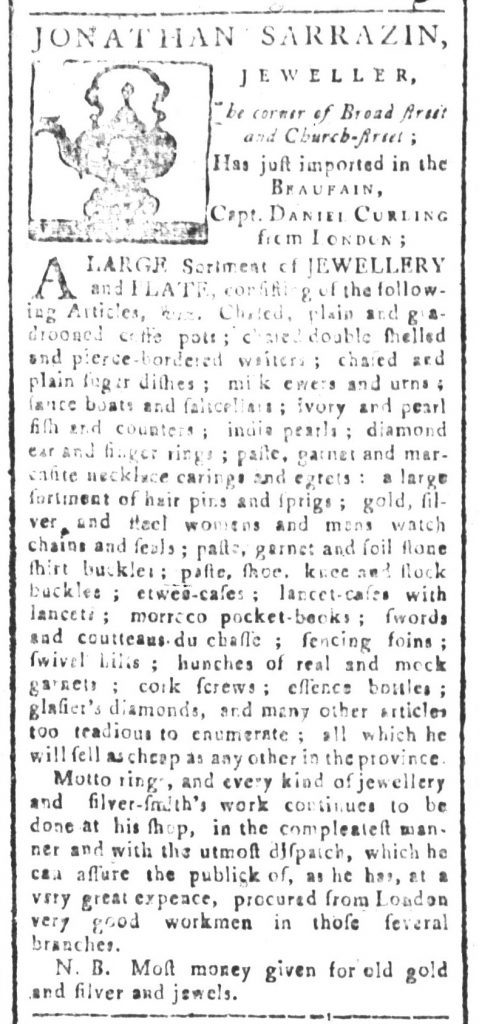
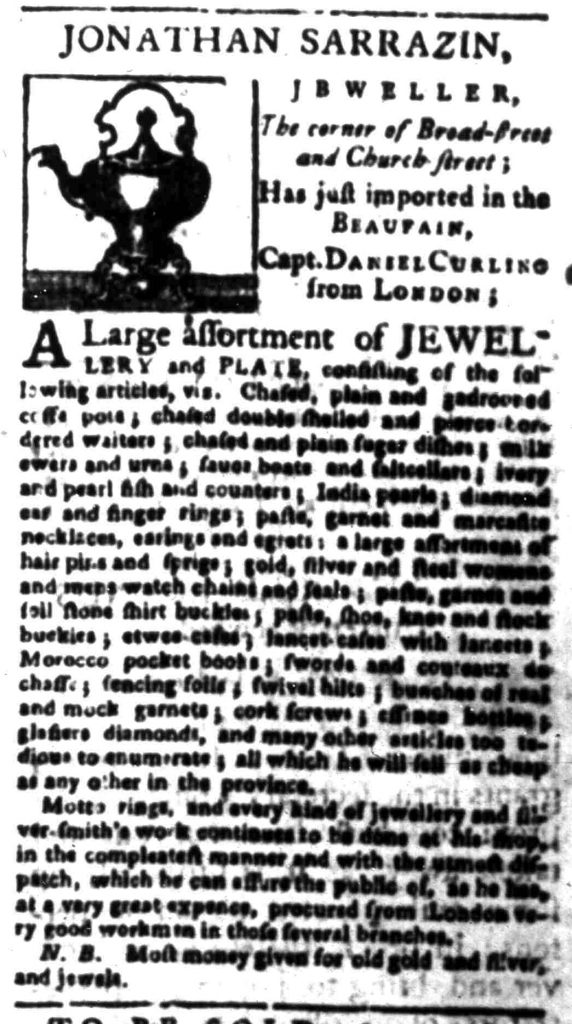
Jonathan Sarrazin once again placed his advertisement for “a LARGE Sortment of JEWELLERY and PLATE” in the January 8, 1768, edition of the South-Carolina and American General Gazette, continuing a series that originated in that newspaper in early December 1767. The same advertisement, including a woodcut depicting a fashionable teapot, also appeared in another newspaper published in Charleston, the South Carolina Gazette.

Last week I examined some of the difficulties in tracing Sarrazin’s marketing efforts in the face of an incomplete archive. Missing or inaccessible issues make it impossible to definitively document when and how often advertisers placed newspaper notices. Today I offer some comments on another challenge inherent in working with surrogates, whether photographs, microfilm, or digital databases, rather than original sources.

A woodcut of a teapot did indeed accompany Sarrazin’s advertisement in both newspapers that carried his notice. Was it the same woodcut? Or was it two separate woodcuts that closely resembled each other? Seemingly trivial at first glance, the answer offers important insights into the effort and expense Sarrazin invested in advertising as well as the business practices of the printers of the newspapers.

Careful examination of the images in the South Carolina Gazette and the South-Carolina and American General Gazette suggests that Sarrazin did commission two separate woodcuts. However due to imperfect remediation, via photography and digitization, it is impossible to definitively state that Sarrazin had two nearly identical woodcuts of an ornate teapot, even thought the visual evidence indicates that was most likely the case.

Accepting that assumption leads to certain conclusions. Along with the copy for his advertisement, Sarrazin submitted a woodcut to the printing office for each newspaper. Acquiring two woodcuts meant that the jeweler incurred greater costs. It also eliminated any need for Sarrazin to shuttle a single woodcut back and forth between printing offices, carefully coordinating with the printers and their production schedules. It also eliminated the possible need for printers to engage in any sort of cooperation required for incorporating a single woodcut into multiple publications. Had Sarrazin commissioned only one woodcut, publishing it in two newspapers would have necessitated greater coordination between advertiser and printer and perhaps even cooperation between competing printers.

The available evidence suggests the most likely circumstances, but examination of the original sources would allow for a much more forceful assertion. Digitized sources tell much of the story, but they are not exhaustive in the clues about the past they reveal. Accurately telling the most complete story of the past requires using digitized and original sources in combination.

January 4

What was advertised in a colonial American newspaper 250 years ago today?

Jan 4 - 1:4:1767 South-Carolina Gazette
South Carolina Gazette (January 4, 1767).

“A Large assortment of JEWELLERY and PLATE.”

Jonathan Sarrazin, a jeweler in Charleston, used a woodcut of a teapot, one of the items he sold, to distinguish his newspaper advertisements from others that also appeared among the pages of dense type. Throughout 1767 and into 1768, his advertisements in the South-Carolina and American General Gazette regularly included this device. Sarrazin’s enthusiasm for associating an image of a fashionable teapot with his business, however, has been partially obscured by a gap in the archive.

Sarrazin could have advertised in any of the three newspapers published in Charleston. In addition to Robert Wells’ South-Carolina and American General Gazette, Peter Timothy printed the South Carolina Gazette and Charles Crouch printed the South-Carolina Gazette and Country Journal. Although all three newspapers had print runs that extended through 1767 and 1768, not all of the issues have been converted into digital surrogates that are digitally accessible to historians, other scholars, and the general public. Accessible Archives provides a complete digital archive for the South-Carolina and American General Gazette and the South-Carolina Gazette and Country Journal for 1767 and 1768, but lacks images of the South-Carolina Gazette for several months of 1767. (The database does include transcripts of the text of issues published during the period.) As a result, consideration of Sarrazin’s advertising campaign in 1767 has been truncated. Working with the available issues reveals that the jeweler advertised regularly in the South-Carolina and American General Gazette, but not in the South-Carolina Gazette and Country Journal. Consulting the transcripts of the South Carolina Gazette could establish whether Sarrazin also advertised in that publication, but that process requires much more time and labor than examining photographs of the original issues. This method also eliminates the most striking feature of Sarrazin’s commercial notices, the woodcut that made it so easy for readers – then and now – to identify his advertisements. (Keyword searches are notoriously unreliable, rendering them inconclusive as well.) Furthermore, the transcripts do not include metadata that indicates when woodcuts accompanied advertisements and news items. In the absence of photographs of the original issues, Sarrazin’s advertising campaign cannot be reconstructed definitively.

Fortunately, Accessible Archives does make available photographs for extant issues of the South Carolina Gazette for all of 1768. Those issues reveal that not only did Sarrazin opt to advertise in a second publication but that he also included a woodcut depicting an ornate teapot in his notices. This demonstrates the jeweler’s commitment to establishing a trademark for his business. He wanted consumers in Charleston and its hinterland to readily identify his advertisements and associate his wares with the fashionable and genteel teapot that appeared in his notices and perhaps doubled as the sign that marked the location of his shop. This testifies to a thoughtful effort to achieve consistency in his advertising in multiple newspapers.

December 11

What was advertised in a colonial American newspaper 250 years ago today?

Dec 11 - South-Carolina and American General Gazette
South-Carolina and American General Gazette (December 11, 1767).

“A LARGE Sortment of JEWELLERY and PLATE.”

Approximately two-thirds of the December 11, 1767, edition of the South-Carolina and American General Gazette consisted of advertising. Among the dozens of advertisement in the issue, Jonathan Sarrazin’s notice had a feature that distinguished it from all others: an image of one of the products he sold at his shop on the corner of Broad Street and Church Street in Charleston.

Sarrazin’s advertisement was not the only one that included a woodcut, but it was the only one with an image, a teapot, created exclusively for the advertiser. Nine advertisements for freight and passage had images of ships. Despite some variation, several had woodcuts that replicated an image used elsewhere in the same issue, including three nearly identical ships on the same page as Sarrazin’s coffeepot. Three advertisements incorporated woodcuts of enslaved men, women, and children, while another three included images of houses and land for sale. One for a “FINE bay MARE” had an image of a horse that in another issue could have been used to advertise a steed “to cover.” For advertisements of the same genre – freight and passage, slaves, real estate, horses – these common images were inserted interchangeably in the eighteenth century. These woodcuts belonged to the printer, a necessary supplement to the type since they were used so often.

Some artisans and shopkeepers, however, commissioned their own woodcuts to accompany their advertisements exclusively. Sarrazin, a jeweler, did so, choosing an image that represented the “LARGE Sortment of JEWELLERY and PLATE” listed in his notice, an ornate teapot with a decorative bird’s-head spout. (For a similar teapot crafted in New York earlier in the century, see this example from the collections of the Metropolitan Museum of Art.) Unlike others who advertised consumer goods and services in the same issue, Sarrazin mobilized text and visual image simultaneously to market his wares to potential customers. On the pages of dense text in South-Carolina and American General Gazette, this set apart his advertisement from others. This strategy likely attracted increased attention from readers.

October 29

What was advertised in a colonial American newspaper 250 years ago today?

Oct 29 - 10:29:1767 New-York Journal
New-York Journal (October 29, 1767).

“The Medley of Goods.”

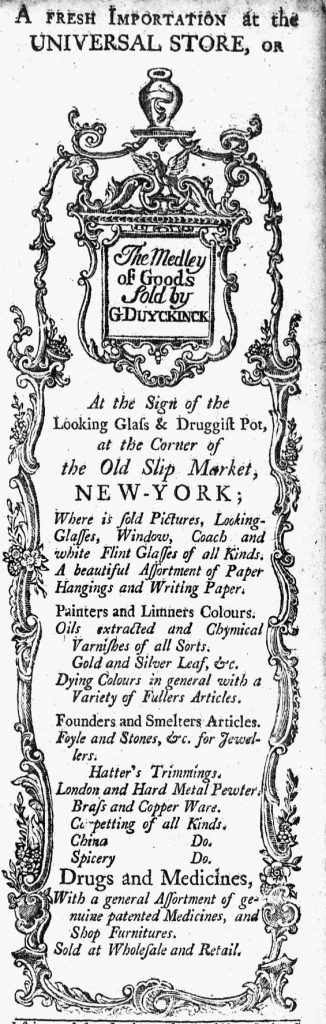
Gerardus Duyckinck, a prolific advertiser in New York’s newspapers in the 1760s, introduced consumers to an innovative advertisement for his “UNIVERSAL STORE” in the October 29, 1767, edition of the New-York Journal. His new advertisement enclosed most of the copy within an ornate rococo cartouche, a design suggestive of the frames for the “Pictures [and] Looking-Glasses” he sold. Visually, his advertisement was unique. Nothing else of the sort appeared in that issue of the New-York Journal, nor in any newspaper published in the colonies.

Several other advertisements included images, but all of them were comparatively crude woodcuts of ships, houses, slaves, and horses. These widely used yet generic images belonged to the printer, a standard part of the type acquired by anyone who printed a newspaper. They could be used to spruce up any relevant advertisement. Occasionally some merchants and shopkeepers commissioned woodcuts for their exclusive use, images often tied to the shop sign that marked their location. In such instances, the image appeared at the top of the advertisement before any copy, not enclosing the text, as was the case for Duyckinck’s notice.

That visual element also distinguished this advertisement from others. In general, eighteenth-century newspaper advertisements did not have borders that set them apart from other items on the same page. Printers usually inserted a line between advertisements to help readers identify where one ended and another began. Sometimes they used decorative ornaments to add some visual appeal, but borders surrounding entire advertisements were exceptionally rare. Jolley Allen experimented with rudimentary borders for his advertisements in Boston’s newspapers the previous year, but they looked primitive compared to the genteel frame that enclosed Duyckinck’s advertisement.

It would have been impossible for readers not to notice Duyckinck’s advertisement. Noticing likely led to reading and examining the advertisement in greater detail, taking in the novelty of a form both new and sophisticated. In addition, the use of an elaborate cartouche introduced a common feature of eighteenth-century trade cards, each printed on its own sheet, into colonial newspapers. The form of one influenced the other, perhaps to the delight of readers. Such an extraordinary advertisement might have also enflamed potential customers’ curiosity about the “Medley of Goods” that Duyckinck sold at his “UNIVERSAL STORE.”

October 25

What was advertised in a colonial American newspaper 250 years ago this week?

Oct 25 - 10:22:1767 Pennsylvania Gazette
Pennsylvania Gazette (October 22, 1767).

“A NEAT assortment of coarse, fine and superfine broadcloths.”

Readers of the Pennsylvania Gazette would have recognized Magdalen Devine’s advertisement at a glance even if it had not featured her name in capital letters. Why? Devine used a woodcut that depicted some of her merchandise. In so doing, she successfully branded her business, repeatedly inserting it along with extensive lists of the merchandise she stocked.

The Adverts 250 Project previously examined another advertisement Devine placed in the Pennsylvania Gazette in May 1767. The content changed significantly. Then, Devine announced that she had imported a variety of goods in the Carolina from London and the Peggy from Glasgow. In her new advertisements, she hawked goods that had recently arrived via the Mary and Elizabeth from London as well as “the last vessels from Liverpool and Glasgow.” Both advertisements listed hundreds of items potential customers would find among her inventory; although the types of goods were similar, she enumerated different items in each.

Some aspects of Devine’s advertisements remained consistent. In May and October she gave her address, “In Second-street, between Market and Chestnut-streets, the fourth door from the Quaker meeting-house,” and concluded by assuring readers that “she will sell at the lowest terms, for cash or short credit.” Yet the most significant feature of her advertisements had to have been the woodcut that appeared at the top, a woodcut that occupied as much space as some of the shorter advertisements in the Pennsylvania Gazette.

Devine deployed the woodcut as a brand to identify her business and distinguish it from others, but it also illustrated some of her merchandise. The shopkeeper sold all kinds of imported textiles; her advertisements filled half a column because she listed so many different styles, colors, and qualities of fabrics. Her woodcut provided visual affirmation of her inventory. It showed two rolls of patterned cloth (suggesting quantity) flanked by swatches that revealed distinctive patterns (suggesting fashion).

Commissioning a woodcut would have been an additional expense for Devine, but the length and frequency of her advertisements indicate that she was willing to invest in advertising. She likely considered the woodcut a good investment since it immediately identified her advertisements whenever they appeared in the pages of the Pennsylvania Gazette, the newspaper that usually included more advertising (including a two-page supplement) than any other newspaper printed in the American colonies in the 1760s. Devine relied on standard marketing appeals throughout her advertisements, but her woodcut attracted attention and distinguished her marketing efforts.

September 21

What was advertised in a colonial American newspaper 250 years ago today?

Sep 21 - 9:21:1767 Pennsylvania Chronicle
Pennsylvania Chronicle (September 21, 1767).

“New Shop at the Sign of the Naked Boy.”

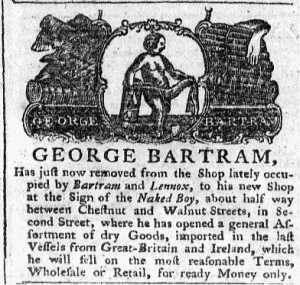
George Bartram launched a new venture in 1767, opening his own shop “at the Sign of the Naked Boy” on Second Street in Philadelphia. To let both former and potential new customers know about his new location, he published an advertisement in the Pennsylvania Chronicle. Bartram promoted the “general Assortment of dry Goods, imported in the last Vessels from Great-Britain and Ireland,” but he did not confine himself to merely describing the goods he stocked. Instead, he included a woodcut that featured some of the textiles he imported and hoped to sell to consumers in the port city. A cartouche in the center depicted a naked boy examining a length of cloth, encouraging potential customers to imagine themselves inspecting Bartram’s merchandise. That the boy held the fabric close to his naked body suggested quality and softness, enticing readers to anticipate the luxurious pleasures that awaited them at Bartram’s shop. Many rolls of fabric flanked the central cartouche, testifying to the “general Assortment” of merchandise. What kinds of tactile sensations might shoppers experience when they compared the weave of one fabric to another? The naked boy surrounded by textiles of all sorts invited colonists to visit Bartram’s shop, where they did not need to confine themselves merely to window shopping but could indulge their sense of touch as well as sight.

The woodcut also included the proprietor’s name on either side of the cartouche, an unnecessary flourish in an advertisement that featured Bartram’s name as a headline. Its inclusion may have been necessary, however, if the woodcut doubled as an accurate representation of the “Sign of the Naked Boy” that marked Bartram’s shop. The shopkeeper had previously conducted business at a “Shop lately occupied by Bartram and Lennox.” To mark his new shop as exclusively his own, Bartram may have instructed the painter or carver who made his sign to include his name as well as the device he intended to serve as his brand. Eighteenth-century advertisements regularly indicate which shop signs marked which businesses, but few of those signs have survived. Woodcuts like the naked boy in Bartram’s advertisement suggest what colonists may have seen as they traversed the streets and visited retailers and artisans who used signs to mark their businesses.

September 3

What was advertised in a colonial American newspaper 250 years ago today?

Sep 3 - 9:3:1767 Pennsylvania Gazette
Pennsylvania Gazette (September 3, 1767).

“Wire work of all sorts, particularly for flaxseed and wheat.”

In the September 3, 1767, edition of the Pennsylvania Gazette, John Sellers updated an advertisement that he had previously inserted in other issues. The copy remained the same (and does not appear to have been reset), but he added an image of a rolling wire screen for separating flaxseed and “cleansing wheat.” In and of itself, the woodcut enhanced the advertisement and likely caught the attention of more readers, especially since images were a relatively rare component of eighteenth-century advertisements. When they did appear, they tended to fall into four main categories – ships, houses, slaves, and horses – that could be used interchangeably in any advertisements related to the corresponding image. Those woodcuts belonged to printers.

On the other hand, advertisers had to commission more specialized images, which then belonged to them and were not associated with other advertisements. This made Sellers’ woodcut of a rolling wire screen all the more extraordinary in the pages of the Pennsylvania Gazette. The advertisements in the September 3 issue and its supplement featured only six images. Three depicted ships, including one announcing that the Phoenix would soon depart for Cork and encouraging readers to make arrangements for “Freight or Passage.” Another depicted Benjamin Jackson and John Gibbons’ seal flanked by a bottle of mustard and a block of chocolate, the two specialty items at the center of their grocery business. The remaining two both had images of wire screens “for cleaning all sorts of Grain.”

Sep 3 - 9:3:1767 Truman Advert Pennsylvania Gazette
Pennsylvania Gazette (September 3, 1767).

That may help to explain why Sellers chose to spruce up his advertisement with an image of the rolling screens he produced. Even though the copy in his advertisement made stronger appeals concerning his skill and the quality of his screens, it may have been overshadowed by Richard Truman’s advertisement that simply presented the image of one of his screens and let it do most of the work in the absence appeals made over the course of many lines of dense text. Sellers may have decided that he needed to increase his investment in his marketing efforts in order to make his advertisements competitive. After all, if the competition’s advertisements got all the attention, it was not worth the expense to advertise at all. Sellers increased the likelihood that potential customers would consider the appeals made in the copy by providing some art as a hook to interest them.