August 11

What was advertised in a colonial American newspaper 250 years ago today?

Aug 11 - 8:11:1766 New-York Gazette
New-York Gazette (August 11, 1766).

“As soon as the Season will permit, they will brew Spruce again.”

Brewers George Harison and James Leadbetter were savvy marketers. They informed the public “that their ALE is now fit to deliver,” but they also stoked anticipation for another product, spruce beer, that was not yet available but would be brewed again “As soon as the Season will permit.” In a single advertisement they attempted to move their current inventory and create demand for another product that would be in stock in the near future. By drawing attention to their spruce beer even before it had been brewed, they prompted potential customers to associate that product with their brewery rather than settle for similar beverages that competitors might deliver before theirs was ready for market.

Aug 11 - American Cookery
Amelia Simmons, American Cookery (Hartford, Connecticut:  Hudson and Goodwin, 1796).  American Antiquarian Society.

Spruce beer, which came in both alcoholic and non-alcoholic varieties, was quite common in colonial America. Harison and Leadbetter did not address any particular sort of customer in their advertisement, but merchants and captains who provisioned ships that passed through New York’s busy harbor may have counted among their clients. As part of the Columbian Exchange of resources and knowledge, French and British explorers had learned from indigenous Americans that beverages made with spruce could be used to ward off scurvy. Spruce beer became an important component of the rations doled out to European sailors. One correspondent in the September 1764 issue of the London Magazine indicated that when he owned a ship that traded between New England and the West Indies he always instructed the captain to take along spruce beer as a means of safeguarding the health of the crew. Not only did spruce beer ward off scurvy, it was also safer to drink than some of the water.

So common was this drink in eighteenth-century America that in 1796 a recipe “For brewing Spruce Beer” appeared on the final page of Amelia Simmons’ American Cookery, the first cookbook written by an American.

August 10

What was advertised in a colonial American newspaper 250 years ago this week?

Aug 10 - 8:9:1766 Providence Gazette
Providence Gazette (August 9, 1766).

“READY MONEY given for Line Rags of any Sort, old Sail Cloth and Junk.”

Printers regularly inserted calls for rags (intended to be used in making paper) in their newspapers, but this appeal was much more extensive than most that appeared during the eighteenth-century.

The proprietors of the Providence Paper Manufactory accepted “Linen Rags of any Sort, old Sail Cloth and Junk.” Furthermore, they listed the prices they would give for each item, even dividing the rags between those “fine than Oznabrigs” and others “coarser than Oznabrigs.” In the process, they also used terminology that would have been familiar to eighteenth-century readers. Colonists would have readily recognized “Oznabrigs” as a type of coarse and plain fabric and “Junk” as old rope that was beyond its usefulness.

The advertisement listed several locations where readers could exchange “Linen Rags of any Sort, old Sail Cloth and Junk” for “READY MONEY.” They could visit the printers or the proprietors of the “Paper Manufactory” in Providence as well as Jonathan Wilson in Newport or another printer, Benjamin Mecom, in New Haven.

Finally, the advertisement concluded with an interesting proposition for subscribers to the Providence Gazette. The rags, sail cloth, and junk could be exchanged for the newspaper itself, as payment “in lieu of Cash.” This established an interesting relationship between the printer of the Providence Gazette and subscribers who traded in their rags. Eventually those subscribers could expect those rags to be returned to them, transformed into linen paper with news and advertisements printed on it.

When it came to paper, the cycle of advertising and consumption in colonial America had a far reach. A colonist could see an advertisement for textiles and make a purchase. After using and wearing out those textiles, he or she could hand them over to the Providence Paper Manufactory or the printers of the Providence Gazette in exchange for more newspapers with additional advertisements for textiles that could be purchased to replace those that had been reduced to rags. At some point in the cycle, colonists could read advertisements for textiles they would purchase printed on linen paper made from textiles that had previously worn or possessed.

August 9

What was advertised in a colonial American newspaper 250 years ago today?

Aug 9 - 8:9:1766 Providence Gazette
Providence Gazette (August 9, 1766).

“JUST IMPORTED … BY THOMPSON AND ARNOLD, AT THEIR SHOP NEAR THE GREAT BRIDGE.”

The graphic design of Thompson and Arnold’s newspaper advertisement would have certainly caught readers’ attention in the 1760s. Featuring a decorative border and three columns listing “A large and general Assortment of English and India Goods,” it was unlike any other advertisements that appeared in newspapers of the period.

Whenever possible, I highlight innovations in format and graphic design that set particular eighteenth-century advertisements apart from their contemporaries. For the most part, these innovations were fairly conservative as advertisers and printers experimented with new methods yet continued to create advertisements that, to a greater or lesser degree, blended in with other commercial notices.

That was not the case with Thompson and Arnold’s eye-catching advertisement. The border was sufficient to mark this advertisement as different, but a small number of other advertisers (such as Jolley Allen) also used borders to set their advertisements apart from their competitors.

Aug 9 - 8:9:1766 Fourth Page Providence Journal
Fourth Page of Providence Gazette (August 9, 1766).

The number of columns in this advertisement also merited attention. Other advertisers frequently divided their lists of goods into two columns, but Thompson and Arnold managed to squeeze three columns into their advertisement. How did they do that? Their advertisement actually extended across two columns of the Providence Gazette, a mode of setting type not commonly used for either advertisements or new items. Typically only the masthead and the colophon extended across more than one column in any eighteenth-century newspaper.

The printer would have had to set Thompson and Arnold’s advertisement separately. Its design and inclusion required special effort and attention. Visually, it dominated the final page of the Providence Gazette. If a reader were holding open the newspaper to read the second and third pages, this advertisement would have also dominated any observer’s view of the first and fourth pages.

Other newspaper advertisements were certainly set in type specifically for inclusion in newspapers and possessed no other purpose. The size and design of this advertisements, however, suggests that it could have also been printed separately as a trade card or handbill, which would have benefited both the advertisers and the printer who generated revenue for the job.

August 8

What was advertised in a colonial American newspaper 250 years ago today?

Aug 8 - 8:8:1766 Rind's Virginia Gazette
Rind’s Virginia Gazette (August 8, 1766).

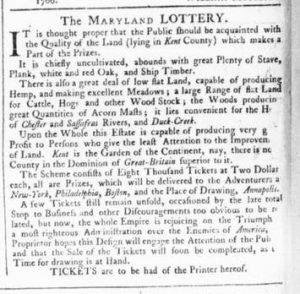
“The MARYLAND LOTTERY. … A few Tickets still remain unsold.”

The Maryland Lottery offered “Land (lying in Kent County)” among its profits. Those operating the lottery described the terrain, assuring readers that “the Whole of this Estate is capable of producing very g[ood] Profit to Persons who give the least Attention to the Improvem[ent] of Land.” They also outlined the “Scheme” of the lottery, detailing the price and how many total tickets were to be sold so “Adventurers” could assess the risk and odds. The drawing was slated to take place in Annapolis, but the Maryland Lottery had attracted attention beyond the Chesapeake colonies. Tickets had already been sold Boston, New York, and Philadelphia.

Given the popularity of this lottery and the quality of the land offered as prizes (“the Garden of the Continent, nay, there is no[t a] County in the Dominion of Great-Britain superior to it”), why did any tickets remain at all? Why hadn’t they been sold out for some time.

Well, most had been sold, but “A few Tickets still remain,” the promoters explained, due to “the late total Stop to Business, and other Discouragements too obvious to be [re]lated.” Indeed, in 1766 the “Stop to Business, and other Discouragements” were indeed well known. The Stamp Act interfered with the operation of lotteries in addition to infringing on the printing of newspapers and hampering the ability of lawyers and merchants to draw up the legal documents necessary to conduct business.

Several months had passed since the colonies received word that the hated Stamp Act had been repealed, but many colonists continued to revel in its demise. Even newspaper advertisements expressed their jubilation: “now, the whole Empire is rejoicing on the Triumph [of] a most righteous Administration over the Enemies of America.” Items published elsewhere in newspapers, either written or selected by printers, often expressed political sentiments, but advertisements gave colonists another venue for sharing their views.

August 7

What was advertised in a colonial American newspaper 250 years ago today?

Aug 7 - 8:7:1766 Pennsylvania Journal
Pennsylvania Journal (August 7, 1766).

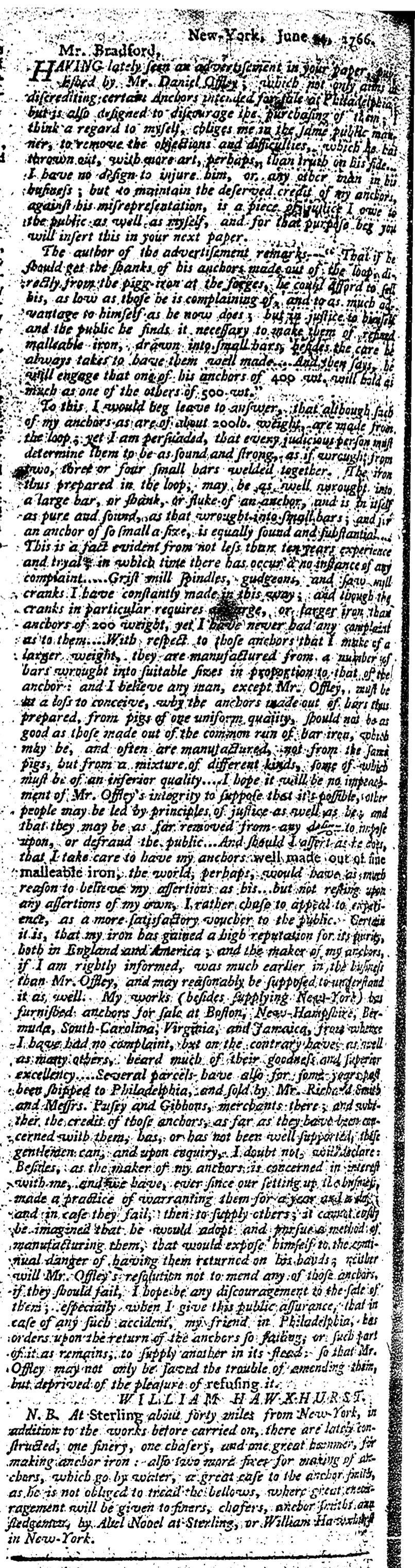
“HAVING lately seen and advertisement … which not only aims at discrediting certain Anchors …”

William Hawxhurst of New York placed an extensive advertisement in response to the charges Daniel Offley made about the anchors sold in Philadelphia in an equally extensive advertisement that appeared in an earlier issue of the Pennsylvania Journal.

Hawxhurst reiterated some of the claims Offley made and then set about dismantling them via a point-by-point rebuttal. He did so not only to defend his own reputation and the quality of the product he sold, but also as “a piece of justice I owe to the public.” Potential customers, Hawxhurst asserted, would benefit once he set the record straight; they deserved to be as well-informed as possible by the producers and suppliers of the goods they contemplated purchasing.

Hawxhurst addressed the process of making anchors, especially forging the necessary iron, in some detail, perhaps exceeding the technical knowledge of most readers of the Pennsylvania Journal (but maybe not that of those most likely to purchase anchors). On the other hand, he then mobilized appeals that any reader would understand.

Rather than choose between “assertions” made by either advertiser, Hawxhurst preferred “to appeal to experience, as a more satisfactory voucher to the public.” To that he end, he proclaimed, “Certain it is, that my iron has gained a high reputation for its purity, both in England and America.” Furthermore, the smith who made Hawxhurst’s iron into anchors had been at the trade longer than Offley. Experience mattered. In addition, Hawxhurst’s ironworks had “furnished anchors for sale at Boston, New-Hampshire, Bermuda, South-Carolina, Virginia, and Jamaica” in addition to New York. Furthermore, he had received no complaints but instead had “heard much of their goodness and superior excellency.” Finally, Hawxhurst had always offered the same sorts of guarantees that Offley promoted, so customers would not gain any advantage by purchasing from them.

Offley had publicly stated that he would refuse to repair any anchors purchased from competitors. Hawxhurst made it clear what he thought of that ploy: “I give the public assurance, that in case of any such accident, my friend in Philadelphia, has orders upon the return of the anchors so failing, or such part of it as remains, to supply another in its stead; so that Mr. Offley may not only be saved the trouble of amending them, but deprived of the pleasure of refusing it.”

Hawxhurst stated that he had “no design to injure” Offley, but found it necessary to “remove the objections and difficulties, which [Offley] has thrown out, with more art, perhaps, than truth.” Both his reputation and his business were at stake, warranting a response that filled approximately two-thirds of a column. Most eighteenth-century advertisers promoted their own products without mentioning competitors, but occasionally some advanced their own businesses by disparaging others.

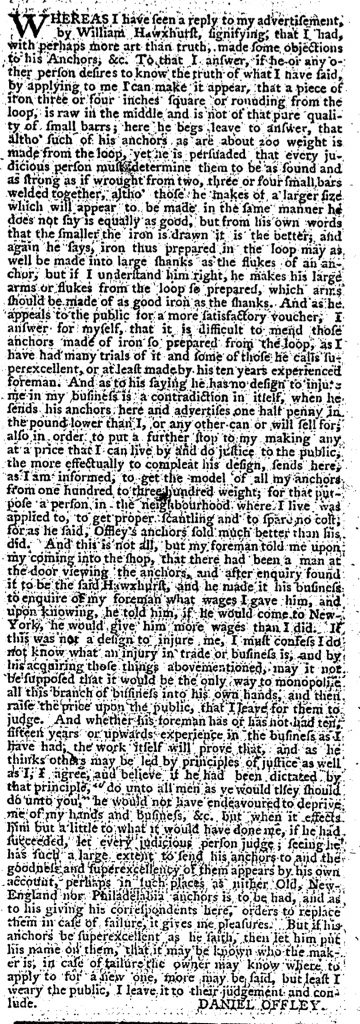
BONUS: Daniel Offley published a response of a similar length. In the August 7, 1766, issue of the Pennsylvania Journal, Offley’s advertisement appeared on the first page and Hawxhurst’s on the final page.

Aug 7 - 8:7:1766 Offley Pennsylvania Journal
Pennsylvania Journal (August 7, 1766).

August 6

Who was the subject of an advertisement in a colonial American newspaper 250 years ago today?

Aug 6 - 8:6:1766 Georgia Gazette
Georgia Gazette (August 6, 1766).

“TALL SLIM LIKELY YOUNG NEGROE GIRL.”

It would have been impossible to overlook Donald Mackay’s description of Maria, an enslaved young woman: “TALL SLIM LIKELY YOUNG NEGROE GIRL.” Each of the adjectives suggested that Maria was attractive, a young woman that most masters and others would have found desirable, a young woman who most likely would have become increasingly alluring as she continued to mature.

In the absence of any sort of visual image (not even a crude woodcut), Mackay put a black body on display by asking readers to imagine Maria’s appearance and inviting them to scrutinize every black woman they encountered to determine if they might be the runaway Maria.

This advertisement also hints at the treatment that Maria may have already experienced or that she was likely to experience at some point. White men had unfettered access to enslaved women throughout early American history, from the colonial period through the antebellum era and the Civil War. Writing under the pseudonym Linda Brent nearly a century after this advertisement was published, Harriet Jacobs published a slave narrative in which she documented the constant threat of sexual absue she faced as a slave in North Carolina in the early nineteenth century. Various other sources – slave narratives, letters, ledgers, and journals, written by both black and white authors – confirm the sexual violence perpetrated against black women under slavery. Some do so explicitly.

Others, like this advertisement, raise the possibility with more subtlety, asking observers to read between the lines.

A multitude of circumstances probably influenced Maria’s decision to run away, but her vulnerability to sexual abuse was likely one of them. Donald Mackay did not elaborate on all the reasons that he wanted this “TALL SLIM LIKELY YOUNG NEGROE GIRL” captured and returned, but eighteenth-century readers would have been aware of what was unwritten. This advertisement was about more than recovering a piece of human property who could work in the fields or do domestic labor in the household.

Advertisements for enslaved men, women, and children allow us to reconstruct portions of their lives when we read against the grain and interrogate the implications of what white authors have written.

August 4

What was advertised in a colonial American newspaper 250 years ago today?

Aug 4 - 8:4:1766 Connecticut Courant
Connecticut Courant (August 4, 1766).

“All those who owe small trifling Debts, must discharge them before the End of August.”

Thomas Davidson wanted to settle accounts and catch up on his bookkeeping. To those ends he published an advertisement with a timetable for customers to pay their debts. Those with “small trifling Debts” had four weeks (“before the End of August”) to pay up, while others who owed more substantial amounts had nearly twice as long (“before the latter End of September next”). Davisdon warned that customers in both categories needed to be punctual or else he would take a step he considered “very disagreeable.” He threatened to sue those who did not heed his call to pay what they owed.

Davidson preferred cash, but he was more interested in settling accounts. If necessary, he was willing to accept a variety of goods that his customers presumably produced on their own farms: “Wheat, Rye, Indian-Corn or Pork.” Cash, credit, and barter all served as modes of exchange in the economy of colonial Connecticut as buyers and sellers negotiated final reckonings for their exchanges.

Although the primary purpose of Davidson’s advertisement seems to have been settling accounts, he also sought to generate more business. After warning customers with outstanding debts that he would sue them “without further Notice,” he announced that he sold “WEST-INDIA RUM, by the Hogshead, or smaller Quantity.” Apparently he did not want to find himself in a similar situation with prospective sales. He declared that he sold the rum “for Cash only.” Such was the tradeoff for purchasing the rum “very cheap.” Customers had to pay in cash.

Eighteenth-century account books, ledgers, and letters are the best sources for revealing business practices of merchants and shopkeepers, but advertisements often provide useful supplements that also demonstrate the public face that entrepreneurs presented to customers and their communities.

August 3

What was advertised in a colonial newspaper 250 years ago this week?

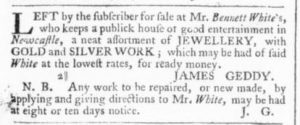
“LEFT by the subscriber at Mr. Bennett White’s … a neat assortment of JEWELLERY.”

Aug 3 - 8:1:1766 Virginia Gazette
Virginia Gazette (August 1, 1766).

James Geddy “became Williamsburg’s best-known colonial silversmith,” according to the entry detailing his silversmithing and retail business by Colonial Williamsburg. His advertisement in the Virginia Gazette did not offer much by way of introduction, but Geddy may have believed that he could rely on the reputation he had established and did not need to promote his “neat assortment of JEWELLERY, with GOLD and SILVER WORK” beyond selling it “at the lowest rates.”

It appears that Geddy placed this advertisement as part of an effort to expand his business and gain customers in a new market beyond Williamsburg, up the James River in New Castle in Hanover County (the vicinity of Richmond today). He did not set up a shop or workshop of his own in that town; instead, he “LEFT” his wares “at Mr. Bennett White’s, who keeps a publick house of good entertainment in Newcastle.” In addition, Geddy also accepted orders via White, either to repair damaged items or create new ones to specification. In choosing a partner in New Castle, Geddy likely valued the high volume of patrons who frequented White’s tavern. Rather than attempt a partnership with a local smith or retailer (neither of which would have appreciated a competitor from Williamsburg attempting to siphon off potential customers), Geddy chose an establishment that likely had greater foot traffic, both locals and travelers. White may have earned commissions on his sales and orders, making the arrangement mutually beneficial to the silversmith and the tavern keeper.

Learn more about Geddy and his business by visiting the original James Geddy House and the reconstructed James Geddy Foundry at Colonial Williamsburg.

August 2

What was advertised in a colonial American newspaper 250 years ago this week?

0089hi
Virginia Gazette (August 1, 1766).

“Any Gentlemen may be supplied with the same … in Norfolk, and … in Williamsburg.”

Philip Watson sold “POOLE’s best Scotch SNUFF” to customers in Shockoe, but that was not the only place in the colony that readers of the Virginia Gazette could purchase this product. Watson concluded his advertisement with a nota bene stating that “Any Gentlemen may be supplied with the same at Mr. Thomas Hepburn’s in Norfolk, and at Mr. James Southall’s in Williamsburg.”

The nota bene demonstrates two aspects of doing business in colonial Virginia. First, it points to the distribution of consumer goods, in this case “POOLE’s best Scotch SNUFF” in particular. Watson knew that many readers of the Virginia Gazette would not find it practical to call on him in Shockoe, so he offered additional locations that carried the same product. In order to make as many sales as possible, Watson incorporated convenience as part of his customer service.

That Watson listed three locations in three towns also testifies to the reach of newspaper distribution in the 1760s in Virginia and other colonies. Newspapers did not serve just the city or town in which they were printed. They passed through networks of subscribers and other readers throughout the city or town’s hinterland and beyond. Even in colonies with multiple newspapers, they tended to be printed in just one city. As a result, advertisements reached far beyond the places where newspapers were printed. Philip Watson could confidently place an advertisement in the Virginia Gazette, printed in the colony’s capital, and know that it would reach readers in Shockoe and Norfolk as well as Williamsburg.

As an aside, this advertisements also points to some of the difficulty using eighteenth-century names for towns. Where was Shockoe? Did Watson mean the relatively remote area that is currently an unincorporated community in Pittsylvania County? Probably not. It’s much more likely that he sold “POOLE’s best Scotch SNUFF” in what became Richmond – on the James River, the colony’s main waterway and means of transporting tobacco and other goods – which now contains the neighborhoods of Shockoe Hill, Shockoe Slip, and Shockoe Bottom. As with many other aspects of eighteenth-century advertisements, contemporary readers needed no explanation of the location of Shockoe.