September 12

What was advertised in a colonial American newspaper 250 years ago today?

Sep 12 - 9:12:1766 New-Hampshire Gazette
New-Hampshire Gazette (September 12, 1766).

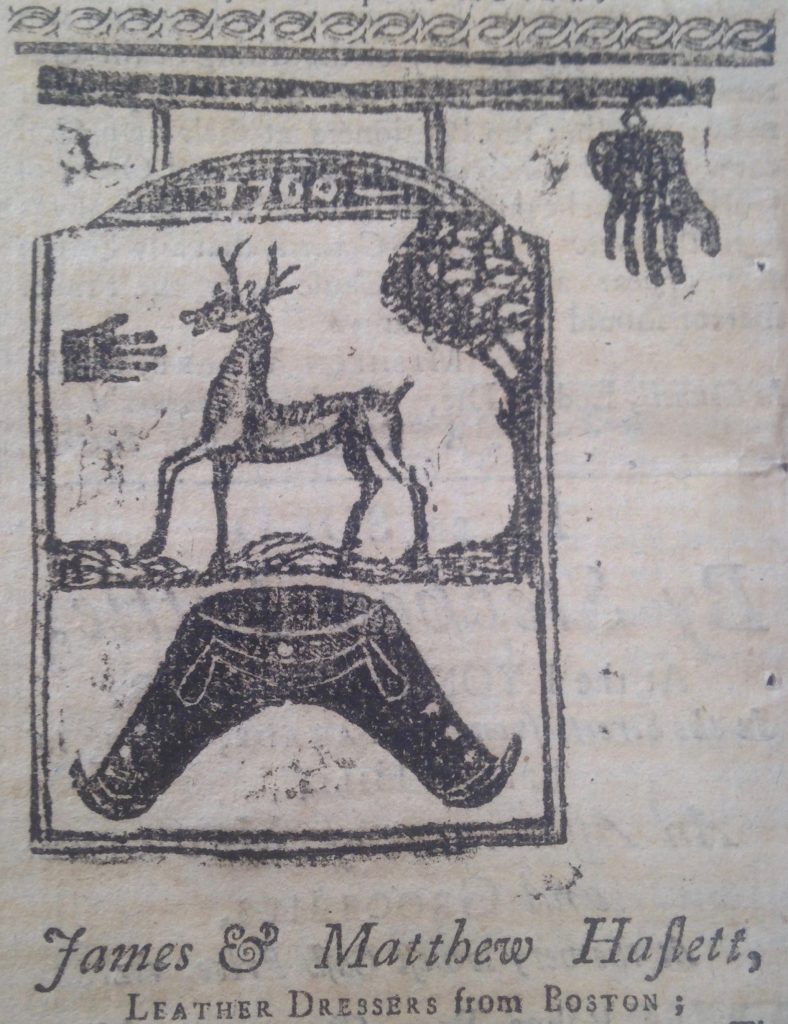
James & Mathew Haslett … have set up their Factory at the Sign of the Buck and Glove.”

Relatively few artisans or shopkeepers included images in their newspaper advertisement during the eighteenth century. Although printers already possessed the type, advertisers were responsible for providing any woodcuts beyond the stock printers ornaments. As a result, most advertisements placed by artisans and shopkeepers lacked images. In contrast, advertisements for runaway slaves, real estate, and vessels clearing port often sported woodcuts of slaves, houses, or ships, respectively. Each type of those stock ornaments could be used interchangeably for advertisements from the associated genre.

On the other hand, when advertisements placed by artisans and shopkeepers included woodcuts, those images were specific to a particular advertiser. In most cases, the text of the advertisement suggested that the image illustrated the shop sign that marked the advertiser’s establishment. The woodcut in James and Matthew Haslett’s advertisement even depicted a shop sign!

Sep 12 - Haslett 8:29
Detail of James and Matthew Haslett’s advertisement in the New-Hampshire Gazette (August 29, 1766). American Antiquarian Society.

The visual culture of the newspaper corresponded to the scenes readers saw on the street. But how closely did these woodcuts replicate the shop signs they were intended to portray? It’s tempting to assume that they were designed to reproduce the original as much as possible, yet the woodcut in the Hasletts’ advertisement throws that supposition to question. The image that appeared in the September 12 issue was the second one used by the Hasletts. Just two weeks earlier they published the same advertisement with a different (but similar) woodcut, before replacing it in the September 4 and September 12 issues. (The woodcut did not appear in the New-Hampshire Gazette again after that throughout the rest of 1766.)

Sep 12 - Haslett 9:4
Detail of James and Matthew Haslett’s advertisement in the New-Hampshire Gazette (September 4, 1766). American Antiquarian Society.

Why did the Hasletts switch from one woodcut to another? What kind of expenses were involved in that decision? Was including a woodcut in their advertisement worth the investment? Did the Hasletts distribute any handbills or billheads that incorporated the same woodcut? Did the new woodcut more closely replicate their actual shop sign?

Today’s advertisement offers some refreshing visual culture among eighteenth-century advertisements usually comprised exclusively of text. However, it also raises questions about the decisions made by advertisers and how closely the crude proto-logos that appeared in newspaper advertisement portrayed the shop signs they were supposed to reference.
Sept 12 - Haslett 9:12
Detail of James and Matthew Haslett’s advertisement in the New-Hampshire Gazette (September 12, 1766). American Antiquarian Society.

While researching this entry, I consulted the original newspapers in the collections of the American Antiquarian Society in addition to the digital surrogates in Readex’s Early American Newspapers.
September 11

What was advertised in a colonial American newspaper 250 years ago today?

Sep 11 - 9:11:1766 Pennsylvania Journal
Pennsylvania Journal (September 11, 1766).

“The above articles all in the newest and genteelest taste.”

Milliners and shopkeepers often promoted their merchandise by noting that it had been imported from London or other English ports, suggesting that this gave their wares special cachet in terms of both taste and quality. They frequently named both the ship and the captain that transported their goods across the Atlantic, which allowed savvy newspaper readers to recognize vessels recently listed in the shipping news elsewhere in the newspaper. In this way, potential customers could assess for themselves that an advertiser stocked the most current fashions.

In most instances, milliners and shopkeepers relied on networks of correspondence involving faraway merchants and producers to obtain the goods they sold to colonists. American retailers – and the customers they served – had to trust that they had indeed received merchandise currently fashionable in metropolitan London, though many suspected that the distance that separated them from the capital allowed correspondents to pawn off leftover or undesirable goods that otherwise would not have been sold.

In this advertisement, however, Ann Pearson stated that she had “Just returned from London” and had imported a vast array of textiles and accouterments for personal adornment. Rather than accept whatever goods distant correspondents dispatched, she had an opportunity to select which items she wished to offer to her customers. She concluded her advertisement with an assurance that the “above articles [were] all in the newest and genteelest taste.” Unlike most other milliners and shopkeepers who sold imported English goods, Pearson was in a unique position to make this claim, having witnessed current styles in London herself rather than relying on the good will of intermediaries and middlemen.

September 10

What was advertised in a colonial American newspaper 250 years ago today?

Sep 10 - 9:10:1766 Georgia Gazette
Georgia Gazette (September 10, 1766).

“AN OVERSEER … will meet with good encouragement by applying to JOHN SIMPSON.”

When John Simpson needed to hire an overseer he placed an advertisement in the Georgia Gazette to alert potential employees that the position was available. Though brief, a mere five lines, the advertisement demonstrates both continuity and change over time when compared to modern hiring practices.

Simpson listed three necessary qualifications. A qualified overseer “understands his business” and could demonstrate both “fidelity and industry.” In other words, Simpson wanted to hire somebody who possessed expertise (likely gained through experience), who was dependable, and who worked hard. Although the advertisement did not specify, the overseer was probably expected to oversee enslaved laborers as well as other operations on Simpson’s property. To “understand his business” likely included previous experience managing (including disciplining) slaves. To demonstrate their qualifications, applicants needed to “bring proper vouchers” that stated they fulfilled these qualifications. Letters of introduction in eighteenth-century America played a similar role to letters of recommendation today.

Simpson also included an additional preference, though it was not a requirement for obtaining the position. It would be “more agreeable” for prospective overseers to be single men. Simpson did not explain why he considered this “more agreeable,” but it may have been linked to the “fidelity and industry” that could be expected of the overseer. Perhaps Simpson assumed (or had learned by experience) that single men devoted more time, energy, and attention to their work in the absence of distractions caused by wives and families. In addition, if an overseer was expected to live on the property, Simpson may have been concerned about incorporating any dependents the operations.

Whatever Simpson’s reason for finding it “more agreeable” to hire an unmarried man, that he specified any preferred marital status at all makes this notice incongruous with modern employment advertisements that make no reference at all to various personal attributes that have no bearing on an individual’s ability to do the job.

September 9

What was advertised in a colonial American newspaper 250 years ago today?

Sep 9 - 9:9:1766 South-Carolina Gazette and Country Journal
South-Carolina Gazette and Country Journal (September 9, 1766).

“To carry on Business on her own proper Account, as sole Dealer and seperate Trader.”

Anne Raymor published an advertisement with an unusual twist. Throughout the colonies, newspaper readers would have been very familiar with advertisements for runaway wives, a genre in which aggrieved husbands announced that their wives had absconded or “eloped” from them and warning merchants, shopkeepers, and other not to extend any credit to them. In such instances, men exercised financial mastery over women, curtailing their ability to participate in the marketplace as consumers.

According to today’s advertisement, Anne Raymor wished to be more than a consumer. She wanted to “carry on Business on her own proper Account, as sole Dealer and seperate Trader, exclusive and free from any Concern with her Husband.” In this instance, it was the wife who sought to sever financial connections with the husband. This was a particularly transgressive course considering the political and economic rights of women under the laws of coverture in eighteenth-century America.

Upon marriage, a woman became a feme covert, her legal identity subsumed by her husband, the head of the family and household. She could not own property in her own name, sign contracts, control her own earnings, or sue others in court. All of these actions would have been important and necessary, then as now, for women who operated businesses, whether shopkeepers, milliners, seamstresses, or tavernkeepers. An unmarried woman, a feme sole, did not labor under such restrictions.

Raymor did not provide any details about her dispute with her husband, but she sought some means to function as a feme sole and pursue her business interests independently of her husband’s oversight or interference. Obtaining credit “from some of her Friends” provided an avenue to do so, at least according to the “Advice of Council at Law” that she had consulted.

This advertisement demonstrates that women found themselves in a precarious position when it came to being entrepreneurs in eighteenth-century America. Making a living was also difficult for men, but it was even more imperative for most women to rely on others, especially networks of friends, when they operated on their own in the marketplace. Anne Raymor found herself in the position of using the limited space in her advertisement to delineate her relationship with her husband rather than extolling the qualities of her merchandise.

September 8

What was advertised in a colonial American newspaper 250 years ago today?

Sep 8 - 9:8:1766 South Carolina Gazette
South Carolina Gazette (September 8, 1766).

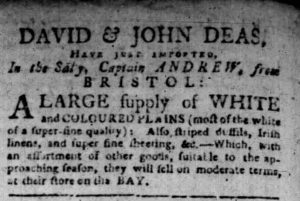
“DAVID & JOHN DEAS, HAVE JUST IMPORTED … an assortment of other goods.”

Contrary to what this short advertisement, rather plain and unremarkable in its appearance, may suggest, David and John Deas made their mark on the history of advertising thanks to the infamous broadsides (what we would call posters today) that they distributed in Charleston, South Carolina, in the decade before the American Revolution.

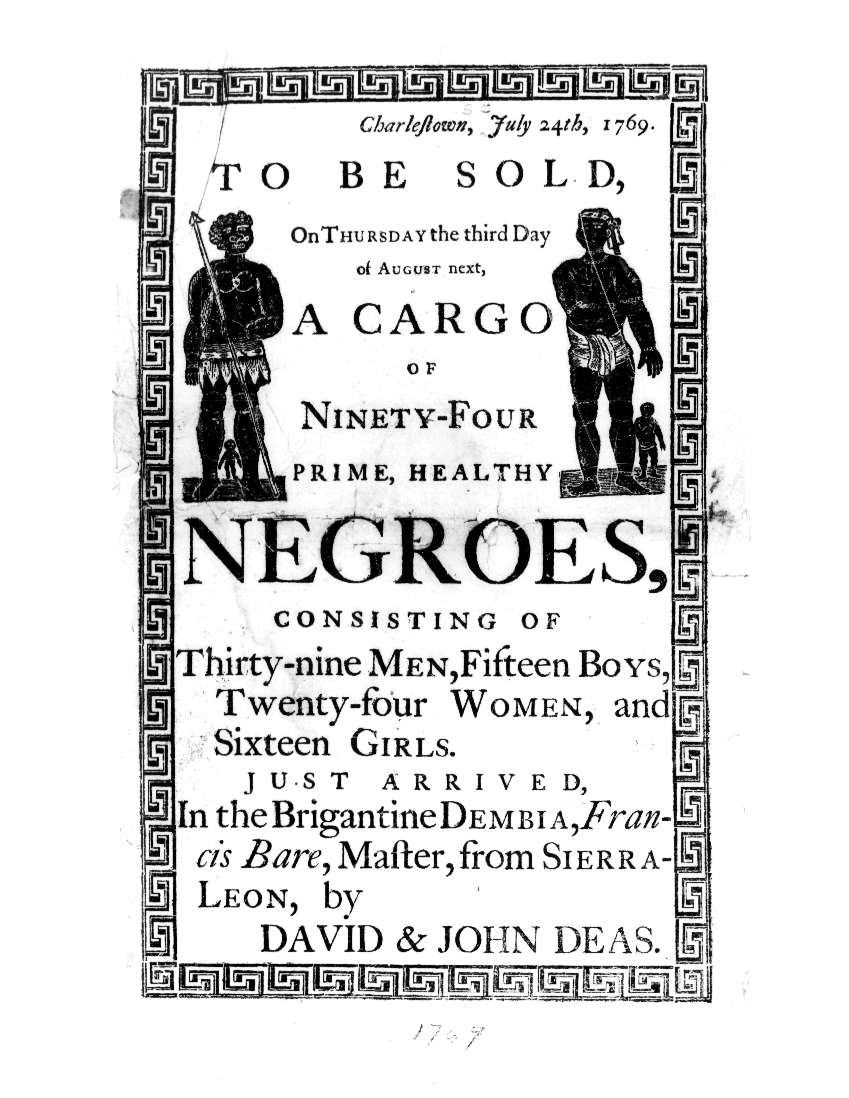
Not much distinguishes this advertisement for textiles, including “A LARGE supply of WHITE and COLOURED PLAINS,” from other commercial notices about imported goods that appeared in the same issue of the South Carolina Gazette. David and John Deas are much better remembered (and not just by scholars who specialize in economic history or advertising) for this broadside that circulated in Charleston and beyond nearly three years later.

Sep 8 - Deas Broadside
David and John Deas’s broadside for a slave auction (Charleston, 1769). American Antiquarian Society.

This broadside measures 32 x 20 cm (12 ½ x 8 in), which would have made it a good size to post around town or pass out as a handbill. The woodcuts depicting “PRIME, HEALTHY NEGROES” and the graphic design are both crude, but exceptionally memorable, at least to modern viewers. The haunting images of Africans treated as commodities elicit emotional responses today, but that would not necessarily have been the case in the 1760s. While it would have been impossible not to notice the images on the broadside, colonial consumers would not have been shocked by advertisements treating people as commodities. Accustomed to trade cards and billheads with images more skillfully and effectively rendered, colonists likely would not taken particularly favorable notice of the artistic or aesthetic qualities of the broadside.

David and John Deas’s newspaper advertisement for textiles did not indicate any direct involvement with the slave trade, though the merchandise they stocked made them part of transatlantic networks of commerce and consumption that depended on human cargoes and the staple crops produced through the labor of enslaved men, women, and children. Still, the juxtaposition of their newspaper advertisement and their broadside offers an important reminder that advertisements often provide evidence concerning only a portion of a shopkeeper’s, merchant’s, or firm’s business enterprises. How many other advertisers who promoted general merchandise via their advertisements at one time or another imported and auctioned slaves?

September 7

What was advertised in a colonial American newspaper 250 years ago today?

Sep 7 - 9:7:1766 Providence Gazette
Providence Gazette (September 7, 1766).

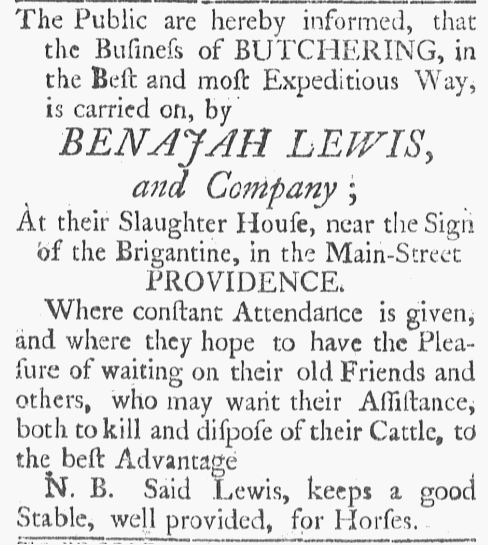
“The Business of BUTCHERING … is carried on, by BENAJAH LEWIS, and Company.”

Benajah Lewis and Company’s advertisement for “their Slaughter House … in the Main-Street PROVIDENCE” reminds us how much the spatial geography of cities has changed since the colonial era. Livestock would have been a fairly common sight in many areas of busy port cities, though cattle and hogs are absent from the urban landscape today. A slaughterhouse would have emitted both loud noises and unpleasant smells, but those have been replaced with loud noises and unpleasant smells of completely other sorts in the wake of urban development, expansion, and industrialization. Today, Armando and Sons Meat Market, Central Meat Market, Joe’s Meat Market, and Plainfield Meat Market each provide specialized butcher services and an enticing array of products to residents of Providence, but none of their websites indicate that live animals are slaughtered on site. That work seems to take place elsewhere (and may even be mandated by health codes and other regulations), distancing most carnivorous consumers from the ultimate source of their meals, much more so than colonists and the animals they ate.

As an aside, it’s interesting to note that two days ago I identified continuity between a newspaper advertisement published in 1766 and current “going out of business” promotions, but today’s advertisement included something that I sincerely doubt would be seen today. Lewis and Company ended their advertisement with a nota bene informing potential customers that “Said Lewis, keeps a good Stable, well provided, for Horses.” Given modern American sensibilities, it seems unlikely that any butchers would mention horses, even just the stabling of horses, in an advertisement promoting the meat sold at their shops or slaughterhouses. To do so would cast suspicion on the quality and the origins of the products they sell.

September 6

What was advertised in a colonial American newspaper 250 years ago today?

Sep 6 - 9:6:1766 Connecticut Gazette
Connecticut Gazette (September 6, 1766).

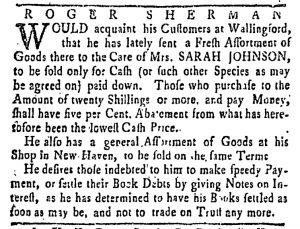
“ROGER SHERMAN … has lately sent a Fresh Assortment of Goods there to the Care of Mrs. SARAH JOHNSON.”

Relative to the number of women who worked as shopkeepers or otherwise operated businesses of various sorts in eighteenth-century America, very few women placed advertisements to promote their endeavors and attract customers. As a matter of principle, I do not wish to further obscure women’s participation in the marketplace as producers and retailers on the supply side of the equation; all too often they are depicted merely as consumers on the demand side. Accordingly, I select advertisements placed by women as frequently as practical.

Today’s advertisement caught my attention because it promotes a business run by a woman, yet it was not placed by the woman herself. Sarah Johnson sold “a Fresh Assortment of Goods” in Wallingford, a town about a dozen miles outside of New Haven. Roger Sherman, however, placed an advertisement in the Connecticut Gazette to “acquaint his Customers at Wallingford” that Johnson sold those goods and provided discounts for customers who bought in volume. He also wanted potential customers in New Haven to know that he sold a similar “Assortment of Goods” on the same terms.

This advertisement raises questions about the arrangements Johnson and Sherman made. It appears that Johnson oversaw the day-to-day operations of the shop in Wallingford, including the necessary accounting and negotiating (as indicated when Sherman allowed for payment in “such other Species as may be agreed on” instead of cash). Yet she seems to have been an employee of some sort rather than a partner. What kind of stake did she have in the enterprise? Did she own any of the inventory she stocked? Did she earn commissions on the goods she sold? How much risk had she assumed compared to Sherman? How much autonomy did she exercise in selecting goods and setting prices? Did she participate in the decisions to offer discounts or to call in debts? Note that Sherman referred to customers Johnson served in Wallingford as “his Customers,” suggesting how he envisioned his relationship to both Johnson and their (his?) clients.

This advertisement acknowledges Sarah Johnson’s presence in the operation of a shop in Wallingford, Connecticut, but it does not fully elaborate on her position relative to Roger Sherman beyond suggesting that even though she participated in the marketplace she did so as a subordinate to Sherman. The advertisement, intended for public consumption, maintained the gender hierarchy of the period, regardless of whatever practices Johnson and Sherman devised outside the public eye.

September 5

What was advertised in a colonial American newspaper 250 years ago today?

Sep 5 - 9:5:1766 New-London Gazette
New-London Gazette (September 5, 1766).

They have a Quantity of Goods remaining on Hand which they’ll Sell cheap.”

Trumbull, Fitch, and Trumbull ended their partnership on June 20, 1766. More than two months later they continued to advertise that their common enterprise had been terminated as they encouraged “All Persons having Accounts open with said Company” to settle them with Joseph Trumbull, one of the partners, “as soon as possible.”

Apparently the former partnership still had inventory remaining to be sold. Trumbull, Fitch, and Trumbull were certainly interested in receiving what they were owed by former customers, but their advertisement also indicated that any reader and potential customer could visit the store they had operated in Norwich and purchase the remaining merchandise. To make this an even more attractive prospect, they noted that “they have a Quantity of Goods remaining on Hand which they’ll Sell cheap for Cash or short Credit.”

The advertisement did not indicate how the current prices compared to what they had been during the partnership, but readers could assume that Trumbull, Fitch, and Trumbull were motivated to sell as they went their separate ways. In effect, the former partners operated an eighteenth-century precursor to a “going out of business” sale, though their advertising was not nearly as bold or flashy as modern promotions of similar events.

Still, this reminds us that some of the most basic marketing techniques were not invented in the twentieth century. Instead, over the last century or so marketers have further developed incipient strategies already deployed in the colonial America. A twenty-first-century version of today’s featured advertisement would likely focus exclusively on offering low prices in order to liquidate inventory (and leave the settling of accounts to be pursued via other means), refining the method used by Trumbull, Fitch, and Trumbull a quarter millennium ago.

September 4

What was advertised in a colonial American newspaper 250 years ago today?

Sep 4 - 9:4:1766 Pennsylvania Gazette
Pennsylvania Gazette (September 4, 1766).

“JAMES REYNOLDS, CARVER and GILDER, … UNDERTAKES to execute all the various Branches of Carving and Gilding.”

James Reynolds, a carver and gilder by trade, announced that he had “Just arrived from London” and set up shop in Philadelphia. He used an advertisement to launch his business in the colonies when he first arrived, but over the next two decades he continued to entice customers to engage his services via advertisements in Philadelphia’s newspapers.

He also passed down his skills in “the various Branches of Carving and Gilding, in the newest, neatest and genteelest Taste” to his sons, James Jr. and Henry. Over time, Reynolds and his sons specialized in selling looking glasses with decorative frames, though they continued to advertise that could be hired to perform the “various Branches” of their trade. In the 1790s the Reynolds brothers offered the same services their father had advertised thirty years earlier, using much of the same language of current and genteel fashions.

They did not, however, restrict their marketing to newspaper advertisements. They also affixed furniture labels to the items they sold “At their LOOKING-GLASS Store, No. 56, Market-street, PHILADELPHIA.” Eighteenth-century artisans, including cabinetmakers and closely affiliated occupations, experimented with various means of advertising the furniture they produced. Like shopkeepers, some distributed trade cards. Others marked their furniture in various ways, including signing, stamping, and branding or pasting labels. Such labels often took the form of miniature trade cards that incorporated copy directly from newspaper advertisements. Marking furniture in this way allowed artisans to continue to advertise their wares to customers long after completing sales.

Sep 4 - Reynolds Furniture Label
Furniture label affixed to looking glass (c. 1795). Decorative Arts Photographic Collection, Winterthur Library.

The elder Reynolds may have devised his own furniture label, though none have survived. His sons certainly labeled the looking glasses they sold as they reminded customers of the variety of goods and services they provided. They wanted to increase the likelihood that customers satisfied with their previous purchases would patronize their shop once again. For many eighteenth-century entrepreneurs, newspaper advertisements were only one aspect of their marketing strategies.

September 3

What was advertised in a colonial American newspaper 250 years ago today?

Sep 3 - 9:3:1766 Georgia Gazette
Georgia Gazette (September 3, 1766).

“BUTTON GWINNETT.”

It’s Founders Chic day at the Adverts 250 Project! Today’s advertisement was inserted in the Georgia Gazette a decade before Button Gwinnett became one of the fifty-six men who signed the Declaration of Independence, one of only three signers from Georgia.

Over time Gwinnett has become famous (sort of) for not being famous. He certainly did not become a household name like other signers of the Declaration, especially John Hancock, Benjamin Franklin, John Adams, and Thomas Jefferson. This was in large part due to his late entry in politics (he did not become an outspoken advocate of American rights until 1775, the year that fighting broke out at Lexington and Concord) and he died in 1777 (in a duel with a political rival over a failed invasion of East Florida, controlled by the British).

Gwinnett was not a man of letters, unlike so many other founders who left behind extensive correspondence. As a result, only fifty-one copies of his signature (including the one on the Declaration of Independence) are known to exist, making Gwinnett’s signature much more rare, valuable, and sought after than those of his much more famous and influential counterparts who signed the Declaration. (Learn more about the scarcity of Gwinnett’s signature at “Radiolab,” 7:50-14:40.) Gwinnett has remained so unknown compared to other signers that “The Late Show with Stephen Colbert” even broadcast a spoof “musical” featuring Lin-Manuel Miranda, the composer and star of “Hamilton: An American Musical.”

In today’s advertisement Button Gwinnett issued a cranky warning against others trespassing on his land and stealing his hogs and cattle. He threatened to prosecute offenders and offered a reward to anyone who provided evidence that contributed to a conviction.

This advertisement certainly did not have the historical magnitude of the Declaration of Independence. However, it provides a glimpse of the daily life and concerns of one of the (minor) founders. In 1766 Gwinnett had no way of knowing that he would someday sign the document that officially severed America’s political ties to Great Britain. It’s easy to put the founders on pedestals, but it might be more helpful to remember that they were also men sometimes consumed with ordinary concerns (like “disorderly people” who trespassed on their land). Asserting that only the most exceptional political philosophers have shaped the American experience and that they were inherently more intelligent and more virtuous than subsequent generations implicitly suggests that everyday people, the common folk who comprise the vast majority of the population, cannot even hope to live up to the examples set by the most famous founders. Button Gwinnett, on the other hand, demonstrates that we are all capable of practicing thoughtful citizenship, whether we have penned influential works of political philosophy or not.