Slavery Advertisements Published February 22, 1771

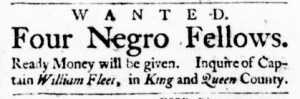
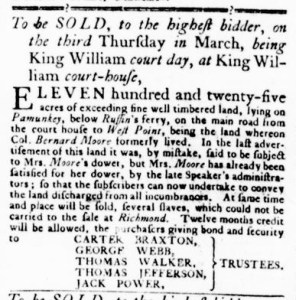
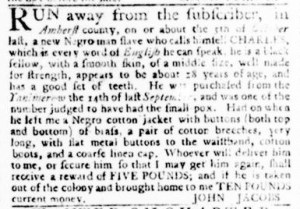
The Slavery Adverts 250 Project chronicles the role of newspaper advertising in perpetuating slavery in the era of the American Revolution. The project seeks to reveal the ubiquity of slavery in eighteenth-century life from New England to Georgia by republishing advertisements about enslaved people – for sale as individuals or in groups, wanted to purchase or for hire for short periods, runaways who liberated themselves, and those who were subsequently captured and confined in jails and workhouses – in daily digests on this site as well as in real time via the @SlaveAdverts250 Twitter feed, utilizing twenty-first-century media to stand in for the print media of the eighteenth century.

The project aims to provide modern audiences with a sense of just how often colonists encountered these advertisements in their daily lives. Enslaved men, women, and children appeared in print somewhere in the colonies almost every single day. Those advertisements served as a constant backdrop for social, cultural, economic, and political life in colonial and revolutionary America. Colonists who did not purport to own enslaved people were still confronted with slavery as well as invited to maintain the system by purchasing enslaved men, women, and children or assisting in the capture of so-called “runaways” who sought to free themselves from bondage. The frequency of these newspaper advertisements suggests just how embedded slavery was in colonial and revolutionary American culture in everyday interactions beyond the printed page.

These advertisements also testify to the experiences of enslaved men, women, and children, though readers must consider that those experiences have been remediated through descriptions offered by enslavers rather than enslaved people themselves. Often unnamed in the advertisements, enslaved men, women, and children were not invisible or unimportant in early America.

These advertisements appeared in colonial American newspapers 250 years ago today.

New-London Gazette (February 22, 1771).

February 21

What do newspaper advertisements published 250 years ago today tell us about the era of the American Revolution?

Pennsylvania Journal (February 21, 1771).

“LIBERTY.  A POEM.”

“RUN-AWAY … a Negro Boy named SAY.”

Like every other newspaper printer in colonial America, William Bradford and Thomas Bradford published advertisements about enslaved people.  The pages of the Pennsylvania Journal contained advertisements offering enslaved men, women, and children for sale as well as notices that described enslaved people who liberated themselves and offered rewards for their capture and return to their enslavers.  The Bradfords generated revenues from both kinds of advertisements.  In the process, they facilitated the buying and selling of enslaved Africans and African Americans.  Their newspaper became part of a larger infrastructure of surveillance of Black people, encouraging readers to scrutinize the physical features, clothing, and comportment of every Black person they encountered in order to determine if they matched the descriptions in the advertisements.

Simultaneously, the Bradfords published news about politics and current events that informed readers about colonial grievances and shaped public opinion about the abuses perpetrated by Parliament.  In addition, advertisements underscored concerns about the erosion of traditional English liberties in the colonies when they underscored the political dimensions of participating in the marketplace.  Purveyors of goods encouraged consumers to support “domestic manufactures” by purchasing goods produced in the colonies as alternatives to imported items.  News, editorials, and many advertisements all supported the patriot cause.

Those rumblings for liberty, however, stood in stark contrast to advertisements that perpetuated the widespread enslavement of Black men, women, and children.  The two ideologies did not appear in separate portions of the Pennsylvania Journal or any other newspaper.  Instead, they ran side by side.  Readers who did not spot the juxtaposition chose not to do so.  Consider, for instance, two advertisements in the February 21, 1771, edition of the Pennsylvania Journal.  The Bradfords advertised “LIBERTY.  A POEM” available at their printing office.  Their advertisement appeared next to a notice about “a Negro Boy named SAY,” a chimneysweeper born in the colonies.  Isaac Coats offered a reward to whoever “secures [Say] so that his Master may have him again.”  For his part, Say seized the liberty that so animated the conversations of those who attempted to keep him in bondage.

That was not the first time that the Bradfords placed advertisements about liberty and slavery in such revealing proximity to each other.  Three months earlier, they advertised the same poem and placed an advertisement offering a young man and woman for sale immediately below it.  “LIBERTY” in capital letters and a larger font appeared right above the words “To be sold by JOHN BAYARD, A Healthy active young NEGRO MAN, likewise a NEGRO WENCH.”  This paradox of liberty and slavery was present at the founding of the nation, not only in the ideas expressed by the founding generation but also plainly visible among the advertisements in the public prints.

Slavery Advertisements Published February 21, 1771

The Slavery Adverts 250 Project chronicles the role of newspaper advertising in perpetuating slavery in the era of the American Revolution. The project seeks to reveal the ubiquity of slavery in eighteenth-century life from New England to Georgia by republishing advertisements about enslaved people – for sale as individuals or in groups, wanted to purchase or for hire for short periods, runaways who liberated themselves, and those who were subsequently captured and confined in jails and workhouses – in daily digests on this site as well as in real time via the @SlaveAdverts250 Twitter feed, utilizing twenty-first-century media to stand in for the print media of the eighteenth century.

The project aims to provide modern audiences with a sense of just how often colonists encountered these advertisements in their daily lives. Enslaved men, women, and children appeared in print somewhere in the colonies almost every single day. Those advertisements served as a constant backdrop for social, cultural, economic, and political life in colonial and revolutionary America. Colonists who did not purport to own enslaved people were still confronted with slavery as well as invited to maintain the system by purchasing enslaved men, women, and children or assisting in the capture of so-called “runaways” who sought to free themselves from bondage. The frequency of these newspaper advertisements suggests just how embedded slavery was in colonial and revolutionary American culture in everyday interactions beyond the printed page.

These advertisements also testify to the experiences of enslaved men, women, and children, though readers must consider that those experiences have been remediated through descriptions offered by enslavers rather than enslaved people themselves. Often unnamed in the advertisements, enslaved men, women, and children were not invisible or unimportant in early America.

These advertisements appeared in colonial American newspapers 250 years ago today.

Massachusetts Gazette and Boston Weekly News-Letter (February 21, 1771).

**********

New-York Journal (February 21, 1771).

**********

Pennsylvania Gazette (February 21, 1771).

**********

Pennsylvania Gazette (February 21, 1771).

**********

Pennsylvania Journal (February 21, 1771).

**********

Pennsylvania Journal (February 21, 1771).

**********

Virginia Gazette [Purdie and Dixon] (February 21, 1771).

**********

Virginia Gazette [Purdie and Dixon] (February 21, 1771).

**********

Virginia Gazette [Purdie and Dixon] (February 21, 1771).

**********

Virginia Gazette [Rind] (February 21, 1771).

**********

Virginia Gazette [Rind] (February 21, 1771).

**********

Virginia Gazette [Rind] (February 21, 1771).

**********

Virginia Gazette [Rind] (February 21, 1771).

**********

Virginia Gazette [Rind] (February 21, 1771).

February 20

What was advertised in a colonial American newspaper 250 years ago this week?

Pennsylvania Chronicle (February 18, 1771).

“We hope to meet with encouragement from the patriotic gentlemen and ladies of this city.”

In January and February 1771, Russel and Moore ran advertisements informing the residents of Philadelphia and its hinterlands that they had “a fine stocking loom a making, in order to weave silk on, in all its different branches.”  That included “breeches and jacket patterns, stockings, mitts, caps, and gloves” adorned with “all different figures and flowers, such as have not heretofore been manufactured in America.”

Russel and Moore launched an enterprise that they framed for consumers as building on other efforts to create commercial opportunities in the colonies.  For quite some time, colonists from New England to Georgia attempted to produce silk.  According to Russel and Moore, “the inhabitants of this city, and places adjacent, have made satisfactory proof or raising raw silk.”  The partners hoped that would inspire others throughout the colonies “to raise such silk in a more extensive manner, which in a short time will find greatly to their advantage.”  For their part, Russel and Moore stood ready “to weave in said loom” and they would “engage to make gentlemen and ladies gloves and mitts” that matched the designs and patterns “wove in any mitt or glove imported from any part of the world.”  Furthermore, they promised the highest standards and quality for the items they produced, predicting it would be “richer in work than any we have seen imported here.”

The partners sought customers among consumers who had been contemplating the benefits of “domestic manufactures,” goods produced in the colonies, for several years.  In response to the Stamp Act and, especially, duties imposed on imported goods by the Townshend Acts, colonists both called for producing more goods in the colonies and encouraged the consumption of those goods as alternatives to imports.  Producers and purveyors of those domestic manufactures addressed that discourse in their advertisements, providing further incentive for consumers to follow through on purchasing goods made locally.  They reminded consumers of the political meanings attached to goods and offered reassurances that they would not sacrifice quality when they chose to “Buy American.”

Russel and Moore did so when they noted that produced items that “have not heretofore been manufactured in America” and requested “encouragement from the patriotic gentlemen and ladies of this city, and places adjacent.”  The partners did their part in producing alternatives to imported goods; in turn, “patriotic gentlemen and ladies” needed to do their part as well.  Russel and Moore reiterated the importance of consumers supporting entrepreneurs who produced goods in the colonies.  “[A]s we are the first persons,” they proclaimed, “that have erected a machine in America, for making of ribbed stockings, or any kind of figured work in said branch, we hope the public will endeavour to encourage a manufactory.”  Russel and Moore promised quality, stating that they would “give full satisfaction to every friend of America.”  In making a call for patriotic consumption, the partners joined many other advertisers who promoted domestic manufactures in the late 1760s and early 1770s.

February 19

What was advertised in a colonial American newspaper 250 years ago today?

South-Carolina and American General Gazette (February 19, 1771).

A few Copies of The TRIAL … of the SOLDIERS … for the Murders at Boston.”

In January 1771, John Fleeming, a printer in Boston, published an account of the trial of the soldiers involved in the “horrid MASSACRE” on March 5, 1770.  He advertised in the Boston Evening-Post in advance of taking the book to press and then continued advertising once copies were available.  Additional advertisements of various length and detail soon appeared in the New-Hampshire Gazette and the Providence Gazette.  Printers and booksellers in New England believed that a market existed for this volume, but they also sought to enlarge that market by inciting more demand.

Commemoration and commodification of the events that culminated in the colonies declaring independence began long before fighting commenced at Lexington and Concord in April 1775.  Writing to Thomas Jefferson in 1815, John Adams reflected on the American Revolution as a process or a series of experiences rather than a military conflict.  “What do we mean by the Revolution?  The war?  That was no part of the revolution; it was only an effect and consequence of it.  The revolution was in the minds of the people, and this was effected from 1760-1775, in the course of fifteen years, before a drop of blood was shed at Lexington.”  In other words, the American Revolution took place in the hearts and minds of colonists prior to declaring independence.

The commodification of events like the Boston Massacre contributed to those transformations.  Advertisements for Fleeming’s book found their way into newspapers published in towns beyond New England, including the February 19, 1771, edition of the South-Carolina and American General Gazette.  “A few Copies,” printer and bookseller Robert Wells announced, “of the TRIAL at large of the SOLDIERS of the 29th Regiment, for the Murders at Boston, March 5th, 1770 … may be had at the Great Stationary and Book Store.”  Far away from Boston, residents of Charleston did not experience the “horrid MASSACRE” in the same way as the inhabitants of the town where it happened.  It did not have an immediate impact on their daily lives.  Yet newspaper coverage and opportunities to purchase commemorative items kept them informed and allowed them to feel as though they also participated in events that unfolded in the wake of the Boston Massacre.  They could not attend the trials, but they could read about them and then discuss politics with friends and neighbors, their views shaped in part by what they learned from newspapers and commemorative items, including books and prints depicting the event.  Printers like Robert Wells helped shaped colonists’ understanding of politics and current events not only through publishing news but also through selling commemorative items.

Slavery Advertisements Published February 19, 1771

The Slavery Adverts 250 Project chronicles the role of newspaper advertising in perpetuating slavery in the era of the American Revolution. The project seeks to reveal the ubiquity of slavery in eighteenth-century life from New England to Georgia by republishing advertisements about enslaved people – for sale as individuals or in groups, wanted to purchase or for hire for short periods, runaways who liberated themselves, and those who were subsequently captured and confined in jails and workhouses – in daily digests on this site as well as in real time via the @SlaveAdverts250 Twitter feed, utilizing twenty-first-century media to stand in for the print media of the eighteenth century.

The project aims to provide modern audiences with a sense of just how often colonists encountered these advertisements in their daily lives. Enslaved men, women, and children appeared in print somewhere in the colonies almost every single day. Those advertisements served as a constant backdrop for social, cultural, economic, and political life in colonial and revolutionary America. Colonists who did not purport to own enslaved people were still confronted with slavery as well as invited to maintain the system by purchasing enslaved men, women, and children or assisting in the capture of so-called “runaways” who sought to free themselves from bondage. The frequency of these newspaper advertisements suggests just how embedded slavery was in colonial and revolutionary American culture in everyday interactions beyond the printed page.

These advertisements also testify to the experiences of enslaved men, women, and children, though readers must consider that those experiences have been remediated through descriptions offered by enslavers rather than enslaved people themselves. Often unnamed in the advertisements, enslaved men, women, and children were not invisible or unimportant in early America.

These advertisements appeared in colonial American newspapers 250 years ago today.

South-Carolina and American General Gazette (February 19, 1771).

**********

South-Carolina and American General Gazette (February 19, 1771).

**********

South-Carolina and American General Gazette (February 19, 1771).

**********

South-Carolina and American General Gazette (February 19, 1771).

**********

South-Carolina Gazette and Country Journal (February 19, 1771).

**********

South-Carolina Gazette and Country Journal (February 19, 1771).

**********

South-Carolina Gazette and Country Journal (February 19, 1771).

**********

South-Carolina Gazette and Country Journal (February 19, 1771).

**********

South-Carolina Gazette and Country Journal (February 19, 1771).

**********

South-Carolina Gazette and Country Journal (February 19, 1771).

**********

South-Carolina Gazette and Country Journal (February 19, 1771).

**********

South-Carolina Gazette and Country Journal (February 19, 1771).

**********

South-Carolina Gazette and Country Journal (February 19, 1771).

**********

South-Carolina Gazette and Country Journal (February 19, 1771).

**********

South-Carolina Gazette and Country Journal (February 19, 1771).

**********

South-Carolina Gazette and Country Journal (February 19, 1771).

**********

South-Carolina Gazette and Country Journal (February 19, 1771).

**********

South-Carolina Gazette and Country Journal (February 19, 1771).

**********

South-Carolina Gazette and Country Journal (February 19, 1771).

**********

South-Carolina Gazette and Country Journal (February 19, 1771).

**********

South-Carolina Gazette and Country Journal (February 19, 1771).

February 18

What was advertised in a colonial American newspaper 250 years ago today?

Boston Evening-Post (February 18, 1771).

“Massachusetts-Spy.”

Just over six months after the Massachusetts Spy commenced publication in July 1770, printer Isaiah Thomas temporarily suspended the newspaper in early February 1771.  Thomas warned both current and prospective subscribers of the hiatus in a series of notices in the Spy, pledging that he would relaunch the newspaper, with improvements, in March.  He hoped that the plans he outlined would attract new subscribers.

During the time that Thomas suspended publication, he turned to other newspapers to promote the Spy and seek subscribers.  On February 18, he placed advertisements in the Boston Evening-Post, the Boston-Gazette, and the Massachusetts Gazette and Boston Post-Boy.  In each, he addressed “all LOVERS of NEWS, POLITICKS, TRUE LIBERTY, and the FREEDOM of the PRESS.”  He also declared that the Spy was “open to ALL Parties, but influenced by None,” though Thomas became an increasingly vocal supporter of the patriot cause.  Indeed, four years later he fled to the relative safety of Worcester and set up his press there because he feared retribution from British officials angered by coverage in his newspaper if he remained in Boston.

Rather than focus on politics in this advertisement, however, Thomas described the plan for publishing the improved Spy.  He originally intended to publish it on Tuesdays, the day after the newspaper that carried his advertisement, but reported that he would instead publish it on Thursdays “at the Request of a great Number of the Subscribers.”  In appearing to give the customers what they wanted, Thomas further enhanced the Spy by gaining “the Advantage of inserting what News may be brought by the Hartford-Post, who arrives on Wednesday Evenings.”  Like other newspapers, the Spy featured extracts of letters and items reprinted directly from other newspapers.

Thomas also listed other details, including the size and appearance of the newspaper and subscription rates.  The revitalized Spy “will be printed on Demy Paper, every Number to contain four Pages large Folio, and every Page four columns.”  While a couple of newspapers published in other towns at that time featured four columns per page, none of those published in Boston did.  In this manner, Thomas sought to distinguish his newspaper from the local competition.  If printers mentioned subscriptions rates in print at all, they most often did so in the plan of publication.  Thomas set the price at six shillings and eight pence per year, with half to be paid on delivery of the first issue and the other half paid at the end of the year.  Like other printers, he extended credit to subscribers.

The enterprising printer also gave instructions for subscribing, inviting “All those who are kind enough to encourage this Undertaking … to give in their Names as soon as they conveniently can.”  Thomas accepted subscriptions himself, but he also specified several agents in Boston.  They included fellow booksellers and printers, though none of the printers of other newspapers published in Boston.  He also had local agents in nearby Charlestown as well as the more distant Salem.  Thomas would eventually collect the “Subscription Papers” from his various agents and collate the names into a single subscription list.

Thomas envisioned significant improvements to the Massachusetts Spy, but he needed the support of subscribers to put his plans into effect.  He first outlined new aspects of his newspaper in the Spy before it temporarily halted publication, but then he turned to advertising in other newspapers to seek subscribers (and presumably advertisers) and generate interest as the public anticipated publication of the new Massachusetts Spy.

Slavery Advertisements Published February 18, 1771

The Slavery Adverts 250 Project chronicles the role of newspaper advertising in perpetuating slavery in the era of the American Revolution. The project seeks to reveal the ubiquity of slavery in eighteenth-century life from New England to Georgia by republishing advertisements about enslaved people – for sale as individuals or in groups, wanted to purchase or for hire for short periods, runaways who liberated themselves, and those who were subsequently captured and confined in jails and workhouses – in daily digests on this site as well as in real time via the @SlaveAdverts250 Twitter feed, utilizing twenty-first-century media to stand in for the print media of the eighteenth century.

The project aims to provide modern audiences with a sense of just how often colonists encountered these advertisements in their daily lives. Enslaved men, women, and children appeared in print somewhere in the colonies almost every single day. Those advertisements served as a constant backdrop for social, cultural, economic, and political life in colonial and revolutionary America. Colonists who did not purport to own enslaved people were still confronted with slavery as well as invited to maintain the system by purchasing enslaved men, women, and children or assisting in the capture of so-called “runaways” who sought to free themselves from bondage. The frequency of these newspaper advertisements suggests just how embedded slavery was in colonial and revolutionary American culture in everyday interactions beyond the printed page.

These advertisements also testify to the experiences of enslaved men, women, and children, though readers must consider that those experiences have been remediated through descriptions offered by enslavers rather than enslaved people themselves. Often unnamed in the advertisements, enslaved men, women, and children were not invisible or unimportant in early America.

These advertisements appeared in colonial American newspapers 250 years ago today.

Boston-Gazette (February 18, 1771).

**********

Boston-Gazette (February 18, 1771).

**********

Massachusetts Gazette and Boston Post-Boy (February 18, 1771).

**********

Massachusetts Gazette and Boston Post-Boy (February 18, 1771).

**********

New-York Gazette and Weekly Mercury (February 18, 1771).

February 17

What was advertised in a colonial American newspaper 250 years ago this week?

Wöchentliche Pennsylvanische Staatsbote (February 12, 1771).

All ADVERTISEMENTS … translated gratis.”

Henry Miller (Johann Heinrich Muller) printed the Wochentliche Philadelphische Staatsbote from January 1762 through May 1779, serving the German-speaking community in Philadelphia and its hinterlands.  Reflecting the reach of the publication, Miller changed the name to the Wochentliche Pennsylvanische Staatsbote in January 1768.  The newspaper began as a weekly, like most others published in colonial America.  It temporarily became a semi-weekly from May 1775 through July 1776, but reverted to a weekly after that.

While intended primarily for German speakers, the Wochentliche Pennsylvanische Staatsbote also aided other colonists in disseminating information, including legal notices and advertisements for consumer goods and services, to broader audiences than they otherwise would have reached via the Pennsylvania Chronicle, Pennsylvania Gazette, Pennsylvania Journal, and other English-language newspapers published in Philadelphia.  Miller encouraged such submissions in the masthead with a nota bene in English, usually the only portion of the newspaper not in German.  “AllADVERTISEMENTS,” the printer proclaimed, “to be inserted in this Paper, or printed single by HENRY MILLER, Publisher hereof, are by him translated gratis.” Placing the nota bene about translating advertisements in the masthead at the top of the first page made it much more visible than nestling it in the colophon at the bottom of the final page.  Miller wanted to increase the likelihood that prospective advertisers would become aware of this service.  To make it even more enticing, he did the translations for free rather than applying an additional charge.  Any advertisements “printed single,” such as broadsides, handbills, and trade cards, yielded even wider circulation of information among German-speaking colonists.

The Wochentliche Pennsylvanische Staatsbote served a particular community, but not in an insulated fashion.  The printer offered a means for English-speaking colonists to share information and seek customers among the German-speaking community.  For purveyors of goods and services, this presented opportunities to enlarge the market for their wares.  This was good business for everyone involved, including German speakers who gained access to more information, English speakers who attracted customers to their businesses, and the printer who generated revenues from each advertisement he translated and published.

February 16

What was advertised in a colonial American newspaper 250 years ago today?

Providence Gazette (February 16, 1771).

“ADVERTISEMENTS of a moderate Length (accompanied with the Pay) are inserted in this Paper three Week for Four Shillings.”

In the eighteenth century, some printers used the colophon, the portion of the newspaper devoted to publication information, as advertisements for their own goods and services.  John Carter, printer of the Providence Gazette, did so in 1770.  He listed his location as “PROVIDENCE, in New-England … at his PRINTING-OFFICE, the Sign of Shakespeare’s Head … where all Manner of PRINTING-WORK is performed on reasonable Terms, with Fidelity and Expedition.”  Other printers hawked books, stationery, and other goods in their colophons.

Most printers did not list their advertising rates, but those who did placed that information in the colophon.  Carter updated his colophon with the first issue of the Providence Gazette published in 1771. He no longer promoted printing work but instead announced that “ADVERTISEMENTS of a moderate Length (accompanied with the Pay) are inserted in this Paper three Weeks for Four Shillings Lawful, and Ninepence for each Week after; longer Ones in Proportion.”  Carter adopted a pricing structure similar to that of other newspapers:  a flat fee for setting type and running an advertisement for a set number of weeks (usually three, but sometimes four) and additional fees for each subsequent insertion.  Longer advertisements cost proportionally more.  If the space an advertisement occupied in the Providence Gazette in those subsequent weeks was worth nine pence, that meant that Carter charged twenty-one pence for setting type.  The four shillings (forty-eight pence) for placing an advertisement amounted to twenty-seven pence for the three weeks it ran in the newspaper with the remainder for preparing the notice for publication.

The information about advertising in Carter’s colophon included one variation that did not appear in most others.  He specified that advertisements were to be “accompanied with the Pay.”  Eighteenth-century printers, like other purveyors of goods and services, frequently extended credit to their customers.  They also regularly published notices calling on subscribers, advertisers, and others to settle accounts, sometimes pleading and other times threatening legal action.  In the February 15, 1771, edition of the New-Hampshire Gazette, for instance, Daniel Fowle and Robert Fowle inserted a lengthy notice addressed to “those who neglect and are indebted for many Years Papers.”  The printers warned that those subscribers “may depend on being sued.”  When it came to advertisers, Carter apparently wanted to avoid finding himself in a similar position, insisting that advertisements must be “accompanied with the Pay.”  Considering that advertising constituted an important revenue stream for early American newspaper printers, this likely had beneficial effects on other aspects of the business Carter ran from his printing office.