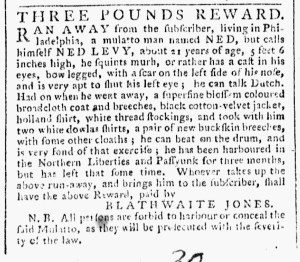
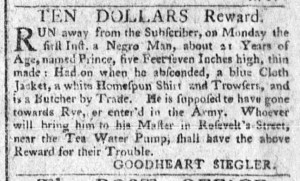
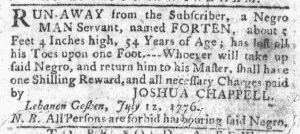
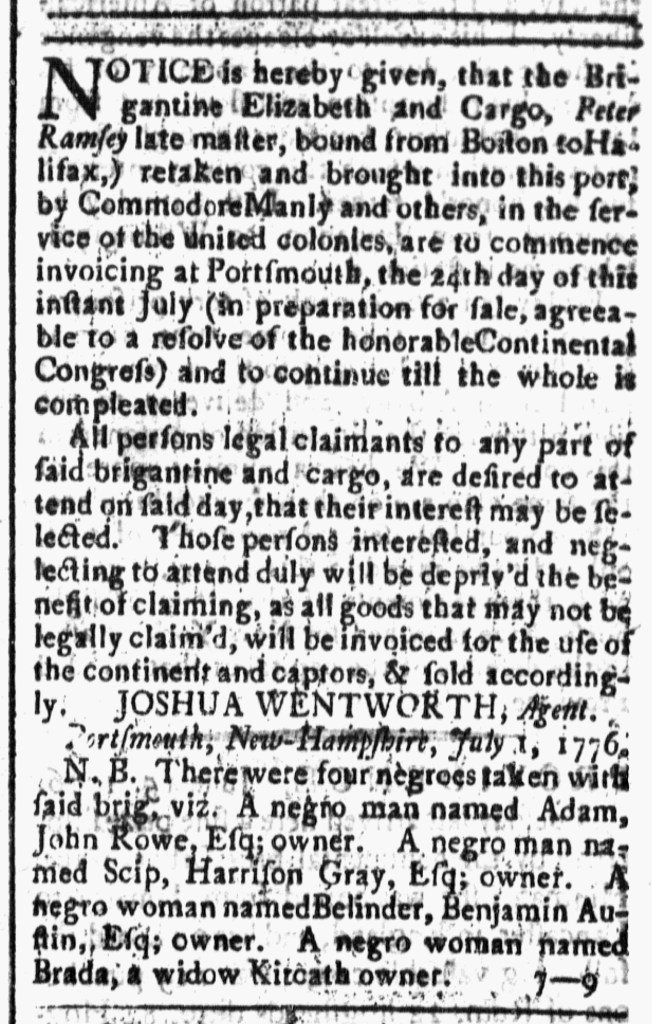
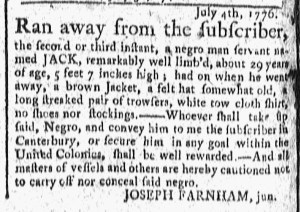
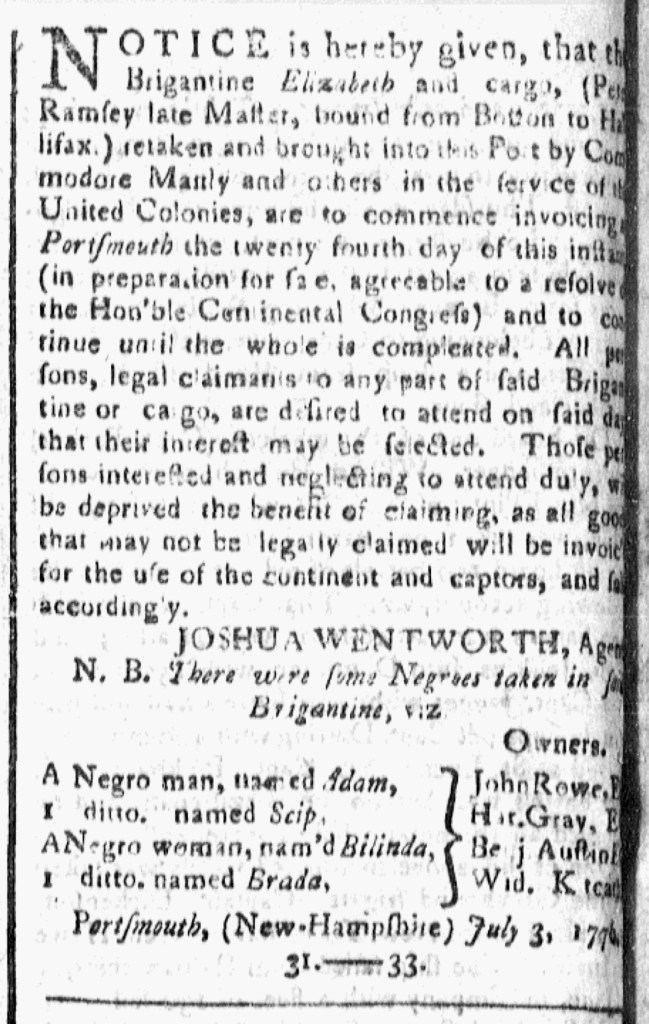
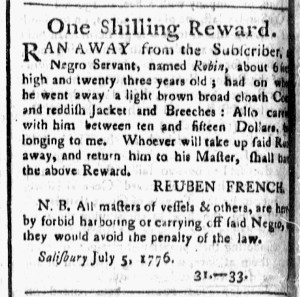
The Slavery Adverts 250 Project chronicles the role of newspaper advertising in perpetuating slavery in the era of the American Revolution. The project seeks to reveal the ubiquity of slavery in eighteenth-century life from New England to Georgia by republishing advertisements about enslaved people – for sale as individuals or in groups, wanted to purchase or for hire for short periods, runaways who liberated themselves, and those who were subsequently captured and confined in jails and workhouses – in daily digests on this site as well as in real time via the @SlaveAdverts250 Twitter feed, utilizing twenty-first-century media to stand in for the print media of the eighteenth century.
The project aims to provide modern audiences with a sense of just how often colonizers encountered these advertisements in their daily lives. Enslaved men, women, and children appeared in print somewhere in the colonies almost every single day. Those advertisements served as a constant backdrop for social, cultural, economic, and political life in colonial and revolutionary America. Colonizers who did not purport to own enslaved people were still confronted with slavery as well as invited to maintain the system by purchasing enslaved men, women, and children or assisting in the capture of so-called “runaways” who sought to free themselves from bondage. The frequency of these newspaper advertisements suggests just how embedded slavery was in colonial and revolutionary American culture in everyday interactions beyond the printed page.
These advertisements also testify to the experiences of enslaved men, women, and children, though readers must consider that those experiences have been remediated through descriptions offered by enslavers rather than enslaved people themselves. Often unnamed in the advertisements, enslaved men, women, and children were not invisible or unimportant in early America.
These advertisements appeared in revolutionary American newspapers 250 years ago today.
What was advertised in a revolutionary American newspaper 250 years ago today?
Newport Mercury (July 15, 1776).
“A DECLARATION of INDEPENDENCE … is now to be sold by S. Southwick, printed on one side of a large sheet.”
On July 15, 1776, three newspapers printed the Declaration of Independence for subscribers and other readers. Although word of mouth carried the news faster than print, the Connecticut Courant and Hartford Weekly Intelligencer, the New-York Gazette and Weekly Mercury, and the Norwich Packet and Connecticut, Massachusetts, New-Hampshire and Rhode-Island Weekly Advertiser gave readers the opportunity to examine the grievances against the king and the political philosophy that supported the Continental Congress’s decision to declare independence.
The Declaration of Independence did not appear in the Newport Mercury even though Solomon Southwick, the printer, had received a copy. The layout and content of the July 15 edition suggest that he did not acquire it before type had been set and printing commenced for that issue. He did have space, however, to insert his own advertisement about the founding document immediately after the news and before other advertisements. “A DECLARATION of INDEPENDENCE was published, by the Honorable CONTINENTAL CONGRESS, the 4th instant,” the printer informed the public, “and is now to be sold by S. Southwick, printed on one side of large sheet.” He likely envisioned consumers purchasing copies to display in their homes, shops, or offices, just as John Holt, the printer of the New-York Journal, suggested that Patriots should do with the copy he printed as the third page of his newspaper four days earlier.
Southwick also planned to disseminate the Declaration of Independence via the Newport Mercury. “Those of our readers who don’t chuse to buy it in this form,” the broadside already on sale, “may see it in the Newport Mercury next Monday, at the furthest.” That last phrase suggested the possibility that Southwick would publish a supplement, postscript, or extraordinary issue sometime before the next regular issue of the weekly newspaper came out. He did just that with a Newport Mercury Extraordinary “Containing the FRESHEST ADVICES” on July 18. It featured the entire text of the Declaration of Independence. Southwick gave it a few days for customers to purchase the broadside, but he then opted to provide subscribers with the momentous document without growing frustrated with the delay as they waited an entire week. He was the only American printer to publish a supplement or extraordinary that deviated from his newspaper’s usual publication schedule upon receiving a copy of the Declaration of Independence.
Unlike Holt, who fit the entire document on a single page of the New-York Journal so readers could display it, Southwick did not manage to fit the Declaration of Independence on just one page. It filled the entire second page and a few lines and John Hancock’s signature spilled over onto the third page. Subscribers could read the Declaration of Independence for themselves, but if they wanted a copy to display then they needed to purchase the broadside available at Southwick’s printing office.
The Slavery Adverts 250 Project chronicles the role of newspaper advertising in perpetuating slavery in the era of the American Revolution. The project seeks to reveal the ubiquity of slavery in eighteenth-century life from New England to Georgia by republishing advertisements about enslaved people – for sale as individuals or in groups, wanted to purchase or for hire for short periods, runaways who liberated themselves, and those who were subsequently captured and confined in jails and workhouses – in daily digests on this site as well as in real time via the @SlaveAdverts250 Twitter feed, utilizing twenty-first-century media to stand in for the print media of the eighteenth century.
The project aims to provide modern audiences with a sense of just how often colonizers encountered these advertisements in their daily lives. Enslaved men, women, and children appeared in print somewhere in the colonies almost every single day. Those advertisements served as a constant backdrop for social, cultural, economic, and political life in colonial and revolutionary America. Colonizers who did not purport to own enslaved people were still confronted with slavery as well as invited to maintain the system by purchasing enslaved men, women, and children or assisting in the capture of so-called “runaways” who sought to free themselves from bondage. The frequency of these newspaper advertisements suggests just how embedded slavery was in colonial and revolutionary American culture in everyday interactions beyond the printed page.
These advertisements also testify to the experiences of enslaved men, women, and children, though readers must consider that those experiences have been remediated through descriptions offered by enslavers rather than enslaved people themselves. Often unnamed in the advertisements, enslaved men, women, and children were not invisible or unimportant in early America.
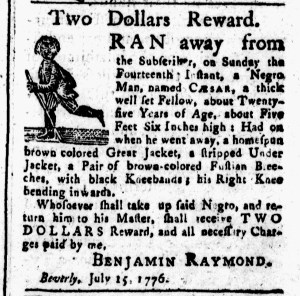
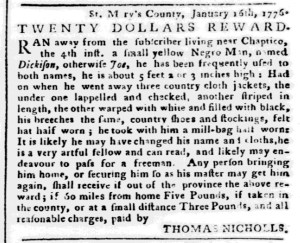
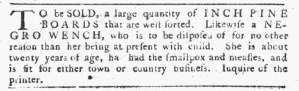
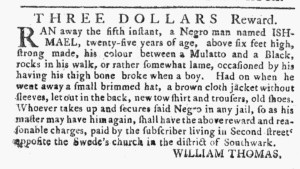
These advertisements appeared in revolutionary American newspapers 250 years ago today.
Dunlap’s Pennsylvania Packet (July 15, 1776).
**********
New-York Gazette and Weekly Mercury (July 15, 1776).
**********
New-York Gazette and Weekly Mercury (July 15, 1776).
**********
New-York Gazette and Weekly Mercury (July 15, 1776).
What was advertised in a revolutionary American newspaper 250 years ago this week?
Providence Gazette (July 13, 1776).
“[Advertisements omitted will be in our next.]”
The July 13, 1776, edition of the Providence Gazette included a note from the printer, John Carter, that “[Advertisements omitted will be in our next.]” Even though some advertisements received in the printing office “at Shakespear’s Head, in Meeting-Street,” did not make it into print in that issue, it still carried a significant number of paid notices. Carter devoted the entire fourth page to advertising as well as the final column of the third page. That meant that advertising accounted for four out of twelve columns or one-third of the content of that issue.
What prevented Carter from inserting certain advertisements? Acquiring a copy of the Declaration of Independence and printing it for his subscribers and other readers likely played a part. Consider where the Declaration of Independence and the note from the printer appeared within the July 13 issue. Both ran on the third page, the last page for which the compositor set type. Like other newspapers published during the era of the American Revolution, the Providence Gazetteconsisted of four pages created by printing two pages on each side of a broadsheet and folding it in half. Printers produced both pages on one side, let the broadsheets dry, and then printed the other two pages on the other side. In most printing offices, that meant taking the first and fourth pages to press first and later printing the second and third pages.
Carter wedged the note that advertisements that did not appear in the July 13 edition would appear in the next issue into the last column on the third page, placing it at the very bottom after squeezing in as many advertisements as possible. The Declaration of Independence started near the top of the first column and filled most of the second column as well. It did not, however, start at the top of the column. Carter concluded a news update from New York. He also included a short introduction: “The following Declaration of the General Congress was Yesterday received from Philadelphia.” That further suggests that he set type for the momentous document as soon as he received it and inserted it into the July 13 edition where it would fit. Doing so displaced some of the advertisements he intended to print before a copy of the Declaration of Independence came to hand.
What was advertised in a revolutionary American newspaper 250 years ago today?
Pennsylvania Ledger (July 13, 1776).
“The True Interest of America Impartially Stated.”
A week after the Pennsylvania Evening Post became the first newspaper to publish the Declaration of Independence, the Pennsylvania Ledger became the last newspaper printed in Philadelphia to carry that momentous document. The news had certainly reached readers by word of mouth long before July 13. Some may have attended the public reading of the Declaration of Independence at the Pennsylvania State House (now known as Independence Hall) on July 8. They could have also read the document in the Pennsylvania Ledger (July 6), Dunlap’s Pennsylvania Packet (July 8), Henrich Millers Pennsylvanischer Staatsbote (in German, July 9), the Pennsylvania Gazette (July 10), or the Pennsylvania Journal (July 10). The text may not have been readily available to James Humphreys, Jr., in time for the July 6 edition of the Pennsylvania Ledger, though he may not have invested the same effort in acquiring it as did Benjamin Towne, the printer of the Pennsylvania Evening Post. Like the printers of the other newspapers published in Philadelphia, Humphreys did not move forward his weekly publication schedule to disseminate the Declaration of Independence, nor did he print a supplement or extraordinary issue.
Still, Humphreys may have published the Declaration of Independence with less enthusiasm than his fellow printers in Philadelphia. Humphreys was widely suspected of being a Loyalist, though Isaiah Thomas, a printer who did not shy away from condemning other printers who did not support the American cause, had a more nuanced view of Humphreys and “his intention to conduct his paper with political impartiality.” Thomas noted “perhaps, in times more tranquil than those in which it appeared, he might have succeeded in his plan.” Humphreys stood by his “oath of allegiance to the king of England … and refused to bear arms against the British government; in consequence of which, he was deemed a tory, and his paper denounced as being under corrupt influence.”[1] In the end, the “impartiality of the Ledger did not comport with the temper of the times” and Humphreys left Philadelphia for his safety by the end of 1776. He eventually returned during the British occupation of the city, accompanied the army to New York, and, following the war, established a newspaper, the Nova Scotia Packet, in Shelburne, a town founded by Loyalists who went into exile.[2]
That “impartiality” described by Thomas found expression in other items that came off Humphreys’s press and appeared in advertisements in the Pennsylvania Ledger. Without comment on the contents of the pamphlet, Thomas reported that Humphreys printed “Strictures on Paine’s Common Sense. Two editions …, consisting of several thousand copies each, were sold in a few months.”[3]The True Interest of America Impartially Stated, as the pamphlet was also known, offered a response to Common Sense. Humphreys placed an advertisement for the second edition of The True Interest of America Impartially Stated on the first page of the issue of the Pennsylvania Ledger that carried the Declaration of Independence. That document appeared on the second page, though probably not the result of Humphreys inserting news only when it arrived. He almost certainly had access to a copy of the Declaration of Independence with sufficient time to place it on the front page of the Pennsylvania Ledger if he wished. After all, the printers of the Pennsylvania Gazette and the Pennsylvania Journal made room for the Declaration of Independence on the front page of their newspapers three days earlier.
The advertisement for The True Interest of America Impartially Stated even carried a quotation from the Continental Congress’s “Address to the People of Great-Britain” in October 1774 that contradicted the action they took in declaring independence less than two years later: “You have been told that we are seditious, impatient of government, and desirous of Independency. Be assured that these are not Facts, but Calumnies – Permit us to be as free as yourselves, and we shall ever esteem a union with you to be our greatest glory and our greatest happiness. – Place us in the same situation we were at the close of the last war, and our former harmony will be restored.” Even as Humphreys published the Declaration of Independence in the Pennsylvania Ledger, not all readers celebrated or agreed with the action taken by the Continental Congress. The Revolutionary War became a civil war among colonizers as much as a contest between a nation seeking independence and Great Britain.
**********
[1] Isaiah Thomas, The History of Printing in America: With a Biography of Printers and an Account of Newspapers (1810; New York: Weathervane Books, 1970), 439-440.
The Slavery Adverts 250 Project chronicles the role of newspaper advertising in perpetuating slavery in the era of the American Revolution. The project seeks to reveal the ubiquity of slavery in eighteenth-century life from New England to Georgia by republishing advertisements about enslaved people – for sale as individuals or in groups, wanted to purchase or for hire for short periods, runaways who liberated themselves, and those who were subsequently captured and confined in jails and workhouses – in daily digests on this site as well as in real time via the @SlaveAdverts250 Twitter feed, utilizing twenty-first-century media to stand in for the print media of the eighteenth century.
The project aims to provide modern audiences with a sense of just how often colonizers encountered these advertisements in their daily lives. Enslaved men, women, and children appeared in print somewhere in the colonies almost every single day. Those advertisements served as a constant backdrop for social, cultural, economic, and political life in colonial and revolutionary America. Colonizers who did not purport to own enslaved people were still confronted with slavery as well as invited to maintain the system by purchasing enslaved men, women, and children or assisting in the capture of so-called “runaways” who sought to free themselves from bondage. The frequency of these newspaper advertisements suggests just how embedded slavery was in colonial and revolutionary American culture in everyday interactions beyond the printed page.
These advertisements also testify to the experiences of enslaved men, women, and children, though readers must consider that those experiences have been remediated through descriptions offered by enslavers rather than enslaved people themselves. Often unnamed in the advertisements, enslaved men, women, and children were not invisible or unimportant in early America.
These advertisements appeared in revolutionary American newspapers 250 years ago today.
Historians consider Thomas Paine’s Common Sense, published anonymously on January 9, 1776, the most influential political pamphlet that circulated in the colonies during the era of the American Revolution. Written in plain language accessible to readers of all backgrounds, the pamphlet made a bold case for declaring independence at a time that many colonizers still sought a redress their grievances by George III and Parliament. Paine’s pamphlet played a vital role in swaying public opinion in favor of declaring independence.
Common Sense was an eighteenth-century bestseller, though Paine wildly overestimated how many copies were published, claiming 150,000 circulated in 1776, and historians later made even more dubious claims that American printing presses produced as many as 500,000 copies. Contrary to those exaggerations, American printers most likely published between 35,000 and 50,000 copies in 1776. Scholars have identified twenty-five American editions, more than twice as many as any other American book or pamphlet published in the eighteenth century.
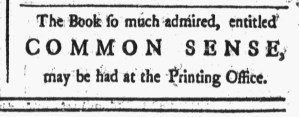
Colonizers certainly discussed Paine’s pamphlet … and printers, booksellers, and others advertised it widely. As a special feature, the Adverts 250 Projectchronicles those advertisements, starting with newspaper notices for Robert Bell’s first edition published in Philadelphia and then subsequent advertisements for that and other editions published and sold throughout the colonies.
These advertisements for Common Sense appeared in American newspapers 250 years ago today.
What was advertised in a revolutionary American newspaper 250 years ago today?
Connecticut Gazette (July 12, 1776).
“We have been obliged to issue only a Half Sheet paper this Week; in which, however, is digested every material Occurrence that is come to Hand.”
Newspapers published during the era of the American Revolution usually consisted of four pages created by printing two pages on each side of a broadsheet and then folding it in half. Due to paper shortages, some issues occasionally had only two pages, one on each side of a half sheet. The July 12, 1776, edition of the Connecticut Gazette had only two pages, but apparently factors other than disruptions in the paper supply led Timothy Green, the printer, to make that decision. In a note to readers at the top of the first column on the first page, he advised, “[In order to expedite some necessary Business for the Government, we have been obliged to issue only a Half Sheet Paper this Week; in which, however, is digested every material Occurrence that is come to Hand.]” Green did not mention the impact that had on advertisements, unlike John Carter, the printer of the Providence Gazette, who inserted a notice in his newspaper the following day that “[Advertisements omitted will be in our next.]” Green found space to publish four advertisements, whereas he filled an entire page with advertising in the previous issue.
The printer undersold the contents of that issue of the Connecticut Gazette when he claimed that he “digested every material Occurrence that is come to Hand.” It carried updates from Charleston, South Carolina; the provincial congress in North Carolina; Williamsburg, the capital of Virginia; Philadelphia; New York; Boston and nearby Watertown in Massachusetts; Portsmouth, New Hampshire; Halifax, Nova Scotia; and Gibraltar by way of London. That issue also carried a few brief items of local news from New London. Yet none of that was the most significant news that the Connecticut Gazette carried. Near the top of the second column on the second page, Green printed the Declaration of Independence, making the Connecticut Gazette the first newspaper in New England to disseminate that momentous document to its readers. Unlike other news, the Declaration of Independence had not been “digested” to fit in the limited space available on the half sheet that Green resorted to publishing that week. Instead, he printed the Declaration of Independence in its entirety. The nation’s founding document was a “material Occurrence” indeed! Its placement in the middle of the second page does not necessarily indicate that Green did not consider the Declaration of Independence significant. Instead, he likely set the type and integrated the document into his newspaper as soon as he acquired a copy. The first page may have already been printed by that time. For eighteenth-century printers and readers, where an item appeared on the page of a newspaper did not necessarily signal the importance associated with it but rather the realities of the printing technology of the period.
The Slavery Adverts 250 Project chronicles the role of newspaper advertising in perpetuating slavery in the era of the American Revolution. The project seeks to reveal the ubiquity of slavery in eighteenth-century life from New England to Georgia by republishing advertisements about enslaved people – for sale as individuals or in groups, wanted to purchase or for hire for short periods, runaways who liberated themselves, and those who were subsequently captured and confined in jails and workhouses – in daily digests on this site as well as in real time via the @SlaveAdverts250 Twitter feed, utilizing twenty-first-century media to stand in for the print media of the eighteenth century.
The project aims to provide modern audiences with a sense of just how often colonizers encountered these advertisements in their daily lives. Enslaved men, women, and children appeared in print somewhere in the colonies almost every single day. Those advertisements served as a constant backdrop for social, cultural, economic, and political life in colonial and revolutionary America. Colonizers who did not purport to own enslaved people were still confronted with slavery as well as invited to maintain the system by purchasing enslaved men, women, and children or assisting in the capture of so-called “runaways” who sought to free themselves from bondage. The frequency of these newspaper advertisements suggests just how embedded slavery was in colonial and revolutionary American culture in everyday interactions beyond the printed page.
These advertisements also testify to the experiences of enslaved men, women, and children, though readers must consider that those experiences have been remediated through descriptions offered by enslavers rather than enslaved people themselves. Often unnamed in the advertisements, enslaved men, women, and children were not invisible or unimportant in early America.
These advertisements appeared in revolutionary American newspapers 250 years ago today.
What was advertised in a revolutionary American newspaper 250 years ago today?
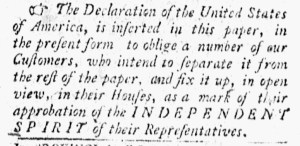
New-York Journal (July 11, 1776).
“The Declaration of the United States of America, is inserted in this paper.”
A day after the Constitutional Gazette became the first newspaper in New York to print the Declaration of Independence, the New-York Journal and the New York Packet both published it on July 11, 1776. The printers may have had access to the complete text sooner than that, but, like their counterparts in Philadelphia, they did not adjust their weekly publication schedule nor print a supplement or extraordinary issue to disseminate the Declaration of Independence. Readers almost certainly heard that the Continental Congress had declared independence before they had an opportunity to read the document approved on July 4.
The New York Packet, printed by Samuel Loudon, carried the Declaration of Independence on the second page, under a heading for news from Philadelphia. It started halfway down the third column and concluded at the bottom of the fourth (and final) column on that page. While that placement may seem unusual to modern readers who would expect the Declaration of Independence to be front-page news, it did not indicate any less importance or urgency to eighteenth-century readers who were accustomed to a different layout for newspapers than what evolved in the nineteenth century. The New York Packet, like other newspapers published during the era of the American Revolution, consisted of four pages created by printing two pages on each side of a broadsheet and then folding it in half. Printers often printed the side with the first and fourth pages first, frequently placing older news on the first page and advertisements on the fourth page. As a result, news that arrived closest to publication appeared on the second or even third page. Readers knew to look for it there. Such was the case when Loudon printed the Declaration of Independence in the New York Packet.
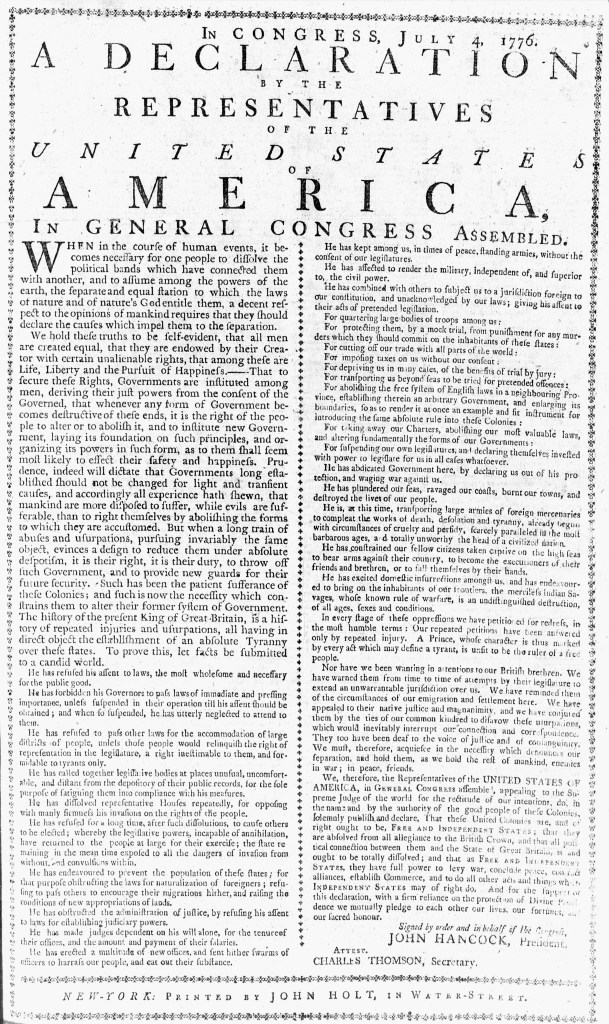
John Holt, the printer of the New-York Journal, devoted the entire third page of the July 11 edition to the Declaration of Independence. Like Loudon, he apparently had type set and printed the first and fourth pages before he acquired a copy of the Declaration of Independence. He opted, however, to make it the only item on the third page. He enclosed the text of the document within a border composed of printing ornaments and devised a headline in font larger than that of the title of the newspaper in the masthead. Holt wanted readers to take note of the Declaration of Independence … and he wanted them to do more than just read it the first time they saw it in his newspaper. In a note that appeared above other advertisements on the second page, Holt stated, “The Declaration of the United States of America, is inserted in this paper, in the present form to oblige a number of our Customers, who intend to separate from the rest of the paper, and fix it up, in open view, in their Houses, as a mark of their approbation of the INDEPENDENT SPIRIT of their Representatives.” Holt provided his subscribers with a piece of patriotic memorabilia. Newspapers were ephemeral, usually discarded once they had been read, but this was a document to save and to display to demonstrate support for the American cause and, especially, the Continental Congress’s bold action of declaring independence.
Even though his name and location appeared in the colophon at the bottom of the fourth page (on the reverse side of the page that carried the Declaration of Independence), Holt added an imprint at the bottom of the third page that he intended for subscribers to “separate … from the rest of the paper” and display “in open view, in their Houses.” It stated, “NEW-YORK: PRINTED BY JOHN HOLT, IN WATER-STREET.” In so doing, Holt simultaneously demonstrated his own patriotism and crafted an advertisement for the services available at his printing office.