February 19

What was advertised in a colonial American newspaper 250 years ago this week?

Boston Evening-Post (February 17, 1772).

“On as low Terms as at any Store in BOSTON.”

The partnership of Amorys, Taylor, and Rogers made low prices one of the focal points of their advertising in a notice that ran in the February 17, 1772, edition of the Boston Evening-Post.  Most newspaper advertisements of the era featured the names of the advertisers as headlines, if they included headlines at all, but in this case “Amorys, Taylor and Rogers” constituted a secondary headline.  Their advertisement commenced with a primary headline that proclaimed, “GOODS EXTREMELY CHEAP.”

The partners then developed that theme in a nota bene that preceded a lengthy list of their inventory that extended three-quarters of a column.  They offered their wares wholesale to retailers, both “Country Shopkeepers” and “Town Shopkeepers.”  Amorys, Taylor, and Rogers explained that they offered their customers low prices because they acquired “almost every Kind of Goods usually imported from Great Britain … immediately from the Manufacturors.”  In other words, they did not deal with English merchants whose intervention tended to inflate prices.  By eliminating those middlemen, Amorys, Taylor, and Rogers kept prices down for American retailers.  In turn, those retailers could generate business by setting their own low prices for their customers.

The partners underscored that they offered the best bargains.  They pledged that “Country Shopkeepers may be supplied at any Time with what Goods they want, and on as low Terms as at any Store in BOSTON.”  Those “Country Shopkeepers” had many choices of merchants supplying retailers with imported goods in that bustling port city, but Amorys, Taylor, and Rogers indicated that they matched the prices of any of their competitors.  In addition, “Town Shopkeepers … who usually import their Goods, may have them on such Terms as may answer them as well as importing.”  Retailers in Boston would not find better deals through corresponding with English merchants, especially since Amorys, Taylor, and Rogers had their goods shipped “immediately from the Manufacturors.”

Low prices played an important role in marketing imported goods among both wholesalers and retailers in eighteenth-century Boston.  Amorys, Taylor, and Rogers explained at some length how they were able to part with their goods “EXTREMELY CHEAP,” hoping to attract the attention of retailers looking to set low prices of their own and pass along the savings to consumers.  That merchants and shopkeepers promoted low prices comes as no surprise, but the commentary about prices that sometimes appeared in newspaper advertisements demonstrates that some advertisers made deliberate efforts to engage prospective customers rather than passively announcing low prices and expecting that would be sufficient to generate business.

February 3

What was advertised in a colonial American newspaper 250 years ago today?

Boston Evening-Post (February 3, 1772).

“Collection of BOOKS … A Catalogue of which may be seen at said Store.”

Henry Knox is most often remembered as the general who oversaw artillery for the Continental Army during the American Revolution and the new nation’s first Secretary of War in George Washington’s cabinet.  Before the Revolution, however, Knox earned his livelihood as a bookseller in Boston.  He frequently advertised books and stationery available at his “LONDON BOOK-STORE” in the Boston Evening-Post and other newspapers.  In an advertisement that ran in February 1772, for instance, he promoted a “Large and valuable Collection of BOOKS” as well as “Writing Paper of all Sorts and Sizes … and almost every other kind of Stationary.”

Knox did not name any of the titles he had on hand, but he did list several genres, including “Divinity, History, Law, Physick, and Surgery” and “A Variety of New Novels, Sea Books, All Kinds of School Books, and Classical Authors.”  To entice prospective customers to visit, he confided that “A Catalogue … may be seen at said Store.”  Many booksellers supplemented their newspaper advertisements with other marketing materials, including trade cards, broadsides, and catalogs.  Some historians of early American print culture have cast doubt on how many book catalogs booksellers actually produced and disseminated, suggesting that many catalogs mentioned in newspaper advertisements never materialized.  In this case, however, Knox likely referred to a thirty-two page “Catalogue of books, imported and to be sold by Henry Knox, at the London Book-Store, a Little Southward of the Town-House, in Cornhill, Boston, MDCCLXXII.”  At least two copies survive, one held by the Grolier Club in New York and the other in the collections of the Sterling Memorial Library at Yale University.

Knox distributed at least one other catalog before the American Revolution.  The Library Company of Philadelphia and the Wellcome Institute for the History of Medicine Library in London each have an undated catalog that highlighted titles by “Much Esteemed Authors in Physic and Surgery.”  That four-page catalog has tentatively been dated to 1772 because the copy in the collections of the Library Company has been bound with and precedes A New Lecture on Heads by George Alexander Stevens, originally printed in London and reprinted for Henry Knox in 1772.  Just as books published in the twenty-first century often include advertisements for other books, printers and booksellers in early American sometimes inserted advertising in the books they produced and sold.

**********

The catalogers at the American Antiquarian Society provided invaluable assistance in telling the story of Henry Knox and his book catalogs.

January 13

What was advertised in a colonial American newspaper 250 years ago today?

Massachusetts Gazette and Boston Post-Boy (January 13, 1772).

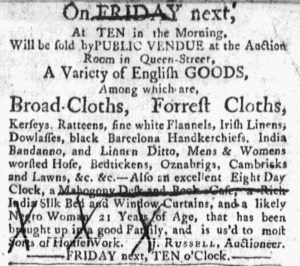
“A Mahogony Desk and Book-Case.”

This advertisement presents a conundrum.  It attracted my attention because someone made manuscript notations on the copy of the Massachusetts Gazette and Boston Post-Boy that has been preserved in an archive and digitized for greater accessibility.  They crossed out “FRIDAY” in the portion of the headline that gave the date of an auction, crossed out “a Mahagony Desk and Book-Case” midway through the advertisement, and placed three large “X” over most of the rest of the content.  I suspected that either Joseph Russell or John Green, the partners who published the Massachusetts Gazette and Boston Post-Boy, made those notations to guide the compositor in setting type for a revised version of the advertisement to appear in a subsequent issue.  Russell, the auctioneer who placed the advertisement, focused primarily on operating the “Auction Room in Queen-Street” while Green oversaw the newspaper and the printing office.

A revised version did not appear in a subsequent edition of the Massachusetts Gazette and Boston Post-Boy.  The same advertisement did run in the Boston Evening-Post and the Boston Gazette on Monday, January 13, 1772, the same day it appeared in the Massachusetts Gazette and Boston Post-Boy.  Those newspapers ran the same copy, but with variations in line breaks because the compositors made their own decisions about format.  I also looked for revised versions of the advertisement in other newspapers published in Boston between January 13 and the day of the sale.  The Massachusetts Spy published on Thursday, January 16, the day before the say, did not carry the advertisement, but the Massachusetts Gazette and Boston Weekly News-Letter distributed on the same day did feature a slightly revised version.  Only the first line differed from the original version, stating that the auction would take place “TO-MORROW” rather than “On FRIDAY next.”

Massachusetts Gazette and Boston Weekly News-Letter (January 16, 1772).

The rest of the advertisement was identical to the one that ran in the Massachusetts Gazette and Boston Post-Boy earlier in the week.  The copy was identical and the format (including line breaks, spelling, and capitals) was identical.  Even the lines on either side of “FRIDAY next, TEN o’Clock” on the final line were identical.  Both advertisements lacked a space between “by” and “PUBLIC VENDUE” on the third line.  The manuscript notations on the original advertisement may have directed someone in revising the first line, but not the remainder of the notice.  Even more puzzling, it looks as though Green and Russell shared type already set at their printing office with Richard Draper, the printer of the Massachusetts Gazette and Boston Weekly News-Letter.  This is not the first time that I have detected such an instance in newspapers published by these printers in the late 1760s and early 1770s.  It raises questions about both the logistics and the business practices of those involved, questions that merit greater attention and closer examination of the contents, both news and advertising, in the two newspapers.

December 18

What was advertised in a colonial American newspaper 250 years ago this week?

Boston Evening-Post (December 16, 1771).

“Benjamin Willard, Clock-Maker.”

Benjamin Willard, one of the most prominent clockmakers in eighteenth-century America, placed an advertisement in the December 16, 1771, edition of the Boston Evening-Post to inform the public that he had moved from Lexington to Roxbury.  He assured customers who had already purchased clocks from him with the intention that he would provide any necessary maintenance that they “still may have the same Care taken by applying to him at Roxbury.”  He also directed customers to his original shop in Grafton, where an employee made clocks “as well as at Roxbury.”  Like many other artisans, Willard promoted domestic manufactures, goods produced in the colonies, as alternatives to imported items.  He declared that consumers acquired clocks made and sold at his shop “on much better Terms than those that are purchased from foreign Countries.”  Accordingly, he advocated that colonists who needed clocks “as well as other kind of Mechanical Performances” should support his workshop, especially since “there have been large Sums of Money sent away for foreign Work which may be retained to the Emolument of this Country.”  The clockmaker referenced trade imbalances with Great Britain that had played a role, along with duties imposed on certain goods, in inspiring nonimportation agreements in Boston and other towns in the late 1760s and early 1770s.

Today, a collection of more than eighty clocks constructed by Willard, his three younger brothers, and three generations of the Willard family are on display at the Willard House and Clock Museum in North Grafton, Massachusetts, the second site mentioned in the advertisement.  Those clocks are exhibited “in the birthplace and original workshop of the Willard clockmakers, along with family portraits, furnishings, and other Willard family heirlooms.”  This public history site allows visitors to “step back in time” (surely the pun was intended!) and “witness a unique and important part of America’s technological, artistic, and entrepreneurial history.”

December 11

What was advertised in a colonial American newspaper 250 years ago this week?

Boston Evening-Post (December 9, 1771).

“[I]f the Teas should not please those that have not yet made trial, they will be received back and the Money returned.”

Archibald Cunningham took to the pages of the Boston Evening-Post to advertise a variety of groceries and housewares in December 1771.  His inventory included sugar, rice, nutmegs, and an assortment of spices as well as “Blue and white China Cups and Saucers” and “Delph & Glass Ware” in several colors.  Cunningham listed each of these items, some with short descriptions, but devoted an entire paragraph to promoting tea.

He informed prospective customers that he carried “Bohea Tea very good” and “excellent Souchong and Hyson Tea.”  According to Cunningham, his tea “has been approved of by good Judges to be of a superior Quality in Flavor and Color to that commonly imported.”  He did not name those “good Judges,” but he also did not expect consumers to accept such testimonials without question.  Instead, Cunningham promised satisfaction by offering a money back guarantee.  [I]f the Teas should not please those that have not yet made trial,” the shopkeeper declared, “they will be received back and the Money returned.”  That likely attracted the attention of some readers as they encountered advertisements placed by several shopkeepers who included tea among their merchandise.

On occasion, purveyors of goods and services experimented with money back guarantees in the eighteenth century, but not so often that such offers regularly appeared in advertisements.  Cunningham provided his customers with an additional benefit that distinguished how he marketed tea from others who advertised the same varieties.  Lewis Deblois and George Deblois listed “Bohea Tea per Chest or Dozen” in their advertisement, giving customer options when it came to quantity.  John Adams and Company commented on the quality of their “Best Hyson and Bohea Tea,” but did not encourage customers to take it home, try it, and then return it for a refund if it did not meet with satisfaction.

In offering a money back guarantee, Cunningham further testified to the quality of his tea.  He would not have made such an offer unless he was confident consumers would rarely invoke the option of returning what they purchased.  The guarantee provided security at the same time that it reassured prospective customers about the quality “in Flavor and Color” of Cunningham’s “Bohea Tea very good” and “excellent Souchong and Hyson Tea.”

September 30

What was advertised in a colonial American newspaper 250 years ago today?

Boston Evening-Post (September 30, 1771).

“A very large Assortment of Winter Goods.”

Most advertisements in eighteenth-century newspapers consisted text unadorned with images, though some did feature woodcuts depicting ships, houses, enslaved people, horses, or, even less frequently, shop signs.  Despite the lack of images, advertisers and compositors sometimes experimented with graphic design in order to draw attention to newspaper notices.  Some of those efforts were rather rudimentary.  In the September 30, 1771, edition of the Boston Evening-Post, for instance, Hopestill Capen’s name served as the headline for his advertisement.  That was not unusual, but the size of the font was.  Larger than the names of any other merchants and shopkeepers who placed advertisements in that issue, the size of Capen’s name demanded attention for his advertisement.  Thomas Lee pursued a similar strategy with a headline proclaiming “SILKS” in a large font.

Capen and Lee may or may not have consulted with the printer or compositor about those elements of their advertisements.  They may have submitted the copy and left the design to the compositor.  Gilbert Deblois, on the other hand, almost certainly gave instructions or even spoke with the compositor concerning the unique format of his advertisement.  The text ran upward at a forty-five degree angle, distinguishing it from anything else that appeared in the pages of the Boston Evening-Post.  Deblois hawked a “very large Assortment of Winter Goods, with every other Kind imported from Great-Britain.”  In so doing, he used formulaic language that appeared in countless other advertisements in the 1760s and early 1770s.  Yet he devised a way to make his message more interesting and noticeable.  That likely required a greater investment on his part.  Advertisers usually paid for the amount of space their notices occupied, not by the word, but in this case setting type at an angle required extraordinary work on the part of the compositor.  Reorienting Deblois’s advertisement was not merely a matter of selecting a larger font, incorporating more white space, or including ornamental type for visual interest.

Deblois carried many of the same goods as Capen, Caleb Blanchard, and Nathan Frazier, all of them competitors who placed much longer advertisements listing the many items among their merchandise.  Rather than confront consumers with the many choices available to them at his shop, Deblois instead opted to incite interest for his “large Assortment of Winter Good” using graphic design to draw attention to his advertising copy.  The unique format of his advertisement made it stand out among the dozens that appeared in that issue of the Boston Evening-Post.

September 9

What was advertised in a colonial American newspaper 250 years ago today?

Boston Evening-Post (September 9, 1771).

“He has invented an HAIR-ROLL upon an entire new Construction.”

In the 1770s, fashionable women preferred a towering hairstyle known as the high roll.  Their high hair testified that they had the leisure time to maintain the style and the means to hire hairdressers or maids to assist in achieving the style.  While some women with high rolls wore wigs, most arranged their own hair around pads and rollers, sometimes embellished with plumes, ribbons, hats, or other adornments.  Women wore high rolls to assert status, but they also became targets of critics who condemned luxury and the corrupting influences sometimes associated with consumer culture in the eighteenth century.

William Warden, a wigmaker who kept shop on King Street in Boston, attempted to catch the attention of prospective customers with an advertisement “To the LADIES” in the September 9, 1771, edition of the Boston Evening-Post.  He promoted a product that he invented to aid women in achieving the style while also making high hair more comfortable to wear.  Warden proclaimed that he “invented an HAIR-ROLL upon an entire new Construction,” one that weighed significantly less than those made and sold by his competitors.  The wigmaker estimated that most “Rolls in common use weigh from Seven to Ten Ounces, whereas those he makes do not exceed Three.”  Warden did not believe that he needed to provide further recommendation for his product.  “The Advantages of a light Roll over a heavy one,” he declared, “are so obvious that it would be affrontive to the Understanding to point them out.”  Women who wore the style may have been delighted to learn of hair rollers that were easier to balance and put less strain on their necks.

According to Warden, being fashionable did not mean having to be uncomfortable, or at least not as uncomfortable as most hair rolls made the women who wore them.  He invited women to give his new product a try, giving them access to a popular fashion, the high roll, without experiencing some of the disadvantages often associated with it.

September 4

What was advertised in a colonial American newspaper 250 years ago this week?

Boston Evening-Post (September 2, 1771).

“Public Vendue, At the Auction-Room in Queen street.”

Colonial consumers encountered advertisements for all sorts of goods when they perused the pages of the Boston Evening-Post and other newspapers.  In the September 2, 1771, edition, for instance, Samuel Austin advertised “A large and compleat Assortment of English, India and Scotch Goods” recently imported from London.  Similarly, Joshua Gardner hawked “A fine Assortment of Fall and Winter Goods” received in vessels from London and Bristol.  Several other merchants and shopkeepers placed advertisements for new merchandise available at their stores and warehouses.

Consumers, however, had other options for acquiring goods.  Some preferred to purchase at vendue or auction where they might get better bargains than buying retail.  Joseph Russell, proprietor of “the Auction-Room in Queen street,” regularly placed advertisements in the Boston Evening-Post and other local newspapers to advise consumers of items soon up for bids.  In a notice that ran next to Austin’s advertisement, Russell promoted “A great Variety of English GOODS.”  He listed several different kinds of textiles as well as “Silk & linen Handkerchiefs” and “Mens & Womens worsted Hose,” many of the same items that Austin, Gardner, and others enumerated in their advertisements.  He concluded that litany with a promise of “a variety of other Goods,” encouraging prospective bidders to check out his auction before shopping elsewhere.

Russell also facilitated the market for secondhand goods, advertising an upcoming auction “At the House of Mr. Benjamin White.”  In particular, that auction featured “A Variety of HOUSE FURNITURE belonging to a Gentleman moved into the Country,” including a clock, a mahogany bureau, and looking glasses.  The inventory also included housewares, such as “a compleat Set of Burnt China for Tea-Table” and brass kettles.  Purchasing secondhand goods at auction or estate sales provided consumers an alternate means of participating in the consumer revolution.  Collectively, advertisements placed by merchants, shopkeepers, and auctioneers alerted colonists to the many options available to them and the multiple trajectories for shopping and obtaining goods of all sorts.

August 19

What was advertised in a colonial American newspaper 250 years ago today?

Boston Evening-Post (August 19, 1771).

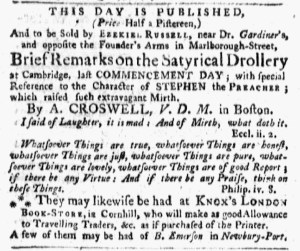
“Will make as good Allowance to Travelling Traders, &c. as if purchased of the Printer.”

A portion of the commencement exercises at Harvard in 1771 generated such enthusiasm in some quarters and outrage in others that printer Ezekiel Russell decided to publish Andrew Croswell’s “Brief Remarks on the Satyrical Drollery at Cambridge, last COMMENCEMENT DAY; with special Reference to the Character of STEPHEN the PREACHER; which raised such extravagant Mirth.”  (Read the British Museum’s copy.)  For those who attended the event, this publication served as a counterbalance to the “vain laughter, and clapping” that “gave great offence” (at least to Croswell).  For others who had not heard the “Satyrical Drollery” and witnessed “such extravagant Mirth,” the pamphlet gave them an opportunity to learn more about what had transpired, though through the lecturing tone of a critic who had not appreciated the behavior he saw exhibited at the commencement.  For Russell, this represented an opportunity to generate revenues and increase foot traffic in his shop.

Yet Russell’s shop on Marlborough Street in Boston was not the only location where consumers could acquire copies of the pamphlet.  An advertisement in the August 19, 1771, edition of the Boston Evening-Post advised that they “may likewise be had at KNOX’S LONDON BOOK-STORE, in Cornhill.”  Henry Knox, the bookseller who later became a senior general in the Continental Army during the American Revolution and the new nation’s first Secretary of War, had recently placed his own advertisements in the city’s newspapers.  In addition, residents of Newburyport and the surrounding towns could instead visit B. Emerson, who stocked a limited number of copies.  The following day, and advertisement in the Essex Gazette advised readers in Salem that Samuel Hall also sold the pamphlet.

Russell also envisioned other means of distribution.  In his advertisement, he indicated that Knox “will make as good Allowance to Travelling Traders, &c. as if purchased of the Printer.”  In other words, itinerant peddlers as well as booksellers and shopkeepers received discounts for buying in volume for the purposes of retailing to their own customers.  Knox offered them the same prices they would have otherwise received by purchasing directly from Russell.  The printer and his associates worked together to incite demand by disseminating copies of the pamphlet and offering deals to retailers.  The newspaper advertisement alerted prospective customers to three locations that carried the “Brief Remarks,” but also encouraged them to ask for it from “Travelling Traders” and others who might have also added it to their inventories.

July 24

What was advertised in a colonial American newspaper 250 years ago this week?

Boston Evening-Post (July 24, 1771).

“Brown Sugars of various Qualities.”

Like most advertisements that ran in eighteenth-century newspapers, Joseph Barrell’s notice in the July 22, 1771, edition of the Boston Evening-Post consisted entirely of text unadorned with images.  That did not mean, however, that Barrell did not deploy graphic design to his advantage.  In listing dozens of commodities available at his store, he adopted a unique format that distinguished his advertisement from others in the newspaper.  Barrell centered his text, producing a distinctive amount of white space compared to other notices.

Consider the most common configurations for enumerating goods in advertisements.  Both styles appeared on the same page as Barrell’s notice.  In the first, the most common, advertisers listed items in dense paragraphs of text with both the left and right side justified with the margins.  This gave such advertisements some visual heft, communicating to prospective customers that the advertisers carried vast assortments of goods, but it also made those advertisements more difficult to read compared to the second option.  Some advertisers decided to divide their notices into columns, listing only one or two items per line.  That method also yielded blank space that made it easier for readers to navigate those advertisement, but it meant that purveyors of goods could not list as many items in the same amount of space.  Charles Dabney utilized the first method for his “general Assortment of English and India GOODS” in an advertisement about as long as it was wide, one that featured very little blank space.  William Scott’s advertisement for a “Variety of English and Scotch Goods” was just as dense and perhaps even more difficult to read since it extended more than twice the length of Dabney’s notice and listed many more items available at his shop.  John Head, on the other hand, resorted to columns for his commodities.  In an advertisement that occupied about as much space as Dabney’s, he listed far fewer items.

Readers readily recognized both formats, but that was not the case for Barrell’s advertisement.  Compositors often centered the first couple of lines of advertisements, the introductory materials that gave the advertiser’s name and location, but rarely did they center the contents in the body of the advertisement.  That made Barrell’s advertisement unique, likely drawing the eyes of readers.  Barrell did not offer goods that differed much from those available in other shops, nor did he make appeals to price or quality that differed from those advanced by other advertisers.  His advantage in communicating with prospective customers derived from the graphic design elements of his advertisement.