December 4

What was advertised in a colonial American newspaper 250 years ago this week?

Pennsylvania Packet (December 2, 1771).

“To be Sold on the cheapest Terms.”

When John Dunlap commenced publication of the Pennsylvania Packet in the fall of 1771, he quickly gained advertisers.  From the very first issue, he distributed two-page supplements because the standard four-page issue could not contain all of the notices submitted to his printing office.  Many merchants and shopkeepers who placed advertisements in the Pennsylvania Packet replicated a style more common in newspapers published in Boston and New York rather than those that appeared in the Pennsylvania Chronicle, the Pennsylvania Gazette, and the Pennsylvania Journal.  A substantial number of advertisements in Dunlap’s newspaper featured extensive lists, naming dozens or even hundreds of items and occupying a significant amount of space.  Perpendicular lines ran down the center of each, creating two columns within those advertisements.  Rather than dense paragraphs of text, one or two items ran on each line, making it easier for readers to navigate the contents.  Many of these catalogs of merchandise extended half a column or more.  Philip Benezet’s advertisement filled an entire column.

Why did notices with this particular format appear in great numbers in the Pennsylvania Packet in the fall of 1771 but not in other newspapers published in Philadelphia?  Did price play a role?  Dunlap included the costs for subscriptions and advertising in the proposals he distributed prior to launching his newspaper.  “The Price to Subscribers will be Ten Shillings per year,” he stated.  In addition, “Advertisements, of a moderate length, will be inserted at Three Shillings each for one week, and One Shilling for each continuance.”  Benezet’s advertisement certainly was not “a moderate length.”  In such instances, Dunlap asserted that he published “those of greater length at such proportionable prices as may be reasonable.”  David Hall and William Sellers did not include the price for subscriptions or advertisements in the colophon for the Pennsylvania Gazette, but William Bradford and Thomas Bradford indicated that “Persons may be supplied with” the Pennsylvania Packetat Ten Shillings a Year.”  William Goddard also charged ten shilling for an annual subscription to the Pennsylvania Chronicle.  None of the printers, however, included prices for advertising in the colophons of their newspapers.

Dunlap set the same rate for subscriptions as his competitors, but did he attempt to undercut them when it came to advertising?  If so, was that strategy only temporary, intended to come to an end once he felt his newspaper had been firmly established?  His proposals included other savvy marketing strategies.  He listed local agents in more than a dozen towns, from Boston in New England to Charleston in South Carolina, demonstrating that he planned for wide dissemination of the Pennsylvania Packet.  He also distributed the first issue “gratis” in hopes of cultivating interest and leveraging commitments from prospective subscribers.  Dunlap may or may not have charged lower rates for advertising as a means of jumpstarting his newspaper, but doing so was certainly within the realm of possibility in Philadelphia’s competitive media market.

November 17

What was advertised in a colonial American newspaper 250 years ago this week?

New-York Journal (November 14, 1771).

A large and neat assortment of Dry Goods.”

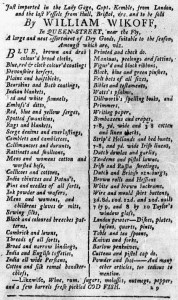
William Wikoff advertised a “large a neat assortment of Dry Goods, suitable to the season” in the November 14, 1771, edition of the New-York Journal.  He attempted to entice prospective customers to his shop by demonstrating the range of choices he made available to them, listing everything from “Devonshire kerseys” to “Mens and womens, and childrens gloves & mits” to “Wire and mould shirt buttons” to “Table and tea spoons.”  His inventory appeared in two columns with one or two items per line, arranged in two columns, to make it easier to peruse.  It looked quite different than most of the advertisements for imported consumer goods that ran in the Providence Gazette the same week.  Several advertisers in that town declared that they stocked too much merchandise “to be particularly mentioned in an Advertisement,” deploying a different strategy for invoking choice as a reason to visit their stores.

Even though he concluded his list by claiming that he has “many other articles, too tedious to mention,” Wikoff decided on a more common means of making an appeal about consumer choice in his advertisement, one that many of his competitors used in their advertisements in the same issue of the New-York Journal.  On the same page as his notice, John Morton, John J. Roosevelt, and George Webster all ran advertisements that listed dozens of items arrayed in two columns.  Henry Remsen and Company and Abeel and Byvanck also listed their wares, though they did not resort to columns but instead published dense paragraphs that required even more active reading on the part of prospective customers.  Elsewhere, John Amiel, Hallett and Hazard, Robert Needham, Thomas Pearsall, Daniel Phoenix, Robert Sinclair, Samuel Tuder, and Kelly, Lott, and Company all inserted lists of goods arranged as columns, while William Neilson and Henry Wilmot opted for paragraphs that took up less space (and cost less since advertisers paid by the amount of space rather than the number of word).  Gerardus Duyckinck placed two advertisements for his “UNIVERSAL STORE,” also known as the “Medley of Goods,” that listed his inventory and deployed unique formats.

In yesterday’s entry, I argued that many merchants and shopkeepers in Providence simultaneously deployed an uncommon strategy for suggesting consumer choice in the fall of 1771.  They proclaimed that they carried “a Variety of well assorted GOODS” but asserted that the choices were so vast that they could not print them in newspaper advertisements.  Today, I offer examples of more common formats that traders in other cities used to catalog their merchandise to demonstrate the choices consumers would encounter in their shops.  In each case, advertisers did more than announce they had goods on hand and expect that was sufficient to attract customers.

February 23

What was advertised in a colonial American newspaper 250 years ago today?

Providence Gazette (February 23, 1771).

“Brass candlesticks.”

Joseph Russell and William Russell regularly placed advertisements in the Providence Gazette in the late 1760s and early 1770s.  Like many other purveyors of goods, they listed some of the many items in stock at their store, including “Mens silk hose,” “Womens newest fashioned furr’d hats,” “Brass candlesticks,” and “Looking glasses.”  In so doing, they demonstrated to consumers the wide array of choices available to them.  The descriptions of some items further underscored that prospective customers could choose according to their own tastes and desires, such as “SCarlet, claret, tyrean, mixed, drab, cinnamon, green & blue broadcloths” and “Sewing silks of all colours.”  The Russells’ notice in the Providence Gazette constituted a catalog of their merchandise in the format of a newspaper advertisement.

In addition to making an appeal to consumer choice, the Russells also deployed graphic design to draw attention to their advertisement and aid readers in navigating it.  Their notice featured two columns of goods with a line down the center.  Only one or two items appeared on each line, creating white space that made the entire advertisement easier to read.  In contrast, most other items in the Providence Gazette (and other colonial newspapers) ran in dense blocks of text.  News items almost invariably took that form.  Most advertisements did as well, including the majority that enumerated the many items offered for sale.  As a result, the design of the Russells’ advertisement likely caused readers to notice it before they actively set about reading it, encouraging them to look more closely.  When they did read it, they could scan the contents more efficiently than working through a lengthy and dense paragraph.  Primitive by modern standards, the two-column design distinguished the Russells’ advertisement from most other items in the newspaper.

That design cost more money since newspaper printers charged by the amount of space advertisements occupied rather than the number of words.  The Russells apparently considered the additional expense worth the investment if it increased the number of readers who engaged with their advertisement.

February 10

What was advertised in a colonial American newspaper 250 years ago this week?

New-York Journal (February 7, 1771).

“A great many other articles, suitable for traveling merchants.”

John Watson, a merchant, sold a variety of goods at his store on Cart and Horse Street in New York.  In an advertisement in the February 7, 1771, edition of the New-York Journal, he listed dozens of items ranging from textiles to “Mens and womens shoes” to “Men, women and boys, best silk gloves and mitts” to “Table spoons, and best Holland quills.”  This catalog of goods, arranged in two columns, presented consumers an array of choices that Watson hoped would entice them to visit his store and make selections according to their tastes.  He also promised that they would encounter an even greater assortment of merchandise, “a great many other articles … too tedious to enumerate.”  Many merchants and shopkeepers who emphasized consumer choice with their lengthy litanies of goods doubled down on that appeal by proclaiming that even with as much space as their advertisements occupied in colonial newspapers it still was not enough to do justice to everything in their inventories.

Watson did not address consumers exclusively.  He declared that he sold his wares “wholesale or retail,” supplying shopkeepers, peddlers, and others who purchased to sell again as well as working directly with consumers.  He noted that he stocked goods “suitable for traveling merchants” to carry to smaller towns and into the countryside.  Participating in the consumer revolution of the eighteenth century was not a privilege reserved for residents of the largest port cities.  Colonists did not need to live in New York and visit Watson’s store in order to purchase the fabrics, ribbons, buttons, snuff boxes, playing cards, and other items he imported and sold.  Instead, those who lived at a distance made purchases via the post or at local shops or from peddlers and “traveling merchants” who helped in distributing consumer goods beyond the major ports.  Bustling cities like New York, Boston, Charleston, and Philadelphia certainly had higher concentrations of shops, affording ready access to consumer goods to local residents, but those places did not have monopolies when it came to the rituals of consumption.  Watson, like many other merchants, used newspaper advertising for multiple purposes, seeking to incite demand among local customers while simultaneously distributing goods to retailers and peddlers who made them available to even greater numbers of customers.

January 5

What was advertised in a colonial American newspaper 250 years ago today?

Providence Gazette (January 5, 1771).

“A variety of other articles too tedious to mention.”

Shopkeepers Ebenezer Thompson and James Arnold placed a lengthy advertisement for a “GOOD assortment of English and India Goods” in the January 5, 1771, edition of the Providence Gazette.  The partners deployed a familiar format, a prologue that gave general information about their enterprise followed by an extensive inventory of their merchandise. The prologue listed their names and location, identified which ship had recently delivered their wares, and promised “the very lowest Rates” or prices for their customers.

Some advertisers, like Nicholas Brown and Company, Joseph and William Russell, and Thurber and Cahoon limited their advertisements to the information in the prologue, but Thompson and Arnold reasoned that if they demonstrated the range of choices available to consumers that they would attract more customers.  As a result, their advertisement filled half a column, enumerating dozens of textiles as well as everything from “womens black worsted gloves and mitts” to “horn and ivory combs” to “temple and common spectacles” to “leather bellows.”  Thompson and Arnold focused primarily on garments and trimmings, but also indicated that they stocked housewares and hardware.

After cataloging so many items, the shopkeepers concluded with a note that they carried “a variety of other articles too tedious to mention.”  Like the lengthy list, that was also a marketing strategy frequently employed by advertisers who wished to suggest that they provided such a vast array of choices that it was not possible to name all of them.  This enhanced the invitation for consumers to visit their shops by providing both certainty about some of the merchandise and opportunities for further discovery.  Thompson and Arnold demonstrated that they carried an assortment of goods to satisfy customers, but also allowed for some surprises that could make the experience of shopping even more pleasurable for prospective customers who took the time to examine their wares.

Thompson and Arnold certainly paid more for their advertisement than their competitors did for their notices.  Five that consisted solely of the material from the prologue filled the same amount of space as Thompson and Arnold’s advertisement on its own.  Yet the more extensive advertisement may very well have been worth the investment.  Not only did it give consumers a better sense of the goods that Thompson and Arnold carried, its length made it more visible on the page and suggested the prosperity and competence of the shopkeepers.

August 15

What was advertised in a colonial American newspaper 250 years ago this week?

Aug 15 - 8:13:1770 New-York Gazette and Weekly Mercury
New-York Gazette and Weekly Mercury (August 13, 1770).

“Coopers Bung borers, adzes, howells, compasses, crozes, bitts and rivets.”

In the 1770s, when merchants and shopkeepers enumerated the “general assortment” of goods they offered for sale, their advertisements usually followed one of two formats.  Most listed their merchandise in a dense paragraph of text that extended anywhere from a few lines to half a column or more.  As an alternative, others created more white space and made their advertisements easier to read by including only one item per line or organizing their wares into columns.  Adopting such methods meant that advertisers could name fewer items in the same amount of space as their competitors who chose paragraphs of text with no white space.

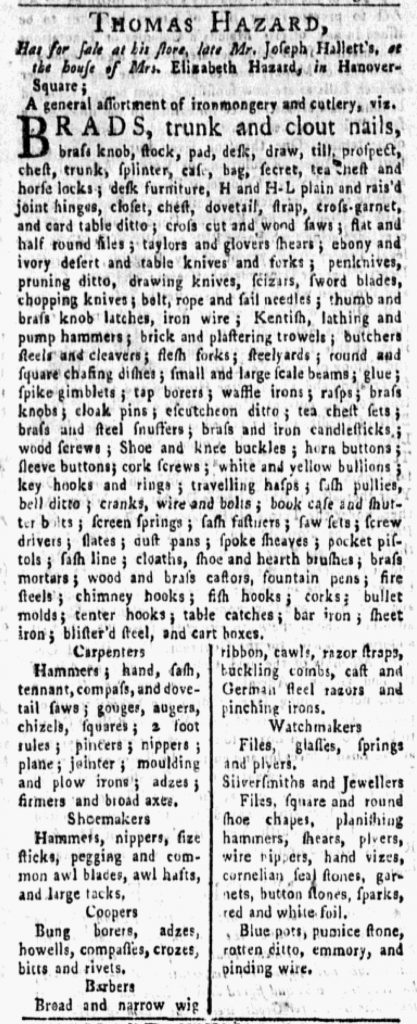
Both sorts of advertisements regularly appeared in the New-York Gazette and Weekly Mercury, but occasionally advertisers (perhaps in consultation with printers and compositors) added variations and innovations.  Such was the case with Thomas Hazard’s advertisement for ironmongery and cutlery in the August 13, 1770, edition.  Hazard began with a dense paragraph that included “H and H-L plain and rais’d joint hinges,” “brass and iron candlesticks,” and “sword blades.”  In addition, he divided a portion of his advertisement into two columns.  Within those columns, he resorted to short paragraphs of text rather than listing only one or two items per line, but those paragraphs were brief and likely easier for eighteenth-century consumers to navigate than the dense paragraph of text that constituted the bulk of the advertisement.  Furthermore, Hazard inserted headers for each of those shorter paragraphs:  “Carpenters,” “Shoemakers,” “Coopers,” “Barbers,” “Watchmakers,” and “Silversmiths and Jewellers.”  Each paragraph listed tools used in a particular trade.  In this manner, Hazard targeted specific consumers and aided artisans in finding the items of greatest interest to them.

Prior to the American Revolution, merchants and shopkeepers published undifferentiated lists of goods in their advertisements, but occasionally some attempted to impose more order and make their notices easier for prospective customers to navigate.  Thomas Hazard did so by grouping together tools used by various sorts of artisans, setting them apart in columns, and using headers to draw attention to them.  Carpenters or watchmakers who might have overlooked items when skimming dense paragraphs of text instead had a beacon that called their attention to the tolls of their trades.

July 27

What was advertised in a colonial American newspaper 250 years ago today?

Jul 27 - 7:27:1770 New-Hampshire Gazette
New-Hampshire Gazette (July 27, 1770).

“TEA … West-India and New-England RUM … handsome colour’d WILTONS.”

Thomas Martin advertised an assortment of goods available at his store in Portsmouth in the July 27, 1770, edition of the New-Hampshire Gazette.  He listed everything from coffee, tea, and sugar to hammers, nails, and files to handkerchiefs, stockings, and shoes.  His inventory was so extensive that his advertisement filled half a column and still concluded with “&c. &c.” to indicate that he did not have space to include everything consumers could find at his store.  (Colonists used “&c.” as an abbreviation for et cetera.)

Like many other advertisements of the era, Martin’s notice looked like a dense block of text.  To modern readers, this has little visual appeal, but Martin likely focused on other aspects of the advertisement in his efforts to market his wares.  In particular, he may have expected the length to attract the attention of prospective customers.  Few advertisements for consumer goods and services in the New-Hampshire Gazette occupied so much space.  Martin borrowed a strategy from advertisers in larger port cities where newspapers much more often ran such lengthy advertisements for consumer goods.  The long list of goods communicated the variety and consumer choice that Martin offered his customers.  They could acquire all sorts of grocery items, hardware, housewares, clothing, and accessories during a single visit to Martin’s store, combining choice and convenience.

Despite the density of the prose, Martin did deploy a couple of visual elements to aid readers in navigating his advertisement.  At various points he inserted lengthy dashes to break what otherwise would have been an undifferentiated paragraph into smaller pieces.  He also capitalized two words to draw attention to those products:  “West-India and New-England RUM” and “handsome colour’d WILTONS,” a popular kind of carpet.  (“TEA” was also capitalized, but that was standard for the first item listed in advertisements of this sort.)  While Martin did not make elaborate use of typography to lend visual appeal to his advertisement, he did not overlook using it entirely.  His advertisement incorporated more variation than the news articles that appeared elsewhere in the same issue of the New-Hampshire Gazette.  The effectiveness of Martin’s advertisement should be considered in relation to other items, both advertisements and news items, that it ran alongside.

June 1

What was advertised in a colonial American newspaper 250 years ago today?

Jun 1 - 6:1:1770 New-Hampshire Gazette
New-Hampshire Gazette (June 1, 1770).

“Ratteen, / Wiltons, / Sagathees, / Ducapes, / Lutestrings.”

James King and Jacob Treadwell each advertised a variety of consumer goods in the June 1m 1770, edition of the New-Hampshire Gazette.  King’s advertisement took the more standard form.  After a brief introduction that included his name and location, the remainder of the advertisement consisted of a dense paragraph of text.  King listed dozens of items available at his shop, from textiles to “a Variety of Necklaces” to hardware.

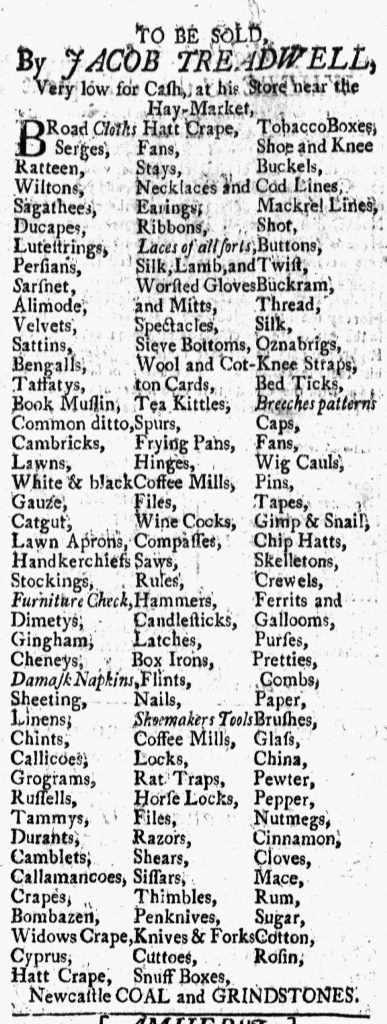
Treadwell also published a catalog of the goods he sold, but his advertisement had a less common format.  Rather than a single paragraph, Treadwell’s notice divided the goods into three columns, listing only one item on most lines.  Given the space constraints, some items overflowed onto additional lines, such as “Shoe and Knee / Buckels,” “Wool and Cot- / ton Cards,” and “Silk, Lamb, and / Worsted Gloves / and Mitts.”  Creating columns also produced white space within the advertisement; the combination made Treadwell’s advertisement easier to peruse than King’s.  It likely helped prospective customers more fully appreciate Treadwell’s extensive assortment of merchandise.  That columns required more space also communicated the range of consumer choice, though Treadwell paid to make that part of the appeal he presented to readers of the New-Hampshire Gazette.  In the eighteenth century, advertisers paid by the amount of space their notices occupied on the page, not the number of words.

To provide further visual distinction, some goods in Treadwell’s advertisement appeared in italics: “BRoad Cloths,” “Furniture Check,” “Damask Napkins,” “Laces of all sorts,” “Shoemakers Tools,” and “Breeches patterns.”  Why these particular items is not readily apparent today … and may not have been in 1770 either.  Did Treadwell believe they were in high demand?  Did he have surplus inventory?  Did Treadwell even instruct that those items appear in italics or did the compositor independently make the decision to provide even greater variation in the advertisement?  Whatever the reason, the graphic design elements of Treadwell’s advertisement likely garnered greater attention for it than King’s notice in standard format that ran on the same page.

April 26

What was advertised in a colonial American newspaper 250 years ago today?

Apr 26 - 4:26:1770 New-York Journal
New-York Journal (April 26, 1770).

“Horn combs, and ivory fine teeth’d ditto.”

Nicholas Bogart sold an assortment of goods at his shop “In the Broad-Way” in New York.  He listed many of them in an advertisement that ran in the April 26, 1770, edition of the New-York Journal.  His inventory included “Worsted and leather womens mits,” “Broad-cloths of various colours and prices,” “A variety of Dutch books for teaching children,” and “Knee garters, various colours.”  He stocked and sold such an array of merchandise that it demanded cataloging in detail in order for prospective customers to realize the full extent.

Yet Bogart did not merely list his wares.  He deployed rudimentary graphic design principles to make them easier for readers to peruse, dividing his advertisement into two columns and mentioning only one, two, or three items on each line.  When more than one item appeared on a line, they were all related to each other.  When a category of items overflowed onto the next line, the second line was usually indented.  In comparison, most merchants and shopkeepers who enumerated dozens of items did so in dense paragraphs.  Such was the case in James Beekman’s advertisement on the same page as Bogart’s notice.  Beekman included a similar number of items, but clustered them together in a manner that required more effort to read.  As a result, Beekman’s advertisement took up only about half the space of Bogart’s.  According to the colophon at the bottom of the page, advertisers paid by the amount of space that their notices occupied, not by the number of words.  That meant that Bogart paid twice as much as Beekman even though they listed a similar number of items.

Bogart was not alone in incorporating columns into his advertisement.  Immediately above Bogart’s notice, John Keating also used columns.  Elsewhere in the same issue, Abeel and Byvanck used columns to organize their “considerable Assortment of Ironmongery and Cutlery.”  Advertisers knew that this option was available to them on request, though the dense paragraph was the default format.  The more attractive option required a greater investment, but some advertisers apparently believed they would benefit from a greater return on that investment if they made it easier for prospective customers to engage with the extensive lists of merchandise they published in newspaper notices.

December 20

What was advertised in a colonial American newspaper 250 years ago today?

Dec 20 - 12:20:1769 Georgia Gazette
Georgia Gazette (December 20, 1769).

“Will be sold … at their store in Sunbury.”

In December 1769, the partnership of Kelsall and Spalding placed an advertisement in the Georgia Gazette to inform prospective customers that they stocked “A Large and Compleat ASSORTMENT of EUROPEAN and EAST INDIA GOODS” recently imported via the Georgia Packet and other vessels. Kelsall and Spalding were not the only merchants and shopkeepers who ran such notices. Samuel Douglass advertised “AN ASSORTMENT OF GOODS.” Reid, Storr, and Reid similarly promoted “A NEAT ASSORTMENT OF GOODS.” Yet Kelsall and Spalding inserted the most extensive advertisement, one designed to showcase the extent of their inventory and demonstrate to consumers the many choices that awaited them “at their store in Sunbury.”

Sunbury! Unlike Douglass and Reid, Storr, and Reid, Kelsall and Spalding did not operate a shop in Savannah. Founded on the Medway River south of Savannah in 1758, Sunbury was an emerging center of commerce in the 1760s and 1770s. That seaport might have eventually rivaled Savannah, but it never recovered from the disruptions of the American Revolution. Today it is remembered as a “lost town” of the colonial era. In the late 1760s, however, it was a bustling community.

That was the narrative that Kelsall and Spalding aimed to bolster in their advertisement. Prospective customers did not need to visit or send to the shops in Savannah to acquire the myriad of consumer goods they desired. Instead, anything they obtain the same merchandise at Kelsall and Spalding’s store in Sunbury. Printed calico fabric? Kelsall and Spalding sold it! Barlow’s best single and doubled bladed penknives? Kelsall and Spalding had them! Tin pudding pans and round sugar boxes? No need to look any further than Kelsall and Spalding’s store in Sunbury! From textiles to housewares to hardware, Kelsall and Spalding did indeed carry “A Large and Compleat ASSORTMENT.”

Kelsall and Spalding’s advertisement was notable for its length, extending more than two-thirds of column in the December 20, 1769, edition of the Georgia Gazette. The partners may have considered such a complete accounting of their wares imperative in convincing consumers that they offered the same array of merchandise as their counterparts and competitors in Savannah. Readers could hardly peruse Kelsall and Spalding’s advertisement without recognizing the variety of goods on offer.