January 1

What was advertised in a revolutionary American newspaper 250 years ago today?
Dunlap’s Pennsylvania Packet (January 1, 1776).

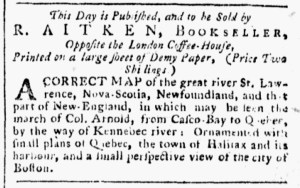
“A CORRECT MAP … in which may be seen the march of Col. Arnold.”

On January 1, 1776, Robert Aitken, a printer and bookseller, advertised that he had for sale a “CORRECT MAP of the great river St. Lawrence, Nova-Scotia, Newfoundland, and that part of New-England, in which may be seen the march of Co. Arnold, from Casco-Bay to Quebec, by wat of Kennebec river.”  The map featured insets depicting the “plains of Quebec, the town of Halifax and its harbour, and a small perspective view of the city of Boston.”  Like several other maps and prints advertised in the months following the outbreak of hostilities at Lexington and Concord in April 1775, this map supplemented the news that colonizers read in the newspapers and heard when they discussed current events.

This “CORRECT MAP” aided in understanding the dual-pronged American invasion of Quebec that commenced near the end of August.  General Richard Montgomery and 1200 soldiers headed from Fort Ticonderoga, New York, recently captured from the British, toward Montreal.  That city surrendered to Montogomery on November 13.  Meanwhile, Colonel Benedict Arnold and 1100 soldiers sailed from Newburyport, Massachusetts, to the mouth of the Kennebec River on September 15.  They made a harrowing trek through the wilderness of northern New England, losing nearly half their number to death or desertion, before reaching Quebec City on November 14.  Arnold and his soldiers besieged the city, eventually supported by Montgomery and reinforcements on December 2.  The enlistments for many of the American soldiers ended on December 31, prompting Montgomery and Arnold to attack the city during a snowstorm.  The weather did not work to their advantage.  Montgomery was killed, Arnold wounded, and four hundred American soldiers captured.  Arnold assumed command and continued the siege, realizing that British reinforcements would arrive when the St. Lawrence River became navigable again in the spring.  When General John Burgoyne arrived in May, Arnold led a retreat to upstate New York.  Ultimately, the American invasion of Canada failed.

When they saw Aitken’s advertisement for a “CORRECT MAP … in which may be seen the march of Col. Arnold” in the January 1 edition of Dunlap’s Pennsylvania Packet, they had no way of knowing about the failed attack that occurred the previous day.  Supporters of the American cause still hoped that Montgomery and Arnold would capture Quebec City, dealing a significant blow to the British.  Along with newspaper coverage, the map chronicled what readers knew about the invasion of Canada, including the hardships endured by Arnold and the soldiers under his command who endured so many hardships in the wilderness of northern New England.

**********

For more information about the Quebec Campaign, see Nathan Wuertenberg’s more comprehensive overview.
August 21

What was advertised in a revolutionary American newspaper 250 years ago today?

New-York Gazette and Weekly Mercury (August 21, 1775).

“To the last Number for July, is affix’d a new and correct Plan of the TOWN of BOSTON, and PROVINCIAL CAMP.”

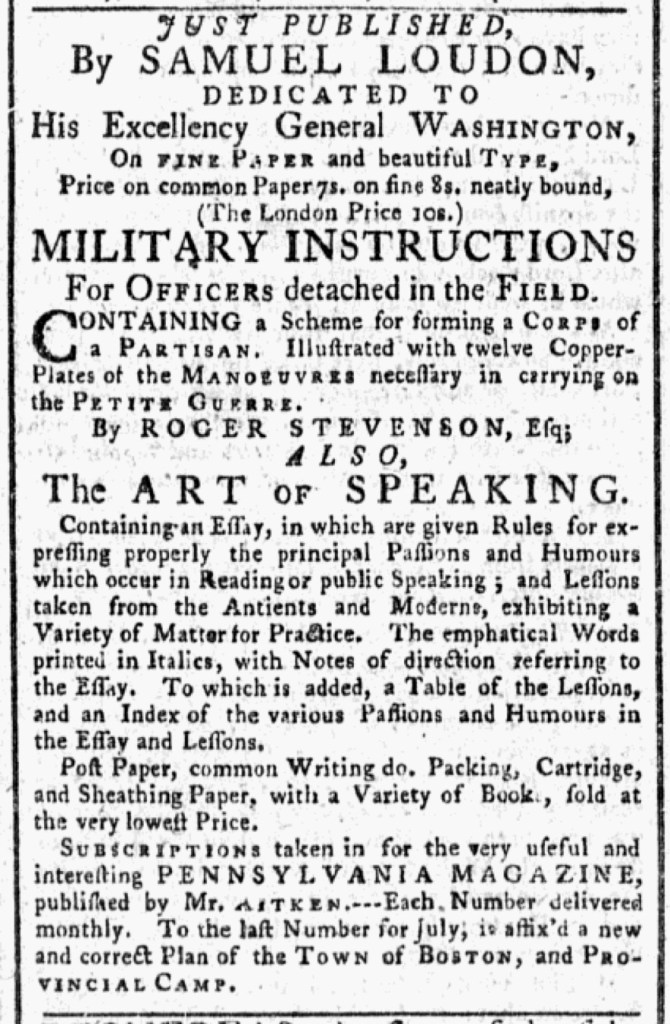
In the summer of 1775, Samuel Loudon, a bookseller in New York, stocked books printed by Robert Aitken in Philadelphia.  He advertised Military Instructions for Officers Detached in the Field, “DEDICATED TO His Excellency General Washington,” and The Art of Speaking in the August 21, 1775, edition of the New-York Gazette and Weekly Mercury.  He also noted that he stocked an assortment of paper and a “Variety of Books” that he “sold at the very lowest Price.”

Loudon concluded his advertisement by promoting another of Aitken’s projects.  The bookseller advised the public that he collected subscriptions “for that very useful and interesting “PENNSYLVANIA MAGAZINE, published by Mr. AITKEN.”  The Pennsylvania Magazine, or, American Monthly Museum commenced publication with its January 1775 issue, briefly overlapping with the Royal American Magazine.  Upon the demise of the latter, it became the only magazine published in the colonies.

To incite interest, Loudon noted that “the last Number for July” featured a “new and correct Plan of the TOWN of BOSTON, and PROVINCIAL CAMP.”  According to the Norman B. Leventhal Map and Education Center at the Boston Public Library, this map “was the earliest printed depiction of Boston after the battle of Bunker Hill, June 17, 1775.”  It includes an inset that “shows the location of the location of the battle, as well as provincial (American) lines in the communities surrounding Boston.”  This demonstrated “the commanding position enjoyed by the Continental Army.”

Getting a free map of Boston following the Battle of Bunker Hill was certainly an incentive to subscribe to the Pennsylvania Magazine!  But was it the first map of Boston created after that battle?  Perhaps, but it might better be described as one of the first depictions of Boston after the Battle of Bunker Hill.  A note in the Leventhal Center’s online catalog states, “This date is inferred,” likely because the map was “Engrav’d for the Pennsylva. Magazine” for July 1775.  Yet the assertion that it was the earliest printed depiction of Boston after the Battle of Bunker Hill may rely on an assumption that colonial printers published magazines at the beginning of the month when they instead issued monthly issues at the end of the month or early in the following month.  Thus, Aitken distributed the July 1775 issue of the Pennsylvania Magazine at the same time that he, Nicholas Brooks, and others advertised Bernard Romans’s map of Boston, a map that also featured an inset showing the “Provincial Lines” during the siege of the city and the site of the Battle of Bunker Hill.  Aitken may have consulted with Romans when preparing a map to accompany the magazine.  For prospective subscribers, it may not have mattered whether they acquired the first map of Boston published after the Battle of Bunker Hill, only that they had access to the map … and at a bargain price since it came as a premium with their subscription to the Pennsylvania Magazine rather than purchasing Romans’s map separately.

“A New and Correct Plan of the Town of Boston, and Provincial Camp” (1775). Courtesy Norman B. Leventhal Map and Education Center at the Boston Public Library.

August 19

What was advertised in a revolutionary American newspaper 250 years ago today?

Pennsylvania Ledger (August 19, 1775).

“Map of Boston … the engagements of Lexington and Bunker’s Hill.”

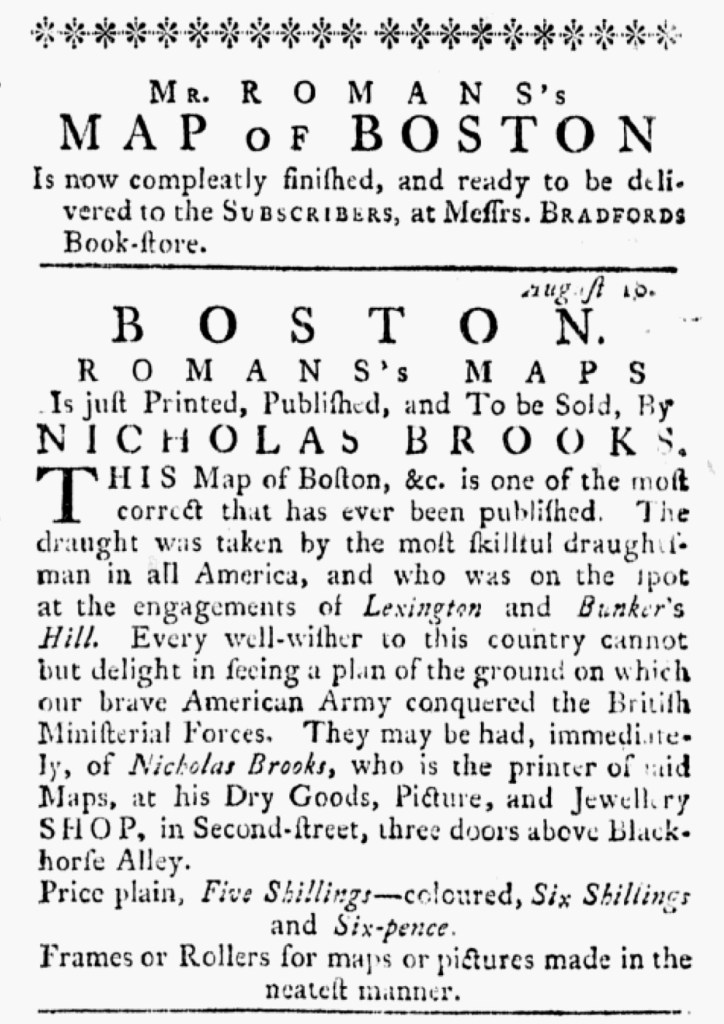
More advertisements for “MR. ROMANS’s MAP OF BOSTON” appeared in the August 19, 1774, edition of the Pennsylvania Ledger.  Bernard Romans, the cartographer who created a “MAP, FROM BOSTON TO WORCESTER, PROVIDENCE AND SALEM. Shewing the SEAT of the present unhappy CIVIL WAR in NORTH-AMERICA,” and Nicholas Brooks, the publisher, previously promoted the project with a broadside subscription proposal that began circulating in the middle of July and scattered references to the map at the end of advertisements in the Pennsylvania Ledger.  Two weeks earlier, for instance, Brooks ran an advertisement that featured an extensive list of merchandise available at his shop and added a nota bene of a single line: “Romans’s map of the seat of war near Boston, &c.”  Robert Aitken mentioned the map in a slightly longer nota bene when he advertised Military Instructions for Officers Detached in the Field.  An advertisement in Rivington’s New-York Gazetteer replicated the copy from the broadside.

Once the map was “completely finished, and ready to be delivered to the SUBSCRIBERS,” as William Bradford and Thomas Bradford put it in their advertisement, or “just Printed, Published, and To be Sold,” as Brooks proclaimed in his own notice, it received greater attention in newspaper notices.  Although many similar projects utilized subscription proposals in newspapers to generate demand attract orders in advance of publication, Romans and Brooks relied on their broadside subscription proposal during their first round of marketing and later added newspaper advertisements once the map was available for sale.

Just four months after the battles at Lexington and Concord, a remarkably short interval for such an endeavor, Brooks advertised copies of Romans’s map of Boston for sale at his “Dry Goods, Picture, and Jewellery SHOP” in Philadelphia.  He touted the quality of the map, declaring it “one of the most correct that has ever been published” and emphasiziong that the “draught was taken by the most skillful draughtsman in all America.”  As if that was not enough to sell it, Romans “was on the spot at the engagements of Lexington and Bunker’s Hill.”  Brooks marketed an eyewitness account of those important battles.  Furthermore, he asserted that consumers had a patriotic duty to examine the map, which they could do by purchasing it.  “Every well-wisher to this country,” Brooks trumpeted, “cannot but delight in seeing a plan of the ground on which our brave American Army conquered the British Ministerial Forces.”  Commemoration and commodification of the American Revolution occurred before the Continental Congress declared independence.

August 3

What was advertised in a revolutionary American newspaper 250 years ago today?

Rivington’s New-York Gazetteer (August 3, 1775)

“MAP … Shewing the SEAT of the present unhappy CIVIL WAR in NORTH-AMERICA.”

On August 3, 1775, Rivington’s New-York Gazetteer carried a subscription proposal for a “COMPLETE and ELEGANT MAP” that extended from Boston to Worcester to the west, Providence to the south, and Salem to the north, “Shewing the SEAT of the present unhappy CIVIL WAR in NORTH-AMERICA.”  The “AUTHOR,” Bernard Romans, realized that colonizers who read and discussed news about the battles at Lexington and Concord in April, the siege of Boston that followed, and the Battle of Bunker Hill would likely be interested in learning more about the geography of New England.  Among the conditions, he specified that “all places where any remarkable event has hitherto occurred, and the provincial lines, &c. shall be particularly pointed out.”  The map itself featured an inset that depicted “BOSTON and itsENVIRONS” that did indeed have its own legend identifying important places, “Provincial Lines,” and “Enemy Lines” as well as an illustration that provided “A View of the Lines thrown upon BOSTON NECK: by the Ministerial Army.”

Romans made support for the American cause an integral part of his marketing effort.  He followed the list of conditions for subscribing (that included the price and descriptions of “good paper and large scale”) with a reflection on the imperial crisis: “Hail, O Liberty! thou glorious, thou inestimable blessing: Banished from almost every part of the old world, America, thy darling, received thee as her beloved: Her arms shall protect thee, – her sons will cherish thee!”  When Romans published the map, it included a dedication “To the Hone. Jno. Hancock Esqre. President of ye Continental Congress … By his Most Obedient Humble Servant.”  As Patriots purchased, collected, and consulted political pamphlets, journals of the proceedings of the First Continental Congress, orations about the Boston Massacre, and sermons about the present state of affairs, Romans presented them with yet another piece of memorabilia that helped them in better understanding current events.  The map was a commemorative item produced and sold even before the colonies declared independence.

**********

The Massachusetts Historical Society has digitized Romans’s map, accompanied by a brief overview of its significance and a short essay about Romans and other cartographers active during the era of the American Revolution.

June 4

What was advertised in a colonial American newspaper 250 years ago today?

Maryland Journal (June 4, 1774).

“An accurate map of Baltimore and Harford counties.”

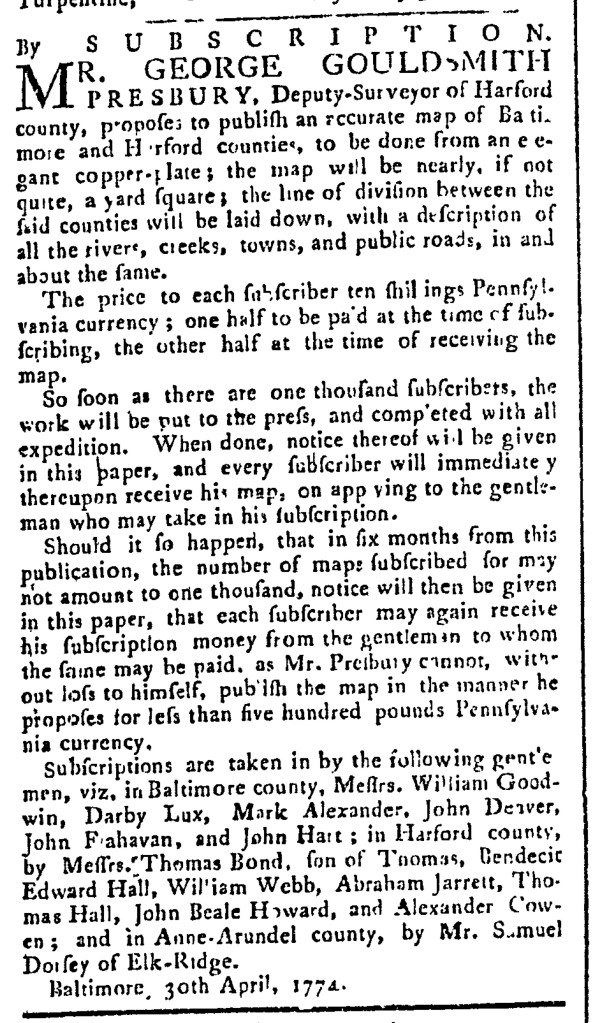
Authors, booksellers, and printers often published books and magazines by subscription in the eighteenth century … or at least attempted to do so.  Before taking publications to press, they distributed subscription proposals to encourage interest and assess demand.  Subscribers reserved copies in advance, sometimes paying deposits.  If the publishers determined that the number of subscribers would make books or magazines viable enterprises, they moved forward with the proposed works.  If subscriptions did not generate sufficient revenue, publishers abandoned projects.

Artists and engravers also used subscriptions for publishing prints, as did surveyors for maps.  George Gouldsmith Presbury, “Deputy-Surveyor of Harford county” in Maryland, published subscription proposals for “an accurate map of Baltimore and Harford counties” in the Maryland Journal, Baltimore’s first newspaper, in 1774.  That the surveyor envisioned a market for this map testified to the growing significance of Baltimore on the eve of the American Revolution.  The map “will be nearly, if not quite, a yard square” and feature “a description of all the rivers, creeks, town, and public roads.”  Presbury needed commitments from “one thousand subscribers” before “the work will be put to press.”  To aid in the endeavor, more than a dozen local agents in Baltimore, Harford, and Anne Arundel Counties accepted subscriptions and deposits.  Upon publication, Presbury would advertise in the Maryland Journal once again, calling on subscribers to collect their maps form the local agents who accepted their subscriptions.

Presbury also allowed for the possibility that the market would not yet support this project.  He allowed for six months for subscribers to reserve their copies, advising that he “cannot, without loss to himself, publish the map in the manner he proposes” if he did not raise enough funds.  If necessary, “notice will then be given in this paper” that the proposal had not succeeded and “each subscriber may again receive his subscription money” from the local agent that received it.  Apparently, that was the case, though Presbury did publish A New and Accurate Map of Baltimore-Town six years later. Presbury and other prospective publishers used subscription proposals to take risks in the marketplace for books, magazines, prints, and maps, but only to an extent, while shielding themselves from losses.

November 2

What was advertised in a colonial American newspaper 250 years ago today?

South-Carolina Gazette and Country Journal (November 2, 1773).

A COMPLEAT and CORRECT MAP of SOUTH-CAROLINA.”

In the fall of 1773, James Cook, a surveyor, advertised a “COMPLEAT and CORRECT MAP of SOUTH-CAROLINA” to readers of the South-Carolina Gazette and Country Journal.  He underscored that he went to “great Expence in surveying” the colony, “informing himself of the District Lines, Sea-Coast, &c. with many other Particulars of general Utility.”  Furthermore, he made arrangements for “the Engraving and Colouring [to be] executed by the best Hands in London.”  The surveyor asserted that his map was “as useful a Piece of Geography as any extant.  According to William P. Cumming in British Maps of Colonial America, as quoted in the overview presented by David Rumsey Map Collection, Cook’s map was “the most detailed and accurate printed map of South Carolina, especially for the interior, yet to appear.”  You may examine a high-resolution image of Cook’s “Map of the PROVINCE of SOUTH CAROLINA” at the David Rumsey Map Collection.

Inset from James Cook, Map of the Province of South Carolina, engraved by Thomas Brown (London: 1773).  Courtesy David Ramsey Map Collection.

In his advertisement, Cook declared that map provided “a clear Idea, not only of this Province, but of the Catabaw Nation, Part of North-Carolina, and as far back as the Blue Mountains, … together with the established Dividing Line of the two Provinces.”  A small amount of territory denoted “CATABAW NATION” appeared in the northern region, but the depiction of “Catabaw Town” consisted of six squares, presumably representing houses.  The insets provided more detail of English settlements and outposts: “A PLAN of CHARLESTOWN,” “A PLAN of GEORGETOWN,” “A PLAN of CAMDEN,” “A PLAN OF BEAUFORT ON PORT ROYAL ISLAND,” and “A DRAUGHT of PORT ROYAL HARBOUR in SOUTH CAROLINA with the Marks for going in.”  Mapping the colony from the coast into the interior was an act of taking possession of the land (including, as the title of the map stated, “Roads, Marshes, Ferrys, Bridges, Swamps, Parishes Churches, Towns, Townships; COUNTY PARISH DISTRICT and PROVINCIAL LINES) and waterways (including Rivers, Creeks, Bays, Inletts, Islands [to facilitate] INLAND NAVIGATION”).  That simultaneously dispossessed indigenous inhabitants or, in the case of the Catawba, confined them to small districts.  One more inset depicted a scene with two well-dressed English gentlemen, either merchants or planters, conversing next to the cargo of a ship with several buildings visible on the other side of a harbor or river.  An enslaved African, shirtless in contrast to the finery of the gentlemen, carries a parcel on his back.  An indigenous man observes, sitting on the other side of a tree and an alligator, removed from the English settlement and the commerce undertaken by the English gentlemen and the enslaved African.  He holds a bow in one hand and an arrow in the other, representing, from the perspective of the producers and consumers of the map, the dangers that colonizers continued to face from the indigenous population.

Cook hoped that the map “will merit the Approbation of the Public” and sell many copies “at the low Price of TWO DOLLARS and a HALF.”  Whatever the sales may have been in the 1770s, only six copies survive, five in institutions in the United States and a sixth at the British Museum.  Perhaps so few survive in part because consumers did not purchase the maps solely to decorate homes or merchants’ offices but instead used them to traverse the land and waterways of the colony.

May 11

What was advertised in a colonial American newspaper 250 years ago today?

May 11 - 5:11:1770 South-Carolina and American General Gazette
South-Carolina and American General Gazette (May 11, 1770).

“May be had … till Capt. Schermerhorn’s Sloop sails.”

The colophon for the South-Carolina and American General Gazette indicated that it was published by Robert Wells “at the Old Printing-House, Great Stationary and Book Shop.”  Like many other eighteenth-century printers, Wells simultaneously operated several affiliated enterprises from his printing office.  An advertisement in the May 11, 1770, edition of his newspaper alerted prospective customers to an item for sale among the books and stationery at his shop, “A PLAN of the CITY of NEW-YORK by Capt. Ratzer, Engineer.”

The advertisement declared that this map was “most elegantly engraved,” but that was not the only marketing strategy deployed to incite demand among consumers.  The advertisement also proclaimed that the map was available for a limited time only.  Customers could acquire their own copies for one dollar each “till Capt. Schermerhorn’s Sloop sails, in which will be returned all the Copies then unsold.”  None would be held in reserve at the printing office to sell in the future.  Anyone potentially interested in this map, the advertisement warned, needed to visit Wells’s shop to examine the map and make a decision about purchasing it as soon as possible or else they would miss the opportunity to obtain it easily from a local bookseller.

May 11 - 10:15:1770 New-York Gazette and Weekly Mercury
New-York Gazette and Weekly Mercury (October 15, 1770).

In its notes on Plan of the City of New York, in North America: Surveyed in the Years 1766 & 1767, the Norman B. Leventhal Map & Education Center at the Boston Public Library cites two states of the map, the first “undated but about 1770” and the second from 1776.  Furthermore, the “attribution of 1770 for the first state of the map is based on a ‘New-York Gazette’ advertisement for the map in October 1770,” according to Margaret Beck Pritchard and Henry G. Taliaferro.  Although available for purchase in two of the largest urban ports in the colonies in 1770, there are “only two known examples of the map in the first state” today.  The advertisements aid historians in telling a more complete story of the production and distribution of the Plan of the City of New York in the late colonial era.

August 27

What was advertised in a colonial American newspaper 250 years ago today?

Aug 27 - 8:27:1766 Georgia Gazette
Georgia Gazette (August 27, 1766).

“A FOUR SHEET MAP of SOUTH-CAROLINA and PART of GEORGIA.”

James Johnston, the printer of the Georgia Gazette, advertised a “FOUR SHEET MAP of SOUTH-CAROLINA and PART of GEORGIA,” a resource that would have been particularly valuable to readers of his newspaper. Although Johnston likely printed the “COMPLETE SETS of ALL the LAWS of this PROVINCE” promoted elsewhere in his advertisement, the map most certainly had been imported from England.

In fact, the map had been produced in London nearly a decade earlier by mapmaker William Gerard de Brahm and engraver Thomas Jefferys. Historians of cartography have described the 1757 map as the most important map of South Carolina and Georgia created during the colonial period. In The Southeast in Early Maps (1958), William P. Cumming noted, “For the first time, for any large area of the southern colonies, a map possesses topographical accuracy based on scientific surveys.”

Aug 27 - Map
William Gerard de Brahm, Map of South-Carolina and Part of Georgia, engraved by Thomas Jeffreys (London: 1757).  Barry Lawrence Ruderman Antique Maps.

The advertisement made clear that the map had been carefully constructed by collating surveys conducted by William Bull, Captain Gascoign, Hugh Bryan, and William de Brahm (though it did not indicate that de Brahm had been appointed surveyor general of Georgia in 1754). The map accurately included the variety of features listed in the advertisement (“the whole sea coast, all the islands, islets, rivers, creeks, parishes, townships, boroughs, roads, and bridges” as well as the boundary lines of several plantations), making it a vast improvement over previous maps.

Johnston cannot be credit with composing copy that promoted the most useful and important features of the map. The entire description in the advertisement came directly from the title printed on the map itself. De Brahm had already embedded the necessary marketing text on the product itself!

July 17

What was advertised in a colonial newspaper 250 years ago today?

Jul 17 - 7:17:1766 Pennsylvania Journal
Pennsylvania Journal (July 17, 1766).

Mary Biddle sold “MAPS of the Province of Pennsylvania and PLANS and PROSPECTS of the CITY of PHILADELPHIA” at “the House of Capt. M’Funn, in Third street, above Arch street.” Her advertisement did not provide much additional information, leaving the impression that she might have been a mere retailer of these items. She offered very little detail about the maps, a bit of a surprise considering the labor and expertise that went into creating and producing maps in the eighteenth century. What was Mary Biddle’s connection to the maps she advertised?

Jul 17 - 10:7:1762 Pennsylvania Gazette
Pennsylvania Gazette (October 7, 1762).

Many readers may have already been aware of some of the particulars of the map Biddle sold. Nearly four years earlier she (and others) had published a subscription notice in advance of producing the map. By seeking subscribers, Biddle and her partners were able to gauge interest in their project in order to determine if it would be profitable. The subscription notice also served to incite interest in the project, increasing the chances that it would be successful and turn a profit.

That subscription notice included more information about Biddle’s role in making the map available to the public. She was listed as an editor, along with Matthew Clarkson. Despite the impression created by her later advertisement, Biddle was not merely a retailer. She was a cartographer in her own right!

The Library of Congress provides some biographical information that tells more of Biddle’s story. She was the daughter of Nicholas Scull and Abigail Heap. Scull was a prominent surveyor and cartographer who served as Surveyor General of Pennsylvania from 1748 until his death in 1761. All three of Scull’s sons went on to become surveyors, but it appears that the elder Scull passed along his knowledge to his daughter as well.

Jul 17 - Map of Philadelphia
Nicholas Scull, Matthew Clarkson, and Mary Biddle, To the Mayor, Recorder, Aldermen, Common Council of Freemen of Philadelphia this Plan of the Improved Part of the City (Philadelphia:  Sold by the Editors, Matthew Clarkson and Mary Biddle, 1762).  Library of Congress.  For more detail, zoom in on the map via the Library of Congress.

When Mary Biddle and her husband fell on hard times, she contributed to the family by editing this map, which had been “surveyed and laid down by the late Nicholas Scull.” The map itself included an advertisement in the lower right corner: “Sold by the Editors Matthew Clarkson and Mary Biddle in PHILADELPHIA.” This map was eventually republished many times, but the 1762 edition was the only one that acknowledged Biddle’s contribution.

Today’s short advertisement belies the significant role that Mary Biddle played in the creation, production, and distribution of this important map. In that regard it was similar to many other advertisements placed by men for the businesses they operated that did not acknowledge the labor, skill, expertise, or other contributions their wives and other female relatives contributed to their enterprises.