August 6

What was advertised in a colonial American newspaper 250 years ago today?

Massachusetts Gazette and Boston Weekly News-Letter (August 6, 1772).

“THE Subscriber takes this Method to inform his Friend and the Public in general …”

When Martin Bicker “prepared a compleat Room at his Dwelling House … for the Reception of Goods, to be Sold at public Sale,” he placed an advertisement in the Massachusetts Gazette and Boston Weekly News-Letter.  He advised prospective clients that “Such who are pleased to favor him with their Commands may, rest assured, that the greatest Punctuality and Honor will be strictly observed.”  He also asserted that since “the Situation is very suitable for said Business” that “the Result of his Undertaking will be attended with mutual Advantage to his Employers and self.”

To draw attention to his overtures “To the Public,” Bicker arranged to have his newspaper enclosed in a border composed of decorative type.  That distinguished the enclosure from the simple horizontal lines that separated other advertisements from one another.  No other advertisements in the August 6, 1772, edition of the Massachusetts Gazette and Boston Weekly News-Letter had a border, making Bicker’s notice all the more distinctive.  That was not the first time that Bicker sought to enliven a newspaper notice with some sort of unique visual element.  Earlier in the summer, he placed an advertisement for hats in the Massachusetts Spy, adorning it with a woodcut depicting a tricorne hat.  Advertisers sometimes availed themselves of stock images of ships, houses, horses, and enslaved people provided by printers, but fewer of them commissioned woodcuts that correlated to the goods they produced or the signs that marked their shops.

Bicker strove to make his advertisements visually interesting on newspaper pages that often consisted primarily of dense text.  Indeed, the first time he inserted the advertisement with the border, it appeared at the top of the final column on the first page.  The two columns to the left contained news from London, Bristol, and Philadelphia.  The border around Bicker’s advertisement clearly signaled that it was not part of those dense dispatches, inviting readers to have a closer look at what merited such special typographical treatment.  Bicker sought to use graphic design to his advantage when he launched his new enterprise.

July 16

What was advertised in a colonial American newspaper 250 years ago today?

Massachusetts Gazette and Boston Weekly News-Letter (July 16, 1772).

“Printed Catalogues may be had at the Auction-Room.”

In the summer of 1772, Joseph Russell, the proprietor of the “Auction-Room in Queen street” in Boston,” advertised a sale of a “very Large and Valuable Collection of BOOKS, in almost every Branch of polite Literature” scheduled for July 17.  In anticipation of the auction, he offered “Printed Catalogues” for customers to peruse and mark.  Some historians of the book have suggested that many catalogs mentioned in newspaper advertisements never existed.  Some booksellers and auctioneers may have promised catalogs as a means of increasing foot traffic, achieving their goal whether or not they passed out any catalogs to anyone who visited their shops or auction halls.  Others may have had the best intentions of supplying catalogs, but lack of time or lack of resources worked against them.

Revisions to Russell’s advertisement as the day of the auction approached suggest that he did indeed distribute catalogs.  In an advertisement in the July 6 edition of the Boston-Evening Post July 9 edition of the Massachusetts Gazette and Boston Weekly News-Letter, Russell informed the public that “Printed Catalogues may be had at the Auction-Room in Queen-street, the Monday preceding the Time of Sale.”  On Monday, July 13, the Boston Evening-Post ran the same advertisement again, but a new advertisement in the Massachusetts Gazette and Boston Post-Boy stated that “Printed Catalogues may be had at the Auction-Room in Queen-street.”  A few days later, the advertisement in the Massachusetts Gazette and Boston Weekly News-Letter featured some new copy.  Instead of opening with “On Friday 17th July,” the new headline proclaimed “TO-MORROW.”  Russell also removed reference to “the Monday preceding the Time of Sale,” asserting that “Printed Catalogues may be had at the Auction-Room in Queen-street.”  That brought his advertisement in line with the one recently placed in the Massachusetts Gazette and Post-Boy.  Even though Russell neglected to update the advertisement in the Boston Evening-Post, he altered the notice in the Massachusetts Gazette and Boston Weekly News-Letter, suggesting that he sought to bring it into conformity with new developments.

July 5

What was advertised in a colonial American newspaper 250 years ago this week?

Massachusetts Gazette and Boston Weekly News-Letter (July 2, 1772).

“M. ASBY, Millener from LONDON.”

In the summer of 1772, James Asby took to the pages of the Massachusetts Gazette and Boston Weekly News-Letter to inform the public that he imported a “compleat Assortment of Gold, Silver, Pinchbeck & Tortoishell WATCHES” and sold them at his shop “nearly opposite the British Coffee-House in King-street.”  He placed that notice in collaboration with M. Asby, a “Millener from LONDON” who advised “her Customers and other Ladies” that she “removed from the Corner of Cross-street to a Tenement in Capt. Joy’s Buildings in Quaker-Lane.”  James and M. did not disclose their relationship.  They might have been husband and wife operating businesses at different locations, but they might have been brother and sister, father and daughter, or mother and son.

Whatever their relationship, promoting the millinery shop accounted for two-thirds of the advertisement, an interesting contrast to most advertisements shared by male and female relations.  In most instances, women’s contributions to the family business or enterprises that they pursued on their own amounted to a brief sentence or two at the end of an advertisement, if they were mentioned at all.  In this case, however, M. described in some detail the “compleat Assortment of dress and undress Caps of the newest Fashions, Ribbons, Gauzes, silk Gloves and Mits, Ladies Patterns for Ruffels, and Handkerchiefs, and many other Articles in the Millenary Way” that she imported.  In addition, she declared that she made cloaks, hats, bonnets, and other garments “on the shortest Notice, and in the most fashionable Taste.”  By reiterating “newest Fashions” and “most Fashionable Taste,” she sought to reassure prospective customers that they could trust her to outfit them according to the latest styles.  Underscoring that she was an entrepreneur in her own right, M. concluded the advertisement with a note that “An Apprentice is wanted to the said Business.”

Even as James and M. invested in an advertisement together, she became the focal point of the notice.  Her name and occupation, “M. ASBY, Millener from LONDON,” appeared in larger font and centered, drawing attention.  In contrast, James’s name, though in all capitals, appeared in the same size font in the middle of a paragraph.  Only on closer examination would readers have discovered that the two placed the advertisement together.  At first glance, most readers likely assumed the advertisement concerned M. and her business alone.  Even though her name appeared second, she took the lead in the advertisement that James and M. shared.

May 25

What was advertised in a colonial American newspaper 250 years ago today?

Massachusetts Gazette and Boston Post-Boy (May 25, 1772).

“ALLEN … will sell … at a very little more than the Sterling Cost.”

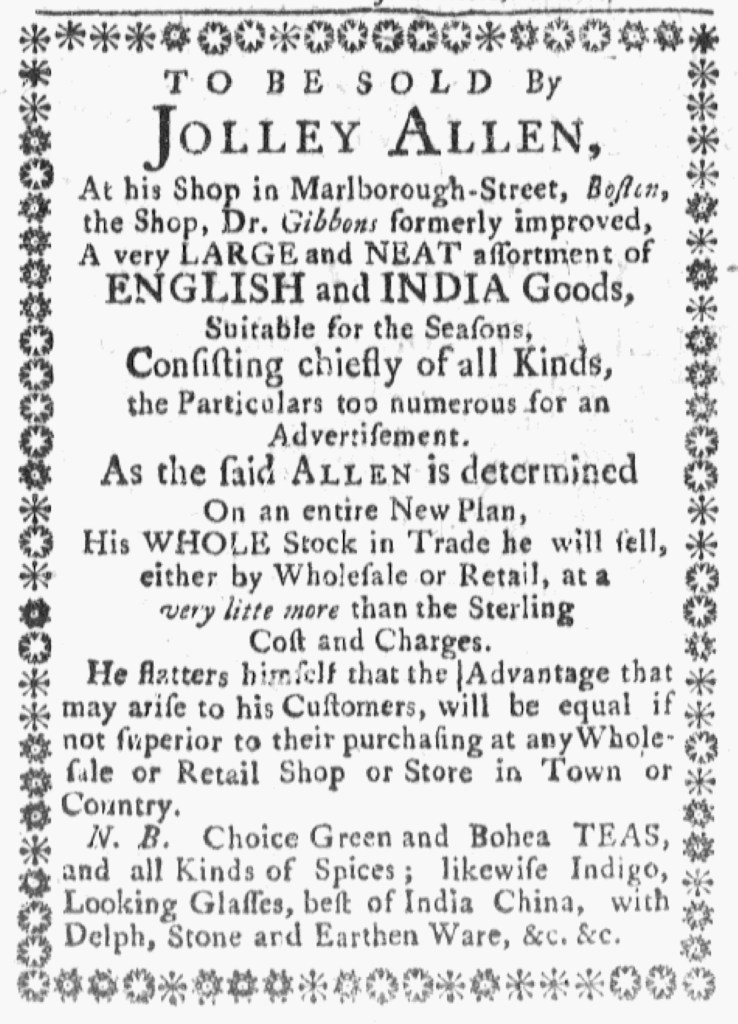
Jolley Allen made his advertisements in the Boston Evening-Post, the Boston Gazette, the Massachusetts Gazette and Boston Post-Boy, and the Massachusetts Gazette and Boston Weekly News-Letter easy to recognize in the spring of 1772.  Each of them featured a border comprised of ornamental type that separated Allen’s notices from other content.  Allen previously deployed this strategy in 1766 and then renewed it in the May 21, 1772, edition of the Massachusetts Gazette and Boston Weekly News-Letter.  Four days later, advertisements with identical copy and distinctive borders ran in three other newspapers printed in town.  Allen apparently gave instructions to the compositors at the Boston Evening-Post and the Massachusetts Gazette and Boston Post-Boy.  Those advertisements had copy identical to the notice in the Massachusetts Gazette and Boston Weekly News-Letter, but the compositors made different decisions about the format (seen most readily in the border of Allen’s advertisement in the Massachusetts Gazette and Boston Post-Boy).  Allen’s advertisement in the Boston-Gazette, however, had exactly the same copy and format as the one in the Massachusetts Gazette and Boston Weekly News-Letter.  For some of their advertisements, newspapers in Boston apparently shared type already set in other printing offices.

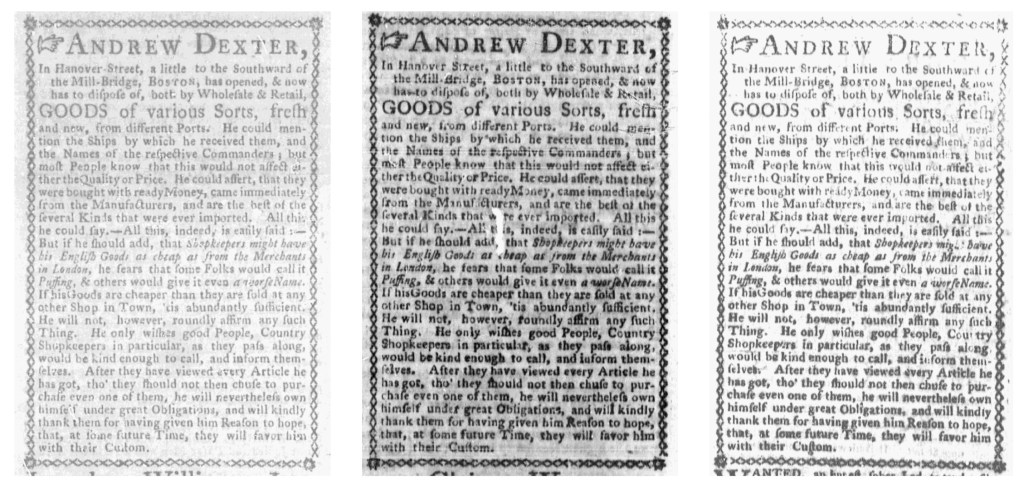
That seems to have been the case with Andrew Dexter’s advertisement.  He also included a border around his notice in the May 21 edition of the Massachusetts Gazette and Boston Weekly News-Letter.  The same advertisement ran in the Boston Evening-Post four days later.  It looks like this was another instance of transferring type already set from one printing office to another.  The compositor for the Boston Evening-Post may have very carefully replicated the format of Dexter’s advertisement that ran in the Massachusetts Gazette and Boston Weekly Mercury, but everything looks too similar for that to have been the case.  In particular, an irregularity in closing the bottom right corner of the border suggests that the printing offices shared the type once a compositor set it.  They might have also shared with the Boston-Gazette.  Dexter’s advertisement also ran in that newspaper on May 25.  It had the same line breaks and italics as Dexter’s notices in the other two newspapers.  The border looks very similar, but does not have the telltale irregularity in the lower right corner.  Did the compositor make minor adjustments?

It is important to note that these observations are based on examining digitized copies of the newspapers published in Boston in 1772.  Consulting the originals might yield additional details that help to clarify whether two or more printing offices shared type when publishing these advertisements.  At the very least, the variations in Allen’s advertisements make clear that he intentionally pursued a strategy of using borders to distinguish his advertisements in each newspaper that carried them.  The extent that Dexter meant to do the same or simply benefited from the printing offices sharing type remains to be seen after further investigation.

**********

Left to Right: Massachusetts Gazette and Boston Weekly Mercury (May 21, 1772); Boston-Gazette (May 25, 1772); Boston Evening-Post (May 25, 1772); Massachusetts Gazette and Boston Post-Boy (May 25, 1772).

**********

Left to Right: Massachusetts Gazette and Boston Weekly News-Letter (May 21, 1772); Boston Evening-Post (May 25, 1772); Boston-Gazette (May 25, 1772).

May 21

What was advertised in a colonial American newspaper 250 years ago today?

Massachusetts Gazette and Boston Weekly News-Letter (May 21, 1772).

“He will sell … at a very little more than the Sterling Cost.”

In an advertisement in the May 21, 1772, edition of the Massachusetts Gazette and Boston Weekly News-Letter, Jolley Allen announced that he adopted “an entire New Plan” for selling the “very LARGE and NEAT Assortment of English and India GOODS” at his shop on Marlborough Street.  He declared that he would sell “HIS WHOLE Stock in Trade…, either by Wholesale or Retail, at a very little more than the Sterling Cost and Charges.”  In other words, he did not mark up the prices significantly over what he paid to his suppliers.  Allen expressed his confidence that “the Advantages that may arise to his Customers, will be equal if not superior to their purchasing at any Wholesale or Retail Shop or Store in Town or Country.”  He was determined to beat his competitors.

The graphic design for Allen’s advertisement may have helped attract attention to his “new Plan” for selling imported goods.  A border comprised of ornamental type enclosed the notice, setting it apart from the news and other advertisements on the page.  That brought this advertisement in line with some that he previously published.  He did not always incorporate a distinctive design element, but he more regularly did so than most advertisers.  Sometimes ornamental type flanked his name in the headline of his advertisement.  On other occasions he opted for borders.  Both strategies appeared in more than one newspaper, suggesting that Allen gave specific instructions to the compositors rather than leaving the format to their discretion.

Curiously, Allen’s advertisement was not the only one in the May 21 edition of the Massachusetts Gazette and Boston Weekly News-Letter to feature a border.  Andrew Dexter’s advertisement had the same format, though a different printing ornament formed the border.  This was not a standard format in that newspaper or any other newspaper published in Boston at the time.  So how did two advertisements in the same issue happen to include borders?  Did one advertiser overhear the other giving directions to the compositor when dropping off copy to the printing office?  Or was it a coincidence?  Whatever the explanation, the borders made their advertisements distinctive enough compared to the rest that readers likely took note of both of them.

May 14

What was advertised in a colonial American newspaper 250 years ago today?

Massachusetts Gazette and Boston Weekly News-Letter (May 14, 1772).

“Much cheaper than they are usually sold.”

In the spring of 1772, Samuel Gray sold “China WARE … At the Three Sugar Loaves in Cornhill, near the Heart and Crown,” the printing office where Thomas Fleet and John Fleet published the Boston Evening-Post.  Gray declared that he stocked a “neat Assortment of India China Ware.”  He provided a short list of merchandise, including a “Variety of pudding, sallad, and soop Dishes, round, eight-square, scalloped, and oval” as well as “octagon, and mackrel Dishes, of different sizes” and “others of various Forms and sizes.”  He also carried a “Variety of Table Plates and Butter Plates, Pattypans, Sauce Boats, Bowls, Tea Cups and Saucers, Coffee [Saucers], and other Articles.”  Repeatedly invoking a “variety” of styles and “others” encouraged prospective customers to imagine an even greater array of choices they would encounter at the Three Sugar Loaves.

In addition to consumer choice, Gray highlighted low prices in his efforts to entice readers into his shop.  The secondary headline for his advertisement proclaimed that he parted with his wares “CHEAP for CASH.”  Near the end of the notice, he underscored the bargains available to customers who paid in cash rather than credit.  He informed them that they could acquire most of his goods “exceeding low for Cash, much cheaper than they are usually sold.”  He likely intended for the italics to draw attention to this deal.  Gray further explained that “many of the Articles will be retailed at the first Sterling Cost,” suggesting that he did not mark up the wholesale prices that he paid.  Gray did not specify which items were among the “many” sold at such low prices.  He may have treated those items as loss leaders, figuring customers who purchased some of those “many” items would also buy other items.  He also acknowledged that he did not sell cups and saucers “much cheaper than they are usually sold.”  After all, he had to make a living.  In his marketing efforts, he carefully balanced bargain prices for most items with standard rates on just a couple, seeking to convince consumers that he offered better deals than they would find among his competitors.

May 7

What was advertised in a colonial American newspaper 250 years ago today?

Massachusetts Gazette and Boston Weekly News-Letter (May 7, 1772.)

“Oils…  Paints… Varnishes… GUMS.”

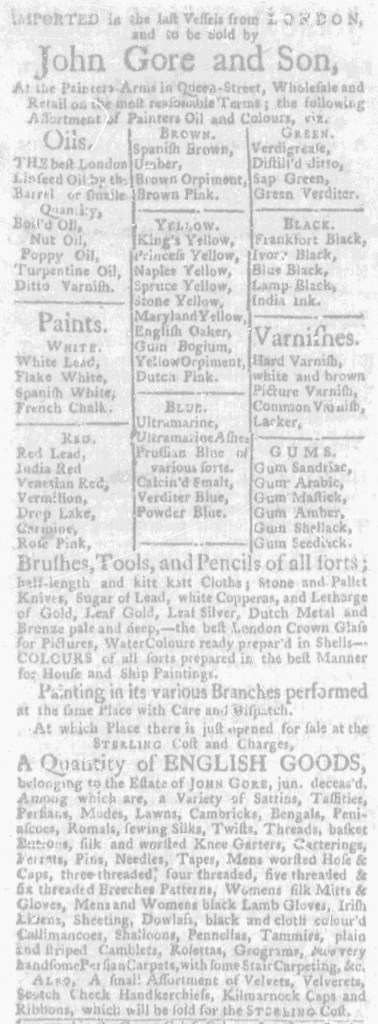
John Gore and Son’s advertisement for an “Assortment of Painters Oil and Colours” available “At the Painters-Arms in Queen-Street” ran once again in the May 7, 1772, edition of the Massachusetts Gazette and Boston Weekly News-Letter.  It featured a table of “Oils… Paints… Varnishes… [and] GUMS” of various colors, making it distinct from other advertisements and easy to recognize.  Among the various paints, the table offered choices that ranged from “Princess Yellow, Naples Yellow, [and] Spruce Yellow” to “India Red, Venetian Red, [and] Vermilion.”  The format both delineated the many choices available to consumers and challenged them to imagine the possibilities.

Readers of the Massachusetts Gazette and Boston Weekly Mercury had seen this advertisement before.  It ran two weeks earlier in the April 23 edition.  Unlike other advertisements that ran for consecutive weeks, however, Gore and Son’s advertisement did not appear in the subsequent issue on April 30.  Instead, it ran in the Boston-Gazette on April 27.  That was not merely a case of an advertiser submitting the same copy to two newspapers.  Careful examination reveals that the notices in the Massachusetts Gazette and Boston Weekly News-Letter and the Boston-Gazette featured identical format, indicating that someone transferred the type from one printing office to another.  That made publishing Gore and Son’s advertisement a collaborative effort among competitors.  It was not the only paid notice that originated in the Massachusetts Gazette and Boston Weekly Mercury and then ran in identical format in another newspaper in the spring of 1772.  The type for Gore and Son’s advertisement eventually found its way back to Richard Draper’s printing office, where the compositor added a final line about “A few Casks of NEW RICE” but otherwise did not make any adjustments to the format.

This raised all kinds of questions about the business of printing in early America.  What kinds of bookkeeping practices did this entail?  How did Draper and other printers keep track of which type belonged to them or to competitors?  How did they go about charging advertisers for notices that ran in multiple newspapers?  Did advertisers receive a discount from those printing offices that did not have to set the type?  Or did the work involved in transferring type from one office to another balance the labor required to set type?  Printers in Boston sometimes collaborated in publishing almanacs and pamphlets.  To what extent did they collaborate in publishing the advertisements that generated significant revenue for their newspapers?

April 29

What was advertised in a colonial American newspaper 250 years ago this week?

Boston-Gazette (April 27, 1772).

“Oils … Paints … Varnishes … GUMS.”

John Gore and Son’s advertisement in the April 27, 1772, edition of the Boston-Gazette raises all sorts of interesting questions.  An identical advertisement appeared in the April 23 edition of the Massachusetts Gazette and Boston Weekly News-Letter.  This does not seem to have been just a case of an advertiser inserting the same notice in multiple newspapers.  That was quite common in the 1770s, especially in Boston.  Yet this was not simply an instance of an advertiser writing out the copy more than once and then submitting it to more than one printing office.  Yes, the copy was identical … but so was the format and every aspect of typography, from the design of the table listing different kinds of paints to the line breaks to font sizes to capitalization of certain words.  Rather than a compositor copying an advertisement as it appeared in another newspaper, this looks like Richard Draper’s printing office outright transferred type already set for the Massachusetts Gazette and Boston Weekly News-Letter to Benjamin Edes and John Gill’s printing office for publication in the Boston-Gazette.

That was not the only instance of such a transfer in the April 27 edition of the Boston-Gazette.  John Barrett and Sons ran an extensive advertisement that previously appeared in Draper’s newspaper on April 23.  So did Joseph Peirce.  To further complicate matters, both of these advertisements also ran in the April 27 edition of the Boston Evening-Post. Once again, this does not seem to have been merely an instance of a compositor consulting an advertisement in another newspaper when setting type.  Instead, the type from one printing office found its way to another printing office.

The placement of these advertisements on the page in each newspaper contributes to some confusion about the sequence of events.  Take into consideration that a standard issue consisted of four pages created by printing two pages on each side of a broadsheet and then folding it in half.  Printers often printed the front and back pages first, filling them with the masthead, colophon, and advertisements.  They saved the second and third pages for the latest news.  Peirce’s advertisement ran on the fourth page of the April 27 edition of the Boston-Gazette, suggesting that the compositor received the type from the April 23 edition of the Massachusetts Gazette and Boston Weekly Mercury fairly quickly.  That also allowed sufficient time to pass along the type to the Boston-Evening Post for inclusion in a two-page supplement that consisted entirely of advertising.  That timing makes sense.

The timing for inserting Barrett and Sons’ advertisement in each newspaper, however, does not seem as clear.  It ran on the first page of the April 27 edition of the Boston-Gazette, printed at the same time that Peirce’s advertisement was printed on the fourth page.  It did not, however, run in the supplement to the Boston Evening-Post or even on the second or third pages among the last items inserted in the standard issue.  Instead, it appeared on the fourth page, presumably making it one of the first items printed for that issue.  The compositor did eliminate the final eight lines listing several imported goods in order to make the advertisement fit among the other content on the page, but did not make other alterations.  That someone transferred the type from one printing office to another so quickly for it to appear in the Boston-Gazette and the Boston Evening-Post on the same day suggests a very efficient operation.

This raises questions about the organization and collaboration between printing offices.  Who assumed the responsibility for transferring the type for these advertisements from one printing office to another?  Did they make sure that the type was returned to its original printing office?  Did any of the printing offices adjust the prices they charged for running these advertisements based on whether they invested time and labor in setting type?  How extensive were these practices of transferring type from one printing office to another?  These are all questions that merit further investigation.

Left: Massachusetts Gazette and Boston Weekly News-Letter (April 23, 1772). Right: Boston-Gazette (April 27, 1772).

**********

Left: Massachusetts Gazette and Boston Weekly News-Letter (April 23, 1772). Center: Boston-Gazette (April 27, 1772). Right: Boston Evening-Post (April 27, 1772).

April 26

What was advertised in a colonial American newspaper 250 years ago this week?

Massachusetts Gazette and Boston Weekly News-Letter (April 23, 1772).

“Oils .. Paints … Varnishes … GUMS.”

John Gore and Son included a table listing the various colors available at their shop “At the Painters-Arms” in Queen Street in Boston when they placed an advertisement in the April 23, 1772, edition of the Massachusetts Gazette and Boston Weekly News-Letter.  They clustered other goods together in dense paragraphs, including “Brushes, Tools, and Pencils of all sorts” and “Stone and Pallet Knives,” but used the table to demonstrate the range of choices and guide prospective customers in selecting the ones that most interested them.

Gore and Son divided the table among “Oils,” “Paints,” “Varnishes,” and “GUMS.”  Each category listed half a dozen items, except for “Paints.”  Instead, Gore and Son further subdivided the table to include sections for “WHITE,” “RED,” “BROWN,” “YELLOW,” “BLUE,” “GREEN,” and “BLACK.”  Each of those sections listed several options.  Rather than settle for blue, customers could choose from among “Ultramarine, Ultramarine Ashes, Prussian Blue of various sorts, Calcin’d Smalt, Verditer, [and] Powder Blue.”  Similarly, the varieties of yellow included “King’s Yellow, Princess Yellow, Naples Yellow, Spruce Yellow, Stone Yellow, Maryland Yellow, English Oaker, Gum Bogium, Yellow Orpiment, [and] Dutch Pink.”  To produce the table of paints and colors, the compositor created three columns and incorporated horizontal and vertical lines to separate each category from the others.

This method of displaying the extensive choices to consumers anticipated the racks of cards on display in hardware and home improvement stores today.  Gore and Son did not merely tell prospective customers that they stocked “COLOURS of all sorts” but instead encouraged them to imagine the different shades and contemplate which they preferred.  They likely hoped that some readers would visit their shop to compare the colors after seeing the many options listed in the table in the newspaper advertisement.  Gore and Son relied on text without images when marketing their paints, yet they still attempted to leverage graphic design and visual effects to make sales.  They opted for typography that simultaneously highlighted choices available to customers and distinguished their advertisement from others.

April 19

What was advertised in a colonial American newspaper 250 years ago this week?

Massachusetts Gazette and Boston Weekly News-Letter (April 16, 1772).

“Joseph Peirce HAS receiv’d by Capt. Scott, who is just arriv’d from London, a genteel Assortment of English and India Goods.”

Joseph Peirce’s advertisement occupied half a column in the April 16, 1772, edition of the Massachusetts Gazette and Boston Weekly News-Letter, listing dozens of items for sale and fulfilling a promise made the previous week.  In the previous issue, an abbreviated version of the advertisement informed readers that “Joseph Peirce HAS receiv’d by Capt. Scott, who is just arriv’d from London, a genteel Assortment of English and India Goods, which he will sell, at his Shop at the North Side of the Town House, Boston, at such Rates as shall give full Satisfaction to the Purchaser.”  A short note also clarified that “The Particulars must be deferred till our next.”

The shipping news from the customs house confirmed that several vessels from London, including one commanded by Capt. Scott, recently arrived “Enter’d in” the bustling port.  In some instances, advertisers placed preliminary notices to alert prospective customers that they had new merchandise before they had time to unpack it or include all the “Particulars.”  In a competitive commercial landscape, they considered it imperative to advertise as quickly as other merchants and shopkeepers.  That does not seem to have been the case with Peirce’s advertisement, however.  Richard Draper, the printer, inserted a note at the bottom of the page, stating that “A Number of New and Old Advertisements, we are obliged to omit for want of Room.”  The decision to delay some of the content of Peirce’s advertisement therefore seems to have been made by the printer rather than by the advertiser.  Even the half sheet that accompanied the standard issue did not provide sufficient space for the remaining advertisements.  Draper declared that “The LONDON NEWS by the last Vessels are in the Gazette Extraordinary.”  That the masthead of the additional half sheet named it the Massachusetts-Gazette Extraordinary rather than the usual Supplement to the Massachusetts-Gazette distributed by Draper signaled that it contained news that readers would not want “deferred till our next.”  He prioritized news for subscribers over paid notices by advertisers, carefully balancing his obligations as printer.  After all, the newspaper depended on the patronage of both kinds of customers.

Peirce’s complete advertisement appeared in the next issue, the original notice serving as an introduction to an extensive catalog of imported goods.  The delay might not have mattered for some readers and prospective customers.  A note from the printer in the April 16 edition indicated that delivery had been postponed because “no Post went last Week” along “the Western Road” so those subscribers received the April 9 and the April 16 editions (and the abbreviated version and the full version of Peirce’s advertisement) at the same time.  Both the advertiser and the printer experienced delays in circulating Peirce’s notice to colonizers in and beyond Boston.