What was advertised in a colonial American newspaper 250 years ago today?
Massachusetts Gazette and Boston Weekly News-Letter (April 16, 1772).
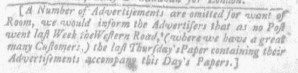
“Last Thursday’s Paper containing their Advertisements accompany this Day’s Papers.”
Advertisements accounted for important revenue for colonial printers. That was certainly the case for Richard Draper, printer of the Massachusetts Gazette and Boston Weekly News-Letter. So many colonizers submitted advertisements for inclusion in the April 16, 1772, edition, that he resorted to distributing a half sheet supplement devoted almost exclusively to paid notices. That helped, but still did not provide enough space for all of the advertisements that he should have published that week. That prompted him to insert a brief note to address the situation. “A Number of Advertisements,” Draper stated, “are omitted for want of Room.” He then tried to convince advertisers that they did not need to be concerned because “no Post went last Week” along “the Western Road, (where we have a great many Customers)” so that meant that “last Thursday’s Paper containing their Advertisements accompany this Day’s Papers.”
Would that mollify advertisers who expected to see their notices in print? Draper did the best he could to give a favorable impression of the situation, assuring advertisers that readers would indeed see their notices that week even if they did not happen to appear in the most recent edition or its supplement. He did not, however, attempt to explain why they should not be concerned that delivery of the previous edition had been delayed by a week, perhaps because everyone understood he had less control over the post than his press. He simply expected advertisers to accept that their notices had not been distributed as widely as they anticipated as soon as they intended. What truly mattered, he sought to convince them, was that their advertisements were now before the eyes of readers. Interestingly, Draper’s note explicitly addressed advertisers, not subscribers. He made no apology to subscribers outside of Boston that they had to wait a week to receive either news or notices. Through that omission, he once again positioned delivery as further beyond his control than the contents of his newspaper. In this instance, maintaining good relationships with customers and safeguarding an important revenue stream meant focusing on the concerns of advertisers.
What was advertised in a colonial American newspaper 250 years ago this week?
Massachusetts Gazette and Boston Weekly News-Letter (April 9, 1772).
“The Second Edition.”
In the spring of 1772, Benjamin Edes and John Gill marked the second anniversary of the Boston Massacre by printing “AN ORATION DELIVERED MARCH 5th … TO COMMEMORATE THE BLOODY TRAGEDY Of the FIFTH of March, 1770.” Dr. Joseph Warren gave the address to “the INHABITANTS OF THE TOWN OF BOSTON.” Edes and Gill advertised the pamphlet widely, starting with a lengthy notice in their own Boston-Gazette on March 23. The next day, the Essex Gazette carried an advertisement alerting readers in Salem and nearby towns that Samuel Hall stocked copies of Warren’s oration “published in Boston.” Over the next week, Edes and Gill ran advertisements in other newspapers, including the Massachusetts Gazette and Boston Weekly News-Letter on March 26 and the Boston Evening-Post on April 1.
Did those advertisements work? Perhaps. Edes and Gill sold enough copies of Warren’s oration that they printed a second edition and began advertising it in the Massachusetts Gazette and Boston Weekly News-Letter on April 9. Their new advertisement, much more extensive than the one that previously appeared in that newspaper, proclaimed that “The Second Edition” was “THIS DAY PUBLISHED … by EDES and GILL.” It informed prospective customers that they could acquire the address for nine pence. It also included two other details that appeared in Edes and Gill’s original advertisement in the Boston-Gazette but not in subsequent advertisements in other newspapers, a quotation in Latin by Virgil and a note that the printers also had on hand “A few of Mr. LOVELL’S ORATIONS Deliver’d last April, on the same Occasion.” Why did Edes and Gill decide to include Lovell’s address from the first anniversary of the Boston Massacre in this new advertisement? Did they believe that the advertisements in several newspapers incited such demand for the address that Warren recently delivered that they had a good chance of selling surplus copies of Lovell’s oration? That Edes and Gill expanded their advertising campaign for “The Second Edition” of Warren’s oration suggests that they considered their first round of notices successful and effective.
What was advertised in a colonial American newspaper 250 years ago today?
Massachusetts Gazette and Boston Weekly News-Letter (April 3, 1772).
“Country Traders … may be supplied with all Kinds of Writing-Paper … at any Store in Town.”
John Fleeming published the Boston Chronicle in partnership with John Mein from 1767 to 1770. That newspaper folded, in large part due to the blatant Tory sympathies espoused by Fleeming’s partner. Mein fled Boston, leaving Fleeming to oversee the business for the few months that the newspaper continued publication in his absence. With the Boston Chronicle behind him, Fleeming turned to job printing and selling stationery and writing supplies. In the April 3, 1772, edition of the Massachusetts Gazette and Boston Weekly News-Letter, for instance, he advertised a “large Assortment of STATIONARY” that included “Writing Paper of all Kinds, Quills, Wax, Wafers, Ink-Chests & Stands of various Kinds, Ivory Folders, Leather Ink Bottles, Ink-Powder, and Patent Cake Ink.”
Fleeming hoped to encourage retail sales among residents of Boston who visited his shop, but he also made an appeal to “Country Traders and Shopkeepers” looking to make wholesale purchases. He promised them that they “may be supplied with all Kinds of Writing-Paper by the Ream, as Cheap as at any Store in Town.” Fleeming competed with a number of stationers who imported paper from England, especially after Parliament repealed the duties on paper and other items and merchants called an end to the nonimportation agreement adopted to achieve that goal. Eager to maximize revenues, Fleeming aimed to attract wholesale as well as retail customers.
In so doing, he resorted to a familiar marketing strategy, one adopted by merchants who sold a variety of imported goods ranging from textiles to housewares to hardware to patent medicines. Some advertised that they filled retail orders sent from colonizers in the countryside. Others did not work directly with consumers outside of Boston, but that did not mean that they neglected to capture wider markets as wholesalers. Merchants frequently assured “Country Traders” that they offered the best bargains, allowing them to generate sales by passing along the savings to their customers. By modern standards, Fleeming’s advertisement may not appear flashy, but that does not mean that it lacked a sound marketing strategy in the eighteenth century.
What was advertised in a colonial American newspaper 250 years ago today?
Massachusetts Gazette and Boston Weekly News-Letter (March 26, 1772).
“An ORATION … to commemorate the BLOODY TRAGEDY.”
Encouragement to participate in the commemoration of the second anniversary of the Boston Massacre by purchasing a copy of the oration delivered by Joseph Warren to mark the occasion continued in the March 26, 1772, edition of the Massachusetts Gazette and Boston Weekly News-Letter. Three days earlier, Benjamin Edes and John Gill announced in their own newspaper, the Boston-Gazette, that they had just published “AN ORATION DELIVERED MARCH 5TH, 1772 … TO COMMEMORATE THE BLOODY TRAGEDY.” The following day, a notice in the Essex Gazette, published in Salem, alerted readers that “Yesterday was published in Boston, and now to be sold by Samuel Hall … An ORATION … to commemorate the BLOODY TRAGEDY.” That advertisement was much shorter than the one in the Boston-Gazette. Edes and Gill included a lengthy excerpt from Warren’s address in their notice as a means of inciting greater interest and enticing prospective customers.
As proprietors of the Boston-Gazette, Edes and Gill had access to as much space in that newspaper for promoting the goods and services available at their printing office as they wished. On the other hand, they presumably had to pay to insert an advertisement in another newspaper, though they could have worked out some other arrangement with fellow printer Richard Draper when they advertised Warren’s oration in the Massachusetts Gazette and Boston Weekly News-Letter. The advertisement in that newspaper was much shorter, consisting of only six lines without any of the excerpt about “the ruinous Consequences of standing Armies to free Communities.” There may have been limits to what Draper was willing to publish, either paid or gratis. After all, the excerpt from the oration amounted to an editorial even though it appeared among advertisements. Draper’s newspaper tended to take a more supportive stance toward the British government, especially compared to the strident critiques that regularly ran in the Boston-Gazette. Among the printers in Boston, Edes and Gill were some of the most ardent in supporting and promoting the Patriot cause. For them to advertise “An ORATION … to commemorate the BLOODY TRAGEDY” in the Massachusetts Gazette and Boston Weekly News-Letter at all had political significance likely not lost on readers.
What was advertised in a colonial American newspaper 250 years ago today?
Massachusetts Gazette and Boston Weekly News-Letter (February 13, 1772).
“BOOKS … which have just been received in the Paoli, Capt, Cazneau.”
This advertisement struck me particularly because I have always been curious about what kinds of books people read during the era of the American Revolution. Henry Knox listed books of divinity, surgery, sea books, and bibles. The source of the books also caught my attention. Many of the books were recently shipped in the Paoli by Captain Cazneau.
I wanted to learn more about the people mentioned in this advertisement, Henry Knox and Captain Cazneau. I learned that Henry Knox lived in Boston and worked as a bookseller before joining the Continental Army and participating in the siege of Boston. He ultimately became a member of George Washington’s cabinet as the first Secretary of War for the United States. I did not locate as much information about Captain Cazneau. In my research, I found a letter from June 8, 1780, written by Thomas Digges to John Adams that mentioned a “Capt. Cazneau” and a voyage to Ireland during the American Revolution. Cazneau delivered “four Louis D’ors” to Digges to pay one of Adams’s debts. I did not find out as much about his role in the American Revolution as I did about Henry Knox.
**********
ADDITIONAL COMMENTARY: Carl Robert Keyes
I often tell my students that being an historian is similar to being a detective. Reconstructing the past requires searching for clues in a variety of places, both primary sources and secondary sources. Especially when consulting primary sources, historians sift through many, many items to determine which provide helpful clues and which do not. It is a laborious and time-consuming process. In the end, we do not always uncover all the clues that we want or need to offer a complete explanation of what happened.
Dillon had that experience in his effort to learn more about the people mentioned in the advertisement he selected. When he embarked on his research, he consulted both primary sources and secondary sources, distinguishing his approach from the work undertaken by most students in my Revolutionary America class working on their own contributions to the Adverts 250 Project. Working with eighteenth-century newspapers gave them an opportunity to consult primary sources from the era of the American Revolution. After selecting their advertisements, each student needed to identify at least one additional source that helped them provide historical context as they explained what we might learn about the past from newspaper advertisements. In most instances, students chose secondary sources to aid in analyzing their advertisements. That presented many opportunities for discussing what constituted authoritative and reliable sources.
When Dillon went in search of primary sources, his research prompted a different conversation about the challenges of “doing” history. He found a reference in a letter to John Adams to a “Capt. Cazneau” that might have been the same “Captain Cazneau” in Henry Knox’s advertisement published nearly a decade earlier. Dillon identified a tantalizing clue, but one that requires much more research and consulting many more documents than the scope of the project assigned to him for my Revolutionary America class. In this instance, I did not expect him to tell a complete story about Cazneau’s life and career. Instead, I considered it valuable for him to have the experience of doing some of that detective work required of historians in order to gain greater appreciation for the research, writing, and revising that goes into crafting the narratives in secondary sources we read and discussed throughout the semester.
What was advertised in a colonial American newspaper 250 years ago today?
Massachusetts Gazette and Boston Weekly News-Letter (February 6, 1772).
“IRISH LINNENS.”
This advertisement is about an item that many colonists purchased in the years before the American Revolution. Colonists imported Irish linens as part of what we now call the consumer revolution. In “Baubles of Britain,” T.H. Breen describes how many American colonists sought goods imported from the British Isles as part of the consumer revolution.[1] Those goods, including linens imported from England, Scotland, and Ireland, gave them a sense of camaraderie with Britain at a time when most colonists were proud to be subjects of the British Crown. In “The British Linen Trade with the United States in the Eighteenth and Nineteenth Centuries,” N.B. Harte states, “[T]he American colonies up to the revolution provided the bulk of the export market for English linens. It is difficult to dis-entangle re-exports of Scottish and Irish linen through London and exports of English Linen.”[2] In this advertisement, William Beatty declared that he imported Irish linens “from the Manufacturers at BELFAST, in the North of Ireland” as part of the larger market that connected the British Isles and the American colonies.
Not only did American colonists depend on England, Scotland, and Ireland as a source of linens at the time, British merchants depended on the colonies as customers and a main source of their income as well. When the colonists first started to rebel against the British, one of the first items they boycotted was linen and other fabrics from overseas in favor of homespun cloth made in the colonies. The colonists wanted to show Britain how resilient they were, but they also believed that hurting the profits of British merchants would cause them to demand that Parliament repeal duties on imported goods. Colonists used decisions about buying imported linens as economic leverage to achieve political goals. Linens, although they might seem insignificant, contributed a great deal to the economy and were part of the American Revolution.
**********
ADDITIONAL COMMENTARY: Carl Robert Keyes
Declan explores some of the major themes from my Revolutionary America class. We examine several kinds of protests from the period, including petitions by colonial assemblies, nonimportation agreements by colonial merchants, and demonstrations by colonizers. We situate nonimportation and nonconsumption agreements within the context of the consumer revolution. Despite the sense of British identity and close ties to Britain that colonizers experienced when they participated in a transatlantic consumer revolution, that did not prevent them from using trade as a political tool when they believed that Parliament infringed on their rights by imposing duties on certain imported goods. Although colonizers in America did not benefit from direct representation in Parliament, British merchants did. American colonizers hoped that if they disrupted the marketplace then British merchants would join them in demanding that Parliament repeal the objectionable import duties.
Textiles became an important political symbol in the colonies. Colonizers produced homespun cloth, usually not of the same quality as imported alternatives. The quality hardly mattered compared to the symbolism of producing, purchasing, and wearing homespun. This occurred within what Harte describes as a “dual economy” for linen in the colonies. “[B]asic linen needs were provided outside the market by the widespread domestic production of homespun coarse linen, while the market was dominated by a range of better-quality (though still low-priced) linens imported from England, Scotland, and Ireland, and imported too from the continent of Europe (especially Germany) via London.”[3] Embracing homespun, women participated in spinning bees. College graduates wore suits made of homespun to ceremonies. Consumers made choices about what to buy … and what not to buy. All of those activities had political valences, communicating support for nonimportation agreements and opposition to Parliament. Harte argues that linen “became the most important single commodity shipped across the Atlantic in the eighteenth century.” That helped to make homespun a powerful symbol, especially in those years that colonizers participated in nonimportation agreements.
**********
[1] T.H. Breen, “‘Baubles of Britain’: The American and Consumer Revolutions of the Eighteenth Century,” Past and Present 119 (May 1988): 73-104.
[2] N.B. Harte, “The British Linen Trade with the United States in the Eighteenth and Nineteenth Centuries,” Textile Society of America Symposium Proceedings (1990): 19.
What was advertised in a colonial American newspaper 250 years ago today?
Massachusetts Gazette and Boston Weekly News-Letter (January 23, 1772).
“Most of these Papers will, probably, be irrecoverably lost in a few Years, unless preserved by Printing.”
On behalf of posterity, printers and consumers in Massachusetts worked to preserve documents that told the story of the colony. In 1769, Thomas Fleet and John Fleet, the printers of the Boston Evening-Post, distributed subscription notices for “A COLLECTION of Original PAPERS, which are intended to support and elucidate the principal Facts related in the first Part of the HISTORY of MASSACHUSETTS BAY.” The printers promoted that volume as an appendix to the first volume of Thomas Hutchinson’s History of the Colony of Massachusetts-Bay, published in 1764.
In 1772, the Fleets promoted a similar project, though an advertisement in the January 23 edition of the Massachusetts Gazette and Boston Weekly News-Letter declared that a “Gentleman in England, of distinguished character for many munificent deeds to the Publick,” envisioned “printing a second Volume of Collection of Papers relative to the History of Massachusetts-Bay.” An ideal companion for the earlier work, the new book would be “about the same size … at the same price” as the earlier one. Acquiring copies of this proposed volume required subscribing. It would not go to press until “Subscribers sufficient to defrey the Expence shall appear.” In addition, “None will be printed for Sale,” only those reserved in advance. Subscribers could submit their names to local agents, most of them printers, in eleven cities and towns in New England, New York, and Pennsylvania.
The “Gentleman in England” who supposedly initiated this project with an initial of subscription of “Ten Guineas” (or ten pounds and ten shillings) claimed to be motivated by “the Preservation of these Papers for the Benefit of Posterity.” Printing the papers served as one means of preserving them, creating so many copies that the contents would survive even if the original documents did not. A note near the end of the advertisement warned that “most of these Papers will, probably, be irrecoverably lost in a few Years, unless preserved by Printing.” That meant that prospective subscribers had an obligation to invest in this enterprise “from a regard to the Public as well as for the sake of their particular Entertainment.” Consumers had an opportunity to participate in historic preservation, not through tending to original sources but instead by purchasing so many copies of the volumes that anthologized those sources to make them always accessible to subsequent generations.
What was advertised in a colonial American newspaper 250 years ago today?
Massachusetts Gazette and Boston Post-Boy (January 13, 1772).
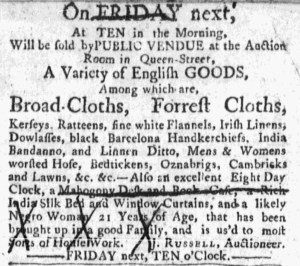
“A Mahogony Desk and Book-Case.”
This advertisement presents a conundrum. It attracted my attention because someone made manuscript notations on the copy of the Massachusetts Gazette and Boston Post-Boy that has been preserved in an archive and digitized for greater accessibility. They crossed out “FRIDAY” in the portion of the headline that gave the date of an auction, crossed out “a Mahagony Desk and Book-Case” midway through the advertisement, and placed three large “X” over most of the rest of the content. I suspected that either Joseph Russell or John Green, the partners who published the Massachusetts Gazette and Boston Post-Boy, made those notations to guide the compositor in setting type for a revised version of the advertisement to appear in a subsequent issue. Russell, the auctioneer who placed the advertisement, focused primarily on operating the “Auction Room in Queen-Street” while Green oversaw the newspaper and the printing office.
A revised version did not appear in a subsequent edition of the Massachusetts Gazette and Boston Post-Boy. The same advertisement did run in the Boston Evening-Post and the Boston Gazette on Monday, January 13, 1772, the same day it appeared in the Massachusetts Gazette and Boston Post-Boy. Those newspapers ran the same copy, but with variations in line breaks because the compositors made their own decisions about format. I also looked for revised versions of the advertisement in other newspapers published in Boston between January 13 and the day of the sale. The Massachusetts Spy published on Thursday, January 16, the day before the say, did not carry the advertisement, but the Massachusetts Gazette and Boston Weekly News-Letter distributed on the same day did feature a slightly revised version. Only the first line differed from the original version, stating that the auction would take place “TO-MORROW” rather than “On FRIDAY next.”
Massachusetts Gazette and Boston Weekly News-Letter (January 16, 1772).
The rest of the advertisement was identical to the one that ran in the Massachusetts Gazette and Boston Post-Boy earlier in the week. The copy was identical and the format (including line breaks, spelling, and capitals) was identical. Even the lines on either side of “FRIDAY next, TEN o’Clock” on the final line were identical. Both advertisements lacked a space between “by” and “PUBLIC VENDUE” on the third line. The manuscript notations on the original advertisement may have directed someone in revising the first line, but not the remainder of the notice. Even more puzzling, it looks as though Green and Russell shared type already set at their printing office with Richard Draper, the printer of the Massachusetts Gazette and Boston Weekly News-Letter. This is not the first time that I have detected such an instance in newspapers published by these printers in the late 1760s and early 1770s. It raises questions about both the logistics and the business practices of those involved, questions that merit greater attention and closer examination of the contents, both news and advertising, in the two newspapers.
What was advertised in a colonial American newspaper 250 years ago today?
Massachusetts Gazette and Boston Weekly News-Letter (January 9, 1772).
“Cutlery Ware.”
Chris Barone, a student in my Revolutionary America class in Fall 2021, selected this advertisement that Nathan Frazier placed in the January 9, 1772, edition of the Massachusetts Gazette and Boston Weekly News-Letter. It prompted a conversation about how the meanings of some words have shifted since the eighteenth century. Frazier advertised “Cutlery Ware” among his “fresh Assortment of English and Scotch GOODS,” but that phrase did not mean knives, forks, and spoons to the shopkeeper or his prospective customers.
Instead, cutlery referred to “the art or trade of the cutler,” according to the Oxford English Dictionary. That gave us a chance to discuss the cutler, “one who makes, deals in, or repairs knives and similar cutting utensils,” as a common occupation in the eighteenth century. It also prompted us to explore the entry for “cutlery” in the Oxford English Dictionary in greater detail. We learned that the word also refers to “articles made or sold by cutlers, as knives, scissors, etc.” That definition included an example from 1787, the same period as the advertisement Chris selected. For other examples, we looked to previous entries in the Adverts 250 Project. We discovered several advertisements placed by cutlers that listed a variety of items they made, sold, and repaired. Samuel Wheeler advertised “good scythes and sickles” in the Pennsylvania Gazette in June 1770. Amos Atwell listed “Case Knives and Forks, Carving Knives and Forks, Pocket and Pen Knives of various Kinds, Razors, [and] Surgeons Instruments” in an advertisement for his “CUTLERY BUSINESS” in the Providence Gazette in 1771. Bailey and Youle, “Cutlers from Sheffield,” informed the public that they “MAKE all sorts of surgeons instruments” and “grinds all sorts of knives, razors, shears, and scissors” in an advertisement in the New-York Gazette and Weekly Mercury in March 1771. A month later, Richard Sause ran a similar advertisement that included the same services and added “sword cutling.” Bailey and Youle included an image depicting about a dozen cutlery items. Sause again imitated his competitors with a similar image.
The Oxford English Dictionary also includes a definition for cutlery more familiar to modern readers: “knives, forks, spoons, etc., used for eating or serving food; a set of table utensils of this kind.” That entry includes several examples, though the earliest dates from 1821, half a century after Frazier placed his advertisement. A note also states that in earlier examples it is difficult to distinguish this meaning from “articles made or sold by cutlers.” Frazier’s advertisement for “Cutlery Ware” demonstrated that colonizers easily spoke a language of consumption among themselves that requires some effort by historians to understand 250 years later.
What was advertised in a colonial American newspaper 250 years ago this week?
Supplement to the Massachusetts Gazette and Boston Weekly News-Letter (December 12, 1771).
“To enumerate all the Articles would be … too expensive to the Advertiser.”
William Jackson sold an array of imported goods at his “Variety-Store … At the Brazen-Head” in Boston in the early 1770s. He regularly placed advertisements in local newspapers, including a notice in the supplement that accompanied the December 12, 1771, edition of the Massachusetts Gazette and Boston Weekly News-Letter. Unlike some of his competitors who published extensive lists of their inventory to demonstrate choices available to prospective customers, Jackson opted to name only a few items. He still made appeals to consumer choice, while also providing an explanation for his decision.
Jackson declared that he carried an “Assortment of Hard-Ware and English Piece Goods.” He listed less than a dozen items, concluding with assurances that he also had in stock “all other kinds of Goods suitable to any Season.” Most other advertisers who deployed similar language stated that they carried goods suitable to “the” season rather than “any” season. Even the name that the merchant gave his business, “Jackson’s Variety Store,” testified to consumer choice.
In addition, he added a nota bene to assure “Country Shopkeepers” that they “will see the best Assortment of Goods of any Store in the Town.” Jackson trumpeted that his inventory rivaled any in the bustling port of Boston. He also explained that “to enumerate all the Articles would be too tedious to the Reader.” Seeing his merchandise by “calling at the Store” would be much more satisfying. Jackson made one more comment about why he did not insert a lengthy list of goods, asserting that doing so would have been “too expensive to the Advertiser.” Rarely did advertisers acknowledge in print the reason they made a choice between cataloging their goods or not. Jackson may have done so to suggest that he made savvy decisions about how to spend his advertising budget. He also benefited from a significant number of competitors listing all kinds of goods, provided that prospective customers would accept his invitation to see for themselves that he carried “the best Assortment … of any Store in the Town.”